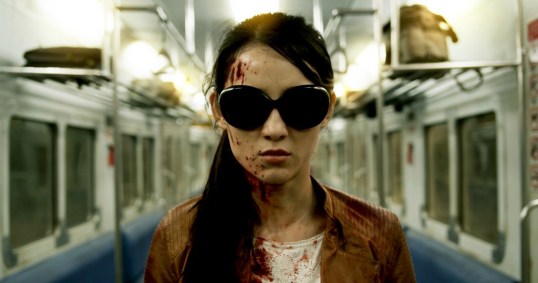
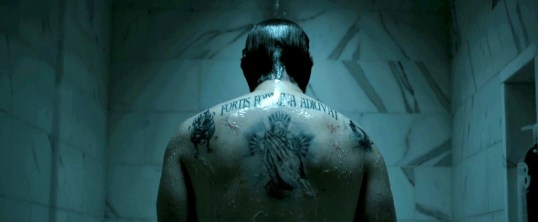
I will be the first to admit that it feels strange to admit that I’m actually looking forward to a movie featuring Shia LaBeouf.
(You ever notice how I always say stuff like that, despite the fact that Lawless wasn’t terrible and I enjoyed Fury about as much as I can enjoy any movie about war. Despite the fact that he’s actually appeared in a lot of decent films, I will always think of Shia as being the whiny kid from The Battle of Shaker Heights. That is the revolting power of Shia LaBeouf…)
However, I am very much looking forward to American Honey!
And you know why?
Because it’s the latest film from Andrea Arnold, who previously directed the absolutely exquisite Fish Tank. Fish Tank is one of those films that I watch and I just see myself, who I’ve been and who I could have become. It’s an amazing film.
I’ll try and keep this short, unlike the movie, which if you watch the director’s cut as I did, comes out to about five and a half hours. Once you’ve sat through something like Jacques Rivette’s Out 1 (1971), which comes out to a little over twelve hours, this isn’t much. Also, despite what I’m going to say about it, it’s problems don’t come from it’s length. A lot of movies damage themselves by going past two hours, but not this one. The length really wasn’t an issue for me.
I’m also not going to pick out all the little stupid things like you see me do with Hallmark movies. Yes, Stellan Skarsgard says the Christian church split up in 1054 into Roman Catholic and Orthodox, but it actually fractured a long time before that break. Or the onscreen text, which you would expect in a Godard film. Especially when Skarsgard brings up Fibonacci numbers. That probably only ticked me off because I went through about nine years of college level computer science and really don’t want to hear about Fibonacci numbers ever again. Also, there’s a scene where she makes one attempt to have sex with black guys. It kind of reminded me of that “documentary” from the early 1970’s called Black Love. It’s there to mention that men are homophobic, but she is implicitly homophobic since sex with a woman is never brought up in this sex addict film. Von Trier also whips out the Two Kinds Of People In The World cliche, but it only makes sense if everyone is right handed. Well, let’s talk about the movie.
First, if you’re a fan of Lars Von Trier, then it’s a no brainer. This movie is for you. Don’t hesitate to watch it. If you are like me and love Breaking The Waves (1996), then this has similar material, but it’s not even remotely as moving. If you were offended by Dogville (2003) like I was, then don’t worry, this isn’t offensive stuff. It’s just boring.
The movie is about a girl named Joe (Charlotte Gainsbourg) who recounts her life as a self proclaimed nymphomaniac to Seligman (Stellan Skarsgad). The movie cuts back and forth between the actual story and then Seligman’s thoughts on it. Kind of like sitting in on a therapy session if it were being conducted by college students in a debate class. And that’s where this film’s biggest issue is for me. A lot of the analysis feels pedestrian or the kind of thing you would expect in a college paper written by a student who hopes the teacher will be impressed. And at times its almost like argument for arguments sake. Like when you’re in a class and a topic is tossed out for discussion. The topic may actually be rather simple, but people keep trying to throw things in to pad out the conversation to fill the class time. A lot of the dialogue feels like that sort of thing.
The story begins when she is a little girl and takes us up to the events that led Seligman to find her in the alley outside of his place at the beginning of the film. Her father is played by Christian Slater who I think does a good job. His British accent may be a problem for you, but it wasn’t for me. Neither was it a problem for me with Shia LaBeouf’s character who is a male presence in Joe’s life pretty much throughout the film. The accent was a problem for me with Uma Thurman’s character though.
There’s a point where Joe just starts referring to the men in her life by letters. She casually tosses them around. During one of these scenes, Uma Thurman shows up as the wife of one of the guys who’s there with Joe along with their kids in tow. The scene is supposed to start a little funny, then get really uncomfortable as it keeps going. Like when Thurman asks if she can show her kids the “whoring bed”. The problem for me was the accent. If they had just let her speak normally, then it would have worked, but it was a voice that at this point in her career is obviously not her’s and I can’t suspend disbelief. So the scene was just hilarious to me. Especially when she actually screams. That made me think of Julianne Moore in Map To The Stars (2014), which also had me laughing.
This film has been dismissed as porn or on the flip side, played up for showing so much. People especially like to mention that the sex is unsimulated. Well, it really doesn’t count in my book if that isn’t Shia LeBeouf’s penis, which it isn’t. They use CGI to graft porn actors genitalia onto some of the actors. So it’s not anything to brag about. Is it porn? Far from it. Anybody who tells you that has no idea what they are talking about. It probably comes closest to an exploitation movie at best in that department.
I said I wouldn’t pick out little flaws, but there’s a big one I have with the title and her consistently referring to herself as either a nymphomaniac or being addicted to sex. She’s not really addicted to sex. She’s addicted to sex like someone who only smokes Marlboro is addicted to cigarettes, but won’t smoke any other brand. She’s like that. She’ll take penetration by a penis, give a blow job, and poorly dabbles in S&M. That’s really it. She’s rather discriminating about what she’ll do. Another analogy is like when someone says they’re a cinephile, but that means to them that they love watching highly acclaimed foreign films. An addiction to something broad like movies or sex means you’re indiscriminate. However, I get why Von Trier sticks with the term nymphomaniac because the movie does have a reason to make sure the apparent love of sex and guilt about it is explicitly associated with a female character. The ending depends on it.
The only thing that was kind of noteworthy to me was how the way the movie is shot changes in the final part of the film. It’s divided into chapters and in the last one Von Trier either shot it to get film grain and over exposed lights or did it in post processing. I think it was probably a reference to a movement in film he was involved in back in the 1990’s called Dogme 95. You can watch something like Thomas Vinterberg’s The Celebration (1998) and it will look similar.
Honestly, it’s not a bad movie, but it’s really for people who like Von Trier stuff. If you like his stuff, see it. If you don’t, definitely skip it. If you’re totally new, then don’t start here. Begin with Breaking The Waves and Europa (1991) before wading into films like The Idiots (1998), Dancer In The Dark (2000), Dogville, and beyond.
2014 had it’s share of very good action films and here are four that I was particularly drawn to. While the film themselves were of varying degrees of quality in terms of storytelling. These 4 films all had one thing that I enjoyed despite their films’ flaws. They all had action scenes that I thought were quite excellent.
You have gritty present-day action thriller, an operatic gangster epic, a revenge thriller and a war film. One stars an aging action star back from playing politician. Another a foreign film whose filmmaker and star have set the bar for all action films for years to come. Then there’s the stunt coordinators and 2nd unit directors finally making their mark with their first feature-length film. Lastly, a war film that brings the brutality of World War II tank warfare to the forefront.
A few years ago, I was on twitter when I came across someone who had just watched The Breakfast Club.
“Whatever happened to Emilio Estevez?” she asked.
Being the know-it-all, obsessive film fan that I am, I tweeted back, “He’s a director.”
Of course, I could not leave well enough along. I had to send another tweet, “He directed a movie called Bobby that got nominated for bunch of Golden Globes.”
“Was it any good?” she wrote back.
“Never seen it,” I wrote back, suddenly feeling very embarrassed because, if there’s anything I hate, it’s admitting that there’s a film that I haven’t seen.
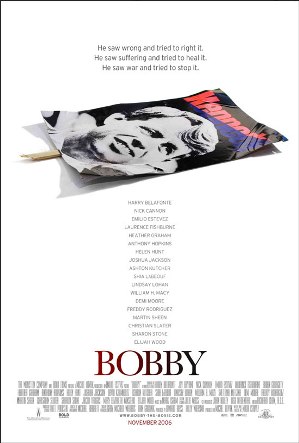
However, Shattered Politics gave me an excuse to finally sit down and watch Bobby. So now, I can now say that I have watched this 2006 film and … eh.
Listen, I have to admit that I really hate giving a film like Bobby a lukewarm review because it’s not like Bobby is a bad film. It really isn’t. As a director, Emilio Estevez is a bit heavy-handed but he’s not without talent. He’s good with actors. Bobby actually features good performances from both Lindsay Lohan and Shia LaBeouf! So, give Estevez that.
And Bobby is a film that Estevez spent seven years making. It’s a film that he largely made with his own money. Bobby is obviously a passion project for Estevez and that passion does come through. (That’s actually one of the reasons why the film often feels so heavy-handed.)
But, with all that in mind, Bobby never really develops a strong enough narrative to make Estevez’s passion dramatically compelling. The film takes place on the day of the 1968 Democratic California Presidential Primary. That’s the day that Robert F. Kennedy won the primary and was then shot by Sirhan Sirhan in the kitchen of the Ambassador Hotel. However, it never seems to know what it wants to say about Kennedy or his death, beyond the fact that Estevez seems to like him.
(Incidentally, it’s always interesting, to me, that Dallas is still expected to apologize every day for the death of JFK but Los Angeles has never had to apologize for the death of his brother.)
Estevez follows an ensemble of 22 characters as they go about their day at and around the Ambassador Hotel. As often happens with ensemble pieces, some of these characters are more interesting than others.
For instance, Anthony Hopkins plays a courtly and retired doorman who sits in the lobby and plays chess with his friend Nelson (Harry Belafonte). It adds little to the film’s story but both Hopkins and Belafonte appear to enjoy acting opposite each other and so, they’re fun to watch.
Lindsay Lohan plays a woman who marries a recently enlisted soldier (Elijah Wood), the hope being that his marital status will keep him out of Vietnam. The problem with this story is that it’s so compelling that it feels unfair that it has to share space with all the other stories.
Christian Slater plays Darrell, who runs the kitchen and who spends most of the movie talking down to the kitchen staff, the majority of whom are Hispanic. Darrell is disliked by the hotel’s manager (William H. Macy) who is cheating on his wife (Sharon Stone).
And then, you’ve got two campaign aides (Shia LaBeouf and Brian Geraghty) who end up dropping acid with a drug dealer played by Ashton Kutcher. Unfortunately, Estevez tries to visualize their trip and it brings the film’s action to a halt.
Estevez himself shows up, playing the husband of an alcoholic singer (Demi Moore). And Estevez’s father, Martin Sheen, gets to play a wealthy supporter of Kennedy’s. Sheen’s wife is played by Helen Hunt. She gets to ask her husband whether she reminds him more of Jackie or of Ethel.
(Actually, Martin Sheen and Helen Hunt are cute together. Much as with Lohan and Wood, you wish that more time had been devoted to them and their relationship.)
And there are other stories as well. In fact, there’s far too many stories going on in Bobby. It may seem strange for a girl who is trying to review 94 films in three weeks to say this but Emilio Estevez really tries to cram too much into Bobby.
At the same time, too much ambition is better none. Bobby may have been a misfire but at least it’s a respectable misfire.
1998 saw the release of Steven Spielberg’s Saving Private Ryan.
Prior to this most films depicted World War II as a noble endeavor that needed to be done to help rid the world of Hitler and the horror he was inflicting upon Europe (beyond if given the chance). It gave birth to the “Greatest Generation” that people still look up to even to this day. These were young men who volunteered for a conflict that would change history and for the millions involved. Yet, World War II films were always cut and dried. It was always the good guys (American, British, Canadian, etc…) fighting against the nameless and efficient Nazi war machine.
In time, so many of these films followed the same formula that character stereotypes came about. We always had the cynical, older veteran who becomes a sort of father figure to a hodge-podge group of young, untested soldiers. What these films also had in common was the fact that they remain bloodless despite the nature of the story being told. Some filmmakers would try to buck this time-tested formula (Sam Fuller being the most prominent), but it would take 1998’s Saving Private Ryan to set a shift in how we saw World War II.
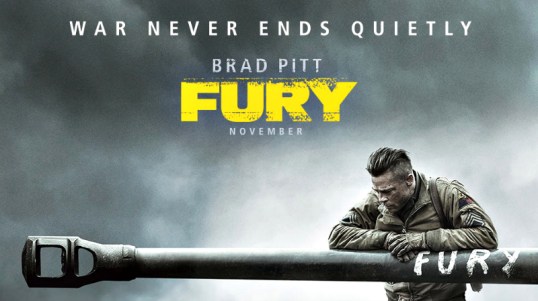
Spielberg lifted the rose-colored glasses from the audience and dared to show that while noble, World War II was still war and it still had the horror and brutality that all wars have. 2014’s Fury by David Ayer would continue this exploration of the last “Good War” in it’s most gritty and blood-soaked detail.
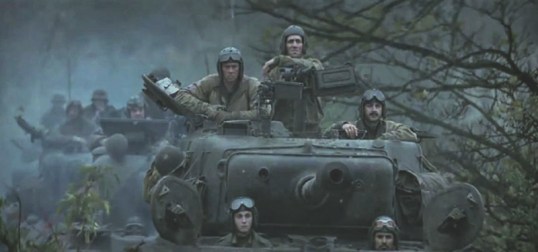
The film shows the last gasp of the German war machine as Hitler gives one of his final orders for the German people to repel the invading Allies. It was to be a scorched earth defense. Whether by choice or forced into this desperate tactic, every man, woman and child was to take up arms to their last breath to defend the Fatherland. It’s in this nightmare scenario that we find the veteran Sherman tank crew led by Don “Wardaddy” Collier trying to survive these final days til war’s end. Their home for the last two and a half years since North Africa has been a modified Sherman tank they call Fury. It’s a crew that’s been battle tested from the sands of North Africa, the maze-like hedgerows of France’s bocage and now the countryside of Germany itself.
We can see right from the start that this crew has been through hell and back many times and already resigned to going through hell many more times before they can eveb think of getting back home. It’s a crew that’s already lost one of it’s own minutes into the film. Wardaddy (Brad Pitt) looms over his crew like a weary father figure. This ragtag group consists of Bible (Shia LaBeouf) as the born-again Christian who sees their survival battle after battle as a sign that God’s grace is upon Fury and her crew. Then we have Gordo (Michael Peña) who has been so traumatized by the war and what he has had to do to survive that he has numbed himself from these memories by being in a constant state of drunkenness. Lastly, we have the tank’s loader Grady (Jon Bernthal) whose misanthropic attitude comes as a crude and brutish counterpoint to Bible’s religious fervor. Into this misanthropic soup of a crew comes in the replacement to their recently killed comrade.
Logan Lerman’s character, the young and naive clerk typist Norman Ellison, becomes the audience’s eyes in the brutal world of Fury and her crew. We’re meant to see the war’s brutality and horror not through the jaded and cynical eyes of Wardaddy and his men, but through a young man who has never killed an enemy or even fired a weapon in anger. Norman becomes the surrogate through which we determine and decide whether there is such a thing a nobility and honor in war.
Honor and nobility have always been used by those always willing to go to war to convince the young and impressionable to follow them into the breach. Fury takes these two words and what they represent and muddies them through the muck and gore left behind with each passing battle and tries to see if they remain unchanged on the other side. Norman is a literal babe in the woods as he must adapt or die in a war nearing it’s end but also becoming even more deadly and dangerous than ever. His very naivete quickly becomes a hindrance and a real danger to Wardaddy and his crew. He’s not meant for this world but has had it thrust upon him.
The film treats Norman’s humanity as a liability in a war that strips it from everyone given enough time. We see Wardaddy attempt to speed up the process during a tense sequence where Norman’s being forced to shoot a German prisoner. It’s a sequence of events that’s both unnerving and disturbing as we see the veteran soldiers encircling Norman and Wardaddy cheering or looking on with indifference in their eyes. They’ve all been in something similar and one can only imagine what they had to do to make it this far.
Fury straddles a fine line between showing and explaining it’s themes to the audience. It’s to David Ayer’s skill as a writer that the film’s able to use some finely choreographed scenes both violent and peaceful to make a point about war’s effect on it’s participants both physically and mentally. Whether it’s through several well-choreographed battle scenes to a sequence of tense and quiet serenity in the apartment of two German women that bring back the plantation segment from Coppola’s Apocalypse Now Redux, the film does a great job in showing how even when stripped down close to the bone, Wardaddy and his veteran crew still has semblance of humanity and the honor and nobility they all began the war with.
As a war film, Fury brings a type of combat to the bigscreen that has rarely been explored and never in such a realistic fashion as we watch tank warfare at it’s most tactical and most horrific. Ayer doesn’t fall for the jump cut style that many filmmakers nowadays sees as a way to convey the chaos of battle. Ayer and cinematographer Roman Vasnayov have planned every sequence to allow the audience to keep track of the two opposing sides and their place in the battle’s geography. And just like Spielberg’s own Saving Private Ryan, Fury shows the very ugly and bloody side of World War II. There’s a lot of bodies being blown apart and torn to chunks of meat yet they never seem to come off as gratuitous. Every bloody moment makes a point on the horrors of war and the level of inhumanity that another man inflicts on another man.
If there’s something that Fury does lag behind on it would be some of the narrative choices dealing with Norman’s character. The film takes place literally over a day’s time and the quick change in Norman’s mentality about the war seem very sudden and abrupt. While this day in the life of Fury and her crew worked well in Ayer’s past films (both as writer or director) here it puts Ayer stuck in a corner that made it difficult to fully justify Norman’s sudden change of heart from babe in the woods to hardened Nazi-killer. We can see throughout the film that the war is affecting him in ways that could lead up to this change, but to have it happen in just under a day really stretches it’s believability to the breaking point.
Yet, despite this the film is able to stay on course and recover from this misstep on the strength of Ayer’s direction and the performances of the ensemble cast. Brad Pitt has been the focus of the media campaign leading up to the release of Fury, but every actor who comprises the crew of Fury leave their own mark in the film. Shia Labeouf has had a tough past year both professionally and personally, but one has to admit that performances like the one he had in Fury is a reminder that he’s a damn fine good actor. Whether this film has become the path to his redemption in the eyes of the public is irrelevant. One doesn’t need to like the man to respect the talent he’s able to put up on the screen.
Awards season is in full swing as Fall 2014 arrives and Fury makes it’s case known that genre films (and make no mistake this is a genre film) can more than hold it’s own with the more dramatic life-exploring films that critics tend to put on the pedestal as examples of great filmmaking. While Fury is not perfect it is a very good film full of great performances that just misses being great.
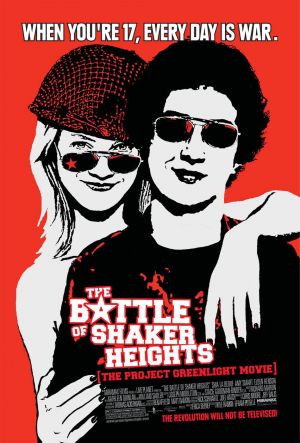
“When you’re 17, every day is war.” — Tagline of The Battle of Shaker Heights (2003)
Anyone here remember Project Greenlight? It’s a show that used to be on HBO and Bravo, in which Matt Damon and Ben Affleck would arrange for a director and screenwriter to get a chance to make their low budget feature film debuts. The catch, of course, is that a camera crew would then follow the director as he (and all of the Greenlight “winners” were male) struggled to get the film made. Mistakes would be made. Money would be wasted. Producer Chris Moore would randomly show up on set and start yelling. In short, it was typical reality show drama with the catch being that the film itself would then be released in a theater or two.
Well, after being consigned to footnote status for the past nine years. Project Greenlight is coming back for a fourth season and a lot of people are pretty excited about it. And why not? I own the first two seasons of Project Greenlight on DVD and I’ve watched the third season on YouTube. It’s a lot of fun, mostly because all of the directors, with the exception of season 3 winner John Gulager, turned out to be so incredibly inept. (Gulager is one of the few Project Greenlight success stories — not only did his movie, Feast, come across as being made by a professional but he’s actually had a career post-Greenlight.) It all makes for good televised drama.
However, it doesn’t necessarily make for a good movie.
Case in point: 2003’s The Battle of Shaker Heights.
The Battle of Shaker Heights is about a creepy 17 year-old named Kelly (played by the reliably creepy Shia LaBeouf). His mother (Kathleen Quinlan) is an artist. His father (William Sadler) is a former drug addict who, despite having been clean for 6 years, still has to deal with his son’s constant resentment. Kelly is a high school outcast who spends all of his spare time thinking and talking about war. Every weekend, he takes part in war reenactments. At night, he works in a 24-hour grocery store where he doesn’t realize that he’s the object of Sarah’s (Shiri Appleby) affection.
(Why Sarah has so much affection for Kelly is a good question. Maybe it’s the scene where he throws cans of cat food at her…)
At a reenactment of the Battle of the Bulge, Kelly meets and befriends Bart (Elden Hansen), which leads to him meeting Bart’s older sister, Tabby (Amy Smart). Tabby is an artist, because the film isn’t imaginative enough to make her anything else. (We’re also told that she’s a talented artist and it’s a good thing that we’re told this because otherwise, we might notice that her paintings are the type of uninspired stuff that you can buy at any county art fair.) Kelly decides that he’s in love with Tabby but — uh oh! — Tabby’s getting married. Naturally, she’s marrying a guy named Minor (Anson Mount). Imagine how the film would have been different if his name had been Major.
As a film, the Battle of Shaker Heights is a bit of a mess. It never establishes a consistent tone, the dialogue and the direction are all way too heavy-handed and on the nose, and Shia LaBeouf … well, he remains Shia LaBeouf. In some ways, Shia is actually pretty well cast in this film. He’s an off-putting actor playing an off-putting characters but the end of result is an off-putting film.
Of course, if you’ve seen the second season of Project Greenlight, then you know that The Battle of Shaker Heights had an incredibly troubled production. Neither one of the film’s two directors were particularly comfortable with dealing with the more low-key human aspects of the story. Screenwriter Erica Beeney was not happy with who was selected to direct her script and basically spent the entire production whining about it to anyone who would listen. (Sorry, Erica — your script was one of the film’s biggest problems. When you actually give a character a name like Minor Webber, it means you’re not trying hard enough.) Finally, Miramax took the completed film away from the directors and re-edited it, removing all of the dramatic scenes and basically leaving a 79-minute comedic cartoon.
So, in the end, Battle of Shaker Heights is not a very good film. But season two of Project Greenlight is a lot of fun!
I must admit that World War II films are a favorite of mine. Even bad ones I tend to enjoy. Whether it’s alternate fantasy fares like Tarantino’s Inglourious Basterds or something that combines historical accuracy with dramatic license like Spielberg’s Saving Private Ryan, the World War II genre always manage to hit straight and true to my film wheelhouse.
This October there looks to be another World War II film that seems almost tailor-fit for me. I’m talking about David Ayer’s follow-up to his underappreciated film End of Watch. This follow-up is Fury and tells the story of an American tank crew in the waning days of World War II in Europe. Just from the two trailer released I already know that I’m seeing this. Ayer looks to be exploring the bond of a tank crew that has seen war from the deserts of Africa and now to the urban and forested landscapes of Germany.
The film is already getting major buzz as a major contender for the upcoming awards season and I, for one, hope that it’s a well-deserved buzz. Even with Shia LaBeouf being part of the cast is not dampening my excitement for this film. Even if it doesn’t live up to the hype I know that I’ll probably still end up enjoying it.
This trailer looks to be selling the utter brutality and carnage of World War II’s final days in Europe when German forces were literally fighting for their homeland and that makes for a desperate enemy (who still had weapons and soldiers that were still hands down better than what the Allies had one-on-one).
On a side note, I like the fact that the tracers in the film actually look like tracers which means they look like freakin’ laser blasts. That’s how tracers behave.
Fury is set to hit theaters on October 17, 2014 in the United States and October 22, 2014 internationally.