The latest pick from Grindhouse of the Day will be from the sci-fi genre and this one I remember clearly as I saw it several times on one of those UHF channels that showed cheap sci-fi and horror flicks. This particular grindhouse pick made a major impression in my preteen mind due to the awesome laserblast weapon which gave the flick its title. Yes, the latest grindhouse pick is literally titled, Laserblast.
It was released in 1978 and I’d hazard a guess and say it was part of the cheap, B-movie craze that tried to capitalize on the megasuccess of Star Wars. This sci-fi grindhouse was awesome when I first saw it as an 8-year old but now I look at it and think to myself, “This thing is so awful that it’s gone beyond any level of awfulness and come out the other side as some sort of classic.” It’s still quite awful, but even now it still entertains even if not the same reasons as when it was first seen. I can understand why the MST3K guys over at Comedy Central picked on it.
The flick had a late 70’s, San Fernando Valley porn sheen to it, but minus all the stuff which made those flicks must-see. The special effects were rudimentary, though I will say that the stop-motion animation for the aliens who hunted down the people who got corrupted by the laserblaster were quite good for such a low-budget. If I had to tell someone two reasons why this should be seen at least once its for the aliens and the awesome cheesiness of the laserblaster.
This flick has the distinction of being director Michael Rae’s only film. He hasn’t made a film since. It would seem he gave it all to this single one. It’s also notable for being the first major work for composer Joel Goldsmith (son of renowned film composer Jerry Goldsmith) who would continue later in his career to composing the soundtrack to sci-fi tv series and major videogame franchises.
I wasn’t able to attend this year’s Comic-Con, but those who did and saw clips from this under-the-radar alien invasion film from the Strause Brothers came away impressed by what they saw. This particular film may be the Zombieland of 2010.
Skyline looks like your typical alien invasion flick with highly-advanced and even more highly-aggressive beings from another world wreaking havoc on the planet with their massive and very cool-looking ships. This one is made by the Strause Brothers who last made the sequel, Aliens vs. Predator: Requiem which was better than I thought it would be. It was still a bad film, but at least the brothers were able to inject some insane fun in the proceedings unlike it’s predecessor.
This second offering from the brothers look to do the same for their version of the alien invasion and this time around the setting centers on Los Angeles and not New York. The film looks to have tentacles (anime fans rejoice) in addition to huge hovering ships destroying city blocks and smaller ships taking on humanity’s armed forces. From what I could gather the acting and dialogue will not be the highlights of the film, but if they keep those at the barest minimum then this little-gem from this year’s Comic-Con may just be one of the best times in the theaters this year.
It looks like the unnamed horror project Guillermo Del Toro was quite coy about during this past week’s San Diego Comic-Con may turn out to be one of his dream projects finally getting a chance to be up on the big-screen. Mike Fleming over at Deadline has reported that Del Toro’s next directing project since leaving The Hobbitwill indeed be his long-gestating project to adapt H.P. Lovecraft’s classic scifi novella, At The Mountains of Madness.
He will not be going alone in this project as best buddy and confidant James Cameron has also joined Del Toro on his dream project as producer. Fresh off of the humngous success of Avatar has made Cameron the King of Hollywood once again and his name and clout should be able to give Del Toro the necessary muscle to get Universal not just to move the project forward but give Del Toro the budget he wants and the hands-off treatment he works best under.
Fleming also reports that the film will be in 3D which makes sense with Cameron being on-board and someone who can give Del Toro all the assistance he needs with the 3D tech Cameron has developed from his work with Avatar. The fact that Cameron will let his name be used in the promoting of the film speaks volumes as Cameron is known to be very choosy as to which projects he lends his name out to that he doesn’t direct.
There will be some moans and groans to the mention of 3D. Del Toro has never dismissed 3D, but didn’t see himself as having a particular project that worked best with it. Like any visually-gifted filmmaker, Del Toro knows how to use the tools of his trade both new and old so I don’t think Cameron’s 3D film-tech will be something he wouldn’t want to try out. Plus, if there was ever a story to be adapted onto the big-screen that would not just work well with Cameron’s 3D tech but also look beautiful it would have to be a Lovecraft tale and especially one with a setting and plot that’s not just epic but cosmic in scale. From the massive vistas of the non-Euclidean structures of the Elder Gods to the Plateau of Leng which may or may not have been the base for Cthulhu and his Star-spawns. Plus, we can’t forget the amorphous beings the “Shoggoths” which definitely would become even more terrifying in 3D.
I really hope that this project moves forward and with the speed with which Del Toro works I won’t be surprised if during San Diego Comic-Con in 2011 we get to see good footage of the film as a sneak-peek for a 2012 release.
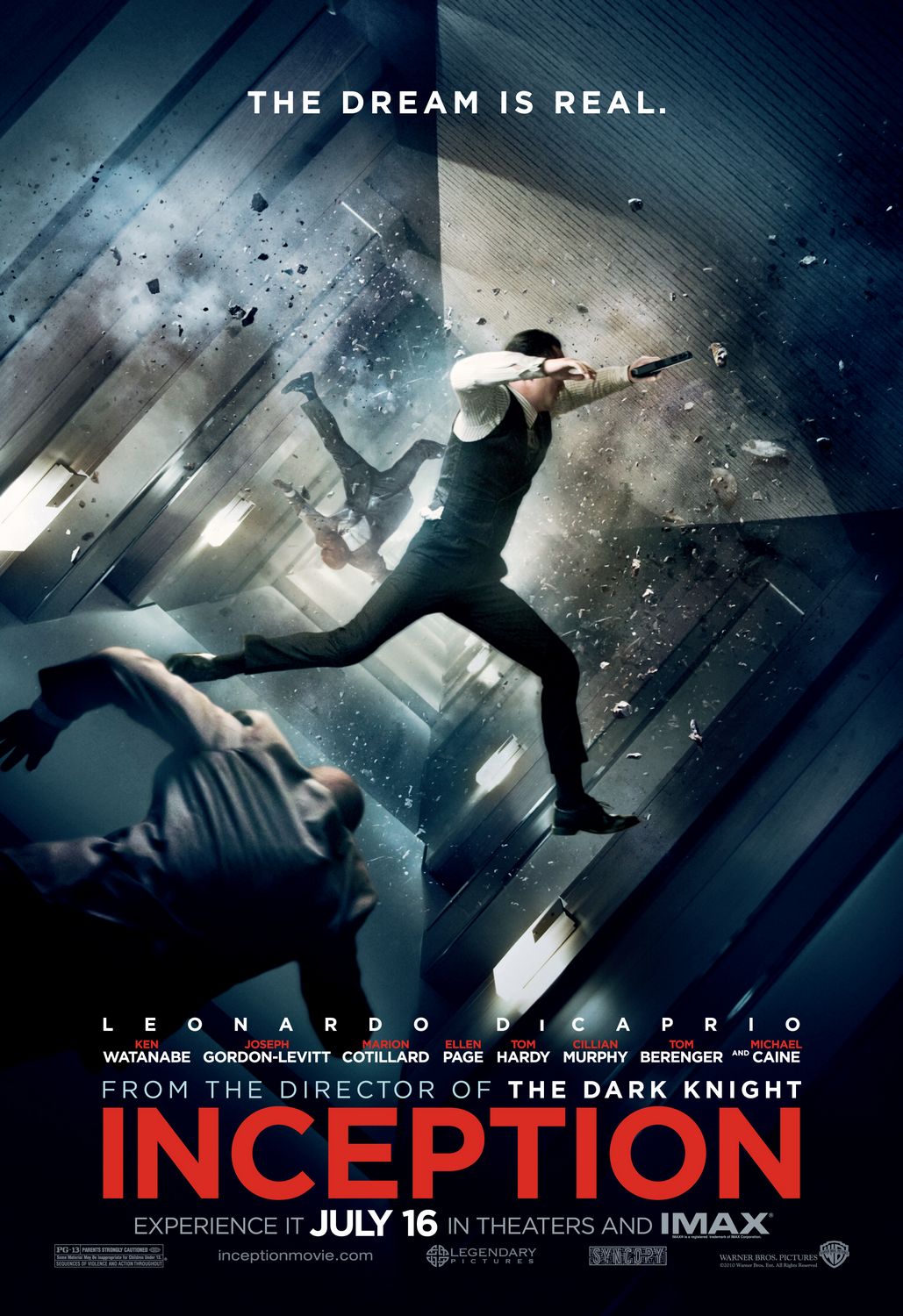
The summer of 2010 has been quite a disappointment. While the films released during this major blockbuster season has been good most have not been able to be that one stand-out which defines a summer season. We’ve had the typical tentpole sequels like Iron Man 2 (good but not great) and Toy Story 3 (also good but not great) to remakes like The Karate Kid to The A-Team. To say that the 2010 summer blockbuster season has been lackluster would be an understatement. Even original films like Splice hasn’t taken in the audience. It now falls to one of the biggest titles for the summer to try and save the season. Whether it will do so financially is still in doubt, but critically the latest from Christopher Nolan may just become the event film of the summer to actually deliver on its hype and the promise of an audience seeing something new, fresh and daring in a sea of mediocrity. Inception comes into the 2010 summer season and delivers on its promises and more than lives up to the hype heaped upon it by critics and fans alike.
A film almost a decade in the making, Christopher Nolan’s epic and sweeping tale of dreams and reality wrapped around a heist film brings the filmmaker one-step closer to becoming the genius filmmaker some of his most ardent followers have dubbed him to be. Nolan as a filmmaker and, more importantly, as a storyteller has always had a fascination with shattered reality and how the subconcious directly affect his protagonists’ sense of the real. We’ve seen this in his film-style of using a disjointed and non-linear structure to his films which goes to creating a sense of confusion in the inattentive viewer. Some have called this style of his as being a gimmick to make a simple story more complex than it really is. I disagree with these individuals and say that Nolan has never done anything to trick an audience with his storytelling style and choices. His films have all the facts laid out before the audience, but in a way that asks the audience to participate in putting the jumbled pieces together. I’ve never seen a red herring used by Nolan in his more personal projects and even in the populist titles he’s done under the rebooted Batman franchise.
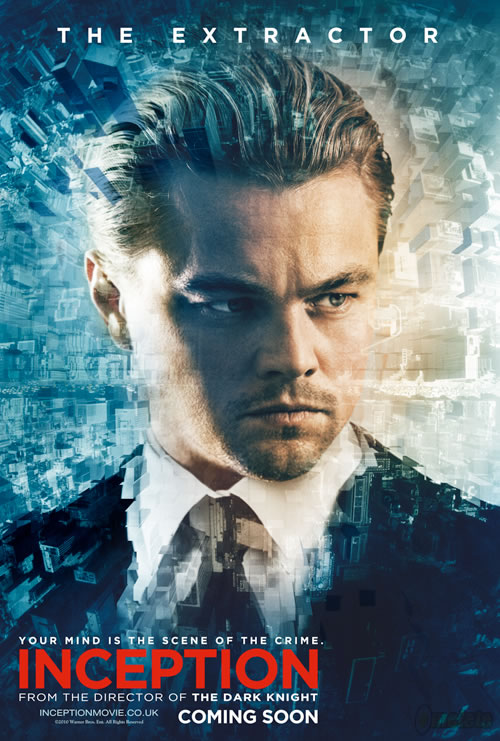
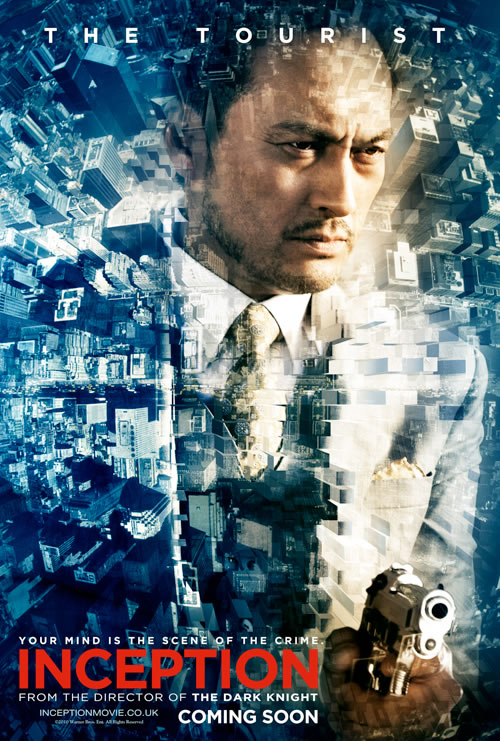
In his latest film, Nolan has refined his non-linear style and used it to successfully create the main setting of the film. Inception is set mostly in the dream world shared by the characters and those they’ve targeted. It is in this shared dream state that the audience learn the rules governing the world of Inception. It is in this dream state that we’re introduced to the first people who would make up an incredible ensemble cast put together by Christopher Nolan and his casting crew. We first meet dream extractor Dom Cobb (played by Leonardo DiCaprio) and his pointman Arthur (Joseph Gordon-Levitt) as they attempt to steal something valuable and important from within the dream of their Japanese-industrialist mark in Saito (Ken Watanabe). We see hints of the rules that will become important for the audience to help them follow the film’s main story as it unfolds. We learn that Saito has already known in advance that he’s in a dream constructed and being shared by Dom and Arthur in their contracted heist by parties unknown. As good as Dom and Arthur are at their job os stealing ideas from a mark through their dreams they have no chance when someone from Dom’s past inserts herself in their plans to sabotage what they’ve worked to accomplish.
It’s in this introductory sequence that we learn of the backstory of Dom and why his latest heist-job didn’t work out too well and has now endangered not just himself but those he has been working with. Saito gives Dom and Arthur a way out of their problems after failing in this job to steal from him by doing a job for him. But unlike previous dream heists Dom and Arthur have done in the past this time Saito doesn’t want something stolen from someone’s mind but to have an idea planted so deep within a mark’s subconscious that the mark believes it to be their very own and not one planted by an outsider. The job doesn’t require Dom to be an extractor of ideas. He’s now to find a way to successfully plant an idea. A job known as “inception” which Arthur and others deem near-impossible to pull off and one quite dangerous not just to the mark but to those involved in the process.
To say anymore about the plot of the film would be to spoil it. Inception works best when as little as possible about the film is known going in. The surprise and awe of the story unfolding is half the fun. It’s like an intricate puzzle or game one tries to solve. It’s ok to know ahead of time how to solve things, but not as fun. While for some people the way Nolan uses non-linear storytelling can be confusing all he asks his audience is to pay attention to the details and clues he’s planting in every scene and piece of dialogue. Let’s be honest this film is not for the inattentive. I won’t say stupid since that implies having low intelligence. It doesn’t take intelligence to pay attention and I’ve known that some of the more intelligent people have a tendency to let their attention wander.
Inception is a film about big ideas and grandiose themes. While the story in of itself when broken down to its simplest common denominator is just a heist film done in a new way, the film allows for layers upon layers of ideas to wrap itself around this simplistic premise. Nolan doesn’t just play with disjointing time for audience. He’s gone and went towards manipulating reality within the subconscious thought to ask the audience a simple question.
Are what we seeing a dream or is it reality?
The film doesn’t trick us using red herrings to make us think one way or another. Everything Nolan has put up on the screen is quite literal and remembering the rules he had set-up in the first hour lays the groundwork for each individual audience to answer that question for themselves. There’s no right or wrong answer to the question, but for some who have seen the film their disappointment seem less to do with the quality of the film, the acting and the direction but more on some of the ambiguous nature of the ending which becomes a dealbreaker for some. Again while I respect their take on this film I find their reasoning for negative criticism to be grounded on thin to non-existent ground. I will get to that ending soon.
While some have called Inception as the anti-Avatar I believe the two filmmaker share similar traits not just in how they create their film, but also in their two latest film. Both Nolan and Cameron are quite known to be very controlling of how their films are made to the point they dabble in every aspect of it. In their latest films they’ve also gone a long way into building a world for their story and characters to inhabit and play around in. While Cameron’s latest was an otherworldly kind in the most literal sense the same could be said for Nolan’s latest but instead inhabits the mind and how anything is possible. From the look of things both film will also share the same sort of near-universal acclaim from the film-going audience with a small, albeit very loud, minority calling Nolan’s film unoriginal, boring and, a word I have loathed for its overuse when something becomes very popular, overrated.
Where the two filmmakers diverge is the way they go about their films. Where Cameron leans heavily in pulling at the emotional strings of the audience through narrative and film sequences in his films, Nolan plies the audiences intellect instead. Cameron for all his technical genius both within the filmmaking sphere and outside of it can be quite the sappy filmmaker and all his films have shown this whether it’s The Terminator or Avatar. For Nolan his films have always felt like an intellectual exercise. An exercise everyone was invited to participate in no matter their level of intellect. He’s been able to marry both his indipendent arthouse sensibilities with the blockbuster the masses seem to crave year in and year out. With Inception he has moved one-step closer to achieving a perfect meshing of the two. This film has all the makings of a great heist and sci-fi thriller wrapped around so many pieces of profound and thoughtprovoking ideas that even after several viewings an audience will find something new to think about. Only one other film I can think of in the last decade or so has accomplished this and that was 1999’s The Matrix by The Wachowski Brothers. While that film was a kick-ass sci-fi action film it also dared to mix in a liberal dose of philosophy both Eastern and Western not to mention subjecting it’s audience to rethink how they see reality.
Christopher Nolan has gone beyond just trying to question the nature of reality. His goal with this film is to deconstruct the nature of the subconscious itself and show how such a thin line separates the dream from the real that at first and, even several glances, one cannot tell the difference. It’s a good thing for the audience watching Inception that Nolan has given them the tools and the rules to follow if they dare. And that’s where I think Nolan will disnguish himself apart from other great directors of his generation and put him up on the level of the true masters in film history. He doesn’t just make films that has worldwide appeal but able to do them while still able to engage his audience to open up their minds to the infinite possibilities his stories offer. While this does make his film a tad cold and distant for some that shouldn’t detract from the high-quality of his work, especially with Inception. The film has heart. It just doesn’t pluck on those particular beats to engage the audience.
I think filmblogger Devin Faraci said it best on his Twitter feed while discussing the film with others. While not exactly verbatim what I got out of it was that he thought it was always easy to engage and/or manipulate the audience through emotional factors, but much harder to engage their intellect. While some have accomplished the former to a great extent and vice versa I think with Inception Nolan has stepped closer than anyone to engage both the heart and the mind of the audience.
This review cannot be too much of a review if I just spoke about the ideas, themes and the inner workings of Nolan’s mind. The film is actually very good. Good enough to that’s close to being perfect. Pick any aspect of the film and those involved have done some of their best work and grown in their craft. As I stated earlier the film sports one incredible ensemble cast. I’ve already mentioned Leonardo DiCaprio and Joseph Gordon-Levitt who both do very great work in their roles. DiCaprio continues to be the go-to-guy when it comes to playing the tortured individual. Similar to his other role in Scorsese’s Shutter Island, DiCaprio as Cobb was quite believable in his personal-made hell in regards to a past event which involved his wife Mal (played with beautiful elegance and malice by Marion Cotillard). But unlike Scorsese’s film Nolan doesn’t reveal this personal issue through a twist in the plot, but let’s it come out naturally with the help of another cast member providing the impetus for Cobb to come clean. This individual is the team’s new dream architect in the form of Ariadne (Ellen Page in her most mature role to date and one that should go a long way from helping her shed the label of being Juno-esque).
Ariadne becomes the proxy by which the audience learns the in’s and out’s of Cobb’s job as a dream extractor and, very soon, inceptor. Through some inventive use of CGI and practical effects we see throught Ariadne’s eyes how the shared dream-state behaves. How specific rules actually exist within this state no matter how many levels of dreams an individual or group goes down into a mark’s subconscious. Some of these scenes people have seen glimpses of in the trailers and tv spots, but even seeing some of them in advance doesn’t detract from how incredible they look when seen on the bigscreen, especially for those lucky enough to see them on IMAX.
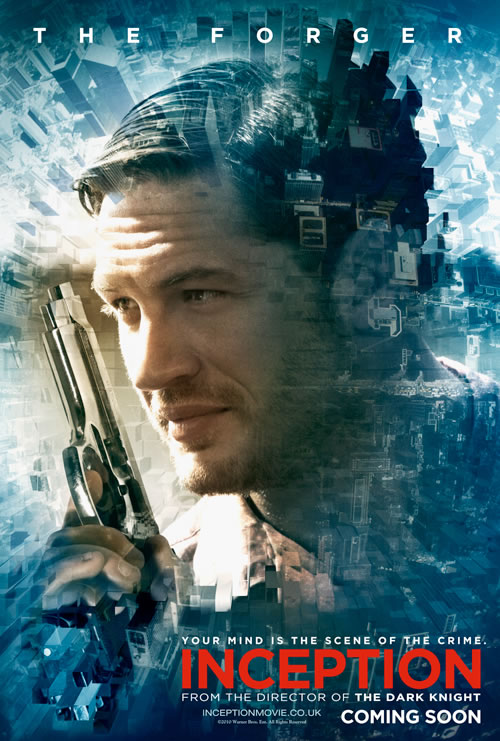
The rest of the cast rounded out by Tom Hardy as Eames the team’s Forger, Dileep Rao as the Chemist in charge of fabricating the compounds needed for the team to enter their mark’s subconscious. Cillian Murphy (starting to become one of Nolan’s regulars) plays Robert Fischer, Jr. their target and mark throughout the film with veteran actors Tom Berenger, Michael Caine and Pete Postlethwaite providing the wise-men roles in the film. It’s Tom Hardy as Eames which stood out in a cast full of extraordinary young and veteran performers. His recent fame as an actor due to his brutal and daring performance in Bronson has made Hardy a hot commodity in Hollywood. His playful character of Eames serves to provide some levity in an otherwise very serious film which allows the audience to come closer to the characters and story instead of remaining distant as Nolan’s detractors like to point out. He nearly pulls off stealing the film from everyone everytime he’s on-screen. It’s a testament to all the actors that he doesn’t as each and everyone have their moments to shine without overshadowing their fellow co-stars.
It would be difficult to review this film without pointing out how beautiful it looks and sounds. The visual part of the film has to go to Walter Pfister who works his magic behind the cameras on this film. Every shot is clear, concise and free of tricks some cinematographers these days have come to rely on too often to make their shots look more dynamic than it really should be. The editing by Lee Smith makes sure that Nolan’s style doesn’t confuse the audience and keeps the non-linear narrative structure easy to comprehend. As for the score one has to look to Hans Zimmer’s growing rapport with Nolan. He’s scored two of Nolan’s film and it looks that Zimmer has tapped into what Nolan wants his film score to sound like. not to dominate or overemphasize particular scenes or beats, but to act as an accompaniment. All three individual do their part as does the actors into making Nolan’s vision of Inception come to life. As great a filmmaker as Nolan is turning out to be these support players have made sure his path towards that goal is done so on smoother ground than not.
Now, there’s going to be some heated and long debates as to the nature of the film because of the final shot. The final shot is of a metal dreidel spinning in the foreground with the camera panning to it. The dreidel is spinning and spinning and looks to keep on doing so. The dreidel is shown earlier in the film as acting as some sort of anchor to tell Cobb whether he is in the real world or in a dream. If it continues to spin and not tip over and fall then he’s still in one. If it spins but ultimately tips over onto its side then he’s out of it. The film ends with the dreidel spinning and for a split second before the film suddenly fades to black we see it wobble.
Many have seen this final shot as being a cop-out by Nolan to play with the audience’s mind. I happen to disagree. I see it as a part of the story itself. nolan has been asking throughout the film what is real and what is a dream. This last shot just emphasizes this question and leaves it up to the audience to decide whether the dreidel continues to spin or eventually tips over. While I lean to the latter in the end it doesn’t detract from the film. The fact that some people have grabbed hold of this scene to negatively criticized the film as a whole tells me just how well-crafted a film Nolan has made that one little sequence lasting no less than 10 seconds becomes a dealbreaker for some when it should stimulate the mind into thinking what it actually means. I see that as the mark of an excellent storyteller.
In the end, Inception has done something this year which most film have so far been unable to do. It has delivered on its high-minded promises of a film that would challenge the audience and not just entertain them. It’s a film which has been overhyped for the last six month but has more than lived up to it and for some surpassed the hype itself. Inception looks to be one of those films which would forever define a filmmaker and this one will definitely define Nolan moving forward no matter what other projects he has in the future. This is a film that dares to appeal not just to the arthouse cineaste crowd but to the general audience who yearn to watch something exciting and original. I won’t say this is Nolan’s best film since he has years upon years to continue making films. Maybe one of those will be his masterpiece, but Inception definitely could be counted as being a nominee for that honor. If nothing else this film has saved what has been a very ordinary and lackluster 2010 summer film season.
Steven Spielberg’s War of the Worlds shows that he hasn’t lost his touch when it comes to creating blockbuster spectacle. While he has spent much of the 2000’s creating dramatic films (The Terminal, Catch Me If You Can and Munich) he hadn’t made a film which spoke epic in both spectacle and themes. He had made two unique films with sci-fi themes with A.I. and Minority Report, but still they lacked the size and oomph of Spielberg’s past blockbusters. It took him remaking for the current generation a classic sci-fi story to bring us back the Spielberg many grew up with. His take on H.G. Wells tale of aliens invading Earth was both grandiose in it’s set-up, but he was also able to deftly weave a very personal story within the larger scheme of the narrative.
Working from David Koepp and Josh Friedman’s adaptation of the classic H.G. Wells novel, Spielberg goes back to his roots as a maker of thrillers that first showed his talents as a director. War of the Worlds has its spectacular CG moments when the alien Tri-Pods first rise up and out of the ground to the look of awe and fear from people witnessing the event. Spielberg begins the film’s unrelentless tension from these scenes and never lets go. Once the Tri-Pods start unleashing their death-rays on the populace and whatever else is in their way the film starts moving at breakneck speed. It’s these same apocalyptic scenes of the alien’s extermination of humans that has prompted critics (both positive and negative) to bring up Spielberg’s use of 9/11 imagery. From the clouds of ash and floating pieces of clothes to the sight of people running in panic as destruction rains upon them from out of nowhere.
Some critics have labeled Spielberg’s film as exploiting the horror of 9/11 and its aftermath, yet when a film like 28 Days Later use the same imagery and themes these same critics applaud the director of this film as daring. Its an unfair criticism of Spielberg and just shows how some people just seem to use the events of 9/11 as a crutch. Yet, it is this same use of people vaporised into nothing but ash and clothng that adds to the tension and horror. It is easy to use blood and gore to bring up a feel of horror, but Spielberg one up’s this and forgo grand guignol scenes. His technique actually brings an inhuman and alien quality to the death and destruction on the screen. From the moment the aliens arrive Spielberg lets us know that this is a war that has not been seen on Earth.
Spielberg and his writers have stuck pretty close to what Wells’ wrote in the original novel, but have decided to look at the story through the eyes of a father and his son and daughter. This gives the film a more personal, disjointed and chaotic feel. There’s no scenes of the government powerbrokers debating and deciding how best to combat the aliens and their machines. No scenes of scientists trying to figure out how best to fight and get through the aliens’ defenses. In fact, War of the Worlds is the anti-Independence Day. What we get instead is a story of a man and his children trying to just survive the apocalypse occuring around them as best as they can. This choice by Spielberg and his writers to go this route is best shown in a scene where Tom Cruise’s character with his kids run into a convoy of military vehicles heading towards the frontline. We see Humvees, M1A2 Main Battle Tanks and other assorted military hardware and hundreds of soldiers. We can hear the sound of the battle just over the ridge of a hill, but just like Cruise’s character we do not actually see the battle happening. We hear snippets of commands and reports from the soldiers around Cruise. Spielberg could’ve easily panned the camera up over the ridge to see how the battle was progressing, but he stays his hand focuses instead on the dad and his family. It’s easier to go the route that Bay or Emmerich would take and show the sturm und drang, but that wasn’t the story Spielberg was trying to tell.
ILM’s work in creating the alien Tri-Pods and the subsequent terraforming the aliens begin were some very good work from an FX company with a history of impressive work. The Tri-Pods kept the original H.G. Wells description from the novels but gave them a modern take. While the George Pal version of the alien ships remain classic sci-fi icons these new Tri-Pods in Spielberg’s War of the Worlds definitely conveyed alien menace and destruction the moment they began to come out of the ground. It was a joy as a sci-fi fan to actually see that Spielberg and the writers decided to show just how menacing the alien invaders were in the way they began to terraform the planet to suit their needs. It definitely put a new definition to the term “the blood is life”.
The acting is what you expect from a Spielberg/Cruise collaboration. Cruise is actually very believable as a loser father who seem to look at his kids as more of a hindrance and a scheduled paternal duty than something he actually enjoys and looks forward to. Some of the best scenes Cruise has in the film are quiet ones between him and his daughter (played by Dakota Fanning) where he realizes that he really doesn’t know his daughter that well and can’t even remotely figure out how to calm her down and make her feel safe. When his daughter asks him to sing her a lullaby, the look of incomprehension at not knowing any showing on Cruise’s face is just brilliant. The one misfire in terms of characters in the film is Tim Robbins. The sequence in the film where they meet up with his paranoid and slowly going nuts character is actually very good in terms of ratcheting up the tension, but Robbins’ performance was more funny than anything else. Spielberg had created such a doom and gloom atmosphere that Robbins’ character’s appearance ruins it abit.
One other thing which kept me from calling this film an outright great film are the kids of Cruise’s character. While the performances by Dakota Fanning as the daughter and Justin Chatwin as the son were quite good the way they were written left them annoying and baffling. Either the daughter was a shrieking and emotional mess or the son was written as a rebellious teen who wanted to get into the fight despite knowing he was his sister’s lone protector to begin the film. It made Cruise’s character seem less of an unattentive father and boor, but more of a parent who tried his best with children who defied and talkbacked at every turn. If the writers just made the kids even remotely sympathetic it definitely would’ve rounded out their characters as real people.
Overall, I think Spielberg’s War of the Worlds succeeds in what it set out to do despite some flaws with some of the characters. It entertains and it also shows that when it comes to blockbuster filmmaking he is still the master and everyone else just pretenders to his throne. As for the ending that some think as being short, abrupt and just a tad deus ex machina in execution, well I suggest they read or reread the book again. The ending fit the film perfectly. If the film was an all-out blast to the senses then a different one may be a better fit, but for the type of story Spielberg decided to film the ending made sense in its execution.
Having recently seen Michael Caine’s revenge film Harry Brown I got to thinking about other revenge-themed films I’ve watched through the years and I realized that there were quite a bit of them. There’s something just primal and Old Testament about revenge flicks. It doesn’t matter whether they’re high-brow art-house films or the cheapest grindhouse flicks in the end it all boils down to one individual raining down their own version of Divine Wrath on those who wronged them.
Who hasn’t fantasized or thought about going all medieval on someone who just screwed them over. Maybe it was an infraction that was minor that one didn’t need to get overly upset over or something so heinous that only violence at its most basest was the only response. Going through with such thoughts usually stayed there: in one’s thoughts and imaginings. Revenge films seems to be quite popular because they allow even the meekest and most pacifist to secretly live vicariously through the revenge-minded leads in the film.
The list below is not the best revenge films out there but they definitely are my favorites…
Oldboy – This revenge film by South Korean auteur Park Chan-wook wasn’t just a blast to watch but also happens to be one of the best films of the past decade. It takes a simple plot of a man imprisoned against his will for 15 years with no explanation whatsoever that he literally goes insane and back to sane during his captivity. Revenge being the one thing which keeps him going and revenge he gets to inflict on all those he discovers were responsible. The mind-twisting last act in the film takes the revenge-theme right on it’s head as we find out that the main lead wasn’t the only one on a revenge train of thought.
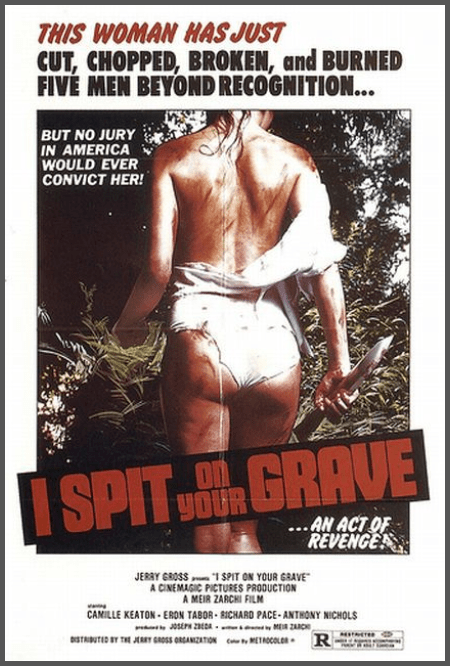
I Spit On Your Grave aka Day of the Woman – This grindhouse classic from Meir Zarchi is the epitome of the rape victim turned revenge valkyrie. The film is not very easy to sit through since there’s nothing subtle about how filmmaker Meir Zarchi filmed every exploitative scene. From the prolonged gang rape sequence to each subsequent revenge act by Camille Keaton’s Jennifer character. Some critics have blasted the film as pandering to the lowest common denominator while others have hailed it as a post-modern feminist film. I like to think that both sides are correct and that the film lies somewhere in the middle. It definitely will put a scare on any group of men who are having thoughts of shenanigans.
Death Wish – When people hear revenge flick they almost always say this iconic film by Charles Bronson from the 70’s. The film was adapted from Brian Garfield’s 1072 novel of the same name and directed by Michael Winner. While critics had mixed reactions to the film with some calling it irresponsible filmmaking, the nation as a whole embraced the film. Here was a film which screamed to the nation that the rising crime-rate in the U.S. during the 1970’s wasn’t going to go unanswered. While some people may have seen the film as a blank check to actually commit vigilantism in the end it just helped a country sick and tired of the crime they see day in and day out. Again here was art becoming a driving force in changing a nation’s collective malaise into something more positive. It didn’t hurt that Bronson was badass as Paul Kersey.
Kill Bill: Volume 1-2 – Who else but the video clerk made good would make what I would consider the greatest genre mash-up film ever made. Quentin Tarantino’s ode to kung fu, spaghetti westerns and revenge flicks became so massive that he had to split the film into two volumes. I am talking about Kill Bill. Not his greatest film ever but I definitely consider it his most geek-friendly and most entertaining. Uma Thurman as The Bride tearing a bloody and witty path of revenge on those who failed to kill her created some of the most iconic fight sequences of the generation this film came out in. Every scene almost seemed to be inspired by other films of a similar theme and genre that film geeks everywhere must’ve exploded in their pants from all the awesomeness they were witnessing. Each volume had two great action sequences that were both fantastical and brutal.
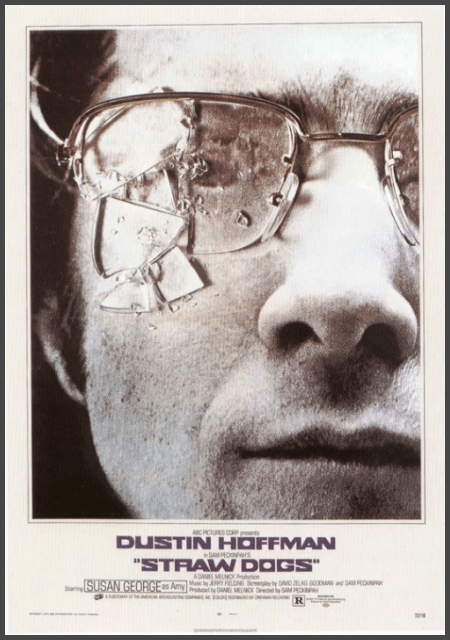
Straw Dogs – One of the most controversial films in Sam Peckinpah’s controversy-filled directing career. Released in 1971 it told the story of how even the meekest person could be pushed into dealing out extreme violent justice on those who have wrong them and those they love. Seen by critics as quite misogynistic due to the nature of the rape scene of Susan George’s Amy character the film was banned for two decades in the UK for it’s unflinching look at violence. Being a huge fan of Sam Peckinpah I had to see it and when I did it automatically became one of my favorite films ever and not just a favorite revenge film. If there was ever a modern retelling of a Biblical-level fable it is this classic from Sam Peckinpah. Every revenge-fueled act by Dustin Hoffman literally oozes Old Testament justice. Just the way I like my revenge. 🙂
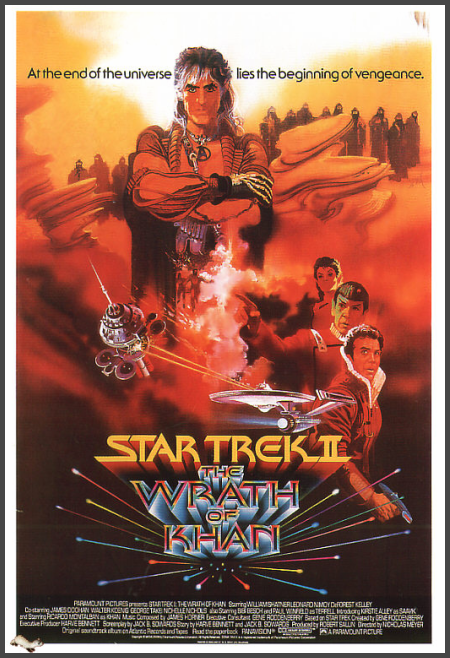
Star Trek II: The Wrath of Khan – Speaking of Biblical this first sequel in the Star Trek film franchise still considered by fans and non-fans alike as the best in the series. Hard to argue with them since it’s also an opinion I share. The sequel takes a popular episode from the original series and follows it up with all the cast of characters older and more seasoned. In the case of Ricardo Montalban’s Khan Noonian Singh quite seasoned and classy as smooth Corinthian leather. It’s a film with Shatner’s Kirk and Montalban’s Khan in an everending cycle of revenge which would culminate in what would be one of film’s most heartbreaking scenes. One could taste the revenge emanating from the two characters as age-won wisdom and genetically-engineered intellect fell by the wayside to feed the vengeance sought by Kirk and Khan. This revenge flick also has one of the most awesome death speeches by a character on film.
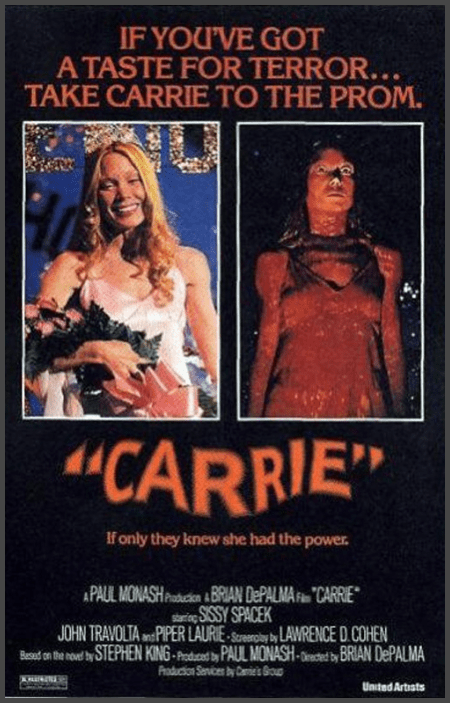
Carrie – Brian De Palma’s film adaptation of one of Stephen King’s better horror novels still seen by many as the best film adapt of a King novel. It combines the existential horror of being a girl and her body maturing in the dog-eat-dog world of high school and the horror said girl can inflict on those tormenting her. It’s high school bullying and revenge with a healthy dose of Stephen King shenanigans mixed in. Sissy Spacek was great as the titular character. One doesn’t have to be a high school girl to feel for Carrie and what she goes through. Her snapping in the last act and inflicting her psychokinetic-brand of revenge on her tormentors must’ve gotten more than a few “Hell yeah!” from some of the teens and adults who went through high school hell. It also has a classic line uttered by Carrie’s mother played by Piper Laurie: “I can see your dirty pillows. Everyone will.”
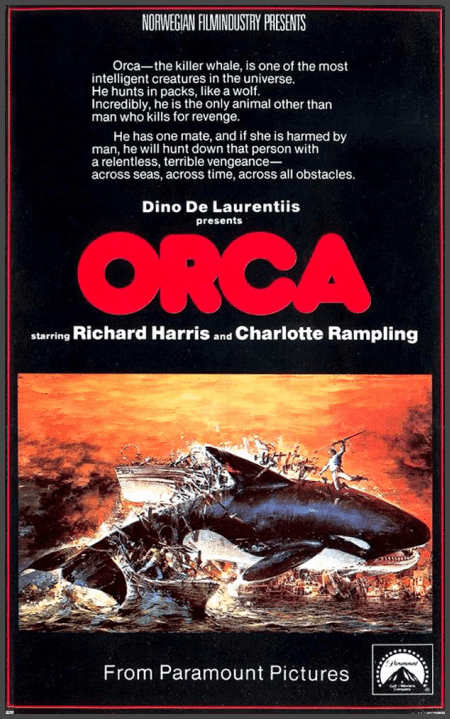
Orca – This film was to be producer Dino De Laurentiis’ attempt to capitalize on the success of Steven Spielberg’s classic man-versus-nature thriller, Jaws. Starring Richard Harris, Charlotte Rampling and Bo Derek the film wasn’t a success when it first came out. While Spielberg’s film was a modern retelling of Moby Dick this killer whale version by director Michael Anderson was Death Wish on water with Paul Kersey as the killer whale. This was one of the first films where I realized none of the people on the screen were worth rooting for to survive. I was all for the killer whale who was on a warpath to avenge his mate and unborn wee killer whale who were killed by Harris and his crew. Shamu this killer whale was not and it always brought a smile to my face whenever the killer whale outsmarted the humans and killed each and everyone in inventive ways. I’m wondering if all the killer whales in all the aquatic parks are just biding their time before they too go all Orca on their handlers and the audience. I’d pay to see that!
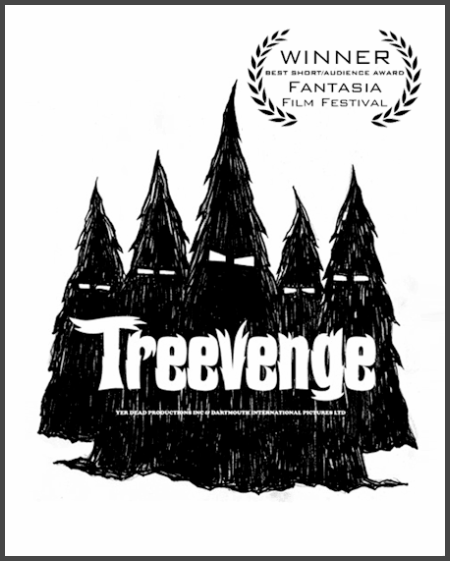
Treevenge – Last but not least the greatest film ever made!
Gamers of the past 5 years pretty much have seen gaming publishers go all-out to advertise their AAA titles to the public whether one was a gamer or not. The first to do so was Microsoft and Bungie Studios to help market the third game in their very popular and blockbuster-selling first-person shooter franchise, Halo. It was in marketing Halo 3 where we see live-action short films that helps build the hype and buzz for the game. Halo 3 was going to sell millions whether these short films turned commercials were made or not, but the fact that they were and the gaming community love them shows that the gaming industry was starting to think of itself as akin to the film industry. These were literally live-action trailers for games.
Three of the Halo 3 live-action trailers were directed by a young South African bloke who calls himself Neill Blomkamp. Halo 3: ODST came out with a couple of live-action trailers with one lasting a whopping 2.5 minutes long. This particular trailer had a Saving Private Ryan vibe to it and was actually critically-acclaimed in the advertising and marketing industry. Now, we have the final Halo title from Bungie Studios and the first live-action trailer has popped up. This is not even the trailer for the full-game out later this fall, but a trailer for the multiplayer beta which will begin in May 2010. This live-action trailer is titled “Birth of a Spartan” and shows a glimpse at how the Spartans (super-soldiers in the Halo universe are created).
The trailer looks great. It has a very futuristic clean look to it and even brings to mind military sci-fi influences. With the game still months from seeing it’s initial release I hope they continue to make these live-action trailers. These really are some of the best game trailers out there. Below are some of the previous live-action trailers that had been made for the other titles in the franchise.
In the beginning of 2010 a scifi-horror film arrived in the theaters to much internet hype. This film showed a future world where a massive societal change and the resulting health crisis following it was described in detail. It was a film which cleverly built a world so different from out very own yet still very similar in its foundation. This film was Daybreakers and for all the wonderful world-building it did to establish a foundation for the story being told the film couldn’t find it’s way to having the film’s plot match what the filmmakers’ established in the beginning. I say this because it is now late March 2010 and another film has done another wonderful job of establishing a future world so very different and yet so very similar in many ways. Where the Spierig Brothers failed in more ways than one to have the rest of Daybreakers live up to the world established in the beginning and a premise that was quite new, Miguel Sapochnik did a much better job — albeit still flawed — in allowing the plot for Repo Men live up to the world established in the opening minutes of the film.
In the near future of Repo Men medical science and technology has advance far enough that most organs and parts of the human body can be artificially replaced when they failed. While this detail of the film sounds like the makings of a future utopia it’s actually much closer to our own reality in that these organs, despite being mass-produced, are still only affordable to the rich. Artificial organs (artiforgs in this film’s vocabulary) sold to the rich like luxury items. Those not-so-rich, but desperate to try and find a way to change a fatal health situation, also offered these artiforgs on a monthly payment plan suitable to their current expense situation. It’s mostly these payment plan artiforg owners who experience the skill sets of the so-called “repo men.” These are individuals employed by the artiforg company called The Union who sell the products. When someone misses too many payments on their artiforgs and goes delinquent on their payment plan then the repo men will be knocking on their door to take back the synthetic organ. It’s similar to banks repossessing cars and homes when payments are not made.
The film’s told in the point of view of one of these repo men. Jude Law’s character Remy is one of The Union’s top repo men who we see enjoys his work despite the ultimate consequence of what he does to the people whose artiforgs he takes back. His partner is Jake (played with childish glee by Forest Whitaker). The two have been friends since grade school and both share a similar sense of sociopathy when it comes to violence. To say that they’re like brothers minus the shared genetics won’t be too far off. The first third of Repo Men shows the audience these two organ repossessors in their element as they hunt down those delinquent in their plan and those who have turned to the black market for their artiforgs. The film’s touches upon the current public hysteria of the two sides in the health care debate. While the film touches upon this current debate it does so without being too broad or preachy. It’s done subtly and without having it distract the audience from the film’s story.
The film does sing and move at an entertaining pace during the first third, but inevitably it does reach a point where the conflict of the story shows itself to add a dramatic ingredient to the film. It’s during what was to be Remy’s final repo mission before he heads over to a less paying, but safer job as sales in The Union that he goes from the repossesser to potential possessee. The switch in roles soon has Remy unable to do what he’s been so good at as cutting into someone delinquent on their artiforg when he himself now has one keeping him alive. It’s a common storytelling telling idea of the insider getting a taste of their own medicine and seeing how the other side lives. Avatar used it late last year and Daybreakers did it clumsily earlier this year.
This second third of the film has some character development flaws which could be attributed to some of the script’s weakness. While Remy’s sudden inability to do his job as a repo man after his own artiforg surgery makes sense the one-note characterization of his wife (played by the Black Book‘s Carice von Houten) who leaves him during this crisis of faith adds an unnecessary factor to his problems. In actuality the roles of the wife and Remy’s son could’ve easily been left off the film and just had the story be about Remy and his long-time friend and fellow repo man Jake. This would’ve been enough conflict and drama to power the rest of the film. This is where less would’ve definitely more and keep the story lean, mean and definitely more efficient. But even with this misstep in the film’s script it doesn’t sink the film. This could be attributed to some strong performances from Jude Law who manages to credibly transition from what amounts to be a paid serial killer to one having his eyes opened to the devastation he has wrought on individuals and families. Even the scene-chewing done by Whitaker as Jake doesn’t diminish Law’s performance and instead just shows that despite some of the horrible things Remy’s done he’s actually the sanest person in the film w/ everyone else close around him playing certain caricatures whose roles are to push him one way or another to picking a side on the issue of artiforgs and their repo issues.
It is in the beginning of the third act which may make or break the film for those who have stayed with it through the first acts. A particular even happens which transitions act to three which ramps up the action to it’s bloodiest and, at times, quite Cronenbergian level. It is this third act which pays homage to several great action-thrillers of the past decade. One scene in particular tries to emulate the classic hallway fight scene from Oldboy. This time around more weapons are used from knives, guns and all the way to a medical hacksaw. This scene leads up to another which pays homage to another Jude Law film of the past with a Cronenberg pedigree. While bloodier than similar scenes in eXistenZ there’s no denying that Sapochnik sure loves his Cronenberg. The climactic finish to the film before a sort of epilogue of a twist just builds and builds throughout the third act. For some the epilogue’s reveal may and will ruin the rest of the film as it seems like a cop-out of a plot twist, but I thought it was actually well done and gives a new meaning to the conventional Hollywood happy ending to an action-thriller.
As a first-time feature-film director Miguel Sapochnik has a deft and keen eye for visuals. The artistic design of the near-future world of Repo Men shows influences from the consumeristic dystopian future of Blade Runner up to the grounded in futurist science of Spielberg’s Minority Report. He’s quite adept at blocking and handling the many action setpieces which helped keep the film from being bogged down by flaws in the script and some uninspired characters. Sapochnik does need to get a better feel for how his cast interacts with each other. As stated earlier with the exception of Law’s Remy character and Liev Schrieber’s delicious turn as a gleefully amoral example of corporate evil at its best, the rest of the cast seem uninspired from von Houten’s role as Remy’s wife right up to Alice Braga’s performance as Beth, the artiforg addicted singer Remy hooks up with halfway through the film.
Repo Men could’ve easily gone highbrow in addition to keeping to it’s genre trappings the way the Spierig Brothers tried to do with Daybreakers. Fortunately, Sapochnik w/ writers Eric Garcia and Garrett Lerner kept things focused on Remy’s journey from hunter to prey to “savior” without trying to overly explain his motivations. While they weren’t subtle in all things they tried to tell with the story they gamely tried to stick to the rule of showing and not telling everything. For his directing debut Sapochnik does a good job despite he flaws and shows promise.
In the end, Repo Men is a very good scifi action-thriller which delivers on its title. Despite missteps in the writing and some uninspired characters the film still turned out to be quite entertaining. It was a fast-paced film with several bloody, gore-filled action setpieces timed to pick up the film when dialogue and exposition starts to drag it down. Miguel Sapochnik’s debut feature-film could easily have turned off the rails and went in so many different directions but he kept things on the straight and narrow. While for some the ending will infuriate and negate what fun they were having through most of the film it also would be seen by others as an inspired take on the Hollywood happy ending. Repo Men won’t be mistaken as the next Brazil and Sapochnik won’t be mistaken as the next Cronenberg or Park Chan-wook, but both filmmaker and film is better than it should be and wholly entertaining from start to finish.
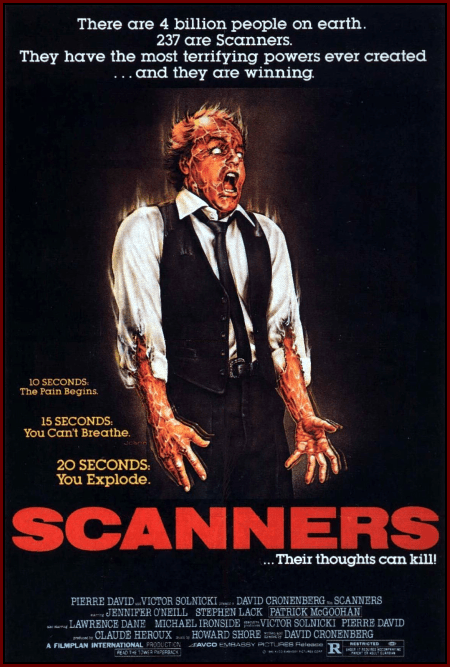
Scanners marks the emergence of David Cronenberg from low-budget horror auteur to one of the most unique voices in filmmaking of the last thirty or so years. He first came onto the scene directing such low-budget horror films such as Shivers, Rabid and The Brood. These three films were later said to have had that Cronenberg propensity to show the horror of the body-politic at its most basic. Cronenberg pretty much points out of how true horror might not be lurking on the outside, but within the the human body. Cronenberg makes the human body as forever changing and mutating against the individual person’s wants and desire of what was suppose to be the ideal. The horror that we as a people do not and will never have control over our own body was where the true horror lie.
In 1981, Cronenberg moves from the purely physical horror to one where the technology man was forever trying to create and achieve perfection would turn on the biological aspect of the human condition. This new form of techno-organic mutation was as terrifying as it was seductive in its potential to those afflicted with it. Cronenberg begins this phase in his filmmaking voice with his excellent, underappreciated and cult-classic Scanners.
The premise for Scanners had alot in common with Stephen King’s novel Firestarter in the fact that in dealt with an omnipresent and powerful organization: the CIA’s shadowy branch that dealt with experimental weapons programs for Firestarter and the ultra-powerful CONSEC multinational corporation in Scanners. These two organizations experiment on random select individuals using experimental drug treatments under the guise of helpful medications. What results from these experiments are more than what was truly expected by their handlers. In Scanners the result comes from mental abilities never seen or documented in the past. CONSEC’s experiments have yielded a unique group of individuals, 237 of them, to manifest powers of the mind that make them living weapons of mass destruction. Instead of becoming a new wonder-weapon for CONSEC to sell to their government contacts, these 237 become unstable in personality, some going as far as to develop a God-complex. Others are driven insane by these new abilities and retreat away from the rest of humanity in order to achieve a semblance of mental peace.
These two different reactions from the 237 are keenly represented by two of the main character’s in Cronenberg’s film. There’s Cameron Vale (played by Stephen Lack who had an eerie resemblance to the same named character of Stephen in Dawn of the Dead) who we first see as a vagrant who seems to be suffering from some sort of mental problem. This is farther from the truth as Dr. Paul Ruth (father of the CONSEC drug effemerol that causes the mutation and played with eccentric flair by Patrick McGoohan) soon discover that Vale’s mental problems is due to him possessing preternatural mental abilities of the highest order. Ruth’s guilt over what his experiments have done and created leads him to use Vale to counter the growing underground of those 237 who have seen their newfound abilities as a stepping stone to supplanting the normal status quo with their own in a plan of global domination that would make fans of X-Men very proud.
Leader of this underground groups of scanners (as the 237 were called) is one Darryl Revok. A scanner whose abilities rival those of Vale’s but whose mental instability for wanting to dominate the normals of the world makes him the most dangerous individual on the face of the planet. Genre veteran Michael Ironside steals the film from everyone else. His grand and classic introduction early in the film has gone down in filmmaking history as one of the most shocking scenes put on film. Ironside’s performance as the scanner with the God-complex was truly megalomaniacal and it was easy to root against him, but hard to take one’s eyes from the screen when he was on. Revok truly made for one of film history’s classic villains.
In the middle of Vale and Revok’s war for control lies Kim Obrist (played by the beautiful Jennifer O’Neill) who tries to lead those who just want to be left alone from being used by both Revok and CONSEC. O’Neill’s performance was the most grounded in reality, as much as a film about people with mental powers could be, and tries to keep the film from getting too fantastic.
This I think was what made Scanners such a great film. As ludicrous a premise as the film had to base its sotry on, there was always a sense of realism to keep everything form becoming too much like a comic book. The story paints a story that could happen in reality since similar things have occurred in the past such as the LSD testing on US military personnel during the 50’s and 60’s. Cronenberg plays on such fears of outside factors introduced by scientists looking to forever improve on what nature took eons to evolve. It’s this hubris about man’s attempt to dominate his own body which interests Cronenberg and what would happen if he did succeed in doing something nature and humanity wasn’t ready for.
Scanners marked Cronenberg’s interest in examining the effect of man’s quest for better and better technology, whether mechanical or biological, on humanity’s physical and mental existence. What he brongs forth, first with Scanners then later on with Videodrome and The Fly, was something both horrific and seductive. Who wouldn’t want to have such abilities as Vale and Revok had at their command. But by the end of Scanners the film posits the question of how much of one’s humanity must be sacrificed for such huge leaps on the evolutionary ladder. Will the resulting amalgamation of nature and technology still leave something human or just something that pretends to look like one.
Some have called Scanners a horror movie and some have called it a sci-fi thriller. It’s both those and more. It’s really hard to pin down just exactly which genre Scanners falls under since Cronenberg never tried to stay within one particular one. The film works as a thriller, as a science-fiction story, a horror flick and a philosophical exercise in examining the human condition. Cronenberg’s skill was clearly evident in keeping all these differing themes and genres from becoming out-of-place and bringing the finished product from becoming too flawed. Cronenberg’s first foray into this new phase of his filmmaking career ushered in what some have called Cronenberg at his most daring and pure. I wouldn’t argue with such an argument. Scanners is a film of great quality that would forever be used as an example of Cronenberg’s genius as a filmmaker.
The Hollywood Reporter blog has reported that Mary Elizabeth Winstead has been cast in the lead role of the soon-to-be filming prequel of the classic scifi/horror The Thing. Slashfilm has picked up on this story and I have confirmed with someone involved in the casting process that she has been cast who I trust explicitly.
She will play the role of Kate Lloyd, the paleontologist chosen to travel to Antarctica to help the research team in the Norwegian camp which has found something buried in the Antarctic ice. The casting of Joel Edgerton in the male lead role of Sam Carter, the American helicopter pilot tasked with bringing the character Kate Lloyd to the Norwegian base, rounds out the news on lead casting.
Ms. Winstead has had her share of being part of a genre production (Final Destination 3 and Grindhouse) so she will not be out of place in such a production. She has enough acting skills to balance out her good looks. With the relatively young look of both leads there’s a chance that writer Eric Heisserer may include a romantic subplot between the two characters. I sure hope that is not the case since this film doesn’t really need it to appeal to the audience. Would I be averse to having some sort mutual attraction, even if just hinted at, between the two character? Not at all, but a fullblown romance just for the sake of having it in the story would be the wrong way to go about it.















 Through the Shattered Lens