What’s an Insomnia File? You know how some times you just can’t get any sleep and, at about three in the morning, you’ll find yourself watching whatever you can find on cable? This feature is all about those insomnia-inspired discoveries!
If you found yourself awake and unable to sleep at 2:30 this morning, you could have always turned over to TCM and watched the 1976 film, A Star is Born.
A Star is Born gets off to a good start by having Gary Busey give Kris Kristofferson a hit of cocaine. As I pointed out on twitter, no movie that starts with Gary Busey offering cocaine to Kris Kristofferson can be all bad.
Anyway, Kris is playing John Norman Howard. John Norman Howard is a big 70s rock star, which means that he has a beard and a bad case of ennui. Despite all of the cocaine and whiskey, his career is on a downward spiral. Part of the problem appears to be that he only sings one song and, half the time, he still can’t bring himself to remember all of the lyrics. The song opens with John growling, “Are you a figment of my imagination or am I one of yours?” and John always ends up storming off stage before we can hear the rest of it.
Anyway, John ends up at this club in Hollywood that looks a lot like the place that Ryan Gosling opened up at the end of La La Land. While at the club, John gets into a fight with Robert Englund (who I assume was playing a young Freddy Krueger) and totally interrupts the performance of the Oreos.
Who are the Oreos? They’re a folk-singin’ power trio. There’s One (Venetta Fields) and Two (Clydie King). (According to the credits, that’s actually their names.) And then there’s Esther Hoffman, who has a truly horrid perm and who is played by Barbra Streisand. One and Two are black. Esther, who stands right in the middle whenever they perform, is white. And they’re called The Oreos!
Uhmmm, yeah…
Anyway, we really don’t learn anything about One or Two, beyond the fact that they are totally and completely devoted to Esther. When Esther gets them fired from recording a cat food jingle, they just smile and laugh. Sure, why not!? After all, it’s not like struggling musicians need money or anything. When Esther interrupts a performance to yell at John, One and Two smile and laugh. When Esther, under John’s tutelage, becomes a big star and basically abandons the Oreos, One and Two show up at a recording session and smile and laugh.
Last night was my first time to actually see A Star is Born, though I had heard and read quite a bit about it. Of all the versions of A Star is Born, this one made the most money at the box office but it also got the worst reviews. Reportedly, the film’s production was a trainwreck with Barbra Streisand and then-boyfriend Jon Peters fighting with … well, everyone.
And yet, like so many cinematic trainwrecks, you simply cannot look away from it. This version of A Star is Born gets so many things wrong that it becomes rather fascinating to watch. Perhaps the scene that epitomizes A Star is Born comes when John refuses to perform his one song at a benefit concert and instead, brings out Esther and has her perform her songs. First off, John’s hard rock band suddenly transforms into a Broadway orchestra and John’s audience — who presumably had paid money to hear that growling song about imagination — is overjoyed to instead have to listen to Esther’s style of lite pop/rock. (Actually, to even call it rock is to needlessly stretch the definition of rock to its breaking point.) Making the scene even more bizarre is that 1) John is basically exploiting a benefit concert to launch Esther’s career and 2) since the concert was being performed to support the American Indian Movement, the disembodied head of a Native American woman keeps appearing over Esther’s shoulder while she’s performing songs that have absolutely nothing to do with the cause that the concert is supposedly supporting. It’s kind of the cinematic equivalent of that Kendall Jenner Pepsi commercial.
Anyway, things get even better when John buys an empty field and, in a ten minute montage, John and Esther literally build a house. Seriously, I’m not kidding. At no point do we see anyone other than John and Esther working on that house and yet, within a matter of minutes, they have an adobe mansion to live in. I had no idea it was so easy to build a house. It makes me wonder why people waste money buying houses when they can just buy an empty field and build their own.
(Maybe they’re scared of the poltergeists. Imagine how different this version of A Star Is Born would have been if it ended with Esther grabbing John and screaming, “YOU MOVED THE HEADSTONES BUT YOU LEFT THE BODIES, DIDN’T YOU!? YOU LEFT THE BODIES!”)
Kris Kristofferson is well-cast as John Norman Howard but the film is pretty much centered around Barbra. That, in itself, wouldn’t be a problem if not for the fact that Barbra is completely miscast. She’s a great singer but she’s not a rock singer. You never believe that the same people who want to hear John sing his one song would also want to hear any of Esther’s songs. The fact that the film is basically 140 minutes of everyone insisting that Esther is the future of music only reminds us of the fact that she’s not. Her style is throwback to the past, which is one reason why everyone’s grandmother loves Barbra Streisand.
This wouldn’t be such a big deal if Barbra and Kris actually had any chemistry but they really don’t. There’s a scene where Barbra and Kris take a bath together and Barbra puts makeup on Kris’s face. Between two people who have chemistry, that would be sexy and sweet. Between Kris and Barbra, it’s just kind of icky and you find yourself wondering who took the time to light the hundreds of candles surrounding them. Whenever Barbra and Kris kissed, I worried for her just because all I could think of was the stubble burn that Esther would have to deal with later.
Yet, in the end, the film makes so many mistakes that it becomes one of the most watchable movies ever made. It may not be good but it sure is entertaining.

Previous Insomnia Files:
- Story of Mankind
- Stag
- Love Is A Gun
- Nina Takes A Lover
- Black Ice
- Frogs For Snakes
- Fair Game
- From The Hip
- Born Killers
- Eye For An Eye
- Summer Catch
- Beyond the Law
- Spring Broke
- Promise
- George Wallace
- Kill The Messenger
- The Suburbans
- Only The Strong
- Great Expectations
- Casual Sex?
- Truth
- Insomina
- Death Do Us Part
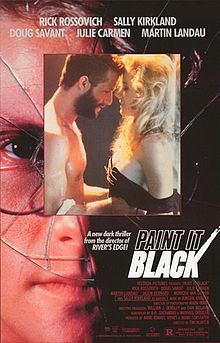 This month, since the site is currently reviewing every episode of Twin Peaks, each entry in Move A Day is going to have a Twin Peaks connection. Paint In Black was directed by Tim Hunter, who directed three episodes of Twin Peaks,

 Through the Shattered Lens