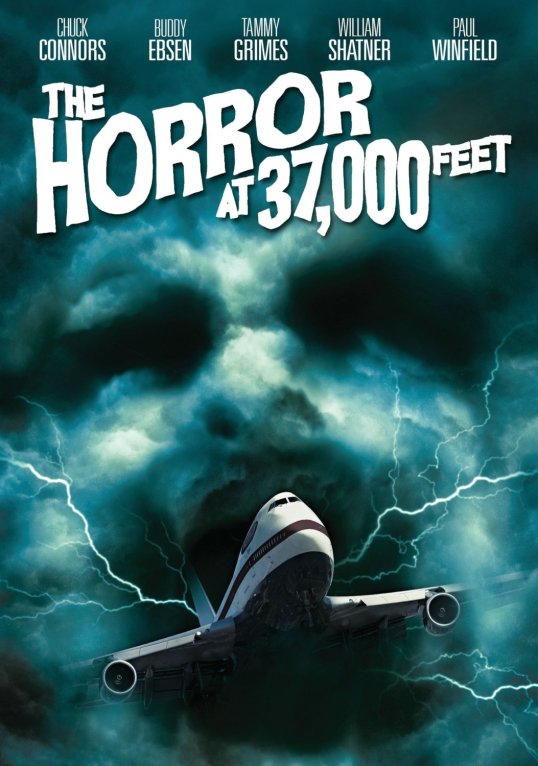
Guilty Pleasure #86: The Horror at 37,000 Feet (dir by David Lowell Rich)


I imagine that it should go without saying that, if you’re on an airplane and you’re flying high above the ground, the last thing that you want to deal with is a bunch of angry ghost druids.

And yet, that’s exactly what happens in this made-for-TV horror film from 1973.

The ghost druids are upset because two architects (played by Roy Thinnes and Jane Merrow) have traveled to England, specifically so that they can supervise the deconstruction of ancient druid altar. Now, they’re flying the pieces of the altar back over the ocean so that the altar can be reconstructed in the United States. The spirits of the ancient druids aren’t happy about being moved so they start doing everything they can to make the journey difficult.

First, they attempt to freeze the plane. When that doesn’t work, they decide to rip it in half. One of the passengers, Mrs. Pinder (Tammy Grimes), suggests that maybe the druids will settle down if they’re offered a sacrifice. When the druids reject an offer of a doll, the passengers start to wonder if maybe the spirits would be happier with a human sacrifice.

Although some of the passengers are reluctant to buy into the whole sacrifice thing, a few of them do start to come around. For instance, there’s a perpetually angry businessman who is played by Buddy Ebsen. Once he realizes that the druids aren’t going anywhere, he has no problem with the idea of a human sacrifice. There’s also a cowboy played by Will Hutchins. If sacrificing a human is what he has to do to have another chance to ride the range, that’s what he’s going to do. Paul Winfield plays a distinguished doctor who tries to keep everyone calm while Chuck Connors is stuck in the cockpit, trying to keep the plane in the air while his passengers and crew debate the ethics of human sacrifice.

And then there’s William Shatner.

Shatner plays a former priest who has lost his faith. From the minute he gets on the plane, he starts drinking and he doesn’t stop for almost the entire movie. It doesn’t matter what’s happening on the plane, Shatner always has a glass in his hand. Playing a character who never has anything positive to say, Shatner smirks through the entire film. Shatner delivers all of his lines in his standard halfting and overdramatic fashion and it’s something of a wonder to behold. Shatner has said that The Horror At 37,000 Feet may be the worst movie in which he ever appeared and just one look at his filmography will show why this is such a bold statement.

The Horror at 37,000 Feet is definitely a film of its time. The plane comes complete with a swinging cocktail lounge, William Shatner wears a turtle neck, and all of the flight attendants wear boots and miniskirts. Everything about this film screams 1973. It’s an incredibly silly but undeniably fun movie. With a running time of only 73 minutes, the pace is fast and the druids don’t waste any time getting down to business. The film’s on YouTube so check it out the next time you’ve an hour and 13 minutes to kill.

Previous Guilty Pleasures

  1. Half-Baked
  2. Save The Last Dance
  3. Every Rose Has Its Thorns
  4. The Jeremy Kyle Show
  5. Invasion USA
  6. The Golden Child
  7. Final Destination 2
  8. Paparazzi
  9. The Principal
  10. The Substitute
  11. Terror In The Family
  12. Pandorum
  13. Lambada
  14. Fear
  15. Cocktail
  16. Keep Off The Grass
  17. Girls, Girls, Girls
  18. Class
  19. Tart
  20. King Kong vs. Godzilla
  21. Hawk the Slayer
  22. Battle Beyond the Stars
  23. Meridian
  24. Walk of Shame
  25. From Justin To Kelly
  26. Project Greenlight
  27. Sex Decoy: Love Stings
  28. Swimfan
  29. On the Line
  30. Wolfen
  31. Hail Caesar!
  32. It’s So Cold In The D
  33. In the Mix
  34. Healed By Grace
  35. Valley of the Dolls
  36. The Legend of Billie Jean
  37. Death Wish
  38. Shipping Wars
  39. Ghost Whisperer
  40. Parking Wars
  41. The Dead Are After Me
  42. Harper’s Island
  43. The Resurrection of Gavin Stone
  44. Paranormal State
  45. Utopia
  46. Bar Rescue
  47. The Powers of Matthew Star
  48. Spiker
  49. Heavenly Bodies
  50. Maid in Manhattan
  51. Rage and Honor
  52. Saved By The Bell 3. 21 “No Hope With Dope”
  53. Happy Gilmore
  54. Solarbabies
  55. The Dawn of Correction
  56. Once You Understand
  57. The Voyeurs 
  58. Robot Jox
  59. Teen Wolf
  60. The Running Man
  61. Double Dragon
  62. Backtrack
  63. Julie and Jack
  64. Karate Warrior
  65. Invaders From Mars
  66. Cloverfield
  67. Aerobicide 
  68. Blood Harvest
  69. Shocking Dark
  70. Face The Truth
  71. Submerged
  72. The Canyons
  73. Days of Thunder
  74. Van Helsing
  75. The Night Comes for Us
  76. Code of Silence
  77. Captain Ron
  78. Armageddon
  79. Kate’s Secret
  80. Point Break
  81. The Replacements
  82. The Shadow
  83. Meteor
  84. Last Action Hero
  85. Attack of the Killer Tomatoes

Late Night Retro Television Reviews: Monsters 1.8 “Sleeping Dragons”


Welcome to Late Night Retro Television Reviews, a feature where we review some of our favorite and least favorite shows of the past! On Wednesdays, I will be reviewing Monsters, which aired in syndication from 1988 to 1991. The entire show is streaming on Tubi.

This week, the lizard are leaping!

Episode 1.8 “Sleeping Dragon”

(Dir by Mark Rezyka, originally aired on December 10th, 1988)

Outside of Reno, Nevada, a stone capsule is found.  Professor Merrick (Kin Shriner) believes that the capsule is from the prehistoric era and that it might prove his theory that there was a highly-developed society on Earth before the rise of human beings.  Merrick brings the capsule to a lab that is located high in the mountains.

While a snow storm rages outside, Merrick and his colleagues, Jeffrey (Russell Johnson) and Jeffrey’s daughter Lisa (Beth Toussaint), examine the capsule.  Jeffrey is skeptical of Merrick’s theories while Lisa thinks that the rock could actually be some sort of time capsule that was buried centuries ago.  When the three of them leave the lab to get a Geiger counter and some more tools to try to pry the capsule open, a humanoid lizard (Wayne Toth) emerges from the stone.

The Lizard is not a friendly visitor and soon, he’s attacking anyone foolish enough to get close to him.  The surviving humans know that he have to find a way to stop the lizard but how do you stop something that you can’t understand?  With the blizzard raging outside, no one is leaving the lab until the battle between lizard and human is resolved.

This episode of Monsters had potential but it suffered because of its short runtime.  If the episode had a bit more time to emphasis the claustrophobia of the lab and to also allow a bit more suspense as the Lizard tracked down the scientists, it would have been far more effective.  As it is, the whole thing felt a bit rushed.

There are two things that I did like about this episode.

First off, it’s a huge plot point that the lab’s phone is dead, which means that the scientists can’t call for help.  The scientists assume that the phone is dead either because of the blizzard or because of the Lizard but, in reality, the phone isn’t dead at all.  It’s just that Lisa, while stumbling around the office, accidentally unplugged the phone and no one noticed until they actually tried to make a call.  That felt like a realistic mistake that one might make while under pressure and it also encouraged the viewer to question whether or not the humans were actually smart enough to survive their lizard encounter.

The second thing that worked about this episode is that lizard man really was frightening.  It helped that he stayed in the shadows for most of the episode and, when he did appeared, he moved quickly enough that you really didn’t notice that he was essentially a guy in a rubber suit.  He was an effective monster and, in the end, that’s what really matters when it comes to a show like this.

Next week, we’ve got another vampire story!

Horror on the Lens: Attack of the Crab Monsters (dir by Roger Corman)


For today’s horror on the lens, we have the 1957 science fiction film, Attack of the Crab Monsters!

About a month ago, I watched this film along with Patrick Smith and all of our friends in the late night movie gang.   To be honest, everyone else seemed to enjoy it a lot more than I did.  It was a fun little movie but … well, maybe I was just having a bad night.

Here’s why you should take 62 minutes out of your Saturday and watch Attack of the Crab Monsters on the Shattered Lens.  First off, it’s a Roger Corman film and anything directed by Roger Corman automatically needs to be watched.  Secondly, it’s about giant crabs that communicate through telepathy.  And when was the last time you saw that!?

(“Last night,” someone in the audience shouts, “as the sun went down over the crab-covered beaches of Denmark!”  I pretend not to hear.)

Anyway!  Here, for your viewing pleasure, is Attack of the Crab Monsters!

Film Review: The Greatest Story Ever Told (dir by George Stevens)


The 1965 biblical epic, The Greatest Story Ever Told, tells the story of the life of Jesus, from the Nativity to the Ascension.  It’s probably the most complete telling of the story that you’ll ever find.  It’s hard to think of a single details that’s left out and, as a result, the film has a four hour running time.  Whether you’re a believer or not, that’s a really long time to watch a reverent film that doesn’t even feature the campy excesses of something like The Ten Commandments.

(There’s actually several different version of The Greatest Story Ever Told floating around.  There’s a version that’s a little over two hours.  There’s a version that’s close to four hours.  Reportedly, the uncut version of the film ran for four hour and 20 minutes.)

Max von Sydow plays Jesus.  On the one hand, that seems like that should work because Max von Sydow was a great actor who gave off an otherworldly air.  On the other hand, it totally doesn’t work because von Sydow gives an oddly detached performance.  The Greatest Story Ever Told was von Sydow’s first American film and, at no point, does he seem particularly happy about being involved with it.  von Sydow is a very cerebral and rather reserved Jesus, one who makes his points without a hint of passion or charisma.  When he’s being friendly, he offers up a half-smile.  When he has to rebuke his disciples for their doubt, he sounds more annoyed than anything else.  He’s Jesus if Jesus was a community college philosophy professor.

The rest of the huge cast is populated with familiar faces.  The Greatest Story Ever Told takes the all-star approach to heart and, as a result, even the minor roles are played by actors who will be familiar to anyone who has spent more than a few hours watching TCM.  Many of them are on screen for only a few seconds, which makes their presence all the more distracting.  Sidney Poitier shows up as Simon of Cyrene.  Pat Boone is an angel.  Roddy McDowall is Matthew and Sal Mineo is Uriah and John Wayne shows up as a centurion and delivers his one line in his trademark drawl.

A few of the actors do manage to stand out and make a good impression.  Telly Savalas is a credible Pilate, playing him as being neither smug nor overly sympathetic but instead as a bureaucrat who can’t understand why he’s being forced to deal with all of this.  Charlton Heston has just the right intensity for the role of John the Baptist while Jose Ferrer is properly sleazy as Herod.  In the role Judas, David McCallum looks at the world through suspicious eyes and does little to disguise his irritation with the rest of the world.  The Greatest Story Ever Told does not sentimentalize Judas or his role in Jesus’s arrest.  For the most part, he’s just a jerk.  Finally, it’s not exactly surprising when Donald Pleasence shows up as Satan but Pleasence still gives a properly evil performance, giving all of his lines a mocking and often sarcastic bite.

The Greatest Story Ever Told was directed by George Stevens, a legitimately great director who struggles to maintain any sort of narrative momentum in this film.  Watching The Greatest Story Ever Told, it occurred to me that the best biblical films are the ones like Ben-Hur and The Robe, which both largely keep Jesus off-screen and instead focus on how his life and teachings and the reports of his resurrection effected other people.  Stevens approaches the film’s subject with such reverence that the film becomes boring and that’s something that should never happen when you’re making a film set in Judea during the Roman era.

I do have to admit that, despite all of my criticism of the film, I do actually kind of like The Greatest Story Ever Told.  It’s just such a big production that it’s hard not to be a little awed by it all.  That huge cast may be distracting but it’s still a little bit fun to sit there and go, “There’s Shelley Winters!  There’s John Wayne!  There’s Robert Blake and Martin Landau!”  That said, as far as biblical films are concerned, you’re still better off sticking with Jesus Christ Superstar.

30 Days of Noir #17: Loan Shark (dir by Seymour Friedman)


The 1952 film, Loan Shark, opens with a familiar film noir situation.

A man walks down a dark city street.  Judging from the way that the man keeps looking over his shoulder, he’s obviously nervous about something.  Suddenly, we hear two sets of footsteps approaching him and it quickly becomes apparent that the man has good reason to be so nervous.  The man is being pursued by two gangsters.  (We know that they’re gangsters because of the suits and the fedoras.)  The gangsters toss the man in an alley and proceed to beat the Hell out of him.

The local tire factory has a problem.  Though its employees are highly valued, they’re not highly paid.  In order to make ends meet, many of them have resorted to gambling.  Plant foreman Charlie Thompson (Russell Johnson) always seems to have the latest tip on a sure thing.  Interestingly enough, the tips never seem to pan out and, as a result, the workers are forced to go to the local loan shark, Lou Donelli (Paul Stewart).  Lou always loans them the money but he charges exorbitant interest and, when the workers can’t pay back the loans, he sends his thugs to beat them up.  The factory’s management knows that they have to do something to take this loan shark out of commission.

Now, what would you do if you were a part of management?  Would you go to the police and maybe see if they could arrange to put a trained undercover cop in your factory?  Or would you hire an ex-con and tell him to just take care of it on his own?

The ex-con in question is Joe Gargen (George Raft).  He’s just been released from prison, though the film is quick to point out that Joe didn’t really do anything that bad.  He just hit a guy who was being obnoxious.  The guy fell back and hit his head and, as a result, Joe was charged with assault with a deadly weapon.  (As Joe explains it, he’s a former boxer and, as a result, his fists are legally considered to be deadly weapons.)  When Joe is first offered the clandestine job at the tire factory, he turns it down.  As he explains it, he’s not looking to get in any more trouble with anyone.  But then when the loan sharks kill his brother-in-law, Joe reconsiders.

Soon, Joe is working at the tire plant.  (If you’ve ever wanted to see, in meticulous detail, how a tire is made, this is the film to watch.)  After Charlie gives him a bad tip on a horse, Joe finds himself in debt to Donelli.  However, when Joe manages to beat up the thugs that Donelli sends to collect, Joe finds himself with another job offer.  Soon, Joe is working for the loan sharks!  Because he can’t reveal that he’s undercover, everyone — from the administrative assistant (Dorothy Hunt) who he once took dancing to his own sister (Helen Westcott) — is disgusted by Joe’s actions.  Joe finds himself a pariah but he’s still determined to discover the identity of Donelli’s boss.

With it’s combination of the mob and exploited blue collar workers (not to mention it’s use of an ex-boxer as its protagonist), Loan Shark lightly treads on the ground that would later be covered, in a far more exacting manner, by On The Waterfront.  Unfortunately, Loan Shark suffers a bit from the miscasting of George Raft in the lead role.  Raft was a charismatic actor but, when he made Loan Shark, he was 51 and looked about 9 years older.  When Raft shares what is meant to be a romantic dance with Dorothy Hart, he looks more like a proud father dancing with his daughter at a wedding reception than anything else.  Loan Shark is one of those films that calls out for a younger actor, a William Holden or maybe a John Garfield.  That said, Raft was a genuine tough guy and, despite his advanced age, he still looked like he could go a few rounds.

That said, Loan Shark is a tough and shadow-filled film, one that features some genuinely exciting fight scenes.  Miscast or not, when George Raft throws a punch, you believe it.

Film Review: This Island Earth (dir by Joseph M. Newman and Jack Arnold)


Oh, those poor aliens!

Ever since the 1950s, intergalactic diplomats, soldiers, and explorers have come to Earth looking for help.  Some of them have come from planets that orbit dying stars.  Some represent civilizations that have been destroyed by war or pollution.  Some of them have come here looking to inspire us to be more peaceful and less destructive.  Others were just looking for something to eat.

What they all have in common is that they all came to Earth and things really didn’t work out that well.  Occasionally, they ran into humans who, due to cynicism and skepticism, simply weren’t willing to help.  Often, the aliens arrived just to discover that the humans had no interest in being conquered.  Remember what Eros yelled at the Plan 9 From Outer Space?  “Your stupid, stupid minds!”  Oh yeah?  Well, our menfolk kicked your ass and blew up your flying saucer.  So there.

Consider the sad case of Exeter (Jeff Morrow), the alien at the center of 1955’s This Island Earth.  Exeter has come to Earth with his associates and disguised himself as a human.  Despite the fact that they all have remarkably high foreheads and a total inability to relate to actual humans, no one seems to suspect that Exeter and his friends are from outer space.  Even when he starts recruiting leading scientists to come hang out at his isolated headquarters, it doesn’t seem to occur to anyone that they should be too concerned.  Exeter’s just a little bit weird.  Why worry?

Well, Dr. Carl Meacham (Rex Reason) is worried!  He’s a pilot and a scientist and he’s got a square jaw and one of those deep, 1950s American male voices.  Everything that Dr. Meacham says sounds authoritative.  When you hear that confident, take-no-prisoners voice, you have no doubt that Eisenhower’s in the White House and everything’s going to be alright.  Carl doesn’t trust Exeter and he suspicions are proven correct when he and Dr. Ruth Adams (Faith Domergue) are taken to Exeter’s war-ravaged planet.  Not only is the planet on the verge of blowing up but the whole place is crawling with mutants!

Unfortunately, it takes a while for Carl, Ruth, and Exeter to reach the planet.  This Island Earth is an oddly structured film.  The first third of the film deals with Carl and his squirmy associate, Joe (Robert Nichols), building something called an interocitor.  Once Carl has shown that he can follow the alien instruction booklet, Carl is allowed to meet Exeter.  (For some reason Joe is left behind.)  Once Carl arrives at Exeter HQ, it’s another lengthy wait before he, Ruth, and Exeter are launched into space.

Still, on the plus side, one of the scientists gets to drive this really cool car:

(Unfortunately, the car doesn’t make it to the end of the movie.)

The movie gets a lot better once the action moves to Exeter’s home planet.  The planet was a gloriously realized world, a pop art masterpiece:

And then there were the mutants!  Look at this thing:

Anyway, despite the slow start, This Island Earth is a classic of 1950s science fiction, one that manages to maintain a perfect balance between the sublime and the ludicrous.  Rex Reason and Faith Domergue are inoffensively bland as Carl and Ruth but Jeff Morrow brings a weary and even tragic dignity to the role of Exeter.  If nothing else, it lives up to its title by suggesting that Earth actually is just one insignificant island in the vast ocean of the universe and that both humans and aliens are mere slaves to fate.  For all of his deep-voiced authority, Carl really doesn’t accomplish much over the course of the film.  By that same token, for all of his efforts and his integrity, there’s little that Exeter can do to alter the destiny of his planet.  At times, This Island Earth is almost existential in its portrayal of both human and extraterrestrial inability to alter the whims of fate.  Of course, it’s also a frequently silly film that will be a lot of fun for anyone who appreciates a good B-movie.

On Saturday night, I watched This Island Earth with my friends in the Late Night Movie Gang.  After last week’s experience with Disco Beaver From Outer Space, I decided to play it safe this week.  We had a lot of fun with This Island Earth.  In case you want to learn how to make an interocitor of your very own, the film is available on YouTube.

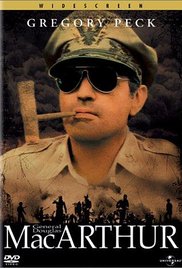
A Movie A Day #326: MacArthur (1977, directed by Joseph Sargent)


The year is 1962 and Douglas MacArthur (Gregory Peck), the legendary general, visits West Point for one last time.  While he meets the graduates and gives his final speech, flashbacks show highlights from MacArthur’s long military career.  He leaves and then returns to Philippines.  He accepts the Japanese surrender and then helps Japan rebuild and recover from the devastation of the war.  He half-heartedly pursues the Presidency and, during the Korean War, gets fired by Harry Truman (Ed Flanders).

MacArthur is a stolid biopic about one America’s most famous and controversial generals.  It was produced by Frank McCarthy, a former general who knew MacArthur and who previously won an Oscar for producing Patton.  McCarthy was obviously hoping that MacArthur was do its subject what Patton did for George Patton and both films follow the same basic pattern. a warts-and-all portrait of a World War II general with all of the action centered around the performance of a bigger-than-life actor in the title role.  Though obviously made for a low budget, MacArthur is a well-made and well-acted movie but it suffers because Douglas MacArthur was just not as interesting a figure as George Patton.  Gregory Peck does a good job subtly suggesting MacArthur’s vanity along with capturing his commitment to his duty but he never gets a scene that’s comparable to George C. Scott’s opening speech in Patton.  The main problem with MacArthur, especially when compared to Patton, is that George Patton was a born warrior while Douglas MacArthur was a born administrator and it is always going to be more exciting to watch a general lead his men into battle then to watch him sign executive orders.

Horror on the Lens: Attack of the Crab Monsters (dir by Roger Corman)


For today’s horror on the lens, we have the 1957 science fiction film, Attack of the Crab Monsters!

About a month ago, I watched this film along with Patrick Smith and all of our friends in the late night movie gang.   To be honest, everyone else seemed to enjoy it a lot more than I did.  It was a fun little movie but … well, maybe I was just having a bad night.

Here’s why you should take 62 minutes out of your Saturday and watch Attack of the Crab Monsters on the Shattered Lens.  First off, it’s a Roger Corman film and anything directed by Roger Corman automatically needs to be watched.  Secondly, it’s about giant crabs that communicate through telepathy.  And when was the last time you saw that!?

(“Last night,” someone in the audience shouts, “as the sun went down over the crab-covered beaches of Denmark!”  I pretend not to hear.)

Anyway!  Here, for your viewing pleasure, is Attack of the Crab Monsters!