The TSL Horror Grindhouse: Messiah of Evil (dir by Gloria Katz and Willard Huyck)


I can still remember the first time that I saw the 1973 film, Messiah of Evil.

It was on a Monday night, many years ago. I had recently picked up a 10-movie DVD box set called Tales of Terror and I was using the movies inside to try to deal with a bout of insomnia. I had already watched The Hatchet Murders (a.k,a. Deep Red) and The House At The Edge of the Park and, at two in the morning, I was faced with a decision. Should I try to sleep or should I watch one more movie?

Naturally, I chose to watch one more movie and the movie I picked was Messiah of Evil. So, there I was at two in the morning, sitting at the edge of my bed in my underwear and watching an obscure horror movie while rain fell outside.

And, seriously — this movie totally FREAKED me out!

Messiah of Evil opens with a man (played by future director Walter Hill) stumbling through the night, obviously trying to escape from something.  A mysterious woman appears and kills him.  We’re left to wonder who the man was supposed to be as the film doesn’t ever really return to his murder.  In most films this would be a weakness but it feels appropriate for Messiah of Evil, a film that plays out with the visual style and fragmented logic of a particularly intense nightmare.

The rest of the story tells the story of Arletty (Marianna Hill), a neurotic woman who drives to an isolated California town in order to visit her father. Her father is an artist who specializes in painting eerie pictures of large groups of black-clad people. However, once she arrives at his home, Arletty discovers that her father has vanished and left behind a diary where he claims that a darkness has overtaken the town.  Meanwhile, it sometimes appear as if the people in the paintings are moving or threatening to come out of the walls.

Meanwhile, one crazed man (Elisha Cook, Jr.) explains that “the dark stranger” is returning.  An albino (Bennie Robinson) drives a truck up and down the street and talks about how he likes to listen to “Wagner.”  The back of the truck is full of blank-faced people staring at the sky and the Albino eats a rat.  Finally, a mysterious man named Thom (Michael Greer) is wandering about town with two groupies (played by Anitaa Ford and Joy Bang) and interviewing random townspeople.  After meeting Arletty, they all end up moving into her father’s house.

Messiah of Evil is literally one of the strangest films that I’ve ever seen. It’s shot in a dream-like fashion and the much of the film is left open to the viewer’s interpretation.  Joy Bang goes to see a Sammy Davis, Jr. western and doesn’t notice as the theater slowly fills up with pale, red-eyed townspeople.  Anitra Ford goes to a grocery store late at night and discovers the townspeople indulging in their appetites.  If the film was only distinguished by those two scenes, it would still be worth saying.  However, Messiah of Evil is a total and complete experience, a film where every scene matters and the audience is tasked with putting the puzzle together.

This film was directed by Gloria Katz and Willard Huyck, two longtime associates of George Lucas.  (They wrote the screenplay for American Graffiti and Huyck directed Howard The Duck.)  There’s absolutely nothing else in their filmography that is as surreal as Messiah of Evil, leading me to suspect that the film itself might be a very fortunate accident.  Apparently, the production ran out of money before Katz and Huyck finished principal photography, which is what led to the film’s disjointed nature.  Accident or not, Messiah of Evil is a masterpiece of surreal horror.
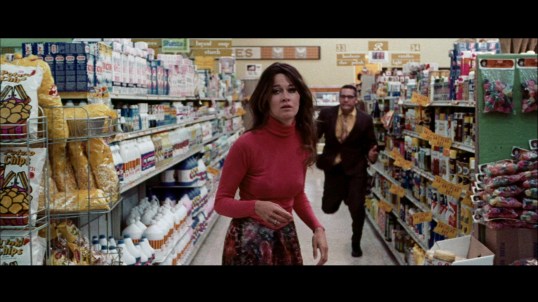
Messiah of Evil (1973, directed by Willard Huyck and Gloria Katz)
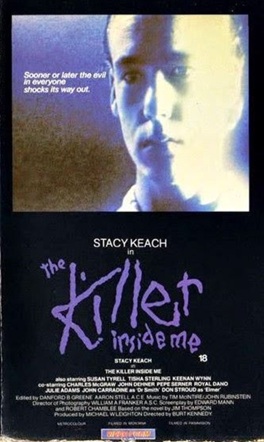
The Killer Inside Me (1976, directed by Burt Kennedy)


Today is Stacy Keach’s 84th birthday.

Stacy Keach has always been an underappreciated actor.  Despite his obvious talent and his ability to play both heroes and villains, he’s never really gotten the film roles that he’s deserved and he’s mostly made his mark on stage and on television.  There have been a few good films that made use of Keach’s talents.  I’ve always appreciated his performance as Frank James in Walter Hill’s The Long Riders.  He was a morally ambiguous Doc Holliday in Doc.  He played a boxer in John Huston’s Fat City.  Horror fans will always remember him for Road Games. The Ninth Configuration featured a rare starring role for Keach but it was treated poorly by its studio.  He was chilling as a white supremacist in American History X.  For the most part, though, Keach’s film career has been made up of stuff like Class of 1999.  For all of his talent, he seems destined to be remembered mostly for playing Mike Hammer in a television series and a few made-for-TV movies.  It’s too bad because Keach had the talent to bring certain character to life in a way that few other actors can.

The Killer Inside Me features one of Keach’s best performances.  Based on a pulp novel by Jim Thompson, The Killer Inside Me stars Stacy Keach as Lou Ford.  Lou is a small town deputy.  Everyone thinks that he’s a good, decent man.  He’s dating the local school teacher (Tisha Sterling).  The sheriff (John Dehner) trusts him.  Lou seems to be an expert at settling conflicts between neighbors.  What everyone doesn’t know is that Lou is actually a psycho killer who is having a sado-masochistic affair with a local prostitute (Susan Tyrrell) and who has zero qualms about punching the life out of someone.  When Lou finds out that Tyrrell is also involved with the son of a local businessman, it sets Lou on a crime and killing spree.  Lou thinks he’s a genius but his main strength is that no one can imagine Lou Ford doing the terrible things that he does.

Burt Kennedy was an outstanding director of westerns and straight-forward action movies but he appears to have struggled with The Killer Inside Me’s morally ambiguous tone.  The end result is not a great film but it does feature a great performance from Stacy Keach.  In both his performance and his narration, Keach captures both the arrogance and the detachment from normal society that defines Lou Ford’s character.  He also shows how Ford coolly manipulates the people around him.  Keach is believable and compelling whether he’s playing the fool or if he’s committing cold-blooded murder and he also subtly shows that Lou is not as smart as he thinks he is.  Though Keach dominates the film, The Killer Inside Me also features good performances from a gallery of 70s character actors, including John Carradine, Keenan Wynn, Don Stroud, Charles McGraw, and Royal Dano.

This version of The Killer Inside Me didn’t do much at the box office.  The movie was remade in 2010, with Casey Affleck miscast as Lou Ford.  That version didn’t do much at the box office either.  The secret to recreating the book’s mix of social satire and pulp action has proven elusive to filmmakers but at least we’ve got Stacy Keach’s performance as Lou Ford to appreciate.

Film Review: The Outlaw Josey Wales (dir by Clint Eastwood)


Towards the end of 1976’s The Outlaw Josey Wales, Josey (played by Clint Eastwood) says, “I guess we all died a little in that damned war.”

He’s referring to the American Civil War and the film leaves you with no doubt that Wales knew what he was talking about.  A farmer living in Missouri, Josey Wales wasn’t involved in the Civil War until a group of guerillas, the Redlegs, raided his home and killed his family.  Seeking vengeance, Wales joined the Bushwackers, a group of Confederate guerillas that were led by the infamous “Bloody Bill” Anderson.  After Anderson’s death and the South’s surrender, Senator James H. Lane (Frank Schofield) offers amnesty to any of the Bushwackers willing to surrender and declare their loyalty to the United States.  Fletcher (John Vernon), the leader of the surviving Bushwackers, thinks it’s a good idea and his men eventually agree to surrender.

Everyone except for Josey Wales.

Fletcher tells Josey that he’ll be an outlaw and that Lane will send his men to capture and execute him.  “I reckon so,” Josey Wales replies.  It’s not that Josey was particularly a fan of the Confederate cause.  Instead, having lost his family and his home and having seen hundreds of men killed, Josey no longer cares.  He’s got a death wish, something that becomes apparent when he later sneaks over to Lane’s camp and discovers that the leader of the Redlegs, Terrill (Bill McKinney), has been made a captain in the Union Army.  The surrendering Bushwackers, with the exception of Fletcher and a young man named Jamie (Sam Bottoms), are gunned down as they swear allegiance to the United States.  Joey springs into action, hijacking a Gatling gun and mowing down soldiers.  It’s a suicidal move and Josey appears to be willing to die, until he sees that Jamie has been wounded.  Josey and Jamie go on the run, pursued by soldiers and bounty hunters.

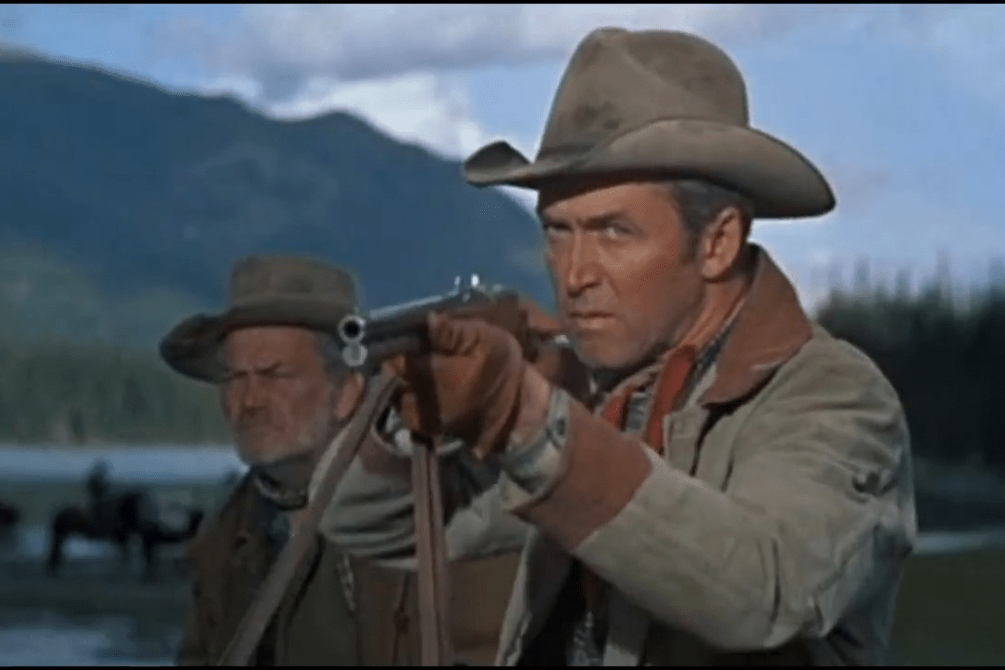
It sounds like the start of typical Clint Eastwood film and, make no mistake about it, The Outlaw Josey Wales features everything that most people have come to expect from Eastwood.  Josey Wales is an expert shot, often firing two guns while charging forward on his horse.  Josey has a way of words, explaining the purpose of getting “plain man dog mean” and telling a bounty hunter that there are better ways to make a living.  The main difference, though, is that Josey is no longer seeking revenge.  He’s lost his family and his home and he knows nothing is going to bring them back.  He sought revenge during the Civil War and saw so many people killed that, much like Jimmy Stewart in Broken Arrow, he just wants to disappear from civilization.

The problem is that men like Lane and Terrill have no intention of letting Josey Wales disappear.  The sociopathic Terrill sees it as almost being his God-given duty to kill Josey Wales and anyone else that he dislikes.  The bounty hunters are also after Josey Wales.  As Fletcher explains it, bounty hunting is the only way that many former soldiers can make money and feed their families.  As Josey moves through the southwest, his legend grows.  Every town that Josey stops in, he hears stories about the growing number of men that he has supposedly killed.

Josey also discovers that he can’t do it all alone.  He soon finds himself as a part of a new family, a collection of misfits that don’t have a home in Senator Lane’s America.  Lone Waite (Chief Dan George) is an elderly Cherokee man who suggests that Josey head for Mexico.  Little Moonlight (Geraldine Keams) is a Navajo woman who Josey rescues from two bounty hunters.  Sarah Turner (Paula Trueman) and her granddaughter, Laura Lee (Sondra Locke), are rescued from Comancheros.  Josey negotiates the release of two of Sarah’s ranch hands and befriends Chief Ten Bears (Will Sampson) while doing so.  Slowly, Josey comes out of his shell and starts to embrace life once again.  Josey goes from searching for death to searching for peace.

It’s one of Eastwood’s best films, ending on a note of not violence but instead sad regret.  It’s not only a portrait of a man learning to embrace life but it’s also a portrait of a country trying to figure out how to come back together after the bloody savagery of the Civil War.  Some, like Fletcher and Josey, want to move on.  Others, like Terrill, don’t have an identity beyond fighting and killing.  Eastwood gives a good performance but, as a director, he gives every member of the cast a chance to shine.  If you only know John Vernon as Dean Wormer from Animal House, his sad-eyed performance here will be a revelation.

Originally, The Outlaw Josey Wales was meant to be directed by Phillip L. Kaufman but Eastwood felt that Kaufman was taking too long to set up his shots and worrying about details that really didn’t matter.  Reportedly, while Kaufman was away from the set, spending hours searching for a historically-correct beer bottle to be used in a bar scene, Eastwood directed the scene himself and then convinced producer Robert Daley to fire Kaufman and allow Eastwood to direct the film.  (Kaufman also objected to the script’s anti-government subtext but seriously, that’s pretty much the subtext of every film that Eastwood has ever been involved with.)  The DGA later instituted a rule that, on productions in which the director was fired,  the replacement could not be a member of his crew or an actor in the cast but that was too late to help out Kaufman.

(Rumor has it that another reason Kaufman was fired was because he and Eastwood both “liked” Sondra Locke.  This was the first of six films that Eastwood and Locke would do together.)

To be honest, I think it worked out in the film’s favor.  It’s a little surprising that someone other than Eastwood was ever considered as director to be begin with, so perfectly does the story and the lead character fit with Eastwood’s persona.  Eastwood captures both the beauty of the untouched land and also the bloody violence of combat.  In many ways, this film almost feels like a prequel to UnforgivenThe Outlaw Josey Wales is Eastwood at his best.

THE FAR COUNTRY (1954) – James Stewart and Walter Brennan head North to make their fortune!


James Stewart is one of the great movie stars of all-time. His work with Frank Capra (MR. SMITH GOES TO WASHINGTON, IT’S A WONDERFUL LIFE) and Alfred Hitchcock (REAR WINDOW, VERTIGO) is legendary. In my household, Stewart’s work with director Anthony Mann is celebrated just as much as those other classics. Mann and Stewart made five classic westerns, beginning with WINCHESTER ‘73 in 1950 and ending in 1955 with THE MAN FROM LARAMIE. I own them all on DVD and watch them quite often. It’s very cold in Arkansas today, so I decided to write about the Yukon-set THE FAR COUNTRY, from 1954. 

Jeff Webster (James Stewart) and his crusty ol’ coot of a partner Ben Tatem (Walter Brennan) head North towards Dawson City, in the Yukon Territory, with a herd of cattle. The two men encounter a variety of problems along the way, with the biggest being the corrupt Judge Gannon (John McIntire) of Skagway, Alaska. When Jeff finds himself in front of the judge for killing two cowhands who tried to steal his herd, Gannon acquits him on the charges but decides to keep his herd as payment for the court fees. With their cattle taken away from them, Jeff and Ben sign up to help business lady Ronda Castle (Ruth Roman) take supplies to Dawson City, where she plans to set up shop. After their first day on the trip, Jeff and Ben double back to Skagway and re-take their herd and take off towards Dawson as fast as they can go, with Gannon and his men in hot pursuit. They’re able to make it into Canada, so Gannon and his goons turn back, determined to hang the men if they ever come back through Skagway.

So Jeff and Ben make it to Dawson City with their cattle where they sell them off for $2 per pound to Ronda. Suddenly flush with cash, the two partners buy a gold claim and proceed to find some nice golden nuggets! When they head back into town, they find that Judge Gannon has now come to Dawson City and is in partnership with Ronda. Of course, that bastard immediately starts cheating the miners out of their claims, this time with gunman Madden (Robert J. Wilke) by his side, enforcing his corrupt actions with lead. Jeff and Ben decide they’re going to sneak out of town with their loot, but Gannon finds out about it and sends his men to stop them. Ben is killed in the process and Jeff is seriously injured. Jeff has tried his best up to this point to not get involved with the mess in Dawson City, but with his best friend now dead, he decides it’s time for Judge Gannon and his thugs to be stopped. 

James Stewart is just so good as Jeff Webster. The best thing about his work with Mann is how each of the movies would give him a meaty role that capitalized on his basic decency, while simultaneously making him a more complex, layered man, miles away from the likes of Mr. Smith or George Bailey. In THE FAR COUNTRY, he’s as tough as nails, but he really doesn’t want to get involved with the people around him. It takes the death of his best friend for him to finally commit to helping them stand up against the bad guys. Stewart’s work here, and in the other Mann westerns, ranks with his very best. 

The remainder of the cast is uniformly excellent. Three time Oscar winner Walter Brennan is always a welcome presence in a movie I’m watching. While he’d pretty much settled into the “old coot” role that would come to personify the later part of his career, his character is a valuable conscience for Stewart a couple of times in the story. I thought that John McIntire and Ruth Roman really stood out in their respective roles as the corrupt Judge Gannon and the stubbornly, independent businesswoman Ronda Castle. Both give excellent performances. The cast is rounded out with a who’s who of character actors like Jay C. Flippen, Harry Morgan, Robert J. Wilke, Royal Dano, and Jack Elam. It’s always nice seeing these familiar faces pop up in these old westerns.

I love it when movies are filmed on location in beautiful places. THE FAR COUNTRY was filmed at the Jasper National Park in Alberta, Canada, which added another interesting element to the film. The final thing I want to say about the film is that the screenplay for THE FAR COUNTRY was written by Borden Chase, who had penned RED RIVER a few years earlier. Not only would Chase write this movie, he would also write the screenplays for WINCHESTER ‘73 and BEND OF THE RIVER, both westerns that paired Anthony Mann and Jimmy Stewart. Chase was an excellent writer of western material, and his strong work in this group of films is crucial to their enduring success. 

Overall, I confidently recommend THE FAR COUNTRY to any person who enjoys westerns or Jimmy Stewart. I might rank THE NAKED SPUR and THE MAN FROM LARAMIE slightly above this one in the Mann / Stewart westerns, but the truth is that you can’t go wrong with any of them. 

I’m sharing the trailer for THE FAR COUNTRY below:

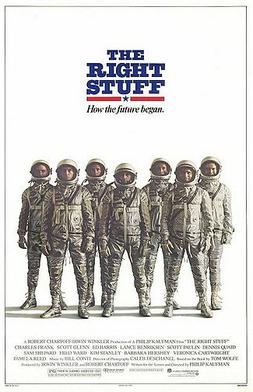
Lisa Marie Reviews An Oscar Nominee: The Right Stuff (dir by Philip Kaufman)


There’s a brilliant scene that occurs towards the end of 1983’s The Right Stuff.

It takes place in 1963.  The original Mercury astronauts, who have become a symbol of American ingenuity and optimism, are being cheered at a rally in Houston.  Vice President Lyndon Johnson (Donald Moffat) stands on a stage and brags about having brought the astronauts to his supporters.  One-by-one, the astronauts and their wives wave to the cheering crowd.  They’re all there: John Glenn (Ed Harris), Gus Grissom (Fred Ward), Alan Shephard (Scott Glenn), Wally Schirra (Lance Henrisken), Deke Slayton (Scott Paulin), Scott Carpenter (Charles Frank), and the always-smiling Gordon Cooper (Dennis Quaid).  The astronauts all look good and they know how to play to the crowd.  They were chosen to be and sold as heroes and all of them have delivered.

While the astronauts are celebrated, Chuck Yeager (Sam Shepard) is at Edwards Air Force Base.  Yeager is the pilot who broke the sound barrier and proved that the mythical “demon in the sky,” which was whispered about by pilots as a warning about taking unnecessary risks, was not waiting to destroy every pilot who tried to go too fast or too high.  Yeager is considered by many, including Gordon Cooper, to be the best pilot in America.  But, because Yeager didn’t have the right image and he had an independent streak, he was not ever considered to become a part of America’s young space program.  Yeager, who usually holds his emotions in check, gets in a jet and flies it straight up into the sky, taking the jet to the edge of space.  For a few briefs seconds, the blue sky becomes transparent and we can see the stars and the darkness behind the Earth’s atmosphere.  At that very moment, Yeager is at the barrier between reality and imagination, the past and the future, the planet and the universe.  And watching the film, the viewer is tempted to think that Yeager might actually make it into space finally.  It doesn’t happen, of course.  Yeager pushes the jet too far.  He manages to eject before his plane crashes.  He walks away from the cash with the stubborn strut of a western hero.  His expression remains stoic but we know he’s proven something to himself.  At that moment, the Mercury Astronauts might be the face of America but Yeager is the soul.  Both the astronauts and Yeager play an important role in taking America into space.  While the astronauts have learned how to take care of each other, even the face of government bureaucracy and a media that, initially, was eager to mock them and the idea of a man ever escaping the Earth’s atmosphere,  Chuck Yeager reminds us that America’s greatest strength has always been its independence.

Philip Kaufman’s film about the early days of the space program is full of moments like that.  The Right Stuff is a big film.  It’s a long film.  It’s a chaotic film, one that frequently switches tone from being a modern western to a media satire to reverent recreation of history.  Moments of high drama are mixed with often broad humor.  Much like Tom Wolfe’s book, on which Kaufman’s film is based, the sprawling story is often critical of the government and the press but it celebrates the people who set speed records and who first went into space.  The film opens with Yeager, proving that a man can break the sound barrier.  It goes on to the early days of NASA, ending with the final member of the Mercury Seven going into space.  In between, the film offers a portrait of America on the verge of the space age.  We watch as John Glenn goes from being a clean-cut and eager to please to standing up to both the press and LBJ.  Even later, Glenn sees fireflies in space while an aborigines in Australia performs a ceremony for his safety.  We watch as Gus Grissom barely survives a serious accident and is only rescued from drowning after this capsule has been secured.  The astronauts go from being ridiculed to celebrated and eventually respected, even by Chuck Yeager.

It’s a big film with a huge cast.  Along with Sam Shepherd and the actors who play the Mercury Seven, Barbara Hershey, Pamela Reed, Jeff Goldblum, Harry Shearer, Royal Dano, Kim Stanley, Scott Wilson, and William Russ show up in roles both small and large.  It can sometimes be a bit of an overwhelming film but it’s one that leaves you feeling proud of the pioneering pilots and the brave astronauts and it leaves you thinking about the wonder of the universe that surrounds our Earth.  It’s a strong tribute to the American spirit, the so-called right stuff of the title.

The Right Stuff was nominated for Best Picture but, in the end, it lost to a far more lowkey film, 1983’s Terms of Endearment.  Sam Shepard was nominated for Best Supporting Actor but lost to Jack Nicholson.  Nicolson played an astronaut.

Retro Television Review: Fantasy Island 5.16 “The Challenge/A Genie Named Joe”


Welcome to Retro Television Reviews, a feature where we review some of our favorite and least favorite shows of the past!  On Tuesdays, I will be reviewing the original Fantasy Island, which ran on ABC from 1977 to 1984.  Unfortunately, the show has been removed from most streaming sites.  Fortunately, I’ve got nearly every episode on my DVR.

This week, Fantasy Island reminds us why we love this show in the first place.

Episode 5.16 “The Challenge/A Genie Named Joe”

(Dir by Cliff Bole, originally aired on February 13th, 1982)

Now, this is a great episode!

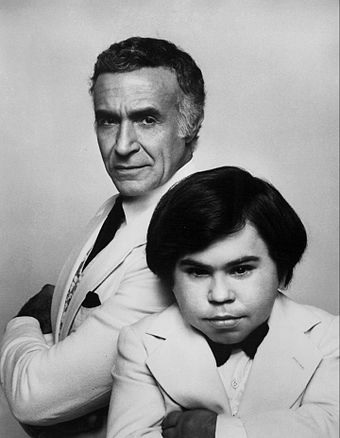
Julie doesn’t appear in this episode, beyond the usual stock footage that appears at the start of every season 5 episode.  In fact, Julie isn’t even mentioned in this episode.  Instead, it’s Roarke and Tattoo all the way.  Roarke and Tattoo greet the visitors together.  Tattoo is the one who helps Roarke put the fantasies together.  Roarke and Tattoo say goodbye to everyone at the end.  In a way, this episode felt like a throwback to the first two seasons of Fantasy Island.

The fantasies feel like throwbacks to the first two seasons as well, with both of them featuring interesting guest stars and just enough twists to keep things interesting.  We’ve got one comedic fantasy and one dramatic fantasy but the comedic fantasy is not too silly and the dramatic fantasy is not too serious.  The episode manages to strike a pretty good balance between the two so, for once, neither fantasy feels rushed or short-changed.

The comedic fantasy features Kim Darby as Rebecca Walters, who wants to find a husband who is courteous and handsome.  Tattoo takes her out to the magical Fantasy Island lagoon, where she meets a genie named …. well, he has a really long genie name but fortunately, he’s happy to be called Joe (Larry Linville).  Joe can grant Rebecca three wishes.  As always happens with genies, Rebecca wastes her first two wishes.  For instance, when she says that it’s a little bit too warm for her, Joe grants her wish and temporarily turns Fantasy Island into a winter wonderland, complete with snow and Christmas music playing.  (Seriously, the sight of snow on Fantasy Island was surprisingly charming, as was Tattoo’s shocked reaction.)  In the end, of course, Rebecca comes to discover that she loves Joe.  Joe transforms from a genie-into-a-man and they leave the Island together.  It was a charming and cute fantasy.  Both Darby and Linville seemed to be having fun with their roles and they had a surprising amount of chemistry together.  This was a fun fantasy.

As for the dramatic fantasy, it allowed us to learn a little about the history of the Island.  Apparently, centuries ago, the Island belonged to a Spanish sea captain.  Ruthless tycoon Douglas Picard (Vic Morrow) came across the deed to the island after he moved into a villa that once belonged to the captain.  Picard claims that the Island is legally his.  Roarke points out that the deed is several centuries old and that it would take years for the legal system to sort out who owned what.  Picard challenges Roarke to three challenges to decide who will own the island, challenges that will test the mind, body, and spirit of the two men.  The person to win two of the matches also wins the Island.  Roarke agrees.

Here’s the thing that I find interesting about all of this.  First off, it’s implied that the Spanish sea captain was a part of the Spanish Armada.  Why would the Spanish Armada have been in the South Pacific?  Even more importantly, though, was the island still capable of granting fantasies when it was owned the Captain?  Are the fantasies created by the Island or by Mr. Roarke?  The case for the Island being magical can be found in this very episode, in which Tattoo takes Rebecca to a lagoon inhabited by a genie.  Throughout the series, there have been many such locations on the Island.  But Roarke himself is clearly more than just the charming owner of a resort.  Ricardo Montalban once said that he felt Roarke was a fallen angel who was doing penance on the Island.  That’s an interesting idea and would certainly explain why Roddy McDowall’s Devil always seemed to want to steal Roarke’s soul.  Of course, the Blumhouse film and the recently-canceled reboot both suggested that Fantasy Island has had many different caretakers but I’m not sure that I consider either one of those to be canonical.  I kind of like the idea Roarke having lived on the Island for centuries, like Richard on Lost.

Anyway, the three competitions are actually pretty interesting.  The first one is a chess match that is won by Roarke.  The second one features Roarke and Picard arm-wrestling over a killer spider.  Roarke is in on the verge of winning that one but allows Picard to have the victory rather than kill him.  The third competition is to do something selfless that improves someone else’s life.  (I’m not sure how the winner would be selected but we’ll just go with it.)  Picard gives money to a charity that he knows little about.  Roarke, however, wins because he made Picard’s sister, Eunice (Jane Powell), happy by choosing not to kill Picard.  Picard is so happy to finally see Eunice happy that he decides he doesn’t need to take ownership of Fantasy Island.  Everyone leaves the Island a better person than they were when they arrived.  Yay!

As I said before, this episode felt like a throwback to the earlier seasons of Fantasy Island.  This was a great trip to the Island!

Horror On The Lens: Messiah of Evil (dir by Willard Huyck)


MOE Mariana HillWith only a few days left until Halloween, I wanted to make sure that I continued an important tradition here at the Shattered Lens by sharing this film with our faithful and wonderful readers.  Messiah of Evil was first released in 1973 and, since it’s in the public domain, it has since been included in a countless number of bargain box sets from Mill Creek.

I can still remember the first time that I saw Messiah of Evil.  It was on a Monday night, many years ago.  I had recently picked up a 10-movie DVD box set called Tales of Terror and I was using the movies inside to try to deal with a bout of insomnia.  I had already watched The Hatchet Murders (a.k,a. Deep Red) and The House At The Edge of the Park and, at two in the morning, I was faced with a decision.  Should I try to sleep or should I watch one more movie?

Naturally, I chose to watch one more movie and the movie I chose was Messiah of Evil.  So, there I was at two in the morning, sitting at the edge of my bed in my underwear and watching an obscure horror movie while rain fell outside.

And, seriously — this movie totally FREAKED me out!

Messiah of Evil tells the story of Arletty (Marianna Hill), a neurotic woman who drives to an isolated California town in order to visit her father.  Her father is an artist who specializes in painting eerie pictures of large groups of black-clad people.  However, once she arrives at his home, Arletty discovers that her father has vanished and left behind a diary where he claims that a darkness has overtaken the town.

Meanwhile, a mysterious man named Thom (Michael Greer) is wandering about town with two groupies (played by Anita Ford and Joy Bang) and interviewing random townspeople.  One crazed man (Elisha Cook, Jr.) explains that “the dark stranger” is returning.  After meeting Arletty, they all end up moving into her father’s house.

But that’s not all.   There’s also an odd albino man who shows up driving truck and who eats mice….

Messiah of Evil is literally one of the strangest films that I’ve ever seen.  It’s shot in a dream-like fashion and the much of the film is left open to the viewer’s interpretation.  There are two classic scenes — one that takes place in a super market and one that takes place in a movie theater and the movie’s worth watching for these two scenes alone.

Messiah of Evil is a film that will be appreciated by all lovers of surrealism and intelligent horror and I’m happy to share it with you today.

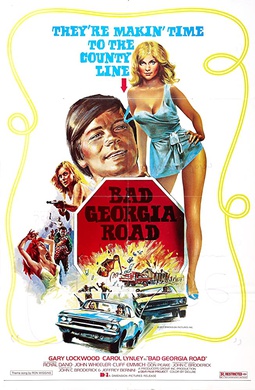
The TSL’s Grindhouse: Bad Georgia Road (dir by John Broderick)


This 1977 film is, for the most part, set in Alabama so I don’t know why it opens with a shot of a car driving down a country road while someone on the soundtrack sings about running moonshine down a “bad Georgia road.”  Then again, I’ve been to both Alabama and California and it’s pretty obvious that, while the film may be set in the former, it was filmed in the latter.  Those hills and mountains in the background definitely belong more to Hollywood than anywhere in the South.

As for the film itself, it’s about Molly Golden (Carol Lynley), a spoiled New York fashion designer who inherits an Alabama farm from an uncle that she barely knew.  When Molly finds out that the land is worth $100,000, she promptly quits her job and moves to Alabama, accompanied by her friend and assistant, Larch (John Kerry and no, not that politician with the private plane).  Molly is planning on selling the land and then heading back north with her money.  Unfortunately, it turns out that her uncle died owing everyone in the county money so, as a result, his farm is worthless and Molly is now in debt.

What is Molly to do?  Fortunately, her uncle’s two farmhands — Leroy (Gary Lockwood, who once co-starred in 2001: A Space Odyssey) and Arthur (Royal Dano) — are onhand to explain to her that her uncle was a moonshiner.  Molly decides to become a moonshiner, too!  Her plan is for Leroy and Arthur to do all the work and for her to make all the money.

While all of this is going on, Molly is also falling for Leroy.  She doesn’t want to admit because she’s a sophisticated New Yorker while Leroy is a redneck slob.  This leads to some conflict between the two of them, as she’s always talking down to Leroy and trying to deny that she’s totally in love with him.  Eventually, in a deeply uncomfortable scene (all the more so because the films attempts to play it for laughs), Leroy literally forces himself on her and Molly realizes that she could be totally happy runnin’ moonshine with a barely literate hick.

I’m a Southern girl and, perhaps even more importantly, I’m enough a country girl that I usually enjoy a good moonshine and car chase film.  And Bad Georgia Road gets off to a good start with an enjoyable chase scene, even if the road that the cars are roaring down is clearly located on the West Coast instead of the Deep South.  But things go off the rails as soon as Molly and Larch show up in Alabama.  What there is of a plot plays out at a painfully slow pace and there’s absolutely zero romantic chemistry between Gary Lockwood and Carol Lynley.  On the plus side, Royal Dano is enjoyable eccentric as Arthur, an old-timer who may not be educated but who knows everything that needs to be known about both the Bible and moonshine.

Bad Georgia Road is the type of 70s film that was specifically made to play in Southern drive-ins, where audiences would undoubtedly appreciate the film’s portrait of a clueless Yankee getting outsmarted by a bunch of country folk.  (For me and probably most other people, that’s actually the main appeal of the moonshine genre.)  But even if you think that Molly is a totally smug and self-righteous New Yorker, she still deserves better than to get stuck with Leroy, a man who looks like he probably reeks of chicken feed and spilled beer.  Especially if you’ve seen his personable performances in films like Model Shop and 2001, it’s hard not to feel bad for Gary Lockwood while watching this film.  What did that bad Georgia road do to him?

https://www.youtube.com/watch?v=KNjEmGJWq2Y

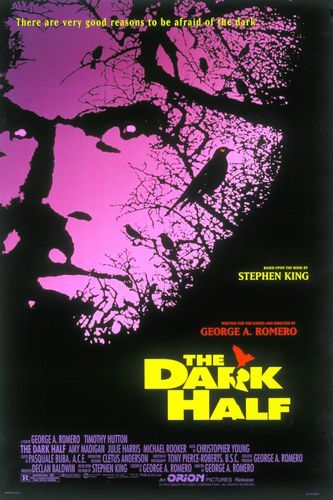
Horror Film Review: The Dark Half (dir by George Romero)


It will always fascinate me that Stephen King, one of the most popular writers in the world and one of the legitimate masters of horror, also has one of the least inspiring accounts on twitter.

Seriously, he may be the most popular author in the world but he tweets like a retiree who has just discovered the internet.  Go over to his twitter account and you won’t find memorable descriptions of small town hypocrisy.  You won’t find scenes of shocking psychological insight.  You won’t find moments of unexpected but laugh-out-loud dark humor.  Instead, you’ll find a combination of dad jokes, boomer nostalgia, and an unseemly obsession with wishing death on any public figure who is to the right of Bernie Sanders.  It’s odd because no one can deny that King’s a good storyteller.  At his best, Stephen King is responsible for some of the best horror novels ever written.  Everyone who is a horror fan owes him a debt of gratitude for the work that he’s done promoting the genre.  At his worst, he’s your uncle who retweets the article without reading it first.

Of course, someone can be great at one thing an terrible at something else.  I can dance but I certainly can’t sing.  Stephen King can write a best seller but a good tweet is beyond him.  That’s the dual nature of existence, I suppose.  That’s certainly one of the themes at the heart of both Stephen King’s The Dark Half and the subsequent film adaptation from George Romero.

Filmed in 1990 but not released for three years due to the bankruptcy of the studio that produced it, The Dark Half tells the story of Thad Beaumont and George Stark (both played by Timothy Hutton).  Thad is a professor who writes “serious” literature under his real name and violent, pulpy fiction under the name of George Stark.  No one reads Thad’s books but they love George Stark and his stories about the master criminal and assassin, Alexis Machine.  (Alexis Machine?  George Stark may be a good writer but he sucks at coming up with names.)  After a demented fan (played, with creepy intensity, by Robert Joy) attempts to blackmail him by threatening to reveal that he’s George Stark, Thad decides to go public on his own.  His agent even arranges for a fake funeral so that Thad can bury George once and for all.

Soon, however, Thad’s associates are turning up dead.  It seems as if everyone associated with the funeral is now being targeted.  Sheriff Alan Pangborn (Michael Rooker) suspects that Thad is the murderer.  However, the murderer is actually George Stark, who has come to life and is seeking revenge.  Of course, George has more problems than just being buried.  His body is decaying and he’s got a bunch of angry sparrows after him.  The Sparrows Are Flying Again, we’re told over and over.  Seeking to cure his affliction and to get those birds to leave him alone, Stark targets Thad’s wife (Amy Madigan) and their children.

The Dark Half has its moments, as I think we would expect of any film based on a Stephen King novel and directed by George Stark.  Some of the deaths are memorably nasty.  Hutton is believably neurotic as Thad and cartoonishly evil as Stark and, in both cases, it works well.  Rooker may be an unconventional pick for the role but he does a good job as Pangborn and Amy Madigan brings some unexpected energy to the thankless role of being the threatened wife.

But, in the end, The Dark Half never really seems to live up to its potential.  In the book, Thad was a recovering alcoholic and it was obvious that George Stark was a metaphor for Thad’s addiction.  That element is largely abandoned in the movie and, as a result, George goes from being the literal representation of Thad’s demons to just being another overly loquacious movie serial killer.  Despite having a few creepy scenes, the film itself is never as disturbing as it should be.  For all the blood, the horror still feels a bit watered down.  Take away the sparrows and this could just as easily be a straight-forward action film where the hero has to rescue his family from a smug kidnapper.  Comparing this film to Romero’s Martin is all the proof you need that Romero was best-served by working outside the mainstream than by trying to be a part of it.

Add to that, I got sick of the sparrows.  Yes, both the film and the book explain why the sparrows are important but “The Sparrows Are Flying Again” almost sounds like something you’d find in something written in a deliberate attempt to parody King’s style.  It’s a phrase that’s intriguingly enigmatic the first time that you hear it, annoying the third time, and boring the fifth time.

The Dark Half was a bit of a disappointment but that’s okay.  For King fans, there will always be Carrie.  (I would probably watch The Shining but apparently, King still hasn’t forgiven Stanley Kubrick for improving on the novel.)  And, for us Romero fans, we’ll always have Night of the Living Dead, Martin, Dawn of the Dead, and the original Crazies.  And, for fans of George Stark, I’m sure someone else will pick up the story of Alexis Machine.  It’s hard to keep a good character down.

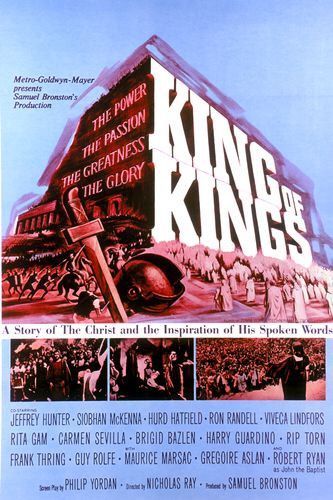
Film Review: King of Kings (dir by Nicholas Ray)


The 1961 film, King of Kings, was the final biblical film that I watched on Easter.  Like The Greatest Story Ever Told, it tells the story of Jesus from the Nativity to the Ascension.  Like The Greatest Story Ever Told, it’s an epic film that was directed by a renowned director.  (In this case, Nicholas Ray.)  Like The Greatest Story Ever Told, King of Kings also has a huge cast and there’s a few familiar faces to be seen, though it doesn’t really take the all-star approach that George Stevens did with his telling of the story.

Probably the biggest star in King of Kings was Jeffrey Hunter, who played Jesus.  Hunter was in his 30s at the time but he still looked young enough that the film was nicknamed I Was A Teenage Jesus.  (Some of that also probably had to do with the fact that Nicholas Ray was best known for directing Rebel Without A Cause.)  But then again, for a man who had so many followers, Jesus was young.  He hadn’t even reached his 40th birthday before he was crucified.  As well, his followers were also young while his many opponents were representatives of the establishment and the old way of doing things.  It makes perfect sense that Jesus should be played by a young man and Hunter gives a good performance.  As opposed to so many of the other actors who have played Jesus in the movies, Jeffrey Hunter is credible as someone who could convince fishermen to throw down their nets and follow him.  He’s passionate without being fanatical and serious without being grim.  He’s a leader even before he performs his first miracle.

King of Kings is one of the better films that I’ve seen about the life of Jesus.  While remaining respectful of its subject, it also feels alive in the way that so many other biblical films don’t.  Perhaps not surprisingly, Nicholas Ray focuses on the idea of Jesus as a rebel against the establishment.  Ray emphasizes the casual cruelty of the Romans and their collaborators.  When John the Baptist (Robert Ryan) is arrested by Herod (Frank Thring), it’s not just so the filmmakers can have an excuse to work Salome (Brigid Bazlen) in the film.  It’s also to show what will happen to anyone who dares to challenge the establishment.  When Jesus visits John the Baptist in his cell, it’s a summit between two rebels who know that they’re both destined to die for the greater good.  When Pilate (Hurd Hatfield) makes his appearance, he’s smug and rather complacent in his power.  He’s not the quasi-sympathetic figure who appears in so many other biblical films.  Instead, he’s the epitome of establishment arrogance.

As a director, Nicholas Ray keeps things simple.  This isn’t Ben-Hur or The Ten Commandments.  The emphasis is not on grandeur.  Instead, the film is about common people trying to improve the world in which they’re living, while also preparing for the next.  Jeffrey Hunter gives an excellent performance as Jesus and, all in all, this is one of the better and more relatable biblical films out there.