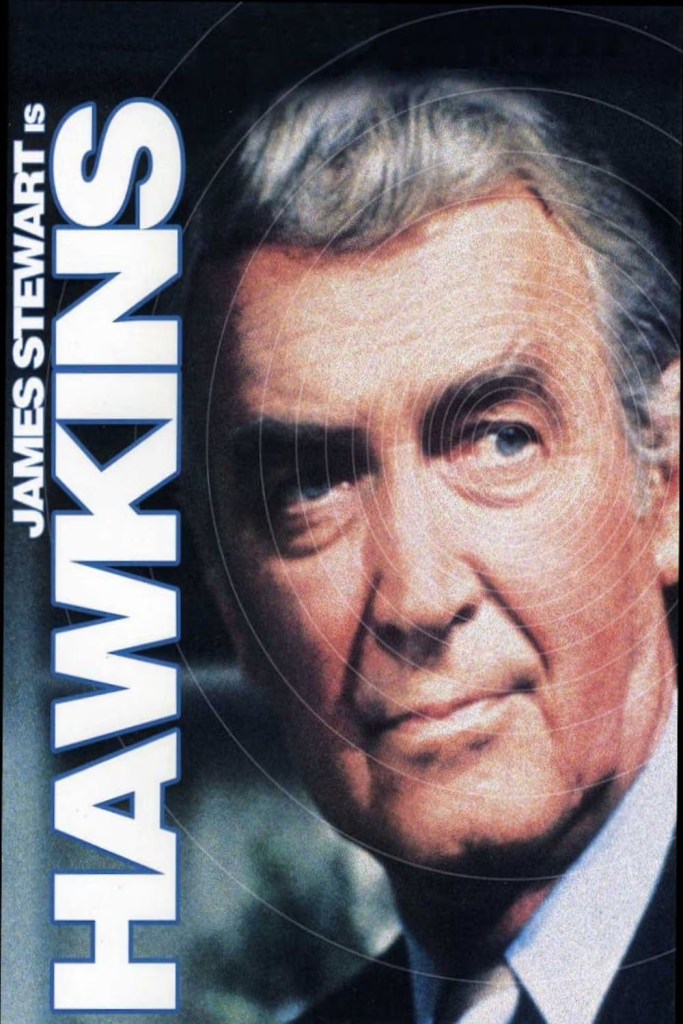
HAWKINS: Death and the Maiden (1973) – starring Jimmy Stewart!


In this pilot episode of the TV-Movie series HAWKINS, Jimmy Stewart plays Billy Jim Hawkins from the fictional town of Beauville, West Virginia, who just happens to be the best defense lawyer in the business. A former prosecutor who changed sides, he has a perfect record for getting his clients off. Billy Jim gets a call to come out to Los Angeles when an heiress, Edith Dayton-Thomas (Bonnie Bedelia), is charged with the murder of her dad, stepmom, and stepdaughter. Billy Jim and his team, which is basically just his cousin R.J. Hawkins (Strother Martin), set about getting to know all the people in her life. There’s the family lawyer Carl Vincent (Robert Webber) who’s been dipping his hand in the family till while also carrying on an affair, much to the chagrin of his wife Vivian (Antoinette Bower). There’s Edith’s aunt Julia (Kate Reid), who doesn’t seem to have a very strong opinion of her now deceased brother in law and was seen arguing with him on the day of his murder. And there’s Edith herself, whose diary would indicate that she hated her dad and her stepmom so much that she wanted them dead. She also just happens to have the reputation for being a little strange and / or crazy. The evidence seems to be stacked against Edith, but Billy Jim doesn’t get to charge those extremely high legal fees for nothing. If anyone can get to the bottom of the case, it’s him. 

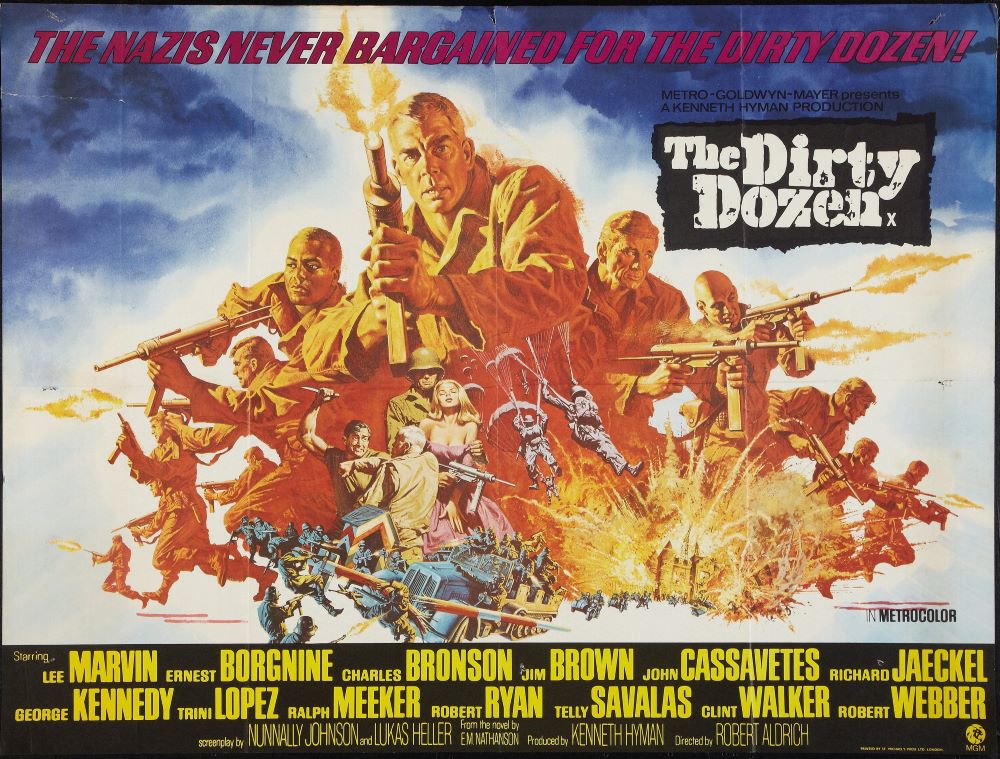
I’ll just go ahead and say that Jimmy Stewart and the character of Billy Jim Hawkins are a match made in heaven. Any person who has seen him in the classic Otto Preminger film ANATOMY OF A MURDER (1959) knows how great he is at playing a down home defense attorney. He excels in the role, and he’s reason alone to invest in the DVD collection from Warner Brothers Archive like I did several years back. It’s so fun watching him question people in his easy going, slow talking, country boy way which almost always leads to the discovery of exactly what he needs to know. And Strother Martin is perfect as his cousin and associate, one of 174 first cousins, according to Billy Jim himself. You see, one of the interesting things about Billy Jim’s family is that he’s one of 14 kids, with 52 nieces and nephews to go along with all those first cousins. That’s some fun character history for a guy like me, whose mom is one of 15 kids, and I also have tons of first cousins. Stewart and Martin are a perfect duo, and their sharing of different theories as the episodes progress make up some of the best scenes. Add to Stewart and Martin a solid group of guest stars in this episode including Bonnie Bedelia (DIE HARD), Robert Webber (THE DIRTY DOZEN), Kate Reid (THIS PROPERTY IS CONDEMNED), and Antoinette Bower (THE EVIL THAT MEN DO), and you can’t help but have an entertaining show. There’s never any doubt that Stewart is going to uncover the murderer, but the fun of course is in seeing how he puts all the clues together. 

HAWKINS: Death and the Maiden is the first of eight “Hawkins” TV movies starring Jimmy Stewart in 1973 and 1974. The character of Billy Jim Hawkins is a clear pre-cursor to the character of Matlock that Andy Griffith would have so much success with a little over a decade later. In a strange move at the time, CBS chose to alternate HAWKINS on Tuesday nights with a series of SHAFT TV movies. Imagine wanting to watch SHAFT only to turn on your TV to discover Jimmy Stewart and Strother Martin solving murder mysteries, or Vice-Versa. Conventional wisdom suggests that this release strategy was probably confusing to the respective audiences for the shows based on their vastly different demographics. I personally think they both sound awesome, but I can see how pairing such different shows in this way could have been a problem for the ratings. Regardless of its short lived tenure, if you’re a fan of Jimmy Stewart, you need to watch HAWKINS. Each episode is a joy to behold. 

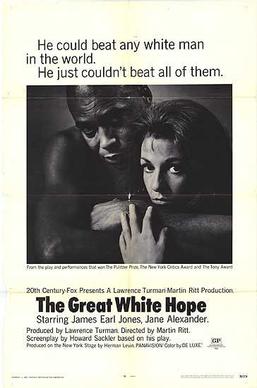
The Great White Hope (1970, directed by Martin Ritt)


The year is 1910 and the sports world is in a panic.  For the first time, a black man has won the title of the heavyweight champion of the world.  Jack Jefferson (James Earl Jones) had to go to Australia because no American city would agree to host the fight but he came out of it victorious.  The proud and outspoken Jefferson finds himself targeted by both the white establishment and black activists who claim that Jefferson has not done enough for his community.

It’s not just Jefferson’s success as a boxer that people find scandalous.  It’s also that the married Jefferson has a white mistress, a socialite named Eleanor Brachman (Jane Alexander, in her film debut).  While boxing promoters search for a “great white hope” who can take the title from Jefferson, the legal authorities attempt to arrest Jefferson for violating the Mann Act by supposedly taking Eleanor across state lines for “immoral purposes.”  Jefferson and Eleanor end up fleeing abroad but even then, their relationship is as doomed as Jefferson’s reign as the heavyweight champ.

Based on a Pulitzer-winning stage play by Howard Sackler, The Great White Hope features Jones and Alexander recreating the roles for which they both won Tonys.  Both Jones and Alexander would go on to receive Oscar nominations for their work in the film version.  It was the first nomination for Alexander and, amazingly, it was the only nomination that Jones would receive over the course of his career.  (It surprises me that he wasn’t even nominated for his work in Field Of Dreams.)  Both Jones and Alexander give powerful performances, with Jones dominating every scene as the proud, defiant, and often very funny Jack Jefferson.  Jones may not have had a boxer’s physique but he captured the attitude of a man who knew he was the best and who mistakenly believed that would be enough to overcome a racist culture.  (Speaking of racist, legendary recluse Howard Hughes reportedly caught the film on television and was so offended by the sight of Jones kissing Alexander that he thought about buying NBC to make sure that the movie would never be aired again.)  Hal Holbrook, Chester Morris, Moses Gunn, Marcel Dalio, and R.G. Armstrong all do good work in small roles.

Unfortunately, The Great White Hope still feels like a filmed stage play, despite the attempts made to open up the action.  Martin Ritt was a good director of actors but the boxing scenes are never feel authentic and the middle section of the film drags.  Jones and Alexander keep the film watchable but The Great White Hope is never packs as strong of a punch as its main character.

Horror On TV: One Step Beyond 1.19 “The Captain’s Guests” (dir by John Newland)


On tonight’s episode of One Step Beyond, a couple moves into a house on the coast.  Everyone tells them that the house is haunted but the couple refuses to believe them.  After all, everyone knows how superstitious people are in New England.  Everyone’s heard the story of the haunted mudroom, right?

However, after moving into the house, the couple starts to realize that they are not alone….

According to the show’s host, John Newland, this is based on a true story (maybe)!

This episode originally aired on May 26th, 1959.  The husband is played by Robert Webber, who also played Juror #12 in Sidney Lumet’s 12 Angry Men.

Enjoy!

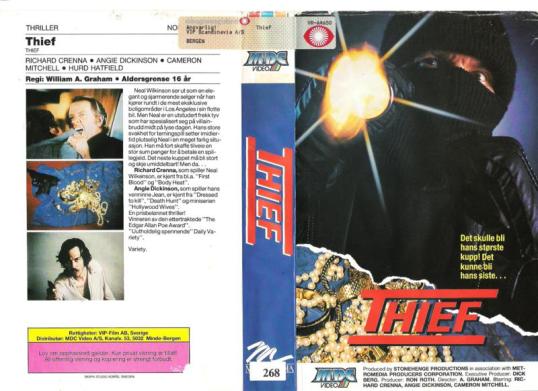
Retro Television Review: Thief (dir by William A. Graham)


Welcome to Retro Television Reviews, a feature where we review some of our favorite and least favorite shows of the past!  On Sundays, I will be reviewing the made-for-television movies that used to be a primetime mainstay.  Today’s film is 1971’s Thief!  It  can be viewed on Tubi and YouTube.

Neal Wilkinson (Richard Crenna) would appear to be living a great life.  He has a nice house in the suburbs.  He has a beautiful girlfriend named Jean Melville (Angie Dickinson).  As he heads into middle-age, he is still fit and handsome and charming.  He dresses well, or at least well by the standards of the early 70s.  (By the standards of today, a few of his ties are a bit too wide.)  Everyone believes that Neal has a nice and comfortable job as an insurance agent.

Of course, the truth is far different.

Neal is a veteran con man and a thief.  He’s just recently been released from prison and his deceptively friendly parole officer (played by the great character actor, Michael Lerner) is convinced that Neal will screw up again eventually.  And, of course, Neal has screwed up.  A gambling addict, he is $30,000 in debt.  Can Neal steal enough jewelry from enough suburban homes to pay off his debt?  Can a man like Neal change his ways?

This is a surprisingly somber made-for-TV movie.  Just from the plot description and the film’s first few minutes, you might expect Thief to be a light-hearted caper film in which Neal and Jean work together to pull off one last heist so that Neal can retire.  Instead, Neal spends almost the entire film lying to Jean and there’s hardly a light moment to be found.  Neal says that he wants to retire from his life of crime but, as the film makes clear, that’s a lie that he’s telling himself.  Neal cannot stop stealing and gambling because he’s as much of an addict as the wild-haired junkie (Michael C. Gwynne) who briefly confronts Neal at the parole office.  At one point, Jean tells Neal, “The more I know you, the less I know you,” but the truth of the matter is that Neal is so deep in denial about the futility of his life that he doesn’t even know himself.

It’s not a particularly happy film.  Richard Crenna is ideally cast as Neal, playing him with enough charm that the viewer can buy that he could talk his way out of being caught in a stranger’s backyard but with also with vulnerability that the viewer can see his fate, even if he can’t.  Thief also provides a rare opportunity to see Cameron Mitchell playing a sympathetic role.  Mitchell is cast as Neal’s attorney, who continually tries to get Neal to stop messing up but who ultimately knows that his attempts to reform Neal are just as futile as Neal’s attempts to go straight.

The movie ends on a surprisingly fatalistic note, one that suggests that there’s only one way to truly escape from a life of crime.  I can only imagine how viewers responded in 1971, when they turned on their television and found themselves watching not a light-hearted caper film but instead a bleak examination of criminal ennui.  It’s not a happy film but it is more than worth watching for Richard Crenna’s lead performance.

Retro Television Reviews: Half Nelson Episodes 1 & 2 “The Pilot”


Welcome to Retro Television Reviews, a new feature where we review some of our favorite and least favorite shows of the past! On Fridays, I will be reviewing Half Nelson, which ran on NBC from March to May of 1985. Almost all nine of the show’s episodes can be found on YouTube!

The year was 1985 and actor/singer Joe Pesci was at an interesting place in his film career.

In 1980, Joe Pesci was nominated for Best Supporting Actor for his performance as Robert De Niro’s brother in Raging BullRaging Bull was Pesci’s second film and he earned critical acclaim for his performance as the second most angry member of the LaMotta family.  In the years immediately following his first Oscar nomination, Pesci went on to play character roles in a handful of other films, including Dear Mr. Wonderful, Easy Money, Once Upon A Time In America, and Eureka.  While no one could deny Pesci’s talent or his unique screen presence, it was also obvious that Hollywood wasn’t quite sure what to do with him.  While Pesci was apparently high on everyone’s list when it came to playing gangsters with hair-trigger tempers, no one was willing to give Pesci a starring role.

Fortunately, television always has room for an Oscar nominee and, in 1985, Half Nelson came calling.  Created by veteran television producers Glen A. Larson and Lou Shaw, Half Nelson was a detective show.  Joe Pesci starred as Rocky Nelson, a tough New York cop who relocated to Los Angeles to pursue his acting career.  While waiting for his big break, Rocky worked for Beverly Hills Security and lived in Dean Martin’s guest room.  And when I say that Rocky was living in Dean Martin’s guest house, what I mean is that Dean Martin actually appeared on the show, playing himself.

NBC liked the idea enough to air the pilot film and then schedule the show as a mid-season replacement.  Audiences were a bit less interested in the show and Half Nelson was canceled after only 8 weeks.  Pesci went on to win an Oscar for Goodfellas and he never starred in another television show.  Half Nelson would probably be forgotten if not for the fact that someone recently came across the opening credits on YouTube.  When shared on Twitter, this video went viral as “the most 80s thing” ever created.

After I watched that video, I knew I simply had to review Half Nelson as soon as I finished up The Brady Bunch Hour.  Fortunately, almost all of the episodes have been uploaded to YouTube so, for the next few weeks, I’ll be taking a look at Half Nelson, starring Joe Pesci!

Episodes 1 & 2 “The Pilot”

(Dir by Bruce Bilson, originally aired on March 24th, 1985)

Half Nelson begins in New York City, with NYPD’s finest, Detective Rocky Nelson (Joe Pesci), disguising himself as a waiter and sneaking into a mafia-owned restaurant.  After punching out two guards, Rocky enters a backroom and discovers a group of guys with a lot of heroin.  Rocky arrests them and becomes a hero.  As Rocky explains in a voice-over, it’s the biggest drug bust in history.  When Hollywood asks for the rights to the story, Rocky insists that he be allowed to audition for the lead role.  Rocky quits the NYPD and heads out to Los Angeles.  Rocky’s going to be a star!

And, at first, it seems like Rocky’s dream might actually come true.  The film’s director (played by the veteran TV character actor, George Wyner) watches Rocky’s audition and announces that Rocky has the screen presence and talent of Al Pacino.  Unfortunately, Rocky is also only 5’3.  “You’re too short to play Rocky Nelson,” the director explains.

“But I am Rocky Nelson!” Rocky exclaims.

Despite the fact that Rocky’s telling the truth, it doesn’t matter.  A tall British actor is cast in the film.  As a dejected Rocky leaves the audition, he’s approached by a security guard who offers Rocky a job with Beverly Hills Patrol, a private security firm.  Rocky’s skeptical until the security guard mentions that Rocky will get to live in Dean Martin’s guest house.

We jump forward six months.  Rocky is now a trusted employee of Beverly Hills Patrol.  When he’s not working as a bodyguard, he’s auditioning for roles.  At the office, his boss is Chester (Fred Williamson) and the office manager is Annie O’Hara (Victoria Jackson).  Chester is cool and all-business.  Annie is flighty and has an obvious crush on Rocky.  She also gives Rocky a pit bull named Hunk.  Hunk is very loyal but also very quick to attack anyone who isn’t Rocky.  I don’t know if a show could get away with a comic relief pit bull today but whatever.  Hunk is a cute dog with a ferocious bark.

In just six months, Rocky has become surprisingly well-known in L.A.  Some of that might be because he lives with Dean Martin.  Martin appears in three scenes of the pilot and, to be honest, he definitely looks and sounds a bit worse for wear.  Half Nelson was Dean’s final acting role.  (He died ten years after the show was canceled.)  But even though Dean was clearly not in the best shape when he appeared in the pilot, his natural charisma still shines through and there’s a lot of pleasure to be found in his scenes with Joe Pesci.  For one thing, Pesci himself seems to be genuinely excited about acting opposite Martin.

Along with becoming friends with Dean Martin, Rocky has also befriended Parsons (George Kennedy), a Los Angeles police chief who is eager for Rocky to quit the Beverly Hills Patrol and to join the LAPD.  Rocky turns down the offer, however.  Rocky is done with police work.  He’s going to be a star!

Of course, he’ll also find time to solve some crimes along the way.

For instance, in the pilot, Rocky investigates the death of his best friend and co-worker, Jerry (Nicholas Surovy).  Parsons insists that all the evidence shows that Jerry murdered his girlfriend, Monika (Morgan Brittany), and then shot himself.  However, Rocky doesn’t think Jerry would do something like that.  When Jerry’s father (veteran screen actor Rory Calhoun) asks Rocky to find the people who killed his son, Rocky doesn’t have to be asked twice.

It turns out that Jerry and Monika were taking money from a tabloid magazine publisher (Terry Kiser).  They had a video tape that would have been very embarrassing to some prominent Angelinos, including a businessman (Rod Taylor), a restauranter (Tony Curtis), a general (Mills Watson), an astronaut (Gary Lockwood), and a television executive (Bernie Kopell).  Rocky assumes that the people on the tape ordered the murders but then he learns that, while the general did send two government agents to find the tape, he also made clear that no one was supposed to be killed.  Instead, someone else who wanted the tapes committed the murders on his own.

Searching for the killer means that Rocky will have to assume many disguises and show off his acting skills.  As an actor, he’s able to wander into the local movie studio and not only raid their wardrobe department but also borrow their cars.  Over the course of the film, Rocky disguses himself as both a cowboy and a traffic cop.  He also drives a Ferrari, a Cadillac, a jeep, a motorcycle, and KITT, the talking car from Knight Rider.  (KITT, unfortunately, does not talk in Half Nelson.)  On the one hand, the use of disguises is a little bit silly because Joe Pesci is always going to be Joe Pesci regardless of what costume he is wearing.  The pilot’s silliest scene involves Rocky dressed up like a cop to confront two men who have been following him.  Somehow, they fail to pick up on the fact that the 5’3 cop with the New York accent is the same 5’3 New Yorker who they’ve been tailing for the last few days.  And yet, it’s one of those things that’s so ludicrous that you can’t help but think that the show was showing a bit of self-awareness and commenting on just how ludicrous most television shows tend to be.

Eventually, Rocky figures out that the killer is …. SPOILER ALERT …. Parsons!  That’s right.  The same police chief who kept offering Rocky a job with the LAPD turned out to be the murderer for whom Rocky was looking.  What’s interesting is that, after realizing that Parsons is the killers, Rocky doesn’t arrest Parsons or attack him or do any of the other things that a typical TV detective might.  And Parsons doesn’t try to flee or fight.  Instead, the two men take a leisurely drive and talk about life, morality, and regret.  Parsons talks about how he was once an honest cop but Los Angeles corrupted him.  Rocky expresses some sympathy and says that he hates that he discovered that Parsons was the murderer.  It’s a well-acted and surprisingly well-written scene.  When Rocky asks Parsons about the murders, Parsons replies, “I had to empty my gun, just to drown out their screams.”  (Yikes!)  Parsons lets Rocky out of the car and tells him, “Don’t let them get to you, kid.”  Parsons then drives the car over a cliff as Roberta and Chester (who have been tailing Parsons) run up to Rocky.

“Hard to believe that a man like that would kill himself!” Roberta says.

“That’s just the funeral,” Rocky replies as Parsons car explodes, “He died a long time ago.”

Wow, that’s dark!  Fortunately, the mood is lightened during the show’s final scene, in which Rocky’s pit bull attacks boxer Larry Holmes.

The pilot for Half Nelson was nicely done.  It set up the series and it gave us an introduction to the characters, which is exactly what a pilot is supposed to do.  The cast showed off their chemistry and the final scene between Parsons and Rocky indicated that the show had the potential to be something more than just another mid-80s detective show.  The pilot’s greatest strength, not surprisingly, was Joe Pesci.  Pesci has played so many mobsters and crooked lawyers that it’s easy to forget what a likable actor he can be.  The pilot featured Pesci at his most amiable and it also gave him a chance to show off his comedic timing.  All-in-all, the pilot was a success and I could understand why NBC would have ordered more episodes after watching it.

But what about the series?  Would the series live up to the promise of the pilot or would it just become another generic detective show?  We’ll find out over the next 8 weeks!

Cleaning Out The DVR: The Sandpiper (dir by Vincente Minnelli)


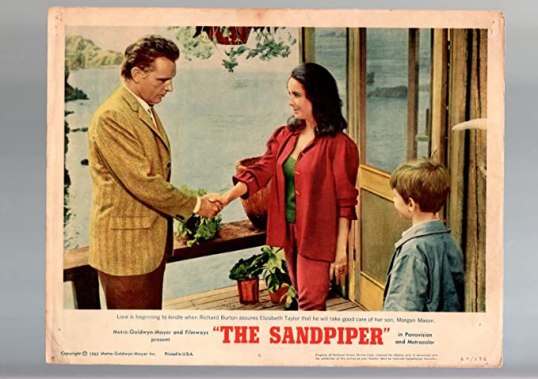
I recorded The Sandpiper that last time that it aired on TCM.  This 1965 film is one of the many films that Elizabeth Taylor and Richard Burton made together after they fell in love during the making of Cleopatra.  And while it’s true that Who’s Afraid of Virginia Woolf? won Taylor an Oscar and probably should have won one for Burton as well, the majority of the Taylor/Burton films were overproduced melodramas that often seemed as if they’d been rushed into production in order to capitalize on the couple’s tabloid popularity.  Unfortunately, Virginia Woolf aside, neither Taylor nor Burton seemed to bring out the best in each other as actors.

The Sandpiper finds Taylor playing Laura Reynolds, an artist who lives in a California beach house with her young son, Danny (Morgan Mason).  Laura is a free spirit who believes that everyone, including her son, should have the freedom to make their own choices.  She is resistant to any and all authority.  She’s a bohemian, a rebel, the type who doesn’t care what society has to say and who flaunts her refusal to follow the dictates of respectability.  Good for her!  However, she’s also Elizabeth Taylor, which means that she’s impossibly glamorous and even her “cluttered” beach house looks like it’s a hundred times more expensive than anything that anyone viewing the film will ever be able to afford.  Though Taylor tries hard, there’s nothing convincingly bohemian about her.

Richard Burton plays Dr. Edward Hewitt, who runs the nearby Episcopal school.  Dr. Hewitt is not a free spirit.  Instead, he and his wife, Claire (Eva Marie Saint), very much believe in structure and playing by the rules.  They believe in a traditional education and, when a judge orders Danny to be enrolled at their school, that’s what Hewitt plans to give him.  This, of course, brings Hewitt into conflict with Laura.  Both of them have differing ways of looking at the world and Laura is not a fan of religion in general.  However, since they’re played by Burton and Taylor, they’re destined to fall in love and have a scandalous affair.

Dr. Hewitt is one of the many religious figures that Burton played throughout his career.  In fact, Burton played so many alcoholic priests that I spent most of the movie assuming that Hewitt was an alcoholic as well.  However, he’s not.  He’s just Episcopalian.  That said, Burton delivers every line of dialogue in his trademark “great actor” voice and every minute that he’s onscreen just seems to be full of self-loathing.  Even before he cheats on his wife, Hewitt seems to hate himself.  Of course, once Burton does start cheating on his wife, it only gets worse.  The film presents Hewitt as being something of a hesitant participant, someone who knows that he’s doing the wrong thing but he simply cannot stop himself.  Laura, meanwhile, is presented as being someone who is fully willing to break up a marriage to get what she wants.  One gets the feeling that 1965 audiences probably just assumed they were watching the true story of how Taylor and Burton fell in love during the making the Cleopatra.  That said, it’s all pretty tame.  Just like Taylor, director Vincente Minnelli was too much of a product of the old Hollywood to truly embrace this story for all of its sordid potential.

If you’ve ever wanted to watch Charles Bronson debate religion with Richard Burton, this is the film for you.  Bronson plays a sculptor and an atheist who upsets Hewitt by calling him “reverend.”  Bronson is actually more convincing in the film than either Burton or Taylor, bringing a rough authenticity to his role.  Whereas Burton and Taylor both seem to be going through the motions, Bronson comes across as if he actually has a personal stake in the film’s story.  It’s not enough to save the movie, of course.  Fortunately, a year later, Liz and Dick would be used to better effect in Who’s Afraid of Virginia Woolf?


Horror On TV: One Step Beyond 1.19 “The Captain’s Guests” (dir by John Newland)


On tonight’s episode of One Step Beyond, a couple moves into a house on the coast.  Everyone tells them that the house is haunted but the couple refuses to believe them.  After all, everyone knows how superstitious people are in New England.  I mean, Stephen King had to pick it up from somewhere, right?

However, after moving into the house, the couple starts to realize that they are not alone….

According to the show’s host, John Newland, this is based on a true story (maybe)!

This episode originally aired on May 26th, 1959.  The husband is played by Robert Webber, who also played Juror #12 in Sidney Lumet’s 12 Angry Men.

Enjoy!

Cleaning Out the DVR #19: Things To Watch When You Have Flumonia!


gary loggins's avatarcracked rear viewer

So I’ve been laid up with the flu/early stage pneumonia/whateverthehellitis for the past few days, which seemed like a  good excuse to clean out the DVR by watching a bunch of random movies:

Bette Davis & Jimmy Cagney in “Jimmy the Gent”

JIMMY THE GENT (Warner Brothers 1934; D: Michael Curtiz ) –  Fast paced James Cagney vehicle has Jimmy as the head of a shady “missing heir” racket, with Bette Davis as his ex-girl, now working for his classy (but grabby!) rival Alan Dinehart. Allen Jenkins returns once again as Cagney’s sidekick, and Alice White is a riot as Jenkins’s ditzy dame. Some funny dialog by Bertram Milhauser in this one, coming in at the tail-end of the Pre-Code era. Cagney’s always worth watching, even in minor fare like this one. Fun Fact: Cagney’s battles with boss Jack Warner over better roles were legendary, and the actor went out…

View original post 786 more words

Horror on TV: Thriller 2.14 “Portrait Without A Face” (dir by John Newland)


For tonight’s televised horror, we have another episode of the Boris Karloff-hosted anthology series, Thriller!

In Portrait Without A Face, an arrogant painter is murdered.  No one knows who murdered him but don’t worry.  Just because he’s dead, that doesn’t mean the artist has to stop painting!  In fact, his first post-death painting might just be a picture of the person who killed him…

http://www.youtube.com/watch?v=6kkwJCp_KsM

Horror On TV: Darkroom Season 1 Episode 1&2 “Closed Circuit/Stay Tuned, We’ll Be Right Back” (dir by Rick Rosenthal and Paul Lynch)


While I was looking through YouTube for TV shows to use for this year’s horrorthon, I came across something called Darkroom.  Apparently, Darkroom was a horror anthology series that aired for a few months in 1981.

So, I figured, why not share!

(Apparently, each episode of Darkroom was made up of two thirty-minute stories.  For syndication purposes, it appears that the each 30 minute segment was considered to be a separate episode.)

Below is the first episode of Darkroom!  It originally aired on Nov. 27th, 1981.  In Closed Circuit, an aging anchorman discovers that he’s about to be replaced by a computer.  In Stay Turned, We’ll Be Right Back, a man discovers that his radio can be used to contact the past and must decide whether or not to change history.  The show is introduced and hosted by James Coburn.

Closed Circuit was directed by Rick Rosenthal, who directed Jamie Lee Curtis in Halloween II.  Stay Tuned is directed by Paul Lynch, who directed Jamie Lee Curtis in Prom Night.

Enjoy!