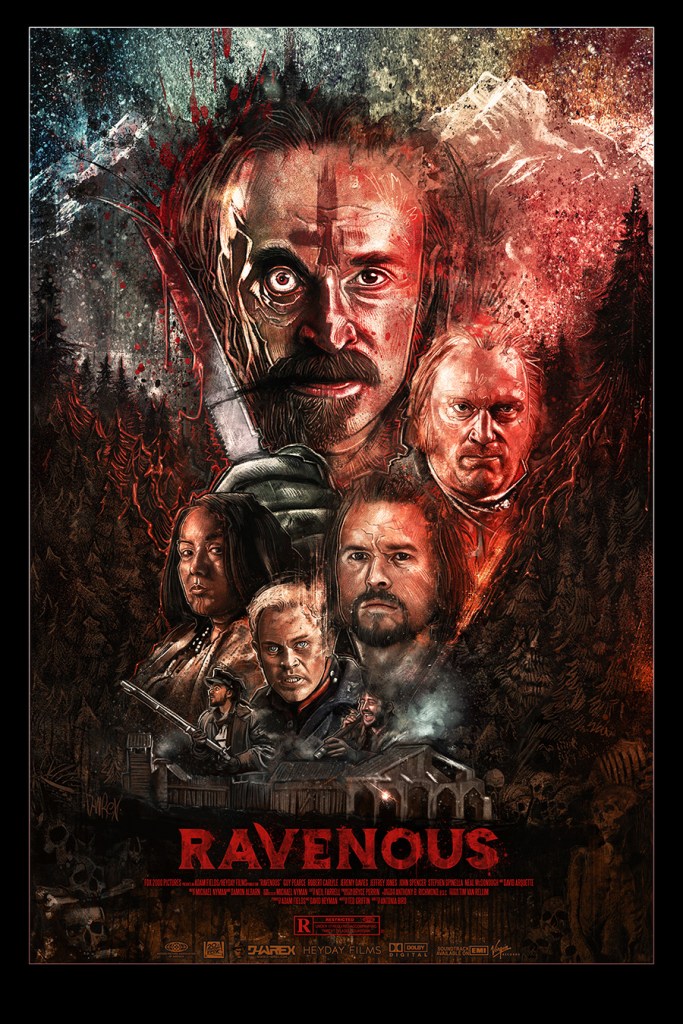
Horror Review: Ravenous (dir. by Antonia Bird)


“Morality… is the last bastion of a coward.” — Colonel Ives

Ravenous remains one of the most fascinating and thematically daring horror films of the late 1990s—a layered meditation on hunger, morality, and the consuming appetite of empire disguised as a tale of survival. Set against the punishing winter backdrop of the Mexican-American War, the film centers on Lieutenant John Boyd, a soldier burdened by cowardice and guilt, sent to an isolated military outpost in the Sierra Nevadas. When a frostbitten stranger stumbles into camp with a horrifying tale of survival, the line between the living and the devoured—and between humanity and monstrosity—begins to blur.

At first glance, Ravenous is a dark horror film about cannibalism in a remote frontier fort. What distinguishes it is the way it transforms that premise into a meditation on civilization and consumption. The screenplay, written by Ted Griffin, draws inspiration from historical accounts such as the Donner Party and Alfred Packer—stories of pioneers who resorted to cannibalism to survive brutal winters. Griffin threads these historical horrors into a broader allegory about 19th-century American expansionism: a national hunger for land, power, and progress that consumes everything in its path, including its own humanity.

The mythological backbone of Ravenous lies in the inclusion of the wendigo, a spirit from Native American folklore. In Algonquin and Ojibwe tradition, the wendigo is born of greed and gluttony, a monstrous being that grows stronger and more grotesque with each act of consumption. The tale served as a warning against selfishness, warning that those who devour others—figuratively or literally—lose their humanity in return. Bird and Griffin seamlessly integrate this legend into the film’s themes, using the wendigo to mirror the psychological and cultural costs of empire. The story implies that the wendigo is not confined to mythic forests but lives in the blood of every nation that feeds on others to survive.

The fort where the story unfolds functions as both a stage and symbol: an outpost of civilization planted in the wilderness, claiming righteousness while sustained by exploitation. As starvation and moral decay take hold, the soldiers’ pretense of order crumbles. The isolated setting reflects the broader American project—civilization advancing through conquest yet losing its moral center in the process. The Native nations displaced and destroyed during expansion, reduced to resources or obstacles, become the unseen victims of this devouring drive. The film reframes cannibalism as a metaphor for Manifest Destiny itself—the act of consuming people, land, and spirit under the guise of progress.

That central metaphor gains power through the film’s performances. Guy Pearce delivers a subdued yet deeply expressive performance as Boyd, embodying the moral paralysis of a man trapped between guilt and survival. His silences, glances, and hesitations speak louder than any dialogue, conveying an internal conflict between virtue and instinct. Through him, the film explores how the will to endure can erode the boundaries of conscience.

Robert Carlyle, as Colonel Ives, stands in vivid contrast—charismatic, witty, and terrifyingly self-assured. He plays the role with the infectious energy of a man liberated by his own monstrosity, wearing sin as philosophy. For Ives, cannibalism is not horror but a revelation—a means to transcend weakness and embrace dominance. His eloquent justifications turn atrocity into ideology, echoing the rationalizations of expansionist politics. It is no coincidence that his confidence parallels Boyd’s doubt; the two men form mirror halves of a single corrupted ideal.

Director Antonia Bird’s touch elevates Ravenous from a historical thriller to a surreal moral fable. She handles violence and absurdity with equal precision, oscillating between grim horror and deadpan humor in a way that keeps viewers uneasy yet enthralled. Her direction never treats the horror as spectacle alone—every moment of gore carries weight, testing the limits of empathy and survival. Moments of unexpected humor punctuate the brutality, serving as a reminder that even atrocity can become ordinary when normalized by power.

While the fusion of dark comedy and horror lends the film its originality, it may also unsettle some viewers. The tonal shifts—helped by Michael Nyman and Damon Albarn’s strange, minimalist score—create an atmosphere that feels intentionally dissonant. This mix may challenge those expecting a traditional horror film, but it reinforces Bird’s vision of moral chaos. The unease generated by those shifts mirrors the absurdity of history itself: how horrors can coexist with banality, how laughter can accompany destruction.

The wendigo myth binds all these elements together. Bird portrays it less as a creature and more as a condition—one that spreads through ideology, greed, and the illusion of progress. The spirit of the wendigo thrives wherever ambition turns men into predators and justifies their violence as destiny. In this sense, every character becomes a reflection of national hunger, caught in a metaphorical cycle of consumption. The act of eating flesh becomes a stand-in for the broader devouring inherent in colonization: of land, of native culture, of moral identity.

By framing the frontier as an arena of both physical and spiritual starvation, Ravenous reimagines American history as a feast of self-destruction. It suggests that survival is often indistinguishable from conquest—both are rooted in the urge to consume. Even at its most surreal or ironic moments, the film refuses to let its viewers forget that the hunger at its center is not merely for sustenance but for dominion.

Though underappreciated upon release, Ravenous has since earned recognition as a rare film that wields gore and satire to expose deeper truths. Bird’s control of tone, Griffin’s allegorical writing, and the actors’ opposing energies fuse into something that transcends genre. The result is a story that both horrifies and compels, holding a cracked mirror to the myth of progress.

The wilderness of Ravenous is vast, beautiful, and pitiless—a perfect reflection of the American spirit it depicts. It is a land that promises renewal but demands devouring, a landscape haunted by the ghosts of all it has consumed. The film endures not simply as a parable of survival, but as a meditation on empire, appetite, and the fragile line separating civilization from savagery.

Both grotesque and profound, Ravenous gnaws not only at flesh but at the conscience, forcing us to confront what happens when hunger—whether for life, for power, or for victory—becomes the only morality left.
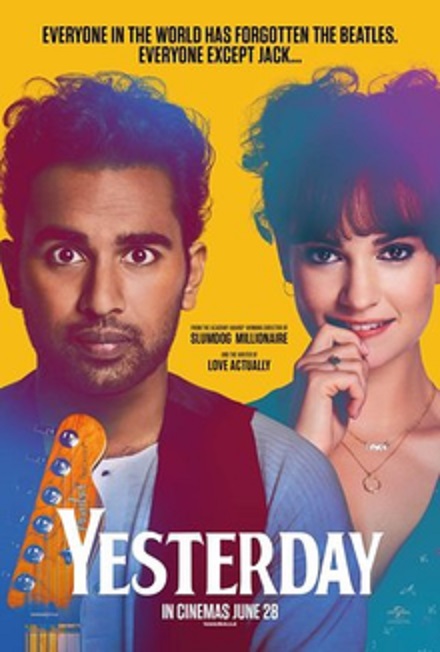
Playing Catch-Up With The Films of 2019: Yesterday (dir by Danny Boyle)


It’s a bit of an odd film, Yesterday is.

Himesh Patel plays Jack Malik, a singer-songwriter who has struggled to find much success.  The only person who believes in him is his manager, a school teacher named Ellie Appleton (Lily James).  (Given the film’s subject matter, Ellie’s last name is a significant one.)  One night, the entire world is hit by a brief blackout.  Jack misses most of the excitement because he’s in a coma, having been hit by a bus.

When Jack wakes up from his coma, he’s shocked to discover that he’s lost several teeth and now looks kind of silly whenever he speaks, sings, or even smiles.  However, he also eventually discovers that he is now apparently the only person in the world who remembers The Beatles!

Somehow (it’s never explained how), that global blackout changed history.  It’s not that the Beatles ceased to exist as individuals.  In one of the film’s more affecting scenes, Jack drives out to the country and meets John Lennon (Robert Carlyle), who never became a superstar and who, as a result, was never assassinated.  However, in this new world, the Beatles never came together as a group and, as a result, some of the most beloved songs in history were never written.  Only Jack knows the lyrics and music for Eleanor Rigby, Yesterday, The Long and Riding Road, Let It Be, Back in the USSR, and …. well, everything!

(Oddly enough, the Beatles no longer existing has also led to several other things no longer existing.  It’s impossible not to laugh when Jack discovers that, without the Beatles, there was never an Oasis.  At the same time, there’s also no Coke or Harry Potter books.  I guess the Beatles weren’t around to inspire J.K. Rowling but why Coke would vanish is a bit more confusing.  Since Coke predates the Beatles by a century, perhaps the the film is less about how strange the world is without Sgt. Pepper’s Lonely Hearts Club Band and instead about how we owe everything good in the world to John Pemberton.)

Needless to say, this leads to Jack becoming a huge star.  He’s soon touring with Ed Sheeran and recording his debut album.  And yet, through it all, Jack is haunted by the fact that the music isn’t truly his.  Will Jack continue to plagiarize his way to stardom?  And will Jack and Ellie ever realize that they’re in love and totally meant to be together?  Watch to find out, I suppose!

As I said at the start of this review, Yesterday is a bit of an odd film.  Directed by Danny Boyle and written by Richard Curtis, it’s a meeting of two talents that you wouldn’t necessarily expect to compliment each other.  Surprisingly enough, though, the mix of Curtis’s sentimentality and Boyle’s more subversive instincts works well.  This is to especially be found in the scene where Jack meets John Lennon.  On paper, the scene shouldn’t work but it does work because Boyle is enough of a contrarian to direct his actors to play the scene with a wistful sadness.  The script may have intended the scene to prove that Lennon would have found happiness no matter what but Boyle directs it as if to say, “It probably would have been better for John if the Beatles has never existed….”  Stylistically, Boyle is too much of a cheerful anarchist to fully embrace Curtis’s romcom-style love of the Beatles.  At the same time, Curtis’s more earnest dialogue often undercuts Boyle’s more excessive instincts.  The end result is a sweet-natured movie with an edge.

Making his feature film debut, Himsh Patel is likable as Jack, even if he doesn’t quite have rock star charisma.  (Then again, that’s also a part of the film’s humor.  On his own, Jack is destined to forever be the opening act, the acceptable performer who is forgotten as soon as the headliners show up.  It’s only after the Beatles are wiped from everyone’s memory that Jack is able to become a star.)  Lily James does her best with an underwritten role and Ed Sheeran plays a hilariously vapid version of himself.

Yesterday is a good-natured tribute to the power of music and one band in particular.

Spring Breakdown #6: The Beach (dir by Danny Boyle)


Here’s a lesson for any and all aspiring film bloggers:

Even if you’ve seen the movie before, always rewatch a film before you write about it.  This is especially true if it’s been a while since you last saw the film.  Often the pressure to say whether a film was bad or good can lead to your memory playing tricks on you.

That was certainly the case with me and the 2000 film, The Beach.  For the longest time, I remembered The Beach as being a gorgeously shot but rather shallow film, one that featured one of Leonardo DiCaprio’s least impressive performances.  Whenever I had to explain my theory that DiCaprio didn’t become a consistently good actor until 2003, The Beach was inevitably one of the film’s that I would cite as proof that, early on in his career, DiCaprio had a tendency to overact.

In short, if I hadn’t rewatched the film on Saturday morning, you would currently be reading a really negative review of The Beach.  However, I did rewatch The Beach and I discovered that both the film and DiCaprio’s performance were a lot better than I initially remembered.  Now, don’t get me wrong.  The Beach is still a frustratingly uneven film and the voice over narration (which DiCaprio recites in a rather overwrought style) still makes me cringe.  But still, it’s hardly the disaster that I initially remembered it being.

DiCaprio plays Richard, a privileged American who finds himself in Bangkok, searching for adventure.  When he meets the appropriately named Daffy (Robert Carlyle), a bemused Richard listens as Daffy talks about an uncharted island in the Gulf of Thailand.  Daffy swears that it’s a paradise that is populated by other travelers.  When Richard smirks and asks Daffy if he’s “fucked in the head,” Daffy responds by drawing Richard a map and then promptly committing suicide.  Richard and his two French friends, Françoise (Virginie Leydon) and Étienne (Guillaume Canet), go searching for the island.

And they find it!  It turns out that Daffy knew what he was talking about.  On the island, they discover a small but thriving commune.  Soon, Richard is killing sharks, having affairs, and becoming close to the leader of the commune, Sal (Tilda Swinton).  Unfortunately, Richard is also starting to lose his mind.  He grows to love paradise so much that he chooses ignore the dangers all around.  When a member of the commune is attacked by a shark, he’s left out in the middle of the jungle because no one wants to deal with the reality of his suffering.  Even more dangerous are the neighboring marijuana farmers, who allow Sal and her followers to live only under the condition that they keep the island a secret.  The problem is that Richard’s not good at keeping secrets.  Before he even knew if the island was real, Richard showed the map to a group of American surfers.  And now, the surfers are coming….

The Beach was directed by Danny Boyle, so it’s not a surprise that the film looks great and that it has an absolutely brilliant soundtrack.  (The film makes great use of both Moby’s Porcelain and Out of Control by the Chemical Brothers.)  At the same time, Boyle is too much of a subversive to fully buy into his film’s vision of paradise.  From the minute that Richard and his friends reach the island, Boyle is offering up hints that utopia isn’t as wonderful as people assume.  When Sal asks for a volunteer to accompany her to the mainland on a supply run, Boyle practically delights in showing everyone freaking out at the idea of having to indulge in responsibility.  Boyle often contrasts Richard’s pretentious narration (which, at times, sounds like it could have been lifted from a Beto O’Rourke medium post) with the rather mundane details of living on the island.  Though it may not be obvious from the start, The Beach works best when viewed as being a satire of middle and upper class ennui.

As for DiCaprio’s performance as Richard ….. well, let’s just say that he spends a lot of time yelling.  During the early part of his career — essentially the pre-Scorsese years — DiCaprio had a tendency to overact.  For all of his obvious talent, it took DiCaprio a while to really get to a point where he seemed as comfortable underplaying as he was just going totally overboard.  The Beach has its moments where DiCaprio gets awkwardly shrill.  (The scene where Richard talks about killing a shark always makes me cringe.)  But, at the same time, DiCaprio’s performance gets better as the film progresses.  (The scenes where DiCaprio is running around the jungle and trying to act like an animal are actually quite good.)  If DiCaprio’s performance sometimes seems shallow or histrionic, that’s because that’s who Richard is meant to be as a character.  (In one scene, Françoise even calls Richard out for being shallow and pretentious.)  Just because Richard’s narrating and is played by the star of the film, that doesn’t meant that we’re necessarily meant to like him.

These are all things that I didn’t really understand until I rewatched the film.  Maybe I was too immature the first time I saw the movie to understand what Boyle was really going for.  Maybe I was just having an off night the first time that I watched The Beach.  Or maybe my memory was just faulty.  For whatever reason, I’m glad that I rewatched this often uneven but still rather interesting film.  For all of its flaws. it was definitely better than I remembered.

Here’s The Latest Trailer For The American Release of T2 Trainspotting!


T2, Danny Boyle’s sequel to Trainspotting, has already been released in the UK, where it received good but not great reviews.

(If anyone is interested in opening a TSL Bureau in the United Kingdom, please let us know.)

It’ll be released in America later this month.  Here’s the latest trailer for the American release!

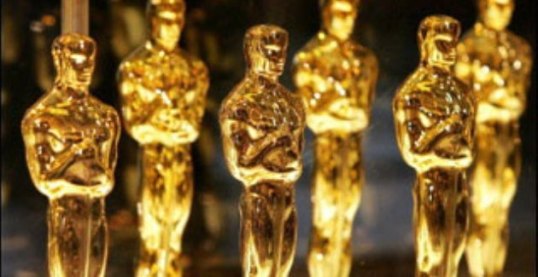
Lisa’s Way Too Early Oscar Predictions For January


2013 oscars

Why are these Oscar predictions “way too early?”

Well, unlike every other movie blogger right now, I am not attempting to predict who and what will be nominated on January 24th.  Instead, with this post, I am attempting to predict which 2017 releases will be nominated next year!  In short, I am attempting to predict what movies and which performers will emerge as Oscar contenders over the next 12 months.

Needless to say, this is more than a little bit foolish on my part.  I haven’t seen any of the films listed below.  Some of these films don’t have release dates and others are coming out so early in the year that, in order to be contenders, they’ll have to be so spectacular that neither the Academy nor the critics end up forgetting about them.  For the most part, the true picture of the Oscar race usually doesn’t start to emerge until the summer.

For now, these predictions are, for the most part, wild guesses and they should be taken with more than just a grain of salt.  Each month, I will revise my predictions.  At the very least, next year, we’ll probably be able to look back at this post and laugh.

(Whenever trying to make early Oscar predictions, one should remember all of the award bloggers who predicted Nicole Kidman would win an Oscar for Grace of Monaco, just to then see the movie make its long-delayed premiere on Lifetime.)

With all that in mind, here are my way too early Oscar predictions for January!

Best Picture

All Eyez on Me

Battle of the Sexes

The Beguiled

Blade Runner 2047

Crown Heights

Darkest Hour

Downsizing

Dunkirk

T2: Trainspotting

War Machine

Again, for the most part, these predictions are a combination of wild guesses, instinct, and wishful thinking.  It’s entirely possible that none of these films will actually be nominated for best picture.  (Some might even end up premiering on Lifetime, you never know.)  Here’s why I think that some of them might be remembered next year at this time:

All Eyez On Me is a biopic of Tupac Shakur.  Assuming the film is done correctly, Shakur’s life would seem to have all the elements that usually go into an Oscar-winning film.

Battle of the Sexes is a film based on a true incident, a 1970s tennis match between a feminist and a self-declared male chauvinist.  It’s directed by the team behind the Oscar-nominated Little Miss Sunshine and it stars two former nominees, Emma Stone and Steve Carell.

The Beguiled might be wishful thinking on my part but, at this point, wishful thinking is all I have to go on for most of these predictions.  The Beguiled is a remake of a Clint Eastwood film and it’s directed by one of my favorite directors, Sofia Coppola!  Much like Battle of the Sexes, its misogynist-gets-what’s-coming-to-him storyline might make it the perfect film for the first year of the Trump presidency.

Blade Runner 2047 is one of the most eagerly anticipated films of 2017 and it’s directed by Denis Villeneuve, who is hot off of Arrival.  The Oscar success of Mad Max: Fury Road proved that a sequel can be a contender.

Every year, at least one contender emerges out of Sundance and this year, it could very well be Crown Heights.  It tells a fact-based story, about a man trying to win his best friend’s release from prison after the latter is wrongly convicted.  That all sounds very Oscar baity.

Speaking of Oscar bait, Darkest Hour stars Gary Oldman as Winston Churchill.  If that doesn’t sound like Oscar bait, I don’t know what does.

Downsizing is Alexander Payne’s latest film.  It’s about a man (Matt Damon), who shrinks himself.  It may not sound like typical Oscar bait but Payne is definitely a favorite of the Academy’s.

Dunkirk is Christopher Nolan’s big epic for 2017.  Will it be another huge success or will it just be bombastic?  We’ll see.  The Academy has a weakness for World War II films and it could be argued that the very successful yet never nominated Nolan is overdue for some Academy recognition.  (It is true that Inception received a nomination for best picture but Nolan himself was snubbed.)

T2: Trainspotting is probably coming out too early in the year to be a legitimate contender but who knows?  The trailer was great.  Danny Boyle is directing it.  And, much as with Blade Runner 2047, Mad Max: Fury Road proved that a well-made and intelligent sequel can find favor with the Academy.

War Machine is described as being a satire about the war in Afghanistan.  Could it be another Big Short?  With Obama out of office, the Academy might be more open to political satire than they’ve been in the past.

Best Director

Danny Boyle for T2: Trainspotting

Sofia Coppola for The Beguiled

Christopher Nolan for Dunkirk

Alexander Payne for Downsizing

Denis Villeneuve for Blade Runner 2047

Again, there’s a lot of random guessing here.  Personally, I’d love to see Sofia Coppola receive a second nomination for best director.  Payne and Boyle are always possibilities and, if Villeneuve’s work on Arrival is ignored this year, nominating him for Blade Runner would be a good way to make up for it.  As for Nolan, he’s going to get nominated some day.   Why not for Dunkirk?

Best Actor

Tom Cruise in American Made

Sam Elliott in The Hero

Hugh Jackman in The Greatest Showman

Logan Lerman in Sidney Hall

Gary Oldman in Darkest Hour

In American Made, Tom Cruise plays a real-life drug runner.  It sounds like one of those change-of-pace roles that often results in an Oscar nomination.  Gary Oldman has never won an Oscar and has only been nominated once.  The Academy might want to rectify that situation by nominating him for playing Winston Churchill.  And finally, Hugh Jackman as P.T. Barnum in a big budget musical that’s scheduled to open on Christmas Day?  It sounds like either a total disaster or the formula for Oscar gold!

Logan Lerman is one of those actors who appears to be destined to eventually be nominated for an Oscar and, in Sidney Hall, he ages over thirty years.  Finally, Sam Elliott is a beloved veteran who has never been nominated.  If The Hero is a hit at Sundance, it’s easy to imagine the Oscar campaign that will follow.

Best Actress

Jessica Chastain in The Zookeeper’s Wife

Judi Dench in Victoria and Abdul

Nicole Kidman in The Beguiled

Emma Stone in Battle of the Sexes

Naomi Watts in The Book of Henry

As of this writing, Meryl Streep does not have a movie scheduled to be released in 2017, which means that another actress will get the sport usually reserved for her.  But who?  Jessica Chastain could be nominated because she’s Jessica Chastain and the Academy loves her.  Judi Dench plays Queen Victoria for a second time in Victoria and Abdul.  The Academy loves movies about British royalty and Dench has already been nominated once for bringing Victoria to life.  Naomi Watts plays a loving but possibly crazy mother in The Book of Henry, which again sounds like a very Oscar baity role.  If Emma Stone doesn’t win for La La Land, the Academy could make it up to her by nominating her for Battle of the Sexes.

As for Nicole Kidman in The Beguiled — well, let’s call that wishful thinking.  My hope is that Sofia Coppola will do great things with The Beguiled and she will get another great performance out of Nicole Kidman.  We’ll see if I’m right.


Best Supporting Actor

Robert Carlyle in T2: Trainspotting

Johnny Depp in Murder on The Orient Experss

James Franco in The Masterpiece

Bill Skarsgard in It

Kevin Spacey in Billionaire Boys Club

Admittedly, the guesses here are fairly random but there is a logic behind each nominee.  Robert Carlyle was great in Trainspotting so he might be just as great in T2.  In Billionaire Boys Club, Kevin Spacey plays a sleazy con artist and that sounds like the type of role with which he could do wonders.  If It is to be a success, Bill Skarsgard is going to have to be a terrifying Pennywise.  If Heath Ledger could win for playing the Joker, surely Skarsgard could be nominated for playing Pennywise.

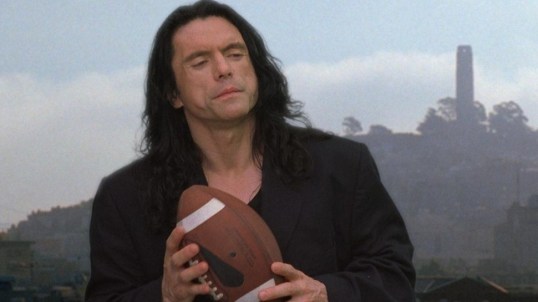
As for James Franco in The Masterpiece … yes, it’s more wishful thinking on my part.  Franco will be playing Tommy Wiseau, the director of the notorious The Room.  Wiseau is, needless to say, an eccentric figure.  Not only do I think James Franco could give an award-worthy performance in the role but I also just like the idea of someone getting an Oscar for playing Tommy Wiseau.

Finally, we have Johnny Depp in Murder on The Orient Express.  Why not?  It seems like someone from that film’s huge cast is destined to be nominated so why not Johnny Depp?


Best Supporting Actress

Jennifer Aniston in The Yellow Birds

Danai Guirra in All Eyez On Me

Kelly MacDonald in T2: Trainspotting

Kristin Scott Thomas in Darkest Hour

Tilda Swinton in War Machine

These guesses are even more random than my guesses for supporting actor.  Jennifer Aniston and Danai Guirra will both be playing mothers who lose their sons.  A lot of people were surprised when Aniston was not nominated for Cake so here’s a chance for the Academy to make it up to her.  As for Kristin Scott Thomas, she’ll be playing Winston Churchill’s wife and the Academy loves historical wives (i.e., Helena Bonham Carter in The King’s Speech and Felicity Jones in The Theory of Everything).

As for the last two predictions, Tilda Swinton is listed because she’s Tilda Swinton.  Kelly MacDonald is listed for the same reason that I put Robert Carlyle down for supporting actor.  She was just so good in the first film.

So, there you go!  Those are my too early Oscar predictions for January!  Will they prove to be accurate?  Probably not.

But we’ll see how things change over the next couple of months.  At the very least, you’ll be able to look back at this post and laugh at me for thinking that … oh, let’s say Battle of the Sexes … would ever be nominated for an Academy Award.

As for me, I’ll be revising my predictions in February.  At least by that point, maybe the Sundance Film Festival will have provided some guidance…

Tommy_Wiseau_in_The_Room

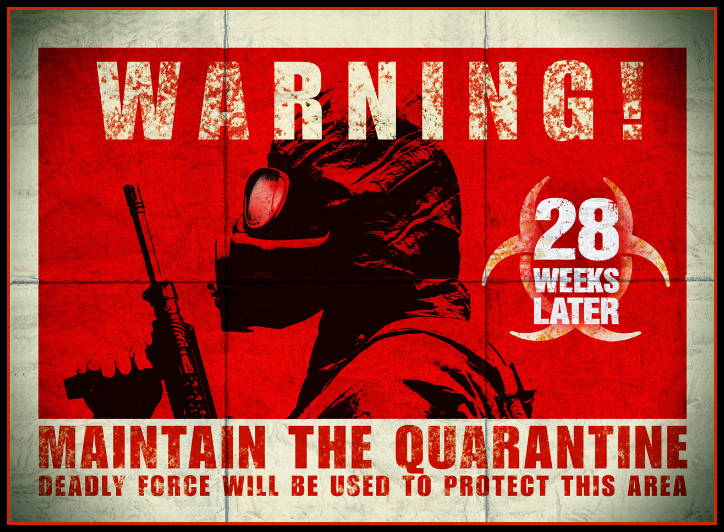
Horror Review: 28 Weeks Later (dir. by Juan Carlos Fresnadillo)


Danny Boyle and Alex Garland’s 28 Days Later was made in such a way that any sequel was almost destined to struggle in its shadow. Their film was not only one of the most influential horror films of the early 2000s, but also an exercise in experimental filmmaking and cinematic reinvention. It fused realism and terror through its digital photography, unconventional pacing, and minimalist score. Any follow-up would have to contend not just with its fresh twist on the zombie mythos (despite the infected not technically being zombies) but also its unique atmosphere, music, and stripped-down aesthetic. Against those odds, 28 Weeks Later manages to stand as an impressive and worthy successor—one that in some respects even surpasses the original.

Spanish director Juan Carlos Fresnadillo approaches the material with a clear reverence for Boyle and Garland’s vision while imprinting his own stylistic and emotional signature on the sequel. From the very first scene, Fresnadillo establishes a tone that blends despair and dread with human frailty. The film opens on a stunningly tense prologue in which Don (a gaunt and haunted Robert Carlyle) and Alice (Catherine McCormack) are living with several others in a rural cottage outside London during the first weeks of the Rage virus outbreak. In this sequence, Fresnadillo distills the central moral dilemma that runs through both films: whether to preserve one’s humanity through compassion or to surrender to pure survival instinct. When Don is forced to choose between rescuing his wife and saving himself, his decision—while horrifying to watch—feels horribly plausible. The following chase through open fields as he flees dozens of Rage-infected attackers captures the raw panic that made Boyle’s original so memorable, yet Fresnadillo shoots it with a sharper sense of chaos and movement. It sets the tone for a story that is both intimate in its human tragedy and apocalyptic in its reach.

Following this intense opening, the film transitions through an introductory credits montage that fills in the aftermath. Don’s escape was not the end of the story but the beginning of a grim reconstruction effort. The British Isles, we are told, were swiftly quarantined when it became clear the infection could not be contained. Twenty-eight weeks later, with the infected population presumed dead from starvation, a U.S.-led NATO force spearheads an ambitious effort to repopulate and rebuild. Led by General Stone (played with austere calm by Idris Elba), the military has converted London’s Isle of Dogs into a heavily fortified safe zone. This enclave represents both restoration and repression—a fragile bubble of civilization built atop the bones of horror.

Within this environment lives Don, now employed as a maintenance manager and struggling to suppress the guilt from his past. The arrival of his two children, Tammy (Imogen Poots) and Andy (Mackintosh Muggleton), who were abroad in Spain during the initial outbreak, reopens emotional wounds he had hoped were sealed. Their reunion, though heartfelt, carries an undercurrent of deception. Don’s explanation of their mother’s fate does not align with what the audience has already witnessed. This dishonesty propels the children into dangerous territory when they decide to sneak out of the Green Zone to retrieve personal belongings from their old cottage. While this act of recklessness fits with youthful impulses and emotional longing, it also feels like the film’s only contrived lapse in logic—an inevitable but frustrating horror trope that sets off the story’s next catastrophe.

What the children discover at the cottage reintroduces the virus in a shocking way. Without realizing it, they bring the Rage infection back into the supposedly secure refuge of London. As soon as containment is broken, the military response escalates with brutal efficiency. General Stone declares a “Code Red,” authorizing the use of extreme measures to eradicate the infected—including indiscriminate firebombing of civilian areas. These scenes echo not only classic apocalyptic tropes but also resonate as a grim reflection of post-9/11 militarism. Many viewers and critics interpreted this act of mass destruction as allegory for the United States’ War on Terror and the ethical corruption of occupation forces. Fresnadillo’s direction, while hinting at this reading, avoids heavy-handed political critique. His portrayal of military overreaction feels less ideological than tragic—a manifestation of fear, confusion, and the blunt-force nature of institutional power. The armed forces are not villains so much as desperate men trapped in an impossible moral quagmire. As in George A. Romero’s The Crazies, which 28 Weeks Later strongly recalls, the destructive consequences stem not from malice but from the futility of trying to maintain order amid chaos.

Where 28 Days Later focused on a small group of survivors and the intimate erosion of morality under crisis, 28 Weeks Later expands the scale dramatically. Fresnadillo transforms Boyle’s compact nightmare into a large-scale urban apocalypse. The sweeping aerial shots of a deserted London—bridges empty, streets silent—hammer home the desolation. When the city is engulfed in flames and gas clouds during the firebombing sequence, the imagery becomes both terrifying and grimly beautiful, a vision of civilization consuming itself. The sequel’s tone is darker and more nihilistic than Boyle’s film, which allowed a trace of optimism in its ending. Here, even innocence becomes a catalyst for doom: it is the children’s actions, driven by love and loss, that inadvertently reignite the infection and condemn the survivors to another wave of horror. This subversion of the “innocent child” trope underscores Fresnadillo’s bleak worldview—where sentiment and humanity, however noble, can still create destruction.

In several ways, 28 Weeks Later aligns more closely with Romero’s Living Dead films than with Boyle’s original. Though Boyle borrowed some of Romero’s thematic DNA, Fresnadillo fully embraces it. The infected may not be reanimated corpses, but the societal collapse, moral ambiguity, and recurring cycles of violence all trace back to Romero’s legacy. One of the sequel’s most striking qualities is its unflinching pessimism: even individuals acting out of love or duty become agents of devastation. The so-called survivors are reduced to primal instincts—running, hiding, killing—in a landscape where institutional power and human decency dissolve together. Fresnadillo makes the action kinetic without glamorizing it. His camera work, switching between chaotic handheld intensity and precise, panoramic destruction, keeps the viewer off balance, mirroring the unpredictability of the apocalypse itself.

The performances elevate the material beyond genre expectations. Robert Carlyle’s portrayal of Don is both gut-wrenching and terrifying. His character’s transformation—from remorseful father to infected embodiment of pure rage—serves as the film’s emotional and thematic anchor. Imogen Poots, in an early standout role, conveys resilience and vulnerability in equal measure, while Jeremy Renner delivers a strong supporting turn as Sergeant Doyle, the soldier torn between obedience and morality. Their performances, though sometimes confined within the film’s relentless pace, enrich its exploration of guilt, loyalty, and the futility of control.

Despite sacrificing some character depth for momentum, the film’s taut editing and grim atmosphere sustain tension throughout. Fresnadillo’s direction never loses sight of his central message: that humanity’s efforts to rebuild are perpetually haunted by its capacity for self-destruction. Even as the few surviving characters reach supposed safety, the final scenes undermine any hope of resolution. The closing image—infected sprinting through the streets of Paris—reminds viewers that, although the city itself appears intact and bustling in daylight, the Rage virus has now breached mainland Europe. This ending shifts the scale of threat from the quarantined British Isles to the broader continent, making containment and redemption feel like dangerous illusions.

As a sequel, 28 Weeks Later earns its place alongside 28 Days Later by honoring the original’s DNA while pushing its boundaries. It retains the visceral dread and societal commentary but broadens the lens to encompass collective failure rather than individual struggle. Fresnadillo’s approach feels colder and more apocalyptic, transforming the story into a study of fear’s infectious nature—social, political, and biological. While his film might not achieve the same creative purity as Boyle’s indie landmark, it succeeds in redefining the tone, expanding the mythology, and pushing the series toward a darker, more cinematic landscape.

In the end, 28 Weeks Later is both a continuation and an escalation—a relentless, despairing study of human fragility under crisis. Its pacing, performances, and imagery combine to create an experience that’s not only horrifying but profoundly unsettling in its realism. If 28 Days Later showed us the collapse of civilization, its sequel reveals the hopeless struggle to rebuild it. Few horror sequels accomplish that much, and fewer still end with such haunting inevitability.