1984’s Silent Madness opens in a mental hospital in New Jersey. In order to cut down on costs, the hospital’s administrators have been giving early release to some of their patients. Dr. Joan Gilmore (Belinda Montgomery) has only been on staff for a few months but even she knows that there’s a risk that a truly dangerous patient could be released. Dr. Gilmore’s worries come true when a homicidal patient named Howard Johns (Solly Marx) disappears from the hospital. Apparently, a computer errors led to Howard being released instead of a patient with a similar name.
Oh, someone screwed up big time!
Or, at least, that’s what Joan believes. In a scene that has to be seen to be believed, the arrogant Dr. Kruger (Roderick Cook) attempts to convince Joan that Howard Johns actually died a while ago and that’s why he’s not in the hospital anymore. Joan demands to see a death certificate. Dr. Kruger is like, “Oh, I don’t know where it is. We’ll have to look for it.” Yeah, that’s the same thing I used to say in college whenever I was running behind on my paying my credit card. “Really? I never received that bill. Can you send it again?”
Knowing that Howard was imprisoned after committing several murders at a sorority house in upstate New York, Joan theorizes that he’s heading back to the college so that he can pick up where he left off. Pretending to be a former member of the sorority, Joan meets the aging house mother, Mrs. Collins (Viveca Lindfors). Mrs. Collins — who often refers to younger women as being “whores” — tells a story of how a hazing ritual gone wrong led to handyman Howard grabbing a nail gun and wiping out a pledge class. When Joan actually spots Howard on campus, she tries to get the sheriff (Sydney Lassick) to do something about it. The sheriff replies that Joan must be seeing things because the hospital called and reported that Howard is deceased. The sheriff than has a beer because he’s the best character in the entire film.
Howard, needless to say, is not dead. He’s hiding out in the sorority house and he’s continuing in his murderous ways. We don’t really learn much about Howard. As the title suggests, he’s a silent killer. That works to the film’s advantage. A silent killer is far more intimidating than one who spends all of his time coming up with bad puns. Because Silent Madness was originally filmed in 3D, Howard enjoys throwing axes and firing nail guns, often straight at the camera.
Silent Madness is a thoroughly ludicrous film but it’s enjoyable as a product of its time. It’s hard not to smile at the thought of a theatrical audience ducking as Howard throws an axe at the camera in 3D. Howard is a properly intimidating killer but the film is totally stolen by Roderick Cook, Viveca Lindfors, and Sydney Lassick, three veteran actors who knew better than to even try to be subtle while appearing in a film like this. Lassick’s performance as the cowardly sheriff is especially enjoyable. We all know that law enforcement is useless in a slasher film. Lassick’s sheriff seems to understand this as well. He’d rather just stay in his office and who can blame him?
Silent Madness is silly and kind of dumb but it’s undeniably entertaining.
Terry Franken (Dwight Schultz), the arrogant director of a new musical that is playing out of town tryouts on the way to Broadway, is shot and killed at the theater. Recently fired stage manager Johnny Whitcomb (Jim Metzler) is arrested for the crime but Perry knows that Johnny is innocent. At the same time that Terry was getting murdered, Perry was in a hospital room recovering from knee surgery. He looked out the hospital window and saw Johnny across the street. Despite Perry providing an alibi, Johnny is still charged with murdering Terry. Broadway legend Amanda Cody (Debbie Reynolds) asks Perry to take Johnny’s case.
This Perry Mason movie featured Perry on the stand, testifying to having seen Johnny. The District Attorney (Valerie Mahaffey) tried to humiliate Perry by suggesting that he was on too many pain killers to be sure what he saw. Never try to humiliate Perry Mason! He’ll not only beat you in court but also make you look like a fool by getting the real murderer to confess while on the stand.
The key to proving Johnny’s innocence was finding the security guard (Rick Aiello) who worked at the theater the night that Terry was killed. Ken (William R. Moses) and his annoying girlfriend Amy (Alexandra Paul) handled that part of the case. Ken is still no Paul Drake, Jr. and his bickering with Amy is like nails on a chalkboard.
I actually remember watching this movie with my aunt when it came on Hallmark one weekend. My aunt enjoyed it. She liked Debbie Reynolds. This one was better than the previous movie. Along with Debbie Reynolds, the cast includes Jerry Orbach and Lori Petty. Dwight Schultz was great as the victim. I still miss William Katt and David Ogden Stiers, though. Perry doesn’t have the same connection to Ken that he had to Paul. David Ogden Stiers was great because, even though he always lost the case, he still seemed like he was a good enough lawyer that he could have won if things had gone differently. These new district attorneys never even have a chance against Perry.
Though the Academy of Motion Picture Arts and Sciences claim that the Oscars honor the best of the year, we all know that there are always worthy films and performances that end up getting overlooked. Sometimes, it’s because the competition too fierce. Sometimes, it’s because the film itself was too controversial. Often, it’s just a case of a film’s quality not being fully recognized until years after its initial released. This series of reviews takes a look at the films and performances that should have been nominated but were, for whatever reason, overlooked. These are the Unnominated.
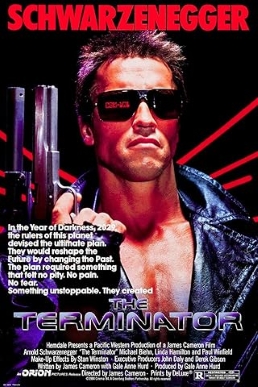
First released in 1984, TheTerminator was the one of the top box office hits of the year. It’s the film that established James Cameron as a filmmaker. It’s the film that made a bona-fide star out of Arnold Schwarzenegger. It’s a film that was imitated a thousand times before it even got its first official sequel. It’s a film that’s still celebrated today. 41 years later, people are still saying, “I’ll be back.” Would Arnold Schwarzenegger ever have become governor of California if he hadn’t first played a killing machine? There’s a reason why his political nickname was the Governator.
And yet, TheTerminator was not nominated for a single Oscar. For all of the explosions and the gunfire and the screaming, it wasn’t even nominated for Best Sound. Some of the special effects may now seem a bit hokey in this age of rampant CGI but it’s still a surprise that TheTerminator was not nominated for Best Visual Effects. The breath-taking action scenes did not result in a nomination for Best Editing. Linda Hamilton was not nominated for her fantastic performance as Sarah Connor, a young woman who finds herself being pursued by a killer cyborg from the future. Arnold Schwarzenegger was not nominated for playing one of the most memorable villains of the past 40 years. Those who claim that Schwarzenegger was just playing himself are being overly glib. Anyone could have said, “I’ll be back.” It took Schwarzenegger’s delivery to make it a great line.
The lack of nominations aren’t really not a surprise, of course. The Academy has only recently started to show an openness to nominating genre films for major awards and, even now, a genre film has to be considered a “cultural event” to even get a nomination. Black Panther, Get Out, and even Mad Max: Fury Road and Dune were all nominated because it was felt that they had transcended their genre origins. TheTerminator is a sci-fi action movie and it’s proud to be a sci-fi action movie. (Terminator 2: Judgment Day, it could be argued, transcended its genre origins but it was released in 1991 and Silence of the Lambs was destined to be the genre nominee that year.) It’s also so relentlessly paced and intelligently written and directed that it’s a film that, even after all these years, it can still leave you breathless. Nominated or not, The Terminator is a film that grabs your attention and holds it for a full 107 minutes. There’s not many films that can make that claim.
TheTerminator is a film that has held up surprisingly well. (It’s certainly held up better than some of its more recent sequels.) The performances of Linda Hamilton, Michael Biehn, and Arnold Schwarzenegger still work. It’s still terrifying to watch as The Terminator relentlessly kills everyone that he comes into contact with. (One thing that always gets me about the Terminator is that, even though he’s huge and superstrong and could probably physically rip anyone he wanted to apart, he still carries and uses a gun. This makes him seem like even more of a bully.) The Terminator is a machine and what makes him especially intimidating is that he doesn’t care if people see him coming or if they witness his crimes. He has one function and that’s all he worries about. When Michael Biehn first shows up, you can’t help but wonder why this guy, with his slight build and his somewhat nervous mannerisms, would be sent to try to stop the Terminator. Of course, by the end of the movie, you understand.
(And what an ending! The sight of those clouds, Linda Hamilton’s delivery of her final line, and the feeling that the future has already been determined, it all definitely makes an impression that has managed to survive every sequel after JudgmentDay. There’s a reason why Skynet — much like “I’ll be back” — has taken on a cultural life of its own.)
There were a lot of very good films that were nominated for Oscars in 1984. The Terminator, much like Once Upon A Time In America, was not one of them but it will still never be forgotten.
Alex (Anthony Edwards) is a patrolman assigned to the nicest neighborhood in Philadelphia but, after he gets in trouble for pulling over a wealthy businessman (David Clennon), he is told that he can either be suspended or he can take a transfer downtown, to the Diamond Street precinct. Alex takes the transfer, even though everyone on the force says that “not even the Terminator would go to Diamond Street.” Alex gets assigned to work with seasoned Sgt. Dennis Curren (Forest Whitaker), who is still emotionally scarred by the death of his former partner and does not want to have to babysit a naive white cop from the suburbs, especially one who is obsessed with the Beach Boys. At first, Alex struggles with his new assignment and his new partner but, when an old friend is murdered by a notorious hitman (Joe Pantoliano), Alex is determined to crack the case and bring the killer to justice.
Downtown is a combination of other, better cop films: Alex’s situation is Beverly Hills Cop in reverse and his partnership with Dennis is lifted straight from Lethal Weapon. Art Evans is the captain who is always yelling at Alex and Dennis and telling them to drop the case and the character is so familiar that I had to check to make sure that Evans had not played the same role in Lethal Weapon. As the bad guys, Clennon and Pantoliano could just have easily been replaced by Beverly Hills Cop‘s Steven Berkoff and Jonathan Banks and no one would have noticed. The only real difference is that Downtown is neither as exciting nor as funny as those two films. Downtown was directed by Richard Benjamin, who will never be known as a particularly versatile filmmaker and who struggles to balance the fish-out-of-water comedy with some surprisingly brutal violence. Beverly Hills Cops had Eddie Murphy and Lethal Weapon had Mel Gibson and Danny Glover. Downtown has Anthony Edwards and Forest Whitaker, who are both good actors but who both seem to be woefully miscast here. (If Downtown were made today, Whitaker could play Dennis but, in 1990, he was too young to be the cop who was “too old for this shit.”) Of the many Lethal Weapon ripoffs that came out in late 80s and early 90s, Downtown is one of the most forgettable.
— Phillip Jeffries (David Bowie) in Twin Peaks: Fire Walk With Me (1992)
Even among fans of the show, Twin Peaks: Fire Walk With Me is controversial.
If you read Reflections: An Oral History of Twin Peaks, you’ll discover that many members of the television show’s cast either didn’t want to be involved in the film or didn’t care much for it when it came out. Fearful of being typecast, Kyle MacLachlan only agreed to play Dale Cooper on the condition that his role be greatly reduced. (Was it that fear of being typecast as clean-cut Dale Cooper that led to MacLachlan later appearing in films like Showgirls?) Neither Lara Flynn Boyle nor Sherilyn Fenn could work the film into their schedules.
When Twin Peaks: Fire Walk With Me premiered at Cannes, it was reportedly booed by the same critics who previously applauded Lynch’s Wild at Heart and who, years later, would again applaud Mulholland Drive. When it was released in the United States, the film was savaged by critics and a notorious box office flop. Quentin Tarantino, previously a fan of Lynch’s, has been very outspoken about his hatred of Twin Peaks: Fire Walk With Me. When I first told people that we would be looking back at Twin Peaks for this site, quite a few replied with, “Even the movie?”
And yet, there are many people, like me, who consider Twin Peaks: Fire Walk With Me to be one of David Lynch’s most haunting films.
It’s also one of his most straight forward. Twin Peaks: Fire Walk With Me is a prequel, dealing with the events leading up to the death of Laura Palmer. Going into the film, the viewer already knows that Laura Palmer (Sheryl Lee) is full of secrets. They know that she is using drugs. They know that she is dating Bobby (Dana Ashbrook), while secretly seeing James (James Marshall). They know about her diary and her relationship with the reclusive Harold (Lenny Von Dohlen). They know that she is a friend to innocent Donna Hayward (Moria Kelly, somewhat awkwardly taking the place of Lara Flynn Boyle). Even more importantly, they know that she has spent the last six years of her life being abused by BOB (Frank Silva) and that BOB is her father, Leland Palmer (Ray Wise). The viewer starts the story knowing how it is going to end.
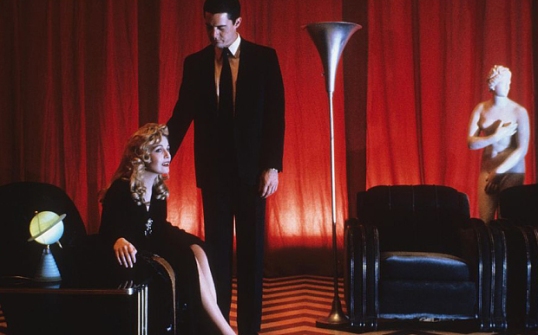
Things do get off to a somewhat shaky start with a nearly 20-minute prologue that basically plays like a prequel to the prequel. Theresa Banks, who was mentioned in the show’s pilot, has been murdered and FBI director Gordon Cole (David Lynch) assigns agents Chester Desmond (Chris Isaak) and Sam Stanley (Kiefer Sutherland) to investigate. Chester and Sam’s investigation basically amounts to a quick reenactment of the first season of Twin Peaks, with the agents discovering that Theresa was involved in drugs and prostitution. When Chester vanishes, Dale Cooper is sent to investigate. Harry Dean Stanton shows up as the manager of a trailer park and David Bowie has an odd cameo as a Southern-accented FBI agent who has just returned from the Black Lodge but otherwise, the start of the film almost feels like a satire of Lynch’s style.
But then, finally, we hear the familiar theme music and the “Welcome to Twin Peaks” sign appears.
“And the angel’s wouldn’t help you. Because they’ve all gone away.”
— Laura Palmer (Sheryl Lee), Twin Peaks: Fire Walk With Me (1992)
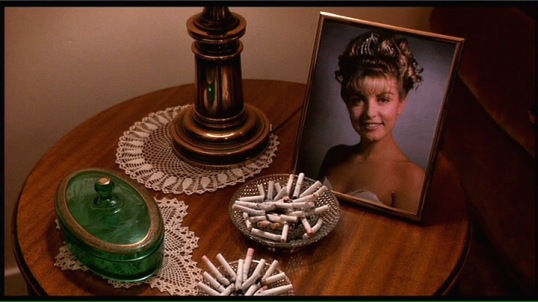
A year has passed since Theresa Banks was murdered. The rest of the film deals with the final few days of the life of doomed homecoming queen Laura Palmer. Laura smiles in public but cries in private. She is full of secrets that she feels that she has to hide from a town that has literally idolized her. She has visions of terrifying men creeping through her life and each day, she doesn’t know whether it will be BOB or her father waiting for her at home. She knows that the world considers her to be beautiful but she also know that, within human nature, there is a desire to both conquer and destroy beauty. When she sleeps, she has disturbing dreams that she cannot understand but that she knows are important. At a time when everyone says she should be happy to alive, all she can think about is death. Everywhere she goes, the male gaze follows and everything that should be liberating just feels her leaving more trapped. For all the complaints that Twin Peaks: Fire Walk With Me is somehow too strange to be understood, it’s not a strange film at all. This is David Lynch at his most straight forward. Anyone who thinks that Laura’s story is incomprehensible has never been a 17 year-old girl.
This is the bleakest of all of David Lynch’s films. There is none of broad humor or intentional camp that distinguished the TV show. After the show’s occasionally cartoonish second season, the film served as a trip into the heart of the darkness that was always beating right underneath the surface of Twin Peaks. It’s interesting how few of the show’s regulars actually show up in Twin Peaks: Fire Walk With Me. None of the characters who represented goodness are present. There’s no Doc Hayward. No Sheriff Truman. No Deputies Andy or Hawk. No Pete Martell. No Bookhouse Boys. Scenes were filmed for some of them but they didn’t make it into the final cut because their tone did not fit with the story that Lynch was seeking to tell. The Hornes, Dr. Jacoby, Josie, none of them are present either.
Instead, there’s just Larua and her father. As much as they try to deny it, Laura knows that she is going to die and Leland knows that he is going to kill her. Killer BOB and the denziens of the Black Lodge may be scary but what’s truly terrifying is the sight of a girl living in fear of her own father. Is Leland possessed by BOB or is BOB simply his way of excusing his own actions? If not for Leland’s sickness, would BOB even exist? When Laura shouts, “Who are you!?” at the spirit of BOB, she speaks for every victim of abuse who is still struggling to understand why it happened. For all the talk of the Black Lodge and all the surreal moments, the horror of this film is very much the horror of reality. Leland’s abuse of Laura is not terrifying because Leland is possessed by BOB. It’s terrifying because Leland is her father
David Lynch directs the film as if it where a living nightmare. This is especially evident in scenes like the one where, at the dinner table, Leland switches from being kindly to abusive while Laura recoils in fear and her mother (Grace Zabriskie) begs Leland to stop. It’s a hard scene to watch and yet, it’s a scene that is so brilliantly acted and directed that you can’t look away. As brilliant as Ray Wise and Grace Zabriskie are, it’s Sheryl Lee who (rightly) dominates the scene and the rest of the film, giving a bravely vulnerable and emotionally raw performance. In Reflections, Sheryl Lee speaks candidly about the difficulty of letting go of Laura after filming had been completed. She became Laura and gave a performance that anchors this absolutely terrifying film.
“Mr. Lynch’s taste for brain-dead grotesque has lost its novelty.”
— Janet Maslin
“It’s not the worst movie ever made; it just seems to be”
— Vincent Canby
If you need proof that critics routinely don’t know what they’re talking about, just go read some of the original reviews of Twin Peaks: Fire Walk With Me.
And yet, having just rewatched the show and now the movie, I can understand why critics and audiences were baffled by this film. This is not Twin Peaks the TV show. There is no light to be found here. There is no comic relief. (Even Bobby Briggs, who had become something of a goofy anti-hero by the time the series ended, is seen here shooting a man in the head.) There is no exit and there is no hope. In the end, the film’s only comfort comes from knowing that Laura was able to save one person before dying. It’s not easy to watch but, at the same time, it’s almost impossible to look away. The film ends on Laura’s spirit smiling and, for the first time, the smile feels real. Even if she’s now trapped in the Black Lodge, she’s still free from her father.
Since this was a prequel, it didn’t offer up any answers to the questions that were left up in the air by the show’s 2nd season finale. Fortunately, those questions will be answered (or, then again, they may not be) when the third season premieres on Showtime on May 21st.

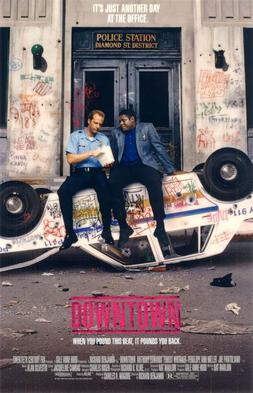 Alex (Anthony Edwards) is a patrolman assigned to the nicest neighborhood in Philadelphia but, after he gets in trouble for pulling over a wealthy businessman (David Clennon), he is told that he can either be suspended or he can take a transfer downtown, to the Diamond Street precinct. Alex takes the transfer, even though everyone on the force says that “not even the Terminator would go to Diamond Street.” Alex gets assigned to work with seasoned Sgt. Dennis Curren (Forest Whitaker), who is still emotionally scarred by the death of his former partner and does not want to have to babysit a naive white cop from the suburbs, especially one who is obsessed with the Beach Boys. At first, Alex struggles with his new assignment and his new partner but, when an old friend is murdered by a notorious hitman (Joe Pantoliano), Alex is determined to crack the case and bring the killer to justice.

 Through the Shattered Lens