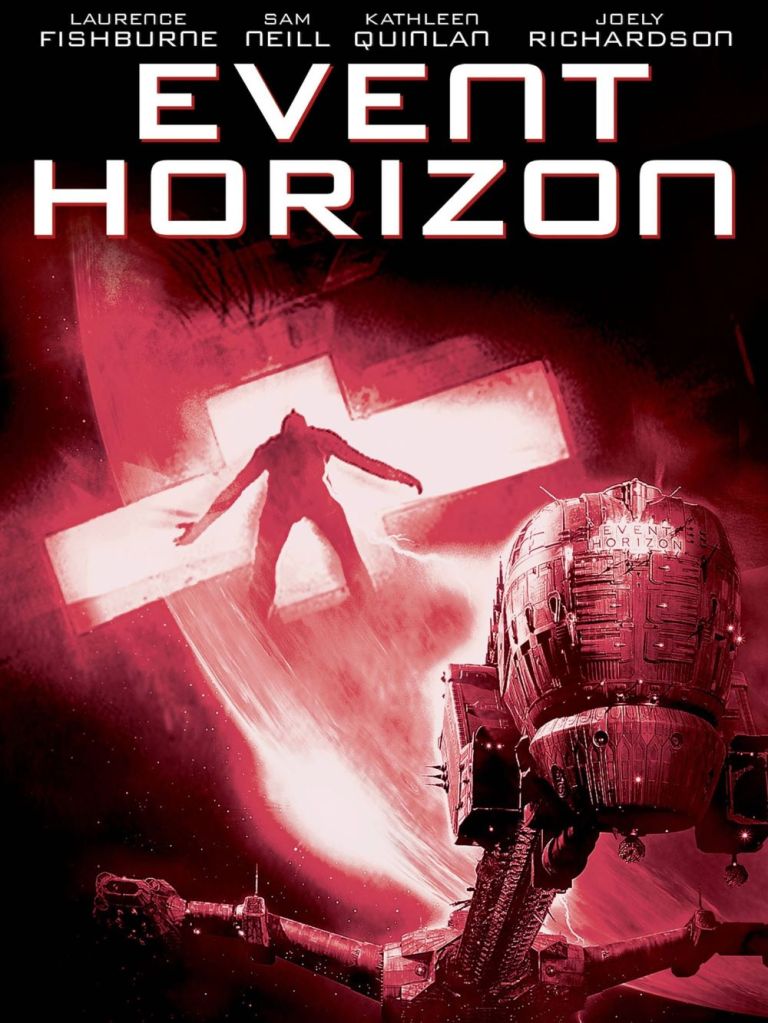
Horror Review: Event Horizon (dir. by Paul W. S. Anderson)


“You know nothing. Hell is only a word. The reality is much, much worse.” — Dr. Weir

Paul W.S. Anderson’s 1997 film Event Horizon stands out as a memorable mix of science fiction and horror, remembered for its gripping atmosphere and disturbing visuals. The story is set in 2047: a rescue crew aboard the Lewis and Clark is sent out to recover the long-missing spaceship Event Horizon, a vessel built to test a new kind of faster-than-light travel. Onboard with them is Dr. William Weir, the Event Horizon’s creator, who explains that the ship vanished after first activating its “gravity drive,” which can fold space to allow for instant travel across vast cosmic distances.

Soon after reaching the drifting Event Horizon, the crew discovers signs of mass violence and horror. They recover a disturbing audio message and realize something traumatic happened to the original crew. As they search for survivors, they experience intense and personal hallucinations—memories and fears brought to life by the ship. It becomes clear that the Event Horizon didn’t just jump through space; it traveled to a place outside reality, a nightmarish interdimensional realm resembling hell.

What makes Event Horizon particularly unique is its concept of hell as an alternate dimension that can infect and corrupt whatever or whoever crosses into it. The ship’s gravity drive doesn’t simply facilitate faster travel—it accidentally opens a gateway to this chaotic, malevolent place. This portrayal of hell as a dangerous interdimensional reality that preys on minds and bodies echoes the idea found in the massive gaming property Warhammer 40K, where hell is depicted as the Warp, a dimension of chaos that corrupts and drives people insane. Like the Warp, the film’s hell is an unpredictable, hostile realm where sanity and physical form break down, infecting and warping everything that comes into contact.

Visually, the film relies on claustrophobic corridors, flickering lights, and unsettling sounds to keep the audience off-balance. The design of the ship itself—part gothic cathedral, part industrial nightmare—adds to the sense of unease and dread throughout. The use of practical effects and detailed sets grounds the sci-fi terror in something tangible, making it all feel more immediate and believable.

Event Horizon also hints at bigger philosophical questions: how far should science go, and what happens when the drive for knowledge is unchecked by ethics or humility? The gravity drive is a technological wonder, but it’s treated with little caution by its inventor, and the catastrophic results suggest that some discoveries may be better left unexplored. The ship becomes both a literal and figurative vehicle for exploring the limits of human ambition and the dangers of pushing beyond them.

As the movie builds toward its climax, the rescue crew faces increasingly desperate odds. The possessed Dr. Weir, now an outright villain, sees the hellish dimension the gravity drive visited as the next step for humanity—a place of chaos and suffering. Multiple characters die in gruesome ways, and the survivors have to fight their own fears and the haunted ship itself. The ending is chilling and ambiguous, leaving open the possibility that the ship’s evil has not been fully contained.

At release, Event Horizon divided critics and audiences. Some found the violence and nightmare imagery too intense or the story too messy to follow. Others praised its ambition and the way it blends psychological horror with cosmic sci-fi. Over the years, the film has developed a cult reputation, frequently cited as one of the more effective and original space horror movies. Its legacy can be seen in later media, especially in video games that tackle similar haunted spaceship scenarios.

However, the film is not without flaws. Many viewers and critics point out uneven pacing, especially in the second half where tension sometimes drains away. The characters often act inconsistently or make choices that feel unrealistic for trained astronauts, which undermines the suspense. The script’s tonal shifts—from serious psychological drama to moments that unintentionally verge on camp—can jolt the viewer out of the experience. The use of jump scares is sometimes predictable, and the film’s heavy reliance on loud, chaotic sequences instead of quiet suspense can feel overwhelming. Some CGI effects haven’t aged well, contrasting with the otherwise impressive practical effects and set design. Acting performances are mixed too; while Sam Neill and Laurence Fishburne are strong, some supporting cast members lack conviction, making emotional engagement uneven.

Importantly, Event Horizon represents Paul W.S. Anderson at his most subtle and effective in directing. Compared to many of his later films, where his style often becomes frenetic and unchecked—possibly due to a lack of producer control—Event Horizon is more controlled, atmospheric, and haunting. This balance between style and substance makes it one of Anderson’s better directorial works, if not his best to date. The film showcases his interest in spatial geography, the use of negative space, and claustrophobic production design, all elements he would expand on in his later work but never as effectively deployed as here. The haunting visual touches, combined with his ability to direct actors and maintain tension, set Event Horizon apart from his more bombastic, less focused later entries.

Despite its flaws, Event Horizon remains gripping and memorable. Its strengths lie in combining deeply personal psychological horror with the vast, terrifying unknown of space and alternate realities. The film explores not just external threats, but also how guilt, fear, and trauma can be weaponized by forces beyond human understanding. For viewers seeking more than a standard haunted spaceship story, Event Horizon offers a disturbing, thought-provoking glimpse into the dark frontier of science, faith, and madness. It stands as a cult classic of sci-fi horror that continues to inspire discussion about the dangers of pushing too far into the unknown.
April Noir: Collateral (dir by Michael Mann)


In 2004’s Collateral, Jamie Foxx stars as Max, a taxicab driver who is hoping, in those days before Uber, to start his own limousine company.  When we first see him, he’s giving a ride to a federal prosecutor named Annie (Jada Pinkett Smith) and he’s even getting her phone number after he drops her off at work.  Unfortunately, for Max, his next passenger is a bit less friendly.

Vincent (Tom Cruise), with his gray hair that matches his suit, is polite, quiet, and direct when he speaks.  He carries a briefcase with him everywhere that he goes and anyone who tries to take the briefcase soon discovers just how far Vincent will go to hold onto it.  Vincent pays Max $600 to drive him around Los Angeles for the night.  Vincent has a lot of business that he needs to attend to.  Max agrees, not realizing until it’s too late that Vincent is a hired assassin and that his business is killing people.  Vincent has been hired to wipe out a collection of crooks and lawyers and, though Vincent is careful not to reveal his emotions, it’s obvious that he’s looking forward to the challenge.

To his credit, Max doesn’t really have any interest in being a part of Max’s killing spree but he soon finds himself unable to escape from Vincent and being forced to drive from location to location.  Along the way, Vincent and Max engage in debates of both morality and philosophy.  Vincent sees death as just being a part of the job.  Max is horrified, especially when people who haven’t done anything wrong end up as collateral damage in Vincent’s killing spree.  The truth of the matter is that, even if Max hadn’t picked up Vincent, there’s no guarantee that he wouldn’t have picked up some other madman.  As a taxi driver, Max surrenders his control once he unlocks the door and allows someone to get in the backseat.  Sometimes, he gets a passenger like Annie.  Other times, he’s going to get a passenger like Vincent.  Somewhat improbably, Vincent and Annie turns out to be connected and Max’s chance encounter with her becomes even more important.

Because this is a Michael Mann film, Los Angeles is as much a character in this film as Max and Vincent.  Mann captures the shadowy darkness of the city at the night and the feeling that both opportunity and danger could lurk around every corner.  Claustrophobic scenes in the taxi cab are mixed with scenes in an equally claustrophobic (though for different reasons) club.  The film’s haunting final image takes place not in the cab but instead on a train.  Everyone is heading somewhere and, at some point during the film, both Vincent and Max deal with the feeling of having no control over where they’ll end up.

When Collateral first came out in 2004, I remember that a lot of people were shocked to see Cruise playing a villain.  Cruise does give one of his best performances here, playing yet another one of Mann’s cool and efficient professionals.  Strangely enough, Jamie Foxx is the one who was nominated for an Oscar, even though he’s actually a little on the boring side as Max.  (In all fairness, Max is meant to be the conventional member of the film’s involuntary partnership.)  The film is dominated by Cruise and his performance is still powerful to this day.

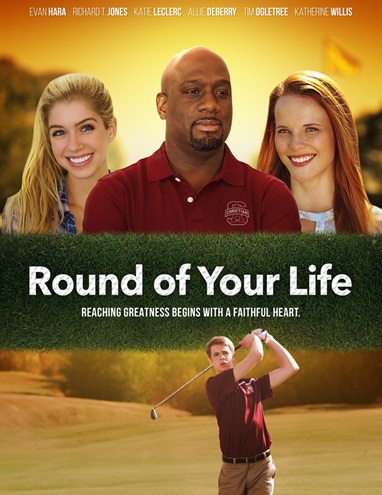
May Positivity: Round Of Your Life (dir by Dylan Thomas Ellis)


2019’s Round Of Your Life tells the story of the Collins family.

Carl Collins (Boo Arnold) is a retired PGA golfer who is still considered to be one of the best to ever play the game.  He’s put a lot of pressure on his two sons to follow in his footsteps.  Tucker (Tim Ogletree), who likes to tell jokes and doesn’t always follow the best golf course etiquette, has just started on the PGA tour.  Meanwhile, 15 year-old Taylor (Evan Hara) would rather play video games than stick with all of the hard work needed to become a golf pro.

When Taylor fails to make the Varsity Golf Team at his high school, an angry Carl goes for a late night drive.  Unfortunately, his car is hit by another car, this one being driven by a teenage girl who was too busy texting to pay attention to the road.  Carl ends up in a coma.  And Taylor ends up determined to join the golf team and make his father proud.

Coach Wilson (Richard T. Jones) is skeptical about giving Taylor a second chance to play for the school.  But then Wilson sees Taylor playing a round with his best player, Connor (Blair Jackson, who gives the film’s best performance).  Realizing that Taylor actually is a good golfer, Wilson allows him to join the junior varsity team.  When one of the varsity players is caught cheating, Taylor moves up to varsity.  He also starts a tentative relationship with Bailey (Alexandria DeBerry), even though Connor considers Bailey to be his girlfriend.

Tucker, meanwhile, starts going out with Minka (Katie Leclerc), a nurse at the hospital.  A surprisingly large amount of screentime is devoted to Tucker and Minka’s romance, despite the fact that there’s not really much of a story there.  Both Tucker and Minka are single and they start dating.  One gets the feeling that the main reason this storyline was given such prominence in the film is because the actor playing Tucker also wrote the film.

This is a faith-based film, so there’s naturally a lot of emphasis on everyone praying for Carl’s recovery.  This is the type of film where people discuss attending a Fellowship of Christian Athletes meeting without a hint of irony.  This is also the rare high school film where no one ever curses, there’s no drinking to be found, and all of the relationships are relatively chaste.  Whether or not the viewer finds this to be realistic would depend on what type of high school they went to.  My high school experience was a bit different.

When the film started, I had a problem with the amount of pressure that Carl put on his sons to follow in his footsteps.  That was especially true in the case of Taylor, who seemed to be a good kid who just happened to be a bit more laid back than either his father or his brother.  Though it’s not made apparent until the film is nearly over, Round Of Your Life did share my concerns.  Visually, Round of Your Life is fairly bland and the twist at the end won’t be a huge shock to anyone who has ever seen one of these films before.  But there is a likable earnestness to this movie.  And, needless to say, the golf courses were lovely.

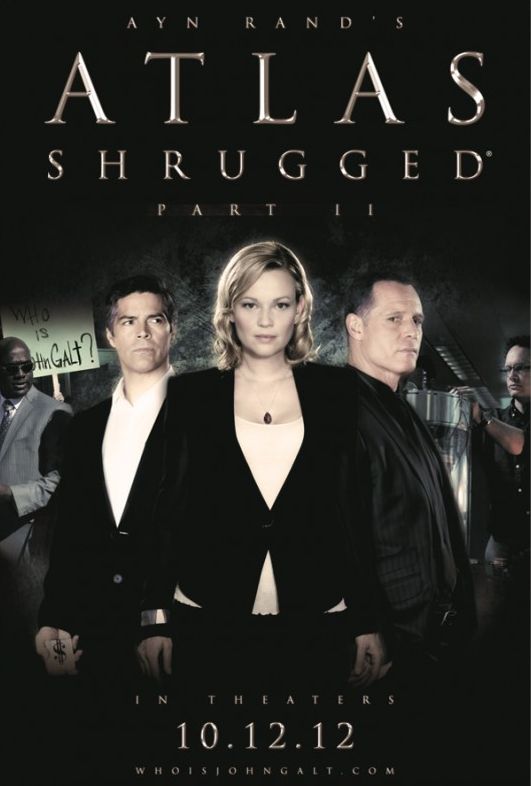
Film Review: Atlas Shrugged, Part II (dir by John Putch)


2012’s Atlas Shrugged: Part II picks up where Part I left off.

The time is still the near future.  (Part I specifically set the story as taking place five years into the future.  Part II declines to use a specific date but it does feature some news personalities playing themselves so it’s still clearly only meant to be a few years from 2012.)  The economy has gotten even worse.  The poor are only getting poorer while the rich are getting richer.  Under the direction of Head of State Thompson (Ray Wise) and his main economic advisor, Wesley Mouch (Paul McCrane), the government has nationalized nearly every business.  Halfway through the film, Thompson declares a national emergency and uses the Fair Share Law to invoke Directive 10-289.  All inventors, businessmen, and other creative people are required to sign their patents over to the government and to stop trying to develop now techniques.  Wages are frozen.  No one can be fired and no one can be hired.  Creative thinking is discouraged.  Asking questions or expressing doubt is forbidden.  People are encouraged to snitch on anyone not following the Directive.  Thompson and Mouch insist that it’s for the “good of the people,” and anyone who disagrees runs the risk of being dragged into court and sent to prison for ten years.  Meanwhile, gas now costs $42.00 a gallon.  One of the funnier moments of the film features someone paying $865.72 to fill up a truck.

Dagny Taggart (Samantha Mathis), the Vice President of Taggart Transcontinental Railways, is still trying to discover who invented an experimental motor that she found hidden away in a mine.  The motor could potentially change the way that goods are transported but it appears to be missing one component.  Unfortunately, all of the great scientists and inventors have been vanishing, with many of them leaving behind notes that ask, “Who is John Galt?”  Meanwhile, Dagny’s lover, Hank Rearden (Jason Beghe), fights to protect Rearden Metal from being taken over by the government and Dagny’s brother, James (Patrick Fabian), sells out to Wesley Mouch with the end result being that there’s no one left at Taggart Transcontinental with the intelligence or the experience necessary to keep two trains from colliding in a tunnel.

Given that Ayn Rand herself was an atheist who wrote very critically of religion, it’s interesting how much of Atlas Shrugged: Part II feels like one of those evangelical films where the Rapture comes and the entire world falls apart because all of the believers have suddenly vanished.  In the case of Atlas Shrugged, the world falls apart because all of the creatives and all of the leaders of industry and all of the innovative thinkers have abandoned it so that they can create a new community with John Galt.  (They’ve “stopped the motor of the world.”)  In many ways, this is the ultimate in wish fulfillment, a way of declaring, “They’ll miss me when I’m gone!”  Indeed, the majority of people who keep a copy of Rand’s novel displayed on their bookcase do so because they believe that they would be one of the lucky ones who was approached by Galt.  No one expects that they’ll be the person left behind to try to run the railroad.  It’s a bit like how like the most strident Marxist activists always assume they’ll be the ones organizing the workers as opposed to being a worker themselves.

Not surprisingly, the same critics who attacked Part I didn’t care much for Atlas Shrugged Part II.  When I first saw it, I thought the film was a bit too long and I was annoyed that, with the exception of a few minutes at the end, the film didn’t really seem to move the story forward.  At the same time, just as with the first film, I appreciated the fact that the second film was proudly contrarian in its portrayal of the government as being inherently incompetent.  After all, this was 2012, back in the “good government” era, when a lot of people still reflexively assumed that the government was staffed only by hyper-competent policy wonks who knew what they were doing and who were only concerned with making sure that “the trains ran on time,” to borrow an old expression.

Rewatching the film this weekend, I have to say that I actually appreciated Atlas Shrugged Part II a bit more than the first time I watched it.  Yes, Part II was still a bit too long and the domestic drama between Hank and his wife fell flat but Part II is still a marked improvement on the first film.  Some of that is because Part II had a higher budget than Part I and, as a result, it didn’t look as cheap as the first film.  The corporate offices looked like actual corporate offices and the factories looked like real factories.  Secondly, the second film had an entirely different cast from the first film.  Samantha Mathis, Jason Beghe, and especially Patrick Fabian were clear improvements on the actors who previously played their roles.  That’s especially important when it comes to Mathis and Beghe because, as opposed to the first film, Part II convinces the viewer that  Dagny and Hank actually are as important as they think they are.  When the trains collide in the tunnel, the viewer never doubts that Mathis’s Dagny could have prevented the disaster if not for the government’s attempts to force her out of her own company.  As well, the viewer never doubts that Beghe’s Hank would fight to the end to protect his business, even if it means prison.  One wouldn’t have necessarily believed that while watching the first film.

Finally, having lived through the COVID era, the film’s portrait of government overreach and incompetence feels a lot more plausible when watched today.  One doesn’t have to be a fan of Rand’s philosophy or agree with her solutions to see the parallels between Directive 10-289 and the policies that led to children being kept out of schools and numerous small business having to shut their doors.  In an era when most people’s faith in governmental institutions has been broken to such an extent that it might never be fixed in our lifetime, Atlas Shrugged Part II resonates.  Whereas the film once felt subversive, now it feels downright prophetic.

Retro Television Reviews: California Dreams 2.11 “Vote of Confidence” and 2.12 “The Year of the Woo”


Welcome to Retro Television Reviews, a feature where we review some of our favorite and least favorite shows of the past!  On Saturdays, I will be reviewing California Dreams, which ran on NBC from 1992 to 1996.  The entire show is currently streaming on YouTube!

This week, it’s all about family!

Episode 2.11 “Vote of Confidence”

(Dir by Don Barnhart, originally aired on November 13th, 1993)

Pacific Coast High School is in the midst of campaign fever!  Who will be elected student council president?  Will it be the crazy environmentalist who says that she’s going to transform the cafeteria into a vegetarian paradise?  Or will it be Harvey, a rich kid who announces that his motto is, “I already have money!  Now, I want power!”

Or will it be Jake!?  Yes, Jake is running for president because he’s feeling inadequate when compared to his older brother Kyle.  Kyle is an Olympic hopeful who is currently attending Harvard and who was apparently also the presidents of the PCHS student council when he was in high school.  How come we haven’t heard anything about Kyle before?  Jake’s brother being an Olympic hopeful seems like something that would have been mentioned earlier.

Jake campaigns by riding his motorcycle through the school’s hallways and singing a country song about how “I’m a regular guy who does what he says.”  It’s not a bad song and Jake appears to actually be singing in the scenes in which he performs, as opposed to just lip-syncing.  In other words, this is the episode that establishes that Jake was actually too talented to be a member of a lame band like California Dreams.

Unfortunately, before Jake announced his candidacy, the Dreams agreed to play Harvey’s victory rally.  The Dreams withdraw from Harvey’s rally but — uh oh! — Sly already spend the two hundred dollars!  Harvey agrees to forgive the debt on the condition that Tiffani go on a date with him.  Jake is surprisingly okay with this, considering that he’s been dating Tiffani for a few episodes.  Perhaps this episode was filmed before Jake and Tiffani became a couple and was shown out-of-order.  Once again, NBC just didn’t care.

Anyway, Jake realizes that he ran for President for the wrong reasons and he resigns from office.  Harvey becomes president in his place.  Yay, rich people!

Episode 2.12 “The Year of the Woo”

(Dir by Don Barnhart, originally aired on November 20th, 1993)

The Dreams have a gig in Burbank, for which they’ll get paid $1,000.  But, the van’s transmission is shot!  Fortunately, Sam’s family had just sent her $800 in “lucky money” that she can use to buy a plane ticket to go back to Hong Kong for the Chinese New Year.  Why couldn’t they have just bought her the tickets?

Anyway, the Dreams convince Sam to pay for a new transmission, with the promise that they’ll pay her back with the money they make from the gig. However, it turns out that Gus the Mechanic isn’t good at his job. Not only does the transmission still not work but he refuses to refund the money.  (Huh?)   Now, Sam has no money and cannot return to Hong Kong. The Dreams are the worst people in the world.

With the help of Tiffani, The Dreams win back the $800 in a poker game but it’s too late for Sam to book a flight.  So, they throw a really cheap party at Sharky’s and they fly Sam’s parents out to California.  (Oddly, Sam’s parents speak in English, even when they’re talking to Sam.  It’s a bit odd that they don’t just speak to each other in Chinese, seeing as how that’s presumably how they spent the last 16 years communicating with each other.)  Sam’s excited but, before she can spend any time with her family, she still has to sing a song with the Dreams.  Imagine having to work at your own party.

This episode was not terrible.  One thing that set this show apart from other Peter Engel shows is that the cast actually had chemistry so they’re kind of fun to watch, even when the story itself is pretty stupid.  That said, the main theme of this episode — again — seemed to be the Dreams are only willing to do the right thing as a last resort.  Even though they fly Sam’s parents out to California with their poker money, there’s still no scene in which the Dreams themselves realize that guilting Sam into paying for the van was kind of a jerky thing to do.

Oh well!  At least everything worked out in the end!

Retro Television Reviews: California Dreams 2.8 “High Plains Dreamer” and 2.9 “Bwa Ha Ha Means I Love You”


Welcome to Retro Television Reviews, a feature where we review some of our favorite and least favorite shows of the past!  On Saturdays, I will be reviewing California Dreams, which ran on NBC from 1992 to 1996.  The entire show is currently streaming on YouTube!

This week, Tony turns out to be a total coward while the Dreams attempt to record their first album.

But first, the opening  credits.  Again, because the post-Jenny opening credits for season two have not been uploaded to YouTube, you have to imagine Jennie Kwan in the place of Heidi Noelle Lenhart.

Episode 2.8 “High Plains Dreamer”

(Directed by Patrick Maloney, originally aired on October 30th, 1993)

Oh Good God.

Like all TNBC shows, California Dreams had its share of bad episodes.  In fact, technically, you could argue that the majority of them were bad.  It’s not like anyone was trying to win an Emmy for a writing or directing a show like Saved By The Bell, Hang Time, or California Dreams.  Still, even the knowledge that we’re not exactly dealing with Friends or Seinfeld here, left me unprepared for the crappiness of High Plans Drifter.

High Plains Drifter is the worst episode of California Dreams that I have seen so far.  At the movies, Tony is threatened by a bully.  Tony reacts by passing out.  Seriously, he doesn’t even get knocked unconscious in a fight or anything like that.  Someone gives him a mean look and he faints!  And then, while he’s passed out, he imagines that he’s a drifter who becomes the sheriff of an old west town.  Matt shows up as the town’s singing cowboy.  Jake is the blacksmith who promised his wife, Tiffani, that he would never pick up a gun.  Sly is the rich ne’er-do-well who owns the town.  Sam runs the town’s dancehall, which is obviously meant to be a brothel.

One gets the feeling that the cast had fun with this episode, because everyone got to wear a costume and speak with an exaggerated Southwestern accent.  But, for the most part, the humor is painfully corny (even by the standards of California Dreams) and the cast’s overly theatrical performances quickly wear out their welcome.

Let’s move on!

Episode 2.9 “Bwa Ha Ha Means I Love You”

(Directed by Patrick Maloney, originally aired on November 6th, 1993)

Jake and Tiffani’s seven-week anniversary is coming up and cash-poor Jake hasn’t even bought her a present yet!  It looks like it’s time for to Jake to set aside both his pride and his leather jacket and take a job at Maniac Music.  Jake puts on a tie and a red vest and soon, he’s the one handing out flyers and saying, “Welcome to — Bwa ha ha! — Maniac Music!”

Unfortunately, only Tony knows that Jake has taken a job.  When the other Dreams — and Tiffani — begin to wonder why Jake appears to be sneaking around, Jake’s fumbling attempts to answer their questions leads to Sam deciding that Jake must be cheating on Tiffani.  And, of course, Tiffani believes it because …. well, who knows?  This is another one of those annoying episodes where a lot of conflict could have been avoided by people just not being stupid.

Meanwhile, the Dreams record their first album!  And hey, it only takes an hour or two!  They perform in Matt’s garage and Sly hits record on the big tape recorder.  They don’t even need a producer or a mixing board or anything else like that.  Sly takes the tape and heads down to Maniac Music.  When he discovers that Jake is working there, Sly convinces him to pressure the store manager into carrying the tape.

The members of the Dreams hear that their album is for sale at Maniac Music so they head down there.  Not only do they discover that Jake has a job at the store but they also discover that all of the tapes are blank!  Sly screwed up the recording but why would the store manager agree to stock the tapes without checking to make sure that there was actually something on them?  Meanwhile, Tiffani is so mad that Jake lied to her that she refuses to speak to him.  Jake angrily quits his job.

Fortunately, all it takes for Jake to get back together with Tiffani is one impassion speech at Sharky’s.  Plus, the Dreams record their performance so I guess they’ll survive the whole blank tape fiasco.  Yay.

This was an incredibly busy episode.  In fact, it was a bit too busy.  Nothing anyone did made sense.  Sly was somehow allowed to remain the manager of the Dreams despite screwing up their big break.  Jake told increasingly elaborate lies to hide from Tiffani the fact that he had a job even though Tiffani has consistently been the only Dream who probably wouldn’t have made fun of him for having to wear a dorky vest.  This was an annoying episode but it was still a hundred times better than the old west episode so it had that going for it.

Seriously, that old west episode was bad!

The Trigger Effect (1996, directed by David Koepp)


Annie (Elisabeth Shue) and Matthew (Kyle MacLachlan) are a married couple with an infant daughter and a macho best friend named Joe (Dermot Mulroney).  When a suddenly blackout throws the city into chaos, Matthew and Annie can only watch as the world seems to go mad all around them.  Matthew quickly goes from being mild and straight-laced to stealing medicine from the local pharmacy and purchasing a shotgun with Joe.  When a potential burglar is killed by one of their neighbors, Annie, Matthew, and Joe decides that it’s time to get out of town and head up to Annie’s parents’ house.  Things do not go as planned as one of the three ends up seriously wounded and the members of the group have to decide how far they’ll go to survive.

The Trigger Effect has an interesting premise and raises some relevant questions about how far people will go to protect themselves in a crisis.  Unfortunately, the execution is almost totally botched.  Shue, MacLahclan, and Mulroney are all good actors but none of their characters are that interesting and an attempt to insert some sexual tension between Annie and Joe just feels like a cheap cliche.  Since the movie doesn’t make it clear who these three were before the blackout, it’s hard to be effected by what they do after the lights go out.

Michael Rooker has a cameo at the start of the film’s third act.  It involves him yelling and, because it’s a big dramatic moment, you won’t want to laugh but it’s hard not to because his rant just goes on for so long.  In that one moment, whatever reality has been created by the film goes straight out the window.  It all leads to a predictable ending that feels like it was taken from the Giant Book of Hollywood Cliches.  That’s a good book if you can find a copy.

This was David Koepp’s directorial debut and it has the weaknesses that you would expect to find in a first film.  Koepp’s second film, Stir of Echoes, would be a marked improvement.

A Movie A Day #322: CHiPs (2017, directed by Dax Shepard)


Based on the campy 70s cop show that will live on forever in syndication, CHiPs is about two unlikely partners who, after a rough beginning, work together to catch a cop’s killer and capture a gang of armed robbers.
Officer Jon Baker (Dax Shepherd) is a flaky former motocross champion who joins the California Highway Patrol to try to impress his estranged wife (Kristen Bell).  Baker pops painkillers like candy, throws up whenever he enters an unfamiliar house, and has a knee that randomly goes out.  Baker can’t shoot, fight, or think but he sure can ride a bike.

Officer Francis Llewelyn “Ponch” Poncherello (Michael Pena) is actually an FBI agent named Castillo who has been assigned to work undercover to investigate corruption in the CHP.  Ponch is a sex addict who is obsessed with yoga pants and who keeps accidentally shooting his former partner (Adam Brody).

Both Baker and Ponch are given one identifying characteristic.  Baker’s thing is that he always says the wrong thing and then apologizes.  Ponch’s thing is that he always says the wrong thing and then doesn’t apologize.  That is about as deep as things get.

I’m not really sure who this movie is supposed to appeal to.  Michael Pena and Dax Shepard have been good in other productions but they’re both awful here, let down by a script that does not have much to offer beyond tepid bromance and dick jokes.  The humor is too deliberately lowbrow and raunchy to appeal to the people who were fans of the quaintly innocent TV show but it’s also neither meta nor clever enough to appeal to the audience that made hits out of 21 and 22 Jump Street.  I guess the ideal audience for this film would be people who still find gay panic jokes to be hilarious because CHiPs is full of them.  If the last movie you saw was made in 1999 and starred Adam Sandler and David Spade, CHiPs might be right up your alley.

CHiPs is a terrible fucking movie but what really distinguishes it from other terrible movies is the amount of contempt that it seems to have for its source material.  The Jump Street movies might have poked fun at the TV series that inspired them but it was still obvious that the films were being made by fans.  CHiPs can’t even be bothered to use the original’s theme music as anything other than a way to punctuate a few cheap jokes.  Erik Estrada, the original Ponch, does have a cameo but only so he and the new Ponch can talk about eating ass in Spanish.  Otherwise, there is nothing that links the movie to the TV show.  A more accurate title would have been Two Assholes On Motorcycles, except the motorcycles really are not that important to the film.  So, I guess the title would actually just have to be Two Assholes.  That sounds about right to me.

CHiPs proves that not every stupid cop show needs a movie version.  Now, excuse me while I get back to work on my T.J. Hooker spec script…

Horror Film Review: Event Horizon (dir by Paul W. S. Anderson)


event_horizon_ver1

Event Horizon, a sci-fi/horror hybrid from 1997, is one of those films that starts out with a series of title cards:

“2015 First permanent colony established on moon.”

Wait … 2015?  How did I miss that?

” 2032 Commercial mining begins on Mars.”

Yay!  Only 16 more years to wait until we’re finally on Mars!

“2040 Deep space research vessel ‘Event Horizon’ launched to explore boundaries of Solar System. She disappears without trace beyond the eighth planet, Neptune. It is the worst space disaster on record.”

Wow, that sucks.  But things happen…

“2047 Now…”

Alright, let’s get this story going!

Seven years after it disappeared, the Event Horizon suddenly sends out a distress signal.  It turns out that it didn’t blow up like everyone assumed.  Instead, it’s still out in space.  The surly crew of the Lewis & Clark is called off of leave and sent on a rescue mission.  (And when I say surly, I do mean sur-ly!  Seriously, nobody on the Lewis & Clark is in a good mood … ever!)  Accompanying the crew is Dr. Weir (Sam Neill), the scientist who designed the Event Horizon.  Captain Miller (Laurence Fishburne) may not be happy about having Dr. Weir on his ship but, then again, Captain Miller always seems to be annoyed about something.

The Event Horizon appears to be deserted.  The walls are covered with blood.  The captain — at least it appears to be the captain — has been crucified and left on display.  Dr. Weir explains that the Event Horizon was designed to create an artificial black hole and it’s possible that the ship went into another dimension and that it may have brought something back with it.  Other crew members speculate that the Event Horizon may have accidentally been transported to Hell.  Either way, it’s not a good thing but, after the Lewis & Clark suffers some damage, the crew find themselves stranded on the Event Horizon.

Soon, the crew members are having hallucinations.  The ship’s doctor (Kathleen Quinlan) sees her son running through the ship.  Captain Miller sees the burning corpse of a friend that he had to abandon during a previous mission.  Another crewman appears to be possessed and attempts to commit suicide by opening up the airlock.  Dr. Weir has visions of his dead wife.  Things get darker and darker.  People die.  Eyes are ripped out of sockets.  A video of the original crew is found and it’s like something out of a painting by Hieronymus Bosch.  Miller wants to blow up the Event Horizon.  Dr. Weir replies, “We are home!”

Agck!

Seriously, Event Horizon is a curious film.  I’ve seen it a few times and I have to admit that it’s never quite as good as I remembered.  If you want to get really technical about it, Event Horizon is a poorly paced film that is overly derivative of the Alien franchise and it features perhaps the worst performance of Laurence Fishburne’s career.

(Yes, even worse than his performance in Contagion…)

But, at the same time, even if I’m always somewhat disappointed with the film, Event Horizon is also a movie that stays with you.  Whatever flaws the film may have, it is genuinely scary and disturbing.  Director Paul W.S. Anderson does a good job of turning that spaceship into the ultimate floating haunted house and, even more importantly, he keeps you off-balance.  This is one of the few horror films where literally anyone can die, regardless of whether they’re top-billed or have an Oscar nomination to their name.  Whatever the evil is that has possessed the Event Horizon, it is ruthlessly and sadistically efficient.

Plus, there’s that video.  If you’ve seen the movie, you know what I’m talking about.  Anderson has complained that the studio made him cut a lot of footage out of the video but what remains is disturbing enough.  Seriously, you’ll never want to hear another Latin phrase after watching Event Horizon.

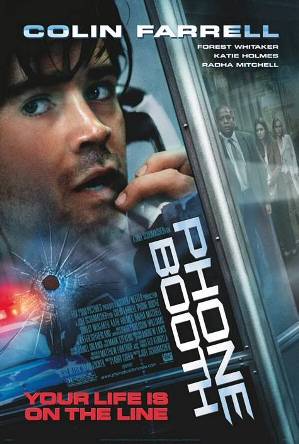
Embracing the Melodrama Part II #104: Phone Booth (dir by Joel Schumacher)


Phone_Booth_movie (1)

First released in 2003, Phone Booth is a good film.

Now, I know that you’re probably thinking, “Okay, that’s good, Lisa.  There were a lot of good films released in 2003.  I can’t think of any off the top of my head but let me go look on Wikipedia and I’m sure I can come back with a few dozen good films and…”

Well, before you go over to Wikipedia and do a search on 2003 in film (and I even included a direct link to make it easy for you because I like to be helpful), allow me to point something else out about Phone Booth.

Phone Booth is not only a good film but it’s a good film that was directed by Joel Schumacher!

That’s right!  There are several online film critics who will tell you that Joel Schumacher is one of the worst directors of all time and, to be honest, there’s actually a pretty good argument that can be made in support of that.  However, Schumacher did direct both The Lost Boys and Phone Booth.  So, he’s directed at least two good films and that’s two more than Uwe Boll.

In Phone Booth, Colin Farrell plays Stu, a slick publicist who has both a wife named Kelly (Radha Mitchell) and a girlfriend named Pam (Katie Holmes).  When Stu steps into the last remaining phone booth in New York City in order to call his girlfriend, he’s shocked when a pizza deliveryman shows up and attempts to give him a pizza.  No sooner has he gotten rid of the pizzaman (and, seriously, who turns down free pizza?), the phone rings.  Stu answers and is told by an unseen sniper (voice by Kiefer Sutherland) that, if he leaves the phone booth, he will be shot.  The sniper goes on to order Stu to tell the truth to both Kelly and Pam or to risk being shot as a consequence.

While all of this is going on, a group of prostitutes demand that Stu get out of the booth and let them use the phone.  When Stu refuses, their pimp approaches the booth and is promptly gunned down by the sniper.  Soon, under the assumption that Stu has a weapon, the police — led by Forest Whitaker — have surrounded the booth and are demanding that Stu step out.  The sniper, however, reminds Stu that he’ll be shot if he leaves the booth.

As a crowd of onlookers (including Pam and Kelly), police, and reporters surround the booth, Stu finds himself literally with no escape…

Telling the story in real time and keeping the film largely focused on Stu’s increasing desperation, Schumacher actually does a pretty good job with Phone Booth.  Colin Farrell gives a great performance, making Stu into a character who you like despite yourself.  While Kiefer Sutherland never appears onscreen, his sexy growl of a voice works wonders and he even manages to sell the point where his character starts to maniacally laugh.  Reportedly, screenwriter Larry Cohen came up with the idea for Phone Booth way back in the 1960s.  It took nearly 40 years for the film to be made but Schumacher, Farrell, and Sutherland made it more than worth the wait.