Chevy Chase, Gregory Hines, and Wallace Shawn all play small-time arms dealers who get involved in a scheme to sell the “Peacemaker” drone to the dictatorship that has seized control of the Latin American country of San Miguel. After Shawn commits suicide, Chase and Hines are joined by his widow, who is played by Sigourney Weaver. Selling the Peacemaker should be easy except that Hines has a religious epiphany and becomes a pacifist and Chase himself is starting to have qualms about the way he makes a living. As his brother-in-law puts it, something bad seems to happen in every country that Chase visits.
Deal of the Century has the unique distinction of being one of the two films that director William Friedkin did not acknowledge in his autobiography, The Friedkin Connection. When Friedkin was asked why he left it out of his book, Friedkin said that he didn’t consider Deal of the Century to be a “Friedkin film.” He wanted to do a Dr. Strangelove-style satire while the studio wanted a board Chevy Chase comedy. The studio won, Friedkin was not given final cut, the movie bombed, and Friedkin didn’t see any reason to revisit the experience of making it.
Deal of the Century is a disjointed film. The best scenes are the one that are probably the closest to Friedkin’s original vision. These are the scenes set in weapons expos and that highlight the commercials designed to sell products of mass destruction. But those scenes are dwarfed by scenes of Chevy Chase being pursued by cartoonish guerillas in San Miguel and Gregory Hines overacting after getting baptized. Chase has a few good smartass scenes at the start of the film, some of which are reminiscent of his career-best work in Fletch. But he loses his way as the film goes on and his change-of-heart never feels convincing. The film ends with a burst of special effects that are unconvincing even for 1983.
Deal of the Century may have been directed by William Friedkin but he was correct to say that it is definitely not a Friedkin film.
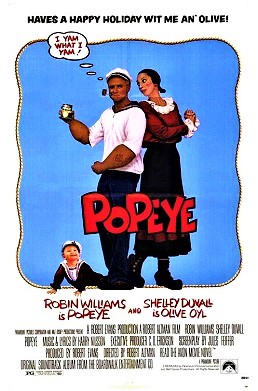
Sometimes, I feel like I’m the only one. Popeye got such bad reviews and was considered to be such a box office disappointment that director Robert Altman didn’t make another major film for a decade. Producer Robert Evans, who was inspired to make Popeye after he lost a bidding war for the film rights to Annie, lost his once-sterling reputation for being able to find hits. This was Robin Williams’s first starring role in a big screen production and his career didn’t really recover until he did Good Morning Vietnam seven years later. Never again would anyone attempt to build a film around songs written by Harry Nilsson. Screenwriter Jules Fieffer distanced himself from the film, saying that his original script had been ruined by both Robert Evans and Robert Altman. Along with Spielberg’s 1941 and Michael Cimino’s Heaven’s Gate, Popeye was one of the box office failures that signaled the end of the era in which directors were given a ton of money and allowed to do whatever they wanted to with it.
I don’t care. I like Popeye. I agree with the critics about Nilsson’s score but otherwise, I think the film does a great job of capturing the feeling of a comic strip come to life. Altman was criticized for spending a lot of money to construct, from scratch, the seaside village that Popeye, Olive Oyl (Shelley Duvall), Bluto (Paul L. Smith), Wimpy (Paul Dooley), and everyone else called home but it does pay off in the movie. Watching Popeye, you really are transported to the world that these eccentric characters inhabit. If the film were made today, the majority of it would be CGI and it wouldn’t be anywhere near as interesting. Featuring one of Altman’s trademark ensemble casts, Popeye create a world that feels real and lived in.
Mumbling the majority of his lines and keeping one eye closed, Robin Williams is a surprisingly believable Popeye, even before he’s force fed spinach at the end of the movie. Paul L. Smith was an actor who was born to play the bullying Bluto and there’s something very satisfying about seeing him (literally) turn yellow. As for Shelley Duvall, she is the perfect Olive Oyl. Not only does she have the right look for Olive Oyl but she’s so energetic and charmingly eccentric in the role that it is easy to see what both Popeye and Bluto would fall in love with her. Though the humor is broad, both Williams and Duvall bring a lot of heart to their roles, especially in the scenes where they take care of their adopted infant, Swee’Pea. Popeye may be a sailor but he’s a father first.
Popeye deserves a better reputation than it has. It may not have been appreciated when it was originally released but Popeye has a robust spirit that continues to distinguish it from the soulless comic book and cartoon adaptations of today.
John Bourgignon (John Candy) is a man of many talents. He’s a limo driver. He’s a drummer. He is an occasional actor, having starred in Kung Fu U. for his friend, director Sal DiPasquale (Eugene Levy). John is also improbably engaged to Nancy Reece (Alley Mills), the daughter of Congressman and presidential candidate Ed Reese (Pat Hingle). As the wedding approaches, John deals with a number of things. He chauffeurs around a group of Spanish Beatles impersonators. He finds himself handcuffed to a fugitive (Ernie Hudson) who dies at an inopportune time. A cult leader (Richard Libertini) attempts to brainwash John into assassinating Ed, though the process might just turn John into a “schmuck.”
Going Berserk was John Candy’s first lead feature role and it was obviously designed to play to Candy’s popularity as one of the stars of SCTV. Going Berserk doesn’t gave a plot as much as it’s a collection of skits, some of which work better than others but all of which are held together by Candy’s comedic timing and amiable presence. Going Berserk is disjointed and wildly uneven but it’s also frequently funny and that is a testament to Candy’s talent. Even an overlong parody of The Blue Lagoon raises a smile because John Candy is just so committed to playing out the joke.
Going Berserk also features several familiar faces, like Richard Libertini, Pat Hingle, Ernie Hudson, Dixie Carter, Kurtwood Smith, Paul Dooley, and two of Candy’s SCTV co-stars, Eugene Levy and Joe Flaherty. I especially liked Levy’s performance as the sleazy director who blackmails his way into filming the wedding. Going Berserk was frequently stupid but, more often than not, it made me laugh.
In 2021, I finally saw the infamous film, The Bonfire of the Vanities.
I saw it when it premiered on TCM. Now, I have to say that there were quite a few TCM fans who were not happy about The Bonfire of the Vanities showing up on TCM, feeling that the film had no place on a station that was supposed to be devoted to classic films. While it’s true that TCM has shown “bad” films before, they were usually films that, at the very least, had a cult reputation. And it is also true that TCM has frequently shown films that originally failed with audiences or critics or both. However, those films had almost all been subsequently rediscovered by new audiences and often reevaluated by new critics. The Bonfire of the Vanities is not a cult film. It’s not a film about which one can claim that it’s “so bad that it’s good.” As for the film being reevaluated, I’ll just say that there is no one more willing than me to embrace a film that was rejected by mainstream critics. But, as I watched The Bonfire of the Vanities, I saw that everything negative that I had previously read about the film was true.
Released in 1990 and based on a novel by Tom Wolfe, Bonfire of the Vanities stars Tom Hanks as Sherman McCoy, a superficial Wall Street trader who has the perfect penthouse and a painfully thin, status-obsessed wife (Kim Cattrall). Sherman also has a greedy mistress named Maria (Melanie Griffith). It’s while driving with Maria that Sherman takes a wrong turn and ends up in the South Bronx. When Sherman gets out of the car to move a tire that’s in the middle of the street, two black teenagers approach him. Maria panics and, after Sherman jumps back in the car, she runs over one of the teens. Maria talks Sherman into not calling the police. The police, however, figure out that Sherman’s car was the one who ran over the teen. Sherman is arrested and finds himself being prosecuted by a power-hungry district attorney (F. Murray Abraham). The trial becomes the center of all of New York City’s racial and economic strife, with Sherman becoming “the great white defendant,” upon whom blame for all of New York’s problems can be placed. Bruce Willis plays an alcoholic journalist who was British in the novel. Morgan Freeman plays the judge, who was Jewish in the novel. As well, in the novel, the judge was very much a New York character, profanely keeping order in the court and spitting at a criminal who spit at him first. In the movie, the judge delivers a speech ordering everyone to “be decent to each other” like their mothers taught them to be.
Having read Wolfe’s very novel before watching the film, I knew that there was no way that the adaptation would be able to remain a 100% faithful to Wolfe’s lacerating satire. Because the main character of Wolfe’s book was New York City, he was free to make almost all of the human characters as unlikable as possible. In the book, Peter Fallow is a perpetually soused opportunist who doesn’t worry about who he hurts with his inflammatory articles. Sherman McCoy is a haughty and out-of-touch WASP who never loses his elitist attitude. In the film, Bruce Willis smirks in his wiseguy manner and mocks the other reporters for being so eager to destroy Sherman. Hanks, meanwhile, attempts to play Sherman as an everyman who just happens to live in a luxury penthouse and spend his days on Wall Street. Hanks is so miscast and so clueless as how to play a character like this that Sherman actually comes across as if he’s suffering from some sort of brain damage. He feels less like a stockbroker and more like Forrest Gump without the Southern accent. There’s a scene, written specifically for the film, in which Fallow and Sherman ride the subway together and it literally feels like a parody of one of those sentimental buddy films where a cynic ends up having to take a road trip with someone who has been left innocent and naïve as result of spending the first half of their life locked in basement or a bomb shelter. It’s one thing to present Sherman as being wealthy and uncomfortable among those who are poor. It’s another thing to leave us wondering how he’s ever been able to successfully cross a street in New York City without getting run over by an angry cab driver.
Because the film can’t duplicate Wolfe’s unique prose, it instead resorts to mixing cartoonish comedy and overwrought melodrama. It doesn’t add up too much. At one point, Sherman ends a dinner party by firing a rifle in his apartment but, after it happens, the incident is never mentioned again. I mean, surely someone else in the apartment would have called the cops about someone firing a rifle in the building. Someone in the press would undoubtedly want to write a story about Sherman McCoy, the center of the city’s trial of the century, firing a rifle in his own apartment. If the novel ended with Sherman resigned to the fact that his legal problems are never going to end, the film ends with Sherman getting revenge on everyone who has persecuted him and he does so with a smirk that does not at all feel earned. After two hours of being an idiot, Sherman suddenly outthinks everyone else. Why? Because the film needed the happy ending that the book refused to offer up.
Of course, the film’s biggest sin is that it’s just boring. It’s a dull film, full of good actors who don’t really seem to care about the dialogue that they are reciting. Director Brian De Palma tries to give the film a certain visual flair, resorting to his usual collection of odd camera angles and split screens, none of which feel at all necessary to the story. In the end, De Palma is not at all the right director for the material. Perhaps Sidney Lumet could have done something with it, though he would have still had to deal with the less than impressive script. De Palma’s over-the-top, set piece-obsessed sensibilities just add to the film’s cartoonish feel.
The film flopped at the box office. De Palma’s career never recovered. Tom Hanks’s career as a leading man was momentarily derailed. Bruce Willis would have to wait a few more years to establish himself as a serious actor. Even the normally magnanimous Morgan Freeman has openly talked about how much he hated being involved with The Bonfire of the Vanities. That said, the film lives on because De Palma allowed journalist Julie Salomon to hang out on the set and the book she wrote about the production, The Devil’s Candy, is a classic of Hollywood non-fiction. (TCM adapted the book into a podcast, which is how The Bonfire of the Vanities came to be featured on the station.) Thanks to Salomon’s book, The Bonfire of the Vanities has gone to become the epitome of a certain type of flop, the literary adaptation that is fatally compromised by executives who don’t read.
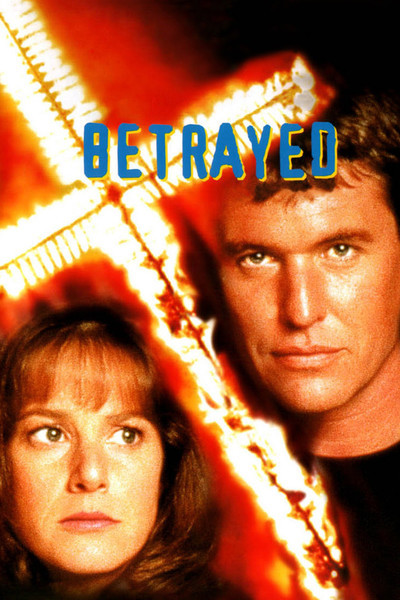
The 1988 film, Betrayed, starts out on a strong note but then quickly becomes annoying as Hell.
It opens with shots of a radio talk show host, an outspoken liberal named Sam Kraus (Richard Libertini). Kraus berates his callers. Kraus ridicules anyone who is to the left of Bernie Sanders. When a man with a rural-accent calls in and attacks Karus for being Jewish, Kraus calls the man an idiot. After he gets off the air, Kraus walks through a parking garage and stops in front of his car. Another car pulls up beside Kraus and suddenly, a masked man with a gun opens fire on Kraus, killing him. The gunman gets out of the car and spray paints, “ZOG” on Kraus’s car before then fleeing the garage.
(ZOG stands for Zionist Occupational Government. It’s a term used by the type of anti-Semitic dipshits who thinks that the Protocols of Elder Zion are real.)
From this shockingly brutal opening, we cut to panoramic shots of beautiful farmland and crops being harvested in the American midwest, the heartland. Gary Simmons (Tom Berenger) owns a farm. He’s a Vietnam vet who nearly received the medal of honor. He lives with his mother and he has two children. (He’s divorced and his ex-wife died as the result of a mysterious hit-and-run in California.) Almost everyone in his small hometown seems to worship Gary. They’re certainly curious about his new girlfriend, Katie Phillips (Debra Winger).
And really, they probably should be. Katie Phillips isn’t Katie Phillips at all. She’s actually an FBI agent named Cathy Weaver and she’s been sent undercover to investigate whether or not Gary was involved in the murder of Kraus. Cathy, who comes from a broken family and who we’re told has always been seeking some sort of deeper meaning in her life, is charmed by both Gary and his family. In fact, she falls in love with Gary. She tells her superior, Mike Carnes (John Heard), that there’s no way Gary is dangerous. Mike doesn’t believe her but, of course, Mike has a personal stake in this because he and Cathy used to be romantically involved.
(That’s right, everyone. Betrayed is so narratively lazy that it resorts to making Mike a scorned lover, even though the film’s plot would have worked just as well if he wasn’t.)
As I said, the first part of the movie works. Debra Wingers gives a strong performance and Tom Berenger is a charming roughneck. For the first half-hour or so, the film does a good job of showing why men like Gary and his friends are susceptible to conspiracy theories and why they feel that the entire world is stacked against them. You can understand why Cathy is so troubled by her assignment because Gary’s friends are hardly master criminals. For the most part, they’re farmers who feel like their entire way of life has been taken away from them.
Unfortunately, almost immediately after Mike refuses to allow her to end her investigation, Cathy returns to the farm and sleeps with Gary. Not only is this a plot development a disservice to everything that has previously been established about Cathy as a character but it also marks the point where the movie entirely falls apart. Immediately after sleeping with Cathy, Gary suddenly goes from being a complex but troubled character to being a cartoonish super villain. And listen — we’ve all been there. You meet a guy. He’s handsome. He says all the right things. He seems like he’s sensitive. He makes you feel safe. You let down your defenses for one night and the next morning, he’s yelling at you for wearing a short skirt in public. It happens. Of course, in Gary’s case, it means that he’s not only criticizing the way that Cathy dresses but he’s also taking her on a hunt where the prey is terrified person of color who Gary and his friends have kidnapped. It also means that Gary drags Cathy along on a bank robbery and then expects her to join him when he wants to assassinate a presidential candidate. Even after all that, Cathy remains conflicted about what to do with Gary. The problem is that it’s not like Gary’s a guy who needs sensitivity training or who spends too much time watching ESPN. Gary is a guy who is carting around weapons and talking about how he wants to kill “mud people.” That Cathy still has mixed emotions after all of that goes against everything that the film previously asked us to believe about her. Gary becomes too cartoonish to be plausible and, as a result, he drags down Cathy’s character as well.
Unfortunately, as the film’s narrative falls apart, so do the majority of the performances. While Debra Winger struggles to make her character’s motivations plausible, Tom Berenger is reduced to doing a lot of glaring. (Poor John Heard spends most of the movie shouting and bugging his eyes.) About the only actor who comes out Betrayed unscathed is John Mahoney, who plays Shorty. Shorty is one of Gary’s friends. He’s a friendly and personable guy who seems to sincerely care about everyone and who has a charmingly gentle smile. He’s also a total racist and the contrast between Shorty’s amiable nature and his hateful thoughts provide the latter half of Betrayed with its only powerful moments. Mahoney gets one big scene, where he talks to Cathy about how much he hates violence but, at the same time, he feels that the world has left him no other choice. Mahoney does a great job with his small role. It’s unfortunate that the rest of Betrayed couldn’t live up to his performance.
After a drug bust goes wrong, Atlanta police detective Tom Sharky (Burt Reynolds, who also directed) is transferred from narcotics to the vice squad, the least desirable assignment in the Atlanta police department. Despite all of his honors and commendations, Sharky finds himself reduced to busting hookers with Papa (Brian Keith) and Arch (Bernie Casey). But then Sharky discovers evidence of a prostitution ring being run by Victor D’Anton (Vittorio Gassman), one that services the wealthiest and most powerful men in Georgia.
Working with Papa, Arch, and a burned-out bugging expert named Nosh (Richard Libertini), Sharky begins a surveillance of Domino (Rachel Ward), one of Victor’s girls. As the days turns into weeks, Sharky falls in love with Domino, who doesn’t even know that she’s being watched. Sharky also discovers that Domino is sleeping with Hotckins (Earl Holliman), who is about to be elected governor of Georgia. At the same time, a heroin-addicted assassin named Billy Score (Henry Silva) is assassinating anyone who could reveal Victor’s crimes.
There are two great sequences in Sharky’s Machine. One is the opening credits scene, in which a bearded Burt Reynolds walks through the roughest parts of Atlanta while Randy Crawford sings Street Life. This scene lets everyone know from the start that this is not another Burt Reynolds good ol’ boy comedy. The other is a cat-and-mouse chase through an Atlanta skyscraper, as Sharky and his partners try to track down Billy Score, who is so doped up on painkillers that he barely flinches whenever he’s shot. Billy Score is one of the most frightening movie villains of all time, seemingly indestructible and capable of moving like a ghost.
With the exception of maybe Deliverance, Sharky’s Machine is Burt Reynolds’s darkest movie. There are moments of humor and appearances by the usual members of the Burt Reynolds stock company, like John Fiedler and Charles Durning. But overall, this is one dark movie. Likable characters die. Sharky cries and loses two fingers when they are graphically chopped off by the bad guys. A woman’s face is literally blown off. Even when Sharky starts to talk about his childhood, a sentimental moment the occurred in almost every Burt Reynolds film, Domino tells him that she doesn’t care.
In other words, this ain’t The Cannonball Run.
Burt Reynolds’s first cut of Sharky’s Machine reportedly ran for 140 minutes. Twenty minutes were cut before it was released into theaters and, as a result, Sharky’s Machine sometimes seems to be rough around the edges. (One important supporting character is killed off-screen and if you don’t pay close attention to the dialogue, you might never know what happened to him.) Still, this violent film noir, which Reynolds once called “Dirty Harry in Atlanta,” is one of Burt’s best.
The 1990 Best Picture nominee Awakenings is exactly the type of film that seems to have been designed to make me cry.
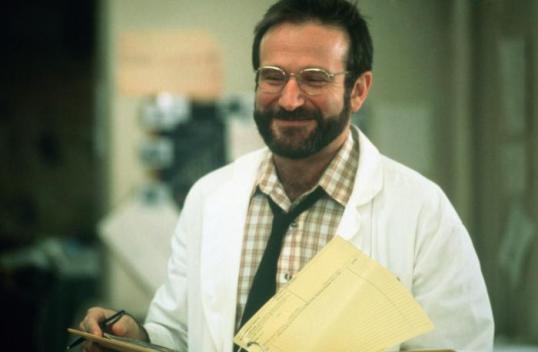
Taking place in 1969 and based (very loosely, I assume) on a true story, Awakenings features Robin Williams as Dr. Malcolm Sayer. Dr. Sayer is a dedicated and caring physician but he also suffers from an almost crippling shyness. He’s at his most comfortable when he’s dealing with a group of patients who have spent the last 40 years in a catatonic state, suffering from a tragic disease known as encephalitis lethargica. (One thing that I learned from watching this film was that, from 1917 to 1928, there was an epidemic of this disease, with millions either dying or being left catatonic.) While the rest of the medical establishment (led by John Heard, who always seems to be the embodiment of the establishment in films made in the 90s) assumes that the patients are destined to spend the rest of their lives in a vegetative state, Dr. Sayer is convinced that the patients can be awakened. He soon discovers that, even in their catatonic state, the patients will react to certain stimulii. One woman can catch a baseball. Another appears to react well to music. And finally, Leonard Lowe (Robert De Niro) — who fell ill with this disease when he was a child — tries to communicate with a Ouija board.
Over the objections of his supervisors, Dr. Sayer treats the patients with an experimental drug. Leonard is the first one to get the drug and is also the first one to wake up. While the rest of the patients wake up, Dr. Sayer tries to help Leonard adjust to the 1960s. At first, everything seems to be going perfectly. Leonard even manages to strike up a sweet romance with a woman named Paula (Penelope Ann Miller). However, it soon becomes obvious that the awakening is only going to be a temporary one as Leonard and all the other patients start to descend back into their catatonic states…
It’s easy to criticize a film like Awakenings for being manipulative and sentimental. And the fact of the matter is that the film is manipulative and it is sentimental and undoubtedly, it probably is a massive simplification of the true story. (The character played by John Heard is such an obvious villain that he might as well have a mustache to twirl.) And yes, you know even before it happens that there’s eventually going to be a montage of an amazed Leonard staring at a girl in a miniskirt while Time of the Season plays on the soundtrack.
But, no matter! It’s a tremendously effective film and it earned the tears that I shed while watching it. Both De Niro and Williams give excellent performances which add a good deal of depth to scenes that could otherwise come across as being overly sappy. De Niro has the more showy role but it really but it’s the performance of Robin Williams that really carries the film. As played by Williams, Dr. Sayer is a fragile soul who hides from the world behind his beard and his professional determination. When he finally asks a nurse (Julie Kavner) out to dinner, it’s impossible not to cheer for him.
It’s also impossible not to cheer a little for Awakenings.





 Through the Shattered Lens