Film Review: Nightcrawler (dir by Dan Gilroy)


Nightcrawler


The new film Nightcrawler tells the story of a strange man named Lou Bloom (played, in the performance of his career, by Jake Gyllenhaal).  From the minute that we first see Lou, we can tell that there is something off about him.  He is a bit too quick to smile and his friendly manner is sharply contrasted with his sunken features.  He watches the world with shifty eyes that are surrounded by dark circles that make it appear as if he hasn’t slept for weeks.  (And it is interesting to note that, at no point during the film, do we actually see him sleep.  He’s always awake.)  When he speaks, it’s in an optimistic and ingratiating tone that can barely disguise the fact that everything he is saying is a cliché.  He speaks in the language of self-help books and inspirational speakers.  What’s interesting is that as empty as Lou’s constant patter may be, he always sounds as if he believes every single word of it.

Despite the fact that Lou is on screen during every minute of Nightcrawler, we learn very little about his background.  We don’t learn where he was born.  We don’t know how he eventually came to be the person that he is at the start of the film.  He has no family.  He has no friends.  He lives in a small apartment that is distinguished only by how anonymous it ultimately is.  The only thing we really know for sure about Lou is that he watches a lot of television.  In one of the few moments in the film where Lou actually lets down his guard, he tries to have a conversation with a reporter on a screen despite the fact that the reporter can not hear a word that he is saying.

Lou is first introduced stealing and selling scrap metal.  When he’s confronted by a security guard, Lou smiles and says a few friendly words before suddenly attacking the guard and throwing him to the ground.  Disturbingly, we never find out what exactly Lou did with that security guard but, when we next see Lou, he’s wearing the guard’s watch.

However, Lou has bigger plans than just being a common thief.  When he comes across a car accident, he sees a freelance video journalist (also known as a nightcrawler) filming the police.  When Lou finds out how much money he can make by simply filming human misery and then selling the footage to a local news station, Lou trades a stolen bicycle for a radio scanner and cheap camcorder.

After several nights of struggling to get some good footage and discovering that the police don’t like nightcrawlers, Lou manages to get some footage of a dying shooting victim.  He sells the footage to a local news station and meets Nina (an excellent Rene Russo), the station’s news director.  Nina is impressed with the footage and encourages Lou to find more.  She explains to him that she needs crime and disaster footage.  She needs footage that will both scare and intrigue her white middle-class audience — violence in the suburbs, families being threatened, and — most importantly — white people being victimized by minorities.  As she tells Lou,  “The perfect story is a screaming woman with her throat cut, running down a street in a good neighborhood.”

Soon, Lou is finding a lot of success as a nightcrawler, to the extent that he even gets an intern named Rick (Riz Ahmed) to serve as his assistant.  Rick is an interesting character and Riz Ahmed gives an excellent performance, one that is overshadowed by the more flamboyant performances of Gyllenhaal and Russo but which is just as important.  In many ways, RIck serves as the film’s conscience.  Alone among the film’s characters, Rick has a sense of morality but, unfortunately, he’s not observant enough to realize that he’s the only one.

Lou is a complete and total sociopath but Gyllenhaal gives such a compelling performance that you often forget until Lou gives you no choice but to remember.  As the film progresses, it becomes obvious that both Lou and Nina depend on bad news for their very existence and, in Lou’s case, he’s not above creating the news that he covers.

Marking the directorial debut of veteran screenwriter Dan Gilroy, Nightcrawler is a hyperkinetic portrait of society at its absolute worst.  As some reviewers have pointed out, Nightcrawler is often a bit heavy-handed when it comes to portraying the vacuousness of television news but then again, have you watched your local station recently?  Have you looked at any of the clickbait articles that are floating around the internet?  If Nightcrawler portrays television news as being shallow and hypocritical — well, why shouldn’t it?  The usual suspects will claim that Nightcrawler‘s portrayal of televised media is flawed but we all know the truth, don’t we?  Even if the film’s satire is heavy-handed, it still captures a larger and undeniable truth.

Not only is Nightcrawler a thought-provoking look at our paranoid society but it also features Jake Gyllenhaal’s best performance.  Gyllenhaal reportedly lost 20 pounds for the role and his commitment to the role pays off as he turns Lou into a truly fascinating monster,  making him the most compelling sociopath this side of Christian Bale’s Patrick Bateman.

Admittedly, the film does have a few flaws.  A scene in which Lou is seen cutting a van’s brake line almost inspired me to shout out, “Direct to video!” because it seriously felt as if it belonged in a lesser film.  (Every direct-to-video thriller features a scene of someone tampering with brakes.)  But, overall, Nightcralwer is one of the best films of the year so far.
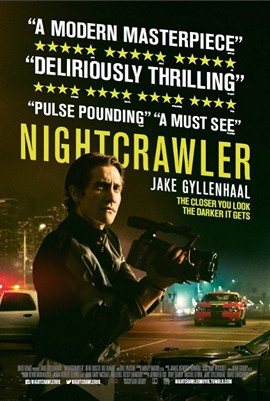
Nightcrawlerfilm

Horror On TV: Twilight Zone 1.22 “The Monsters Are Due On Maple Street”


TheTwilightZoneLogo

As Halloween comes to a close, so does both horror month here at the Shattered Lens and our series of televised horrors. What better way to finish out this feature than with one of the best known and most popular episodes of The Twilight Zone?

There’s a lot I could say about The Monsters Are Due On Maple Street but really, all that needs to be acknowledged is that it’s a classic and it features one of the best endings ever. As well, it also contains an important message about paranoia and conformity that remains as relevant today as when the episode was first broadcast.

The Monsters Are Due On Maple Street was written by Rod Serling and directed by Ron Winston. The episode was originally broadcast on March 4th, 1960.

Horror Film Review: The Visitor (dir by Giulio Paradisi)


The_Visitor_1979_film_poster

Do you want to see a strange horror film?

Just check out The Visitor, a 1979 Italian film that has recently been re-released by Drafthouse Films and occasionally shows up on TCM.  In many ways, The Visitor is a total and complete mess.  But, as is so often the case with Italian horror films, that very messiness — combined with some genuinely imaginative narrative and directorial choices — serves to make The Visitor into one of the most memorable films that you (possibly) have never heard of.

Like many of the Italian exploitation films released in the 70s and 80s, The Visitor is a rather blatant rip-off of a successful American film.  What makes The Visitor unique is the amount of different movies that it rips off.  The Visitor takes films that you would assume had no connection and mixes them together to create something wonderfully odd.

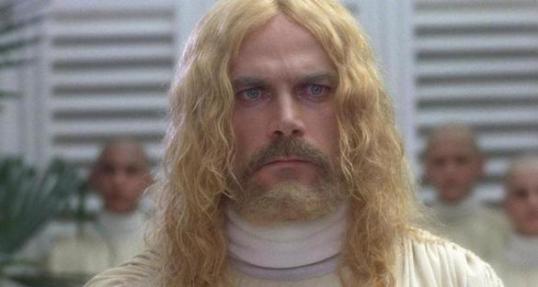
Franco Nero as Jesus in The Visitor

Franco Nero as Jesus in The Visitor

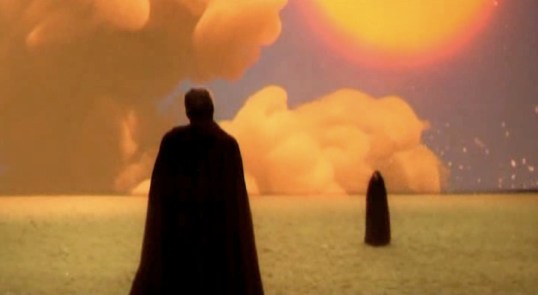
Much like Close Encounters of the Third Kind and 2001: A Space Odyssey, The Visitor opens with the idea that intergalactic beings have been visiting Earth for centuries and are subtly influencing the development of humanity.  The Visitor literally opens with Jesus Christ (played by Franco Nero!) sitting on a satellite and telling a version of the creation story to a bunch of bald children.  He explains that, long ago, he battled an evil intergalactic demon known as Sateen.  Sateen (who, the film implies, is better known on Earth as Satan) was eventually blown up but his genes were spread throughout humanity.  The bald children surrounding him are the descendants of Sateen.  Whenever one of them is born, Jesus sends an old man named Jerzy Colsowicz (played by director John Huston) to Earth so that Jerzy can bring the child to the satellite.  Of course, whenever Jerzy isn’t kidnapping kids for Jesus, he spends his time hanging out in a psychedelic dimension.

Yes, you did read that correctly.

This is where Jerzy lives.

This is where Jerzy lives.

Once you get past the intergalactic part of the story, The Visitor is a pretty obvious rip-off of both The Omen and Damien: Omen II, with the main difference being that the demon child here is not a cherubic little boy but instead is a rather bratty 8 year-old little girl named Katy (Paige Collins).  However, Katy is not the Antichrist.  Instead, her job is to mate with a male child who also has Sateen’s genes and then her baby will be the Antichrist.  In order to get this male child, Katy is pressuring her mother (Joanne Nail) to have sex with businessman Raymond Armstead (Lance Henriksen, who was also in Damien II: The Omen) so that Katy can have a half-brother to mate with.  (Ewwwwwwww!)  Raymond is a follower of Sateen and, adding to the film’s already odd feel, he also happens to own a basketball team.

(So, along with everything else going on, The Visitor also features a lot of basketball footage, which I guess would be exciting if I knew anything about basketball.)

Despite being a pretty powerful figure in the Sateenist hierarchy Raymond is not the head Sateenist.  No, the head Sateenist is played by Mel Ferrer, an actor who was once married to Audrey Hepburn and who will be familiar to anyone who has ever watched an Italian horror film.  (You can spot Ferrer in Zombie Holocaust, for example.)  Ferrer and the other Sateenists are all old, distinguished looking white men who spend all of their time meeting in an ornate corporate boardroom.

So, Jerzy comes down to Earth  to, with the help of a nanny played Shelley Winters, try to kidnap Katy but, for some reason, he doesn’t just do that.  Instead, he spends most of his time just watching Katy do destructive things.

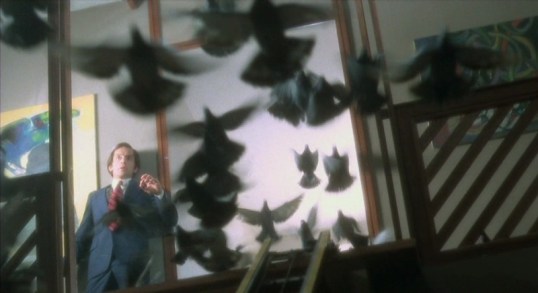
Much as in The Omen, anyone who gets too close to discovering the truth about Katy ends up dying an elaborate and bloody way.  Often times, their death involves black crows, who the film suggests might actually be all of those little bald kids in animal disguise. So is Jesus sending those crows to kill people?  Seriously, this movie is weird.

Beware the Crows

Beware the Crows

Meanwhile, Katy’s mom is having doubts about both Raymond and her daughter.  She even goes and talks to her ex-husband, an abortionist who is played by yet another film director, in this case Sam Peckinpah.  Katy gets annoyed with her mom and, after happening to come across a gun hidden away inside of a birthday presents, shoots her in the back and leaves her paralyzed.

And did I mention that Katy is telekinetic, much like Carrie?  That’s right!  During my favorite scene, Katy goes skating at the local mall’s ice rink and, after a group of boys bully her, she uses her powers to send those bullies flying all over the mall.  Oddly enough, nobody seems to notice this chaos.  Except, of course, for Jerzy who just stands off in the corner and watches without doing anything…

Seriously, I love The Visitor.  Along with being surprisingly well-acted and visually inventive, the film is just so weird!  In many ways, it epitomizes everything that I love about the old Italian exploitation films.  While it is rather shameless about ripping off other movies, the film still brings its own unique spin to everything.

Normally, I’d say that The Visitor is a good film for Halloween but you know what?  Anytime is a good time for an Italian horror film!

Welcome

Welcome


A Blast From The Past: Halloween is Grinch Night


So, we all know that the Grinch once tried to steal to Christmas and then his heart grew a few sizes but did you know that apparently, the Grinch also tried to steal Halloween?

Until a few days ago, I did not.  I was going through YouTube, searching for horror films that I could share here on the Shattered Lens, and guess what I came across?

A TV special from 1977 entitled Halloween is Grinch Night!

Unlike How The Grinch Stole Christmas, Halloween is Grinch Night apparently never became a holiday classic.  Perhaps that’s because Halloween is Grinch Night is not exactly the most heart-warming of holiday specials.  Whereas How The Grinch Stole Christmas tells us about how the Grinch learned the true meaning of Christmas, Halloween is Grinch Night gives us a Grinch who has no redeeming features.  There is no hope for this Grinch.  This Grinch will steal your soul and probably drink your blood.  This Grinch is pure Grinchy evil.

This is the Grinch of our nightmares.

Check out Halloween is Grinch Night below and hope the Grinch doesn’t capture you this Halloween…


Horror on The Lens: Night of the Living Dead (dir by George Romero)


429px-Night_of_the_Living_Dead_affiche

Happy Halloween!

Here at the Shattered Lens, we’re all about tradition!  And what could be a better tradition than watching Night of the Living Dead on Halloween?

Watch it below and enjoy!  And then, after you’ve watched it, be sure to read Arleigh’s excellent review!

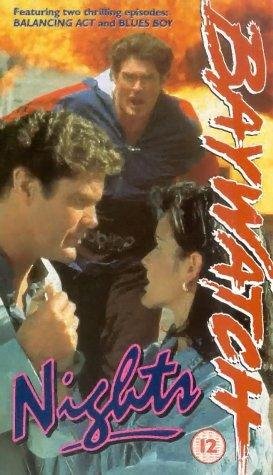
Special Bonus Horror On TV: Baywatch Nights 2.9 “Night Whispers”


NM

Remember how, in the last episode of Baywatch Nights that we shared, David Hasselhoff was possessed by a demon?  Well, in this special bonus edition of Horror on TV, he’s menaced by a vampire.  And it’s just as silly as you would probably expect…

Enjoy!


Horror on TV: The Twilight Zone 2.6 “Eye of the Beholder”


TheTwilightZoneLogo

First broadcast on November 11th, 1960, Eye of the Beholder is one of the best known and most acclaimed episodes of The Twilight Zone. Telling the story of a bandaged patient and the shadowy doctors who continually talk about how the patient’s upcoming surgery will be her final chance, this is one of those universal episodes that is probably more relevant today than when it was first broadcast.

Horror On The Lens: Los Monstruos del Terror (dir by Tulio Demicheli, Hugo Fregonese and Eberhard Meichsner)


For today’s Horror on The Lens, we have a Spanish film that was originally made in 1969 and given an international release in 1970.  In the United States, it was released under several different names: Monsters of Terror, Assignment: Terror, and Dracula vs. Frankenstein.

Despite the title, this film really isn’t about Dracula fighting Frankenstein.  There is, of course, a Frankenstein monster in the film and there is a vampire who, in some versions of the film, is referred to as being Dracula and, in other versions, is referred to by a lot of other names.  (What’s he called in the version below?  You’ll have to watch to find out.)

What this film is about is Waldemar Danisky, a tragic werewolf who was played by Paul Naschy in a series of films.  In this, his third appearance, Waldemar and a host of other monsters are brought back to life by aliens who are looking to take over the Earth.  Fortunately, Waldermar is a werewolf with a conscience and battles not only the aliens but the other monsters as well.

Yes, it’s all a bit silly and really doesn’t make much sense but you really owe it to yourself to watch at least one Paul Naschy film before this October ends..


Horror on TV: Twilight Zone 2.26 “Shadow Play”


TheTwilightZoneLogo

This is one of my favorite episodes of The Twilight Zone! In Shadow Play, a man (Dennis Weaver) is curiously unconcerned about being on death row. According to him, it’s all just a recurring dream and everyone around him — the other prisoners, the District Attorney, the judge, the jury, and everyone else — is just a part of his dream. As the other characters start to realize that Weaver could be telling the truth, they’re forced to consider what will happen when he either wakes up or starts the dream over…

I love this one. It’s just a lot of fun and not quite as heavy-handed as some of The Twilight Zone‘s other attempts at social commentary.

This was originally broadcast on May 5th, 1961. It was directed by John Brahm and written by Charles Beaumont.

Horror on the Lens: The Cabinet of Dr. Caligari (dir by Robert Wiene)


We previously shared and reviewed this movie two Halloweens ago but so what?  It’s a horror classic and watching it is a bit of a Halloween tradition and here at the Shattered Lens, we are all about tradition!  Add to that, this is one of the most influential films of all time.  First released in 1922, The Cabinet of Dr. Caligari both introduced the world to German expressionism and it was one of the first films to feature a twist ending.

So, the next time you’re thinking about how much you love M. Night Shyamalan, be sure to say a word of thanks to Robert Wiene for directing The Cabinet of Dr. Caligari!