Icarus File No. 5: mother! (dir by Darren Aronofsky)


You have to admire the courage of a filmmaker like Darren Aronofsky.  After receiving some overdue Oscar love for Black Swan, Aronofsky probably could have settled into the type of career that Tim Burton currently has: i.e., the self-styled quirky director who makes safe studio films.  Instead, Aronofsky has continued to chart his own course as an artist by following up Black Swan with two films that seemed specifically designed to challenge audiences and annoy the complacent.

With Noah, Aronofsky dared to suggest that God’s mistake with the Great Flood was to allow anyone to survive at all.  Then, he followed up Noah with 2017’s mother!, which was a film that practically dared confused and alienated audience members to stand up and walk out.  And walk out they did.  mother! was one of the few films to score an F on Cinemascore.  I mean, typically, a bad movie will at least get a C.  You have to really piss off the audience to get that F rating.  Watching mother!, it’s obvious that pissing off the audience was a part of the film’s design.

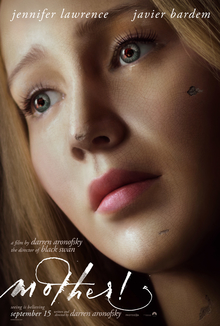
Paramount Picture advertised mother! as being a horror film and, to a certain extent, it is.  Jennifer Lawrence plays the Mother.  She lives in a beautiful house with a poet named Him (Javier Bardem).  Him spends a lot of time talking about how much he loves the Mother but it quickly becomes apparent that he’s rather self-absorbed.  People are constantly showing up at the house to speak to and eventually worship Him and he continually lets them, regardless of how difficult it makes things for the Mother.  The Mother is reduced to begging people not to make a mess but no one listens to her.  As the crows gets bigger, fights break out.  There are sounds of war and explosions rock the Mother’s meticulously cared-for home..  Him can only smile and shrug while his visitors trash the house.  The more the Mother complains, the more cruelly she’s treated by the crowds.

Among those who show up are the Man (Ed Harris) and the Woman (Michelle Pfeiffer).  They have two teenage sons who have developed a dangerous rivalry.  Him seems to be very concerned with them but the Mother just wants them all to leave.  Once they finally do leave, Him is inspired to write his greatest work which, of course, just leads to more people showing up.  It’s a dangerous cycle….

I could actually relate to what the Mother was going through.  I tend to be a little bit on the neat side, which is a polite way of saying that I’m obsessed with keeping the house clean and tidy.  Nothing annoys me more than when a stranger comes in and drags dirt or leaves or whatever across a freshly vacuumed carpet.  When Jennifer Lawrence was reduced to begging people to just make the most basic effort towards not messing up the house, I totally sympathized with her.  Jennifer Lawrence yells so much in this movie that she actually starts to lose her voice in a few scenes.  I could relate.

Of course, Jennifer Lawrence is not just playing a homeowner who doesn’t want her house to get trashed.  And Bardem isn’t just playing a poet.  As you probably already guessed, Bardem is God and Jennifer Lawrence is the Earth and Ed Harris and Michelle Pfieffer are a surprisingly old version of Adam and Eve.  The entire film is a biblical allegory and it all gets a bit heavy-handed.  Aronofsky has said that the film was a result of “anger and anguish” but it’s obvious that all of that anger and anguish prevented him from considering that mother! would have worked better as a 15-minute short film than a two-hour epic.  It doesn’t take long to figure out what’s going on and the film occasionally gets almost embarrassingly obvious in its attempt to push it metaphor.  Aronofsky, at times, seems to think that his film is more enigmatic than it actually is.

Still, despite the fact that the film goes on for way too long and is never quite as much of a mindscrew as Aronofsky seems to think that it is, you have to admire not only the courage of Aaronofsky but also the dedication of Jennifer Lawrence.  This film was not the first high profile Jennifer Lawrence film to not be a hit with audiences (Passengers wasn’t exactly beloved) but it is the one that’s most often cited whenever anyone writes an article about why Jennifer Lawrence’s star is a bit dimmer today than it was back in the days of The Hunger Games.  Undoubtedly, some people did go to the film expecting to see a “typical” Jennifer Lawrence film, just to suddenly be confronted with Javier Bardem ripping her heart out of her chest.  But, at the same time, you have to appreciate a star who is willing to take a chance and that’s what Lawrence did her, lending her star power to a project that was thoroughly out of the mainstream.  Both Aronofsky and Jennifer Lawrence took a chance with mother! and, even if the film is not quite the triumph that some viewers may want it to be, you still respect them for having done so.
Previous Icarus Files:
  1. Cloud Atlas
  2. Maximum Overdrive
  3. Glass
  4. Captive State


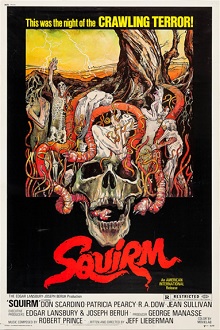
Horror Film Review: Squirm (dir by Jeff Lieberman)


Worms are creepy and you don’t want to get them in your hair.

I think that, more than anything, explains the continuing appeal of this lightly satirical Southern shocker from 1976.  The film’s plot is a simple one, as the plots of the best horror films often are.  There’s a storm.  The power lines over Fly Creek, Georgia get knocked down.  The power line lands in the mud and soon, you’ve got thousands of electrified worms crawling all over the place.  These worms are angry and noisy and they like to eat people’s faces and take control of their bodies.  Of course, since the power lines are all down, you’re can/t exactly call for help and even worse, you’re thrown into darkness once the sun goes down.  Squirm gets at some very basic fears.

Squirm has a welcome sense of humor, as any film about killer worms should.  It’s obvious that Lieberman knew that the audience would be demanding that the worms get revenge on at least a few fisherman and those scenes are tossed in there.  The film’s nominal hero is Mick (Don Scardino), a visitor from New York City, and he’s so out-of-place in rural Georgia that it becomes funny watching him try to do simple things like order food or have a simple conversation.  Even when he tries to warn people about the worms, you can tell they’re thinking, “He might be right but do I want to listen to a yankee?”  As we say down here in Texas, you can always spot the yankee because they’re the ones sweating profusely and talking about killer worms.  The scenes of Mick trying to order something at the local diner reminded me of the great “We don’t got no goddamn trout” scene from Hell or High Water.

Mick is in Georgia to visit his girlfriend, Geri (Patricia Pearcy).  Almost everyone who Mick meets seems like they could have come out of an overheated first draft of a Tennessee Williams play.  Once the worm attack starts in earnest, Geri’s mother sinks into a state of denial that would have impressed Blanche DuBois.  Meanwhile, Squirm has its own wannaba Stanley Kowalski in the form of Roger (R.A. Dow), who obviously can’t understand why Geri would want a boyfriend from New York when she could have him.  Roger is a creep but he’s a familiar creep.  Anyone who has ever lived in the country will immediately recognize Roger and know everything that they need to know about him.

That said, the worms are the real stars of Squirm and they certainly do manage to get everywhere.  On the one hand, it’s funny to see the worms emerging from a shower head but, on the other hand, it’s actually really terrifying because, when you’re standing naked in a shower, the last thing you want is to get about a thousand worms dumped on your head.  Seriously, that would freak me out even more than threat of getting killed by Norman Bates’s mother.  The film is also full of close-ups of the worms and, to be honest, worms are really freaky to look at.  The opening and closing of that little mouth is like pure nightmare fuel.

Squirm is a classic of Southern horror.  You’ll never look at a worm the same way again.


Horror On The Len: The Abominable Dr. Phibes (dir by Robert Fuest)


For today’s horror on the lens, we have one of Vincent Price’s most popular films, 1971’s The Abominable Dr. Phibes!

This is Price at his considerable best.  Be sure to read Gary’ review.

And watch the film below!

Enjoy!


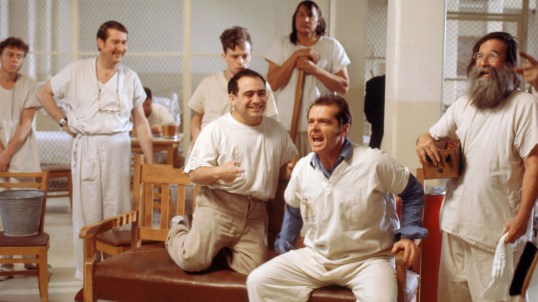
Lisa Reviews An Oscar Winner: One Flew Over The Cuckoo’s Nest (dir by Milos Forman)


Technically, the 1975 film One Flew Over The Cuckoo’s Nest is not a horror film.

Though it may take place in a creepy mental hospital, there are no ghosts or zombies.  There’s no masked killer wandering the halls.  The shadows do not leap off the walls and there are no ghostly voice in the night, unless you count the rarely heard voice of Will Sampson’s Chief Bromden.

Admittedly, the cast is full of horror and paranormal veterans.  Michael Berryman, of the original Hills Have Eyes, plays a patient.  Louise Fletcher, who won an Oscar for playing the role of Nurse Ratched, went on to play intimidating matriarchs in any number of low-budget horror movies.  Vincent Schiavelli, a patient in this film, played the angry subway ghost in Ghost.  Another patient, Sidney Lassick, played Carrie’s condescending English teacher in Carrie.  Brad Dourif, who received an Oscar nomination for playing the meek Billy Bibbit, has become a horror mainstay.  Will Sampson appeared in the Poltergeist sequel.  Both Scatman Crothers and Jack Nicholson would go on to appear in The Shining.

Nicholson plays Randle Patrick McMurphy, a career criminal who, hoping to get out of prison early, pretends to be mentally ill.  He ends up getting sent to an Oregon mental institution, where his rebellious ways upset the administrators while, at the same time, inspiring the patients to actually try to take some control over their lives.  The film is, in many ways, a celebration of personal freedom and rebellion.  The only catch here is that, in One Flew Over The Cuckoo’s Nest, being a little bit too rebellious can lead to not only electroshock treatment but also a lobotomy.  Those in charge have a way of making you permanently compliant.

And really, to me, that’s what makes One Flew Over The Cuckoo’s Nest a horror film.  It’s about the horror of conformity and bureaucracy.  The film may start out as something of a comedy and Nicholson brings a devil-may-care attitude to the role of McMurphy but then, eventually, you reach the scene where McMurphy is tied down and given electrical shocks to make him compliant.  You reach the scene where Ratched coldly informs Billy Bibbit that she will be telling his mother that Billy lost his virginity to a prostitute and Billy reacts by slicing open his wrists.  Finally, you reach the scene where McMurphy returns to the ward having had a bit of his brain removed.  In those scenes, One Flew Over The Cuckoo’s Nest becomes a horror movie.  The monster is not a ghost or a demon or a serial killer.  Instead, it’s a system that is determined to squash out any bit of rebellion or free thought.

What makes Nurse Ratched such a great villain is the fact that, as opposed to being some sort of a maniacal force of evil, she’s really just someone doing her job and refusing to question her methods.  She’s the ultimate symbol of bland authoritarianism.  Her job is to keep the patients from getting out of control and, if that means lobotomizing them and driving one of them to suicide …. well, that’s what she’s going to do.  For all the time that Ratched spends talking about therapy, her concern is not “curing” the patients or even helping them reach a point where they can leave the hospital and go one with their lives.  Ratched’s concern is keeping everyone in their place.  As played by Fletcher, Ratched epitomizes the banality of evil.  (That’s one reason why it was so silly for Ryan Murphy to devote his most recent Netflix series to giving her an over-the-top origin story.  Ratched is a great villain because she doesn’t have any complex motivations.  She’s just doing whatever she has to do to keep control of the people are on her ward.  Part of keeping control is not to allow anyone to question her methods.  Everyone has had to deal with a Nurse Ratched at some point in the life.  With the elections coming up, we’re about to be introduced to whole new collection of Nurse Ratcheds.)

I like One Flew Over The Cuckoo’s Nest, even though it’s an undeniably dated film.  That said, it’s not as dated as the novel on which it’s based, nor is it as appallingly misogynistic.  Jack Nicholson’s rough but charismatic performance holds up wonderfully well.  (I don’t know if an actor has ever matched a character as perfectly as Nicholson does with McMurphy.)  Louise Fletcher brings a steely resolve to the role of Nurse Ratched.  Fans of spotting character actors in early roles will probably get a kick out of spotting both Danny DeVito and Christopher Lloyd as patients.  The movie skillfully combines drama with comedy and the ending manages to be both melancholy and hopeful.

When it comes to the 1975 Oscar race …. well, I don’t know if I would argue that One Flew Over The Cuckoo’s Nest deserved to win Best Picture over Nashville, Dog Day Afternoon, or Barry Lyndon or Jaws.  Dog Day Afternoon and Nashville feel as if they were ahead of their time, with their examination of the media and politics.  Jaws set the template for almost every blockbuster that would follow and it’s certainly one of the most influential horror films ever made.  Barry Lyndon is a stunning technical achievement.  Compared to those films, One Flew Over The Cuckoo’s Nest seems rather simplistic.  Watching it today, you’re very much aware of how much of the film’s power is due to Jack Nicholson’s magnetic screen presence.  Nicholson definitely deserved his Oscar but it’s debatable whether or not the same can be said of One Flew Over The Cuckoo’s Nest as a whole.

So no, I wouldn’t necessary say that One Flew Over The Cuckoo’s Nest was the best of the films nominated that year.  Still, it’s an entertaining film and a helluva ride.  It’s a great film to watch whenever you’re sick of faceless bureaucrats trying to tell you what to do.  And, in its own odd way, it’s a great film for Halloween season.

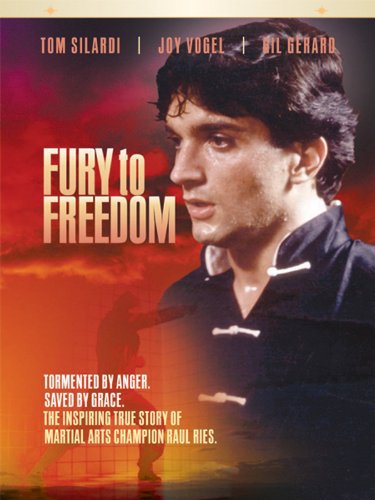
Cleaning Out The DVR: Fury To Freedom (dir by Erik Jacobson)


It’s that time of year again!  It’s the time when entertainment hoarders like me take a look at our DVR and discover, to our horror, that we’ve only got about 3 hours of space left.  When that happens, it means that it’s time clean out the DVR and hopefully make some space before 2021 brings a whole new collection of shows and movies to be recorded.

Yesterday, I got a start on cleaning out my DVR by watching the 1985 film, Fury to Freedom.  I originally recorded it back in August and I’m going to guess that I did so because I liked the title.  Fury by itself is good.  Freedom is even better.  Put them together and you’ve got something I’m definitely going to record!

As for the movie itself, it was obviously a low-budget and independently made movie.  I’m guessing that it was specifically made to be shown to church groups.  It’s one of those films that tells the true story of a sinner who becomes an evangelist.  It ends with preaching but, before you reach that point, you’ve got about an hour or so of sinning.  It’s the old Cecil B. DeMille method.

The film tells the story of Raul Ries (Tom Silardi), a teenager who grew up in an abusive home and constantly finds himself in a conflict over whether or not to do the right thing.  His girlfriend, Sharon (Joy Vogel), always pushes him to follow the right path.  All of Raul’s friends are always pushing him to follow the wrong path.  As for Raul, he just wants to earn a black belt in karate but the local sensei doesn’t think he’s ready to learn.

After Raul loses his tempter at a party and slashes someone’s face (agck!), he ends up joining the Marines and getting trained to fight in Vietnam.  (I was pretty sure that, during the basic training scene, I spotted a young Jon Favreau as one of the Marines but, according to the imdb, it was someone else.)  Anyway, Raul actually does pretty well in basic training but then he fakes a breakdown to get out of serving in Vietnam.  He returns home, knocks up his girlfriend, gets stuck in a go-nowhere job at a grocery store, and eventually he somehow opens up his own dojo.

Anyway, after about an hour or so of Raul being a jerk and hitting Sharon, he reaches the point where he’s contemplating committing a murder/suicide but then he sees a preacher on TV and, the next thing you know, he’s going to his old high school and preaching.  “Yo!  Listen up!” he yells at the students.

It was kind of a predictable film but it was also sincere in its goals and nowhere near as preachy as you might expect given the subject matter.  Tom Silardi and Joy Vogel both gave good performances as Raul and Joy and the film deserve some credit for resisting the urge to use Buffalo Springfield’s For What It’s Worth as an easy way to establish that it was taking place in the 60s.  Probably the most interesting thing about this film is that it was obviously made in the wake of the success of The Karate Kid because it spends as much time on the karate as it does on the religion.

Fury to Freedom was an effective, low-budget, and very sincere film.  And now, it’s off of my DVR.

A Blast From The Past: What About Juvenile Delinquency? (dir by Herk Harvey)


Well, what about it!?

Today’s Blast From The Past comes to use from 1955.  In this short film, a group of no-good 30 year-old high school students attack a middle-aged man who was just trying to drive home.  That man just happens to be the father of a member of the gang!  Now, due to the violence, the city council is considering a curfew!  That’s not fair to the good kids but what can be done about juvenile delinquency?

Watch and discuss.

This film was shot in Lawrence, Kansas and it was directed by Herk Harvey.  Harvey directed a ton of educational short films like this but horror fans will always know him before for directing Carnival of Souls.  I’ll be sharing Carnival of Souls soon.  For now, give some thought to delinquents!

Horror on the Lens: Baffled! (dir by Philip Leacock)


Baffled! is an entertaining little made-for-TV movie from 1973.  Leonard Nimoy plays a race car driver who suddenly starts to have psychic visions of a woman who lives in what appears to be a gothic manor.  The woman is in some sort of danger.  Nimoy, of course, would rather just race cars but a parapsychologist (Susan Hampshire) convinces him that he has to figure out what his visions mean.

Now, to be honest, Baffled! is not a particularly scary movie.  Some of Nimoy’s visions are spooky but there’s nothing in this movie that’s going to give you nightmares.  Though it may not be horrifying, Baffled! is a lot of fun.  Apparently, it was meant to be a pilot for a TV series.  If it had been picked up, I guess Nimoy and Hampshire would have been helping out a new guest star every week.  Nimoy seems to be having a lot of fun playing a psychic race car driver and he and Susan Hampshire have a really sweet and enjoyable chemistry.

Enjoy!


Music Video of the Day: Night by John Carpenter (2015, dir by Gavin Hignight and Ben Verhulst


Okay, so it’s more cyberpunk than horror but ….

Listen, it’s John Carpenter.  As a month, October pretty much belongs to John Carpenter and there’s never a more appropriate time to share a music video for one of his songs.  Interestingly enough, Night is one of Carpenter’s rare compositions that is not also a part of a soundtrack.

It certainly sounds like it belongs in a movie though, right?

Enjoy!

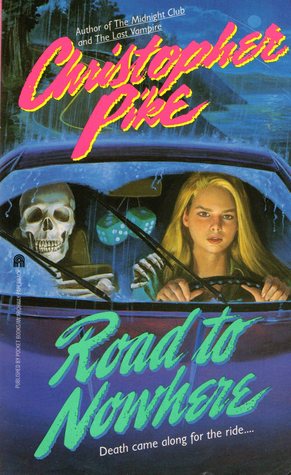
Horror Book Review: Road to Nowhere by Christopher Pike


To be honest, I ordered a copy of this 1993 YA novel from Half-Price Books strictly because of the cover.  I mean, there were several old Christopher Pike books to chose from but that image of the young woman driving her car with the skeleton sitting beside her just leaped out at me.  I think a lot of it had to do with the fuzzy dice hanging from the rear view mirror.  I’ve got a St. Patrick medal hanging from my mirror but if I wasn’t half-Irish and if I hadn’t been raised Catholic, I definitely would have the dice….

Well, actually, I probably wouldn’t have anything hanging from my mirror.  Seriously, those big dice look like they’re going to get in the way.  I mean, she’s already driving in the rain and she’s got a skeleton sitting next to her.  Does she need the distraction of giant dice?  No wonder death is coming along the ride….

Anyway, the book itself is about an 18 year-old named Teresa.  Teresa is an aspiring songwriter and singer.  She just broke up with her boyfriend Bill.  The book takes place on the night that she was planning to lose her virginity to Bill but now that she’s single and miserable, she figures that she might as well just drive to the Bay area.  Teresa also decides to pick up two hitchhikers because apparently, she’s never read a scary book or seen a horror movie before.

The hitchhikers are named — look, I’m not joking — Freedom Jack and Poppy Corn.  Freedom Jack and Poppy Corn are also heading to the Bay and they have all sorts of interesting stories to tell about yet another couple, John and Candy.  Now, to be honest, I wouldn’t pick up hitchhikers in the first place.  I don’t care how lonely I am.  I don’t care how much its raining.  I don’t care how late at night it is.  I’m not picking you if you’re standing on the side of the road.  But even if I did pick up a pair of hitchhikers, I would probably kick them out of the car as soon as they started telling me a story about a doomed couple who are obviously the hitchhikers in a past life.  Somehow, Teresa doesn’t immediately catch onto the fact that Freedom Jack and Poppy Fresh are actually John and Candy despite the fact that it’s incredibly obvious.  (John = Jack.  Candy = Poppy Corn.  I mean, come on….)  Then again, Teresa doesn’t seem to be the smart in general.

Anyway, Teresa’s journey with the two hitchhikers leads to her stopping off at both a castle and a church and losing her virginity.  The journey continues without anywhere seeming to get anywhere because they’re on a road to nowhere and this is one of those Christopher Pike books where nothing is what it actually seems to be.  There’s a lot of twists but they’re all somewhat predictable twists.  If you’ve read any of Christopher Pike’s other books, you’ll be able to guess what’s going on in The Road to Nowhere.  In the end, everyone has come to peace with their past and chosen their future.  While the stories of Teresa and Bill and John and Candy contain moments of deep darkness, Road to Nowhere , especially when compared to Pike books like The Immortal and Die Softly, is actually rather optimistic about the ability of people to move on and find some sort of peace.

Finally, let’s give the book some credit for coming up with names like Freedom Jack and Poppy Corn.  That, in itself, is an accomplishment worth celebrating.  Still, I wish the cover had more accurately reflected the content of the book.

The TSL’s Horror Grindhouse: The Alien Dead (dir by Fred Olen Ray)


This 1978 film takes place in Florida.

No, not in Miami.  Not Jacksonville.  Not Ft. Lauderdale.  Certainly not Orlando.  No, this film takes place off the back roads of Florida, where people are honest country folk and some folks live in a houseboat and you should always be careful when walking around the bayous because there might be some alligators lurkin’ about.  Of course, in this part of Florida, they call them gators.  Anyone who says alligator obviously thinks they’re too good for downhome country living.

Anyway, it turns out that there’s more to worry about in Florida then just alligators.  There’s also the chance that your houseboat might get struck by a meteor.  And then, everyone on the houseboat might be transformed into a zombie and, after they’ve eaten all the alligators, they might start eating all the humans.

When a sudden zombie outbreak occurs, you have to hope that you’ll get a good law enforcement response.  Unfortunately, law enforcement in these parts means an elderly sheriff and a bearded deputy who is always trying to catch a peek of the local women skinny dipping.  The sheriff, by the way, is played by Buster Crabbe.  In the 20s and 30s, Crabbe was an champion swimmer who won Olympic medals and went on to play Tarzan, Flash Gordon, and Buck Rogers.  At the height of his popularity, he was known as “the King of the Serials.”  In The Alien Dead, the 70-something Crabbe plays Sheriff Kowalski and, if nothing else, it seems like he was enjoying himself.  Really, that’s important thing when it comes to a movie like this.

The Alien Dead is an extremely-cheap looking film and, with the exception of Crabbe, none of the actors appear to have done much before or after appearing in The Alien Dead.  There are some scenes that are so dark that it’s next to impossible to actually tell what’s going on.  Despite being a rather short film, the pace is still slow and there are certain scenes that seem to drag on forever.  There’s a lot of perfectly valid criticisms that one can make about The Alien Dead.

But you know what?

I like the film.

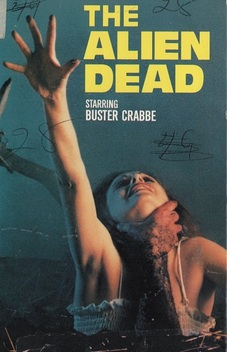
Seriously, in a strange way, the film actually does work.  Yes, the acting is pretty bad and the dialogue is often rather clunky and the plot doesn’t make sense and blah blah blah.  Those are all true facts.  But, there are isolated moments where The Alien Dead achieves a dream-like intensity.  For instance, there’s a lengthy scene where the zombies attack and all of the action is shown in slow motion.  I realize that may have been done to pad the film’s running time but strangely enough, it works.  Even more oddly, the film’s cheap gore effects add to the movie’s already dream-like feel. Finally, if nothing else, the film captures the humid atmosphere of the Florida bayou.  Watching the film, you can feel the sweat and hear the buzzing of mosquitos.  At its best, The Alien Dead works as a piece of outsider art.

Finally, The Alien Dead is one of those films that had been released and re-released a few times on video.  As you can see below, one of those releases was apparently inspired by the success of Evil Dead.