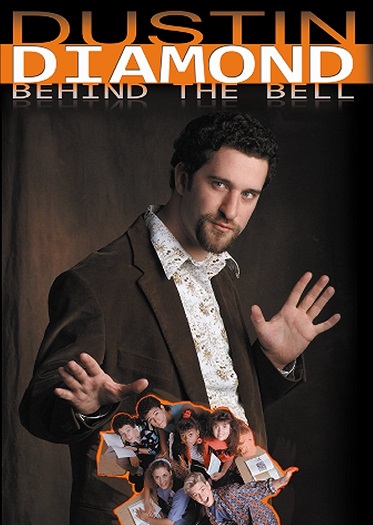
Book Review: Behind the Bell by Dustin Diamond


How bitter can one celebrity be?  The 2009 “memoir,” Behind the Bell, attempts to answer that question.

I was originally planning on reviewing Behind the Bell last year.  I didn’t, for the obvious reason that Dustin Diamond passed away in April of 2021 and Diamond did not come across particularly well in the book.  At the time, I know that a lot of culture bloggers, myself included, felt a bit conflicted when Diamond died.  Several years ago, I was one of the contributors to a blog about Saved By The Bell: The College Years, in which we spent nearly every review trashing the character of Screech Powers and the performance of the actor who played him.  To be honest, if I had to do it again, I probably wouldn’t change a thing that I wrote because Screech was a terribly-written character on a show that was full of them and Dustin Diamond’s increasingly cartoonish performance in the role didn’t do anything to help matters.  But still, after he died, I did find myself thinking about all the crap that Diamond took over the years for playing the character and I realized that it wasn’t entirely fair.  With the scripts that were being written, I doubt any actor could have made Screech any less annoying of a character.

That said, it also doesn’t diminish the tragedy of a non-smoker dying of lung cancer at the age of 44 to admit that Dustin Diamond did some fairly shady things after his time on Saved By The Bell.  There was the sex tape.  There was the controversial fundraiser to save his house.  There was the stabbing incident in a Wisconsin bar and his subsequent arrest for violating the conditions of his parole.  But again, you have to ask yourself if any of that would have happened if Diamond hadn’t, at the age of 11, been cast on the television show that would both make him famous and also pretty much typecast him as everyone’s least favorite student at Bayside.

Yes, Dustin Diamond was only 11 years old when he was cast as an 8th grader in Good Morning, Miss Bliss, the show that would eventually become Saved By The Bell.  He was considerably younger than the rest of his castmates, which undoubtedly led to him becoming the show’s outsider.  Along with Dennis Haskins, he stuck with the franchise all way to the end, for ten years.  He was 21 when Saved By The Bell: The New Class ended.  At a time when most people were having their first legal drink, Diamond was trying to figure out what to do with his life now that his acting career was pretty much over.  One would have to be heartless to not have some sympathy for the kid.

Behind the Bell deals with Diamond’s time on Saved By The Bell and his attempts to figure out what to do with his life after the show ended.  Unfortunately, as I mentioned earlier, Diamond doesn’t come across particularly well in Behind the Bell.  If anything, it’s perhaps one of the most bitter showbiz memoirs ever written.

Of course, before I write anything else, I should point that Diamond himself claimed that he didn’t actually write the book.  In 2013, during an interview for Oprah: Where Are They Now?, Diamond said that the book was ghost written by a guy who interviewed him and who either exaggerated his answers or took things out of context.  That may be true.  There are a few obvious factual errors in the book, a big one being the claim that Elizabeth Berkley starred in Showgirls while also appearing in Saved By The Bell.  Everyone knows that the original Saved By The Bell had already ended its run before Showgirls even went into production.  At the same time, the book’s bitterness is so obsessive, so detailed, and so personal that it’s hard to believe that it could all just be the product of a ghost writer’s imagination.  Diamond may have told the truth about having a ghost writer but it’s hard to buy his claim that the entire book was just based on a few vague and general answers that Diamond provided in an interview.

The majority of the book’s bitterness is directed at his fellow castmates.  Mario Lopez is described as being a bully.  Tiffani-Amber Thiessen is portrayed as being a bitch.  (And yet, at one point, Diamond mentions that he briefly lived with Tiffani-Amber and her family while he was being stalked by a fan.)  Elizabeth Berkley and Lark Voorhies are both described as being vapid while Dennis Haskins is apparently difficult to work with.  Diamond insinuates that Ed Alonzo seduced Neil Patrick Harris while Harris was still underage.  Still, the book reserves most of its ire for Mark-Paul Gosselaar.  Interestingly enough, Gosselaar is never described as doing anything that bad and, if anything, he comes across as being rather level-headed for a teen idol.  And yet, Diamond insists on telling out that Mark-Paul was actually a “douchebag” who got all of the attention and didn’t want to hang out with “the Dust.”  Throughout the book, Mark-Paul is frequently referred to as being “the golden child,” as if Mark-Paul owed Diamond an apology for being the best-looking actor on a show that was all about appearance.

When Diamond (or his ghost writer) isn’t trashing the rest of the cast, he’s telling us about the 2.000 women that he claims to have had sex with while playing Screech.  Diamond even claims to have had an affair with one of the show’s executive producers, who was in her 30s at the time.  (Diamond would have been 14.)  The woman later died of cancer and, as such, was not available to respond to Diamond’s claims.  An entire chapter is devoted to getting laid at Disneyland or “the Dizz” as Diamond (or his ghost writer) calls it.  Diamond really should have insisted on a better ghost writer.

(He also should have insisted on better copyeditor and fact checker.  The book is full of formatting errors and, at one point, a paragraph appears twice.  Hopefully, a fact checker would have noticed that Elizabeth Berkley was no longer on Saved By The Bell when Showgirls went into production.)

And yet, there are moments in the book that are actually kind of sweet.  The middle section of the book described a typical week in the production of Saved By The Bell and, for once, Diamond stops bitching about his castmates and trying to impress the readers and instead, he just talks about a unique experience that only he and a few other people experienced.  For a few brief chapters, the book actually becomes an interesting read and you can briefly see who Diamond was when he wasn’t busy being bitter.  There’s a wistful nostalgia to this section of the book.  Unfortunately, it only last for a few chapters and then we’re back to accusations of drug abuse and a nauseating “open letter” to all the women who Diamond claimed to have had sex with over the years.

In the end, I guess the main lesson of not just Behind the Bell but also of Dustin Diamond’s life in general is that child actors need a strong support system around them.  Too many people will try to take advantage of them and the pressure to often be the sole provider for the family is too much weight to be put on any 11 year-old’s shoulders.  Diamond needed someone to look out for him and sadly, it appears that very few people were willing to do that.
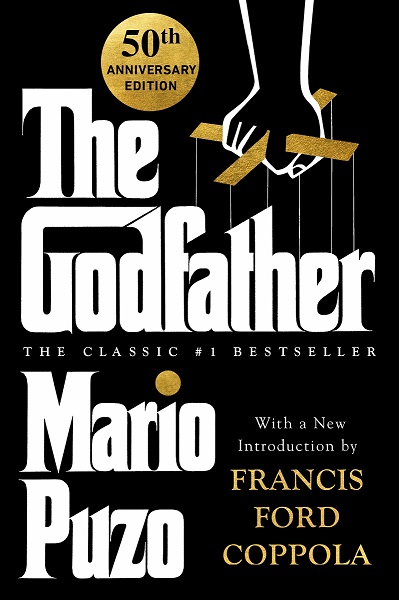
Book Review: The Godfather by Mario Puzo


“The book,” it is often said, “is always better than the film.” But is that always true?

No, it’s not and, if you need proof, just read Mario Puzo’s The Godfather and then re-watch the movie. Or re-watch the movie and then read the book. Either way, you’ll be left with the conclusion that, while the novel did lay the foundation for what became the greatest movie ever made, the novel itself is still a bit …. off.

The Godfather was originally published in 1969 and, before I write anything else, it should be noted that Mario Puzo himself never claimed that the book was meant to be a great work of literature. Puzo had previously written three novels and one children’s book. One of those novels was a pulp paperback that he wrote under a pseudonym for a quick payday. The other two novels were both meant to be works of “serious literature” that examined the human condition. Puzo considered his second novel, The Fortunate Pilgrim, to be his best and most poetic work. The only problem is that, while the reviewers were respectful, hardly anyone read Puzo’s “serious” fiction. As such, The Godfather was Puzo’s attempt to write the most commercial book possible, a page-turner that would climb the best seller list and help Puzo pay off his gambling debts. The Godfather certainly did that, spending 67 weeks on the New York Times’s Best Seller List and selling over 9 million copies in two years. Producer Robert Evans was so sure that the novel would be a hit that he even paid for the film rights while the book was still in the galleys.

Reading the book, especially after watching the movie, can be an odd experience.  The film itself is largely faithful to the book. Just about everything that happens in the movie can be found in the book.  Michael, Sonny, Tom, Fredo, Vito, Kay, Barzini, Sollozzo …. they’re all here.  Usually, characters are more complex in the original book than they are in the subsequent film adaptation.  In this case, the opposite is true and reading Puzo’s somewhat leaden prose really does make you appreciate the depth and nuance that actors like Al Pacino, Marlon Brando, James Caan, Robert Duvall, and John Cazale brought to the characters.  (Perhaps the most extreme example is Kay Adams, who was written as a dull nonentity with none of the nervous likability than Diane Keaton brought to the role.)  To be honest, perhaps the only character who comes across more vividly in the book than in the film is Luca Brasi.  The book goes into the details of what Brasi did for the Don in the past and, as a result, it’s much easier to understand why everyone was so terrified of him.

But, as I said, all of the events that can be found in the movie can also be found in the book.  However, there’s also a lot of things in the book that we’re left out of the film and it’s easy to see why.  In the film, for instance, Johnny Fontane shows up in only two scenes.  Tom Hagen goes to Hollywood.  Jack Woltz ends up with a horse’s head in his bed.  And that’s it for the film industry.  (In the book, the horse’s head is just placed in Woltz’s room as opposed to his bed.  Francis Ford Coppola later admitted that he misread the passage where Woltz finds the head.)  In the book, however, the Hollywood scenes go on forever.  Large sections of the narrative are handed over to Johnny Fontane and his best friend as they party in Hollywood.  It gets frustrating.  You want to read about the Corleones but instead, you’re reading predictable Frank Sinatra fanfic.

When the book’s not getting bogged down on Fontane, it’s getting caught up with Lucy Mancini and her quest to find a man who is as well-endowed as the late Sonny Corleone.  Lucy was Sonny’s lover.  He was the only man who was large enough to satisfy her.  After Sonny’s death, Lucy is given a casino in Las Vegas.  It’s while in Vegas that Lucy meets Dr. Jules Segal, an abortionist who explains to Lucy that she can’t achieve sexual satisfaction because her vagina is too big.  Fortunately, he can help.  Or, as he puts it, “Baby, I’m going to build you a whole new thing down there, and then I’ll try it out personally.” Awwwwwww!

Anyway, for whatever reason, Francis Ford Coppola decided not to include any of this when he made his film version.  And it’s for the best.  When it comes to The Godfather as a book …. well, the movie’s great.  And the sequel’s even better!  The book really makes you appreciate what Coppola and his amazing cast and crew were able to accomplish.

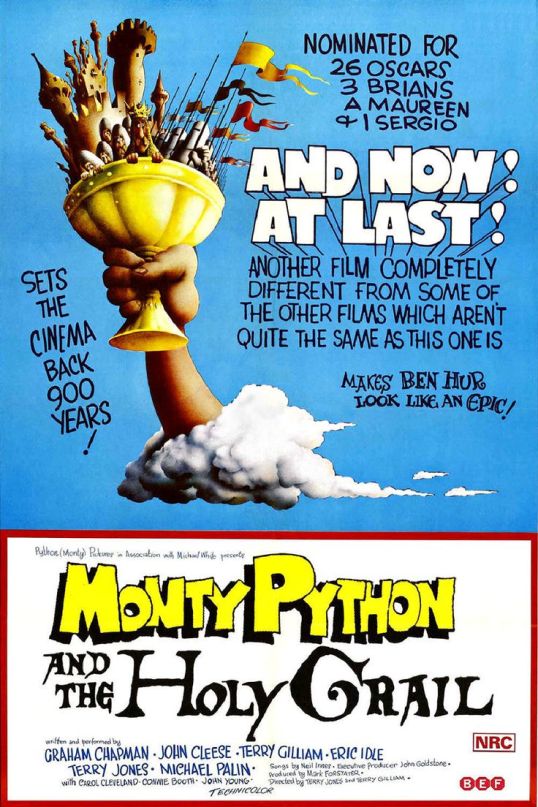
The Unnominated: Monty Python and the Holy Grail (dir by Terry Gilliam and Terry Jones)


Though the Academy of Motion Picture Arts and Sciences claim that the Oscars honor the best of the year, we all know that there are always worthy films and performances that end up getting overlooked.  Sometimes, it’s because the competition too fierce.  Sometimes, it’s because the film itself was too controversial.  Often, it’s just a case of a film’s quality not being fully recognized until years after its initial released.  This series of reviews takes a look at the films and performances that should have been nominated but were,for whatever reason, overlooked.  These are the Unnominated.

Really, Academy?

No nominations for one of the most influential and widely-quoted films ever to be released?

Well, actually, I get it.  Monty Python and the Holy Grail was first released in 1975 and 1975 was an unusually good year for cinema.  Back in the 70s, of course, the Academy only nominated five films for Best Picture and, as a result, a lot of good films were not nominated that year.  There just wasn’t room for them.  Check out the five films that were nominated and ask yourself which one you would drop to make room for a different nominee.

Would you drop:

Barry Lyndon, which was directed by Stanley Kubrick was considered to be the most realistic recreation of the 18th Century to ever be captured on film,

Dog Day Afternoon, in which director Sidney Lumet brilliantly mixed comedy and drama and which featured wonderful performances from Al Pacino, John Cazale, Chris Sarandon, and Charles Durning,

Jaws, the Steven Spielberg-directed hit that changed the face of Hollywood,

Nashville, Robert Altman’s sprawling and ambitious portrait of a country tying to find itself after a decade of trauma,

or

One Flew Over The Cuckoo’s Nest, in which Milos Forman paid tribute to individual freedom and Jack Nicholson gave perhaps the best performance of his legendary career?

I mean, those are five great films.  Even the weakest of the nominees (which, in this case, I think would be the eventual winner, One Flew Over The Cuckoo’s Nest) is still stronger than the average Best Picture nominee.

So, I can understand why there wasn’t room for an episodic and rather anarchistic British comedy, one that largely existed to parody the type of epic and period filmmaking that the Academy tended to honor.  If there had been ten nominees in 1975 and Monty Python and the Holy Grail had been snubbed to make room for something like The Other Side of the Mountain, my feelings might be different but there weren’t.

That said, even if there wasn’t room in the Best Picture slate, what to make of the lack of nominations for a script that is so full of quotable lines and memorable incidents that even people who haven’t seen Monty Python and the Holy Grail are familiar with them?  No nominations for the costumes, the production design, or the cinematography, all of which are surprisingly good for a low-budget film that was directed by not one but two untested neophyte directors?  No nominations for the thrilling music or the Camelot song?  How about a special award for the killer rabbit?

How about at least a best actor nomination for Graham Chapman, who played King Arthur not as a comedic buffoon but instead as being well-intentioned but also increasingly frustrated by the fact that his subjects cared not about his quest or his royal title?  Though 1975 may have been a strong year for movies, it appears that the Academy still struggled to find five best actor nominees and they resorted to giving a nomination for James Whitmore’s performance as Harry Truman in a filmed version of his one-man stage show, Give ‘Em Hell Harry.  Nothing against James Whitmore or Harry Truman but I think we all know that spot belonged to Graham Chapman and his performance as King Arthur.

Monty Python and the Holy Grail is often described as being a satire of the Arthurian legends.  I think, even more than being a film about King Arthur, it’s a film about a group of people trying to make an epic despite not having the resources or the patience to do so.  Python humor has always featured characters who were both foolishly confident and stubbornly aggressive and both of those traits are on wide display in Monty Python and the Holy Grail.  The production can’t afford horses so Arthur and his knights hit two coconuts together to duplicate the sound of the hooves on the ground and when they’re confronted about it, they attempt to change the subject.  Can’t afford to shoot in a real castle?  Simply declare Camelot to be a silly place and walk away.  Can’t afford to get permits to film on a certain location? Film illegally and run the risk of getting arrested just when you’re about to start the film’s climatic battle scene.  Can’t afford to hire God for a cameo?  Use a cut-out.  Can’t afford a real knight?  Just hire some people who get carried away and then hope one of them doesn’t kill the local academic who has shown up to explain the film’s historical context.

“I just get carried away,” John Cleese’s Lancelot says more than once and he has a point.  But the entire movie is about people getting carried away.  The Black Knight is so carried away in his belief in himself that he continues to fight despite having neither arms nor legs.  The villagers are so carried away in their desire to burn a witch that they cheer when it’s discovered that she weighs the same amount as a duck.  (“It’s a fair cop,” the witch, played by Connie Booth, admits.)  Eric Idle’s Sir Robin is so carried away in his ability to answer questions that he doesn’t consider that he might be asked about the capitol of Assyria.  The Knights of the Round Table as so carried away in their dancing and their singing that no one wants to go to the castle.  Even the film’s animator gets carried away, suffering a heart attack and saving Arthur and his surviving knights from a fate worse than death.

Monty Python and the Holy Grail is a very funny film, of course.  We all know that.  (I once read a story about a woman who, having learned she only had a few weeks to live, decided to watch this film everyday until she passed.  I don’t blame her.)  But what I truly love about this film is that, in scene-after-scene, you can literally see the Pythons realizing that they were actually capable of making a real movie.  Michael Palin, especially, seems to be having so much fun playing the eternally pure Sir Galahad that it’s impossible not to get caught up in his happiness.  There’s a joie de vivre that runs through Monty Python and the Holy Grail, even at its darkest and most cynical.  The Pythons are having fun and it’s impossible not to have fun with him.

And, while the Oscars may have snubbed Monty Python and the Holy Grail, the Tonys did not.  When the film was later turned into Spamalot, it received 14 Tony nominations and won three.

Previous entries in The Unnominated:

  1. Auto Focus 
  2. Star 80

Cleaning Out The DVR: And Now For Something Completely Different (dir by Ian MacNaughton and Terry Gilliam)


A tall, dark-haired British man sits behind a desk that is rather oddly sitting in the middle of a field.  He wears a dark suit and he looks quite serious as he says, “And now, for something completely different….”

Cut to a short film about a man with a tape recorder up his nose, followed by another short film about man who has a tape recorder up his brother’s nose.

A Hungarian man tries to buy cigarettes while using an inaccurate English phrasebook.  The publisher of the phrasebook is later brought before the court.

Poor old Arthur Pewty goes to marriage counseling and can only watch impotently as the counselor seduces his wife.  Having filed to stand up for himself, Pewty is crushed by 16-ton weight.

A self-defense instructor teaches his students how to defend themselves when they are attacked by a man with a banana.

A loquacious man in a pub says “nude nudge” and “wink wink” until his drinking companion is finally forced to slam down his drink.

A man who sees double recruits a mountaineer to climb the two peaks of Mt. Kilimanjaro.  Hopefully, they’ll be able to find last year’s expedition, which was planning on building a bridge between the two peaks.

There’s bizarre, almost Dadaist animation, featuring classic works of art interacting with cartoonish cut-outs.

Uncle Sam appears to explain how communism is like tooth decay.  A toothpase commercial explains how taking care of your teeth is like racing a car.  A motor oil company shows how it can destroy darkness and grim.

A prince dies of cancer but the spot on his face flourishes until it falls in love and moves into a housing development.

A man tries to return a dead pigeon.  The store clerk insists the pigeon is merely stunned and then sings about wanting to be a lumberjack.

A general complains that things have gotten much too silly.

The narrator appears randomly, announcing, “And now for something completely different….”

Okay, okay, you get the idea.  First released in 1971, And Now For Something Completely Different was the first film to be made featuring all of the members of Monty Python’s Flying Circus.  It was their initial attempt to break into the American market, a collection of surreal sketches that they had previously performed on television for the BBC.  Unfortunately, at the time, no one in America really knew who Monty Python was and the film failed at the box office, to the extent that many in the UK advised against Monty Python even allowing their program to later air on PBS because it was felt that Americans just wouldn’t get it.  Of course, Americans did eventually get it.  The show remains popular to this very day.  Countless Americans are convinced that they can speak in a perfectly convincing British accent, as long as they’re quoting a line from Monty Python.  The previous 4th of July, when the town band played John Philip Sousa’s Liberty Bell, I saw hundreds of people stamping down their feet at the end of it.  As for And Now For Something Completely Different, it was re-released in 1974 and became a bit of a cult favorite in the States.

That said, the members of Monty Python were never particularly happy with the film.  They were convinced to make the film by Victor Lownes, who was the head of Playboy’s UK operation.  Lownes, however, alienated the members of the group by trying to exert control over the material.  He particularly objected to the character of Ken Shabby, a perv who probably had a stash of sticky Playboys back at this flat.  Lownes also put up very little money for the production, meaning that the Pythons had to resort to shooting the film, without an audience, in a deserted factory.  Apparently, even the deliberately cheap-looking special effects of the television show were considered to be too expensive to recreate for the film.  Michael Palin and Terry Jones both later complained that the film itself was series of scenes featuring people telling jokes while sitting behind desks.

Of course, Lownes’s biggest sin was trying to insinuate that he was somehow the Seventh Python.  (One can only imagine how many people were guilty of the sin over the years.  Claiming to be the Seventh Python was probably a bit like claiming to be the Fifth Beatle.)  When Terry Gilliam was animating the film’s opening credits, the names of the cast were shown in blocks of stone.  Lownes insisted that his name by listed the same way.  Gilliam reluctantly acquiesced but then redid the names of the Pythons so that they were no longer in stone.  Fortunately, Victor Lownes would not involved in the subsequent Python films.

All that said, there’s no denying that And Now For Something Completely Different is a funny movie.  I mean, it’s Monty Python.  It’s John Cleese, Michael Palin, Graham Chapman, Eric Idle, Terry Jones and Terry Gilliam, all youthful and at the heights of their considerable comedic talents.  Even if all of the sketches are familiar from the show, they’re still funny and it’s impossible not to enjoy discovering the way that the movie threads them together.  (Combining the Lumberjack song with the dead parrot sketch worked out brilliantly.  “What about my bloody parrot!?” Cleese is heard to shout as Palin walks through the forests of British Columbia.)  Personally, my favorite Python is Eric Idle but I also love any sketch that involves Michael Palin getting on John Cleese’s nerves.  Everyone knows the dead parrot sketch, of course.  But I also like the vocational guidance counselor sketch.  It’s hard not to get caught up in Palin’s excitement as he discusses his lion tamer’s hat.  Almost as wonderful as Palin’s turn as Herbert Anchovy, accountant was Michael Palin’s turn as the smarmy host of Blackmail.  Actually, maybe Michael Palin is my favorite Python.  I guess it’s a tie between him and Eric.

And Now For Something Different has been on my DVR for quite some time.  I’ve watched it several times.  I’m not planning on deleting it any time soon.

Guilty Pleasure No. 52: Saved By The Bell 3.21 “No Hope With Dope” (dir by Don Barnhart)


Saved By The Bell is the show that will not die.

Saved By The Bell started out in 1989, airing on NBC on Sunday mornings.  The show followed the adventures of Zack Morris, AC Slater, Screech, Jessie Spano, Kelly Kapowski, and Lisa (hey!) Turtle as they navigated their way through Bayside High.  It’s bit of an odd show, in that there was no real continuity and Zack was a designated hero who often came across as being a young sociopath.  Zack and his friends were rich and, with the notable exception of Jessie, apolitical.  The only time they all, as a group, cared about anything was when there was an oil spill near the duck pond that was just because Zack had befriended one of the ducks.  The humor was goofy but the acting was occasionally better than it had any right to be.  (Mario Lopez was the cast MVP.)

Saved By The Bell had a loyal audience when it originally aired but it owes it popularity to syndication.  When I was in high school and college, Saved By The Bell always seemed to be playing somewhere.  I have friends who scheduled their day around, though none of them will admit it now.  As I sit here writing this, Saved By The Bell can currently be viewed on about a dozen different streaming services and there’s currently a very self-aware reboot streaming on Peacock.  Reruns of this show will probably be outlive us all.  There’s no escaping the Bell.

Interestingly enough, for all of the show’s cultural cachet, there are really one three episodes of Saved By The Bell that are really “must-see.”  The first one, of course, was the infamous episode where Jessie got hooked on sugar pills and ended up shouting, “I’m so excited!” when Zack tried to get her to wake up.  The second one was the episode where Zack passed out in his garage and dreamt about the future of his band, Zack Attack.  (“Friends forever.  It’s an nice idea.”)  And finally, there’s the “No Hope With Dope” episode.

First airing in 1991 (on November 30th, to be exact), “No Hope With Dope” feels like a time capsule.  Big-time movie star Johnny Dakota (played by Eddie Garcia) comes to Bayside and, after Zack leads the students in an anti-drug rap song, Johnny decides to shoot his latest anti-drug PSA at the high school.  This not only gives Jessie a chance to once again tell everyone about her sugar pill addiction (which I’m sure everyone at the school was sick of hearing about) but it also gives Zack, Slater, and Screech the excuse to become amateur narcs.  When they discover a joint in a Bayside bathroom, they immediately accuse Scud, who is wearing a Slayer t-shirt and is therefore the number one suspect.  Scud reveals that he only smokes cigarettes because, when it comes to marijuana, “Not even I’m that dumb!”  Slater still destroys Scud’s cigarette because cigarettes can kill too.

However, at a big movie star party, Zack and Kelly are offered a joint by — OH MY GOD! — Johnny Dakota!  Though Johnny doesn’t actually try to force the death weed on the two of them after they initially refuse it, Zack and Kelly are so disgusted by Johnny’s actions that they leave the party.  The Bayside Gang announces that they cannot sanction Johnny’s buffoonery.  (“The reputation of Bayside was at stake!” Jessie says.)  Johnny gets mad and leaves.

Watching this episode today, most viewers will probably say, “BUT IT WAS JUST A JOINT!”  Seriously, it’s not like Johnny was snorting coke in Mr. Belding’s office or shooting heroin in the school’s locker room or anything similar to that.  Johnny was only doing something that, today, is legal in many states and probably will be legal in every state by the time 2030 rolls around.  And yet, everyone at Bayside acts so shocked to discover that someone who is apparently the biggest film star in the world occasionally smokes weed.  The way that Zack and the gang react to marijuana in 1991 in comparison to how most people react to it in 2022 is one of the things that makes this episode such a guilty pleasure.  It’s a time capsule with a laugh track.

(Of course, one reason why “No Hope With Dope” became such a popular episode is that much of the show’s later audience was probably high when they first saw it.)

Anyway, Johnny’s gone and Bayside is still eager to make an anti-drug PSA.  Fortunately, Mr. Belding has a friend at NBC!  It turns out that the then-president of the network went to school with Mr. Belding!  He agrees to come to Bayside and share with everyone his hit new idea for the fall season: Don’t.  Do. Drugs.  He also does the old, “Maybe I could produce a TV show about a bunch of rich high school kids …. nah, it would never work!” joke.  “Come back and visit any time,” Jessie tells him.  Yeah, Jessie, I’m sure that’ll happen….

The show ends with the Bayside “No Hope With Dope” PSA and these few minutes are what transforms this episode into a true cultural landmark.  Watch it below and be sure to note that, when Screech pops out of the locker, there’s a picture of John Lennon smoking a joint on the door.

Previous Guilty Pleasures

  1. Half-Baked
  2. Save The Last Dance
  3. Every Rose Has Its Thorns
  4. The Jeremy Kyle Show
  5. Invasion USA
  6. The Golden Child
  7. Final Destination 2
  8. Paparazzi
  9. The Principal
  10. The Substitute
  11. Terror In The Family
  12. Pandorum
  13. Lambada
  14. Fear
  15. Cocktail
  16. Keep Off The Grass
  17. Girls, Girls, Girls
  18. Class
  19. Tart
  20. King Kong vs. Godzilla
  21. Hawk the Slayer
  22. Battle Beyond the Stars
  23. Meridian
  24. Walk of Shame
  25. From Justin To Kelly
  26. Project Greenlight
  27. Sex Decoy: Love Stings
  28. Swimfan
  29. On the Line
  30. Wolfen
  31. Hail Caesar!
  32. It’s So Cold In The D
  33. In the Mix
  34. Healed By Grace
  35. Valley of the Dolls
  36. The Legend of Billie Jean
  37. Death Wish
  38. Shipping Wars
  39. Ghost Whisperer
  40. Parking Wars
  41. The Dead Are After Me
  42. Harper’s Island
  43. The Resurrection of Gavin Stone
  44. Paranormal State
  45. Utopia
  46. Bar Rescue
  47. The Powers of Matthew Star
  48. Spiker
  49. Heavenly Bodies
  50. Maid in Manhattan
  51. Rage and Honor

Film Review: Lost Horizon (dir by Charles Jarrott)


“Friends forever.  It’s a nice idea.”

With those words, the late Casey Kasem closed out the infamous “Rockumentary” episode of Saved By The Bell.  In this episode, Zack Morris fell asleep in his garage while waiting for his high school friends to arrive for band rehearsal.  While he was asleep, he dreamt about becoming a superstar as the result of Zack Attack’s hit song, Friends Forever.  Later, of course, Zack was led astray by a publicist who tried to sell him as being a “male Madonna.”  Zack didn’t care about the fame.  He was more concerned that the music and the lights at his concert were so excessive that the audience couldn’t even hear his lyrics.  Because, seriously, when you’re coming up with banger lyrics like “We’ll be friends forever/yes we will,” you want to make sure that they can clearly be heard.

It’s easy to make fun of the band and the show but that doesn’t make Casey Kasem’s words any less true.  Friends forever.  It is a nice idea.  It’s also a totally unrealistic and implausible idea.  People grow apart.  People develop new interests.  People move to different towns.  Sometimes, people just decided that they need to take a little break from the same old thing.  Instead of demanding that people remain friends forever, it would perhaps be more realistic to encourage people to enjoy and treasure the time that they have in the present.  But, to be honest, entertainment is not about that type of reality.  No one wants to hear, “Be friends until you get bored.”  Instead, they want to hear “Friends forever!”  It’s a simple idea and the simple ideas are the ones that usually bring us the most comfort.

Take the idea behind Shangri-La, for instance.  Shangri-La was a utopia that was hidden away in the Himalayas.  It was a place where there was no war, no greed, and everyone was in nearly perfect health.  It was a place where it was common for people to live to be well over a hundred years old.  It’s a place where people literally can be friends forever.  And while the place does have one very big drawback — i.e., once you decide to stay there, you can’t return to the outside world for even so much as a brief visit — it’s still easy to see why this idealized existence would appeal to many people.

The lamasery of Shangri-La was first introduced in a 1933 novel called Lost Horizon.  Written by James Hilton, Lost Horizon told the story of a group of westerners who, fleeing from a political uprising in India, find themselves in Shangri-La.  That the novel’s portrayal of a peaceful utopia hidden away from the “modern world” proved to be popular should not come as a surprise.  In 1933, the world was still recovering from the Great War.  Much of Europe was still in ruins, both economically and physically.  The combination of the First World War and the Spanish Flu pandemic had shaken everyone’s faith in the future.  Even as a group of idealistic activists, industrialists, and politicians tried to make war illegal, Mussolini seized power in Italy.  Spain was on the verge of civil war.  In Germany, a fanatical anti-Semite named Adolf Hitler had managed to move from being a fringe politician to being named chancellor.  The U.S. was suffering from the Great Depression.  Even the UK was so mired in political turmoil that it was no longer a reliable bulwark against chaos.  To the readers who were having to deal with all of that on a daily basis, the idea of Shangri-La was an inviting one.

(One of those readers was Franklin D. Roosevelt, who named his presidential retreat Shangri-La.  Years later, Dwight Eisenhower would rename Shangri-La after his son and it’s remained Camp David ever since.)

Not surprisingly, the book’s success led to it being adapted for the movies.  Frank Capra took the first crack at it, release his film version in 1937.  At the time, Capra’s adaptation was the most expensive film to have ever come out of Hollywood.  (It cost $1.6 million dollars!)  It also underperformed at the box office, nearly bankrupting Colombia Pictures.  Even though the film itself was nominated for Best Picture of the year, it still took five years for the film to earn back its cost.  Because Colombia edited the film to shorten its lengthy running time, Capra sued the studio and the end result was that everyone involved lost a good deal of money.  Considering all of the bad luck that befell the first production, one might wonder why Hollywood would even risk making a second version of the film.  And indeed, it would be several decades before any major studio attempted to bring Hilton’s novel back to the screen, despite the fact that the idea behind Shangri-La was probably looking more attractive with each crisis-filled day.

Ross Hunter

In 1973, producer Ross Hunter was sleeping on a mountain of cash.  Well, perhaps he wasn’t but a look at some of the films that he had produced would definitely suggest that he could have if he had so chosen.  Hunter started his career producing melodramas that starred Rock Hudson and were often directed by Douglas Sirk.  He was the type of producer who understood that importance of glitz and glamour, especially with the film industry facing a new competitor named television.  In the 60s, he made films that were totally out-of-touch with the turmoil of the decade but which still appealed to middle-aged viewers who wanted an escape from the hippies and the assassins.  In 1970, he scored his biggest hit of all time when he produced Airport.  As dull as that film seems to us today, it was the biggest hit of 1970 and it also gave birth to the disaster genre.  (It was also the only Ross Hunter production to be nominated for Best Picture.)

It was after the success of Airport that Ross Hunter decided to produce a remake of Lost Horizon.  Following the approach that he used in Airport he gathered an all-star cast.  In fact, George Kennedy appeared in both Airport and Lost Horizon!  Joining Kennedy were Oscar nominees Sally Kellerman, John Gielgud, Charles Boyer, Peter Finch, and Liv Ullmann.  Michael York, fresh off of Cabaret, and Olivia Hussey, who was best-known for playing Juliet in the wildly successful 1968 version of Romeo and Juliet, were cast as rebellious lovers who tried to escape the paradise of Shangri-La.  Larry Kramer, the future playwright and political activist, was hired to write the script.  Charles Jarrott, who specialized in big, glossy films and who had been nominated for Best Director for his work on Anne of a Thousand Days, was brought in to direct.  And Burt Bacharach was enlisted to write the song because, on top of being a literary adaptation with an all-star cast, Lost Horizon was also going to be a musical.

What could go wrong?

What indeed.

The 1973 version of Lost Horizon opens with an endless aerial view of the Himalayas.  In the background, singers sing about peace and love.  “There’s a lost horizon/waiting to be found/where the sound of guns/don’t pound in your ears/anymore,” the singers repeat several times, as if to hammer home the fact that the audience is not about to get Burt Bacharach at his best.

When the opening credits finally end, we find ourselves at an airport.  A very non-musical protest has broken out.  The characters in the film describe it as a revolution but instead, it just looks like a bunch of confused extras standing on a landing strip.  When it comes to an epic film like this, it’s always a good idea to see what the extras are doing.  In a good film, the extras will actually be a part of the world onscreen and you won’t even think of them as being a crowd of paid performers.  In a bad film, like this one, they’ll all stand around in a perfectly organized group and they’ll all do the exact the same thing at the same time, like shaking their fists at a plane.

Despite all of the “drama” at the airport, one airplane does manage to take off.  On the plane are the Conways, diplomat Richard (Peter Finch) and his younger brother, George (Michael York, whose blond prettiness suggests that there’s not a chance he could share any DNA with the much more rough-hewn Peter Finch).  There’s also a Newsweek photographer named Sally Hughes (Sally Kellerman), who pops pills and who suffers from a pronounced case of ennui.  She describes her job as “taking pictures of the headless so that people with heads can look at them in magazines while getting their hair done.”  (Damn, Newsweek apparently used to be  really messed up publication!)  Sam Cornelius (George Kennedy) is an engineer and an embezzler.  And finally, there’s Harry Lovett (Bobby Van), who introduces himself to everyone as being “Harry Lovett, the comedian.”  Harry was playing an USO show when the revolution broke out and apparently, he was abandoned in the country because his act was so bad.  Is the film suggesting that, in 1973, the United States would actually abandon a citizen in a dangerous, war-torn country?  I hope someone impeaches that President Nixon!

Our heroes may think that they’re escaping to freedom but it turns out that the plane is actually being hijacked!  One thing leads to another and eventually, as happens in all good musicals, the plane cashes in a remote area of the Himalayas.  At first, it seems like our heroes are done for but, fortunately, they’re discovered by Chang (the very British John Gielgud) and a group of Shangri-La monks.  Chang leads the party through the snowy mountains and eventually, they arrive at what appears to be a Disney resort but what we’re told is actually Shangri-La, a tropical paradise that sits in the middle of one of the most dangerous places on Earth!

Shangri-La has something for everyone:

Sally gets off drugs and discovers a library that, oddly enough, has every book ever written even though no one knows where Shangri-La is, none of the inhabitants can leave the area without running the risk of rapidly again, and Amazon wasn’t a thing in 1973.

Sam discovers a gold mine but, realizing that money doesn’t matter, he instead uses his engineering skills to help out the farmers of Shangri-La.  It really didn’t appear that the farmers of Shangri-La needed any help but whatever, I guess.  As long as Sam is happy.

Harry Lovett becomes a big star as the children of Shangri-La love his comedy.  Children are well-known for their lack of taste when it comes to comedy.

Richard not only falls in love with the local teacher (Ingmar Bergman’s muse, Liv Ullman) but he also meets the High Lama (the very French Charles Boyer).  It turns out that the High Lama is finally going to die and that he’s determined that Richard is the man who is destined to take over Shangri-Law, despite the fact that Richard has only recently arrived and isn’t even a Buddhist.

In fact, almost everyone is so happy that they start to sing and dance!  It takes 50 minutes for the film to reach its first big musical number.  Unfortunately, there’s a reason why most successful film musicals open with a big number instead of holding off on it.  It’s important to, early on, get the audience used to the idea that they’re watching a film set in a world where it’s perfectly common for people to break out into song.  From West Side Story to La La Land, good musicals have understood the importance of bringing the audience in early.  Lost Horizon waits until everyone has gotten used to the film being a somewhat rudimentary adventure/disaster film before suddenly springing the singing and the dancing on everyone.  It’s a bit jarring.  It wouldn’t matter, of course, if the songs were any good but again, this was not Burt Bacharach’s finest moment.

Unfortunately, one member of the group doesn’t want to stay in Shangri-La and dance and sing.  George Conway does not want to be friends forever.  Instead, he’s fallen in love with the local librarian, Maria (Olivia Hussey).  Maria dreams of seeing New York and London.  George is determined to grant her wish, despite being told that Maria is nearly as old as John Gielgud and will start to age as soon as she leaves Shangri-La.  Richard feels an obligation to accompany his brother.  Needless to say, things don’t go well.  (As Michael York would later put it himself, “There is noooo sanctuary….”)  Will Richard be able to find his way back to Shangri-La?

“Let’s not go to Camelot, ’tis a silly place,” King Arthur famously declared in Monty Python and the Holy Grail.  Lost Horizon suffers the opposite problem.  While Lost Horizon’s Shangri-La is occasionally a silly place, it’s usually just an incredibly boring place.  One can’t help but feel that Maria has a point, regardless how much time Sally spends singing about her hatred of the New York night life.  The film’s downfall is that it argues for Shangri-La being viewed an ideal without making Shangri-La into any place that you would want to visit.  Add in the anemic songs and the confused performances and Charles Jarrot’s inability to maintain any sort of compelling pace and you have a film that’s too dull to really even qualify as a fun bad film.  It’s just bad.

That said, much like friends forever, Shangri-La is a nice idea.

6 Classic Trailers For January 1st, 2022


Well, it’s the first day of a new year and that means that it’ time for me to bring back a feature that was once quite popular on this site, Lisa Marie’s Favorite Grindhouse and Exploitation Film Trailers.  This is where I just share six trailers, sometimes all dealing with the same thing and sometimes not.  Unfortunately, because there’s only so many trailers available on YouTube, you’ll probably see a few trailers listed more than once.  It can’t be helped but no matter!  Trailers are fun and hopefully, watching a few of them will be an enjoyable way for you to start your day or your week or whatever.  I certainly enjoy them!

Since it’s the start of a new year and I already shared a music video for The Hustle, I figured I would continue that disco theme now.  Below are 6 trailers that will hopefully leave you dancing!

  1. Thank God It’s Friday (1978)

Considering that this film won an Oscar and was released by a major studio and featured both Jeff Goldblum and future Oscar nominee Debra Winger in the cast, it may seem odd to include this trailer in a feature about exploitation film previews.  But seriously, just watch the movie!  Yes, Last Dance is great but otherwise, this movie is pure drive-in gold.

2. Skatetown USA (1979)

“The greatest story ever rolled!”  Check out Patrick Swayze, playing a bad guy.  Swayze made his film debut here and, when he became a star, he actually tired to buy the rights to the film to keep anyone from ever seeing it again.  Honestly, though, it’s not that bad.  The music’s good.  Some of the routines are fun.  Swayze smolders with intensity.  Put on your skates and dance!

3. Roller Boogie (1979)

At the same time that Patrick Swayze was dominating Skatetown USA, Linda Blair was teaching a nation how to roll, dance, and love.

4. Disco Godfather (1979)

Of course, the disco wasn’t always a safe place.  Even in the 70s, it was a dangerous world out there.  Fortunately, Rudy Ray Moore was around to keep the peace and prevent the dancers from getting hooked on PCP.  “Put your weight on it, put your weight on it, put your weight on it!”

5. Can’t Stop The Music (1980)

You can’t stop the music …. no matter how much you try!  This was an attempt at a Village People movie.  It apparently didn’t really go very well.  I’ve never actually seen the film, though I suppose I’ll have to watch it someday.

6. Xanadu (1980)

Heh …. on YouTube, this is listed as being “A Gene Kelly movie.”  Yeah, Gene Kelly is one of the stars but I still don’t know if I’d necessarily call this “A Gene Kelly movie,” in the same way that I might use the label for Singin’ In The Rain or An American In ParisXanadu was one of the last of the big disco movies and it’ll live forever, though perhaps not in the way that it was originally intended to.

Music Video of the Day: The Hustle by Van McCoy (dir by ????)


“Do the Hustle!”

And may all the scolds go to Hell!

Well, it’s a new year and what better way to ring it in than by dancing and celebrating the Hustle?  Van McCoy’s The Hustle is a song that’s been heard by anyone who has ever watched a movie about the disco era.  It’s pretty much appeared on almost every soundtrack ever compiled.  If it’s a disco film, you’re going to hear The Hustle.  It’s a song that just makes you think about dancing, disco balls, and cocaine.  Lots and lots of a cocaine.  From what I understand, copies of this song were originally sold with their own souvenir coke spoons.  That may or may not be true but you get the idea.

Interestingly enough, the dance came before the song.  Van McCoy was at Adam’s Apple, a New York City nightclub, in 1975 when he saw that the patrons were dancing a new dance that they called The Hustle.  He was so taken with the dance that he wrote a song about it.  He had three lyrics and a beat you could dance to and that was all he needed to create the soundtrack of the late 70s.  The Hustle was a hit and it came to define an era.  Sadly, it was an era that McCoy himself would not survive.  He died of a heart attack in 1979, while in New Jersey.  He was only 39 years old.

The video below was released in 2010 and, as you can tell, it was made up by clips of McCoy performing the song on various shows.  You can debate whether this is a legitimate music video or just a compilation.  That’s fine, though.  We’re all about debate here at the Shattered Lens!  Ultimately, what is truly important is that it’s a good song and it’s a new year!  It’s 2022!  Get out there and dance!  Get out there and do the hustle!  And you know what!?  Don’t be afraid to use exclamation points!  You’ve earned them and you’ve earned the right to use them as much as you want!

Personally, I think the attitudes of the 1920 and the 1970s are about to make a comeback.  (Actually, the comeback has already started but only a few people are willing to acknowledge it.  That will change soon.)  After the past few years, people want to have a good time.  They want to dance.  They want to move to wherever the music takes them.  The past few years have been dominated by people demanding that everyone else be as miserable as they are.  You may not know it from reading twitter.  You may not know it from watching the news.  But most people want to enjoy themselves.  Most people want to pursue their own pleasures and their own happiness in their own way.  The 2020s are going to have a lot more in common with the 1920s and the 1970s than there are with the 1960s and the 2010s.  Old Joe and Young Greta and the moralistic social media scolds can wag their fingers all they want.  People are ready to do the hustle.

Enjoy!

Scene That I Love: A New Year In Cuba From The Godfather, Part II


Happy New Year!

Well, the clock has now struck midnight on the West Coast and that officially means that it is 2022 in the United States!  It’s a new year, which means that we have another chance to get things right or, at the very least, not repeat the mistakes of the previous year.

I’m looking forward to 2022 for a number of reasons.  We’ve got a lot planned here at Through the Shattered Lens.  So, what better way to start things off than by sharing a scene that I love from one of the greatest and most important films of all time, 1974’s The Godfather Part II?

The scene below takes place on New Year’s Eve.  The scene starts in 1958 and it ends in 1959.  Michael Corleone (Al Pacino) and his brother Fredo (John Cazale) are in Havana at the invitation of Hyman Roth (Lee Strasberg).  Roth know that Cuba could be a gold mine for the American mob but Michael, from the start, realizes that the country’s corrupt government is on the verge of collapse.  Tragically, it’s also in Havana that Michael realizes that Fredo betrayed him to his enemies.

On December 31st, 1958, as the corrupt and wealthy celebrate a new year in Havana, the communist rebels ride into the city.  While the President of Cuba prepares to announce that he will be fleeing the country, Michael confronts his brother and tells him that he knows the truth.  Later, as they both attempt to flee the country, Michael and Fredo see each other on the streets.  Fredo runs from Michael, refusing his offer to help.  Though Fredo would eventually return to the family, the film’s ending revealed Fredo’s first instinct was the correct one.

Much of the scene below is based on fact.  The Cuban government did fall on New Year’s Eve and Fidel Castro and his rebels did triumphantly ride into Havana on January 1st.  Before Castro came to power, the Mafia did have a major stake in Cuba and reportedly quite a few mobsters were in Havana when Castro took over.  Meyer Lansky (on whom the film’s Hyman Roth was based) was one of the many mob officials who were rumored to have caught the last flight off of the island.  Seeking to be the only mob boss in his country, Castro did force the Mafia out of Cuba, which led to an alliance between organized crime and the CIA to try to overthrow Castro.  At the time that The Godfather Part II was released, the details of the CIA and the Mafia’s attempts to assassinate Castro were just starting to be revealed to the public.  As powerful as the scene below is today, it probably resonated even more with audiences in 1974.  In 1974, this was all still recent history and it undoubtedly brought to mind the still-fresh national trauma of the assassination of the Kennedy brothers.

Beyond the historical significance of the scene below, it also features brilliant work from two actors who will forever be linked together, Al Pacino and the late John Cazale.  Cazale and Pacino first met while they were both working off-Broadway, years before Mario Puzo even started writing the novel that would become The Godfather.  They were close friends and, along with co-starring in The Godfather films, they also played bank-robbing partners in Dog Day Afternoon.  Tragically, John Cazale died of cancer at the age of 42.  He only appeared in five films, every one of which was nominated for Best Picture and one could argue that the Academy’s failure to nominate Cazale for either Dog Day Afternoon or Godfather Part II is one of the most unforgivable oversights in Oscar history.

That said, it’s a new year.  Save the arguing for later.  Here’s a scene that I love:

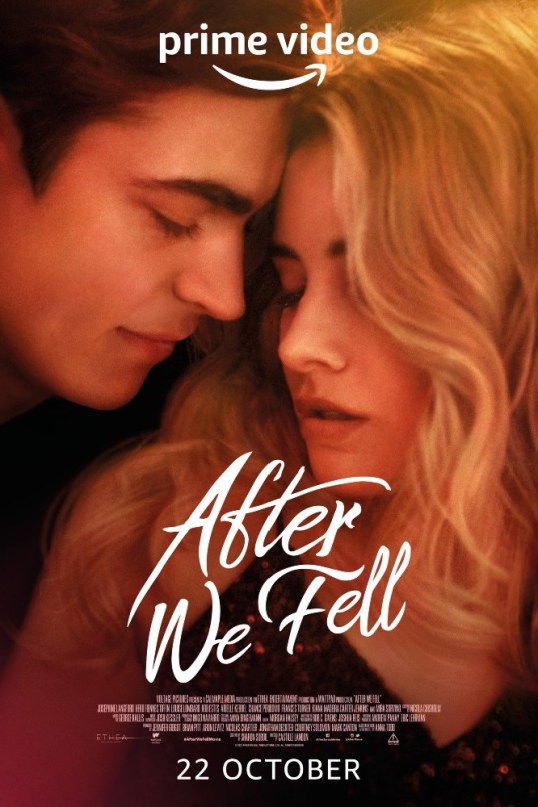
Catching Up With The Films of 2021: After We Fell (dir by Castille Landon)


After We Fell continues the story of Tessa and Hardin, the world’s most boring couple.

If you’ve seen After and After We Collided, you know the story of Tessa (Josephine Langford) and Hardin (Hero Fiennes-Tiffin).  You know that Tessa has an alcoholic father and that she met and fell in love with Hardin during her first semester of college.  You know that Hardin is a British bad boy with a lot of really lame tattoos but he also really likes The Great Gatsby.  Hardin’s from a wealthy family and he’s a recovering alcoholic.  Hardin may come across like a sullen jerk but that’s just because no one but Tessa understands who he truly is.  Blah blah blah.

Hardin and Tessa spent the first two movies having a bunch of boring relationship problems and that’s pretty much what they spend the third movie doing, as well.  There’s a lot of tastefully filmed sex scenes but no one’s going to mistake these films for Fifty Shades of Grey.  Whenever Hardin and Tessa have sex in After We Collided, there’s a close-up of Hardin grabbing a condom.  The one time that Hardin doesn’t grab a condom, it leads to one of the film’s few plot developments.  It’s the rule of Chekhov’s Condom.  If a condom is used in the first act, a condom will not be used in the second act, and there will be consequences in the third act.

There’s not really much of a plot to this one.  Tessa takes a job in Seattle.  Hardin doesn’t want her to go to Seattle.  Tessa’s drunk dad shows up.  Hardin bonds with the drunk dad.  Hardin’s mother gets married so the film’s action moves to London.

When Hardin and Tessa visit his mom, Hardin’s mom says, “I set your bed up, Hardin.”

“I was expecting to stay on the floor,” Hardin replies.

OH, SHUT THE FUG UP, HARDIN!  JUST SAY THANK YOU FOR ONCE!

The After films wouldn’t be so bad if Hardin wasn’t such an annoying douchebag.  And it would help is Tessa actually had a personality that went beyond her relationship with Hardin.  They’re a boring couple.  Whatever chemistry Fiennes-Tiffin and Langford had in the first two films is totally missing in After We Fell.  When they have phone sex, you feel bad for whoever at the NSA is having to transcribe their conversation.  They have no interests outside of each other and listening to middlebrow music.  Hardin continually fears that Tessa is going to leave him but Tessa wouldn’t exist if she wasn’t half of a couple and neither would Hardin.  They’re not individuals.  They have no personality outside of worrying about each other, fighting with each other, and talking about each other.  One gets the feeling that they are the couple that everyone tries to avoid at a party.  “Don’t get stuck in a corner with those two unless you’re ready to spend the entire night listening to the story about that time Hardin was reading The Great Gatsby in the student union….”

The film ends with the promise of “To be continued.”  I’m looking forward to After The Divorce.