Late Night Retro Television Reviews: Friday the 13th 1.13 “The Baron’s Bride”


Welcome to Late Night Retro Television Reviews, a new feature where we review some of our favorite and least favorite shows of the past! On Fridays, I will be reviewing Friday the 13th, a show which ran in syndication from 1987 to 1990. The show can be found on YouTube!

This week, Micki and Ryan go to 1870s London!

Episode 1.13 “The Baron’s Bride”

(Dir by Bradford May, originally aired on February 15th, 1988)

The latest cursed antique that Jack has decided to retrieve is a cursed cape.  As Jack explains it, any man who wears the cape will automatically become irresistible to women.  So, with that in mind, why does Jack take Ryan and Micki with him?  Wouldn’t it make more sense to leave Micki at home and just bring Ryan who, as a guy, would be immune to the cape’s powers?

Seriously, Jack did not think this through!

As well, Jack also doesn’t know the full extent of the cape’s power.  It not only makes the wearer irresistible to women but it also turns him into a vampire.  And if blood gets on the cape’s brooch, the vampire and anyone near him will be transported into the past.

Jack, Ryan, and Micki arrives the home of Marie Simmons (Diana Barrington), just in time to see her giving the cape to her new boarder, Frank Edwards (Tom McCamus).  Of course, as soon as Micki sees Frank, she falls under her spell.  When Marie attacks Micki, she cuts Micki’s cheek.  Micki’s blood hits Frank’s brooch and they (along with Ryan) are transported into the past.

All three of them end up in London in 1870.  While Frank stalks victims on the streets of London, Micki and Ryan team up with a young writer named — *ahem* — Abraham (Kevin Bundy) and his wife, Caitlin (Susannah Hoffman).  Frank is determined to find Micki and, because Frank is still wearing the cape, Micki once again finds herself falling under Frank’s spell.

This is an excellent and atmospheric episode.  As soon as Ryan, Micki, and Frank are transported to London, the show switches from color to black-and-white and the story plays out like a macabre Universal horror film.  The episode is full of scenes of Frank running in slow motion towards his victims and revealing his fangs as he snarls at his enemies and Tom McCamus gives a wonderfully sinister performance as the innocent boarder turned vampire.  This episode packs a lot action into just 45 minutes of screen time and Micki and Ryan (and Robey and John D. LeMay) again prove themselves to be a good team.

The episode ends with a neat, if predictable twist.  Back in the present day, Jack asks Micki and Ryan if they happened to learn Abraham’s last name.  When they reply that they only knew him by his first name, Jack reveals that they spent their time in London working with Bram Stoker.  So, in their way, Micki and Ryan are responsible for Dracula!  Woo hoo!  Way to go, guys!

This was a great and fun episode.  Episodes like this make me glad that I decided to review this show.

One final note: Keep an eye out for Friday the 13th — A New Beginning‘s John Shepherd as a police constable.

Retro Television Reviews: T and T 2.11 “Hard Way Home”


Welcome to Retro Television Reviews, a new feature where we review some of our favorite and least favorite shows of the past! On Fridays, I will be reviewing T. and T., a Canadian show which ran in syndication from 1987 to 1990.  The show can be found on Tubi!

T and T is back …. with a kidnapping!

Episode 2.11 “Hard Way Home”

(Dir by Al Waxman, originally aired on January 23rd, 1989)

Joe has the worst luck when it comes to making new friends!

One of the main themes of the second season of T and T has been T.S. (and, occasionally, Amy) acting as a mentor for teenage Joe Casper.  The season began with Joe losing his mother to a bomb that was set by Canadian Neo-Nazis.  T.S. apparently adopted Joe and now, the kid spends all of his time at Decker’s gym.  Whenever Joe makes a new friend, they either turn out to be a criminal or a victim of a crime.

This week, Joe’s new friend is George Papadopolous (David Stratton), who invites Joe to toss a football around with him in the park.  However, once they get to the park, George is grabbed by a couple of thugs and tossed into the trunk of a car.  Joe chases the car and even grabs onto the bumper but ultimately, he can’t save George.

When a banged-up Joe returns to Decker’s gym, T.S. assures him that his new scars will make him the most popular kid at his school.  Joe then calls George’s father and is told that the whole kidnapping was a prank and that he shouldn’t call the police.  This sounds strange to T.S. so he investigates on his own.

It turns out that George’s father is Peter (George Sperdakos), a big man in Toronto’s Greek mafia.  Someone has kidnapped George and is demanding a huge ransom.  Members of the Greek community are all donating their own money to help Peter raise the amount.  Because Joe was able to get the license plate number of the car that George was tossed into, it doesn’t take long for T.S. to discover that George was abducted by Peter’s rival, a used car dealer named Frangos (George Touliatos).  However, Frangos is not working alone.  It turns out that Peter arranged the kidnapping of his own son so that he could pocket the ransom money!

Needless to say, thinks work out in the end.  George is freed and Peter is arrested.  At first, Amy tells T.S. that there is no way that she would ever agree to represent Peter because 1) she knows that Peter is guilty and 2) Peter can’t afford to pay.  But then the members of Greek community (who are apparently very forgiving) donate their own money to convince Amy to defend Peter in court.  Does Amy win the case?  The episode ends before we find out.

This episode really showed the disadvantage of trying to tell a story like this in just 30 minutes.  There was never any suspense over who kidnapped George because there was only time to introduce one suspect!  Peter turning out to be in on it was a nice twist but it came out of nowhere because there really wasn’t any time to properly set it up.  This would have been a good hour episode but, at 30 minutes, it just felt rushed and it didn’t have any fun Mr. T line readings.  Toronto looked nice and cold but otherwise, this was a forgettable episode.

Late Night Retro Television Reviews: Highway to Heaven 1.15 “One Winged Angels”


Welcome to Late Night Retro Television Reviews, a feature where we review some of our favorite and least favorite shows of the past!  On Thursdays, I will be reviewing Highway to Heaven, which aired on NBC from 1984 to 1989.  The entire show is currently streaming on Tubi and several other services!

This week, Jonathan falls in love.

Episode 1.15 “One Winged Angel”

(Dir by Michael Landon, originally aired on January 16th, 1985)

This week, Jonathan’s mission seems simple.

Libby Hall (Robin Dearden) is a widow who owns a small hotel, one that she manages with her mother (Peggy McCay).  Libby’s son, Max (a young Wil Wheaton), has been struggling without a father figure in his life and has reached the point where he now regularly acts out and refuses to obey his mother.  He’s so obnoxious that guests will often check out of the hotel early rather than spend another minute around him.  The owner of the local gas station, Earl (John Lawlor), has a crush on Libby but he is too shy to ask her out.  It doesn’t help that Earl knew Libby’s late husband and he feels guilty about liking her.

When Jonathan and Mark show up at the hotel, it’s obvious what is meant to happen.  Jonathan just has to help Max deal with his anger and help Earl summon up the courage to ask out Libby.  Jonathan says that mission is so simple that Mark can spend the whole week fishing.  Mark’s excited about that!

Except …. uh-oh!  Jonathan starts to fall in love with Libby and Libby starts to fall for him.  Max is soon looking up to Jonathan and asking him if he wants to throw the old football around.  Earl can only watch helplessly.  Jonathan explains to Mark that he knows what his mission is but he can’t help how he feels about Libby.  Mark suggests that maybe “the boss” wants Jonathan to be reminded of what it feels like to be human.

Well, no worries!  With Jonathan struggling with his feelings, Mark takes it upon himself to go out fishing with Earl.  He tells Earl that he and Jonathan travel from town to town, get involved in people’s lives, and then move on.  Mark isn’t lying but Earl takes it to mean that Jonathan is just leading Libby on.  This gives Earl the courage to tell Jonathan how he feels about Libby (and to also tell Jonathan not to hurt her).  Realizing the Libby and Earl are meant to be together, Jonathan checks out of the hotel and tells Libby and Max that it’s time for him to move on.  Libby and especially Max are upset but things brighten up when Earl shows up.  He not only offers to give Max a job at the garage (and to also throw around the football with the kid) but he finally asks Libby out on a date.

This was a pretty sad episode, all things considered.  Earl and Libby are finally together and it’s obvious that they belong together but Jonathan is still really depressed as Mark drives him out of town.  But, seriously, Jonathan had to know about the dangers of falling in love with a human woman.  As an angel, he has surely read the Book of Enoch and knows about the Nephilim.  All that aside, this was a very sincere and a very earnest episode about lost love and it was nicely done.

Retro Television Reviews: Turn-On 1.1 “Episode One”


Welcome to Retro Television Reviews, a feature where we review some of our favorite and least favorite shows of the past!  On Thursdays, I will be reviewing Turn-On, which aired on ABC in 1969.  The entire show is currently streaming on YouTube!
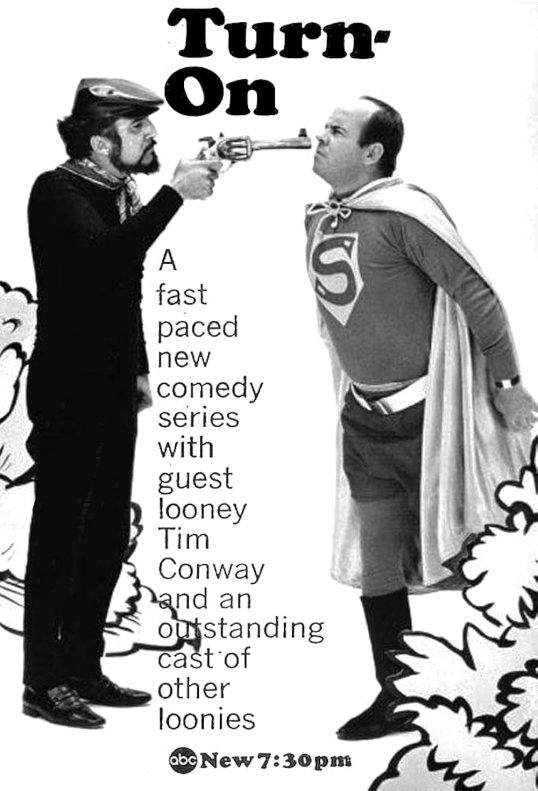
The year was 1969 and ABC wanted to appeal to the counter-culture.  That’s really the only explanation for Turn-On, an experimental collection of absurdist comedy sketches that premiered during prime time and was cancelled by many affiliates before the show even ended.  Produced by George Schlatter and Digby Wolfe, Turn-On was an attempt to revolutionize television but audiences — many of whom tuned to ABC that night to discover that the nightly serial Peyton Place had been pre-empted — did not want the revolution.

Episode 1.1

(Dir by Mark Warren, originally aired on February 5th, 1969)

Turn-On opens with two men walking up to and sitting down at a huge computer console.  One of them explains that the computer will be programming the television show that is about to air.  He tells the computer, “Tonight’s guest star: Tim Conway.”

Suddenly, out of thin air, Tim Conway materializes in front of the computer and announces, “Good evening, ladies and gentleman, and welcome to Peyton Re-place.”

So, less than a minute into the show, Turn-On had already predicted AI.  In all fairness, that’s no small accomplishment.

The rest of the show is series of quick skits, all of which take place against a white background:

A woman appears in front of a weather map and says that they cannot do the weather report for Hong Kong.

This is followed by Tim Conway dressed as superman and getting a gun pointed at him by a Fidel Castro.

A woman in a rocking chair sings “I got rhythm, I got rhythm,” while an audience sitting below her appears to try to stare up her short skirt.

A commercial for tired eyes ends with Tim Conway wearing elaborate eye makeup.

A black man glares at a white man and says, “Mom always did like you best.”

A woman in a sarong plays a tuba while a stuffed hippo puppet listens.  The woman laughs.

A busty woman stands in front of a brick wall, wearing a blindfold.  A soldier tells her that the firing squad has a last request.

A dancer twirls across the screen.

A swastika-shaped table appears on screen.  “You are now looking at table at the Paris Peace Talks,” an announcer tells us.

A military office tells another officer that he doesn’t think “Major Burns is stable enough to lead a platoon.”  “You’re right,” the other officer replies, “make it a regiment.”

We’re only two minutes into this and I’m already …. well, I’m not turned on.  I’m bored, to be honest.  All of the quick-cutting and the prophetic references to AI cannot change the fact that none of this really that funny.  I imagine the show’s defenders (and there are a few) would claim that this is all meant to be absurdist humor but actually, it’s a bit bland.  The jokes may be designed to appeal to what was then the counter-culture but the delivery is pure vaudeville.

The show continues.  A black woman appears on a park bench and says she feels guilty for lying around when she could be out shopping somewhere.

A man with a mustache tries to sell a cereal that is soaked with mescaline.  “Your family will say it’s wonderful.”  Okay, that made me chuckle.

On a screen divided into four squares, two women talk about a vulgar boyfriend.  A cardboard cut-out carrying a sign that reads, “God Save The Queens” wanders by.  Ha ha, “Queens” …. get it?

An old woman on a motorcycle announces, “It’s time to Turn-On!”

It’s time for the opening credits!  OH MY GOD, ALL OF THAT WAS JUST THE PRE-CREDIT SEQUENCE!?

This is followed by a fake commercial for Bufferin Aspirin (which actually did sponsor the first episode of Turn-On), in which Tim Conway is beat up at a maypole.  “It’s Bufferin time!” an announcer says.

Back the computer, the men have conversations like, “Are you a hawk or a dove?”

A woman asks Tim Conway if he loves her and he says that he does after she re-assures him that she’s a “smoking, jaded radical.”  The little cartoon figure walks by with a sign that reads “Keep the baby, Faith.”

A policeman runs through a park.  “Hello, young lovers,” he says, “wherever you are!”

The busty woman from the firing squad sketch appears sitting on a divan and says that, “Mr. Nixon, as President, now becomes the titular head of the Republican Party.”  An announcer says, “Ladies and gentleman, The Body Politic.”

Tim Conway appears a samurai.  “Down with haya education!” says the sign of a cardboard cut-out who speeds by on a motorcycle.

A man announces that the nuclear bomb test has been moved up to 8:30 a.m., so as not to inconvenience the people who are evacuating.

And it just keeps going and going.

“Where is the capital of South Vietnam?” one man asks.  “In Swiss bank accounts,” is the reply.

Tim Conway appears to say that, due to student unrest, high schools should be shut down “in the interest of education.”

A woman in a graduation gown throws a grenade.

The man with the mustache announces, “Girls, I want to be a friend to your feet.”  A cardboard cut-out walks by, carrying a sign that reads, “E. Eddie Edwards is a pervert.”

While this is going on, the opening credits are still playing out and we discover that Albert Brooks helped to write this episode.

Dollar signs appear on the screen, followed by “Yen.”

“Do you believe in capital punishment?” a woman asks Tim Conway.  “Only as a part of a rehabilitation program,” he replies.

A cop whistles while a purse snatcher attacks an old woman.  “Sorry,” the cop says, “we’re on strike.”

The Castro look-alike announced that he has suspended the constitution and dismissed the Senate and he will rule by decree “to prevent the overthrow of the government.”

A gun fires.

Having been convicted of murder, Tim Conway uses his one phone call to order some fried chicken.  A toy plane flies overhead with a banner asking, “Why not fly United?”

And it keeps going (and I should add that, 10 minutes in, the opening credits are still flashing on the screen).

A woman is angry when her drunk cop husband returns home.

A question mark appears on the screen, followed by a close-up of a woman’s eyes.

A cop eats a newspaper.

Hamilton Camp wears a straight-jacket.

A plane flies by with a banner that reads, “The Amsterdam levee is a dyke.”

Tim Conway does a commercial for deodorant.

A mugger says, “Your money or your life!” and is handed a Life Magazine.  (*sigh*  That did make me chuckle.)

A copy of Playboy is tossed on top of issues of the New York Times, Time, and Ramparts.  “It’s our job to expose,” a voice says.

A cop tells a prisoner to get his hands back in the cell.

A blonde woman smiles.

Tim Conway says that his son will not get a ride to school.  He can take a taxi.  Cut to an illustration of a teenage boy carrying a taxi.  (Again, I smiled.  So, that’s three laughs in fifteen minutes, for those keeping track.)

The woman on the divan says that the California Highway Patrol says that women obey traffic laws better than men.  “The one exception?  Failure to yield.”

An ugly woman with flowers in hair laughs.

Tim Conway smokes a cigar and says his friend Chauncey is much to valuable to be President of the United States.

The dancer appears.

A woman shows off a tattoo of a cat staring at her navel.

A red light bulb shatters.

A cardboard cut-out holds a sign reading, “Stamp out mass production.”

Tim Conway tells a student to “Shut your dirty mouth.”

Tim Conway performs a ballet.

Two women discuss whether they should try to be more seductive while a cardboard airplane flies by with a banner reading, “Free Oscar Willie.”

A woman says she and her husband make love “Two times for him and eight tenths for me.”  Tim Conway says that his wife doesn’t understand the new math.

Hamilton Camp appears, dressed as a monk, and announces that Moses was spoken to by a burning bush.

“Only thou,” a bear says, “can preventeth forest fires!”  (That was the fourth chuckle that this show got from me.)

Tim Conway offers a rich black man a shoe shine.

Tim Conway tells a married couple that their silence indicates that they are bored.

A cowboy complains about Moses marrying an Ethiopian woman.

“What are we going to do about inflation?” one woman asks.  “Well,” another replies, “I’ve been taking the Pill.”

The woman then gets birth control pills from a candy machine but — uh oh!  The machine’s not working!

A hotel clerk promises to send a bible up to “Mr. Gideon.”

A group of cowboys talk about their protective attitude towards “our womenfolk,” while cardboard cut-out walks by with a sign that reads, “We refuse the right to provide refuse to anyone.”

Tim Conway tells a man that, if his wife appears to be “out of sorts,” that “you have to understand …. it’s hostility!”

The word “Sex” appears on screen for five minutes while Tim Conway and a woman stare at each other.  The Pope briefly appears.

A woman plays Taps.

A cardboard monks wanders by with a sign reading, “Break glass and pull lever.”

A snake puppet says, “I could have given you the Apple and the Pill.”

Tim Conway turns off his TV.

The computer guys turn off their computer.

The show finally ends.

Of course, for much of America, the show ended after ten minutes.  That was the moment when many of the local affiliates, responding to calls from people demanding to know what they were watching, stopped showing Turn-On and instead put on whatever local programming they had in the archives.

Turn-On was an experimental show and an attempt to do something that had never been done before on television.  In many ways, it predicted both AI and the future of comedy.  That’s all great but the show itself, for all the quick cuts and the weird humor, was actually pretty dull.  Over the course of 27 minutes and a hundred jokes (and I didn’t include all of them in my review), I laughed a total of four times.  The show attempted to be subversive but it ultimately came across as being the “Hello, fellow kids!” meme come to life.

Turn-On was cancelled after one episode and has since regularly been described as one of the worst shows in the history of television.  I don’t know if I’d got that far, as there a lot of bad shows out there.  That said, I am glad that I only had to watch and review one episode.

Well, that concludes Turn-On!  Next week, we’ll look at a new show!

Late Night Retro Television Reviews: Monsters 1.14 “Parents From Space”


Welcome to Late Night Retro Television Reviews, a feature where we review some of our favorite and least favorite shows of the past! On Wednesdays, I will be reviewing Monsters, which aired in syndication from 1988 to 1991. The entire show is streaming on Tubi.

This week on Monsters, peace-loving aliens crash land on Earth and meet some really unlikable people.  Hmmm …. didn’t we just do this last week?

Episode 1.14 “Parents From Space”

(Dir by Gerald Cotts, originally aired on February 11th, 1989)

Poor Cindy (Mary Griffin)!

Cindy is a sweet-natured and caring orphan who is treated like a slave by her cruel foster parents, Ward (Frank Gorshin) and June (Peggy Cass).  Ward and June don’t care about Cindy.  All they care about is the money that they make for taking care of her.  When the social worker visits, they pretend to be a sweet, old couple.  When the social worker leaves, they treat Cindy like a slave and refuses to even show a hint of compassion when Cindy’s beloved hamster is seriously injured.

Fortunately, there are two rat-like aliens in the basement.  Their spaceship crashed and their bodies cannot handle Earth’s atmosphere.  In order to find a way home, the rats temporarily switch minds with Ward and June.  In the rat bodies, Ward and June enter into a catatonic state.  In the human bodies, the two rats try to figure out how to survive and escape.

The two rats turn out to be a lot nicer than Ward and June and they even heal the hamster.  Cindy loves her foster rat parents but she’s disappointed when the two rats say that they are going to have to switch bodies again.  As they explain it, it is simply not ethical for them to leave Ward and June in the rat’s bodies, especially since the rat bodies can’t survive on Earth for too long.  Cindy responds by disintegrating the rat’s bodies (and, of course, the minds of Ward and June).  The rats remain in the human bodies.  When a social worker shows up to check in on the living situation, she discovers a very happy family but also a very messy house.  The rats may be in human bodies but they are still rats.

This is an incredibly simple story with a one-joke premise.  It’s a fun episode but it also feels a bit rushed due to the 20-minute runtime.  Ward and June are such terrible foster parents that there’s never really any doubt as to what Cindy is going to do.  I think a lot of people who grew up with abusive parents (foster or not) will definitely find a lot of wish-fulfillment in this episode.  Cindy has terrible parents but she gets to trade them in for a better set.

The best thing about this episode was definitely the rats themselves.  For a low-budget show, Monsters usually had effective creature effects.  Just check out these two:

Evil, they make look but they’re actually the nicest aliens this side of Glim-Glim.

This was a slight but likable episode.  Cindy got a nice family and the hamster lived.

Catching Up With The Films Of 2023: Gran Turismo: Based On A True Story (dir by Neill Blomkamp)


Having had a rough day, I decided that I needed to watch a crowd-pleaser tonight.

Gran Turismo: Based on a True Story is definitely that.  The film may have an unwieldy title and it might not really break any new ground as far as sports films are concerned but it’s still definitely a film that will leave viewers feeling satisfied.  It tells the story of Jann Mardenborough (Archie Madekwe), who gets a chance to turn his love for and skill at the Gran Turismo video game into a real life career when he is selected for GT Academy, a school in which the world’s best simulation drivers are trained to be real-life racers.  Though GT Academy may have started out as a PR stunt that was masterminded by executive Danny Moore (Orlando Bloom), both Jann and his trainer, Jack Salter (David Harbour), are determined to prove that the simulation drivers deserve to be taken seriously.

Gran Turismo hits all of the expected moments.  Jann’s father (Djimon Hounsou) is a former professional soccer player who worries that his son is going to waste his life pursuing an impossible dream.  Jann’s mother (played by my favorite Spice Girl, Geri Halliwell-Horner) worries that Jann is going to be one of the drivers who wrecks his car and doesn’t emerge from the remains.  Jann has a pretty and supportive girlfriend named Audrey (Maeve Courtier-Lilley).  Jann has a quirky love for the music of Kenny G and Enya.  Jann has to win everyone’s respect, including Jack’s.  Jann has to deal with arrogant rivals.  Jann has to conquer his own insecurities before he can win and Jack has to conquer his own past before he can truly help to lead Jann to victory.

And, of course, Jann is involved in a massive car wreck that causes him to lose his confidence right before the big race.  The wreck is actually based on something that truly did happen to Jann Mardenborough, though it occurred two years into his racing career as opposed to at the beginning of it.  Tragically, in both the movie and in real life, the crash resulted in the death of a spectator.  One can understand why the car crash was moved (because otherwise, Jann would have been too confident going into the big race and there wouldn’t be as much suspense as to whether or not he would be able to conquer his fears) while also feeling that it was a bit of a tacky thing to do.  The film reducing a real-life tragedy to a plot point feels all the more gauche when you consider that the filmmakers could have just made up some incident to cause Jann to lose his confidence.  I mean, we all know that “based on a true story” doesn’t actually mean that a film’s story is 100% (or even 10%) true.

If you can overlook that bit of narrative tackiness, Gran Turismo is a well-made and likable sports film.  Not a single moment really took me by surprise but, more often than not, I still found myself smiling whenever Jann proves the naysayers wrong and finished strong.  Director Neill Blokamp made a huge splash with his first film, 2009’s District 9, but, his subsequent films have struggled to recapture the energy and narrative verve of his debut.  Gran Turismo proves that Blokamp is still capable of directing a crowd-pleaser.

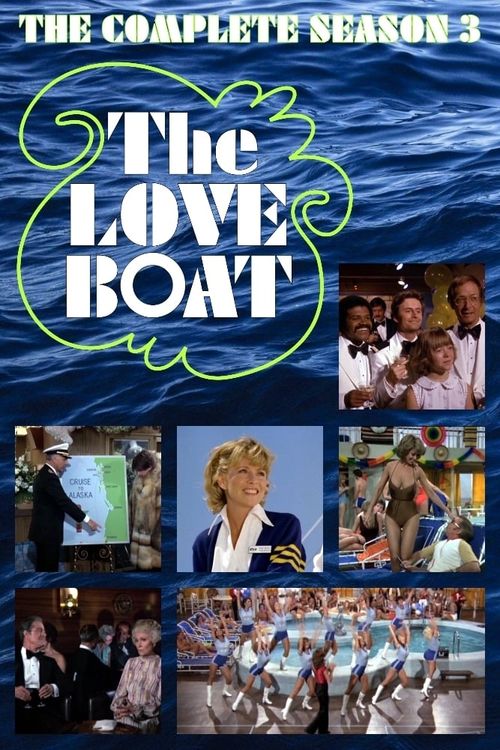
Retro Television Reviews: The Love Boat 3.24 “Dumb Luck/Tres Amigos/Hey, Jealous Lover”


Welcome to Retro Television Reviews, a feature where we review some of our favorite and least favorite shows of the past!  On Wednesdays, I will be reviewing the original Love Boat, which aired on ABC from 1977 to 1986!  The series can be streamed on Paramount Plus!

The week, the crew is surprisingly incompetent.

Episode 3.24 “Dumb Luck/Tres Amigos/Hey, Jealous Lover”

(Dir by Roger Duchowny, originally aired on March 15th, 1980)

The members of the crew really disappointed me this week.

For instance, Gertrude (Jayne Meadows) and Milton Benson (James Gregory) are on the cruise.  Gertrude is friendly and tries to talk to everyone.  Whenever Milton sees any man talking to his wife, he flies into a jealous rage and threatens them.  The crew reacts to this not by telling Milton to calm down but instead, by hiding whenever they see Milton or Gertrude on the boat.  They’re terrified of Milton and yet, somehow, members of the crew keep ending up in the cabin with Gertrude.

Finally, at the end of the cruise, Milton shows up at the captain’s cabin and …. OH MY GOD, HE’S GOT A GUN!  Goper, Doc, Isaac, and Stubing all end up diving to the floor.  Milton explains that he acts jealous because he wants his wife to still feel as if she’s as desirable as the day they first met.  He also says that he’s giving the gun to Stubing as a gift to thank him for the enjoyable cruise.

Later, as she prepares to leave the ship, Gertrude tells Gopher and Isaac that she knows that Milton can be jealous so she specifically dresses as drably as possible so that he won’t have to worry about any other men hitting on her.  In the name of love, she tries to look ugly and he acts like a homicidal lunatic.  Well, whatever works for them!  They seemed to be happy together.  Still, it must be said that the crew could have handled the whole situation better.  Hiding in hallways and under desks is not what I expect from an experienced group of sailors.

Meanwhile, Julie’s friend, Carol Ketay (Shelley Hack), is on the cruise.  Carol is a nuclear physicist and a member of a think tank.  Julie is worried that men are intimidated by Carol being too smart.  Julie also mentions that she’s never had that problem.  Julie takes Carol aside and tell her that she needs to learn how to “talk dumb” if she wants to get a man.  After borrowing a dress from Julie, Carol goes out of her way to sound like an idiot and she immediately catches the attention of Chris (Kevin Tighe).  Chris and Carol have a great time on the ship but Carol is shocked to learn that Chris doesn’t want to date her on dry land because he thinks she’s too dumb.  Carol reveals that she’s actually a nuclear physicist and they leave the boat arm-in-arm.  Good for them!  Julie really gave terrible advice but then again, I think she just wanted her friend to get laid.  She wasn’t really that concerned with Carol getting a long-term relationship.

Finally, Vicki gets to do something this cruise.  She befriends Keith (Ronnie Scribner), the young son of Alice (Jennifer Darling) and Floyd Gaines (John Gabriel).  While exploring the ship, Vicki and Keith meet a young stowaway named Luis (Tony Ramirez).  Though Vicki is not enthused about hiding a stowaway from her father, she still takes a blood oath and promises to protect Luis.  (This would be ground for Vicki being fired if she was actually a paid member of the crew as opposed to just someone who pretends tp have a job.)  As for Keith, he steals $200 from his parents and gives it to Luis.  His parents freak out when they can’t find the money and they accuse the crew of robbing them!  (The crew can’t even handle a jealous husband.  How are they going to steal $200?)  While searching for the money, Gopher and Julie discover Luis.

So, I guess Luis is going into the juvenile justice system, right?  No, not on The Love Boat!  Keith’s parents allow Luis to have the money and Stubing and Vicki pay for Luis’s ticket so Luis is no longer a stowaway.  This storyline was okay.  All of the kids were natural actors so things never got overly cutesy.  That said, I can’t help that notice that a lot of people have stowed away on the ship over the years.  Captain Stubing might want to talk to his crew about that.

Next week …. an agent of Child Protective Services takes a cruise.  Look out, Vicki!

Song of the Day: White Rabbit (performed by Jefferson Airplane)


Since today is Grace Slick’s 85th birthday, today’s song of the day features her (and, to be fair, the rest of Jefferson Airplane) performing White Rabbit at the first Woodstock.

Grace Slick and Jefferson Airplane not only performed at Woodstock but they were also among the bands who attempted to perform at the Altamont Free Concert a few months later.  Needless to say, the vibe at Altamont — which featured the Rolling Stones as headliners and the Hell’s Angels providing security — was far more aggressive and hostile than the vibe at Woodstock.  While the Stones were performing, a member of the audience got into a fight with the Hell’s Angels, raised a gun, and was stabbed to death.

As seen in the documentary Gimme Shelter, even before the murder that ended the 60s, the Angels were aggressive, even knocking out Jefferson Airplane’s other singer, Marty Balin, in the middle of the band’s performance.  Also seen in that documentary is Grace Slick doing her best to calm the crowd and, along with Paul Kanter, rather fearlessly talking back to a drunk Hell’s Angel who tried to take over the stage.

(It should be noted that Grace did all of that even though she had forgotten to put in her contact lenses that day.  Me, I can’t even walk from one end of a room to another if I forget to put in my contacts.)

White Rabbit

(Lyrics by Grace Slick)

One pill makes you largerAnd one pill makes you smallAnd the ones that mother gives youDon’t do anything at allGo ask AliceWhen she’s ten feet tall
And if you go chasing rabbitsAnd you know you’re going to fallTell ’em a hookah-smoking caterpillarHas given you the callCall AliceWhen she was just small
When the men on the chessboardGet up and tell you where to goAnd you’ve just had some kind of mushroomAnd your mind is moving lowGo ask AliceI think she’ll know
When logic and proportionHave fallen sloppy deadAnd the White Knight is talking backwardsAnd the Red Queen’s off with her headRemember what the dormouse saidFeed your headFeed your head

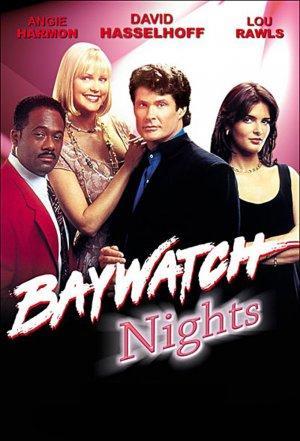
Late Night Retro Television Reviews: Baywatch Nights 1.8 “Balancing Act”


Welcome to Late Night Retro Television Reviews, a feature where we review some of our favorite and least favorite shows of the past!  On Tuesdays, I will be reviewing Baywatch Nights, an detective show that ran in Syndication from 1995 to 1997.  The entire show is currently streaming on Youtube!

This week, we discover how it all began!

Episode 1.8 “Balancing Act”

(Dir by Gus Trikonis, originally aired on November 18th, 1995)

The eighth episode of Baywatch Nights opens with Ryan and Garner on a stakeout.  It’s the middle of the day and they’re waiting for someone carrying an envelope full of evidence.  Mitch is nowhere to be seen, which actually makes sense.  I mean, Mitch is still working as a lifeguard.  Over the past seven episodes, I’ve often wondered how Mitch can work full-time as both a detective and a lifeguard captain.  This episode finally acknowledges that Mitch actually does have another job.

Garner and Ryan start talking about the first that they met and how they came to be partners in a detective firm.  It’s flashback time!  The flashbacks are to the show’s previously unaired pilot.  What’s funny is that, even though Garner is the one who is telling the story, the flashbacks are all narrated by Mitch.  I know that Garner and Mitch were extremely close friends during the early seasons of Baywatch but I didn’t realize they could actually hear each other’s thoughts.

Flashback Mitch explains that both he and Garner were wondering if there was anything more to life than their jobs.  Garner wanted to be more than just a beach cop.  Mitch was wondering if maybe there was something more out there than just being a lifeguard.  One day, when Mitch on vacation from his lifeguarding job, Mitch decided to accompany Garner to investigate a mysterious boat that had been showing up around the marina.  It was during the investigation that Mitch and Garner first met Ryan.  Ryan had paid $25,000 for a private detective agency in California, just to discover that the agency was not the high class operation that the previous owner, Nicky Pine (Philip Bruns), claimed it was.  However, before Ryan could confront him, Nicky was apparently killed by a group of criminals who wanted a valuable bracelet that Nicky owned.  Except the bracelet, which he gave to Ryan, was actually a fake and Nicky wasn’t actually dead and….

Ugh, this is complicated.  Seriously. I hate to admit that I couldn’t follow the plot of an episode of Baywatch Nights but this plot had so many nonsensical twists and turns that I pretty much gave up on trying to make sense of it all.  The important thing is that Garner got fed up with the police and quit, Mitch realized that he wanted to be a private eye, and Ryan got to be totally awesome as usual.  At one point, Ryan explained to Mitch that she was tough because she was from Dallas.  Woo hoo!  You tell him, Ryan!

Because this was a pilot, there were a few examples of early installment weirdness.  Troy Evans showed up as a police detective and one got the feeling that he was originally envisioned as being a recurring character.  Lisa Stahl’s Destiny was nowhere to be seen but there was a character named Andy (Linda Hoffman) was acted quite similarly to Destiny.  Even Nicky and his girlfriend, Rose (Jeanette O’Connor), seemed to be set up to become semi-regular characters.  Obviously, there was some retooling done after this pilot was produced.

Anyway, this episode’s plot is impossible to follow but the California scenery is lovely, which I think is the most that anyone could realistically demand from any show from the Baywatch universe.  Having now watched the pilot, I’m glad that the show went forward with just Mitch, Garner, and Ryan as regulars.  They’re a good team.

Catching Up With The Films Of 2023: May December (dir by Todd Haynes)


What comes after a life of tabloid infamy?

That’s one of the many questions posed by Todd Haynes’s latest film, May December.

Elizabeth Berry (Natalie Portman) is an actress who comes to Savannah, Georgia in order to research her next role.  We don’t learn much about Elizabeth’s career as an actress but it appears that, while it has brought her a certain amount of fame, it hasn’t exactly been full of acclaimed work.  One person mentions seeing a picture from a film that she did in which she was involved in a blood sacrifice.  (“I googled ‘naked Elizabeth Berry,'” he explains.)  Several other people mention how much they love her TV show, Norah’s Ark, in which Elizabeth plays a veterinarian.  Elizabeth’s latest film features her playing a real person, someone who was at the center of a scandal 20 years previously and who has since faded from the public view.  Elizabeth seems to believe that this role could redefine her career.

(Hey, it worked for Margot Robbie in I, Tonya.)

Elizabeth is going to play Gracie Atherton-Woo in an upcoming indie film.  Way back in 1992, the real-life Gracie (Julianne Moore) was 36 years old and married when she was caught having sex with a 13 year-old named Joe in the back of a pet store.  Joe was a classmate of Gracie’s son and Gracie was the one who was responsible for him getting hired at the pet store in the first place.  Gracie was sent to prison, where she gave birth to Joe’s daughter.  During her trial, Gracie and Joe were both tabloid mainstays.  The nation was transfixed by their affair before eventually moving on to the next scandal.  When Gracie was eventually released from prison, she married Joe.  Now, decades after appearing on the front of every trashy magazine, Gracie and Joe (Charles Melton) are still married and they now have three children.  They live in a big house in Savannah, Gracie has a career as a pastry maker, and, from the outside, they would appear to have a perfect domestic life together.

Wearily, Gracie and Joe allow Elizabeth to spend time with the family so that she can research her role.  Elizabeth interviews other people who were effected by Gracie’s actions.  Gracie’s ex-husband (D.W. Moffett) is surprisingly forgiving.  Gracie’s children are considerably less forgiving.  Georgie (Cory Michael Smith), who was Gracie’s son from her first marriage and a schoolmate of Joe’s, is bitter and describes his mother as being mentally unbalanced while, at the same time, trying to leverage his knowledge of Gracie’s past into a job on the film.  As for Gracie and Joe’s first daughter (Piper Churda), she states that she doesn’t want the film to be made.

Cracks start to appear in the perfect image that Gracie and Joe present to the world.  Gracie can be rigid and controlling while insisting that Joe was the one who initiated the encounter in the pet store.  Gracie talks about growing up with four brothers, two of whom were older and two were younger.  Gracie mentions that one of her brothers is an admiral and it’s implied that she grew up in an atmosphere where failure was not an option.  Gracie’s daughter talks about how, when she graduated, her mother gave her a scale as a graduation gift.  When someone cancels an order for a cake, Gracie takes it as a personal rejection and breaks down into tears.  Gracie is friendly towards Elizabeth but never totally lets down her guard.

As for Joe, he emerges as well-meaning but confused, someone who is still often treated like a child by bother his wife and, eventually, the woman who is studying his wife.  Whenever we see Joe with any other adults, he’s awkward as if he’s not sure how to behave.  (When he tells his elderly father that he can hardly believe that all of his children will soon be in college, the old man’s silence tells us everything that we need to know about their relationship.)  Joe is nearly forty but it’s clear that a good deal of his emotional development stopped when he was thirteen, leaving him desperate for approval.  When he catches his teenage son smoking a joint, Joe isn’t angry as much as he’s curious.  Smoking weed is one of the many things that Joe never did when he was younger.  When Joe get high, he becomes a paranoid and emotional mess as all the feelings that he’s repressed for 23 years come spilling out.  At the same time, when Gracie has a breakdown, Joe knows exactly what to say to help her through it.

Do Gracie and Joe truly love each other or is their marriage just their way of denying the reality of what happened?  Did Gracie groom Joe or, as Gracie insists, was their affair consensual?  At first, the audience’s natural tendency is to sympathize with Elizabeth and to expect her to play some sort of role in clarifying what actually happened in that pet store.  But Elizabeth soon proves herself to be a rather detached observer, a mimic who copies the emotions of others but who, even after she gets to know Gracie and Joe as human beings, still views them as just being characters in a story.  In the end, Elizabeth can’t help us understand what happened in the pet shop because, the film suggests, not even the people who were actually there understand what happened.  All Elizabeth can do, as an actress and an observer, is try to recreate what she imagines happened.

It’s a well-made film, with Haynes deftly mixing scenes of high drama with the awkward comedy of people trying to rationally discuss the irrational.  It can also be a frustrating viewing experience, if just because Haynes often does not seem to be sure what he’s trying to say about the characters or why we should even care about either Gracie or Elizabeth.  Fortunately, the film is lucky enough to have a wonderful cast.  While Moore and Melton gets the big, dramatic scene, it’s Portman who takes the audience by surprise, giving a performance that goes from being likable to being rather chilling as Elizabeth transforms herself more and more into Gracie.  For all the film’s themes about conformity, morality, and tabloid culture, it’s main message may very well be to never trust a method actor.

May December sticks with you, even if it’s not up to the level of Haynes’s Carol.  It’s a film about what happens after the infamy, with Gracie, Joe, and Elizabeth destined to be forever defined by what happened over the course of a few minutes in the backroom of a pet store.