Late Night Retro Television Review: Baywatch Nights 2.16 “Zargtha”


Welcome to Late Night Retro Television Reviews, a feature where we review some of our favorite and least favorite shows of the past!  On Tuesdays, I will be reviewing Baywatch Nights, a detective show that ran in Syndication from 1995 to 1997.  The entire show is currently streaming on YouTube!
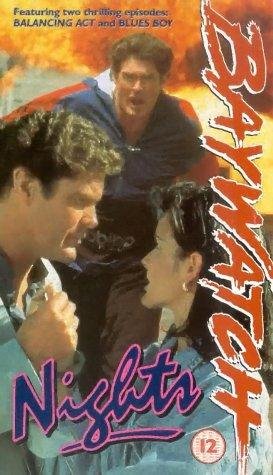
This week, it’s werewolf time!

Episode 2.16 “Zargtha”

(Dir by Rick Jacobson, originally aired on April 5th, 1997)

The discovery of a murdered teenage runaway on the beach leads to Mitch investigating a series of killings involving homeless teens.  The police think that the murders must be the result of a wild animal, a wolf of some sort.  Daimont Teague shows up to tell Mitch that he thinks the killer is a Zargtha, a type of Eastern European werewolf that has found its way to California.

Mitch declares that he’s seen a lot of things over the past few months but there’s no way that he’s going to buy into the idea of a werewolf from Eastern Europe.

Okay, let’s consider this.  Over the past few months, Mitch has

  1. encountered numerous sea monsters,
  2. been sucked into the past and hunted by an axe-wielding frontierman
  3. gone to the future and been hunted by cannibal mutants
  4. watched multiple animals explode after getting exposed to space dust
  5. watched two 900 year-old Vikings come back to life and pick up their blood feud right where they left off,
  6. discovered that the world is secretly controlled by the Knights Templar and,
  7. fought an actual vampire!

That’s just some of what Mitch has seen since the start of the second season of Baywatch Nights.  And yet, after all that, a werewolf is just too out there!?  I know that Mitch is supposed to be a skeptic and I respect that.  I’m a skeptic myself.  But there’s a point where skepticism becomes stupidity.  I may not believe in vampires but that’s going to quickly change if I ever meet one.

After learning that there’s a group of homeless teenagers living in abandoned building, Mitch and the head of the local shelter, Cindy (Pamela Bach-Hasselhoff), try to find and warn them before the killer reaches them.  Complicating this matter is that a recent earthquake is threatening to make the building come crashing down and also, the killer is already in the building.  And yes, the killer is a werewolf from Eastern Europe.

This was actually a pretty good episode.  Though the werewolf makeup wasn’t that great, the creature’s ferocious growls and the relentless way that it would attack still made it far more effective than the usual Baywatch Nights monster.  As well, the abandoned building turned out to be a wonderfully atmospheric and creepy location.  For once, all the Dutch angles felt appropriate.  This episode played out like a nightmare and I imagine, back in 1997, it was probably quite scary to watch with the lights out and maybe a storm raging outside.

Pamela Bach-Hasselhoff was married to David Hasselhoff when this episode was filmed.  That may explain why Ryan is barely in this episode and, for the first time in a long time, there’s no scenes of Ryan and Mitch flirting.  Instead, Mitch spends this episode protecting Cindy and the kids.  That’s kind of sweet.  Good for the Hoff!
Bonus Horror On TV: The Halloween That Almost Wasn’t (dir by Bruce Bilson)


Oh no!  Halloween might be canceled because people just aren’t scared of the old monsters!  Dracula (Judd Hirsch) calls all of the classic creatures to a meeting in his castle (where they all happen to be freeloading) and give them an ultimatum.  Be more scary!  It turns out to be easier said than done.

This originally aired in 1979 but, for people of a certain age, it achieved a certain immortality thanks to regular airings on the Disney Channel.  It’s a cute show.  It might seem a little bit corny today but that’s a large part of its appeal.  It’s a reminder of a more innocent time.

Warren the Werewolf, by the way, was named after Warren “Werewolves of London” Zevon.

Horror on TV: One Step Beyond 3.27 “The Confession” (dir by John Newland)


Tonight’s episode of One Step Beyond features the great Donald Pleasence, making it perfect viewing for the Halloween season!

Pleasence plays an attorney who prosecuted  a man for a murder that he didn’t commit.  Pleasence did so, even though a woman (Adrienne Corri) claiming to be the supposed victim of the crime came to him and said that she had not been murdered.  Pleasence refused to believe her.  Now, years later, his guilt is driving him mad while host John Newland looks on.

Can you prove it didn’t happen?

This episode originally aired on April 11th, 1961.

October Hacks: Wrong Turn (dir by Rob Schmidt)


Poor West Virginia!

Seriously, I’ve been to West Virginia.  It’s a beautiful state and the majority of the people that I met while I was there were just lovely.  And before anyone trots out all the usual stereotypes about rural communities, let me say that one of the nicest used book store that I’ve ever been to was in West Virginia.  It’s a nice state, one that feels like a throwback to a less cynical universe.  Even all of the bridges and the streets named after the loathsome Robert Byrd added to the lovely quaintness of the place.

And yet, when it comes to the entertainment industry, West Virginia is rarely portrayed in a positive light.  The coastal elite has never had much use for West Virginia or the surrounding states and that’s something that comes out in the films and television shows that are made in New York and California.  Whenever anyone says that they’re from West Virginia in a movie or a television show, you can be sure that they’re either going to be a meth cook or a villainous redneck.  West Virginia is one of those regions that’s never given much respect in Hollywood and that’s a shame.

Take Wrong Turn, for instance.  First released in 2003, the original Wrong Turn taught an entire generation that West Virginia was full of cannibals and blood farmers.  If you’re going to go for a drive in the wilderness of West Virginia, this film tells us, keep an eye out for barb wire booby traps.  If you’re going to hiking in the mountains, notify your next of kin because you probably won’t be coming back.  Wrong Turn follows a group of friends as they are tracked by a family of cannibal hillbillies and the main message seems to be, “For the love of God, stay out of Appalachia!”

(When I first started writing for this blog, I caused a mini-controversy when I said that no one would pay good money to see a film called The Vermont Chainsaw Massacre.  My point was that Texas has a reputation, albeit one that has more to do with fevered imaginings of out-of-staters than anything rooted in reality, that made it the only place where that film could really be effectively set.  The same is true of Wrong Turn.  It’s a story that people wouldn’t buy if it was happening anywhere other than in Appalachia.  Nobody would care about cannibals living in Minnesota, for instance.)

West Virginia slander aside, the original Wrong Turn holds up well.  It’s a slasher film from the era right before slasher films started taking themselves so seriously.  It’s a throwback to the rural horror films of the 70s, with an attractive cast getting picked off in various gruesome ways.  The cannibals are frightening and the victims are all likable without being so likable that you can’t handle seeing them killed off.  Jeremy Sisto and Lindy Booth both bring some comic relief to the film before their characters are dispatched.  Desmond Harrington is a sold-enough lead.  When I first saw Wrong Turn, my main reaction was that Eliza Dushku kicked ass and that was still my reactions when I rewatched it.  The film is bloody, shameless, and fully willing to give the audience what it wants without scolding them for it.  In short, it’s a perfectly fun slasher film and, watching it, it’s hard not to miss the era before horror films started taking themselves so damn seriously.

Wrong Turn‘s a fun movie.  But West Virginia is a lovely state and that should never be forgotten!


The TSL Horror Grindhouse: Don’t Look Away (dir by Michael Bafaro)


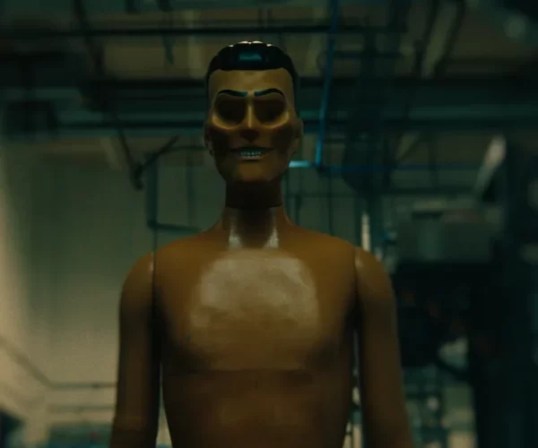
The main thing you need to know about 2023’s Don’t Look Away is that the killer looks like this.

Yes, the killer is a mannequin and a rather silly-looking one at that.  Silly or not, the mannequin is undeniably creepy, as mannequins tend to be.  The mannequin is apparently stalking a group of friends.  Frankie (Kelly Bastard) is convinced that the mannequin is alive and possessed by some sort of supernatural power.  Her friends disagree …. until they start dying, one-by-one.

Now, I should make clear that, for the majority of the film’s running time, we don’t actually see the mannequin kill anyone.  At the most, we see the mannequin suddenly show up behind someone.  He evens shows up in a swimming pool at one point.  Occasionally, his facial expression seems to change but, for the most, he always has the same goofy smile painted on his face.  The mannequin stalks one person-at-a-time and if you see him behind you and then look away, he’ll be closer the second time you look at him.

We do see the aftermath of meeting the mannequin.  As silly as it may seem to get killed by a mannequin (and I mean, seriously, how do you handle that shame while waiting in Purgatory), Kelly’s friends are actually dying, though it appears that they could all just be having unfortunate accidents or committing suicide.  Is it possible that the mannequin is just a mess delusion and that Kelly’s paranoia has poisoned the group?  The thing is, though …. if you were going to imagine a scary mannequin trying to kill you, wouldn’t you actually visualize something a lot more scary than a naked, emasculated wooden man with a silly smile on his face?

Don’t Look Away doesn’t quite work.  None of the friends really make a huge impression or even register as anything more than horror movie stereotypes.  There’s a scene set in a disco that I appreciated but that’s just because I appreciated anything that’s set in a disco.  Don’t Look Away suffers from a common affliction amongst horror films that were made after It Follows, in that the action moves way too slowly.  When the film should be fast-paced and silly, it’s somber and strangely self-serious.

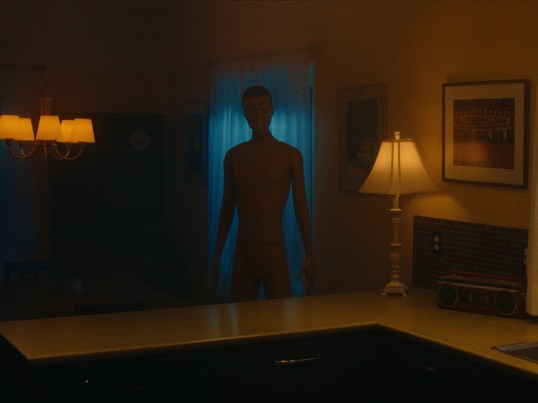
The film’s big star, of course, is that mannequin.  Here’s another shot of him.

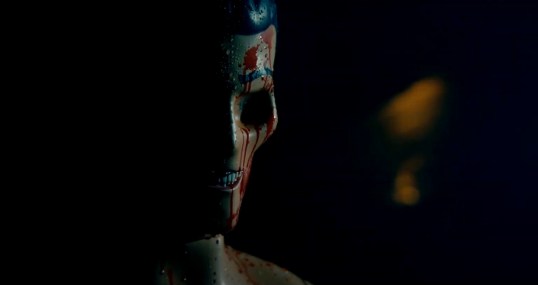
I mean, yeah, he’s creepy.  The first few times that you see him, he’s legitimately scary.  But then, after a while, he just become silly.  There’s only so much you can do with a goofy-looking mannequin.  I mean, don’t get me wrong.  I’ve seen some good killer mannequin films.  Mannequins can definitely be scary and I wouldn’t want to get locked in a warehouse with them or anything like that.  Mario Bava’s Lisa and the Devil makes wonderful use of the creepiness of mannequins.  But the mannequin at the heart of Don’t Look Away becomes less creepy and more goofy every time that you see him.  I’ll admit that I looked away a few times in an effort not to laugh.

Hmmm …. that may have been a mistake.

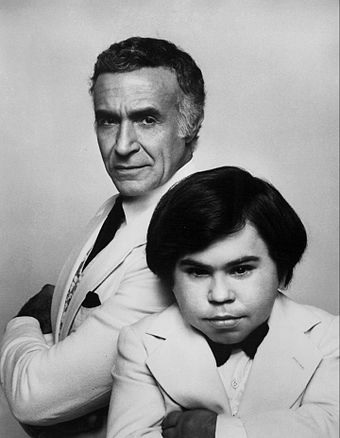
Retro Television Review: Fantasy Island 5.15 “The Case Against Mr. Roarke/Save Sherlock Holmes”


Welcome to Retro Television Reviews, a feature where we review some of our favorite and least favorite shows of the past!  On Tuesdays, I will be reviewing the original Fantasy Island, which ran on ABC from 1977 to 1984.  Unfortunately, the show has been removed from most streaming sites.  Fortunately, I’ve got nearly every episode on my DVR.

This week, Mr. Roarke might be a father!

Episode 5.15 “The Case Against Mr. Roarke/Save Sherlock Holmes”

(Dir by Don Weis, originally aired on February 6th, 1982)

After last week’s episode with Julie, Tattoo returns this week and Julie is nowhere to be seen.  When Mr. Roarke asks where Julie is, Tattoo mentions that Julie is helping with the Custer’s Last Stand fantasy.  At this point, I can only assume that a life insurance policy has been taking out on Julie and Roarke or Tattoo, or maybe both are trying to get her killed so they can collect.

Julie not being present means that she misses out on one of the biggest scandals in Fantasy Island history.  A former guest, Fran Warner (Laraine Stephens), returns to the Island after seven years.  Accompanying her is her six year-old daughter, Nancy (Nicole Eggert).  Fran loudly declares that Mr. Roarke is Nancy’s father and that he now has an obligation to take care of her.  Fran even has a birth certificate where, under the father’s name, someone has written — and I kid you not — “Mr. Roarke.”

Is Mr. Roarke the kid’s father?  As is his habit, he refuses to answer the question directly when Tattoo asks it.  But it soon turns out that no, Mr. Roarke is not Nancy’s father.  Instead, Fran is sick and may be dying and she wants to make sure that Nancy is cared for.  When Nancy learns the truth, she runs away and Tattoo leads a search party across the Island.  Fear not, of course.  Nancy is found and a very forgiving Mr. Roarke allows Nancy and Fran to stay on the Island.  And Fran’s terminal disease suddenly becomes less terminal!

While this is going on, security guard Kevin Lansing (Ron Ely) gets to live his fantasy of helping a great detective.  Kevin doesn’t care which detective he gets to help so Roarke sends him back to Victorian-era London so that Kevin can work with Dr. Watson (a charming Donald O’Connor) to save Sherlock Holmes (Peter Lawford, not looking well in one of his final performances) from the clutches of Moriarty (Mel Ferrer, being as sinister here as he was in countless giallo films).  Kevin also falls for Nurse Heavenly (RIta Jenrette, the wife of a corrupt Democrat member of Congress) and is pleased to discover that she’s not really Moriarty’s assistant.  Instead, she was just another guest on the Island having a fantasy.

The Sherlock Holmes story was silly but fun, in the way that Fantasy Island often is.  It’s always interesting when this show goes into the past and we get to see how the show’s crew dressed up the show’s sets to try to make them look historically accurate.  The same street appears in every episode but sometimes, that street is in 1890s London and sometimes, it’s in 1690s Salem and sometimes, it’s just in modern day Fantasy Island!  As for the Mr. Roarke’s a father storyline, it was predictable but still, it was a good showcase for Ricardo Montalban’s enigmatic interpretation of Mr. Roarke.

This was a pleasant trip to the Island!

Horror Film Review: Godzilla vs. Megaguirus (dir by Masaaki Tezuka)


It has always bothered me whenever a long-running franchise decides that the best way to reboot things is to wipe away its own history.

Consider the James Bond films, in which the current producers apparently decided that Daniel Craig’s grim and whiny interpretation of the character was so definitive that it would be no big deal to wipe all of the previous Bond films out of existence.  Sorry, Sean Connery.  Sorry, Roger Moore, Timothy Dalton, Pierce Brosnan, and even George Lazenby.   Sorry, everyone who enjoyed the original Bond films and who enjoys spies who are relatively free of angst and self-pity.  Your films are now no longer canon, all because someone thought it would be a good idea for Bond and Blofeld to be brothers.

Consider the DC films, in which there are so many different versions of the same characters floating around that it’s next to impossible to keep straight what is an “official” film and what isn’t.  Admittedly, the majority of the DC films weren’t that good but still, there’s just something kind of annoying in the way that franchise in particular tends to just shrug and say, “Okay, that film doesn’t really count.”  Own your mistakes.

And then there’s my beloved Halloween franchise, ruined by David Gordon Green’s belief that he was better than the genre.  After years of brother/sister drama between Laurie Strode and Michael Myers, Green simply decided to do away with all of that and, in the process, he made the entire story (and Laurie Strode as a character) far less interesting.

Usually I think of this as being a relatively new phenomena but, as I watched 2000’s Godzilla vs. Megaguirus, I realized that reboots that do away with years of continuity are nothing new.  Godzilla vs. Megagurius opens with a narrator literally telling us to forget about all the films that came out after the original Gojira.  And we’re also told to forget about the ending of Gojira because that never happened either.  The Oxygen Destroyer was not used and Tokyo had to be abandoned.  Godzilla survived the end of Gojira and he continues to use Japan as his own personal power source, attacking not only a nuclear reactor but also a plasma reactor.  So, sorry, Mothra.  Sorry, Rodan.  Sorry, all of you fans of Ghidorah.  Sorry everyone who enjoyed the classic Godzilla films.  We’re now in a universe where none of that happened.

That’s not to say that Godzilla vs. Megagurius is a bad film, of course.  The majority of the people who watch these films (and films in general) could hardly care less about continuity.  They want to see a fight between giant monsters and they want to hear Godzilla’s roar and this film provides both of them.  After Japan attempts to destroy Godzilla with a satellite that shoots — I kid you not — miniature black holes, it finds itself being attacked by prehistoric dragonflys.  While Godzilla searches for a new power source, the dragonflys attempt to siphon off Godzilla’s energy for their own uses.  As so often happened with these movies, humanity’s attempt to destroy Godzilla actually leads to far more destruction than if they had just left Godzilla alone.  It turns out that creating miniature black holes and ripping open the time/space continuum is not the solution to all the world’s problems.  It’s the human beings who are ultimately the bigger threat than the giant monsters.

It’s an entertaining film.  The Megagurius is a good monster and a worthy opponent to Godzilla.  Godzilla does what he does best.  The film wiped out a decades worth of continuity but at least it kept the Godzilla roar.  In the end, you can’t silence a good giant monster.

Previous Godzilla Reviews:

  1. Godzilla, King of the Monsters (1958)
  2. Godzilla Raids Again (1958)
  3. King Kong vs Godzilla (1962)
  4. Mothra vs. Godzilla (1964)
  5. Ghidorah: The Three-Headed Monster (1964)
  6. Invasion of the Astro-Monster (1965)
  7. Godzilla vs. The Sea Monster (1966)
  8. Son of Godzilla (1967)
  9. Destroy All Monsters (1968)
  10. All Monsters Attack (1969)
  11. Godzilla vs Hedorah (1971)
  12. Godzilla vs Gigan (1972)
  13. Godzilla vs Megalon (1973)
  14. Godzilla vs Mechagodzilla (1974)
  15. The Terror of Mechagodzilla (1975)
  16. Cozilla (1977)
  17. Godzilla 1985 (1985)
  18. Godzilla vs. Biollante (1989)
  19. Godzilla vs King Ghidorah (1992)
  20. Godzilla vs. Mothra (1992)
  21. Godzilla vs Mechagodzilla 2 (1994)
  22. Godzilla vs SpaceGodzilla (1994)
  23. Godzilla vs. Destoroyah (1995)
  24. Godzilla (1998)
  25. Godzilla 2000 (1999)
  26. Godzilla, Mothra, and King Ghidorah: Giant Monsters All-Out Attack (2001)
  27. Godzilla (2014)
  28. Godzilla: Planet of the Monsters (2017)
  29. Godzilla, King of the Monsters (2019)
  30. Godzilla vs Kong (2021)
  31. Godzilla Minus One (2023)

October “True” Crime: Bundy Reborn (a.k.a. The Inflicted) (dir by Matthan Harris)


Right now, on Tubi, you can find a film that the service says is titled Bundy Reborn.  It’s a horror film, one that centers on a medical student named David O’Hara (played by the film’s director, Matthan Harris) who turns into a serial killer.  Struggling with the trauma of having witnessed his father (Bill Moseley) murder his younger sister, David kidnaps Melissa Daniels (Lindsay Hightower) and then disappears into the night when Melissa is rescued by Inspector Lorenzo (the one and only Giovanni Lombardo Radice).  Nine months later, David comes out of hiding after Melissa gives birth to their child.  David once again kidnaps Melissa and kills several other people as well.

It’s pretty much a standard serial killer film.  Despite the title, it has little to do with Ted Bundy.  In fact, Bundy isn’t even mentioned in the film.  David, like Bundy, is a handsome serial killer who went to college.  But, whereas Bundy killed because he enjoyed it, David is trying to recreate a family that was destroyed by his equally sociopathic father.  There’s a germ of an interesting idea to be found in this film.  For all of his crimes and his evil actions, David really is just carrying on the family tradition.  Can evil be passed down genetically?  Or would David be perfectly normal if he just hasn’t witnessed his father killing his sister?  Those are legitimate questions that this film raises and then promptly seems to forget about.  The title, however, suggests that David is literally Ted Bundy in a new body and that’s simply not the case here.

Indeed, the film was originally released under a totally different title, The Inflicted.  That title worked well with this film’s portrayal of a son who inherited his murderous compulsions from his father.  David has been inflicted with the same evil that his father carries in his heart.  The Inflicted is an honest title but, at the same time, it’s not a title that’s going to grab the audience.  It’s a title that feels a bit too generic.  Bundy Reborn, on the other hand, is an acknowledgement of the fact that Ted Bundy is a particularly macabre part of the American pop cultural landscape.  As evil and worthy of hate as Ted Bundy may have been, viewers just can’t get enough of him.  Ted Bundy never had much of a chance to pursue his political ambitions but today, more people probably know who Ted Bundy was then know that Connecticut Senator Richard Blumenthal lied about serving in Vietnam.

As for the film, the plot is full of contrivances and moments that just don’t make much sense.  For horror fans, it is a chance to see several icons in one film, though most of them have extremely small roles.  That said, it’s nice to see a usually villainous actor like Sid Haig cast as a kindly psychiatrist.  Bill Moseley is properly menacing as David’s father.  Doug Bradley seems to be enjoying himself as an FBI agent.  As for Giovanni Lombardo Radice, how can you not smile when he’s onscreen?  Radice’s Italian accent may seem out of place in a film that is shot and was made in North Texas.  But Radice had an undeniable screen presence and he looked good wearing a trenchcoat and holding a gun.  He simply was Lorenzo.

On a persona note, this film was shot in my part of the world.  Several scenes were shot in my hometown.  Several other scenes were filmed in the town where I went to college.  When Inspector Lorenzo gets a call about David’s activities, I immediately yelled, “Oh my God, he’s at the Shops at Legacy!”  Later, my heart ached when I saw that the hospital that Melissa was taken to was the same hospital that my father was taken to immediately after his car accident back in May.  I recognized almost every location in the film as some place that I had been personally and that was definitely kind of exciting.

Finally, let’s all just be happy that Bundy has not been reborn but instead was apparently cremated and dumped out over some anonymous swimming pool somewhere.


Horror Film Review: All You Need Is Death (dir by Paul Duane)


Folk music is the music of evil people.

That’s something that I’ve been saying for years.  Of course, as is usually the case with such pronouncements, I was only being half-serious when I originally said it.  The first time I said it, it was to an older relative who had just forced me to sit through a 20 minute performance of I’ll Fly Away.  The second time I said it, it was to a friend who was really into Woody Guthrie, Pete Seeger, and all those commies  After that, I found many excuses to say it because I was going to college that was renowned for its music program.  It was one of those colleges where you couldn’t turn a corner without potentially running into someone who was taking a class in folk music.  They were always a bit annoying.  For folkies, it wasn’t enough to tell you that their music was better than your music.  They also had to tell you why listening to the Weavers on scratchy vinyl made them better human beings than you.

That said, I was never totally serious about folk music being the music of evil people.  That seemed like a far more appropriate thing to say about prog rock.  But, having watched All You Need Is Death, I’m now not so sure.  Folk music may very well be evil.

All You Need Is Death tells the story of Anna (Simone Collins) and Aleks (Charlie Maher), a couple who live in Dublin.  Anna is a gifted singer and, when we first see the two of them, Anna and Aleks appear to be deeply in love.  They work for an academic named Agnes (Catherine Siggins), whose goal is to find the oldest known versions of various folk songs.  Their work brings them to an apparently demented old woman named Rita (Olwen Fouere), who is rumored to know a song that is in a language the predates the Irish language.  Rita reveals that she does indeed know the song, which was apparently inspired by a romantic betrayal and a brutal death.  She explains that the song has been passed down from one woman to another over the centuries.  It can never be recorded and men are not allowed to hear the song.  After Aleks excuses himself, Rita sings the song to Anna.  As they drive back home, Anna tries to sing the song from memory but struggles, which isn’t surprising considering that the song isn’t even in a living language.  However, they’re stopped by Agnes who reveals that she secretly recorded Rita singing.  Meanwhile, Rita is herself gruesomely murdered by a mysterious force.

Things get progressively stranger from there, as Anna finds herself being targeted by Rita’s unhinged son (Nigel O’Neill) and Anna and Alek’s previously blessed relationship suddenly seems to be cursed.  There’s even a touch of Cronenbergian body horror as the film plays out.  The film’s plot is not always easy to follow and that’s not a bad thing.  This is one of those horror films that works because the audience never feels quite secure in their understanding of what they’re seeing.  The story plays out at its own pace, putting an emphasis on atmosphere over easy shocks and jump scares.  It’s about as close to a filmed dream as the viewer is likely to find.  It’s a horror film that sticks with you after the end credits role.  You’ll never listen to another folk song.

Horror Film Review: The Tomb of Ligeia (dir by Roger Corman)


Did Roger Corman have an issue with cats?

That’s the question I asked myself as I watched 1964’s The Tomb of Ligeia.  Loosely based on a short story by Edgar Allan Poe, The Tomb of Ligeia tells the story of Verden Fell (Vincent Price).  Fell’s wife, Ligeia, has recently died but Fell worries that her spirit is still haunting and watching him.  One gets the feeling that Fell hated his late wife but, at the same time, was obsessed with her.  Fell has an eye condition which causes him to wear dark glasses on the rare occassions that he leaves his manor.  He’s definitely a creepy guy but that doesn’t stop Rowena (Elizabeth Shepherd) from falling in love with him and leaving her fiancé, Christopher Gough (John Westbrook), to marry him.  Unfortunately, Rowena is soon feeling the spirt of Ligeia as well, in the form of a black cat who keeps attacking Rowena.

Now, in all honesty, I doubt that Roger Corman specifically had an issue with cats.  It’s possible the Edgar Allan Poe had an issue with cats, as he lived at a time when cats were rarely kept as pets and were instead just used to catch and kill mice and rats.  (And, in fairness to the 19th century, that was a very important job in those days of bad hygiene and outhouses.)  There’s no cats to be found in Poe’s short story about Ligeia but there was one very prominently featured in The Black Cat.  As Ligeia was not exactly one of Poe’s most detailed stories, it’s probable that Corman and screenwriter Robert Towne just included the evil black cat because that story was one of Poe’s best-known.

That said, for me, it was difficult to watch an entire movie about people hating and attempting to destroy a cat.  It’s certainly not the cat’s fault that it’s been possessed by the spirit of Ligeia.  As I watched the film, it occurred to me that cats may not have been as popular in the 1960s as they are today.  I mean, there was no internet when this film was made and, as a result, people weren’t constantly being bombarded by cute cat pictures.  Instead, people probably just knew cats for their habit of hissing at people and scratching their owners.  Today, we find that behavior to be cute.  Perhaps back in 1964, people felt differently.

If I seem to be rambling on about the cat, that’s because there’s not really a lot to be said about The Tomb of Ligeia.  It was the last of Corman’s Poe films and neither Corman nor Price seem to be particularly invested in the material.  Price is actually rather miscast as Verden Fell.  Fell is meant to be a mysterious aristocrat, in the spirit of Maxim de Winter from Rebecca.  But Vincent Price is …. well, he’s Vincent Price.  Vincent Price was a wonderful actor and personality but he wasn’t particularly enigmatic.  From the first minute we see Price, we know that he’s being haunted by his dead wife because he’s Vincent Price and the same thing happened to him in several other films.

The Tomb of Ligeia is full of the ornate sets and beautiful costumes that were featured in all of Corman’s Poe films.  And even a miscast Vincent Price is still fun to watch.  But, when compared to the other films in the Poe Cycle, this one falls flat.