Film Review: Winnebago Man (dir. by Ben Stienbauer)


Yesterday, me and my sister Erin saw the documentary Winnebago Man at the Dallas Angelika.  The Angelika is absolutely my favorite theater in the entire world.  It’s also just about the only place in Dallas that you can see offbeat, out-of-the-mainstream movies like Winnebago Man.  Add to that, the Angelika is located right next to the Mockingbird DART rail station and it’s right next to the Townhouse Irish Pub.  There’s also a Virgin Megastore, an Urban Outfitters, and a Victoria’s Secret (among other stores) right next to the theater.  So, for me, a taking the train to see a movie at the Dallas Angelika is like a scaled-down version of one of those “shopping spree” montages that always seem to turn up in romantic comedies.  It’s like catch the train, shop for lingerie, see an art film, get drunk on Guinness, and then take the train back home.  What could be better?

Well, there is one problem with the Dallas Angelika and that is that it is located right next to Southern Methodist University.  For those of you who aren’t natives of Dallas, SMU is where the rich kids go to major in Business, Rohypnol, and youthful fascism.  Going to the Angelika means you’re always going to have the risk of having more than a few SMU toadsuckers and dumbfugs in the audience with you.  You can always spot them because they’re the ones who make it a point to laugh the loudest at the most obvious of jokes.  I guess it’s their way of trying to convince the rest of us that they actually are capable of semi-intelligent thought.

Quite a few of them were in the audience for Winnebago Man.  Erin and I were unlucky enough to attract the attention of two of them.  They sat down in front of us and, as we waited for the movie to begin, they turned around in their seats and asked us if 1) we lived nearby and 2) if we wanted to “hang out sometime.”  And while I’m certainly not a stranger to occasionally lowering my standards for the sake of a good time, I do have a problem with people who ask me if I want to “hang out,” as if I should just be so flattered to have the opportunity to be a part of their social circle.  So, I smiled and said, “No, but my sister’s available.”  Erin still hasn’t forgiven me.

Now, you may be wondering why these two idiots would have any interest in seeing a documentary not entitled Jackass or Girls Gone Wild.  Well, once the film started, it quickly became obvious that they (and most of the other SMU blackshirts in the audience) were fans of the original Winnebago Man video that inspired this documentary.  That video consists of outtakes of a man named Jack Rebney attempting to film a promotional video for Winnebago.  In the outtakes, Rebney continually forgets his lines, angrily curses, complains about the heat, and continually fights with an intern who, at one point, literally throws a towel at him.  An excerpt from the video can be found below:

Now, I have to be honest.  Up until I first saw the trailer for this documentary, I had never heard of the “Winnebago Man,” (also known as the Angriest Man In The World) and I’m almost as addicted to searching YouTube as I am to divulging TMI details of my life on twitter.  However, apparently, the Winnebago Man is one of the most popular videos on Youtube.  As director and narrator Ben Stienbauer explains in this documentary, a large part of the appeal of the Winnebago Man outtakes is that you’re literally seeing the worst day of Jack Rebney’s life.  Not only is he making a video promoting the Winnebago (or as I call them, Murdermobiles, because it’s impossible for me to imagine anyone other than a serial killer owning one) but he’s apparently doing it in the worst heat possible and getting attacked by flies as he does so.  It’s hard for the viewer not to relate his bad day to her own bad days.  However, what  really makes the video memorable is that Rebney doesn’t just quietly accept the heat, the flies, and the frustration.  Instead, he fights back in the only way he can — with constant variations on the “F” word.  Just watching the excerpts included in the documentary, I found myself wishing that I had simply told the two guys sitting in front of us, “Do me a kindness and fuck off.”

The documentary Winnebago Man beings with Ben Stienbauer telling us how he first saw the footage in the early 90s (in those pre-youtube days, it was apparently passed around on VHS tapes) and how the sight of angry, dehydrated Jack Rebney came to obsess both him and several other filmmakers.  Eventually, Steinbauer decides to try to track down Rebney (though he initially believes that there’s a good chance that Rebney’s dead) to find out what happened the day that infamous Winnebago video was filmed and whether or not Jack Rebney is indeed the angriest man in the world.

The first half of Stienbauer’s film is taken up with the search and for me, this is the best part of Winnebago Man.  Stienbauer makes for a likable protagonist and the aspiring detective in me loved watching as he explained, step-by-step, how he went about finding the elusive Jack Rebney. 

Even better, Stienbauer devotes a good deal of Winnebago’s Man first half examining why and how people become internet celebrities.  As Stienbauer correctly points out, most Internet celebrities are not known for being succesful.  Instead, they — like Jack Rebney — often become famous as a result of having something humiliating and degrading happen to them while being filmed.  One example that Stienbauer makes effective use of is the infamous “Star Wars” kid who became the most popular video on YouTube and ended up having a nervous breakdown as a result.  In many ways, Internet fame is the cruelest fame because not only is it a fame based on failure but the failure is usually very personal.   Stienbauer himself admits that there’s a certain morbidity behind his desire to find Jack Rebney.  He wants to see is Rebney has survived being known as the “Winnebago Man.”

Well, Stienbauer does find Jack Rebney and it turns out that Rebney has survived.  In his 80s, Rebney is nearly blind and lives an isolated existence in a cabin on a mountain.  Stienbauer finally visits his idol and discovers just who exactly the angriest man in the world really is.

For me, Winnebago Man is far less effective once Stienbauer actually finds Jack Rebney because it turns out that, in real life as opposed to in outtakes from a 20 year-old promotional video, Rebney is kind of a pain.  While Rebney first attempts to present himself as being a calm, rather mild man (in an attempt to counter his angry reputation), he soon starts to make regular phone calls to Stienbauer (all of which were, of course, recorded by the filmmaker) and gradually, he reveals his true self.

What is that true self?

Well, he’s kind of an asshole, to be honest.  He’s essentially an angry, incredibly boring old man who still can’t get over the fact that it’s not 1955 anymore.  When Stienbauer asks him what he wants to do with his Internet fame, Rebney says he wants to deliver a political message to everyone younger than him.  That message, by the way, is that Dick Cheney’s a crook.  Well, no shit.  Thanks for sharing.  Rebney doesn’t seem to get that my generation figured that out way before his generation did.  In the end, Jack Rebney just comes across as an angry old crank who wants to complain about the world being fucked up when he’s a part of the group that fucked it up in the first place. 

I mean, thanks for trying to tell me how to live my life but I think I’ll survive quite nicely without the advice.  Quite frankly, I don’t have much use for the Jack Rebneys of the world.

Winnebago Man is an interesting documentary that examines just what exactly it means to be famous in today’s world.  Though Jack Rebney himself eventually proves to be unworthy of such interest, the story of how Ben Stienbauer tracked him down and the “relationship” (it’s never exactly a friendship) that is created as a result is fascinating and thought-provoking.  I remained interested in Jack Rebney’s story even as I found myself wanting to ask him to do me a kindness and shut the fuck up.

Undercover Boss: An Orwellian Sham


I’m not ashamed to admit it.  I love reality TV.  Survivor, Big Brother, Real World, The Amazing Race, Project Runway, the Bachelor(ette) – I could watch these shows forever.  To me, Paradise Hotel (remember that one?) was one of the most brilliant television events in history.  It’s traditional for culture snobs to hate reality television and to spend hours crying about how it represents the decline of civilization and blah blah blah. 

Well, strangely enough, this year has seen the premiere of a reality show that has made me start to say “Blah blah blah.”  What’s worse is that this show has become something of a populist hit, a show that has been embraced by the very people who should hate it.  That show is Undercover Boss.

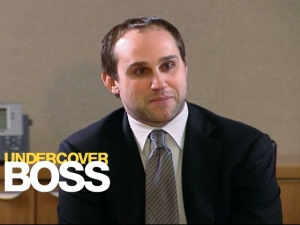
In Undercover Boss, a CEO goes undercover as an entry level worker in his own company.  The experience is meant to humble him and bring him back down to Earth.  Of course, what’s not mentioned is that each show basically works as a 60-minute commercial for whatever company is being featured on each episode.  For that reason, we hear that the CEO of 7-11 knows that he needs to know how to improve his company’s image.  However, at no point do we say anyone informing the CEO that he might end up getting shot if he works the late shift.

One of the reasons why Undercover Boss has become so popular is that every episode pretty much follows the exact same format.  There’s never anything unexpected hiding in the shadows.  This means that viewers can not only turn off the majority of their brain and still follow what’s going on but that they also get to pat themselves on the back for being able to predict what’s going to happen before it actually does.  The show makes the audience feel smart by making them more stupid.  George Orwell would be proud.

Each episode plays out as follows:

First, we get an overview of whatever company we’ll be investigating tonight.  For the most part, these are companies that we’ve heard of but we rarely give much thought to.  They are also companies that are successful enough that it really doesn’t matter whether the CEO goes undercover or not.

We then meet the CEO.  If the 1st season is any indication, a CEO is a boring white guy who was either given his job by his father or else graduated from an Ivy League college.  Apparently, this is one of those no-girls allowed type of jobs.  I guess we’re just too emotional to handle the responsibility.  We get to see our masculine CEO with his perfect family (which usually consists of a nameless wife and two or three kids just to make sure we know that our male CEO is a real man).  The manly CEO will often make a point of telling us that he loves motorcycles or skydiving or something else that he thinks will make him less inherently boring than he actually is.  The really pathetic CEOs are the ones who insist on being filmed while surfing.  “See, I am too a normal guy!  I own a surf board and wear a wet suit.”

However, the CEO tells us that he feels like he needs to go and get his hands dirty.  He has to know what’s going on in his company.

The CEO then holds a meeting with his “corporate board.”  His corporate board is usually a group of people who are somehow even more boring than the CEO.  For the most part, this corporate board is equally male, white, and bald.  Most of them could also seem to have that unfortunate thing where it’s impossible to tell where the chin ends and the neck begins.  Strangely, a lot of these guys respond to this condition by trying to grow a beard which basically just makes them look a 100 times worse.  Another thing I always notice about these corporate types is that they’re almost always wearing a suit but not a tie.  Instead, they just leave their collar unbuttoned and show off a small fraction of their sweat-stained undershirt.  I’m assuming they’re trying to say that they haven’t become corporate, that they’re still Jenny From The Block no matter how money they’re making.  However, they just look like they forgot to finish getting dressed in the morning.  Seriously, guys, fuck you.

For the sake of diversity, there are usually one or two women on the board.  For the most part, the women are white and their lipstick is bleeding into the wrinkles surrounding their mouth.  There’s usually a black guy on the board too.  Usually, he’s wearing a nametag that reads “Token.”

One odd thing about this show is that every CEO seems to have the same board of directors.  I don’t just mean that all the boards are made up of bald white guys.  I mean, that they seem to be made up by the exact same bald white guys.  Honestly, I’m one of those bohemian artist girls.  I don’t know much about Corporate America.  Maybe there’s a traveling board of directors that goes from company to company.  I’ll have to give the show the benefit of the doubt.

Anyway, the CEO says, “I’m going undercover.  I’m going to pretend to be a very verbose blue collar worker with an Ivy League education.  I’m going to lie to people to get them to tell me the truth.  I’ll be in the trenches, working.  Kinda sorta.”

What’s hilarious here is that, while he’s speaking, the camera will always find the one kissass board member who actually starts taking notes.  I always want to know what they are actually writing down.  Maybe something like: I am the Angel of Death.  My time is now while the boss is out…

Another member of the board will then say, “Do you think you can hack it?  I mean, those are silk boxers you’re wearing there.”

Everyone laughs nervously.  The CEO glares and then says, “That’s what I’m going to find out, you smug asshole.”

The CEO goes undercover.  This means that he either stops shaving or he does shave if he’s one of those insecure men who thinks a beard will somehow make him impressive.  He takes off his tie.  He puts on a baseball cap.  BAM, suddenly he’s just your average articulate, well-spoken 57 year-old laid off construction worker.  He tells us that if he’s going to undercover, he’s going to have to live like a poor person.  This apparently means getting a room at some otherwise deserted motel where he promptly proceeds to snort a line of cocaine off the nightstand.  Staring at the camera, he rubs his red nose and says, “Don’t film this, okay?  God, my life is such a fucking lie!”

(I’m still waiting for one of the undercover CEOs to get stabbed to death in the shower…)

The Undercover CEO explains that he’ll be using a fake name.  He also says that the camera crew will be explained away as a crew that’s making a TV show about entry level jobs.  Oddly enough, apparently this story actually works.  Nobody ever says, “Hey, articulate, educated, old white blue collar guy, why are there a bunch of TV cameras following you around?”  Me, I have to wonder why anybody would want to watch a TV show about entry level jobs when they could be watching one about clueless undercover CEOs fucking up in their own companies.

Speaking of which –

The first job that Undercover CEO takes almost always seems to involve a lot of physical activity and speed.  He shows up for the job looking all unshaven and laid off-like.  He meets his new supervisor.  Undercover CEO grins like an idiot and goes, “I’m here to work.”  The new supervisor says, “I give a fuck, kid.”  Again, nobody mentions the camera crew.

Anyway, the supervisor assigns Undercover CEO to do the most demanding, difficult, and demeaning job possible.  The Undercover CEO is assigned to work with either a jovial black man or a fat woman.  The Undercover CEO is really, really impressed by his new co-workers.  “Why they’re just the type of poor people I was hoping I’d meet!” he says. 

They get to work.  Undercover CEO does a terrible job.  He can’t keep up.  The Supervisor comes by and says, several times, “Jesus Christ, strangely soft-spoken blue collar worker, you sure do suck.”  Undercover CEO tells the camera, “This is hard work!”

I think part of the CEO’s problem here is that he simply won’t shut up and do his job.  Instead, he’s spending the whole time asking everyone around him questions like, “How long have you worked here?” and “Do you enjoy your job?” and “How do you work here and take care of your children?”  His coworkers – who need their jobs much more than Undercover CEO – answer every single one of his questions.  Does nobody find it weird that this stranger wants to know about everyone’s children?

Anyway, at the end of his first shift, Undercover CEO is told that he can’t cut it.  “We don’t need you back,” the supervisor says.  Dejected, Undercover CEO goes out, picks up a male prostitute, and goes back to his hotel where he allows his date for the night to tie him down to the bed and drip hot candle wax on his genitals.  (Okay, maybe that was just Michael Rubin, who was probably the most clueless asshole of the 1st season’s CEOs.)

The next day, a properly sore and chastised Undercover CEO goes to work in the “service” part of his company.  He’s either a short order cook or a cashier or something like that.  Again, he’s assigned someone to train him.  This time, the Undercover CEO does his job adequately despite the fact that he still won’t stop harassing his new co-workers with a bunch of inappropriate questions.  He asks, “Do you like working here?” and “What do you think this company could do better?”  Amazingly enough, people still answer him even though there’s a camera crew there filming them.  Does it never occur to these people that there’s something weird about some stranger with a camera crew wanting to know every intimate detail of their lives within minutes of first meeting them? 

Amazingly, Undercover CEOs always end up getting trained by the one person in the company who either needs an organ transplant or who has a child on dialysis.  Undercover CEO is moved to tears.  During his break, he tells the camera, “I wish all my employees were like her.”  Which I guess means that he’s wishing all of his employees were terminally ill and unable to pay for adequate medical coverage.

Undercover CEO returns to his motel.  He’s got a lot to think about now.  He sighs.  “Did you know,” he tells the camera, “that before I became a CEO, I was just another dirty little boy who liked to touch himself?  Somehow, I have to get back in touch with that little boy.  Hold me.”

Day 3, Undercover CEO is forced to deal with the dark underbelly of his corporation.  This was the day that the CEO of 7-11 discovered that one of his stores did not have working lights.  Shrimpy little Michael Rubin had to work with a rude woman in customer service on Day 3.  (“I nearly went off on her,” Michael informs us.  What-evuh, Michael.  Go fuck yourself.)  Most notoriously, the Hooters CEO met a manager who forced his waitresses to play “reindeer games.”  Amazingly, these people engage in their bad behavior even though there’s a camera crew about two feet away from their face.

Undercover CEO’s mad now.  “Yes,” Undercover CEO says, “my company may not be perfect but dammit, that’s just not the way we do things at Hooters! ” Undercover CEO sneaks outside.  He yanks out his cell phone.  He calls someone at the corporate office.  He says, “This is your CEO speaking.  We’ve got bad juju going down.”  The person at corporate probably says, “I’ll get right on that, sir,” in a tone of contempt and seething hatred.  Undercover CEO says, “Get on it, stat!”  He hangs up his phone.  He looks at the camera.  “That’s not the way we do things!” he repeats as saliva forms at the edge of his mouth. 

A few minutes later, a van pulls up in front of Hooters.  Undercover CEO watches as Jack Bauer gets out of the van and runs into Hooters.  For a few seconds, silence.  Then a barrage of gunfire erupts.  Bauer runs out of Hooters and jumps back in the van.  As the van speeds off, the offending Hooters blows up.  Undercover CEO looks at the camera and nods.  “Sometimes,” he says, “it’s about doing what’s right.”

Back at the motel, Undercover CEO grins as he tells the cameraman, “That’s not the first time I’ve had to do that.  What’s funny is that I’m not even the CEO of Hooters.”  Undercover CEO starts to giggle.  “I’ve been a baaaaad wittle boy, mommy,” he says.

Cut to commercial.

The next day, Undercover CEO has his final assignment.  Inevitably, there’s someone at this last job who knows who Undercover CEO actually is.  So Undercover CEO has to have a meeting where he goes, “Hey, I’m all undercover and stuff.  You blow my cover and I’ll have your family killed and fed to a bunch of pigs.”  Everyone agrees to keep Undercover CEO’s identity a secret.  The audience sighs a sigh of relief because the audience is made up of a bunch of total dumgfugs.

Anyway, during the final assignment, Undercover CEO ends up working with an inspiring member of a minority who reaffirms the Undercover CEOs faith in humanity.  Undercover CEO tells the camera, “That guy could be really valuable in this company, even though he’s black/Mexican/Indian/actually a woman.”  Undercover CEO does his final job well.  For some reason, everyone tells him every detail about their lives.  Undercover CEO is moved.

However, Undercover CEO isn’t moved enough to actually give them any of his money.  Instead, he just checks out of the Bates Motel and returns to his corporate office.

He has a meeting with his board of directors.

A member of the board goes, “I heard everyone hated you and you really suck.”

Undercover CEO says, “I’ve seen the light!  We’re going to change how we do things at this company!”

The kissass board member continues to take notes.

Undercover CEO either starts to shave again or else grows his beard back.  He puts on a suit.  He says, “Thank God, I’m rich again.  What are those fucking cameras still doing here?  Oh yeah, I’ve got to let everyone know that I spent a whole day lying to them.”

Everyone that Undercover CEO has worked with is invited to the corporate office.  They’re interviewed as they’re driven to the office.  They say, “I’m scared.  I hope I’m not getting fired.”  None of them seem to connect the current TV cameras to the last group of TV cameras that they saw. 

They meet the CEO.  The CEO says, “You remember me?  I actually run this company!”

“Bullshit!” the former co-worker replies.

“No, it’s true!”

“What-evuh, freak.  Go fuck yourself.”

Most of this is edited out in post-production but you know it happens.

Undercover CEO tells everyone what a great job they’re doing.  And he tells them that he’s going to reward them for being sick or not being able to take care of their children.  (Never mind everyone else in his company who is in a similar situation.) 

The co-worker smiles, probably hoping to hear that he’s getting a raise.

Undercover CEO says, “I was really touched by how your son is about to die if he doesn’t get a kidney transplant.  So, I made a $1,000 dollar contribution to the Stop Global Warming fund.”

“Oh,” the co-worker says, “I guess that’s good.  Considering that I had to do a lot of extra work to cover for your middle-aged ass…”

“Now, get the fuck out of my office and make sure you cut your overtime,” Undercover CEO says.

Finally, everyone who works for Undercover CEO gathers in a conference room where they watch clips of him fucking up.  They all laugh and go, “See, I told you the boss is an idiot!”

Undercover CEO then addresses his employees.  “See,” he says, “I am too a great guy.”

And life goes on.

That so many Americans have apparently been seduced by this obviously manufactured piece of mainstream propaganda is just sad.

The most common adjective that I hear to describe this show is “positive.”  Supposedly, it celebrates the workers of America.  It makes people feel better about their own largely pointless lives.  And to all that, I say “Bullshit.”  Yes, the CEO gets to be poor for a week but he does it secure in the knowledge that it’s only going to be for a week and that he’s not going to lose his job.  The CEO is less an undercover investigator and more of a pampered tourist who looks at poverty all around him, says, “How awful,” and then promptly gets on the next plane home.

Film Review: The Expendables (Dir. by Sylvester Stallone)


I know that I really should have hated The Expendables.  For one thing, it’s a very, traditional, let’s-blow-up-Eric-Roberts-and-save-the-damsel-in-distress action film.  Storywise — well, there really isn’t a story beyond a bunch of inarticulate, muscle-bound men blowing shit up.  The Expendables is perhaps the most hyper-masculine film since Avatar, the type of movie that was obviously not made with anyone possessing a brain or a vagina in mind. 

In short, the Expendables is the type of mainstream, action movie that — based on everything I’ve ever written on this site — I should have hated.  But you know what?  I didn’t hate it.  I’m not saying that I loved the movie (because I certainly did not) but on the whole, The Expendables is a fun movie and sometimes, that’s more than enough.

The Expendables are a group of mercenaries, led by Sylvester Stallone and Jason Stathan.  They are, of course, the best at what they do.  They must be as their existence is apparently a well-kept secret despite the fact that they all have prominent Expendables tattoos and all they drive motorcycles covered with colorful Expendable decals.  So, the question is — can you accept the fact that the movie tells us the Expendables are a secret even though they clearly would never be able to pull that off in real life?  If the answer is yes, read on.  And if the answer is no, please don’t ever talk to me because you probably lack a proper appreciation for the absurd.

Anyway, The Expendables are hired by Mr. Church.  Mr. Church is played by Bruce Willis who, in his very short scene, manages to chew up more scenery than a termite in heat.  (That’s a lot of scenery.)  Mr. Church wants the Expendables to go to a poor, island nation and overthrow the military dictator.  Or something like that.  To be honest, I never really figured out what the exact mission was other than it involved blowing a lot of shit up. 

Oh, I nearly forgot to mention that Eric Roberts is on the island too.  He’s a bad guy.  You know he’s a bad guy because he’s always stopping the action to tauntingly explain his evil plans.  (It also helps that he’s played by Eric Roberts.)  Roberts is a bit of let down as a villain and its hard not to feel that his performance was basically made up of deleted scenes from The Dark Knight.  Then again, in Roberts’ defense, he’s having to compete with memories of Jason Patric playing a similar character in The Losers.

If Roberts’ villain is disappointing, the Expendables themselves are played well enough.  While Sylvester Stallone is hardly a great actor, he knows how to play an action hero and he brings just the right mix of self-aware parody and self-righteous fury to his role.  His second-in-command is played by Jason Stathan who displays something resembling charisma for the 1st time in his odd film career.  The other Expendables don’t get much to do beyond deliver a few quirky lines of dialogue and blow stuff up.  One of them is played by Jet Li who dominates his few scenes even though he doesn’t really get to do much.  Another Expendable is played by the Old Spice Guy who, according to Wikipedia, is actually a pro-athlete named Terry Crews.  However, all of the Expendables appear to enjoy hanging out together.  You get the feeling that they had a good time making this movie and, as a result, you feel almost guilty for worrying about stuff like logic or ambiguity.

The main selling point of The Expendables is that it apparently features every single action star in existence.  Even Arnold Schwarzenegger gets to make a largely pointless cameo and deliver the film’s worst one liners while, in real life, the state he’s supposed to be running descends further and further into financial doom.  While I recognized Stallone, Stathan, Willis, Roberts, Mickey Rourke, and Jet Li, apparently everyone else in the cast used to be someone at some point as well.  Luckily, I saw this movie with my friend Jeff who got very excited as he explained to me who everyone was and why their presence on-screen was making all the men in the audience so positively giddy.  To be honest, I think I probably actually understood a little less than a fourth of the information that Jeff provided me with but he was so incredibly cute trying to explain it all.

(I imagine I probably gave him the same look that he gave me when I attempted to explain Sex and the City 2 to him.)

As I explained at the start of this review, the Expendables is not, technically, a good film but it is a lot of fun.  As opposed to the Avatars of the world, the Expendables is a movie that is at peace with what it is.  There’s no attempt to try to fool the audience into thinking that they’re seeing a work of art.  There’s something to be said for that type of honesty, especially when you consider that we’re approaching that time in the film season when every movie is going to be marketed as a sure-fire Oscar contender.

And if the film is a hyperactive overload of testosterone — well, it is what it is.  After sitting through hundreds of films based on books by Nicholas Sparks, all featuring Miley Cyrus, Emma Roberts, or Amanda Seyfried haunting the beach all to win the love of some sensitive lifeguard eunuch, there’s something undeniably appealing about watching a bunch of guys acting like guys.  Zac Efron might have the heart and soul of poet but can he blow shit up?

A Quickie With Lisa Marie: Twelve (directed by Joel Schumacher)


I’ve seen a lot of reviews for the just-released Twelve that have referred to this movie as just being an extended episode of Gossip Girl, largely because the movie deals with spoiled, rich teenagers and it stars Chace Crawford.  I’m going to venture a guess that the majority of these reviewers have never actually seen an episode of Gossip Girl, which is actually entertaining and self-aware in a way that the ploddingly obvious Twelve could never hope to match.

Crawford plays White Mike.  He’s a recent high school drop out who now makes his living selling drugs — mostly marijuana — to his former classmates.  However, his classmates — not to mention his cousin, Charlie — are more interested in sampling a new designer drug known as twelve.  We’re told that twelve feels like a combination of cocaine and ecstasy.  As this movie struggled to reach its apocalyptic conclusion, I found myself thinking, “That doesn’t sound too bad.  I wonder if I can get some twelve after the movie…”

Anyway, Twelve charts out four days in the life of Crawford and his former classmates.  It starts with Crawford ignoring a pathetic phone call from his junkie cousin and it ends with a shooting rampage at a party that leaves the majority — but not all — of the cast dead.  It’s supposed to be an anti-drug film but, like far too many anti-drug films, it can’t disguise the fact that the characters are a lot more fun to watch when they’re on drugs than when they aren’t.  (For instance, we’re told early on that White Mike doesn’t do drugs, smoke, or drink and just look how miserable he is.)  Director Joel Schumacher gives us a lot of really pretty images but there’s nothing below the surface and as a result, the film’s massacre doesn’t so much feel tragic as it just feels like a poorly planned fashion spread in Elle. 

(As opposed to Nick McDonnell’s original novel, the film Twelve is mainstream enough to only allow unlikable characters to die at the end.)

The cast is almost achingly pretty but, at the same time, largely forgettable, with two major exceptions.  Poor Rory Culkin (who I worry about because he always seems so sad every time he shows up in a movie) brings a lot of pathos to his role as the geeky kid who happens to have the perfect party house, permissive parents, and a psychotic older brother.  Emily Meade is memorable playing a character who, in many ways, is a female version of Culkin’s.  Playing a bipolar girl who discovers a love for twelve, Meade actually manages to overcome the generic plot (the type that demands that she go from being an honor’s student to selling her body to Curtis “50 Cent” Jackson in little over 24 hours) and makes her character compelling.  Plus, she has a fun scene where her teddy bears encourage her to kill people.

Still, the movie ultimately belongs to Keifer Sutherland who never appears on-screen but who gets more dialogue than anyone else in the entire film.  Sutherland plays the narrator.  That’s right, as simplistic as the movie is, Schumacher apparently felt that the movie needed a narrator to tell us what we’ve just seen onscreen.  For instance, we see Crawford selling drugs.  Suddenly, Sutherland’s voice informs us, “White Mike is a drug dealer.”  “Oh,” we say in the audience, “so that’s why he’s exchanging marijuana for money…” 

Even though the narrator is essentially just quoting large chunks of prose from McDonnell’s novel, the use here is technically a mistake.  I say “technically” because it cannot be denied that Sutherland has probably got the sexiest narrator voice around.  Regardless of whether the movie needed it, I needed it.  If nothing else, I will always remember seeing Twleve as the time I heard Keifer Sutherland say, in his purring growl of a voice, “I want to tap that ass,” and I thought, “Well, okay…”

Film Review: Cyrus (dir. by Mark and Jay Duplass)


Last Tuesday night, as we watched the end credits of Cyrus rolling across the screen at the Plano Angelika, a very dear and close friend of mine leaned over and whispered in my ear, “That was a really odd fucking movie.” 

(Actually, it was two weeks ago.  Sorry, I started this review a while ago and only recently returned to finish it.)

And he’s right.  Though the film is worth seeing (though I’d honestly suggest waiting until it comes out on DVD unless you’re just the world’s biggest John C. Reilly or Jonah Hill fan), Cyrus really is an odd fucking movie.

Cyrus is the latest film from Jay and Mark Duplass, the two brothers responsible for 2008’s Baghead, one of the unacknowledged great films of the last decade.  In Cyrus , John C. Reilly plays a character named — appropriately enough — John.  John is a likable loser, a less musical version of the character Reilly played in Chicago.  When the movie opens, John is depressed over the fact that his ex-wife, Jamie (Catherine Keener), is getting married again.  At Jamie’s suggestion, he goes to a party where he proceeds to have too much to drink, flirts awkwardly with every woman he sees, and somehow manages to charm Molly (Marisa Tomei).  Molly is soon sleeping over at John’s house but every morning, John wakes up to discover that she’s either already left or is in the process of sneaking out.  John asks her if she’s married.  Molly replies that she’s not but is still vague about why she never stays the entire night.  Finally, one morning, John follows Molly after she leaves.  He sits out in front of her house and, after she’s left for work, John proceeds to creep around outside the house. 

And, of course, its while he’s doing all of this creepy stalker stuff that he first meets Cyrus (played, of course, by Jonah Hill).  Cyrus is Molly’s 22 year-old son and from the minute he first appears, its obvious that there’s something off about him.  He’s far too friendly and speaks in the oddly stilted cadence of someone who is obviously making an effort to act “normal.”  He  spends all of his time composing New Agey synthesizer music in an elaborate home recording studio.   Of course, the main sign that there’s something odd about Cyrus is that he’s played by Jonah Hill.

However, the main thing that distinguishes Cyrus is just how close he is to his mother.  From the first moment that we see him and Molly interact (he’s playing his music and Molly enters the house and immediately starts dancing to it), its obvious that Cyrus is Oedipus, Norman Bates, and Yanni all wrapped up into one package.  And, obviously, he views John as being competition…

Cyrus is an uneven film, one that starts out strong but — once the title character is actually introduced — suddenly seems to get hit by an identity crisis.  Is it a realistic portrait of sad, lonely people trying to find love in uncertain times or is it an Apatowish mix of stoner sentiment and over-the-top comedy?  Is Cyrus meant to be the emotionally wounded, painfully insecure outsider that he appears to be the movie’s more contemplative moments or is he just a sociopathic comedic device that Reilly has to overcome in order to pursue his relationship with Tomei?  That’s the question that is at the heart of Cyrus and discovering the answer is the film’s entire excuse for existing.  Unfortunately, the Duplass Brothers don’t seem to know the answer themselves and as a result, the entire film feels directionless and we’re left with too many unanswered questions.

For instance, where is Cyrus’s father?  It’s mentioned by both Cyrus and Molly that the father is no longer in their lives but why?  Though its never explicitly stated, its obvious that both Cyrus and Molly have suffered abuse in the past, probably at his hands.  However, the issue itself is never directly confronted and its hard to believe that John wouldn’t have asked about it at some point.  For that matter, beyond her role as Cyrus’s mother and John’s girlfriend, Molly isn’t given any back story whatsoever.  Considering the fact that the entire movie is about how Cyrus and John feel towards her, it’s interesting that she’s never given a scene where she really gets to explain how she truly feels towards either of them.  A good deal of the film’s attitude towards Molly can be seen in the fact that, while a major plot point hinges on her being at her job as opposed to at home, we never find out just what exactly it is that she does for a living.

That’s unfortunate because, in many ways, Cyrus shows a good deal of promise and psychological insight.  One of the subtle pleasures of the film is seeing how all of the various relationships (John and Molly, John and Cyrus, Molly and John, John and his ex-wife, Cyrus and Molly) actually run parallel with each other.  When Molly first flirts with John, John replies, “Are you hitting on me?  I’m Shrek.”  And it seems like he’s got a point until you see Cyrus and Molly together.  It’s at that point that you realize that John probably once looked just like Cyrus and that Cyrus is eventually going to grow up to be John.  It’s hard not to wonder if Cyrus’s father looked like John or if Molly is attracted to John because he reminds her of her son.  On the other hand, much as Cyrus is totally dependent on Molly, John is similarly dependent on his ex-wife (who, as played by Catherine Keener, looks strikingly similar to Marisa Tomei).  In a nice touch, his ex-wife’s new husband seems to have the same opinion of John that John has of Cyrus.

The Duplass Brothers also get a quartet of excellent performances from the film’s leads.  This is all the more exceptional considering that three of them are playing characters that are either underwritten (Tomei and Keener) or else totally inconsistent (Hill).  The film really belongs to John C. Reilly who is such a sympathetic, likable presence as John that he convinces the audience to forgive a lot of the film’s unevenness.  His best moments are to be found in the film’s opening party scene where he essentially acts like a total drunk jackass yet you still feel oddly sorry for him.  He’s just such a nice guy.

As previously stated, Cyrus is an odd film, an uneasy mix of independent and mainstream sensibilities.  Watching it, I found myself wondering if the Duplass Brothers were really sure what type of movie they wanted to make, if they wanted to emulate the cold, detached dry wit of the Coen Brothers or if they were indulging in a little Judd Apatow-style schmaltz.  Both styles attempt to co-exist in Cyrus and the end result is a movie that seems to be struggling to establish its own identity.  Still, Cyrus is worth seeing if just for the performances.  As flawed as the film is, it confirms what Baghead indicated, that the Duplass Brothers as intriguing filmmakers to watch out for in the future.

A Quickie With Lisa Marie: Blood Freak (dir. by Brad Grinter)


It’s difficult to explain why exactly Blood Freak, a no-budget horror film from 1972, is a movie that you simply have got to see.  I could tell you about how it’ll force you to wonder if the movie was meant to be taken seriously or if it’s all just a huge joke.  I could go on for paragraph after paragraph about how this movie (and its status as one of the great cult films of the last century) represents one of the purest triumphs of independent cinema and how this movie is one of the few American films to ever come close to Lucio Fulci’s theory of “pure film.”  But I fear that even after I do all that, I will not be able to convey just how beautifully odd and wonderful this movie truly is. 

So, instead of doing all of that, I think I’ll just tell you what Blood Freak is about.

Steve Hawkes (a body builder who appeared in several Spanish exploitation films in the late 60s) plays an aimless drifter who, as the movie starts, finds himself in Florida.  He meets a virginal young woman named Angel.  Soon, they are a very clean-cut, chaste couple.  As seen in the clip below, Angel even gets him a job working at the local turkey farm.

However, there’s trouble brewing.  Angel has a sister named Ann.  Ann is Angel’s opposite in every way.  Not only does she stay out for all hours of the night with her sleazy friends but she also introduces our hero to a little drug called marijuana.

Soon, Hawkes discovers that — apparently like most of America in the early 70s — he is now addicted to marijuana! (“I have a feeling I’m hooked!” he explains.)  Of course, we all know what happens when you mix marijuana and repeated exposure to turkeys.  That’s right, our hero ends up falling asleep and then waking up as a blood-crazed man/turkey hybrid,  as seen in the scene below (which, fair warning, has some fake blood in it).

However, if that wasn’t enough, there’s one more thing that makes this movie an absolute requirement for any discerning film lover.  Blood Freak has a narrator.  And our narrator isn’t some wimpy, off-screen guy with a stern voice and a moralistic outlook.   No, our narrator is Brad Grinter, the film’s writer and director.  Grinter pops up every few minutes, sitting behind a desk and explaining the larger social and moral concerns raised by the story of a muscle-bound drifter transformed into a half-Turkey.  Whenever Grinter appears to lose his train of thought (which happens frequently), he holds up what appears to be the film’s script and reads his commentary line-for-line.  While he explains why marijuana is bed (Mmmkay), Grinter puffs away on an ever-present cigarette.  Several times, he has to pause in his commentary in order to hack up a lung.  One of his more inspiring moments can be seen below:

Blood Freak.  See it.

(On a related note, I usually love Something Weird Video but I’m a little bit annoyed with them that they’re apparently only selling the Blood Freak DVD as part of an over-priced box set.  Still, a used copy of the film on DVD shouldn’t be hard to track down.  Why anyone would want to sell their copy of it, I can’t begin to guess but apparently, not everyone recognizes the brilliance of this film in quite the same way as I do.  Their loss.)

A Quickie With Lisa Marie: Holocaust 2000 (dir. by Alberto De Martino)


Earlier this morning, while suffering from an annoyingly persistent case of insomnia, I decided to spend 2 hours watching a classic Italian exploitation film, Alberto De Martino’s oddly effective Omen rip-off, Holocaust 2000.

In Holocaust 2000, Kirk Douglas plays a businessman who wants to build a gigantic nuclear power plant in the Middle East.  There are a few problems with this plan.  First off, the site that Douglas selects just happens to be right next to a cave that is full of religious artifacts.  Secondly, there’s a handful of angry environmentalists picketing his London office.  And, perhaps the biggest problem, Douglas’ son happens to be the Antichrist.  This fact is obvious to the viewer because not only is his son named Angel (yes, we’re in the land of irony) but he also looks and acts nothing like Douglas.  Not only does Angel have a noticeably weak chin (no cleft to be seen at all) and speak with a rather posh accent but he’s also so extremely English that he’s even played by an actor named Simon Ward.

In other words, the viewer is pretty much in on the game from the beginning.  What makes the movie work is that director De Martino understands that everyone’s going to know that Angel’s the antichrist from the minute he first appears so, as opposed to the Omen films, he doesn’t waste a lot of time playing any “is-he-or-isn’t-he” games.  Instead, in the great tradition of Italian exploitation, De Martino jumps straight into the apocalypse without worrying about things like narrative cohesion and the end result is an enjoyably chaotic film that rarely makes sense but is never boring.  Whereas the Omen films are almost tedious in their attempts to provide theological justification for all the blood that’s spilled on-screen, Holocaust 2000 has a cheerful, let’s-make-it-up-as-we-go-along feel to it that, at times, almost makes the whole thing feel like some long lost Lucio Fulci film.

Holocaust 2000 is probably best known for two sequences.  The first features a helicopter blade very graphically chopping off the top of a man’s head.  If seeing the original Dawn of the Dead made me nervous around helicopters, seeing Holocaust 2000 has ensured that I will never ever step anywhere near one of those things.  Seriously, I’ve seen a lot of gore over the past few years but the decapitation scene in this movie …. well, perhaps it’s best to just shudder and move on.  (For the record, Holocaust 2000 came out before Dawn of the Dead so the helicopter decapitation scene here was not stolen from that film.  If anything, it was simply a more graphic version of David Warner losing his head in the Omen.)

The second sequence is a scene in which a very nude Kirk Douglas (who, it must be admitted, looked a lot better at 61 than most 20 year-olds do today) has a nightmare in which he watches the world literally come to an end.  Set to Ennio Morricone’s intense and memorable score, this sequence manages to be surreal, disturbing, and entertaining all at the same time.  It epitomizes everything that makes Holocaust 2000 such a surprisingly effective work of pure cinematic exploitation.

Like many of the great Italian exploitation films, Holocaust 2000 was released under several titles.  It is currently available on DVD under the title Rain of Fire and a big bleh to Lionsgate for choosing to go with such a boring name.  Admittedly, I can see their logic.  Though the movie was first released in theaters in 1977, it took 31 years for it to show up on DVD.  During that time, 2000 came and went and the world didn’t end (or maybe it did and the last 10 years have just been an extended hallucination, the choice is yours).  But still, Rain of Fire sounds like a substandard country song about a nasty divorce that ends in murder.  On the other hand, a title like Holocaust 2000 — nakedly exploitive and borderline offensive — represents everything that we’ve come to so love about Italian exploitation films.

Film Review: Salt (Directed by Phillip Noyce)


I have long come to accept that, when it comes to issues of gender equality, most movies are like Iron Man 2.  If you’ll remember, that’s the film in which Gwynneth Paltrow said she was better suited to be a secretary than a CEO, Scarlett Johansson beat up an army but only because she was given permission ahead of time by a very manly Samuel L. Jackson, Jr., and the world was saved because Robert Downey, Jr. made peace with the patriarchy.  While the inherent sexism of most movies has never ceased to bother me, I’ve come to accept it because I love film. 

(For the record, I enjoyed Iron Man 2 even if I did roll my eyes more than once.)

Still, hope continues to rest at the bottom of Pandora’s box.  With the year only a little more than a half over, American movie screens have played host to a handful of unusually strong and independent female characters.  (It’s the independence that sets them apart.)  From Jennifer Lawrence in Winter’s Bone to Katie Jarvis in Fish Tank to even Kristen Stewart and Dakota Fanning in the Runaways, they have challenged the standard movie stereotype of the weak, ultimately helpless female.  The best known of them is, of course, Noomi Rapace as Lisbeth in The Girl With The Dragon Tattoo and its sequels.  However, if the Girl With the Dragon Tattoo features the strongest woman to appear on American movie screen this year, the just-released Salt features the second strongest.

In Salt, Angelina Jolie plays Evelyn Salt, a CIA agent who is married to Mike (August Diehl), a nice guy who happens to be the world’s leading authority on spiders.  On the day of her wedding anniversary, Salt finds herself tasked with interrogating a Russian defector named Orlov.  As Salt listens (and her fellow agents watch), Orlov tells a story of how, decades earlier, hundreds of Russian children were secretly smuggled into the U.S. where they served as “sleeper” agents, working their way into American society until such time as they might be activated.  Orlov goes to explain that one of these sleeper agents is going to assassinate the President of Russia.  That agent, Orlov adds, is named “Evelyn Salt.”  While Salt’s co-workers react to this accusation by attempting to arrest her, Salt reacts by escaping from custody and fleeing in an attempt to both find her husband, who has mysteriously disappeared, and prove her innocence.

Or is she?  There’s a lot of twists and turns in Salt’s plot and while they don’t always make sense, they’re a lot of fun to watch.  Director Phillip Noyce keeps the action moving and, in the lead role, Angelina Jolie brings a wonderful sense of moral ambiguity to the character that you’re never quite sure whose side she is really on.  Jolie makes the character seem real even when she’s jumping off a bridge and landing on top of a speeding truck without so much as even a bruise as a result.

Admittedly, I enjoyed Salt for much the same reason that I enjoyed the far superior Girl With The Dragon Tattoo.  It was fun to not only see a woman in a movie do stuff that usually only a man is allowed to do but also manage to do all of it a lot more convincingly than most contemporary male action heroes.  With the exception of a very intense torture scene at the start of the film, Salt is never shown with tears in her eyes.  She is never shown begging for mercy.  Most importantly, she is never portrayed as being helpless.  Considering just how much importance society puts into the idea of all women being inherently helpless, movies like Salt are a refreshing change of pace.

Of course, that doesn’t change the fact that pretty much everything Salt did in the film was basically done to save her marriage.  As strong a character as Salt was, its unfortunate that the film had to make sure we understood that it was all due to the purifying love of one man.  It’s as if the filmmakers were worried that if they made Salt too independent, they’d lose the audience and they were probably right.

Still, 2010 may very well be remembered as the year that women in movies were finally allowed to kick some ass.  After an eternity of serving as decorations (with their every action governed by some male filmmaker’s infantile Whore/Madonna complex), women are finally being allowed to do something other than scream and wait to be rescued.  Will this trend continue?  Probably not.  It’s a bit much to ask of a country that can’t even bring itself elect a female President.  However, while it lasts, I’m enjoying the trend and I’ll miss it once it’s over.

Film Review: Drag Me To Hell (directed by Sam Raimi)


There are exactly two things that keep Sam Raimi’s otherwise entertaining 2009 horror romp Drag Me To Hell from being a classic.

The first is that, about halfway through the movie, Alison Lohman murders her pet kitten.  Admittedly, Lohman’s character is trying to thwart a gypsy curse at the time and the action does show just how terrified she’s become.  But that doesn’t change the fact that it’s a cute kitten and quite frankly, I’m getting sick of seeing cats being killed in horror films.  There’s something truly hypocritical about how far most filmmakers are willing to go to assure an audience that a dog has somehow survived the end of the world while cats are continually killed on-screen without a second thought.

Am I saying that the film would have been better is Lohman had murdered a cute puppy instead?  Yes, I am.  At least that would have been unexpected.  That would have let the audience know that all the rules no longer applied.  Quite frankly, whenever you see a cat in a horror film, you know that cat is going to end up either pinned to a door or hanging in the closet.  Dogs, however, always make it to the end.

I imagine this is because there’s more “dog people” than “cat people” in the world.  People — especially men of a certain age — just love dogs and I’ve never really understood why.  I guess there’s a charm to a loud, smelly, slobbering beast eating its own fecal matter that I’ve never been able to pick up on.

The second thing that keeps Drag Me To Hell from reaching classic status is the fact that Bruce Campbell is nowhere to be found, making this the 1st Raimi film not to feature Bruce in at least a cameo.  Regardless of how well-made or entertaining the movie may have been, I sat through the entire thing waiting for Bruce to show up and, when he didn’t, it was hard not to feel as if perhaps an era in filmmaking had come to an end.

However, despite these two issues, Drag Me To Hell is probably one of the best horror movies to have been released in the past few years.  If nothing else, it proves that, even after directing three Spiderman films, Raimi is still a B-movie director at heart and a brilliant one at that.

In Drag Me To Hell, Alison Lohman plays Christine, a young bank loan officer who, attempting to impress her boss and win a promotion, refuses to give a loan to a decrepit old gypsy woman (played, wonderfully, by Lorna Raver as the type of grotesque character who could only appear in a Raimi film).  The gypsy woman responds by promptly dying but before doing so, she puts a curse on Christine.  In three days, Christine will be dragged to Hell.

What makes this is so effective is that Raimi, as opposed to a less adventurous director, sets the film up to suggest that perhaps Christine deserves to be dragged to Hell.  As disgusting as the old woman is, she clearly doesn’t deserve to be treated as badly as she is by Christine and Christine herself (even before she kills that poor kitten) is a bit of a fake, a former “fat girl” who, when she lets her guard down, reverts back to a country hick accent that she’s obviously spent a lot of time trying to lose. 

Lohman does an excellent job in the lead role, giving a likeable performance as an unlikeable character.  Speaking as a former country girl who still occasionally feels a twinge of shame when I hear myself say “git” instead of “get,” one of my pet peeves is when an actor or actress trots out an unconvincing, patronizing attempt at a rural accent.  However, Lohman captures the accent perfectly and, unlike most actors who try to play country, never allows her performance to just be about doing dialect.  Instead, both she and Raimi show how Christine’s insecurities lead to her actions without ever suggesting that they excuse them.

Though absence of Bruce Campbell is painfully obvious, Raimi still surrounds Lohman with a very strong supporting cast who all bring just the right amount of B-movie seriousness to their roles.  As Raver’s daughter, Bojana Novakovic appears in one the film’s best scenes in which she tauntingly explains the cure to Lohman.  Dileep Rao (who would be wasted later that year in Avatar) steals almost every scene he’s in as a friendly psychic who tries to help Lohman.  Lohman’s boyfriend is played by Justin Long (of the “I’m a Mac” fame) and he’s perfect as a somewhat nerdy guy who, quite frankly, seems like he might be a little bit too nice for his own good.  Plus, the film’s final scene proves that Long can shed a tear with the best of them.  Bruce Campbell would have been ideally cast as Lohman’s boss but, in Campbell’s absence, David Paymer fills the role well enough.

When Drag Me To Hell was first released in 2009, the majority of reviews described it as being an entertaining throwback to the old school horror films of the 50s and 60s.  And, in many ways, this is a totally correct assessment.  What wasn’t often mentioned was that Drag Me To Hell is one of the very few Hollywood horror films to capture the chaotic spirit of H.P. Lovecraft.  Countless filmmakers have attempted to bring Lovecraft’s Cthulhu mythos to the screen and they’ve failed because they could never translate to the screen Lovecraft’s theme of mankind as a bunch of powerless pawns, existing and dying at the whims of a bunch of “demons” whose motivations could never be understood or questioned.  Though Drag Me To Hell is not based on Lovecraft’s work, it perfectly captures the feeling of helplessness in the face of metaphysical chaos that runs through Lovecraft’s best stories.  As the movie progresses, it becomes apparent that Christine isn’t going to be dragged to Hell so much because of the gypsy curse as much as just because the movie’s demon has decided to drag her to Hell.  It’s this theme (and the way that Raimi relentlessly develops it) that takes Drag Me To Hell to a whole other level and which makes its final scene so powerful and effective.

When first released, Drag Me To Hell’s special effects were criticized by some and it is true that the film’s demon, when he does show up, is an obvious CGI creation but who cares?  If anything, the obvious fakeness of the demon adds to the film’s exploitation charm (though the demon is probably another role that Bruce Campbell could have done wonders with).  If you want perfect CGI devoid of subtext or originality, Avatar’s out on DVD.  Me, I’ll take Drag Me To Hell any day.

Review: Sole Survivor (Dir. by Thom Eberhardt)


In my “which movie should I review poll” 1983’s Sole Survivor came in dead last, receiving a total of 3 votes out of the 234 cast.  I really wasn’t surprised to see that because Sole Survivor, along with having a dreadfully generic title, isn’t really that well-known.  I found the DVD at Half-Price Books where it was being sold for a dollar in the clearance section.  If not for the fact that I can’t resist a bargain, I would never have heard of this movie either.  Which is a shame because, taken on its own low-budget terms, Sole Survivor is actually a pretty effective horror film.

Written and directed by Thom Eberhardt, Sole Survivor has a plot that should be familiar with anyone who has ever seen any of the Final Destination films.  Denise (played by an actress named Anita Skinner) is a neurotic commercial producer who, as the film opens, is the sole survivor of a horrendous airplane crash.  (When we first see Denise, she’s still sitting in her seat, surrounded by the remains of her fellow passengers.)  Against the advice of just about everyone, Denise insists on dealing with the trauma of the accident by trying to return to her normal life.  This is complicated, however, by the fact that she’s still having dreams about the plane crash.  Everywhere she looks, she sees mysterious and menacing strangers watching her.  And, on top of everything else, she is now being stalked by a mentally unstable former actress who claims to be having nightmarish visions of Denise’s future.  Is Denise suffering from survivor’s guilt (as her doctor boyfriend insists) or is she instead being pursued by Death?  If you’ve ever seen a horror film, you can probably guess the answer.

As I mentioned previously, its easy to compare Sole Survivor with the Final Destination films.  However, a more appropriate comparison would be to the 1962 black-and-white classic Carnival of Souls.  Whereas the Final Destination films are largely about coming up with ludicrously convoluted ways for Death to get what he or she wants, Sole Survivor (like Carnival of Souls)  is less concerned with how Death gets the job done and more concerned with building and maintaining a growing sense of dread and hopelessness.  For the most part, director Eberhardt disdains easy shock effects in order to concentrate on building up a palpable atmosphere of doom.  As a result, the film can occasionally seem to be a little slow but it stays with you even after the final credit. 

Also, much like Carnival of Souls, Sole Survivor features an excellent lead performance from an actress who, more or less, disappeared from movie screens after the film’s release.  Carnival had Candace Hilligoss.  Sole Survivor has Anita Skinner.  Skinner gives an excellent lead performance, always remaining a sympathetic.  According to an interview with the film’s producers, Skinner was uncomfortable with the more excessive side of Hollywood and retired from acting shortly after making Sole Survivor.

Sole Survivor was released on DVD by Code Red, so now people like me can appreciate this neglected movie.  The transfer looks great.  Unfortunately, the DVD is pretty thin when it comes to extras.  Neither Eberhadt nor Skinner are interviewed nor do they contribute to the film’s commentary track.  Instead, we have to make due with the film’s producers.  In general, producers usually provide the worst DVD commentary tracks with typical insights running along the lines of “We had the same lawyer” and “So, after that, we brought in another screenwriter.”  The producers of Sole Survivor aren’t quite that bad but their commentary is still definitely lacking in insight. 

But that’s a minor complaint.  In the end, what matters is the movie and not the commentary track.  And as a movie, Sole Survivor is a an overlooked classic of the horror genre.