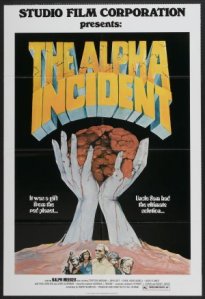
Lisa Marie Is Confused By The Demons of Ludlow (dir. by Bill Rebane)


Last night, after I finished with The Alpha Incident, I decided to watch yet another Bill Rebane film from the Mill Creek 50 Chilling Classics box set, 1983’s The Demons of Ludlow.

The Demons of Ludlow

Ludlow is a tiny New England town that is celebrating its 200th birthday.  Now, when I say tiny, I mean that there appears to be about 17 people living in the town.  Anyway, a mysterious piano is sent to the town as a birthday present and, uh-oh — guess what’s possessed with the angry spirit of a warlock who happened to be murdered by the citizens of Ludlow 200 years ago?  Anyway, this warlock has a whole lot of other angry ghosts with him and soon, they’re exacting revenge on the citizens of Ludlow. 

Okay, I think I can hear Arleigh going, “Uhmmm…Lisa Marie, remember a little film called The Fog!?” and yes, I guess the plot is a bit similar to John Carpenter’s film.  It’s also reminiscent of another 1983 horror film called The Devonsville Terror.  While The Devonsville Terror was directed by the infamous Ulli Lommel, Bill Rebane is listed as being one of the “associate producers.”  I’m sure there’s probably a story there.

But anyway, back to The Demons of Ludlow.  This is very much a horror film of the 80s, which means that it has a real nasty streak.  As opposed to The Alpha Incident, where Rebane actually did appear to have a higher purpose in mind, the Demons of Ludlow is pretty much all about killing people.  Yet, this lack of higher purpose actually makes Demons of Ludlow a far more entertaining film to watch.  It helps that none of the 17 citizens of Ludlow are actually likable enough for you to get too upset once they die. 
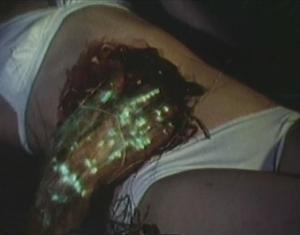
A shocking scene of demonic vengeance...or something.

The demons of Ludlow themselves are far more interesting, if just because they challenge logic by their very existence.  As the reviewer known as Scarina pointed out in her own excellent review, the film’s own internal logic states that the ghosts that are helping out the warlock in the piano are the exact same ghosts who ran him out of Ludlow in the first place.  So, therefore, why are they helping him? Now, if pressed, I can accept that perhaps he used his warlock powers to take control of their ghosts.  I mean, he’s had to kill 200 years doing something, right?

But what’s odd is that we’re told that Ludlow is 200 years old.  Seeing as the film came out in 1983, let’s give the movie the benefit of the doubt and say that Ludlow was founded in 1782.  Okay, that would mean that Ludlow was established during the final year of the American Revolution.  Therefore, why are half the ghosts of Ludlow dressed like pilgrims from a community theater Thanksgiving pageant?   I say half because the other half are dressed like decadent nobles from pre-Revolutionary France.  Seriously, they’ve got the powdered wigs and the fake moles and everything!  And then, to top it off, five pirate ghosts show up at the end of the movie.  I mean, my God, I would have loved to have been back in Ludlow in 1782.  Apparently, it was like the New Orleans of colonial New England.
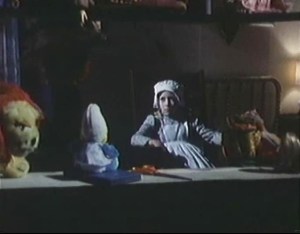
Pilgrims of LudlowPirates of Ludlow

Marquis De Sade of Ludlow

 Still, I have to admit I enjoyed the Demons of Ludlow.  It doesn’t drag as much as The Alpha Incident and this is a film that definitely has more than enough “What the Fuck” appeal to be watchable.  There’s even one sequence — in which one unfortunate citizen ends up getting shot by a musket-holding Pilgrim who suddenly shows up in a mirror — that is actually rather effective.  This is one of those films that people like me tend to defend by citing its “dream-like” qualities.  That may be going a bit too far in this film’s case but it’s still a definite success d’estime.

Lisa Marie Considers The Alpha Incident (dir by Bill Rebane)


It seems that every film lover owns at least one of those box sets of public domain films that Oak Creek Entertainment puts out.  You know which ones I mean — the box sets usually have about 50 to 100 movies crammed onto 12 discs and always have titles like “Astounding Adventure Classics.”  Most of the time, you’ll recognize one or two of the movies included (usually Night of the Living Dead) and you’ll end up buying it because they only cost like 6 bucks and that’s pretty good for 50 movies, even if you already know most of those movies are going to suck.  I own several of these box sets, including 50 Chilling Classics. 

I’ve recently decided to write a review for every single film that I have in my collection and I figured, what better place to start than with the often-forgotten and ignored public domain films that can be found in 50 Chilling Classics?  So, let’s get things started by reviewing a little public domain film from Wisconsin called The Alpha Incident.

Made in 1977, The Alpha Incident tells us what happens when a train, carrying a deadly virus brought back from Mars, makes a stop over at a small country train station.  It seems that Hank (played by George “Buck” Flower, who giggles a lot) had taken it upon himself to inspect that deadly cargo and has accidentally released it into the atmosphere.  The train station, and the five people trapped inside, are quarantined by the U.S. government.  Trapped in the station are the increasingly crazed Hank, the cold Dr. Sorenson (Stafford Morgan), gruff bully Jack (John F. Goff), neurotic secretary Jenny (Carol Irene Newell), and the shy station agent, Charlie (Ralph Meeker, who was the best-known actor in the cast).  The five are told to wait while American scientists try to find a cure for the virus.  Under no circumstances can they 1) leave the station and 2) fall asleep because, the minute they do, the virus will cause their brain to literally explode out of the back of their head.  For the rest of the film (which, honestly, would probably have worked better as a play), the five fight among themselves, wonder if they’re infected, and above all else, struggle to stay awake.

The Alpha Incident was directed by Bill Rebane, an independent filmmaker who is based up in Wisconsin.  Apparently, Rebane’s unique cinematic vision has won him a cult following among fans of low-budget horror and sci-fi films.  One term that I’ve often seen used to describe him is “the Ed Wood of Wisconsin.”  On the basis of the Alpha Incident, I don’t know if that’s a fair comparison.  Yes, the film does drag at time and the editing pretty much defines the term “ragged” but the movie still held my interest and not in a solely “what the fuck am I watching?” sort of way.  Yes, the performances are uneven, ranging from histrionic (George “Buck” Flower and John F. Goff) to boring (Stafford Morgan) to adequate (Ralph Meeker) to surprisingly good (Carol Irene Newell) but the characters themselves aren’t the usual stereotypes and, while the dialogue is often a bit clunky, the film’s story is an interesting one and the ending is just so wonderfully cynical and downbeat.  With it’s portrayal of common people trying to survive the mistakes of a faceless government, The Alpha Incident is so wonderfully 70s that I it made me want to go to a club, tell my companions, “I’m going to powder my nose,” and then snort someone else’s cocaine. 

Like many of the best B-movies, The Alpha Incident was made with more ambition than skill but it’s still a film that, if you truly appreciate the low-budget exploitation movies of the 70s, is more than worth seeing.

A Quickie Review: Dylan Dog: Dead of Night (dir. by Kevin Munroe)


Yesterday, I called into work because my asthma was acting up and, in order to pass the time, I watched Dylan Dog: Dead of Night.  To be honest, I probably should have just risked having another asthma attack and spent 108 minutes at work, answering the phone.  It would have been a more productive use of my day.

Dylan Dog is based (quite loosely) on the same Italian comic book that inspired one of the best Italian horror films of all time, Dellamorte Dellamore.  Brandon Routh gives a charisma-free performance as Dylan Dog, a New Orleans-based private investigator who is hired by a mysterious woman (Anita Briem) to investigate the circumstances of her father’s death.  It turns out her father was killed by a werewolf and fortunately, Dylan is apparently an expert on New Orleans’ supernatural underground, including the decadent vampires that are led by Taye Diggs (who, seriously, deserves better than this movie.)

Dylan Dog: Dead of Night plays less like a movie and more like a greatest hits collection of other, better movies (and tv shows).  We get werewolves and vampires going to war, we get an athletic blonde woman doing karate moves on a bunch of vampires, and we get a lot of casual decadence being committed by vampires who speak with Southern accents that just drip molasses.  Now, I love True Blood, Buffy the Vampire Slayer is one of the shows that gave me the strength to survive a lot of hard times, and I’ve even got a girlcrush on Kate Beckinsale as a result of Underworld.  But I’ve also got all of those wonderful shows on DVD.  I can see them whenever I want.  I didn’t spend $5.00 to rent Dylan Dog OnDemand just so I could see Dylan become the millionth film hero to walk in slow motion while firing two guns at the same time.

By all accounts, the film’s version of Dylan Dog has very little in common with the comic book version of Dylan Dog.  It’s hard for me to say for sure because, while I’ve read and heard a lot about the Dylan Dog comic, I’ve never actually read it.  Even if I could get my hands on a copy, it wouldn’t be much help since I’m not exactly fluent in Italian.  This is what I assume to be true, strictly based on my own research:

1) The comic book Dylan Dog is a melancholy character who, despite dealing with the supernatural on a regular basis, also suffers from several irrational phobias of his own.  The movie’s Dylan Dog is a blank-faced mannequin who utters useless quips and appears, in the tradition of American movie heroes, to have no fear. 

2) The comic book Dylan Dog has an assistant who is a Groucho Marx imitator.  The American Dylan Dog has an assistant who is a zombie.  That assistant is well-played by Sam Huntington and he actually does have a few good moments but it’s still impossible to watch him and not wish he was a Groucho Marx imitator.  (In the film’s defence, it appears that the Marx estate took legal action to prevent Groucho’s likeness from being used in the film.) 

3) The comic book Dylan Dog lives in London.  The movie Dylan Dog lives in New Orleans for absolutely no reason other than these movies always seem to be based in New Orleans.  Seriously, New Orleans is one of the most overrated cities in America.

4) Finally, the comic book Dylan Dog is one of the most popular cult heroes in Europe.  The movie Dylan Dog is the subject of one of the biggest cinematic flops of 2011.

It’s really hard to know what to say about a film like Dylan Dog other than the fact that it’s really, really bad.  In fact, I’m tempted to call it the worst of 2011 so far but, after giving it a lot of thought, I decided that title still belongs to The Conspirator.  Unlike The Conspirator, Dylan Dog isn’t a pompous film, it’s just a very, very lazy one. 

I think the best thin to say in regards to Dylan Dog: Dead of Night is that it might inspire viewers to seek out and watch Dellamorte Dellamore.  Now, that’s a film.

Lisa Marie’s Guilty Pleasure: Beastly (dir. by Daniel Barnz)


Much like Take Me Home Tonight, Beastly is a film that I missed when it originally played in theaters but then later caught via On Demand.  While Jeff and I were visiting Baltimore last month, Jeff’s younger sister, Jessica, recruited me to watch Beastly with her and I was more than happy to do it.  Getting to meet and spend time with Jessica was one of my favorite things about visiting Baltimore.  Even though we’re not actually related (which is actually a pretty fortunate, all things considered), we were like sisters from the moment we met.  Perhaps that explains why we spent Beastly giggling and trying not to choke on microwave popcorn.

I really don’t want to have to talk about the plot of Beastly because it’s one of those films where the plot is somehow both painfully simple and annoyingly complicated (as opposed to complex) at the same time.  Basically, Kyle (Alex Pettyfer) is a conceited high school student who picks on a sullen witch.  This witch is played by Mary Kate Olson and, since she’s supposed to be a goth here, she dresses exclusively in black and scowls a lot but that can’t change the fact that she’s still Mary Kate Olson.  Anyway, Pettyfer is running for high school political office and gives a speech where he declares that good-looking people are better than normal-looking people.  Olson is so disgusted with this sentiment (because, apparently, Mary Kate Olson is supposed to be one of the “normal” looking people) that she casts a curse on Kyle.  Suddenly, Kyle is transformed into the “Beast,” which in this film means that he loses all of his hair, his skin gets bleached, and he gets some aesthetically pleasing tattoos on his face.  I mean, seriously, he looks better once he’s cursed.  But Kyle doesn’t see it that way and neither does Kyle’s father who quickly sends Kyle away to an isolated New York apartment.  Anyway, Kyle learns that he had can go back to being a pretty boy if he can make someone fall in love with him and kiss him.  But who could love someone with kinda pale skin?  Fortunately for Kyle, Mary Kate Olson isn’t the only girl in the movie.  Vanessa Hudgens is there too.

I can’t really argue that Beastly is a good film because it’s not.  Actually, it’s kinda, sorta, really, really … well, not good.  The film drags (which is why you have to watch this with someone talkative because otherwise, the slow spots will seem even slower), the actors either refuse to or are incapable of bringing any sort of real pathos to their roles, and the film’s lesson — don’t judge a book by its cover — is sabotaged by the fact that even the “ugly” members of the cast still look better than most people do at their absolute best.

And, in the end, if I had to explain why I enjoyed Beastly, it’s precisely because it was so bad and so silly that the film actually became enjoyable despite itself.  As we watched this film, I lost track of the number of times that either Jessica or myself said, “God, this is so stupid,” in between giggles.  (Though Jessica eventually decided to keep count but, of course, we then just started to say, “God, this is so stupid,” every chance we got just so she’d end up with the highest number possible.)  This is one of those films where everyone looks like a model, the dialogue drips with pretension and melodrama, Mary Kate Olsen plays a glowering goth, and all plot holes are immediately followed by a musical montage.  Oh, and to top it all off, Neil Patrick Harris just showed up out of nowhere, playing a blind man who likes to hit golf balls off of the top of a New York City apartment building.

In short, Beastly is a perfect film for those of us who enjoy a little guilt with our cinematic pleasure.

Film Review: Take Me Home Tonight (dir. by Michael Dowse)


I missed the 80s retro-themed comedy Take Me Home Tonight when it was released to theater earlier this year.  It was one of those films that I meant to see but then it ended up spending such a short time in theaters that I just never got the chance.  A few days ago, via OnDemand, I finally got a chance to see Take Me Home Tonight in the comfort of my own bedroom.

Plotwise, Take Me Home Tonight feels like a cinematic Frankenstein monster, stitched together from elements from all those old school 80s comedies.  Therefore, it’s appropriate that the film itself is set in 1988.  Matt (Topher Grace) is a recent graduate from M.I.T. who is spending his post-graduate life working at Suncoast Video.  One day, while at work, he happens to run into Tori (Teresa Palmer), his high school crush.  When Tori asks Matt what he’s doing with his life post-high school, Matt quickly replies that he’s working at Goldman Sachs.  Tori then invites Matt to attend a weekend party being held by Kyle Masterson (Chris Pratt), a vaguely insane frat boy type who also happens to be the boyfriend of Matt’s twin sister, Wendy (Anna Faris).  In typical 80s comedy fashion, this leads to Matt and his friend Barry (Dan Folger) stealing a car, coming across a secret stash of cocaine, destroying a suburban neighborhood with a big metal ball, and eventually coming to several heart-warming (but not too heart-warming) conclusions about what they want out of life and what the future holds.

For a film like this to work, you have to care about the characters enough to be willing to stick with them even though they spend the majority of the film acting like complete morons.  Fortunately, the film is very well-cast with nice supporting turns from Folger, Faris, and Michael Biehn (who plays Matt’s father and who gets a great scene where he “arrests” his own son).  Folger is especially good, bringing a hilarious intensity to a familiar role.  From the minute that little baggie of cocaine first shows up on-screen, you know that Folger’s going to end up with a white powder all over his face.  What you don’t expect is just how hilarious a committed comic performer can make even the most familiar of comedic developments.  Dan Folger rubs cocaine on his teeth as if the world depended upon it. 

However, the film really belongs to Topher Grace (who not only stars in but also co-produced and co-wrote the film).  Now, I have to admit that when I was much younger, I used to love That 70s Show and I had the biggest crush on Topher Grace.  (I had an even bigger crush on Danny Masterson but that’s another story.)   As this film was apparently put together by many of the same people who were involved with That 70s Show, it’s not surprising that Take Me Home Tonight almost feels like it could be a sequel to that show.  Much as he did in That 70s Show, Grace provides the anchor here, keeping the film grounded (at times just barely) in reality.  It seems like whenever I see Topher Grace in the movies, he’s always playing some sort of psycho.  So, it was nice to see him back to doing what he does best, playing the sympathetic everyman who spends every day walking the fine line between cool and awkward. 

When Take Me Home Tonight was released in theaters earlier this year, it was greeted with mediocre reviews and poor box office.  But you know what?  It’s really not that bad of a film.  Yes, the plot is predictable and the jokes are more warmly amusing than laugh-out-loud funny.  However, this film is predictable in much the same way a funny but oft-told joke is predictable.  Take Me Home Tonight is a case where familiarity breeds not contempt but comfort.  It’s a type of comfort that’s probably better suited for being watched on a television while multi-tasking as opposed to being seen on the big screen with no other distractions.  Seriously, if Take Me Home Tonight was a weekly sitcom, it would probably end up getting nominated for all sorts of Emmys.

The Most Meh Film of 2011: Cowboys and Aliens (dir. by Jon Favreau)


For about a year now, I’ve been seeing the trailer for Cowboys and Aliens before every single film I’ve gone to see.  And now, finally, the Jon Favreau’s latest film has been released.  I saw it on Friday afternoon with my friend Evelyn and our reaction to it can be summed up in one word:

Meh.

Seriously, this might not be the worst film of 2011 so far (not as long as Priest, The Conspirator, The Beaver, and Sanctum continue to exist in our reality) but it’s definitely one of the most meh films of all time.  Cowboys and Aliens epitomizes everything that we mean when we say “meh.”  It’s not exactly terrible but it’s not good either.  What it is, ultimately, is very forgettable. 

This is one of those films where everything just seems to be a little bit off-track.  It’s like a car that technically runs but the whole time you’re inside of it, you know that there’s a chance the engine’s going to explode and you’re going to be stranded in Oak Cliff* with a dying cell phone.  You’re just happy that it gets you to your destination so you can get out of the car, not because you actually enjoyed the trip.

If you want to get into specifics, I’d point out that:

1) Daniel Craig isn’t all that believable as a notorious gunslinger.

2) Harrison Ford looks annoyed to be there.

3) The cast is full of excellent character actors — like Sam Rockwell — who essentially get to do nothing.

4) The aliens basically look like leftovers from Skyline andBattle L.A. 

5) The action sequences are pretty boring (there’s not one moment that makes you gasp and go, “Wow!”) and are so badly edited that it’s difficult to keep track of who is shooting at who. 

6) For the first quarter of the film, we’re watching a bad western and then, suddenly, we’re watching a boring, uninspired science fiction action film. 

7) A major plot point essentially centers on Daniel Craig (with the aid of some helpful Indians, of course) going on a “spirit quest.”  Seriously, filmmakers today use spirit quests and sweat lodges in much the same way that filmmakers of the 60s used garish acid trips.  It’s all an excuse for a bunch of zoom lenses and bright color filters.

8 ) Finally, and this is most fatal of the film’s flaws, it just takes all of this so seriously.  There’s not even a scene of a brave gunslinger shouting, “Draw, you four-armed bastard!” at an alien.  Seriously, this should have been a fun film.  Instead, it’s just another overproduced, forgettable establishment film.

Jon Favreau is a likable enough actor (even if he does seem to be fated to spend his career competing for roles with Kevin James) and he’s made some likable films (Elf, Iron Man, Zathura)  but Cowboys and Aliens could have been made by just about anyone.  It’s a film that feels like it was put together on an assembly line.  Originally, me and Evelyn swore that, if Cowboys and Aliens sucked, we were going to react by running down to the front of the theater and entertaining everyone by doing the Timewarp.  However, by the time it became apparent just how meh this film was, neither one of us really felt like creating a little sexy civil disobedience.  Quite frankly, we just wanted it to end so we could move on to the next film.

—————

*Oak Cliff, for all you Yankees out there, is a neighborhood of Dallas.  I used to live there but I was only a few months old at the time and I still wouldn’t want to end up stranded out there.


Lisa Marie Considers A Better Life (dir. by Chris Weitz)


I recently had a chance to see A Better Life, the new film from director Chris Weitz that a lot of critics have already predicted will be a major contender for all sorts of awards at the end of the year.

A few critics have said that A Better Life is similar to the classic Italian neorealist film Bicycle Thieves.  Look, let’s be honest.  A Better Life is Bicycle Thieves except Rome has been replaced by Los Angeles and the Italian father-and-son are now an Illegal immigrant and his son (played by Demian Birchir and Jose Julian, both of whom give award-worthy performances).  While Julian struggles to resist the temptation to get involved with gangs, Birchir struggles to pay the bills as a gardener.  Eventually, Birchir manages to purchase a truck even though he knows that just by driving, he’s increasing the risk of being caught and deported back to Mexico.  However, after only one day, the truck is stolen.  Unable (because of their own status as illegal aliens) to turn to the police, Birchir and Julian embark on an increasingly dangerous quest through the shadows of Los Angeles, searching for their truck and everything that it represents (i.e., the better life of the title).

As a director, Chris Weitz takes a low-key, rather subdued approach to the material.  While the cinematography emphasizes the idea of Los Angeles being both seductive and remote at the same time, Weitz focuses our attention on Birchir’s worn, world-weary face.  Each line and wrinkle on that face tells us a different story of struggle and, ultimately, hope for a better life and a better future.  Weitz slips up a little during the film’s final act.  Some of the dialogue gets a bit too heavy-handed, despite the skill with which Bircher and Julian deliver it.  It’s in these scenes that we suddenly start to see the hand of the filmmakers and suddenly, we’re no longer watching the story of a proud man sacrificing so his son can have a better life.  Instead, we’re suddenly reminded that we’re watching a movie. 

I have to admit that, as time has passed, I’ve become a bit less enthusiastic about A Better Life.  It’s one of those films that carries a lot of power when you first see it but then, once you’ve had some time to think about it, it becomes obvious that you’re not so much reacting to what the film is as much as what you wish the film was.  When I first saw A Better Life, much like a lot of critics, I thought I was seeing one of the best films of 2011.  In retrospect, A Better Life is one of the better films (so far) of 2011 but hardly the best.  What it is ultimately is a well-made film that struggles under the weight of its own good intentions.

Still, as I watched A Better Life, I couldn’t help but remember a crowd-pleasing scene from last year’s The Kids Are All Right.  If you’ll remember, that’s the film where Julianne Moore is a professional landscaper who deals with the guilt of having an affair with Mark Ruffalo by yelling at, abusing, and eventually firing Luis, the Mexican who works for her.  You may remember Moore snapping, “What are you looking at!?” and Luis replying with, “I am not looking at anything, that is just my face.”  The line, of course, is delivered in a thick accent and the scene where Moore actually does fire him is largely played for laughs.  We don’t see Luis again for the rest of the movie though Moore does get a throw-away line about how she wishes she hadn’t fired him (probably because she now has to do all dangerous physical labor herself). 

Now. I have to admit that scene bothered me when I saw it and it has bothered me since.  I doubt that the liberal audiences that flocked to see The Kids Are All Right would have found it as hilarious if Julianne Moore had unfairly fired an African-American character who spoke in exaggerated ebonics.  It was as if the audience members were so exhausted from patting themselves on the back for watching a movie that pretended to be about lesbians that they were relieved to have an ethnic stereotype to laugh at. 

To me, it’s because of scenes like that one that we will always need films like A Better Life.

What Lisa Marie Watched Last Night: Cyberbully (directed by Charles Biname)


It’s been a while since I posted a What Lisa Marie Watched Last Night, which is unfortunate because these are some of my favorite posts to write.  If nothing else, they give me an excuse to use this site to extol the virtues of a good Lifetime movie.  Well, last night, I watched a made-for-TV movie that belonged on Lifetime, despite the fact that it actually premiered on ABC Family.  The name of this film is Cyberbully and it doesn’t have much in common with Larry Clark’s Bully.

Why Was I Watching It?

After you see the same commercial about fifty times, you really don’t have much choice but to watch.  That’s why commercials work.  However, I am happy to say that I did stand up to the forces of relentless advertising by DVRing the movie and watching it on my own time.  So there.

What Was It About?

So, there’s this teenage girl (played by Emily Osment) who gets a laptop for her birthday and her mother (Kelly Rowan) foolishly allows Osment to spend hours surfing the web unsupervised.  So, Osment joins this social site called Clickster which is supposed to be like Facebook but, from what they showed onscreen, really looked a lot more like MySpace.  And I mean the MySpace of today and not the cool MySpace that we all used to brag about being on.

Anyway, somebody hacks Osment’s Clickster Account which leads to Osment getting a reputation for being a slut and soon all the rich girls in high school are giving her a hard time and then somebody sets up a fake account as some boy from another school and eventually, Osment tries to commit suicide and her mom ends up blaming it all on a lack of governmental regulation.

What Worked?

It’s difficult to really criticize this film, despite the fact that — like a lot of films about cyberbullying — it was obviously made by people who don’t really understand how the Internet works or how teenagers view the world.  The people who made the film obviously had their hearts in the right place and the film’s ultimate message was a pure and sincere one.  It was obvious that a lot of the film’s plot was inspired by the true life of case of Megan Meier, a 13 year-old girl who committed suicide after being cyberbullied in much the same way as the character played by Emily Osment in this film.  The case of Meier was so tragic that I can still not write about it without getting tears in my eyes. 

The film was actually pretty well-acted, especially by Osment and Kay Panabaker, who plays Osment’s best friend.

Most importantly, the film didn’t allow its good intentions to keep it from going totally and completely over the top in a few key moments.  Perhaps the moment that most made me forget about the film’s good intentions and just enjoy it on a camp level was when Osment, struggling to open up a child-proof bottle of pills, screams, “I CAN’T GET THE TOP OFF!”

What Didn’t Work?

Okay, maybe this wasn’t a big moment but it’s something I noticed and it really gnawed at me.  When Osment first finds herself being bullied, she responds by calling one of the bullies a “bitch” online and then her mom finds out and goes, “No, you cannot be mean just because other people are being mean,” and as the film goes on, it becomes apparent that we’re meant to agree with her.  But seriously, some day, I’m going to have a daughter and if she ever gets in trouble for calling a bully ” a bitch,” you better believe I’m going to stand behind my daughter 100%.  Actually, I’ll probably call the bully a bitch first.

When I saw that scene, I immediately flashed back to what my mom once told me when I came home from school crying because of some mean girls.  She sat me down, explained to me the importance of keeping my thumb on the outside whenever I made a fist, and then said, “Lisa Marie, if those putas de mierda try to make you cry, you break their nose.” 

Now, I have to be honest — despite the fact that I now knew how to make a fist, I still had no idea how to use that fist to break someone’s nose.  I doubt I have the upper body strength to pull that off anyway.  But, regardless of whether it was good advice, it was what I needed to hear at that time because, at the very least, it let me know that I had someone in my corner and, even more importantly, it assured me that I was the victim and not to blame.

Anyway, back to Cyberbully, the main problem with this film is that after one hour or so, the movie’s storyline becomes far too much of a PSA for its own good.  Unfortunately, the PSA isn’t for bullies to reconsider their actions or for the victims of bullies to know that “it gets better.”  Instead, the PSA tries to convince us that we can wipe out bullying by passing legislation, getting the government involved, and doing the whole activist thing, as if 1) bullying is an activity that can be regulated as opposed to just a really ugly expression of human nature and 2) we can actually trust the government to make life better for anyone. 

This is one of those films where, at the end of the film, the entire school stands up to the bully and basically bullies her into being a nicer person.  Honestly, it seems like it would be a lot more helpful for all these anti-bullying films to just say that being a teenager sucks, it’s going to suck for a long time, but if you get through it, you’ll have the pleasure of seeing everyone who bullied you get fat and miserable.  Instead, we get these false visions of humanity in which the entire world will have your back just because you’re in the right.  That’s all very uplifting but what are you going to do once you realize that the world, for the most part, doesn’t even know you exist?

“Oh my God!  Just like me!” Moments

Well, the entire film was about silly girls acting over dramatic so there were … ahem … there were a few just like me moments.  Well, more than a few. 

Perhaps the biggest just like me moment was due to the fact that I had my e-mail, Facebook and MySpace accounts hacked by an ex-boyfriend once and he changed all of my statuses to something slutty (well, more slutty and definitely lacking my trademark sense of postmodern humor) and sent out a mass e-mail under my name that read, “I want to fuck you madly.”  (If nothing else, that made me the most popular girl in the Art History study group for a week or two.)  Anyway, I ended up deleting every account I had, getting a restraining order on the guy, and spending the next two years being very paranoid and untrusting.  So, in other words, don’t be a cyberbully because it seriously fucks people up.

Lessons Learned:

Be kind and remember that there’s a human being reacting to everything you say.  Also, some pill bottles are more difficult to open than others.  But mostly the be kind part.

Lisa Marie Goes To Rio (dir. by Carlos Saldahna)


Rio is one of those films that I missed when it had it’s initial run at the theaters.  However, last week, I finally got a chance to see it at the “dollar” theater.  Now, I have to admit that I consider the dollar theater to be something like the sixth ring of Hell and, before the movie started, I posted the following to twitter: “Wow, there’s a lot of ugly and obese children in this theater.”  And indeed, that was the case.  What I forgot to mention is that a lot of them were there with equally ugly and obese parents, the types who talked loudly through the film in accents that carried the dual twang of ignorance and stagnation.  Despite the surroundings though, I found Rio to be a perfectly pleasant little animated film.

Rio is the story of Blu (voice by Jesse Eisenberg), a blue macaw who, though originally from Brazil, has grown up in Minnesota and, as a result, has never learned how to fly.  Blu returns to Brazil with his owner (Lesley Mann) so that he can mate with another macaw, Jewel (Ann Hathaway) and keep the species from dying out.  However, things don’t go exactly as planned as 1) Jewel is more interested in escaping captivity than in mating and 2) both Rio and Jewel are abducted by a psychotic Cockatoo named Nigel (Jermaine Clement).  Nigel works for a bunch of poachers and soon Jewel and the flightless Blu find themselves on the run, looking for their owner while the Rio Carnaval goes on all around them. 

As one of my old theater teachers one said about me, Rio “is not without a certain fun charm.”  The film’s storyline of neurotic animals getting lost in an exotic locale and eventually finding the strength to believe in themselves is pretty much standard animation fare but the action moves along quickly and the movie takes full advantage of the whole Rio mystique.  The film’s animators create the Rio de Janeiro that everyone hopes they’ll discover if they ever make it down to Brazil.  Perhaps most importantly, Rio is child-appropraite without ever being so childish as to inspire adults to start drinking while the little ones laugh.

The voice actors all do a pretty good job distinguishing their individual characters.  Jesse Eisenberg is perfectly neurotic as Blu while Anne Hathway’s vocals are properly headstrong as Jewel.   The real stand-out here is Jermaine Clement of Flight of the Conchords. Clement, with his deep, wonderfully dramatic voice, brings a lot of flair to the villainous Nigel and, despite being a psycho Cockatoo, quickly became an audience favorite.  Though the human bird owners don’t get much to do, Leslie Mann and Rodrigo Santoro are so endearing that you actually wish they had more screen time.  On the other hand, if, like me, you found George Lopez to be grating before seeing Rio, this film isn’t going to do much to change your mind.  (Lopez, not surprisingly, plays the know-it-all bird who helps Blu and Jewel make their way through Rio.)

As I watched Rio, I realized just how spoiled we all got last year as far as animated films were concerned.  Last year, I got a chance to see Toy Story 3, How To Train Your Dragon, Shrek Forever After, A Town Called Panic, The Illusionist, Megamind, and Despicable Me.  It was, in many ways, a banner year for cinematic animation.  With the exception of Rango, there haven’t been any animated films so far that can really compare with what we were given last year.  As a result, it’s easy to be dismissive of a straight-forward, relatively simple family film like Rio.  That’s unfortunate because, taken on its own terms, Rio is a perfectly enjoyable way to spend 90 minutes.  Just don’t go into it expecting to see Toy Story 3 and you’ll be fine.

A Quickie With Lisa Marie: Kill The Irishman (dir. by Jonathan Hensleigh)


Jonathan Hensleigh’s fact-based gangster film Kill The Irishman had a brief (and limited) theatrical run earlier this year and received generally mixed reviews.  I myself didn’t see it in the theaters but instead, caught it OnDemand a few weeks ago and I was genuinely surprised to discover that this film, while far from being perfect, is also hardly the simple Goodfellas rip-off that I had originally been led to suspect.  Instead, Kill The Irishman is a somewhat flawed but ultimately quite rewarding David-and-Goliath story about a real-life David who was known as “the Irishman.”

Kill The Irishman tells the true story of Danny Greene (played by Ray Stevenson), an Irish-American gangster who went from being a corrupt union boss to challenging the Sicilian mafia’s dominance of the criminal underworld of Cleveland, Ohio.  In 1977, Greene became, for a brief period of time, a media celebrity when he survived several assassination attempts while fighting a war for control of the Cleveland rackets.  As the film both informs and shows us, this violent, underground war led to a total of 35 bombings, all designed to kill either Greene or one of his allies.  By surviving these attacks, Greene briefly appeared to be indestructible and seemed to be on the verge of reviving the long-dormant Irish mafia. 

As a film, it takes a while for Kill The Irishman to really click.  From the start director Hensleigh shows a real feel for capturing the feel of a once great city slowly dying but the 1st half of the movie still threatens to get bogged down in all the clichés of the modern gangster film — there’s a bit too much clunky narration from Val Kilmer (who sleepwalks through his role as a fictional police detective who grew up with Greene) and a few too many montages set to old rock tunes.  It’s all watchable enough and there’s a few memorable sequences (my favorite being the early scenes of Greene on the job, slaving away under an oppressive sun) but on the whole, it just feels like the 100th low-budget remake of Goodfellas.  The highlight of this part of the film is Christopher Walken’s typically eccentric yet genuinely sinister performance as an early Greene mentor-turned-enemy.

However, once Greene goes on his own and starts to blow up every inch of Cleveland, the film comes into its own and establishes its own rough identity.  Hensleigh proves to be very adept at orchestrating chaos and, with the entire Mafia out to kill him, Greene goes from just being a thug to being a true underdog.  It’s impossible not to root for him and, much like the film, it’s here where Ray Stevenson comes into his own.  For the 1st half of the film, Stevenson seems like an adequate but uninspired choice for the role of Danny Greene.  However, once Cleveland starts exploding around him, Stevenson comes into his own.  He not only captures Greene’s cocky defiance but, as the film reaches its inetivable conclusion, he also captures Greene’s own growing paranoia and fear.  By the end of the film, Stevenson has given a performance that has masterfully juggled pride and regret, defiance and fear.  Regardless of whether it’s an accurate statement about the real Danny Greene, Ray Stevenson makes his version into a true tragic hero.

Along with Stevenson’s anchor of a performance and Walken’s scene-stealing characterization, Kill the Irishman is filled with familiar mob movie character actors, most of whom contribute some nicely realized turns as the various members of the Cleveland underworld.  Tony Lo Bianco, Mike Starr, and Paul Sorvino are all convincingly brutish as the leaders of the local Mafia and Vincent D’Onofrio is wonderfully flamboyant as Greene’s one Italian ally.  My personal favorite supporting performance came from character actor Robert Davi who was almost a little bit too believable as a cold-blooded murderer.  Not to get too specific here but if I ever happen to hire a professional assassin, I hope he looks like Robert Davi.

I have to admit that one reason why I ultimately enjoyed this flawed but worthwhile film is because I’ve always wished that I could have been a member of the Irish mafia.  (I wanted to be like Maggie from Gangs of New York and use my fingernails to rip open throats.)  For many of us Irish-Americans, there’s just this romance to the whole idea of the Irish Mafia and we’re always looking for evidence that the organization wasn’t, more or less, wiped out by the Italians.  (Fortunately, I happen to be a fourth Italian along with being a fourth Irish so the St. Valentine’s Day Massacre is a smidgen less traumatic for me).  If nothing else, the Irish mafia epitomizes two things that every true Irish-American knows to be true: 1) the Irish will never stop fighting no matter how intimidating the odds and 2) we’re all ultimately doomed regardless.  Kill the Irishman may not be a perfect film but it’s a fitting tribute to a better kind of criminal.