What Lisa Watched Last Night: Saved By The Bell: Wedding in Las Vegas (dir. by Jeff Melman)


Recently, I spent the night watching a bunch of commercials for Everest College that had been recorded onto my DVR.  Occasionally, the Everest commercials were interrupted by 1994’s made-for-tv movie Saved By The Bell: Wedding in Las Vegas.

Why Was I Watching It?

Back when I was like 10, I used to always watch Saved By The Bell: The New Class every Saturday morning.  Even at that age, I knew that show was kinda stupid and that Dustin Diamond’s Screech Powers was one of the most annoying television characters of all time.  But I still watched it and occasionally, I would catch a rerun of the Old Class as well.  (Quite honestly, up until a few years ago, there was never a time that reruns of Saved By The Bell weren’t being broadcast somewhere.)  By the time I was in high school, I appreciated Saved By The Bell as being almost a type of performance art.

As of late, it’s been difficult to find Saved By The Bell reruns on television and that made me a little bit sad because I felt like my childhood was disappearing and that I might be turning into an adult.  So, imagine how happy I was when I discovered that MTV2 now shows a two hour-block of Saved By The Bell every afternoon and, thanks to the wonderful thing that is the DVR, I can watch them without having to quit my job to do so.  Yay!

Two weeks ago, MTV2 showed the final Saved By The Bell movie, 1994’s Wedding in Las Vegas.  Though I knew, of course, that Zack (Mark-Paul Gosselaar) and Kelly (Tiffani Amber Thiessen) had gotten married at the end of the original series, I had never actually seen the wedding.  And I have to admit that I really didn’t have much desire to see the wedding until it suddenly showed up on my DVR…

What Was It About?

This is one of those rare cases where the film’s title truly tells you everything you need to know.  Zack and Kelly get married in Las Vegas while their friends Screech, Slater (Mario Lopez), and Lisa (Lark Voorhees) have wacky adventures of their own.  Zack has $1,200 dollars to try to put on his dream wedding but, as often happens in the world of Saved By The Bell, there are countless complications that are largely the result of Zack being a sociopathic pathological liar.  Zack loses all of his money but, instead of telling Kelly the truth, he attempts to win the money by becoming a male escort.  Meanwhile, Slater falls in love with a girl who is being pursued by the Mafia and Lisa (Hey, I just noticed that we have the same name!  Yay!) ends up flirting with a hot guy who has a pony tail and who, fortunately, happens to be as rich as everyone else that she went to high school with.

What Worked And What Did Not Work?

Normally, I separate this into two separate questions but that’s kind of pointless when you’re dealing with something like Saved By The Bell: Wedding Las Vegas.  The main thing that works about a show like Saved By The Bell is that absolutely nothing really works.  It’s all very silly, shallow, predictable, dated, occasionally cringe-worthy, and, in its way, very calming.  Despite the film’s many flaws, it’s difficult to really justify criticizing it too harshly because you know what you’re getting into when you decide to watch something called Saved By The Bell: Wedding In Las Vegas in the first place.

Almost everyone in the cast is really cute in a 90s kinda way and even the usually horrible Dustin Diamond (who I hated even when I was ten years old and watching him on the New Class) is tolerable in Las Vegas.  Though the film — much like the series — is focused on Mark-Paul Gosselaar as Zack, I’ve always felt that Zack was overrated.  Mario Lopez, with his confident smile and perfectly chiseled body, was (and still is) the hot one.   Whereas Zack always seemed to have an off-putting air of entitlement, Slater knew what he wanted and he took it.  That trend continues in Wedding In Las Vegas where Slater won’t even let the Mafia stand in the way of getting a date.

This film is technically a comedy though you don’t so much laugh with it as you laugh at it.  However, there was one moment that made me genuinely laugh out loud and that was the scene where “the gang” visits a 24-hour wedding chapel and director Jeff Melman gives us a quick tracking shot of the long line of couples waiting to get married.  Along with the expected Elvis impersonators, there’s also a very pregnant girl standing next to a scared-looking boy who has an old man pointing a shotgun at him.  That made me laugh.

This is yet another one of the shows where every single problem could have been avoided by the characters just not acting like idiots.  Seriously, I don’t know what’s worse — that Zack felt that it would be better to become a male escort as opposed to just telling Kelly the truth or that Kelly so quickly forgave him.  (Me, I would have been so mad at him but it doesn’t seem to bother Kelly that her future husband lied to her on the night before their wedding.)

As I stated before, there’s a lot that technically doesn’t work about Wedding in Las Vegas but it is Saved By The Bell, after all.

“Oh my God!  Just like me!” Moments

If ever get married in Las Vegas, I imagine it’ll be quite a bit like Saved By The Bell: Wedding in Las Vegas, in that I fully expect that 1) I’ll stay at a nice hotel, 2) I’ll get a mani/pedi with my best girlfriend, and 3) the Mafia will somehow be involved. 

That said, Dustin Diamond will not be invited to my wedding.

Lessons Learned

Nothing can stand in the way of true love.  Especially when you’re rich and white.
Film Review: 96 Minutes (dir. by Aimee Lagos)


Bleh.

I’ve read a lot of really over-the-top laudatory reviews of 96 Minutes, an independent urban crime film that’s opening in limited release this weekend.  Reviewers and bloggers are describing this film as being insightful and powerful and important.  Here’s a quote from one review that was posted over on the IMDb: “I would encourage all of those who see the (film’s) themes as stereotypical to get outside of their own box for 2 minutes and spend some time with those who will you give example after example of how the youth in this country still struggle with the same things as they did 10, 20, and 30 years ago.”

And again, I say “Bleh.”  I saw 96 Minutes last night.  It’s a movie that’s full of good intentions but so what?  A bad movie is a bad movie, regardless of the noble intentions of the filmmakers.

The film starts out with four people in a car.  Dre (Evan Ross) is driving while, in the passenger’s seat, his jumpy friend Kevin (J. Michael Trautman) points a gun at two girls huddled in the backseat: Carley (Brittany Snow) and her friend Lena (Christian Serranos).  Lena, by the way, has been shot in the head.  The film proceeds to show us (by jumping back and forth in time) how this situation came to be and guess what?  It all unfolded exactly how you think it did so the end result is like being stuck with someone who continues to tell you the same long story even after you’ve said, “Yes, you already told me all this.”

From what I’ve been able to gather from online research, 96 Minutes was (much like Crash, which this film resembles) inspired by an actual carjacking that involved the film’s director. As such, 96 Minutes starts out by informing us that the film we’re about to see is “Based on true events.”  That should have been a warning because, while the whole “based on a true story” thing is usually a good sign when it comes to an old school exploitation film, it’s almost always the kiss of death when it comes to well-meaning but overly earnest independent cinema.  Ironically, films that are “based on true events” often feel rather false and predictable and the end result is a movie that comes across like an overlong version of one of those awful Mutual of Omaha “Ah-ha Moment” commercials.

(“My name is Carley and this is my Ah-ha moment.  Oh my God, we were getting carjacked!  At that moment, so many things went through my head…”  “Brought to you by Mutual of Omaha, proud sponsor of life’s Ah-ha Moments…”)

In the film’s defense, it is well-acted (especially by Evan Ross, who has a very quiet power) and director Aimee Lagos comes up with a few strong visuals but ultimately, it doesn’t add up to much.  The film feels predictable and the fractured narrative structure doesn’t provide any unexpected insight into the characters or their actions.  The scenes with Kevin and Dre feel as if they were clumsily lifted from a hundred other urban crime films, right down to the predictable pairing of a complete psycho with a sensitive criminal who wants to go straight.  Meanwhile, Carley and especially Lena come across not so much as actual characters but more as dramatic devices.  This wouldn’t be so much of a problem if this was a 15-minute short film about the quirks of fate but stretched out to 96 minutes, the film’s characters and themes feel quite thin indeed.

In many ways, 96 Minutes reminded me quite a bit of last year’s Another Earth.  Much like Another Earth, 96 Minutes doesn’t have much to say but it pretends like it does and I imagine that a quite a few gullible viewers will be tricked into thinking that they’re watching something powerful and important play out in the screen in front of them.  If they’re anything like the members of the Another Earth cult, they’ll probably get really offended over any suggestion that the film they’ve just watched isn’t a masterpiece.  Well, my reply to them is this: If the film was really as great and important and insightful as some people are claiming then you wouldn’t care what I have to say about it.  If this review makes you defensive, it’s because you know I’m right.

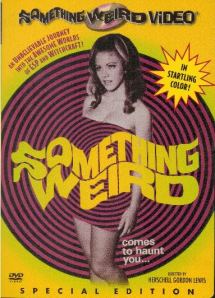
Film Review: Something Weird (dir. by Herschell Gordon Lewis)


Now that I’ve finished reviewing the Friday the 13th series, I can finally take the time to make a few comments about a film that I’ve been meaning to review for a while here on the Shattered Lens: Herschell Gordon Lewis’s 1967 film Something Weird.

How to describe Something Weird?  Well, I could tell you that it was one of the first films to realize that ESP, witchcraft, and LSD made for a potent combination.  I could also point out that everyone’s favorite company — Something Weird Video — took their name from this film.  However, I think the best (and maybe only) way to tell you about this film is to simply tell you what happens.

The film starts out brilliantly with ten minutes of vaguely connected and disjointed images.  We start out with a close-up of a pair of legs that apparently belong to someone being chased down a city street.

Cut To: 

Two guys practicing karate.  One of them we will never see again.  The other one is a doughy-faced guy named Alex Jordan (William Brooker).  The one we will never see again explains to Alex that he’s not actually that talented when it comes to the martial arts.  Alex looks annoyed.

Cut to:

Alex is fooling around with a blonde that we’ll never see again and who will never be mentioned again for the rest of the film.  “You’re electrifying,” she tells him.

Cut to:

Some random guy is electrocuted by a downed power line.  Cronin “Mitch” Mitchell (Tony McCabe) runs over to help him and gets hit in the face by the same power line.  He falls to the ground while a group of random people wander over.  “Has anybody called an ambulance yet?” someone calmly asks.

Suddenly, there’s a man in a suit kneeling down by the two bodies and apparently, he’s some sort of medicine man because, while looking at the first man, he says, “I’ll have to call the coroner on this man.”  

However, Mitch is still alive so he’s put into the back of a station wagon and driven to the local hospital.  As we watch Mitch being pulled out of the back of the car, the camera pans up to the cloudy sky and suddenly, a narrator comes out of nowhere and starts rambling about “the sixth sense, ESP!”  The narrator is also nice enough to let us know that Alex — the guy from the Karate lesson — is apparently a government scientist who is in charge of figuring out how to use ESP against America’s enemies.

This all happens in the first 10 minutes of the film and, unfortunately, the remaining 70 minutes of the film struggles to live up to the surrealistic brilliance of this little montage.

Anyway, Mitch is alive but now he’s got both a scar on his face and the ability to see the future.  As one of his doctor’s puts it, “He’s a different man since the accident … cynical.  Maybe even morbid!”  Once he’s released from the hospital, Mitch takes to wearing a black bandana over the lower half of his face and becomes a professional psychic.


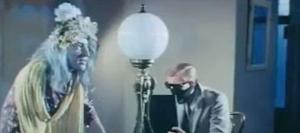
He finds a little success but, as we’ve been told, he’s now “cynical…maybe ever morbid!”  However, things change for Mitch when he’s approached by a grotesquely ugly woman with a blue face and a cackling laugh.  She explains that she’s a witch and she’s willing to restore his face but only if he takes her as his lover.  Mitch reluctantly does this and his scars suddenly vanish.

Soon, Mitch is a celebrity, appearing on television.  Everywhere he goes, the witch is on his arm.  The rest of the world sees her as a beautiful woman named Ellen Parker (Elizabeth Lee) but whenever Mitch looks at her, he sees her in her true blue-faced form. 

Meanwhile, there’s a serial killer preying on the woman of Jefferson, Wisconsin and the chief of police (played by Lawrence Wood, the man who gave the infamous “fire sale” monologue in Lewis’s Scum of the Earth) invites Mitch and Ellen to come help with the investigation.  The government meanwhile sends Alex (remember him?) to the town to investigate Mitch and perhaps recruit Mitch into the service of his country.

Alex is, at first, skeptical of Mitch but then he sees Mitch exorcising a disgruntled spirit from a local church and he starts to think that Mitch might have some psychic abilities after all.  Mitch might just need a little help and Alex is there to provide it.

Meeting with Mitch in the police chief’s office (and with the entire police force looking on), Alex produces two white pills from his pocket and says, “I have a drug here — LSD.  Ever hear of it?”  Alex proceeds to echo many real-life MK-Ultra conspiracy theories as he explains that LSD will increase Mitch’s psychic abilities to the extent that he’ll be able to catch the killer.   Mitch replies, “I’ve never taken the drug before but I’ll be glad to, doctor.”

Well, needless to say, the LSD produces the typical cinematic red-tinged, desert-themed trip but it still ends with Mitch figuring out who the killer is. It also allows Mitch to understand that the killer is sane “98% of the time.”  However, there’s a problem because now that killer is out to kill Mitch and Alex has fallen in love with Ellen, the blue-faced witch…

To be honest, Something Weird is not one of Herschell Gordon Lewis’s best films.  Even by typical Lewis standards, the plot doesn’t make much sense and the acting is incredibly bad.  Whereas other Lewis films (like Blood Feast) featured performances that were deliberately over the top, the cast of Something Weird comes across as if they were as confused while making Something Weird as the audience would later be while watching it.  (However, it should be noted that Elizabeth Lee at least seems to be having fun in the role of the constantly cackling witch.) 

However, I still love Something Weird because, unlike so many other movies, it actually lives up to its name.  This is a movie that promises to be weird and that’s exactly what it is.  There’s just so much to love in this film.  Check out the way that Mitch’s “facial scars” never look the same from scene-to-scene.  (At one point, the scars cover his entire face but, in the next scene, they can be easily hidden by a bandana.)  Watch in amazement as the same set is used and re-used for almost every scene in the movie, with just the furniture occasionally being rearranged depending on whether the scene is supposed to take place in an office or a hotel room. 

Ultimately, my love for this film comes down to the little details.    I love how the ambulance at the start of the film is just an old school station wagon (complete with wood paneling) with a siren on top of it.  Even better is how the police captain’s office is decorated with a faded pictures of George Washington and Abraham Lincoln that literally appear to have been ripped out of an old history textbook.

In the greatest tradition of the grindhouse, there is no other movie like Something Weird and, for that reason alone, it’s worth watching.

Lisa Marie Deals With Intruders (dir. by Juan Carlos Fresnadillo)


Earlier this month, I saw Intruders, the latest film from director Juan Carlo Fresnadillo.  Spanish horror films are currently the trendy genre to love and Intruders has everything that we’ve come to expect from Spanish horror: creepy children, gothic atmosphere, claustrophobic staging, ineffectual representatives of the Church, and a feeling that the society of the present is held hostage by the sins of the past. 

Intruders tells two parallel stories about two children who are haunted by a malevolent, faceless spirit known as Hollowface.  Hollowface comes out at night and searches for a new face (and who can blame him, really?).  As the film opens, he is haunting a young boy (Izan Corchero) and his mother (Pilar Lopez de Ayala) in Spain.  The boy deals with his fear of Hollowface by writing a lengthy story about him.  Meanwhile, in England, 12 year-old Mia (Ella Purnell) finds a copy of the boy’s story in an empty tree stump and reads it aloud.  Shortly after doing this, she starts to see Hollowface in the shadows of her bedroom.  The only person who believes her is her father (played by Clive Owen).  The film proceeds to cut back-and-forth between these two haunted children until finally, in its final few minutes, the two stories come together. 

Intruders starts out strong but then quickly starts to fall apart.  As a malevolent force, Hollowface is effective as long as he’s just a shadowy figure floating through childish nightmares but, as the film progresses, he becomes less and less intimidating until finally he’s just another poorly defined villain in a costume.  By that same token, Fresnadillo’s direction is nicely atmospheric and creepy during the first half of the film but then, as the two parallel stories come together, the film starts to feel more and more generic.  The two stories are, of course, linked together by a big twist.  Oddly enough, even though I managed to guess the twist, it still felt like it came out of close-to-nowhere. 

That said, Intruders isn’t a disaster.  The film is fairly well-acted (especially by Clive Owen, who in a perfect world would be playing James Bond in Skyfall) and even once the narrative falls apart, Fresnadillo still comes up with the occasional effective shock.  Even if I wasn’t familiar with Fresnadillo’s previous films, I would probably take a chance on his next movie.

Just as long as it’s not The Return of Hollowface or anything like that.

Lisa Marie Goes Salmon Fishing In The Yemen (dir. by Lasse Hallstrom)


After spending the last two weeks watching the endless mayhem of the Friday the 13th franchise, I was really in the mood for a nice, low-key romantic comedy and that’s exactly what I got on Tuesday night when I went to the Dallas Angelika and saw Salmon Fishing In The Yemen.

Now, I have to admit that I come from a family that is full of people who like to fish.  I, however, am not one of them.  First off, as I’ve explained here numerous times, Lisa does not do water.  Second, I have never seen the appeal of spending hours doing nothing just on the off-chance that you might catch a slimy fish that you’re just going to toss back into lake or river or wherever it is that they’re just trying to live their lives day-to-day.  (Seriously, it seems like that would be very traumatic for the fish.)  I understand that there’s supposed to be some zen nature thing that comes along with fishing but … no, I just don’t get it.

Fred Jones (played by Ewan McGregor) would disagree with me.  Fred is a world-renowned expert on fish and fishing who works for the British government.  It quickly becomes apparent that Fred is more comfortable fishing than dealing with other human beings.  (The film goes as far as to have another character suggest that he has Asperger’s syndrome but I’m going to disagree with that diagnosis because, quite frankly, I think that the current popularity of characters and celebrities with self-diagnosed Asperger’s syndrome is really more of a case of lazy characterization than anything else.)  Anyway, Fred is stuck in a failing marriage and is suffering from a huge case of ennui but that all changes when he meets Harriet (Emily Blunt).

Harriet is a neurotic girl whose boyfriend Robert (a very handsome and charming Tom Mison) is serving in Afghanistan.  Harriet works for a consulting firm that has been contracted by a wealthy sheikh (Amr Waked) who wants to introduce salmon fishing to the desert country of Yemen.  While Fred claims that the sheikh’s idea is impossible, the British government decides that the project has a lot of PR value and soon, both Fred and Harriet find themselves in Yemen, attempting to introduce salmon into a foreign habitat, dealing with suspicious and militant locals, and, of course, falling in love.

Salmon Fishing In The Yemen is an undeniably uneven film and it didn’t really change my opinion of fishing but I still enjoyed it.  It’s a genuinely sweet-natured film and, as was proven last year in Beginners, nobody falls in love on-screen as convincingly as Ewan McGregor and he and Emily Blunt have a very likable chemistry.  They make for a super cute couple and you really do find yourself hoping that they get together and really, what else can you ask for when you go to a see a romantic comedy? 

I was a bit less impressed with the film’s attempt at political satire but that may have had more to do with my own election year fatigue than anything else.  That said, the Prime Minister’s press secretary is played Kristin Scott Thomas and she literally gives one of the most ferocious performances that I’ve ever seen.  She snarls and snaps with such skill that she made even the film’s most heavy-handed moments entertaining.  Perhaps her signature moment comes when another character offers her his resignation and she snaps back, without missing a beat, “Accepted.”  Scott Thomas utters that one line with the perfect combination of venom, annoyance, and gratitude.

Seriously, somebody get Kristen Scott Thomas her own HBO sitcom.  She deserves it.

Lisa Marie Finds Herself On Lockout (dir. by James Mather and Stephen St. Leger)


This Friday saw the release of two new genre films, The Cabin In The Woods and Lockout.  As you may have heard by now, The Cabin In The Woods is one of the best films of 2012.  But what about Lockout? 

Well, let’s just say that it’s no Cabin In The Woods.

Co-written by Luc Besson, Lockout takes place in the 2079.  The world is pretty much exactly the same  as it is right now with the exception of the fact that there’s a big space prison orbiting the Earth.  The prisoners — who we’re told early on “aren’t here for traffic violations” — are kept in a state of suspended imagination.  Though the process apparently has the side effect of making the prisoners even more psychotic than before, keeping the prisoners in “stasis” also keeps the prison relatively peaceful.  However, as usual, lefty do-gooders are concerned as to whether or not “stasis” is humane and they basically end up ruining the whole thing and getting a bunch of people killed. 

While the president’s daughter (played by Maggie Grace of Taken and Lost fame) is visiting the station in order to investigate whether the prisoners’ rights are being violated, the most psychotic prisoner is revived so that she can interview him.  Why they would select this prisoner — out of the 400 that they have — to wake up is anyone’s guess.  Anyway, this leads to that prisoner escaping, all the other prisoners waking up, and the president’s daughter being held hostage.

Who can save her?  Well, how about a surly and disgraced former CIA agent named Snow (and played by Guy Pearce)?

The main problem with Lockout is that, with the exception of few welcome moments, it’s never quite as fun as it should be.  This is a film that opens strong (with a witty interrogation sequence and a thrilling chase scene) but it’s almost all rapidly downhill from there as the film fails to come up with anything to match the excitement of the first five minutes.  The space prison, itself, is well-designed but the prisoners within are a pretty bland and predictable bunch and they make for boring villains.  (The one exception is Joseph Gilgun as a half-blind, gleefully insane maniac named Hydell.)  Maggie Grace made for a perfect kidnapping victim in Taken but she’s a lot less convincing here.  Listen, I’m about as independent as you can get and I’m proud of it but I can guarantee you that if I was trapped in a prison and surrounded by potential rapists, the last thing I would do would be to give attitude to the one guy who has been sent to rescue me. 

Especially if that guy was Guy Pearce!  Seriously, this film has its flaws but Guy Pearce is not one of them.  Whether he’s telling off his superiors and informing Maggie Grace that she’s on her own as far as getting off the space prison is concerned, Pearce is pure surly sexiness.  Ultimately, Lockout works best as a showcase for Pearce and he makes the most of it.  He looks good beating people up, he’s a better actor than Jason Statham, and he’s got a sexier voice than Ira Glass.  He’s such a charismatic animal that, if he hasn’t played Stanley Kowalski in a production of A Streetcar Named Desire yet, somebody better hurry up and cast him.

Seriously.

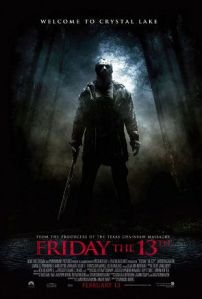
What Lisa Marie Watched Last Night: Friday the 13th (dir. by Marcus Nispel)


Last night, Jeff and I watched the 2009 reboot of Friday the 13th.

Why Was I Watching It?

For the past two weeks, I’ve been reviewing the 12 films that make up the Friday the 13th franchise.  This is the last installment so far and, appropriately enough, I’m reviewing it on Friday the 13th.  (No, that’s not just a coincidence.)

What’s It About?

It’s a reboot!  That’s right — forget about every other Friday the 13th film because, apparently, they never happened.  Instead of trying to figure out some new gimmick to try to get audiences to watch Jason Voorhees kill yet more teenagers, producer Michael Bay and director Marcus Nisepl have simply gone back to the beginning and started all over again.  (I think I saw something similar in an episode of Futurama once.)

Basically, this is the first four films all rolled into one.  The film starts with a young Jason Voorhees watching as his murderous mother (Nana Visitor) gets beheaded by a camp counselor.  30 years later, Jason (now played by Derek Mears) is living in the woods around Camp Crystal Lake.  A bunch of obnoxious campers come up to the Lake because they’re looking for a marijuana crop and Jason, being the culture warrior that he is, responds by killing all of them except for Whitney (played by Amanda Righetti), who he just kidnaps.

A month later, Whitney’s brother Clay (Jared Padalecki) arrives at Crystal Lake to search for his sister.  Upon arriving, he runs into yet another group of obnoxious campers who have decided to take a vacation up at Crystal Lake.   Jenna (Danielle Panabaker) agrees to help Clay look for Whitney and while the two of them are off searching, Jason shows up and starts killing everyone else. 

What Worked?

One reason that I’m using the What Lisa Watched Last Night format to review this film is because, to a large extent, it’s pointless to get all nitpicky while reviewing a film like the reboot of Friday the 13th.  This is not a film you watch because you’re looking to see something that’s going to redefine cinema.  This is a film you watch so that you can scream, laugh, and grab your boyfriend.  And, on all those fronts, Friday the 13th succeeds well enough.  Director Marcus Nispel obviously understands the slasher genre and he provides everything that we’ve come to expect from a film like this.

Also, I have to admit, I always scream at the end of the film even though I know what’s going to happen.

The victims are all very disposable and forgettable but Aaron Yoo is funny as the token stoner.

What Did Not Work?

With this film, The Texas Chainsaw Massacre, and Conan The Barbarian, Nispel shows that while he may understand how to make a genre film, he also doesn’t seem to be capable of adding anything new to them.  This isn’t a problem if you’re just looking to be entertained but, for true fans of the original films that have been rebooted by Nispel and producer Michael Bay, it’s hard not to wonder just why exactly these franchises needed a reboot as opposed to a sequel.  Watching a film like Friday the 13th reboot, it’s hard not to feel as if the filmmakers simply gave up trying to bring anything new to the equation and instead rather cynically decided to just capitalize on the earlier work of filmmakers who, as opposed to Nispel and Bay, aren’t in the current mainstream of the Hollywood establishment.

The main difference between a reboot like Friday the 13th and the original films in the franchise is that the reboot cost a lot more to make.  It’s a lot slicker (and therefore, you never really buy into the reality of the horror) and, with a few exceptions like Aaron Yoo, it’s full of bland actors who are recognizable from TV and who seem to be going out of their way to “act like characters in a slasher film” as opposed to at least trying to give actual performances.  It almost feels as if Nispel, Bay, and the cast are specifically going out of their way to wink at us and tell us, “We’re so much better than the movie that you just paid money to see.”  It feels incredibly condescending.

The film’s attempt to shoehorn the original first four films of the franchise into one 97 minute movie results in a film that often feels rather rushed.

“OMG!  Just Like Me!” Moments

Oh, a lot.  I would be so dead if I ever wandered into a slasher film.

Lessons Learned

From rewatching the entire Friday the 13th franchise, I learned several lessons: Don’t have premarital sex (or probably not even marital sex for that matter, Jason has got some issues), don’t drink beer, don’t smoke weed, don’t snort cocaine, don’t skinny dip, don’t go commando, don’t go in the wood, don’t go camping, don’t walking into a dark room, don’t say, “Is there anyone here?,” don’t shower, don’t sleep in abandoned cabins, don’t help out strangers, don’t hitchhike, don’t flirt, and … well, don’t do anything and you should be just fine. 

However, what fun would that be?

Well, this concludes my series on the Friday the 13th franchise.  I’ll be posting a few final thoughts on the franchise as a whole later tonight or on Sunday but for now, I hope you’ve enjoyed reading these reviews as much as I’ve enjoyed writing them.  Stay supple and don’t go wandering around in the dark.  Happy Friday the 13th!

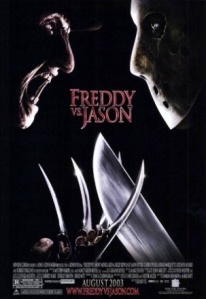
Film Review: Freddy Vs. Jason (dir. by Ronny Yu)


(This review probably contains what some people would consider to be spoilers.)

Today, as part of my continuing series reviewing the films of the Friday the 13th franchise, I take a look at Freddy Vs. Jason.

After spending 15 years in development Hell, the film Freddy Vs. Jason was finally released in 2003.  With this film, New Line Cinema brought together the stars of their two best-known horror franchises, Jason Voorhees (played here not by Kane Hodder but by Ken Kirzinger) and Freddy Krueger (Robert Englund.) 

During the time that Freddy Vs. Jason was languishing in development Hell, a huge number of potential storylines were pursued and a lot of scripts were written.  Some of those scripts are surprisingly good and one of them (the one with the enviromental message) is hilariously self-important.  Most of them are just terrible and can be found online via a google search.  The main problem was how to convincingly bring both Jason and Freddy together when the two of them essentially epitomized two radically different subsets of the slasher genre.  Especially when compared to some of the other ideas that were considered, the concept behind FreddyVs. Jason is actually pretty clever.

As the film starts, Freddy is trapped in Hell because he’s been forgotten by the teenagers of the world.  They’re no longer scared of him and, as such, they’re not having nightmares about him.  Freddy’s solution?  He tracks down Jason (also hanging out in Hell and having dreams that neatly parody his whole image of being a murderous defender of purity) and, by disguising himself as Pamela Voorhees, he convinces Jason to resurrect himself in Freddy’s old hometown.  Jason promptly starts killing teenagers and Freddy is blamed.  Soon, people are having nightmares and Freddy has his gateway back into the real world.  Unfortunately for Freddy, Jason keeps killing everyone before Freddy can get to them.  Freddy sets out to kill Jason and it all leads to one “final” battle between the two of them.

I have to admit that when I first saw Freddy Vs. Jason, I didn’t care much for it.  Of course, at that point in my life, my view of whether or not a film was good or bad was largely based on the type of night I was having when I saw it.  I saw Freddy Vs. Jason with a guy who 1) thought proper date attire was shorts, a t-shirt, and a baseball cap and 2) who apparently thought my right breast was just an armrest there for him to lean on whenever he got bored.  Bleh.  Beyond the company that I saw the film with, I was also upset that the character I most related to, Katharine Isabelle’s Gibb, was rather brutally killed off while boring old Monica Keena was allowed to survive.  My initial response to Freddy Vs. Jason was that it had to be bad film because I had a bad time while I was watching it.

However, I recently rewatched it again with my BFF Evelyn (who always dresses up and is pretty good about not feeling me up every three minutes) and I actually enjoyed Freddy Vs. Jason a bit more the second time around.  I think it also helped that, in between the two viewings, I got a chance to see all the other Friday the 13th and Nightmare on Elm Street films along with a lot of other horror films and was now able to see how scenes that seemed pointless the first time around were actually meant to comment on the history and the conventions of both the Friday the 13th and Nightmare on Elm Street franchises.  The 2nd time around, I could better appreciate the perverse parody at the center of Robert Englund’s performance as Freddy Krueger.  While the human characters are never all that interesting, the “final” battle between Jason and Freddy is genuinely exciting.  When I first saw it, I thought that the film’s final scene (with Freddy’s decapitated head winking at the camera before laughing) was incredibly stupid but now I appreciate it for what it is — a deliberately campy homage to the over the top exploitation films of the 70s and 80s. 

As opposed to the previous few films in the Friday the 13th franchise, Freddy vs. Jason was a huge box office success.  It was the first (and, come to think of it, only Friday the 13th film) that I saw in an actual theater and it actually did give me nightmares (mostly because I foolishly chose to relate to the obviously doomed Katharine Isabelle).  With that type of success, it was inevitable that there would be another film in both the Friday the 13th and Nightmare on Elm Street franchises.  Those two films, however, would not be sequels.  Instead, they would be (bleh) reboots.  We’ll take a look at the reboot of Friday 13th (and finish off this series of reviews) tomorrow.

Film Review: Jason X (dir. by Jim Isaac)


Last night, my friend Evelyn and I stayed up way too late and we watched the 10th film in the Friday the 13th franchise, 2002’s Jason X.  I was watching it for a second time because I’ve been reviewing the Friday the 13th films for this site.  Evelyn was watching it for the first time because she’s my BFF, we were having ourselves a girl’s night in, and she’s willing to watch anything with me because she has complete faith in my taste in movies .*

Anyway, after the end credits rolled, we both immediately agreed on one thing: Jason X sucks.  Seriously.

Jason X is yet another one of the Friday the 13th gimmick films.  This time the gimmick is (all together now): JASON.  IN.  SPAAAAAAAAACE!  However, before we get into space, the film opens in the “near future” of 2010.  Apparently, there is now some sort of underground, government controlled lab underneath Lake Crystal Lake and being held prisoner there is Jason Voorhees (played, for the last time, by Kane Hodder).  Apparently, the government has spent the last two years trying to figure out a way to kill the bound Jason but his cells keep regenerating. (No mention of demonic slugs for this film!)  Government scientist Rowan LaFontaine (Lexa Doig) wants to freeze Jason but another scientist, Dr. Wimmer, wants to use Jason as a weapon.  We know Dr. Wimmer is evil because he’s played by David Cronenberg.

Anyway, while Dr. Wimmer and Rowan are arguing about the ethics of exploiting an undead serial killer, Jason manages to escape and kills everyone in the underground lab except for Rowan.  She manages to freeze him in a cryogenic pod but gets frozen herself in the process.

Nearly 500 years later, Earth has been abandoned because Al Gore was right (yawn!) and the planet is now too polluted to live on.  Humanity had relocated to Another Earth.  However, students occasionally conduct field trips to the old Earth and one of those field trips comes across Jason and Rowan, still in deep freeze.  The students take the two of them back to their spaceship, thaw them out, and — needless to say — things don’t end well for the majority of them.

Jason X was made, of course, because Jason Vs. Freddy had spent the previous 9 years languishing in development Hell.  Jason X was New Line’s way of reminding people that they owned the Friday the 13th franchise and it certainly managed to do that, though it didn’t bring that many people to the theaters.  (Jason X is the second-lowest grossing film in the series.)  The reviews, at the time, were scathing and it’s easy to see why: the special effects looked incredibly cheap, everything about the film’s vision of the future (from the garish set design to the ugly costuming choices) felt tacky, and the acting was terrible.  Lisa Ryder, who played the perpetually cheerful robot KM 14, had a role that should have been actor-proof but she still managed to give a memorably bad performance, the worst moment being when she let out a weak-sounding “Yeah,” after it was incorrectly felt that she had killed Jason.)

The one exception: Kane Hodder.  In this unworthy little film, Hodder probably gives his best performance in the role of Jason.  Here, Jason is less an undead serial killer and more just an old man who is sick of kids wandering across his lawn.  He kills less because he’s evil and more because he’s just frustrated at being surrounded by so many stupid people.

And after watching Jason X, ever though you still can’t sympathize with him, it’s harder to blame him.

—-

* Evelyn has requested that I make it clear that the main reason she ended up watching Jason X with me was because she was “in the wrong place at the wrong time.”

Film Review: Jason Goes To Hell: The Final Friday (dir. by Adam Marcus)


(This review contains major spoilers.  Please don’t whine about them.)

Today, continuing my series of reviews of the films in the Friday the 13th franchise, we take a look at 1993’s Jason Goes To Hell: The Final Friday.*

After the disappointing box office performance of Jason Takes Manhattan, Paramount Pictures sold the right to the Friday the 13th franchise to New Line Cinema.  At that time, New Line was best known as the home of the rival (and far more critically appreciated) slasher franchise, A Nightmare On Elm Street.  As detailed in Peter M. Bracke’s Crystal Lake Memories, several attempts had already been made to create a Freddy Vs. Jason film and it was felt, as a result ot New Line acquiring the rights to the F13 franchise, that film would be much easier to make.  However, before Jason could fight Freddy, he had to be 1) reintroduced to film audiences as a special effects-dependant New Line monster (as opposed to just a stodgy old Paramount slasher) and 2) Jason had to go to Hell.

As I’ve mentioned previously, the last few Friday the 13th films were all “gimmick films” that attempted to breathe new life into the franchise by pairing Jason’s usual camper stalking with some new element, like a psychic adversary or Manhattan.  In Jason Goes To Hell, the gimmick is that Jason (again played by Kane Hodder) isn’t just a zombie serial killer but he’s also some sort of demonic slug that, even after his outer Jason shell is destroyed, can still slither into other people and possess them.

Yep, that’s what it does alright.

Anyway, Jason Goes To Hell starts out brilliantly, with a typical slasher movie victim wandering around old Camp Crystal Lake so she can take a shower and then turning out to be a decoy who is part of an elaborate sting effort that results in Jason being literally blown into little pieces by the F.B.I.  I love this opening because it basically reflects what would probably happen if Jason ever showed up in the real world.  It may have taken 9 films but apparently, people in the Friday the 13th world are finally using some common sense.

Except, of course, they’re not.

Jason’s remains are sent to the local coroner and it’s here that we get our first clue that the New Line Jason might be a little bit different from the Paramount Jason.  See, Jason’s heart — despite being rather violently removed from Jason’s body — is still beating and the local coroner proceeds to eat it and soon, he’s possessed by the aforementioned demonic space slug.

Now, the space slug may sound a little bit silly but it actually makes more sense that, after being killed at the end of The Final Chapter, Jason was reanimated by a demon worm than that he was brought back to life by a random bolt of lightning.  It would explain why, following Jason Lives, Jason can not be killed (or apparently even slowed down) regardless of how much punishment he takes.  (It can’t explain the end of Jason Takes Manhattan but then again, what could?)  So, the demonic space slug actually makes sense.

Except that it doesn’t.

A bounty hunter named Creighton Duke (Stephen Williams) pops up in Crystal Lake and explains that the demonic space slug can bring Jason back into existence if it manages to enter the body of a relative.  Apparently, the demonic space slug is somehow linked to the Voorhees family tree and that would suggest that Jason was possessed by the demon worm even back when he was just living in that shack in Part 2.  Was Pamela Voorhees possessed by the cosmic serpent back in Part One?  Creighton doesn’t bother to say but he does explain that apparently, Jason can only be killed by a magic dagger and he has to be stabbed by a member of his family and again, you really have to wonder why whoever created the space slug and the dagger made everything so overly complicated. 

Creighton Duke,  by the way, also takes the time to explain that — even though we’ve never seen him before — he’s been pursuing Jason for several years.  It’s somewhat odd that random teenagers have no trouble coming across Jason but apparently, a trained bounty hunter hasn’t been able to track him down.

Anyway, the Jason slug is now hopping from person to person because he’s trying to track down his half-sister Diane (Erin Gray) and his niece Jessica (Kari Keegan).  Creighton and Jessica’s ex-boyfriend (played by John LeMay) are in pursuit of the demon slug but eventually, the slug does manage to get inside a relative and Jason is not only reborn but he’s reborn wearing his hockey mask so I guess that was possessed as well.  Anyway, Jason is eventually stabbed by that super dagger and Jason finally goes to Hell (with Freddy Krueger’s clawed glove coming out of the ground to grab his hockey mask). 

And then the movie ends.

Much as I’ve always wanted a time machine so I could go back to 1941 and experience an audience seeing Citizen Kane for the very first time, I wish I could go back to August 13th, 1993 and see how audiences first reacted to the revelation that Jason Voorhees was just a demonic slug.  How did audiences react to seeing a Friday the 13th film that, for all essential purposes, wasn’t really a Friday the 13th film?  Probably not well, considering that Jason Goes To Hell was the third-lowest grossing film in the franchise.

Seen today, the main problem with Jason Goes To Hell is that it’s just not that much fun.  Seriously, there is no excuse for a film about a space slug to be boring but yet somehow, Jason Goes To Hell manages to be just that.  I think a large part of the problem is that the iconic hockey-masked Jason is absent for much of the film.  Instead, his spirit simply possesses one random passerby after another and the end result is rather bland. 

I’ve read quite a few reviews that have argued that Jason Goes To Hell is the worst installment in the franchise but I disagree.  It’s close, but it’s marginally better than both Part 3 and Jason Takes Manhattan.  It’s saved from being a total disaster by that clever opening and likable performances from John LeMary and Kari Keegan.  Though the character eventually becomes somewhat annoying, Steven Williams has a lot of fun going over the top in the role of Creighton Duke.

After Jason Goes to Hell, the franchise lay dormant for nearly ten years as various screenwriters and producers struggled to come up with Jason Vs. Freddy.  In 2002, Friday the 13th returned with it’s biggest gimmick yet — Jason in space!  We’ll take a look at Jason X tomorrow.

—-

*By the way, I think I deserve hazard pay for actually sitting through this movie.