James Bond Film Review: Dr. No (dir. by Terrence Young)


Hi there!  As you may already know, in the days leading up to the release of Skyfall, we’re going to be looking at the previous films in the James Bond franchise.  Today, we take a quick look at the first of the “official” James Bond films — 1962’s Dr. No.

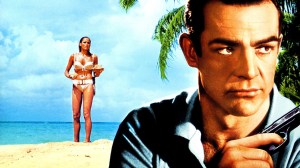
Dr. No is a film of many firsts.  It was the first film to be adapted from one of Ian Fleming’s original novels.  (Though it was not the first adaptation, that honor going to the 1954 made-for-tv version of Casino Royale). It was, of course, the first Bond film to be produced by the legendary team of Harry Saltzman and Albert Broccoli.  It featured the first true Bond girl, with Ursula Andress playing Honey Rider and spending the entire film in an iconic white bikini.  Dr. No featured the first appearance of both M and Miss Moneypenny (played, respectively, by Bernard Lee and Lois Maxwell).  That iconic theme music made its first appearance in Dr. No as well.  However, most importantly, Dr. No featured the first appearance by Sean Connery in the role of James Bond.  Even more than Andress’ white bikini, Connery is the reason why Dr. No proved to be the rather unlikely launching pad for one of the most succesful film franchises in cinematic history.

Dr. No, in fact, is a film that contains so many historic firsts that, often, it seems like reviewers tend to neglect the film itself and, instead, chose to concentrate on the film’s legacy.  And indeed, 50 years after it was first released, it’s difficult to watch Dr. No without viewing everything about it in relation to what the James Bond franchise would eventually become.  Instead of evaluating the film on its own individual merits, the tendency is to watch Dr. No and to spend a lot of time thinking things like: That’s the first time the world ever heard Sean Connery say, “Bond, James Bond.”  We tend to forget that, when Connery and director Terrence Young actually made Dr. No, they had no way of knowing that 22 sequels would follow.  They didn’t know that they were making film history.

Dr. No begins with a shooting in Jamaica.  John Strangeways, the British Intelligence station chief, is ambushed and gunned down by three assassins.  Shortly afterward, in a surprisingly brutal scene, his secretary is also assassinated.  In response, James Bond is summoned to the offices of MI6.  When he receives the summons, Bond is busy gambling and seducing Sylvia Trench (Eunice Grayson).  Sylvia, incidentally, was originally meant to be a character who would pop up in all of the subsequent Bond films.  Basically, she would have functioned as Bond’s girlfriend, the loyal woman who waited at home while Bond went to exotic countries and slept with every other woman in the world.  Perhaps wisely, this idea was abandoned after just two movies but still, Bond’s initial meeting with Sylvia (and the audience) is such an iconic moment that words simply won’t do it justice.  Here it is, for your viewing pleasure:

This scene has to rank as one of the best intro scenes in film history.  In just a few brief minutes, this scene tells us everything that we need to know about both James Bond and, even more importantly, Sean Connery’s interpretation of the character.  In this scene, Connery’s Bond is the epitome of narcissistic charm, giving just a hint of the determined cruelty lurking right underneath the surface.  It’s especially interesting to compare Connery’s Bond here to Daniel Craig’s interpretation of the character.  Whereas Craig’s Bond often seems to be on the verge of having a nervous breakdown, Connery is established in his first scene as being a cool and calm professional.  Craig may be the ideal Bond for our troubled reality but Connery will always be the Bond of our dreams and fantasies.

Bond is sent to Jamaica, where he teams up with CIA agent Felix Leiter (played by Jack Lord).  Again, it’s interesting to compare this version of Felix Leiter with Jeffrey Wright’s more-recent interpretation of Felix.  Whereas Jack Lord’s Felix Leiter is a cool, calm professional (a bit like an asexual version of Connery’s Bond, to be honest), Jeffrey Wright’s Felix often seems to be mired in self-loathing.  Both interpretations are perfectly legitimate (and Felix is usually such a superfluous character that just about any interpretation will do).  Instead, they’re interesting largely because of the way that each one of them epitomizes the decade in which each film was made.

With the help of Leiter, Bond quickly figures out that Strangeways’ death is linked to the mysterious, Dr. No (Joseph Wiseman), who has his own private island near Jamaica.  The natives claim that a dragon guards the island but Bond, never one to let something like that stop him (especially when it’s always his allies — like the unfortunate Quarrel — who get killed in these films, as opposed to him) sneaks onto the island.  It’s here that he first spies Honey Rider (Ursula Andress) walking along the beach.  Again, Honey’s introduction is such an iconic scene that, rather than try to describe it, it’s better just to show it:

For all the talk of how the Bond girls were often sexist stereotypes, I would have loved to have been an old school Bond girl.  Seriously, they got to be all sexy, they got to make love to James Bond, and occasionally, they got to help save the world.  Seriously, what fun!

I’ve spent so much time talking about James Bond and Honey Rider that I haven’t left much room for Dr. No.  But that’s okay because, to be honest, Dr. No is not really that interesting of a villain.  As opposed to future Bond villains, Dr. No is something of a bland character.  Joseph Wiseman plays him with a lot of menace and he has a few over the top moments but it doesn’t matter because there’s really nothing to distinguish Dr. No from any other megalomaniac that’s ever shown up in a low budget spy movie.  He’s a perfectly acceptable villain but he’s not an extremely memorable one.  (Perhaps if Christopher Lee had accepted the role when it was offered to him, Dr. No would have been a bit more of an effective character.)  Rest assured that Dr. No does have an impressive secret headquarters and, that once he does capture Bond and Honey, he takes his time to explain all of his evil plans as opposed to doing something sensible like killing them.

So, how does Dr. No hold up 50 years after first being released?

Surprisingly well.

Despite having a weak villain, Dr. No is still a lot of fun.  As opposed to future Bond films, Dr. No was a low-budget affair and, at it’s best, it comes across as an appealing B-movie.  Ultimately, the film is best known for introducing audiences to Sean Connery in the role of James Bond and perhaps that is for the best because Connery truly is the best thing in Dr. No.  Five decades later, you can still see why the world was so intrigued with both the actor and the character.

Tomorrow, we’ll take a look at one of my personal favorite films of all time — From Russia With Love!
The Name’s Bond, Jimmy Bond: Casino Royale (1954)


Hi there!  On November 9th (which just happens to be my birthday, by the way), the latest James Bond film will opening here in the States.  The early reviews of Skyfall have been nothing sort of amazing, with several critics declaring it to be the best Bond film ever.  Well, time will tell.  The fact of the matter is that many of those same critics said the exact same thing about Quantum of Solace before it was actually released.

That said, the James Bond franchise seems to be one of the few things that everyone on this planet has in common.  It seems that everyone has seen (and loved) at least one Bond film.  There’s a reason why Skyfall is going to be the number one film in the world despite having a totally generic title.  For over 50 years, people have loved Bond.

Here at the Shattered Lens, we’re observing the 50th anniversary of the James Bond franchise by reviewing every single James Bond film that’s ever been made.  In the days leading up to the American release of Skyfall, we’ll be taking a look at every single adventure that the cinematic James Bond has had.  Everything from the good to the bad to the ugly.

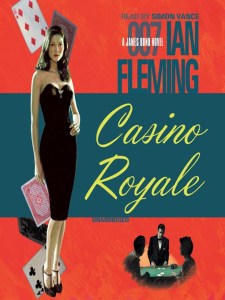
Everyone knows that Sean Connery made his debut of James Bond in 1962’s Dr. No but what they may not know is that Sean Connery was not the first actor to play James Bond.  James Bond made his first appearance 8 years earlier when an American television show called Climax! presented a 48-minute adaptation of Ian Fleming’s first Bond novel, Casino Royale.

In this version of Climax!, James Bond was known as Jimmy Bond and he was about as American as you can get.  (Felix Leiter, meanwhile, was now English and named Clarence Leiter).  Jimmy Bond was played by Barry Nelson, an actor who is probably best known for playing the blandly friendly hotel manager in Stanley Kubrick’s The Shining.  Casino Royale’s villain, Le Chiffre, was played by none other than Peter Lorre.

This version of Casino Royale was initially meant to serve as a pilot for a weekly television series but, perhaps fortunately, the Climax version of Casino Royale didn’t get much attention when it was originally aired.  According to Sinclair McKay’s authoritative Bond book, The Man With The Golden Touch, this version of Casino Royale was forgotten about until a copy of it was discovered in the 1980s.  By that time, of course, everyone knew that James Bond was English and that Felix Leiter was American.

Thanks to YouTube, I’ve seen the Climax! Casino Royale and it’s a curiosity.  If Dr. No hadn’t launched the James Bond film franchise, there would be little reason to watch this version of Casino Royale.  It moves a bit slowly, is way too stagey, and it reveals that, contrary to what we’ve all heard, live television was not always the greatest thing on the planet.  Not surprisingly, this adaptation contains none of the brutality or the moral ambiguity that makes Fleming’s novel such a fun read.  American television audiences would not see Jimmy Bond strapped naked to a chair and an American television show would never end with the hero saying, “The bitch is dead.”  The best you can say about this version of Casino Royale is that Peter Lorre makes for a good villain (in fact, of the three versions of Casino Royale, the television version is the only one to feature an effective Le Chiffre) and Barry Nelson would have made a good Felix Leiter.

That said, I still find the television version of Casino Royale to be fascinating from a historical point of view.  This is the type of show that you watch for curiosity value.  This is the type of show that you watch so that you can think about how different things could have been.

So, presented for your viewing pleasure, here’s the original version of Casino Royale:

Coming tomorrow: The James Bond film franchise gets off to its proper start with … Dr. No!

What Lisa Watched Last Night #52: Boy Meets World S5E17 “And Then There Was Shawn” (dir by Jeff McCracken)


Last night, my BFF Evelyn and I watched the infamous “And Then There Was Shawn” episode of the old ABC sitcom Boy Meets World.

Why Were We Watching It?

We were watching it because it’s October and we both had Halloween on the mind.  Of course, according to the Boy Meets World wikia — and yes, I am as shocked as you to discover that such a thing exists — this episode actually originally aired on February 27th, 1998 so, technically, it was more of a belated Valentine’s Day episode than a Halloween episode.  But anyone who has ever sat through And Then There Was Shawn knows that this was so totally a Halloween episode, even if it did air in February.

What Was It About?

And Then There Was Shawn pretty much starts out the exact same way as every single episode of Boy Meets World: Obsessive-stalker Cory (Ben Savage) and frigid, self-righteous Topanga (Danielle Fishel) are having issues and the entire world is just so concerned about whether or not they’ll be able to get back together so that they can eventually get married at the age of 18.  Cory’s friend Shawn (played by the very adorable Rider Strong) manages to stop talking about living in the trailer park long enough to disrupt Mr. Feeney’s history class.  Rather then questioning why his entire life seems to revolve around a bunch of 16 year-olds, Mr. Feeney (William Daniels) responds by giving everyone detention.

So, Topanga, Cory, and Shawn are all in Mr. Feeney’s after-school detention, along with Shawn’s boring girlfriend Angela and a random student named Kenny.  (It took me a while to recognize that Kenny was being played by Richard Lee Jackson, who I remembered from Saved By The Bell: The New Class.)  Since this is Boy Meets World, everyone is using their time in detention to discuss Cory and Topanga’s creepy relationship when suddenly “No one gets out of here alive” appears on the chalkboard, written in blood.

And from that moment on, it goes from being a standard episode of Boy Meets World to transforming into being perhaps one of the weirdest episodes ever to show up in a family sitcom.

Soon, Kenny’s dead as the result of someone jamming a pencil into his head, Mr. Feeney’s dead with a pair of scissors in his back, there’s a creepy janitor stalking the hallways, and Cory’s cute older brother Eric (Will Friedle) shows up, along with Jennifer Love Hewitt.  By the end of the episode, almost the entire cast has been killed and, of course, it turns out that it’s all because the entire world revolves around Cory and Topanga…

What Worked?

Over the course of the episode, just about every character on the show is killed off.  Considering just how annoying most of the characters on Boy Meets World could be, it’s hard not to appreciate this episode’s determination to kill all of them off.

The episode, itself, is actually pretty well-written and clever.  Unlike a lot of sitcom Halloween episodes, And Then There Was Shawn actually feels like a legitimate (and respectful) homage to the great horror films of the past.

What Did Not Work?

I’ve often wondered if the audiences in the 20th Century found the character of Cory Matthews to be as creepy as I find him to be in the 21st.  Seriously, whenever I see Boy Meets World, I’m struck by the fact that Cory basically spends every episode telling everyone that 1) they’ll never love anyone as much as he loves Topanga, 2) that Topanga’s belonged to him her entire life, and 3) that everyone in the world has an obligation to think about him and Topanga before they do or say anything.  In addition to that, you have to consider his oddly co-dependent relationship with Shawn, the fact that he looks nothing like anyone else in his family, and the fact that whenever he and Topanga have a fight, he yells, “NO!  We’re not supposed to ever disagree because I love you Topanga and … YOU LOVE ME!”  Seriously, what a creep!  Fortunately, Corey is less of a jerk than usual in this episode but, all things considered, it’s still hard to root for that little psycho.

Finally, what was up with the Boy Meets World theme song?  I mean, it’s awful but it certainly does get stuck in your head.

“OMG!  Just like me!” Moments

To be honest, I find almost all of the regular characters on Boy Meets World to be so annoying that I’m almost tempted to say that there wasn’t a single “Just like me!” moment in this episode.  However, I do have to admit that — much like Jennifer Love Hewitt in this episode — I probably would have found time to make out with Eric as well.  Seriously, he was soooooooooo cute!

Lessons Learned

Sitcom love = creepy love.

A Grindhouse Horror Review: Zombie Holocaust (dir. by Marino Girolami)


Traditionally, I like to start my film reviews with a trailer but, with this trailer, I do feel the need to include a quick warning.  The film being advertised, 1980’s Zombie Holocaust, was released at the height of the Italian exploitation boom and  combined two notably gory genres of horror — the cannibal film and the zombie film.  The trailer below is pretty explicit (even by the standards of the free speech zone known as the Shattered Lens) and is definitely not safe for work.

Like many of the classic Italian grindhouse films, Zombie Holocaust opens in New York City.  A hospital attendant is caught devouring a cadaver in a morgue.  After he attempts to escape by throwing himself out of a window, it’s discovered that 1) he’s a native of the Asian Molucca islands and 2) he’s only one of several natives to have both recently immigrated to New York City and gotten a job at a morgue.  Dead bodies across NYC are being eaten and anthropologist Lori (played by Aelxandra Delli Colli, who is best known for being the only sympathetic character in Lucio Fulci’s New York Ripper) is determined to discover why.

In order to investigate, Lori and Dr. Peter Chandler (played by Ian McCullough, who was also in Fulci’s classic Zombi 2) lead an expedition to the island.  Almost as soon as the expedition arrives, they find themselves being pursued by not only cannibals but zombies as well!  Even worse, it turns out that there’s a mad scientist on the island.  Dr. Obrero (Donald O’Brien, an Irish actor who appeared in a few hundred Italian films of every possible genre) is convinced that he can unlock the secrets of life by experimenting on dead bodies and doing brain transplants.

(To be honest, I’ve seen this film a few times and I’m still not quite sure what exactly Dr. Obrero was trying to accomplish but I guess it doesn’t matter.  He’s a mad scientist with his own private laboratory so I guess he can pretty much do whatever he wants.)

I love Italian zombie films but, for the most part, I try to avoid the cannibal films.  I saw both Cannibal Ferox and Cannibal Apocalypse because they both featured Giovanni Lombardo Radice and I saw Cannibal Holocaust because, seriously, that’s one of those films that any student of cinematic horror has to see at least one time.  But otherwise, I tend to avoid the cannibal films because, to me, they’re just not that much fun to watch.  (And the fact that most of them contain scenes of actual animal cruelty doesn’t help…)

However, Zombie Holocaust is one of the rare cannibal films that I can watch and enjoy because it’s just so ludicrous and over-the-top.  It also helps that the film’s gore is so obviously fake that it becomes almost a postmodern statement on Italian cannibal films.  And, finally, this film has got zombies in it and who doesn’t love zombies?

Of the countless zombie films that came out of Italy during the early 80s, Zombie Holocaust is one of the odder entries in the genre.  While most Italian exploitation films were shameless when it came to imitating other movies, Zombie Holocaust attempts to outdo them all by cramming the conventions of three different genres into one mess of a movie.  As such, the movie starts out as a standard cannibal film just to suddenly become an almost shot-by-shot remake of Zombi 2 before then finally wrapping things up by having Donald O’Brien pop up, acting like Peter Cushing in a Hammer Frankenstein film.  There’s nothing graceful or subtle about this film’s everything-and-the-kitchen-sink approach to its story and, while the end result isn’t exactly pretty, it’s still watchable in much the same way that a televised police chase is watchable.

Director Marino Girolami was a veteran filmmakers who was ending a long career with his work on Zombie Holocaust and you have to admire the fact that, as opposed to many other filmmakers who have found themselves in a similar situation, he made an honest and unapologetic exploitation film, a shameless rip-off of about a thousand other films.  Instead of being embarrassed by the film’s silliness, he instead embraced it and his cast did the same.

Playing the lead role, Scottish actor Ian McCullough plays his character with an attitude that, at times, almost comes across as a parody of stiff upper lip English imperialism.  You may have to be a fan of grindhouse cinema to truly appreciate it but, whenever I’ve sat through this film, I always found myself smiling every time that McCullough discovered that another member of his expedition has been killed and responded with a frustrated, “And none of this would have happened if you had simply done as I had told you to do.”  By the end of the film, I was expecting McCullough to approach the last remaining native and tell him, “You’re a better man than I am, Gunga Din.”

However, the film is truly stolen by Donald O’Brien, who plays the mad scientist with an almost alarming sense of authenticity.  For the most part, nothing that O’Brien says during the film makes the least bit of sense but he delivers the lines with such conviction that it really doesn’t matter.  In one of the film’s most famous scenes, O’Brien delivers the line, “Patient’s screams annoying me…performed removal of vocal chords.”  It takes a special type of actor to make a line like that work and O’Brien was that actor.

Indeed, watching a film like this, it’s hard not to admire the fact that both the filmmakers and the cast managed to stay sane regardless of how ludicrous the film eventually became.  That’s perhaps the best way to describe Zombie Holocaust.  It’s ludicrous but it’s still a lot of fun.

(Speaking of ludicrous and fun, when Zombie Holocaust was released here in the States, it was renamed Dr. Butcher, M.D. and it was apparently advertised by a sound truck known as the Butchermobile.  To me, that sounds like a lot of fun and it again reminds me that I was born a few decades too late.)

Horror Film Review: House At The End of the Street (dir. by Mark Tonderai)


Hi there!  I’m back!  For the past two weeks, I’ve been “on the road,” traveling from my home in Texas to Baltimore, Maryland and then back to Texas again.  It was a great two weeks and a much-needed vacation and now, I am back at my office here at the Shattered Lens Bunker, and I am refreshed and I am ready to get caught up on what really matters: reviewing movies.

This is October, perhaps the third greatest month of the year.  Traditionally, October is horror month here at the Shattered Lens and, for my first post-vacation film review, I want to take a look at an underappreciated horror film that came out right before I left for Maryland.  It was released to theaters on September 21st, was the number one film in the country for a week, and got next to no love from either mainstream critics or my fellow film bloggers.  It’s still playing at a theater near you and, believe it or not, it’s not that bad.  The name of the film?  The House At The End of the Street.

(Or, as my BFF Evelyn and I called it, “The House at the End of the Cleavage” because seriously…)

In The House At The End of Street, recently divorced Sarah (Elisabeth Shue) and her daughter Elissa (Jennifer Lawrence) move to a small country home.  Sarah has managed to buy a house that she really shouldn’t be able to afford and the new neighbors quickly explain to them that this is because, many years ago, a crazy girl named Carrie-Ann was living at the house at the end of the street and she murdered her parents before then disappearing into the woods.  Apparently, this has caused all of the property values in town to plummet and I really have to wonder why.  I’m not a real estate expert (for instance, I have no idea what a mortgage is and I have no desire to learn) but, personally, I would love to live next to a murder house.  Seriously, imagine the interesting conversations that could be started by saying, “So, my neighbor buried a salesman in his basement…”

But anyway, it turns out that Elissa has a perfect view of the house at the end of the street from her bedroom window and she quickly discovers that the house is not deserted.  It turns out that Carrie-Anne’s brother Ryan (Max Thieriot) is living in the house and, despite being shunned by the entire community, he seems to be a nice, sensitive guy.  Despite her mother’s misgiving, Elissa befriends Ryan and defends him against everyone who claims that he’s crazy.

Of course, what Elissa doesn’t know is that there’s another girl in Ryan’s life and she’s locked up in his basement…

When I look over the negative reviews of House at the End of the Street (especially the ones written by male film bloggers), I frequently come across the phrase “lifetime movie.”  Their argument seems to be that House At The End of the Street, with its emphasis on a single mom raising her daughter, was essentially just a PG-13 rated Lifetime movie.

Well, they’re right.

But so what?

Seriously, Lifetime movies are a lot of fun to watch when you’re in the right mood for them and that’s a perfect way to describe House At The End Of The Street.  It’s a lot of fun, the type of silly horror film that’s fun to watch with a group of friends.  Max Thieriot plays the type of cute but damaged (and potentially dangerous) outsider that every girl has had a crush on and, for the boys in the audience, there’s plenty of cleavage and visible bra straps.

Finally, I think the main reason that House At The End of the Street stayed with me is because both Elisabeth Shue and Jennifer Lawrence really invested themselves in their roles.  They were totally believable as mother and daughter and their loving but occasionally contentious relationship felt totally true-to-life (or, at the very least, it was true to my life).  Lawrence and Shue both give performances that bring some unexpected depth to this underrated film.

A Horror Quickie With Lisa Marie: Slaughter High (dir by George Dugdale, Mark Ezra, and Peter Litten)


Before I left on my vacation, I watched several free horror movies on Fearnet.  The majority of those films were worth exactly what I paid for them but, occasionally, I came across a film that was worth a quarter or two more.  One of those fifty cent films was Slaughter High.

Though it was obviously made a few years earlier, Slaughter High was released in 1986 and was a part of the whole mid-80s slasher cycle.  Like many of the films in this cycle, Slaughter High opens with a high school prank gone wrong.  Poor Marty (Simon Scuddamore) is the victim of an incredibly cruel April Fool’s Day prank that ends with him totally naked and being dunked in a toilet by a group of 8 students who are surprisingly sadistic.  Of course, part of that sadism could have something to do with the fact that they all appear to be in their 30s, yet they’re still students in high school.  A coach (who appears to be the only teacher in the entire school) happens to come across the students tormenting Marty and he punishes them by ordering them to go to the gym and start doing push ups.

“This is all Marty’s fault!” one of the 8 sadists exclaims.

So, naturally, they play yet another prank on poor Marty.  This prank involves Marty smoking a poisoned joint and then accidentally spilling a jug of acid on his face.  As his tormenters watch, a seriously disfigured Marty is taken out of the school on a stretcher.

Exactly ten years later, the 8 sadists (who have now all graduated) get an invitation to attend a reunion at the old high school.  When they arrive, they discover that 1) they’re the only ones who have been invited and 2) the high school has been abandoned and is on the verge of collapsing.  Now, you might think that this might lead at least one of them to remember that it’s been exactly 10 years since they totally destroyed Marty’s face and life but you would be wrong.  Instead, the group decides to break into the old school and spend the night.

You can probably guess how well that works out.  Even as our guests discover that random pictures of Marty have been posted throughout the school, none of them suspects that something bad might be about to happen.  In fact, it’s not until one of them drinks a beer that’s been spiked with acid that it occurs to any of them that they might not be alone…

Slaughter High is something of a surprise, a low-budget horror film that works exactly because it doesn’t make any sense.  Nobody in this film acts like a logical (or halfway intelligent) human being and that — along with a genuinely creepy setting, a camera that never stops prowling through the dark corridors of that dilapidated school, and some surprisingly brutal death scenes — all comes together to create a narrative that feels more and more dream-like as the story continues.  Narrative logic is ignored in favor of nightmarish imagery and the end result is a slasher film that seems to be directly descended from Lucio Fulci’s Beyond trilogy.

It’s hard to talk about Slaughter High without talking about the film’s ending and it’s impossible to talk about that ending without spoiling the entire film.  So, I’ll just say that Slaughter High has two endings.  One concludes the action at the school and then, a few minutes later, there’s a twist ending that concludes the film as a whole.  Just on the basis of a few online reviews that I’ve read, the “twist ending” is something that people either love or they hate.  Myself, I felt that the film’s first ending would have been a perfect place to end things but, at the same time, the twist didn’t bother me.  If nothing else, it nicely complimented the entire film’s lack of narrative logic.

A sad sidenote: Simon Scuddamore, who plays Marty here, never made another film because he apparently killed himself a few weeks after filming his role.  On another odd casting note, Caroline Munro plays one of Marty’s high school tormentors despite being in her mid-30s at the time.

A Horror Quickie With Lisa Marie: The Amityville Curse (dir. by Tom Berry)


Before I left for my vacation, I watched several of the free horror movies that are available on Fearnet and, to a large extent, I got what I paid for.  That said, seeing as how it is October and how this Horror Month here at the Shattered Lens, I committed myself to reviewing each film that I watched via Fearnet, regardless of how thoroughly awful any particular film might turn out to be.

And that brings us to The Amityville Curse, a Canadian film from 1990 that was made to capitalize on the whole Amityville Horror scam.

In the Amityville Curse, a group of 6 friends spend the night in a haunted house and things work out as you might expect.  You’d be justified in assuming that the haunted house is the same house from the Amityville Horror but you’d be wrong.  Instead, they’re staying in a different house that just happens to also be in Amityville and which just happens to be haunted as well.  (One lesson to be learned from this mess of a movie: when it comes to haunted house stories, it’s often best to keep things simple.) 

Apparently, decades earlier, a priest was murdered in the house while taking confession and the local community has scorned the house ever since.  However, at the start of the film, a fat, balding guy and his boring wife buy the house and their friends come down to help with the remodel.  Unfortunately, one of those friends is played by Kim Coates and, as everyone knows, the minute Kim Coates shows up in a horror movie, he’s going to end up getting possessed and killing a lot people.

Which is pretty much what happens here.

I have to admit that I feel sorry for Kim Coates whenever I see him in a movie like this.  Kim Coates (who is currently a member of the cast of Sons of Anarchy) is a talented character actor and, when given the chance, he has proven that he can play likable and sympathetic characters.  But, he’s got these slightly off-center eyes and a nervous, jumpy manner about him.  As a result, whenever he shows up in a movie, he always seems to be killing people.  Whenever I see a talented actor like Kim Coates in a movie like The Amityville Curse, I clench my little hand into a fist and I shake it at the unkind Gods of typecasting.

As for The Amityville Curse, well, what can I really say about it?  This is a truly terrible movie, one of the worst that I’ve ever seen.  It’s a horror movie without a single scare.  It’s the type of movie that I would warn everyone to stay away from except that I doubt this already obscure film will ever again see the light of day.

Except maybe on Fearnet.

A Horror Quickie With Lisa Marie: 976-Evil II (dir. by Jim Wynorski)


(Before I left on my vacation, I made it a point to watch several horror films that were available for free on Fearnet.  In the case of many of the films, I suspect that I may have paid too much.  Regardless, since it is October and horror month here at the Shattered Lens, I am going to share my thoughts on some of these Fearnet films.)

Before I review 976-Evil II, I need to make a quick confession  The one time that I attempted to watch the first 976-Evil, I ended up falling asleep immediately after the opening credits.   I don’t know much about the film beyond the fact that it was directed by Robert Englund and, even by the standards of the majority of the films that are available on Fearnet, it looked to be cheap and unimpressive.

That said, as I watched Part 2, it quickly became apparent that it’s not really necessary to have seen the first film to follow the plot of the second.

A small town in California has a problem.  Mr. Grubeck (an enjoyably over-the-top performance from Rene Assa) is the dean of the local college (which, to be honest, looks a lot like a high school).  Grubeck is a courtly, middle-aged man who lives in a nice house and just happens to be a demented serial killer.  He’s been dialing a mysterious phone number and, with each call, he gains more and more supernatural powers. 

At that start of the film, however, a drunk janitor (played by George “Buck” Flower, of course) sees Grubeck killing a student.  The janitor goes to the police and Grubeck is promptly arrested and placed in jail.  Unfortunately, the police allow Grubeck his one phone call and Grubeck, of course, dials 976-Evil.  As a result, Grubeck is given the power to wander about in astral form while his physical body rests.  Grubeck uses his powers to start killing anyone who can link him to the murders, as well as to stalk a student named Robin (Debbie James).

However, Robin has another stalker.  Spike (Patrick O’Bryan), who was apparently the protaganist of the first film, comes rolling into town on his motorcycle and soon, he and Robin are searching for a way to defeat Grubeck once and for all. 

(As a sidenote, I think that the minute a baby is named Spike, the rest of his or her life is pretty much predestined.)

976-Evil II is the type of film that almost always gets universally negative (and snide) reviews but, when taken on its own terms, it’s actually a fun little movie.  This is the type of film where all of the actors speak their lines in the most dramatic way possible and authority figures react to bad news by defiantly slamming their hand on top of their desk.  In short, this is a film that is not meant to be taken seriously and its obvious that director Jim Wynorski understood that.  This is a film that winks at the audience even as it grows more and more implausible.  While the film’s scares are more likely to make you smile than jump, there is one very effective sequence where Robin’s friend Paula (played by Leslie Ryan) finds herself literally sucked into the TV.  At first, since she was watching It’s a Wonderful Life, everything’s okay.  But then, somebody changes the channel to Night of the Living Dead.  It’s this type of outrageous sequence that distinguishes 976-Evil II from other similar (but forgettable) horror films.

976-Evil II was released in 1992 and, wow, is it obvious.  Everyone has big hair, wears too much spandex, and uses a landline phone.  Even the villainous Mr. Grubeck wears a vest with a floral design.  That said, the film was so dated as to be oddly charming.

That’s actually how I would sum up 976-Evil II as a whole.

Oddly charming.

A Horror Quickie With Lisa Marie: The Curse of the Zodiac (dir. by Ulli Lommel)


(Before I left for vacation, I watched a handful of horror films that were available for free on Fearnet.  For the most part, I think I may have overpaid.  But, since I am dedicated to reviewing every film that I see, good or bad, I’ve decided to review these Fearnet films for Halloween here at the Shattered Lens!)

In the past, I have occasionally defended the German director Ulli Lommel against the oft-stated charge that he is the worst director of all time.

“Yes,” I’ll admit, “Lommel is kind of pretentious and a lot of his films can’t overcome the burdens of their low-budget origins.  And no, he can’t director actors.  But, his early films have a certain dream-like quality and The Boogeyman holds up fairly well for what it is.  Plus, consider these two words: Uwe Boll.”

Unfortunately, I’m not sure that even Uwe Boll could have directed a film as bad as Lommel’s 2007 straight-to-DVD film, The Curse of the Zodiac.

The Curse of the Zodiac is one of Lommel’s “true crime” films.  In these films, Lommel claims to tell the “true” stories of American serial killers like BTK, the Son of Sam, and Zodiac.  (In fact, Lommel has directed two unrelated films about the Zodiac killer.)  A while ago, I read an interview with Lommel in which he stated that his serial killer films are about revealing the hypocrisy of puritanical American society.  Maybe they are but they’re also pretty bad and The Curse of the Zodiac is one of the worst of them.

Taking place in the early 1970s (though you’d never guess it from the lack of period detail), The Curse of the Zodiac tells the story of the Zodiac Killer.  In real life, the Zodiac Killer is one of the most intriguing (and nightmare-inducing) serial killers in history.  In the film, he’s just a bald guy who wanders around San Francisco, kills a few random people, and spends almost the entire movie repeating the phrase, “Hey there, fat fuck.”  The fat fuck in question is a writer who is investigating the crime and who is kind of fat.  We never discover the writer’s name or who he is or why he’s investigating the Zodiac or why the Zodiac knows him or …. well, anything.  He’s just a character who shows up every few minutes.  Another character who shows up every few minutes is a psychic who has visions of the Zodiac committing his murders.  The Zodiac refers to her as “hippy chick.”  Neither the writer nor the psychic really do anything that a normal person would do when confronted with a serial killer but then again, Zodiac doesn’t really do anything that a normal serial killer would do when confronted by a writer and a psychic.

What can you really say about a film like The Curse of the Zodiac, beyond that fact that, in the course of 82 minutes, nothing really happens beyond watching three anonymous characters wander around San Francisco.  Lommel doesn’t get one good performance out of his tiny cast, though he does find a lot of excuses to show off some nausea-inducing hand-held camera work.

The best thing that I can say about The Curse of the Zodiac is that it deserves to be seen just as evidence of how bad a bad film can truly be.

Film Review: The Dead Pool (directed by Buddy Van Horn)


Hi there!  Today, I will be concluding my look at the Dirty Harry series with the final film in the franchise, 1988’s The Dead Pool.

Harry’s back and he’s still carrying a gun.  He’s also older, wrinklier, grouchier, and suddenly famous because he’s just given testimony in a mob boss’s trial.  You would think that Harry would already be famous seeing as how he not only killed the Scorpio Killer but he also rescured the Mayor from all those communists.  But, I guess that’s what Harry gets for living in the same city that’s been sending Nancy Pelosi to Congress for the last 100 years.

Harry and his new partner (Evan C. Kim) are assigned to investigate the death of rock star Johnny Squares (Jim Carrey).  Harry immediately suspects that the murderer was pretentious film director Peter Swan (Liam Neeson).  This is largely because Swan makes the type of horror films that inspire Harry to snarl with disdain.  It also turns out that Swan has been playing a “dead pool” game and that the various celebrities on his list have been getting killed.  And guess what?  Harry’s name is also on that list…

The Dead Pool was the final Dirty Harry film and, in many ways, it also feels like the most generic.  Whereas Dirty Harry actually had quite a lot on its mind and the first three sequels at least pretended to be concerned about something more than just mayhem, The Dead Pool is often content to be a rather cartoonish action film.  With the exception of a rather witty car chase involving a remote-controlled toy car that’s been strapped with an explosive, the action scenes are predictable and Eastwood’s character could just as easily have been named Spinner Mason or Eli Goldworthy.  There’s simply no huge reason for this film to be a Dirty Harry film, beyond the fact that it wouldn’t show up on AMC every few weeks if it wasn’t.

And yet, it’s impossible for me not to like The Dead Pool.  Though the film might feel generic overall, there’s still the occasional moments that hint that the movie is actually a bit smarter than it might first appear to be.  Considering that the film largely takes place on a movie set and features a film critic among its victims, it’s tempting to see The Dead Pool as being almost a spoof on both the Dirty Harry films themselves and the controversy that’s been generated by their violent content.  It makes sense that Harry Callahan’s name would appear on Swan’s dead pool list because, after spending four films battling serial killers, fascists, communists, gangsters, white trash, and a countless amount of bank robbers, the only opponent left for Harry to face is his own reputation.

The Dead Pool has one of the more interesting casts of the Dirty Harry films.  After dominating the previous films in the series,Clint Eastwood steps to the side and instead, allows his supporting cast to run off with the movie.  It’s a little bit bizarre to see Jim Carrey playing  a rock star (and even more bizarre to see him lip-synching to Welcome to Jungle) but that odd touch seems strangely appropriate for a film that doesn’t seem to be too concerned with much more than being entertaining.  Evan C. Kim is one of Harry’s more likable partners and Liam Neeson, complete with pony tail and superior attitude, is a lot of fun to watch as he spoofs every single pretentious filmmaker that you’ve ever been unfortunate enough to have taken a film class with. 

For a lot of reasons, The Dead Pool was the last of the Dirty Harry films.  It was a box office disappointment and, even way back in 1988, Eastwood looked a just little bit old for an action hero.  Eastwood has said that he has no interest in playing the character again and that’s probably for the best because, after five films, you have to wonder just what exactly was left for Harry to deal with.  (That said, I’ve always thought of Gran Torino as being the unofficial sixth Dirty Harry film.)

Well, that concludes my look at the Dirty Harry film series and, not coincidentally, it also concludes the month of September as well!  Starting tomorrow, along with all the other usual great stuff that you expect from us at the Shattered Lens, we’re going to be starting horror month!

Enjoy!