Film Review: Body Shots (dir. by Michael Cristofer)


(Spoilers)

Recently, I saw a 1999 film called Body Shots on the Fox Movie Channel.  If you look at the poster at the top of this review, you’ll see that Body Shots was apparently advertised with the boast: “There are movies that define every decade…”  That’s true.  It’s also true that, every decade, there are movies that define self-importance and pretension.  Can you guess what Body Shots defines?

Since Body Shots claims to be a film that exposes what secretly goes on in American society, I figured I would start this review by sharing a secret of my own.

Ready?

I love over-the-top morality tales.  I love movies that attempt to expose 20something for being the shallow, terrible people that older people believe us to be.  Every decade sees at least a handful of these films.  Typically, they are made by male filmmakers in their 50s and they attempt to paint an accusing portrait of the foibles of youth.  These films assure the older generation that their children have all grown up to be a bunch of drug-abusing, heavy-drinking, over-sexed degenerates.  It’s a proud of tradition of American cinema and television, one that includes everything from the crazed pot smokers of Reefer Madness to The Newsroom’s Jeff Daniels announcing that my generation is the “WORST.  GENERATION.  EVER.”

Typically, dreadfully earnest filmmakers who think that they are making an important statement about the future of human society are responsible for these films.  That the filmmakers often turn out to be so totally out-of-touch and histrionic just adds to the campy charm.

Body Shots is a part of this tradition.  According to the imdb, director Michael Cristofer (who is currently appearing on Smash) was 54 years-old when he made this film about 8 decadent 20-somethings who spend a decadent night at a Los Angeles nightclub and then have to deal with the consequences in the morning.

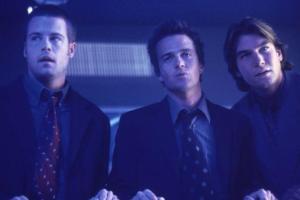
For the first part of Body Shots, we’re introduced to the 8 main characters (4 men and 4 women, which works out nicely as far as pairing off is concerned).  While they’re all generically attractive (and, at times, interchangeable), they are also each meant to represent a different take on sexuality and relationships.
body-shots-645-75

The men:

Rick (played by Sean Patrick Flannery) is a lawyer.  He doesn’t have much of a personality but he’s in the most scenes so I guess he’s supposed to be the protagonist.  Flannery is required to awkwardly deliver the line, “Hey, Penorisi, have another cocktail, why don’t you?” not once but three time.

Mike Penorisi (played by Jerry O’Connell) is a professional football player who drives a Mercedes and who spends almost the entire movie struggling to keep his hair out of his eyes.  We know he’s a jerk because Jerry O’Connell plays him and he does things like shout, “If pussy’s on the menu, I’m there!”  (Seriously, Body Shots?)

Shawn (played by Brad Rowe) is a friend of Rick’s.  He’s a nice guy and he says things like, “Sex without love equals violence.”  (And, again, seriously?  Agck!  If a guy ever said that to me, I would be out the door so quick…)

Trent (played by Ron Livingston) is Shawn’s roommate.  We’re continually told that Trent is a loser but, since he’s played by Ron Livingston, he’s also one of the only likable people in the entire film.  Trent is crude and obsessed with sex but, as opposed to everyone else in the film, he’s at least honest about it.  Unlike the rest of the cast, Livingston is intentionally funny.

The women:

Jane (played by Amanda Peet) is kind of Rick’s girlfriend.  Like Rick, she really doesn’t have much of a personality and she’s mostly distinguished by being an absolutely terrible dancer.  (Unfortunately, the filmmakers don’t seem to realize just how awkward Peet looks out on the dance floor.)

Sara (played by Tara Reid) is Jane’s best friend.  She’s blonde, drinks to excess, and is open about her sex life.  So, naturally, the filmmakers go out of their way to punish her during the film’s second half.

Whitney (played by Emily Proctor, from CSI: Miami) is another blonde who drinks to excess and is open about her sex life.  In order to keep us from confusing her with Sara, the filmmakers have Whitney sodomize one of the men with a dildo.

Emma (played by Sybil Temchen) is depressed and worries that people can tell that she “hasn’t gotten laid in months” just by looking at her.

Anyway, these eight characters spend the first part of the movie getting ready to go out, going out, meeting up, hooking up, and occasionally telling us their thoughts on sex and relationships.  And by telling us, I mean that, in a technique beloved by first-time playwrights who have yet to learn anything about being subtle or allowing characters to reveal themselves organically, they literally look straight at the camera and deliver monologues about what they’re looking for in life.  I suppose this is all supposed to make us feel as if we’re getting an intimate look into the inner angst and secret loneliness of these characters but the monologues are all so awkwardly written that they just make the characters seem even more shallow than before.  Trust me, I could have happily lived my entire life without having Jerry O’Connell staring straight at me while discussing oral sex.  (“No teeth!” Jerry grins.  BLEH!)

And yet, I still enjoyed the first part of Body Shots, precisely because the characters were so shallow and the movie was so unintentionally over-the-top in its efforts to paint the Los Angeles nightlife as the equivalent of Sodom and Gomorrah.  The scenes where the women were getting ready to go out for the night all had a ring of truth of them and Ron Livingston (who appeared to be the only member of the cast to understand just how silly a film Body Shots would ultimately turn out to be) was a lot of fun.

Even better, once everyone gets to the club, Michael Cristofer decides to earn his auteur credentials by tossing in every trick he can think of.  Scenes where the action is needlessly sped up follow scenes that play out in slow motion.  The camera glides through the club, focusing on all the neon while a generic beat blasts in the background.  The walls are covered with graffiti that reads, “Swim At Your Own Risk” and “No Diving” and you better believe that the camera lingers over every letter.  Meanwhile, Amanda Peet dances awkwardly while trying to give Sean Patrick Flannery a come hither look while Emily Proctor passes out shots and Jerry O’Connell keeps tossing back his hair.  And then Ron Livingston shows up, straight from a golf course and – you’ve got it! – still dressed for his game.

Seriously, it’s all so stupid and silly and over-the-top unbelievable.  And, of course, while all this going on, the characters still find the time to stare straight at the camera and tell us their feelings about bondage and whether or not true love actually exists.  Cristofer is trying so hard to say something profound and he fails so completely that it’s actually a lot of fun to watch.

Unfortunately, during the second part of the film, Body Shots falls apart.  The next morning, Sara shows up at Jane’s apartment and says that Penorisi raped her.  Penorisi is arrested and claims that the sex was consensual and that Sara was just upset because he accidentally called her “Whitney.”  We get flashbacks to both Mike and Sara’s version of the events.  While they each tell a different story, Cristofer seems to be implying that, regardless of who is telling the truth, it wouldn’t have happened if Sara had not been out drinking and flirting.

To be honest, it’s pretty fucking offensive.

If the first part of Body Shots appeared to have been made by an out-of-touch guy with good intentions, the second part is the work of a moralistic hypocrite.  What makes it even worse is that the film ends without resolving the case.  I’m sure that Cristofer would argue that the open ending was meant to make the audience think about what they had just seen but, ultimately, it feels like a cop out.  It’s almost as if Cristofer reached a point where he said, “Okay, I’m tired of making this movie.  Let’s just quit.”

And considering how the second half of the movie plays out, you can’t really blame him.  Still, the first part of Body Shots is unintentionally hilarious and a lot of fun.  Just don’t watch past the 45-minute mark.

Review: Bates Motel 1.8 “A Boy and His Dog”


Bates Motel A Boy and His Dog

Last night’s episode of Bates Motel featured Norma (Vera Farmiga) trying to flirt her way to prosperity and out of trouble, Norman (Freddie Highmore) dealing with a therapist, Emma’s Dad (Ian Hart) waxing poetic about taxidermy, Dylan (Max Thieriot) pulling a gun on a pushy hippie, and Jake (Jere Burns) being brilliantly sleazy.  It was a lot of fun and a definite improvement over last week’s dour episode.

For those of us who are still invested in the idea of this show being a prequel to Psycho, last night’s episode was important because it opened with Norman learning about taxidermy from Emma’s dad, Will. Norman is getting his poor dog stuffed and mounted and, no offense to any taxidermists out there, but it’s all a bit creepy.  No wonder that, when Norma drops her son off at Will’s shop, she tells him that she’s not sure if Norman should be spending all of his time with dead things.  Despite the fact that Will points out that taxidermy makes Norman happy, I can actually see Norma’s point.  No mother looking forward to someday being able to play with her grandchildren is going to be happy about seeing her son taking up taxidermy or ventriloquism.

However, that’s the least of Norma’s problems.  Despite her attempts to first flirt with and then blackmail Sheriff Romero (Nestor Carbonell), Romero refuses to use his influence to help Norma get a seat on the town’s planning commission.  Instead, Romero, in that wonderful way that Nestor Carbonell has of being enigmatically threatening, tells her, “We’re not friends.”

Even worse, Norma can’t get Jake to leave the motel.  In one of the best scenes of the entire first season, Norma follows Jake when Jake drives out to Deputy Shelby’s boat.  (Or was it Keith’s boat?  Sometimes, I have a hard time keeping all the dead perverts of Bates Motel straight.)  When Jake discovers Norma watching him, Norma attempts to convince him that she hasn’t been following him.  Speaking in a chillingly child-like voice, Jake replies, “Where’d you hide it?”  (“It” being that sex slave who was last seen running off into the woods.)  Norma finally finds the strength to order Jake out of her motel and, despite the fact that Jake leaves, it’s pretty obvious that he’s not gone.

Meanwhile, at the high school, poor Emma is hiding in the girls room stall and using her inhaler (which brought back a lot of asthmatic memories for me) when she overhears a group of mean girls talking about how weird Norman is and how there’s no way Bradley (Nicola Peltz) would ever sleep with him.  This leads to Emma stepping out of the stall and telling them that Bradley did just that.  Words get back to Bradley, Bradley gets mad at Norman, and Norman ends up up having a mini-breakdown at school.  This leads to two scenes, a hilarious one where Norman and Norma attend a meeting with a therapist and a truly touching one in which Emma apologizes to Norman and tells him that she likes him.  Awwwwwwwwwwww!  Seriously, Norman and Emma are such a cute couple that it’s really a shame that one of them is destined to grow up to be a cross-dressing voyeuristic serial killer.

Finally, Dylan and Remo go on a road trip to pick up some hippies to work at the marijuana farm.  One of the hippies is a really obnoxious guy with a guitar and I spent the last half of the show worried that he was going to be a new regular character.  However, fortunately, he got on Dylan’s nerves so Dylan pulled a gun and left the guy and his guitar on the side of the road.  Yay, Dylan!

Since it first started two months ago, Bates Motel is a show that has struggled to find an identity.  That, in itself, is not surprising.  Few succesful TV shows look the same during their final season as they did during their first.  I recently rewatched the pilot episode of Lost and I was surprised at how different it felt from the show that Lost eventually became.  The fact that Bates Motel is struggling to find itself is not surprising.  What is surprising is just how different Bates Motel can feel from week to week.  Whereas last week’s episode felt a bit forced and melodramatic, this week’s episode felt a lot more self-aware.  This week’s episode was deliberately over-the-top and campy, in a way that acknowledged how ludicrous the series can occasionally be without ever descending to self-parody.  Bates Motel has already been renewed for a second season and hopefully, season 2 will look a lot like last night’s episode.

Random Observations:

  • Tonight’s episode ended with Norma finding Shelby’s mummified body in her bed.  I’m assuming that was a message left for her by Jake, since I don’t think Norman has quite reached the grave robbery stage just yet.
  • The episode started out with clips from last week’s episode so, once again, I had to watch that poor little dog get hit by that car.  I wanted to cry all over again.
  • Was it just me or did Sheriff Romero’s secretary sound like she had a bit of an atittude while she was talking to Norma on the phone?  Speaking as an administrative professional, I thought that was a bit unprofessional.
  • Vera Farmiga’s scene with Nestor Carbonell was definitely Bates Motel at its best.
  • God, that guitar-strumming hippie was annoying.
  • “Actually…I’d like my room made up now…” Agck!  Jere Burns is soooo creepy!
  • “Are you supposed to be putting your hands on the students?”
  • “Not many people write poetry but we still have to have poets, don’t we?”

What Lisa Watched Last Night #81: California Dreams 3.15 “Junior Achievements” (directed by Patrick Maloney)


Last night, as the world froze outside, I battled insomnia by watching yet another old episode of California Dreams.

Why Was I Watching It?

Last night, Texas was hit by a cold front.  So, there I was, wide awake at 3 in the morning, curled up on the couch in my beloved Pirates t-shirt and panties and shivering as the wind howled and the temperature outside plunged into the low 30s.  I figured that maybe watching something silly on YouTube would help me get a little sleep.  So, I figured why not watch a show from sunny, always warm California?

Unfortunately, as I’ve explained in my previous California Dreams–related posts, there aren’t any old episodes of Saved By The Bell: The New Class on YouTube so I had to watch California Dreams instead.

What Was It About?

It’s flu season in California.  Instead of doing the smart thing and staying home and resting, the very sick Tony (William James Jones) continues to go to school and work.  Fortunately, Tony’s girlfriend Sam (Jennie Kwan) is from China and therefore, using typical California Dreams logic, is capable of brewing a magical tea.

Meanwhile, the economics teacher at Pacific Coast High School is handing out $500 to his students and demanding that they use it to start a successful business.  While Jake (Australia’s Jay Anthony Franke) and Mark (Aaron Jackson) struggle to sell music lessons, Sly (Michael Cade), Tiffany (Kelly Packard), and Lorena (Diana Uribe) go into business selling Sam’s magic tea.  However, their greed angers Sam’s ancestors.

Naturally, lessons are learned.

What Worked?

The commercial shoot was amusing.  Anyone who has ever appeared in a student film will be able to relate to it.  I especially liked the fact that Tiffany’s response to Tony’s direction was to repeat the line in the exact same way as before.

I liked the way that Jake’s student delivered the line, “A public debut might be a bit premature…”

What Did Not Work?

Wow, California Dreams — ethnic stereotype much?

I have to admit that I’m a bit confused about PCHS.  In some episodes, it’s portrayed as being this school where there’s little to no discipline and the student body is absurdly powerful.  And then, in an episode like this one, it’s suddenly full of teachers who just randomly hand out money, demand that their students start and run a successful business, and sentence people to summer school on a whim.

As well, you have to wonder how the teacher could punish Jake and Mark for not charging for their lessons while then giving Sam an A just because she was pretty much forced, by a random set of circumstances, into doing the right thing.  I mean, how exactly is that integrity?

Seriously, California must have a really powerful teachers union.

“Oh my God!  Just like me!” Moments

Back when I was in college, I had a role in a student film where I was required to spend a lot of time in bed while wearing a black negligee.  The script didn’t call for me to cough but I did so anyway because I felt that’s what my character would do in that situation.  “Lisa, don’t cough,” the director said.  I glared back at him and said, “Well, excuse the fuck outta me for trying to give a good performance.”  Everyone laughed and assumed I was joking so I just went with it.

Lessons Learned

Back in the 90s, you could do a lot with $500.

Review: Bates Motel 1.7 “The Man In Number 9”


Bates-episode7

Really, Bates Motel?

After all that build-up and all the dramatic cliffhangers, that’s how you resolve the Deputy Shelby subplot?

Last week’s episode of Bates Motel ended with the evil Deputy Shelby (Mike Vogel) getting shot by Dylan (Max Thieriot) and ending up lying dead at the feet of Norma (Vera Farmiga) and Norman (Freddie Highmore).  How, we wondered, would the Bates Family get out of this one?  How would they handle the suspicions of Sheriff Romero (Nestor Carbonell)?  How could they possibly get anyone to believe what had happened, especially since Shelby’s sex slave had disappeared into the woods?

Well, that was all resolved in the episode’s first five minutes.  Romero showed up, believed everything that Norma told him, and agreed to help cover up the truth.  Problem solved.

Oh, and the missing sex slave?

Well, who knows?

To be honest, nobody seems to be too concerned about her.

Despite the fact that the rest of the episode was actually pretty well-done, it was all overshadowed by the anti-climatic resolution of the whole Shelby subplot.  (Or, as it was referred to in this episode, “The Deputy Shelby scandal.”)  So far, Dylan, Norman, and Norma have — individually and together — murdered four people and they’ve managed to rather easily get away with it despite the fact that they live in a town where criminals are burned alive in the town square.

(Are we ever going to hear about that again?)

Anyway, once Romero let the Bates Family off the hook, Bates Motel got back to normal.  In preparation for the grand opening of the Bates Motel, Norma attempted to pass out some brochures at a few local businesses but was told that nobody wanted anything to do with the Bates Motel because of the “Deputy Shelby scandal.”  I have to say that I laughed out loud when I heard that phrase.  I just imagined people driving by the Bates Motel and saying, “Did you hear about the Deputy Shelby scandal?”

However, there is a glimmer of sordid hope on the horizon when a guy named Jake (played by Jere Burns) shows up at the motel.  As Jake explains, he had a standing reservation with the motel’s former owner for a block a rooms every few weeks.  It’s pretty obvious from the first minute Jake shows up that he’s evil and creepy but Norma needs the money…

Meanwhile, Norman has perhaps the worst week of his life.  He discovers a stray dog and starts feeding it.  He even names it Juno.  (At first, I assumed that he had named it after the Ellen Page movie but I doubt Norma would have allowed him to see that film.)   Then, Bradley (Nicola Paltz) rejects him, explaining that their sexual encounter was a one time thing.  An upset Norman walks back to the motel and arrives just in time to see Juno get run over by a passing car!

Picking up his dead dog, Norman announces that he’s going to see Emma’s father the taxidermist and that’s where this episode ends.

There was a lot to like in last night’s episode.  Jere Burns gave an appropriately creepy performance as Jake and Vera Farmiga continues to find the perfect balance between melodrama and camp.  However, the rather convenient resolution of the “Deputy Shelby scandal” overshadowed the entire episode.  Normally, I enjoy the melodramatic shifts on tone that have come to define Bates Motel but, during last night’s episode, it was all just a bit too much.

Random Observations:

  • Jere Burns certainly is a creepy looking guy, isn’t he?  He looks and occasionally sounds like he could be Christopher Walken’s younger brother.
  • I say this nearly every week but Olivia Cooke really does deserve her own show where she plays a high school student who solves crimes in her spare time.  Her scenes with Vera Farmiga were a lot of fun.
  • Norma’s sex talk with Norman was performed to squirm-inducing perfection by Farmiga and Freddie Highmore.
  • It looks like Bradley might like Dylan and who can blame her when Dylan’s played by Max Thieriot?
  • When Norman was imagining being in bed with Bradley early in this episode, I briefly thought the show was acknowledging what I initially suspected — that Norman and Bradley’s earlier encounter took place solely in Norman’s mind.  However, it turns out I was wrong on both counts.
  • I wanted to cry when Norman’s dog got run over.

What Lisa Marie Watched Last Night #80: A Mother’s Rage (dir by Oren Kaplan)


Last night, I turned the TV over to the Lifetime Movie Network and I watched A Mother’s Rage.

Why Was I Watching It?

First off, it was on the Lifetime Movie Network and, as anyone who knows me can tell you, I am an LMN fanatic.  Seriously, there’s nothing I love more than watching a good, silly Lifetime movie.

Secondly, just the title, A Mother’s Rage, is so melodramatic and over-the-top.  Just hearing that title, I knew this movie would be the epitome of everything I usually love about a good Lifetime movie.

What Was It About?

After her daughter is murdered, Rebecca Mayer (Lori Loughlin) sets out to find the man responsible.  Driving across a desolate desert highway and hallucinating that her daughter (Jordan Hinson) is still alive, Rebecca murders every man that she comes across.

Fortunately, all of these men happen to be rather scummy but still, the local police are determined to catch Rebecca and stop her trail of a murder.  Sheriff Emily Tobin (Kristen Dalton) pursues Rebecca with the help of her own teenaged daughter (played by Alix Elizabeth Gitter).

What Worked?

Lori Loughlin and Jordan Hinson were well cast as mother and ghost daughter and, for the first 20 minutes or so, the movie did a pretty good job of keeping you guessing as to whether or not Hinson was real or if she was just a hallucination.

Over the course of the film, Loughlin did murder a few people but, fortunately, everyone she killed was so sleazy that she still managed to remain a sympathetic character.

What Did Not Work?

Even by the melodramatic standards of Lifetime, A Mother’s Rage was not a very believable story.  Plot holes abound and the film’s final scenes were so sloppily edited that the film’s  imdb message board is full of people still trying to figure out what exactly happened at the end of the movie.

One huge issue that I had with this film was that Lori Loughlin essentially murders several people in broad daylight and yet, somehow, there are never any witnesses.  Seriously, Loughlin apparently managed to find the least traveled highway in America.

Then again, it was a Lifetime movie and therefore, it all worked.  Criticizing a Lifetime movie for being melodramatic is like criticizing a kitten for being cute.

“Oh my God!  Just like me!” Moments

Lori Loughlin’s daughter is described as being an aspiring dancer who had a massively overprotective mother and, seriously, how could I not relate to that?  Meanwhile, Kristen Dalton’s daughter spends her time stealing crime scene photographs and trying to solve crimes and again, how could I not relate?  Seriously, there were times when this entire film seemed like one big “Oh my God!  Just like me!” moment.

Lessons Learned

I will apparently watch anything that shows up on Lifetime.

Is Upstream Color The Best Film of 2013?


(Minor Spoilers Ahead)

Is Upstream Color, the new film from Shane Carruth, the best film of 2013?

Realistically, it’s probably too early to say.  After all, it’s only April and there’s a lot of films waiting to be released.  However, it’s hard for me to imagine how a more thought-provoking, haunting, and occasionally frustrating film could be released this year.

Don’t get me wrong.  A lot of viewers aren’t going to embrace this low budget, independently made film.  Some will dismiss Upstream Color as being pretentious or they’ll incorrectly assume that the film is all about style over substance.  Even in this age of Tree of Life and Beasts of the Southern Wild, Upstream Color is not the type of film that’ll be embraced come Oscar time.

But no matter.  As of right now, Upstream Color is the best film of 2013.

Director Shane Carruth made his directorial debut in 2004 with Primer.  Made on a budget of $7,000 and filmed in my hometown of Dallas, Primer was a low-key but intriguing film about time travel.  It was a science fiction film that succeeded not through CGI but through an intelligent presentation of ideas.  I have to admit that I’ve watched Primer a handful of times and I still don’t quite understand everything that happens in the film.  However, that’s a huge part of the film’s appeal.

The same can be said of Upstream Color.

Playing out like a mash-up of David Cronenberg and Terrence Malick and told through a series of jump cuts, Upstream Color begins with Kris (Amy Seimitz), a successful young woman who is kidnapped by an enigmatic figure known as the Thief (Thiago Martins).  The Thief uses a drug made out of orchid larvae to hijack her mind.  Once she has given him all of her money, the Thief vanishes while the larva continues to grow in Kris’s body.

A mysterious man identified in the credits as The Sampler (played quite brilliantly by Andrew Sensenig) comes to Kris’s aid.  As Kris lies unconscious in a tent, The Sampler cuts the larva out of her body and then puts it into the body of a pig.  The pig is set loose in a pen with hundreds of other pigs who apparently carry larvae in their bodies.  Kris, meanwhile, wakes up the next morning in her car with no memory of why she’s covered in blood, why she’s lost her job, or why her bank account is now empty.

One jump cut later and suddenly, we see Kris riding a train through downtown Dallas.*   We’re not sure how much time has passed but we can see that Kris has changed.  With her hair cut short, Kris sits huddled in the back of the train.  Also on the train is Jeff (Shane Carruth).  Despite Kris’s efforts to be anonymous, Jeff notices her and eventually manages to strike up a conversation with her.

Kris finds herself oddly drawn towards Jeff, especially after he confesses to her that he once stole a lot of money from his employers and he’s not quite sure why he did it.  Not realizing that they’re both victims of the Thief, Jeff and Kris fall in love.  Fortunately, Carruth and Seimetz have a palpable chemistry.  You believe both of them as wounded souls and as lovers.  As a result, even as the film gets more and more surreal, you still care about these two characters and their relationship.

While Kris and Jeff fall in love and struggle to understand what happened to them in the past, the Sampler continues to appear throughout the film as a detached observer.  Sometimes, he’s recording the sounds of nature.  At other times, he’s looking over his pigs.  And then, sometimes, he’s just there.  For his first few appearances, the Sampler seems to be almost a benevolent figure but, halfway through the film, he performs one action that forces you to reconsider everything that you’ve previously seen him do.

Who is the Sampler and how is he connected to the Thief and Kris and Jeff?  This is one of the many questions that the film poses and, quite frankly, the answer is not easy to find.  Don’t get me wrong, the answer is there.  You just have to be willing to look for it.  Carruth, a former engineer, directs with an eye for the reoccurring patterns of nature. (For instance, the curve of the larva in Kris’s bloodstream is later replicated by the sight of Kris and Jeff curled up in each other’s arms.)  As opposed to the very verbal Primer, Upstream Color is a film almost totally told through image and, as a result, one has to be willing to be an observant viewer in order to learn the answers to the film’s questions.  The film’s final 15 minutes features no dialogue, just images scored to Carruth’s propulsive electronic score.  It’s a brave move on Carruth’s part and, even more importantly, it works brilliantly.

As you might guess from reading this review, Upstream Color is not an easy film to understand.  As a filmmaker, Carruth emphasizes the surreal and the obscure but, much like David Lynch, he comes up with images that are so haunting that you can’t look away even if you don’t fully understand what you’re seeing.  Upstream Color may, at times, be an obscure film but it’s compelling in its obscurity.  This is a film that is meant to be seen with four of your smartest friends.  This is a film that is meant to be debated and argued about.

In other words, it may very well be the best film of 2013.

——

*On a personal note, I do have to admit that I loved seeing how much of this movie was filmed at places that I either go to or drive by every single day.

Review: Oblivion (dir. by Joseph Kosinski)


Oblivion-Movie-Poster

Good science-fiction films tend to be far and few between. Most of the time the ideas and ambition to make a good or great science-fiction film are right there on paper, but loses much once people actually have to create it for others to see. This puts the latest sci-fi film from Tron: Legacy filmmaker Joseph Kosinski in a weird position. His follow-up to the underwhelming sequel to the classic sci-fi film Tron is called Oblivion and it manages to be thought-provoking and entertaining, yet also have a sense of a been there and done that to the whole proceeding.

Oblivion quickly gets the introductions to the film’s backstory out of the way. Earth was attacked 60 years ago by aliens who were called “Scavengers” (Scavs for short) who destroyed the moon thus causing massive tectonic upheaval and gigantic tsunamis to ravage the planet. Humanity in its desperation would fight back with the only weapons it had left once the aliens began landing troops and that would be the nuclear kind. The planet is now devastated with the surviving population leaving Earth for a new colony on Saturn’s moon of Titan and in a massive tetrahedron space station orbiting Earth simply called “The Tet”.

It’s the story of the technician pair left behind to provide support for the array of armed drones who patrol Earth for any remaining Scavs and protect the reclamation factories that has been removing the remaining resources that the planet has to be used as an energy source for the Titan colony. This pair of technician are Jack (Tom Cruise) and Victoria (Andrea Riseborough) who live in a towering base above the clouds. Jack does the dirty work by flying patrols in the area that encompasses what used to be the East Coast of the United States while Victoria (who also happens to be Jack’s lover) provides comm and technical support back at their base.

Oblivion01

Victoria can’t wait to finish their five-year stint on Earth and with two weeks left before they can rejoin the rest of humanity on Titan her dream is coming closer. Yet, Jack doesn’t seem to want to leave Earth behind. He has begun to dream about Earth before the war that he should have no memory of. First they’re dreams while he’s asleep but as the film shows it soon begins to invade and distract his waking hours as well.

It’s during one such mission where he comes across the a sudden arrival of a human spacecraft with surviving humans aboard that his dreams become reality. A woman he has dreamed off that he’s never met is one of the survivors (played by Olga Kurylenko) and she becomes the key to unlocking the secret that’s been kept from him about the true nature of the war that devastated Earth sixty years past and why he continues to have flashes of memories that he should never have had.

Oblivion sounds like it’s original at first glance, but as the story moves along we begin to see influences (at times outright plot point lifts) from past innovative sci-fi films such as Moon and The Matrix. While Kosinski (who co-wrote the film as well as directed it) does put his own spin on these ideas it’s not enough to fully distinguish the film from past sci-fi films which did them better. Oblivion is not bad by any means, but it fails to stretch beyond it’s influences that would’ve made it a great film instead of just being a good one. It doesn’t help that the script lags behind Kosinski’s talent for creating some beautiful images and vistas. The world-building he does with art director Kevin Ishioka manages to make a devastated Earth look serenely beautiful which when paired with cinematographer Claudio Miranda’s panoramic sweeps of the Icelandic location shoot make Oblivion one of the best looking film of 2013.

Yet, the script tries too hard to explore some heavy themes such as the nature of memory and identity. The film doesn’t explore them enough to make this film come off as something heavy sci-fi like Solaris. It just teases the audience enough to start a spark that could lead to conversations afterwards. The action that does punctuate the more introspective sections of the film does come off quite well despite coming only few at a time and not for any extended length.

Oblivion02

What seems to hold the film together outside of it’s visuals would be the performance of the cast which sees Tom Cruise doing a very workman-like performance as Jack. We’ve seen him do this sort of performance time and time again that it seems to be second-nature to him by now and something audiences come to expect now. Even Morgan Freeman as an aged resistance fighter lends a bit of serious gravitas to the film whenever he’s on-screen. But it’s the performances of the two female leads that sells the film despite it’s flaws. Olga Kurylenko has less to work with in the role of Jack’s mystery woman Julia. What she does get she does so with a level of empathy that instantly sells the notion that Jack and her were destined to be together despite the vast gulf of time and space.

The stand-out performance comes from Andrea Riseborough as Jack’s lover and partner Victoria. Where Jack comes off as restrained chaotic glee who marvels at the sight he sees every day he’s out on patrol the opposite is Victoria. Her organized and reserved demeanor comes off as sexy in a cold and calculated way, yet just behind that British reserve we see glimpses of her hanging on by a thread at the chaos she sees in Jack. Andrea Riseborough plays Victoria so well that every scene she’s in she steals it from Cruise. Her performance was all about slight changes to her body movement, a quick glance that speaks volumes of what she’s thinking. While this film may not make Riseborough an outright star it will get her noticed by other filmmakers soon enough.

With the summer blockbuster season of 2013 coming closer like a freight train with the approach of Iron Man 3 it’s a good thing that Oblivion was released weeks before this hectic season. For despite it’s flaws in it’s script and the lack of originality in it’s premise the film does succeed in being entertaining and thought-provoking enough that people should see it on the big-screen. Plus, nothing but the massive screen (especially IMAX) does full justice to some of the vistas shot of Iceland that doubles as devastated Earth. So, while Oblivion may not be the slam-dunk hit for Kosinki after failing with Tron: Legacy it is still a film worth checking out.

Review: Bates Motel 1.6 “The Truth”


Bates Motel The Truth

(Warning: Spoilers Ahead)

Ever since Bates Motel began, one of the central questions has been just who was responsible for the death of Norman’s father.  The implication from the start was that Norma (Vera Farmiga) was responsible.  After all, the series began with Norman (Freddie Highmore) finding his father’s body and Norma responding rather calmly to the whole situation.  It was Norma who insisted on leaving town, buying a motel, and starting a new life.  For the past five episodes, it’s Norma who has been the dramatic and manipulative one while Norman has apparently been the one struggling to live a normal life while dealing with his overbearing mother.

In short, it was easy to assume that Norma was responsible.

That said, there has always been a number of viewers who have suspected that Norman would turn out to be the actual murderer.  When the show started, I was one of them.  However, I have to admit that, as Bates Motel progressed, I found myself so caught up in all the other subplots — like the return of Dylan (Max Thieriot) and the creepy Deputy Shelby (Mike Vogel) with his sex slave — that I forgot that there actually was any mystery about the death of Mr. Bates.  I figured it would be one of those plot points that would forever be left open to interpretation.

It turns out I was wrong because last night, the mystery was solved.  As Norma explained to Dylan, Mr. Bates was murdered by Norman.

And, with that explanation, Bates Motel suddenly made a lot more sense.

In the past, Bates Motel has often struggled to define itself.  Last night, however, Bates Motel finally had an identity.  Bates Motel is now a show about a mother trying to protect the world from her son and her son from himself.  With that one revelation, Norma went from villain to sympathetic character and Norman became a lot more creepier.

It’ll be interesting to see how this development will play out over the rest of the series.  Should we be worried about Emma (Olivia Cooke) or the oddly-named Bradley (Nicola Peltz)?

While last night’s episode was dominated by the truth about the death of Mr. Bates, it was also memorable for the fate of Deputy Shelby (Mike Vogel).  After discovering that his sex slave was at the motel, Shelby went on a rampage before finally being shot and killed by Dylan.  Last night’s episode ended with the Bates family staring down at Shelby’s dead body.

How much you want to bet that next week’s episode will feature Shelby being dumped in a nearby swamp?

Random Observations:

  • The Truth is the best episode of Bates Motel so far.  It was certainly the first episode to have a true and definite idea of what the show is trying to be.
  • I loved Norma’s awkward conversation with Emma (Olivia Cooke) at the beginning of the episode.  Emma desperately wants a mom and Norma is frightened of letting anyone get too close to her or Norman.  It created an interesting dynamic.
  • Judging from the previews, next week sees the return of Nestor Carbonell!  YAY!


Disconnected From Disconnect


Disconnect, the feature film directing debut of award-winning documentarian Henry-Alex Rubin, has been getting some fairly positive reviews.  According to Rotten Tomatoes, the film has a critical score of 71 while audiences have been even more impressed.  The last time I checked, it had an audience score of 83%.  If you’ve seen any of the commercials for this film then you’ve undoubtedly heard it referred to as being “the best film of the year.”

That’s high praise for a film that’s essentially Crash with better acting.

Much like Crash (which, incidentally, I consider to be the worst film to have ever won the Oscar for Best Picture), Disconnect is an ensemble film that tells several different stories.  For whatever reason, first-time directors seem to have a weakness for movies with ensemble casts and multiple-story lines.  When done well, an ensemble film can say something profound about the way that people in a society relate to one another.  When done poorly (like in Crash or Disconnect), they just feel trendy.  Watching Disconnect, I felt as if the filmmakers couldn’t come up with a way to tell one compelling story from beginning to end so, instead, they just tossed together fragments of three separate stories and then desperately tried to come up with a theme to connect them all.

That theme, by the way, is that our reliance of modern technology has created a society where people are Disconnected from one another.

Gee, you think?

Disconnect tells three separate, inter-connected stories.  In one story, Paula Patton and Alexander Skarsgard are a married couple who are struggling to deal with the recent death of their child.  Skarsgard deals with his grief by going on long business trips and getting addicted to online gambling.  Meanwhile, Patton joins an online support group and finds herself tempted to have affair another member (Michael Nyqvist).  Patton’s activities leads to identity theft and bankruptcy.  With the help of a sleazy private investigator (Frank Grillo), Patton and Skarsgard try to track down the man who stole their identity.  This story falls apart once Patton and Skarsgard find the man and both characters suddenly start acting in the most inconsistent ways conceivable.  It really should be impossible t0 make charismatic performers like Alexander Skarsgard and Paula Patton seem  bland and boring but somehow, Disconnect manages to do it.

In the film’s best storyline, Grillo’s teenage son (Colin Ford) catfishes and cyber-bullies an alienated classmate (Jonah Bobo).  When Bobo hangs himself as a result, Ford is wracked with both guilt and fear.  Ford’s attempts to cover-up his involvement leads to him meeting and briefly befriending Bobo’s father (Jason Bateman), who has no idea what led to his son attempting suicide.  In this story, Bateman proves that he’s as good with drama as he is with comedy and Ford’s complex and multi-layered performance is more than award-worthy.  This was probably the most powerful part of the film and, if the filmmakers had simply concentrated on this story (as opposed to diluting it by making only one part of a multi-part film), Disconnect would fully deserve the high-praise that it’s currently receiving.

In the film’s third (and most flamboyant) storyline, Andrea Riseborough is a cynical and opportunistic reporter who does a story about a cocky teenager (Max Thieriot) who performs on an adults-only site and who recruits other teenagers for a manipulative pimp (played by none other than Marc Jacobs).  Riseborough finds herself charmed by the teenager (and who can blame her because, after all, he’s played by Max Thieriot) and soon she’s having an affair with him.  However, her news story captures the attention of the F.B.I. and soon both Thieriot and Riseborough find themselves in danger.

At first, I thought I was going to enjoy this storyline because I love Max Thieriot.  He’s ideally cast here and he gives a good, sympathetic performance. For that matter, so does Andrea Riseborough and even Marc Jacobs brings a certain reptilian charm to his role.  However, this story falls apart as it quickly becomes obvious that the filmmakers, having set up a potentially interesting situation, have no idea what to do with it.  Instead, much as with the characters played by Skarsgard and Patton, Riseborough ceases to behave with anything resembling logic or consistency.  Both she and Thieriot go from being interesting, well-rounded characters to being mere plot devices.

That, ultimately, is the main reason why Disconnect fails.  With the exception of the characters played by Bateman and Ford, nobody in this film feels real and, again with the notable exception of Bateman and Ford’s storyline, very little that happens feels genuine.  The film is watchable because of the talented cast but, otherwise, it’s a melodramatic and predictable mess that seems to think that it’s a lot smarter than it actually is.

Perhaps that’s why so many people over on the imdb have been praising this film as “the best of the year.”

Some people will always enjoy feeling like they’re thinking without actually having to do it.

The Daily Grindhouse: Homebodies (dir by Larry Yust)


Can we just be honest about something?

Most of us are a little bit scared of the elderly.

Oh, we try to deny it.  We talk about how they’re “real characters” or we attempts to convince ourselves that their eccentricities are actually signs of an incurable zest of life.  We tell ourselves that old people remind us of the value of carpe diem but, ultimately, they creep most of us out because, when we look at them, we see our own future.  Regardless of what we do today or tomorrow, we’re all going to eventually become old.  Perhaps that’s why there’s a whole industry devoted to keeping old people out of sight and out of mind.

Today’s entry in the Daily Grindhouse, the obscure 1974 film Homebodies, is effective precisely because it understands that unpleasant truth.

Directed by Larry Yust, Homebodies tells the story of Mattie (Paula Trueman).  Mattie is one of seven elderly retirees who are the sole residents of a condemned apartment building.  All around them, buildings are being torn down and replaced with new apartments.  When an uncaring social worker (Linda Marsh) shows up and informs them that they’re going to be forcefully relocated to an assisted living facility, Mattie take matters into her own hands.  She realizes that every time there’s an accident on a construction site, work stops for a few days.  Hence, if there are enough accidents, work will be stopped indefinitely.  Mattie and her fellow residents (some reluctantly and some not) are soon murdering anyone they view as a threat.  While this is effective initially, things get complicated once Mattie starts to view some of her fellow residents with the same contempt that she previously reserved for construction workers.

Homebodies is one of those odd and dark films that could have only been made in the 70s.  When the film begins, one would be excused for expecting to see a heart-warming comedy about a bunch of plucky seniors outsmarting the forces of progress and real estate.  After all, the elderly residents of the condemned building are all appropriately quirky and, as played by Paula Trueman, Mattie doesn’t seem like she’d be out-of-place as one of the prankers on Betty White’s Off Their Rockers.  Linda Marsh’s social worker and Kenneth Tobey’s construction foreman both seem like the type of authority figures who one would expect to see humiliated in a mawkish 1970s comedy film.

Instead, Homebodies turns out to be an effectively creepy and dark little film.  When the elderly residents of the apartment building fight back, they do so with a surprising brutality that’s all the more effective because of the harmless exteriors of Mattie and her fellow residents.  Paula Trueman makes Mattie into a truly fascinating and frightening monster.  When a few of her fellow residents start to question Mattie’s methods, you truly do fear for them because Mattie has truly proven herself to be capable of just about anything.  While Trueman dominates the film, the entire cast is excellent.  As a classic film lover, I was happy to see that one of the residents was played by Ian Wolfe, a character actor who will be recognizable to anyone who has ever watched TCM.

(Remember the old man who gave the lecture at the observatory in Rebel Without A Cause?  Him.)

I first saw Homebodies on YouTube and I was going to share it below but, apparently, the video has been pulled from the site.  That’s a shame because it’s a film that definitely deserves to be seen, if for no other reason than to appreciate the performances from a cast of underrated character actors who, sadly, are no longer with us.   Unfortunately, the best I can offer is this Spanish-language trailer for the film.