Retro Television Reviews: T. and T. 1.17 “The Game” and 1.18 “A Victim of Fashion”


Welcome to Retro Television Reviews, a new feature where we review some of our favorite and least favorite shows of the past! On Fridays, I will be reviewing T. and T., a Canadian show which ran in syndication from 1987 to 1990.  The show can be found on Tubi!

This week, Mr. T plays the game!

Episode 1.17 “The Game”

(Dir by Robert Malenfant, originally aired on May 2nd, 1988)

“In this episode,” Mr. T explains, “Amy and I disagree on tactics as I try to bring an end to a very dangerous game.”

Pam Richards (Cynthia Preston) and her boyfriend Nash Weaver (David Orth) are two spoiled rich kids, playing a dangerous game.  Nash steals some expensive dishes and silverwear from the home of his father (who is judge, no less) and, with Pam’s help, puts it in the locker of one of their shy classmates, Greg Walker (Victor Erdos).  Nash then calls the police, gives them an anonymous tip, and Greg is arrested.  Greg is only 14 but it appears that he’s going to be tried as an adult!  Canada is going to make an example out of him!

Fortunately, Greg’s attorney is Amy Taler and that means that T.S. Turner is on the case!  It doesn’t take T.S. long to figure out what happened.

“The way I see it,” he tells Amy, “the girl played decoy so they could plant stuff in Greg’s locker!  These are the type of games these kids are into.  I’m going to see if I can play too.”

T.S. stakes out Pam’s house.  Nash orders a pizza for him.  “I don’t eat while on duty,” T.S. growls.

That night, Nash and Pamela leave Nash’s house and break into a neighbor’s house.  T.S. follows them, just to discover that they’ve already left the house.  In the kitchen, T.S. finds a balloon that looks like an eyeball.  The balloon pops, revealing a note that reads, “We’re watching you too.”  Suddenly, the cops show up and arrest T.S!

Waiting outside the house, Nash tells T.S. to “give my regards to the boys in blue.”

“Give it to them yourself,” T.S. replies.

Nash and Pam claim that they were just going in the house to water the plants and T.S. is not charged with breaking and entering.  Detective Jones assures T.S. that he doesn’t like Nash much either, saying that the kid has been in trouble before but he’s never been charged.

“Why?” T.S. snarls, “Because his father’s a judge?”

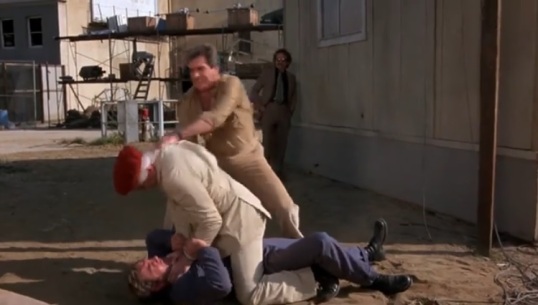
T.S. returns to staking out Nash’s house.  (He’s eventually joined by Greg, who simply cannot believe that Pam would frame him.)  “These kids are not playing kid games!” T.S. says.  Eventually, Nash and Pam drive off to small warehouse.  When T.S. follows them, Nash pulls a gun on them.

“You want to go to prison?” T.S. demands, “You know what prison’s like?  Being locked up in the small cell, 24 hours!  After you shoot me, who is next?  Is it Pam?  How about your father …. BECAUSE HE’S A JUDGE!”

(T.S. is really hung up on that.)

Nash points the gun at his own head.

“It’s not worth it, brother!” T.S. shouts.

A sobbing Nash surrenders himself.

Later, T.S. tells Amy, “Nash was just a little frightened kid, reaching out for love and attention.”

Here’s the thing — this all happened over the course of 30 minutes running time.  As a result, Nash’s surrender seemed to come out of nowhere.  This is an episode that would have benefitted from a full hour.  As it is, this episode ends on a jarringly abrupt note and therefore, Nash’s surrender is neither as effective nor satisfying as it should have been.

Episode 1.18 “A Victim of Fashion”

(Dir by Don McCutcheon, originally aired on May 9th, 1988)

“In this episode,” Mr. T tells us, “the world of fashion loses its glamour as threats and murder come into play.”

“I’m not going to hire no tux and go to no bourgeois fashion show and that’s that!” T.S. Turner tells Amy when she informs him that he has no choice but to accompany her to an uptown fashion show.  This leads to a genuinely amusing scene in which Amy leads T.S. onto an elevator, where T.S. is suddenly grabbed by two men who proceed to …. get his measurements so they can rent him a tuxedo.

Fashion designer John Merrick (Richard Monette) has hired Amy and T.S. because he was mailed a slashed up picture of his top model, Anita (Tonya Williams).  Anita doesn’t know that she’s being stalked and Merrick wants T.S. to be her bodyguard without explaining why.  Tonya, for her part, is just happy to be famous enough to require a bodyguard.

“Please,” T.S. tells her, “call me T.S.”

“Okay,” Anita replies, “if you’ll tell me what it stands for.”

“Tree Surgeon.”

Who could the stalker be?  Could it be the long-haired man wandering around with a camera?  Of course it is!  This is only a 30 minute show so it’s not like there’s time to develop a lot of suspects.  However, it turns out that Lonzo (Patrick Brymer) was not really stalking Anita as much as he was demanding that Merrick admit to stealing Lonzo’s designs.  When Merrick tries to murder Lonzo, T.S. is there to save the day!  Yay!

Again, just as with the other episode I looked at this week, this is an episode that would have been considerably more effective with a 60-minute running time.  With only 30 minutes to tell the story, it felt rushed.  There was a lot of comedic potential to the idea letting Mr. T loose in the fashion world but sadly, there was enough time to get to any of it.

Next week — T.S. quips his way through another case!  Evildoers beware!

Late Night Retro Television Reviews: Highway to Heaven 1.1 “Pilot: Part One”


Welcome to Late Night Retro Television Reviews, a feature where we review some of our favorite and least favorite shows of the past!  On Thursdays, I will be reviewing Highway to Heaven, which aired on NBC from 1984 to 1989.  The entire show is currently streaming on Tubi and several other services!

Highway to Heaven is one of those old shows that, decades after its final episode, still always seems to either be airing or streaming somewhere.  The show’s premise was a simple one.  Jonathan Smith (Michael Landon) was an angel who had been sent to Earth to help people.  Working with him was a retired cop named Mark Gordon (Victor French).  Together, they drove across the country and met a different guest star every week.

Though the show aired its final episode over 30 years ago and both of the stars have since passed on, Highway to Heaven remains popular in both syndication and streaming.  From the few episodes that I’ve seen, it appears that the show’s main appeal was just how unabashedly sentimental it was.  For people living in a cynical age, the show is a throwback to a simpler time.  Of course, I imagine that some people also find it to be a fairly campy show.  There’s nothing subtle about the messaging of Highway to Heaven. 

Anyway, it seems like a good show to review for Retro Television Reviews, so here we are.  Let’s head down that highway!

Episode 1.1 “Highway to Heaven: Part One”

(Dir by Michael Landon, originally aired on September 19th, 1984)

In a small town in Arizona, there’s a retirement community that is full of people who are in need.

For instance, Estelle Wicks (Helen Hayes) hasn’t left her room in years.  She’s convinced that her daughter is going to come to get her at any minute, even though everyone else at the community tries to get her to understand that her daughter hasn’t been by to see her in years.  That said, at least Estelle still has some hope.  Everyone else in the community appears to be resigned to spending all of their time indoors, watching television and waiting for the end.

Mr. Haskins (John O’Leary), the owner of the community, is struggling to pay the bills and is thinking of selling the retirement home to a group of land developers.  Mr. Haskins rarely smiles and hardly ever interacts with the people living at the community.  He doesn’t want them going outside or doing any special activities because he’s worried about potential lawsuits.  He’s not willing to spend the money necessary to even make the community look like an inviting place to live.

Mr. Haskins’s assistant, Leslie Gordon (Mary McCusker), is a lonely woman who lives in an apartment with her brother, Mark (Victor French).  Mark is a former cop who refuses to trust anyone and who can’t hold down a job.  He’s developing quite a drinking problem and spends most of his time either watching television and having a beer or going down to the local bar and having even more beer.

No one, and I mean no one, in this town appears to be happy.  But then a mysterious drifter named Jonathan Smith (Michael Landon) hitchhikes into town and applies for a job as a maintenance worker at the retirement community.  As he explains to Mr. Haskins, he doesn’t have any references but he’s willing to work without a salary for a month in order to prove that he can handle the job.  Mr. Haskins hires Jonathan, who immediately plants a flower garden and gets to know the residents at the retirement community.  He even gets Estelle to agree to take care of a puppy.

With Jonathan’s gentle encouragement, even Leslie starts to enjoy life a little bit more.  When Jonathan shows up one morning with a bicycle, Leslie rides it to work.  When Leslie asks Jonathan how he could afford the bike, he says that a friend gave it to him.  When she asks how Jonathan could afford to plant all of the flowers for the retirement home, he says that a friend helped out.  For a drifter who just came to town, Jonathan certainly seems to have a lot of friends!

This raises the concern of Mark, who thinks that Jonathan must be a conman of some sort.  He sets out to investigate just exactly who Jonathan is.  He first stop is the local bicycle shop, where the owner says that he’s never met a Jonathan Smith.  And then — the episode ends!  “TO BE CONTINUED” reads the title card.

It’s a rather abrupt ending, undoubtedly the result of the pilot originally being aired as a two-hour movie.  As often happens, the pilot was split into two parts for syndication.  Of course, the viewer already knows that Jonathan is an angel who has been sent to Earth to help people but the first episode of the series ends with Mark still convinced that Jonathan is just a con man.  I assume he’ll find out the truth next week.

As far as first episodes go, this one is hard to judge because it’s obviously incomplete.  That said, the pilot’s unapologetic earnestness is definitely its strongest trait.  Early on, Jonathan says, “Kindness doesn’t cost a thing,” and Michael Landon delivers the line with such sincerity that he makes it work despite the fact that it’s also a cliché.

Anyway, next week, we’ll finish up the pilot and see if Mr. Haskins will ever learn how to run a retirement community.  Hopefully, Estelle will finally come out of her room as well.  And, most importantly, we’ll see how Mark went from thinking Jonathan was a con artist to traveling around the country with him.

Until then, be kind.

Retro Television Reviews: Jennifer Slept Here 1.1 “Pilot”


Welcome to Retro Television Reviews, a feature where we review some of our favorite and least favorite shows of the past!  On Thursdays, I will be reviewing Jennifer Slept Here, which aired on NBC in 1983 and 1984.  The entire show is currently streaming on YouTube!

Since it is October, I figured why not take a look at short-lived sitcom about a ghost?  What’s the worst that could happen?  (Heh heh….)

Episode 1.1 “Pilot”

(Dir by Charles S. Dubin, originally aired on October 21st, 1983)

Jennifer Farrell was, at one time, the world’s biggest movie star but then, in a tragic accident, an ice cream truck backed over here and she lost her life.  Three years later, her former lawyer, George Elliott (Brandon Maggart, the father of Fiona Apple), has decided to move into her Hollywood home.  Accompanying him is his wife, Susan Elliott (Georgia Engel), his 8 year-old daughter Marilyn (Mya Akerlin), and his teenage son, Joey (John P. Navin, Jr.)

Joey is not particularly happy about having moved from New York to California.  First off, he left behind his girlfriend, Elizabeth.  Secondly, a Hollywood tour bus keeps driving by and announcing that his new home is the former home of Jennifer Farrell.  Finally, Jennifer’s ghost (Ann Jillian) is living in his bedroom, which is something that Joey discovers when he tries to close the window.

Jennifer, it turns out, likes to keep the window open so she can hear the tour bus announce her name.

Joey refuses to accept that Jennifer is a ghost but then his father enters the bedroom and says that he can’t see the woman that Joey claims is standing at the window.  Then, after his father leaves, Joey tries to grab Jennifer and his hand goes through her shoulder.

Remarkably, it doesn’t take Joey that long to accept that his house is haunted by a ghost that only he can see.  Perhaps that’s because Joey isn’t planning on sticking around the house for long.  He’s planning on running away from home and catching the next flight back to New York City.  Fortunately, Jennifer is there to grab the suitcase from his hand (and yes, we get a shot of the suitcase floating up the staircase with the wires barely visible) and explain to him that everything that he needs is in the house, with his family.  She also encourages Joey to flirt with the girl who lives next door.  Problem solved!

It’s a remarkably simple pilot.  In fact, it’s a bit too simple for its own good.  Joey is a bit too quick to accept that ghosts are real but, even more importantly, his parents and his best friend, Marc (Glenn Scarpelli), are surprisingly quick to ignore the fact that Joey keeps talking to himself and yelling at someone who they can’t even see.  As well, it’s never really explained why George decided to move his family into Jennifer’s home, especially since George continually refers to Jennifer as being both his worst client and as being a “tramp.”  That said, the pilot did what a pilot was supposed to do.  It introduced the characters and it spread the seeds for future storylines.  The majority of the cast seemed a bit lost but Ann Jillian delivered her lines with just the right amount of ghostly sassiness.  The main problem with the pilot is that it wasn’t particularly funny but traditionally, pilots are usually the weakest episode of any sitcom.  So, let’s see how things go over the next few weeks!

Late Night Retro Television Reviews: Monsters 1.1 “The Feverman”


Welcome to Late Night Retro Television Reviews, a feature where we review some of our favorite and least favorite shows of the past!  On Wednesdays, I will be reviewing Monsters, which aired in syndication from 1988 to 1991.  The entire show is streaming on Youtube.

Monsters was an anthology series that ran, in syndication, from 1988 to 1991.  It was produced by Richard Rubinstein and Mitchell Galin, who had previously produced another anthology series called Tales From The DarksideMonsters, unlike Tales, almost exclusively focused horror stories and, as the title suggests, each story featured at least one monster.  As well, each episode opened with a family of monsters sitting around a television and looking for something to watch.

Sounds like fun!  I’m looking forward to watching and reviewing this series for Through the Shattered Lens.

Episode 1.1 “The Feverman”

(Dir by Michal Gornick, originally aired on October 22nd, 1988)

Timothy Mason (John C. Vennema) is in a panic because his daughter (Michele Gornick) has a contracted a fever and is now on the verge of death.  When Mason’s friend, Dr. James Burke (Patrick Garner), is unable to lower the girl’s fever, Mason decides to take her to see the Boyle (David McCallum), the feverman.  A disreputable fellow who is never seen without a glass of liquor in his hand and a dingy crystal hanging out around his neck, Boyle claims that he can pull fevers out of those suffering.  He charges a good deal of money for his services but he also claims that, unlike the doctors of the world, he’s never lost a patient.  Indeed, Boyle claims that, if anyone brought to him died, he would die as well.

Burke goes with Mason to Boyle’s house and, when Boyle announces that he must be alone with Mason’s daughter in order to cure her, Burke denounces him as being a charlatan.  Still, Mason agrees to leave his daughter alone with Boyle in Boyle’s basement.  However, as Burke and Mason wait for Boyle to return from the basement, they grow impatient and Burke pressures Mason to disobey Boyle’s orders.  Finally, Burke and Mason head into the basement and that’s where they catch Boyle wrestling with this thing….

It turns out that Boyle wasn’t lying when he said that he could literally bring the fever out of a patient.  However, when Burke and Mason interrupt him, that allows the fever monster to once again reenter Mason’s daughter.  The crystal necklace falls off Boyle’s neck.  Boyle explains to Burke that he is now dying and he can no longer fight the fever.  And, because it’s all Burke’s fault, it is now Burke’s obligation to wear the crystal and battle the fever.

Realizing that he’s at fault, Burke puts on the crystal and he wrestles with the fever monster.  Burke manages to destroy the monster but, afterwards, he discovers that he cannot take the crystal off.  As Boyle explains it, Burke is the new feverman and he will now wear the crystal until the day he dies.  Mason, happy that his daughter is now cured, still refuses to stick around to talk to Burke afterwards.  Burke is now an outsider.  Resigned to his fate, Burke starts drinking and prepares to meet his next patient.

This was an effective episode, featuring a wonderfully dissolute performance from David McCallum as Boyle and plenty of grimy atmosphere.  Maybe it’s just because I’m still getting over having the flu last week but the fever monster totally freaked me out.  I imagine that creature probably is what a fever really would look like.  This episode was the exact right way to start things off for Monsters!

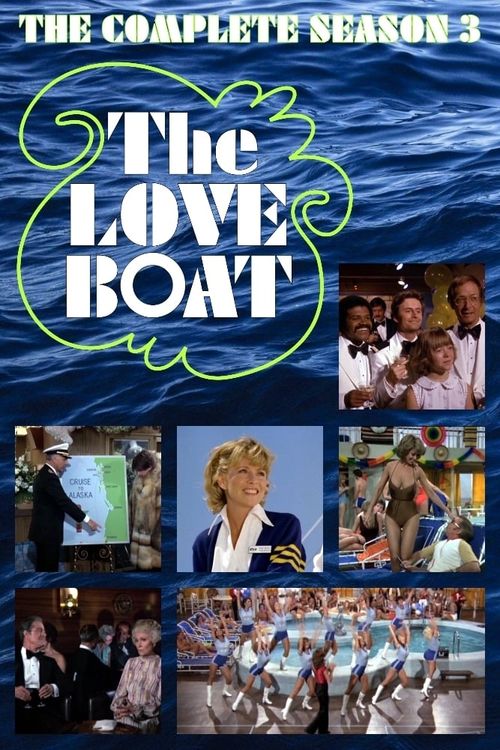
Retro Television Reviews: The Love Boat 3.9 “Trial Romance/Never Say Goodbye/A New Woman”


Welcome to Retro Television Reviews, a feature where we review some of our favorite and least favorite shows of the past!  On Wednesdays, I will be reviewing the original Love Boat, which aired on ABC from 1977 to 1986!  The series can be streamed on Paramount Plus!

This week, the Love Boat gets a new member of the crew!

Episode 3.9 “Trial Romance/Never Say Goodbye/A New Woman”

(Dir by Gordon Farr, originally aired on November 3rd, 1979)

This episode is a big one for Captain Stubing so let’s quickly get the non-Stubing storylines out of the way.

First off, Barney Briscoe (Louis Nye) and Rose Kennycott (Gale Storm) are two older passengers who board the ship looking for love.  Since they’re both kind of old-fashioned and not a fan of public displays of affection, Julie thinks that they would be perfect together.  Unfortunately, while Barney does like Rose, he also thinks that Julie is hitting on him while Rose thinks that the man Julie says likes her is Doc Bricker!  Rose decides to take matters into her own hands and heads to Doc Bricker’s office.  Thinking that she’s feeling ill, Doc tells her to go in the exam room and remove her clothes.  Rose, fearing that things are moving too quickly, flees from Bricker’s cabin.  Fortunately, she and Barney do end up together but Barney is always in such a cranky mood that you can’t help but feel that Rose is going to get tired of dealing with him after a week or two.

Meanwhile, Harry Stewart (Vic Tayback) boards the ship, fresh from getting finished with jury duty.  He was a part of jury that heard a case that drew national attention.  A woman was accused of poisoning her husband and the trial ended with a hung jury.  Harry explains to Gopher and Isaac that 11 men were ready to convict but the one woman on the jury refused to vote guilty.  That woman is Ann Noyce (Jo Ann Pflug) and — surprise! — she’s also a passenger.  Harry and Ann spend the entire cruise arguing the facts of the case before eventually falling in love. It’s a typical Love Boat storyline and Tayback and Pflug don’t exactly have the greatest romantic chemistry.  It’s easy to believe them when they’re arguing but not quite as easy to buy them as sudden lovers.

But really, the only storyline that matters is the one involving Captain Stubing and his daughter Vicki (Jill Whelan, who is listed as a guest star for this episode but joins the regular cast next week).  Now 11 years old, Vicki has been writing to Stubing on a regular basis and telling him about how much she wishes she could see him again.  However, Stubing tells Bricker that he has resolved never to see Vicki again because it would be too painful for him to have to say goodbye to his daughter all over again.  However, Vicki has discovered that Stubing is her father and she decides to take matters into her own hands by running away from home and boarding the ship in Acapulco.  Stubing finally admits that he is Vicki’s father but he still feels that a ship is not the right place for a child.  He returns her home to her aunt, just to discover that her aunt is in the middle of a divorce and she feels that Vicki should be with her father.  Stubing and Vicki return to the ship, where Vicki will now live.

Awwwwww!

Actually, I’m not totally sure how this thing with Vicki living on the ship is supposed to work.  She’s 11 years old, which is a bit young to be working on a cruise ship.  Does the Love Boat have a school on one of its decks?  Is Vick really going to be happy living on a boat that is largely populated by elderly people?  There’s a lot of questions to be considered but it really doesn’t matter.  Gavin MacLeod gives such a sincere and emotional performance that it feels almost churlish to obsess on the specifics of how Vicki is going to be raised.  Captain Stubing has always been more interesting of character than one might assume.  Though he’s often a bit goofy and it’s hard not to cringe whenever he gets a storyline that requires him to flirt, Gavin MacLeod always did a wonderful job of showing Stubing’s more vulnerable side.  Whether he was talking about Vicki’s mother or his own struggles with alcoholism, there was always an undercurrent of melancholy with Captain Stubing and MacLeod always seemed to make the most of those scenes that allowed Stubing to open up about his life and regrets.

In the end, the viewer is just happy that Captain Stubing has finally been reunited with his daughter.

Next week: The Dallas Cowboy Cheerleaders board the ship!

Late Night Retro Television Reviews: Gun 1.1 “The Shot”


Welcome to Late Night Retro Television Reviews, a feature where we review some of our favorite and least favorite shows of the past!  On Tuesdays, I will be reviewing Gun, an anthology series that ran on ABC for six week in 1997.  The entire show is currently streaming on Tubi!

Produced by filmmaker Robert Altman, Gun was an anthology series that followed one gun from person-to-person.  Each week would feature a new cast and a new story.  The show itself didn’t catch on but, because of Altman’s prestige, is still managed to attract some prominent and interesting guest stars during it’s 6-episode run.

The first episode, for instance, brings the gun together with Daniel Stern, Ed Begley, Jr., and model Kathy Ireland.

Episode 1.1 “The Shot”

(Dir by James Foley, originally aired on April 12th, 1997)

The first episode of Gun opens with an unnamed dumbass purchasing a pearl-handed, .45 semi-automatic pistol.  When he takes it home, his kids are impressed but his wife threatens to kick him out if he ever fires the gun in the house.  Next thing you know, the dumbass is pretending to be Robert De Niro in Taxi Driver and pointing the gun at the television.  The final shoot-out from The Good, The Bad, and The Ugly leads to the TV getting shot.  The dumbass returns the gun.  Later, that night, someone breaks into the gun store and steals the gun.

Who stole it?  It turns out that it was just a guy who spends his time holding up convenience stores.  Unfortunately, his next attempt at a convenience store robbery does not go well, largely due to one aggravated customer.  Harvey Hochfelder (Daniel Stern) is already in an agitated state before the robbery even begins.  He just wants to leave Los Angeles for Virginia but, before he can leave, he had to stop off at the slowest convenience store in L.A.  Harvey loses it as soon as he realizes that the robbery is going to mean his escape to Virginia is going to be even further delayed.  When Harvey’s wife (Kathy Baker) enters the store, the robber is startled into first shooting at Harvey and then dropping the gun.  The robber runs outside and tries to steal Harvey’s car, with Harvey’s son and dog in the back seat.  Harvey grabs the gun and chases the robber down.  The robber crashes the car and Harvey holds him at gun point until the police arrive.

Harvey becomes a celebrity.  He even appears on the cover Newsweek, with the simple headline, “American Hero.”  Hollywood wants to make a made-for-TV movie about what happened in the convenience store, with Harvey playing himself and Kathy Ireland playing his wife.

Unfortunately, the friends of the robber are not happy that Harvey “fingered our homie” (yes, that’s actual dialogue) and they decide that they want to get revenge on Harvey.  When they force his car off the road and then pull guns of their own on him, Harvey diffuses the situation by offering them roles the movie.  Everyone wants to be a star!

Finally, the day of filming has arrived.  Under the guidance of the film’s director (Ed Begley, Jr.), Harvey prepares to climb into bed with a lingerie-clad Kathy Ireland….

Suddenly, Harvey is back in the convenience store, getting shot multiple times by the robber and expiring as a security camera records his final moments.  His entire time as a Hollywood star was just a dying fantasy which, honestly, was kind of obvious just by how cartoonish all of the Hollywood scenes were.

Well, as far as first episodes are concerned this was really, really …. bad.  Anthology shows are always a bit hit-and-miss and this episode was definitely almost all miss and no hit.  As good a character actor as he may be, Daniel Stern overacts to such an extent in this episode that it’s difficult to really have much sympathy for Harvey and the episode’s final twist largely fell flat.

The first episode of Gun is an almost entire …. dare I say it? …. misfire.

Retro Television Reviews: Fantasy Island 3.17 “Playgirl/Smith’s Valhalla”


Welcome to Retro Television Reviews, a feature where we review some of our favorite and least favorite shows of the past!  On Tuesdays, I will be reviewing the original Fantasy Island, which ran on ABC from 1977 to 1986.  Almost entire show is currently streaming is on Youtube!

This week, Leslie Nielsen returns to Fantasy Island!

Episode 3.17 “Playgirl/Smith’s Valhalla”

(Dir by Michael Vejar, originally aired on January 26th, 1980)

This week, Tattoo is super excited because one of the guests is Erica Clark (Barbie Benton), a famous centerfold for Rooster Magazine!  Erica, however, no longer models.  As she explains to Mr. Roarke, she grew tired of men treating her as just being a sex object.  Indeed, her fantasy is to be able to treat men the same way!  (Today, of course, Erica could save however much money she spent for the fantasy by simply watching clips of Magic Mike on YouTube.)

In perhaps the simplest fantasy that Mr. Roarke has ever put together, he sends Erica to the Island’s famed Jackrabbit Club, where men dance while women watch.  Again, to be clear, all Mr. Roarke had to do was send her to the island’s version of Chippendales.  I mean, Erica could have just done that on her own.  Anyway, Erica witnesses one of the dancers, Walter Wilde (Fabian Forte), getting fired for refusing to go along with being sexually harassed by one of the women in the audience.  Relating to Walter, his desire to go to medical school, and his life as a single father to Dinah (Heather McAdam), Erica agrees to come out of retirement and pose (in a bikini with a big rooster tail hooked on the back) for the club’s owner, Big Earl Sanderson (Denny Miller).  However, when Big Earl demands that Erica do more than just pose, Walter is there to punch him out.

Anyway, it turns out that Dinah’s fantasy was for Walter to fall in love and Roarke combined her fantasy with Erica’s, presumably to save some money.  So, Erica, Walter, and Dinah leave the island together and I guess Erica learns that …. well, I’m not sure anyone learned anything.  This was a pretty weak fantasy that claimed to be about treating men as sex objects but spent the majority of time looking for excuses to put Barbi Benton in a bikini.  Seriously, Jackrabbit was the tamest male strip club I’ve ever seen.

Meanwhile, the Island finds itself in what should be an international incident after a group of dirty commies hijack a plane and make it land at an abandoned Fantasy Island airport.  The communists say that they are doing this because they have to get people to pay attention to their cause but it’s hard not to notice that there’s next to no media coverage of the events, there are no soldiers or police surrounding the airport, and Mr. Roarke merely shrugs it off.

The only person who does care is Jason Smith (Hugh O’Brian), whose fantasy is to lead a combat mission.  The fantasy becomes personal for Jason when he discovers that his wife (Emily Banks) is one of the hostages!  Mr. Roarke arranges to Jason to work with three combat experts.

Buck Tanner (Sean Garrison) is an explosives expert who suffers from war flashbacks.

“Weasel” Forbes (Charlies Dierkop) is a wild sniper.

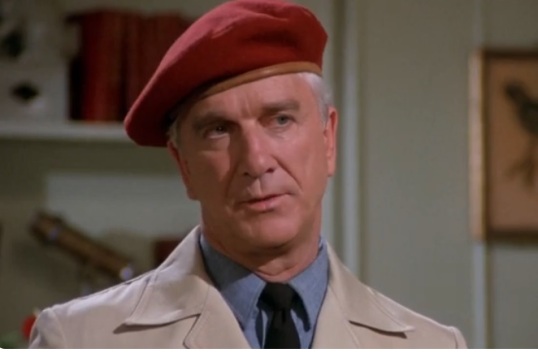
And French soldier of fortune Emile Bouvier is …. LESLIE NIELSEN!

Yes, this episode of Fantasy Island features Leslie Nielsen is one of the last of his “serious” roles, playing a French mercenary by wearing a red beret and not even attempting an accent.  Bouver is tough and no-nonsense, as we learn when he catches Buck drinking on the job.

Anyway, Jason is able to rescue his wife and the other hostages and the communists are all arrested and hopefully sacrificed to the Fantasy Island mermaid.  Bouvier sacrifices his life to save Jason’s but Mr. Roark explains that it was no big deal because Bouvier was dying anyways and his fantasy was to end his life doing something heroic.  Once again, it appears that Mr. Roarke saved some money by combining fantasies.  Was Fantasy Island feeling the effects of the Carter recession?  Perhaps.

Other than Leslie Nielsen playing a serious role, probably the most interesting thing about this episode is that Mr. Roarke and Tattoo barely spoke to each other over the course of it.  There was none of the usual comedic banter or anything like that.  Indeed, even in the scenes greeting and saying goodbye to their guests, Ricardo Montalban and Herve Villechaize refused to every look at each other.  Obviously, it wasn’t all happy days on Fantasy Island.

Last Night Retro Television Reviews: Nightmare Cafe 1.1 “Nightmare Cafe”


Welcome to Late Night Retro Television Reviews, a feature where we review some of our favorite and least favorite shows of the past!  On Mondays, I will be reviewing Nightmare Cafe, which ran on NBC from January to April of 1992.  The entire show is currently streaming on YouTube!

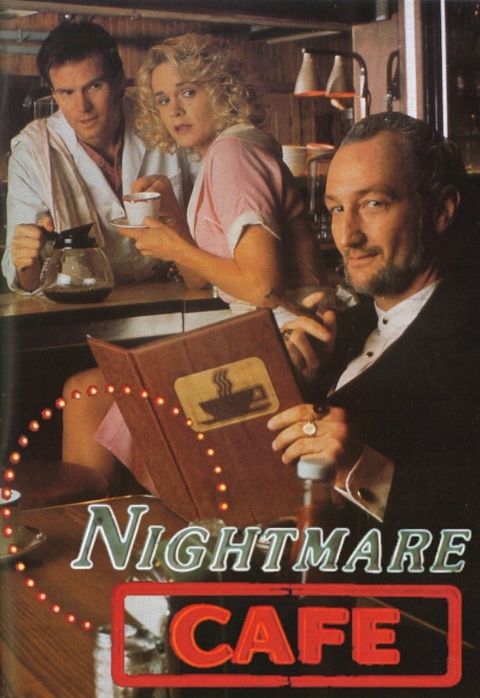
Created by Wes Craven and Thomas Baum, Nightmare Café was an anthology show about a mysterious café and the people who worked there.  The proprietor was played by Robert Englund.  The series only aired for six episodes and apparently, NBC didn’t really give the show much of a chance to find an audience.  Myself, I just recently came across it on YouTube and I’m looking forward to reviewing it over the course of October!

Episode 1.1 “Nightmare Café”

(Dir by Phillip Noyce, originally aired on January 29th, 1992) 

“See those two folks up there?” Robert Englund, playing a sharply-dressed man named Blackie, asks while staring straight at the camera.  “They’re about to get a second chance.  And you know what?  I bet they blow it.”

The two people to whom Blackie is referring are Frank Nolan (Jack Coleman) and Fay Pernovic (Lindsay Frost).  On a foggy night, Fay stops her car on the side of the bridge and jumps into the water below.  Fortunately, Jack already happens to be in the water so he grabs her and pulls her to dry land.  Standing on the deserted road and soaking wet, Fay refuses to say thank you and Frank refuses to mention why he was there to begin with.  However, when they see an all-night café in the distance, they decide to get a cup of coffee.  As they head to the café, Blackie watches them from the shadows.  As they enter the café, the neon sign changes from saying “Night Café” to “Nightmare Café.”

The café appears to be deserted, though in working order.  Jack goes behind the counter finds a chef’s outfit.  Fay finds a waitress outfit.  When she heads into the restroom to change clothes, she briefly hears the sound of a woman crying but, upon entering, she finds no one.  Meanwhile, Jack notices that a TV screen at the front of the café has come to life and …. uh-oh!  He’s suddenly watching what appears to be security footage of Fay removing her wet clothes.  Jack does the right thing and turns the TV off but seriously, what’s happening with this place!?

In the restroom, Fay marvels at how well the waitress uniform fits, almost as if it was made for her.  Suddenly, she hears more crying.  She touches the bathroom mirror and she sees herself sobbing and pulling pills out of a medicine cabinet.

Fay steps back into the main part of the café.  Frank confesses about watching her change on the television.  Fay demands to know what color underwear she was wearing.  “White …. with red hearts on back,” is Frank’s reply.  (For the record, as I sit here typing this, I am wearing black underwear with red hearts on the back.)  Fay accuses him of being a pervert and peeking in on her while she was changing.  Frank turns on the TV in an attempt to prove that he’s not a perv but, instead of showing the restroom, the TV shows the chemical plant where, according to Frank, he works as a night watchman.  He watches as two men steal a barrel of chemical waste and brag about how they’re going to dump it into the harbor.  Frank says that his worst nightmare is seeing something that’s wrong and not doing anything to stop it.  Fay pinches Frank in an attempt to wake him up.  On the TV screen, Frank Nolan tries to stop the men from driving off with the chemical waste.  Frank is fired and then knocked unconscious.

Realizing the Frank has vanished from the café, Fay runs over to a payphone and dials 9-1-1, just to be informed that the number cannot be reached.  Fay opens the door to the café and discovers that she and the café are apparently floating in space!

Returning to the television, Fay sees that, at the chemical plant, Frank is still on the ground and his employer tells a bunch of thugs that he wants them to make Frank watch as they dump the waste into the harbor.  However, once the thugs drive down to the harbor, Frank jumps out of the trunk of their car and into one of the trucks transporting the chemical waste.  The thugs shoot at the truck until it explodes and then decide that it’s time to get a cup of coffee.

Realizing that the thugs might be coming, Fay decides she better pretend to be a real waitress.  She grabs a cup of coffee and walks into the back where she discovers Frank rising out of a water-filled sink.  “You know what?” Frank says, “I don’t think this is your run-of-the-mill all night café!”

Fay congratulates Frank on doing the right thing and standing up to the thugs.  Suddenly, Fay starts to worry about what she saw in the restroom so she and Frank enter and, in the mirror, they see the two thugs approaching the cafe.  Frank and Fay run into the kitchen.  Frank opens a door marked exit and plunges back into the harbor.  Fay closes the door and then opens it again and finds herself staring at a back alley.  Deciding to face the thugs, she heads to the front of the café, where the two thugs demand to know where Frank is.  She tells them that he’s in the ladies room.  They rush into the restroom and suddenly find themselves on a police shooting range with a bunch of cops aiming their guns at them.

“This place has possibilities,” Fay says as the two thugs run from the café.

Suddenly, the TV turns on Fays sees herself in her bedroom, getting dressed for a date.  Frank steps back into the café and watches the TV, barely noticing that Fay has vanished from the café.  While he’s doing this, Blackie steps into the café and, breaking the fourth wall, says, “This ought to be interesting.”

On the television, Fay gets a call from a guy named Al (John D’Aquino) who explains that he’ll be delayed but he’ll see her later.  Frank recognizes Al as being his boss at the chemical plant and then he realizes that Blackie also worked at the chemical plant and was one of the people who always told him not to waste his time reporting the toxic waste dumping.  Blackie holds up a deck of cards and says that whoever pulls the low card will pay for their meal.  Frank says that the only person that he’s betting on is Fay.

On the TV, Fay drives towards Al’s house.  Suddenly, Frank is standing on the side of the road and hitchhiking.  Fay gives him a ride and suddenly, the two thugs pop up and start shooting at them.  Fay speeds off, with Frank in the car.  Fay outmaneuvers the pursuing thugs, who end up crashing their car into the harbor.

Suddenly, Blackie is the only one sitting in the café.  He watches Fay and Frank talk in the car.  Frank tells Fay all about Al and Fay kicks Frank out of the car, not understanding how he could possibly know her name.  Suddenly, Frank is back in the café.  He and Blackie watch as Fay knocks on the door of Al’s penthouse.  No one answers and Frank cheers as Fay starts to walk away.  Suddenly, Blackie appears on the television and unlocks the door so Fay can enter the penthouse.

Fay gives Al a really ugly sweater for his birthday but is then shocked to discover that Al is at the penthouse with another woman (played by Carrie-Anne Moss in an early role), who promptly asks if Fay is the maid.  As Fay heads for the penthouse’s bathroom, one of the thugs shows up and announces that he previous saw Fay at the café.  Meanwhile, Fay searches the medicine cabinet for pills before heading back to her car

Seeing Fay driving towards the harbor on the television, Frank runs out of the café to save Fay again.  But this time, instead of jumping into the harbor, Fay looks at the water and then says that it would be foolish to kill herself over a loser like Al.  Suddenly, Al drives up and Fay and Frank have to jump into the water to avoid getting hit.  However, once they hit the water, Frank realizes that they’re already dead.

Upon figuring this out, Frank and Fay are transported back to the café where Blackie tells them that they’re dead in the real world but they’re alive in the café and now, they get to make a difference in other people’s lives.  Blackie opens the door, to show Frank and Fay that they are once again floating in space and that the Earth in the distance.  Blackie tells them that they’ve been selected by “a higher authority” to help the people who enter the café and “maybe learn a little about yourselves along the way.”  But they’re both dead so what’s left to learn?

Suddenly, Al enters the café.  Blackie tells Al that Frank and Fay are in the restroom.  Al steps into the restroom and suddenly has a vision of Fay testifying against him in court.  Terrified, Al runs from the café but, upon opening the door, he plunges through space and lands in a vat of chemical waste.

A woman (played by Joan Chen of Twin Peaks fame) opens the front door.  “Hi,” she asks, “Are you open?”

Nightmare Café only ran for 6 episodes and anthology shows are notorious for being uneven.  All that considered, I really enjoyed the pilot for Nightmare Café, with its twisty plot, frequently surreal visuals, and — last but not least — Robert Englund having what appears to be a lot of fun as the show’s host.  The pilot was directed by Philip Noyce, who keeps the action moving a great pace.  Even more importantly, from their first scene together, Lindsay Frost and Jack Coleman have a lot chemistry.  I’m looking forward to watching the remaining episodes and seeing where all of this goes!

Retro Television Reviews: Miami Vice 1.4 “Cool Runnin'”


Welcome to Retro Television Reviews, a feature where we review some of our favorite and least favorite shows of the past!  On Mondays, I will be reviewing Miami Vice, which ran on NBC from 1984 to 1989.  The entire show is currently streaming on Tubi!

This week, Crockett and Tubbs gain an informant!

Episode 1.4 “Cool Runnin'”

(Dir by Lee H. Katzin, originally aired on October 5th, 1984)

One of the main themes of Miami Vice was that, no matter how many drug lords that Crockett and Tubbs got off the streets, there was always someone in the wings waiting to replace them.  The drug trade was (and is) big business and there was always someone willing to step into the vacuum that was left by the downfall of any of the major players.  For all of their efforts, Crockett and Tubbs were essentially fighting a war on drugs that could not be won.

Cool Runnin’ features an early example of this.  With Calderone having fled Miami for Colombia, he’s been replaced by Desmond Maxwell (Afemo Omilami), a Jamaican who is willing to murder just about anyone who gets in his way.  When he’s first seen, he and the members of his gang are gunning down a group of rival drug dealers in a mall parking lot.  Later, Desmond kills one undercover cop and seriously wounds another.

Another major theme in Miami Vice is that Crockett (and, to a lesser extent, Tubbs) are willing to put others at risk to take down their targets.  The majority of this episode deals with Nugart Neville ‘Noogie’ Lamont (Charlie Barnett), a talkative thief and speed freak who is recruited, somewhat against his will, to be an informant.  When Crockett and Tubbs discover that Noogie served time with Desmond, they use Noogie to set up a meeting with Desmond.  When Crockett tells Desmond that he wants to buy from him and that he’ll be waiting for him at Noogie’s apartment, Tubbs points out that Crockett is putting Noogie’s life in danger without even bothering to tell Noogie beforehand.

(Crockett, it should be noted, isn’t thinking straight for most of this episode because his wife has filed for divorce and wants to take his son to Georgia.)

At first, it appears that Noogie is going to get a reprieve when a calls comes in that the man who killed the undercover cops has been arrested.  It doesn’t take long for Crockett (and the audience) to figure out that the man who has been arrested is not Jamaican (instead, he’s Haitian) and that he’s been beaten by the racist cop who arrested him.

Instead, the killers are now at Noogie’s apartment, where they are waiting for Crockett and Tubbs to show up so that they can kill both the cops and their informant.  It all leads to final shoot-out, one that is shown almost entirely in slow motion and which is surprisingly effective.

This was a good episode about the human cost of getting involved as law enforcement, whether as a cop or a criminal.  While Desmond Maxwell was not a particularly nuanced character, he was appropriately intimidating and the audience never had any doubt that he would coldly kill anyone who he viewed as being a threat.  (One of the more haunting moments of the episode features the Vice Squad listening to the tape of shooting in which Desmond gunned down two detectives.)

The episode was largely dominated by Charlie Barnett’s performance as Noogie.  Barnett was a stand-up comedian who first came to prominence performing in Central Park.  He was nearly cast on Saturday Night Live until it was discovered that he struggled with reading.  Barnett was replaced, at the last minute, by another New York comedian, Eddie Murphy.  As Noogie. Barnett never stops moving, talking, and performing.  It’s actually exhausting just watching him.  But, as the episode proceeds, Barnett starts to calm down and, by the end of it, the audience is actually happy that he wasn’t killed in the shoot-out.

Unfortunately, next week, a major character will be killed in a shootout.  Who?  Find out next Monday!

Late Night Retro Television Reviews: Degrassi Junior High 1.1 “Kiss Me, Steph” and 1.2 “The Big Dance”


Welcome to Late Night Retro Television Reviews, a feature where we review some of our favorite and least favorite shows of the past!  On Sunday, I will be reviewing the Canadian series, Degrassi Junior High, which aired on CBC and PBS from 1987 to 1989!  The series can be streamed on YouTube!

As much as I love Degrassi, I have to admit that I’ve never really sat down and watched the two shows that launched the entire franchise, Degrassi Junior High and Degrassi High.  I figured why not give it a shot now?

Episode 1.1 “Kiss Me, Steph”

(Dir by Kit Hood, originally aired on January 18th, 1987)

Welcome to Toronto!  It’s time for a new school year at Degrassi Junior High!

As I watched the first episode of Degrassi Junior High, the first thing I noticed was just how grainy and depressing everything looked.  As opposed to the bright lighting and vibrant colors of Degrassi: The Next Generation, the world of Degrassi Junior High looked overcast and not always inviting.  The school itself looked old, as if it had been a while since anyone bothered to paint the walls or even sweep the floors.  In short, visually, Degrassi Junior High looked pretty much like a real middle school.  The overcast imagery neatly mirrored the way that most people feel when they’re starting the first day of school, especially if it’s a new school.

It’s the first day of school for Arthur Kobalewscuy (Duncan Waugh) and, being short and way too trusting for his own, it doesn’t take long before the school prankster, Joey Jeremiah (Pat Mastroianni), tricks him into getting locked into the janitor’s closet.  Poor Arthur but, far more importantly …. JOEY!  As any true fan of Degrassi knows, Joey would go on to become one of the most important parts the franchise, both in the original series and a good deal of The Next Generation as well.  In the first episode, he’s far a cry from the likable Joey that we all know.  Instead, he’s just an obnoxious kid who wears a fedora to school.

Arthur is the younger brother of Stephanie Kaye (Nicole Stoffman), who is the most popular girl in the school.  One would think that this would be a good thing for Arthur but Stephanie begins the school day by ordering Arthur not to talk to her because she’s in “grade 8” and he’s only in “grade 7.”  Stephanie and Arthur’s parents are divorced, with Stephanie living with her mother and Arthur living with her father.  Stephanie is determined to have a new image for Grade 8 and, as soon as she steps into the school, she heads to the bathroom and takes off her boring white blouse and blue skirt to reveal the crop top and tight jeans that she’s wearing underneath.  Her best friend, the somewhat dour Voula (Niki Kemey), watches in horror as Stephanie puts on makeup.  (I usually waited until I arrived at school to do my makeup as well.)

When Stephanie hears an announcement that student council elections are coming up, she decides to run for President.  Voula is happy to serve as Stephanie’s campaign manager until Stephanie starts exchanging kisses for votes.  Voula is scandalized that Stephanie isn’t talking about the issues and is running with the slogan, “All The Way With Stephanie Kaye.”  Voula warns Stephanie that none of the girls are going to vote for her but Stephanie explains that she only needs the votes of the boys.  Of course, the main reason why Voula is upset is because Stephanie is giving all the credit for her successful campaign to Joey instead of her.

(Interestingly enough, one of the first episodes of Degrassi: The Next Generation also featured a student council election and a sister trying to ignore her dorky younger brother.)

While Stephanie is winning over the boys, Arthur finally manages to get a new friend named Yick Yu (Siluck Saysanasy).  Yay, everyone needs a friend!

Stephanie wins the election.  The announcement is made while Stephanie is in home room where her teacher is none other than Mr. Raditch (Dan Woods), who would later be the first of many principals on Degrassi: The Next Generation.  Joey jumps up and hugs Stephanie as the announcement is made.  “Mr. Jeremiah!” Mr. Raditch snaps, “Not in my class!  Save that behavior for the polls!”

(Fortunately, Mr. Raditch would warm up to Joey by the time that Joey’s stepson was enrolled in the school.  But that’s not going to happen for a while….)

Having won the election, Stephanie discovers that she’s actually expected to do a lot of stuff, like give a speech to the PTA.  Stephanie begs Voula to write the speech for her but Voula tells Stephanie that she doesn’t want to be her friend anymore.  “You’re on your own, Ms. President!  You and your new image!”

Oh well.  With great power comes great responsibility and all that stuff.  Personally, I think Stephanie should just blow off the speech.  And really, Voula is being a bit too self-righteous here.  I mean, it’s student council.  It means nothing!  The episode ends with Stephanie swearing that she’s going to be the best president that the school has ever had but it shouldn’t be that difficult since it’s not like the president makes school policy or anything.  As Stephanie, once again dressed modestly, leaves the school, she finally acknowledges Arthur as her brother and Arthur offers to write the speech for her.

This was not a bad way to start the franchise and I enjoyed spotting future Degrassi stars like Wheels, Snake, and Spike wandering around the school.  This episode did a good job of capturing the silliness of student council elections and also the way every day of high school and middle school can feel like the biggest drama ever.  Arthur and Yick are likable in their nerdy way.  I related Stephanie.  Voula kind of needs to get over herself but we all had a friend like that in school, didn’t we?

Episode 1.2 “The Big Dance”

(Dir by Kit Hood, originally aired on January 25th, 1987)

It’s time for the fall dance!

Voula, who is still unreasonably angry with Stephanie, suggests that they use the dance as a way to raise money for the foster child that the school is sponsoring.  Everyone thinks this is a great idea and they think Voula should give a speech while handing over the money at the end of the dance.  Unfortunately, Voula’s superprotective father (Paul Brock) refuses to allow Voula to stay out past 9:30.  He also freaks out when he sees that Voula is wearing lipstick and suddenly, it makes more sense why she’s so jealous of Stephanie.

As for Stephanie, she asks Wheels (Neil Hope) to take her to dance and — OH MY GOD, IT’S WHEELS!  Now, as anyone who knows anything about Degrassi can tell you, Wheels eventually became one of the most important characters on the show.  As soon as I saw Joey talking to him, I immediately started to think about the fact that this is the same Wheels who is going eventually lose his parents to a drunk driver, get molested while hitchhiking, develop a drinking problem, and end up going to prison shortly after graduating high school.  In this episode, though, he’s just a pleasant-natured friend of Joey’s.

Voula lies to her father about spending the night with a study group and instead, heads to the dance.  Meanwhile, Stephanie goes to the house of her friend Lucy Fernandez (Anais Granofsky) so she can change into her school dance clothes.  (Fans of Degrassi know that Lucy is destined to end up getting temporarily blinded and crippled as a result of Wheels driving drunk.)  Along with the two creepy twins, Heather and Erica (Maureen and Angela Deiseach), Stephanie ends up having way too much to drink at Lucy’s.

The end result is that Stephanie shows up drunk at the school dance and ends up embarrassing herself in front of Wheels while Voula is caught breaking curfew by her father.  In typical Degrassi fashion, no one gets a happy ending!

I kind of groaned a little when I saw that this was going to be a Voula episode but actually, the episode did a good job of showing why Voula got so angry at Stephanie.  As well, in what would be a Degrassi hallmark, the episode handled the theme of underage drinking with sensitivity as opposed to judgmental melodrama.  Yes, Stephanie has too much to drink and ruined her date but the episode understood that, rather than being the end of the world, this is just a part of growing up.  On Degrassi Junior High, teenagers were allowed to make mistakes.

Finally, during the dance, I spotted Joey dancing with Caitlin (Stacie Mistysyn), who is of course destined to become the great love of Joey’s life.  It was a nice case of (probably inadvertent) foreshadowing.

Next week: Yick thinks Mr. Raditch is a racist!