Welcome to Retro Television Reviews, a feature where we review some of our favorite and least favorite shows of the past! On Saturdays, I will be reviewing The American Short Story, which ran semi-regularly on PBS in 1974 to 1981. The entire show can be purchased on Prime and found on YouTube and Tubi.
This week, The American Short Story comes to a close.
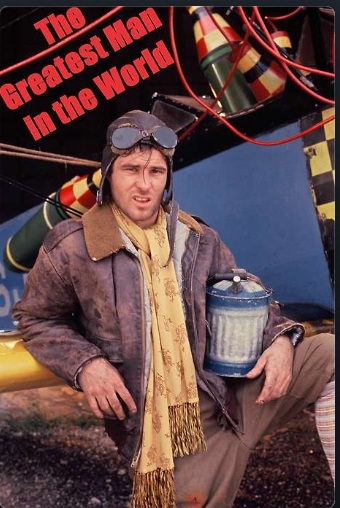
Episode #17: The Greatest Man In The World
(Dir by Ralph Rosenbaum, originally aired in 1981)
In this adaptation of a James Thurber short story, a country boy named Jack Smurch (Brad Davis) briefly becomes a celebrity when he breaks Charles Lindbergh’s record for flying nostop around the world. Two reporters (Reed Birney and John McMartin) are assigned to write a glowing profile of him. The U.S. Secretary of State (William Prince) wants to make him a symbol of America. The only problem is that Smurch himself is a violent and dull-minded habitual criminal who can barely fly his plane and who almost crashes when he comes in for a landing at the end of his flight. Before he took off in his plane, the only person who cared about Smurch was his girlfriend (Carol Kane). Even Smurch’s own mother says that she hopes that he crashes and drowns. But once he manages to land, Smurch becomes a hero. As the saying goes, print the legend.
Smurch, unfortunately, isn’t smart enough to play along with the hero routine. At a meeting with the Secretary of State and the President (who is implied to be FDR), Smurch proves to be so obnoxious that he’s tossed out of a window. He plunges to his death but he dies an American hero.
The final episode of The American Short Story was also the best, a wonderfully dark satire on the media and our cultural need for heroes. Brad Davis’s naturally obnoxious screen presence — the same presence that made audiences enjoy seeing him get tortured in Midnight Express — is put to good use here. Jack Smurch is such a jerk that you really can’t blame anyone for tossing him out that window. If nothing else, it got him to stop talking.
The American Short Story was, overall, an uneven series. Too often, the episodes failed to really capture the tone and style that made the original stories so memorable. That said, there were a few good episodes, like this one. If nothing else, perhaps this series inspired people to read the original stories for themselves. That would have been the best possible outcome.
Next week …. something new will premiere in the time slot! What will it be? I’ll give you a clue — it’s set on the beach but it’s not Pacific Blue. Let’s just say that some people stand in the darkness….
2016’s Precious Cargo tells the story of Jack (Mark-Paul Gosselaar) and his ex-wife Karen (Claire Forlani).
Karen is a professional thief who has botched a robbery for her former lover, crime boss Eddie Filosa (Bruce Willis). Eddie wants Karen dead so, of course, Karen flees down to the Florida everglades, where she finds Jack living in a swamp shack and making love to his latest girlfriend, Jenna (Lydia Hull). Karen tells them to go ahead and finish up and she’ll just wait out in the kitchen. Jack in not particularly happy to see Karen again but then he notices that she has a baby bump. “Always use a condom,” Karen tells Jenna. Eddie’s men, led by Simon (Daniel Berhardt), attack and it all leads to a boat chase that is surprisingly exciting when you consider that Precious Cargo is a low-budget, direct-to-video offering.
It turns out that Jack can save Karen from Eddie’s wrath by planning and executing a heist for the crime boss. Jack assembles his crew, Jack gets ready for the heist …. uh-oh, it’s time for a double cross! The plot is nothing special. It’s identical to a hundred other low-budget crime films that you’ve seen recently. It’s the type of thing that Michael Mann could have turned into a metaphor for American ennui but, in this film, it’s just a typical heist. The viewer enjoys it while it’s happening and then forgets about it two minutes afterwards.
That said, Precious Cargo is not quite as bad as the typical direct-to-video film. Mark-Paul Gosselaar — yes, Zack Morris himself — gives a reasonably compelling performance as Jack. To a certain group of people, he’s always be Zack and I imagine he’s sick of people asking him about whether or not he still has his giant phone but, as he’s gone from teen idol to adult actor, Gosselaar has shown himself to be a talented actor. (For the record, Zack lost his phone in the drunk driving episode. I know some people say that episode doesn’t count because it was a Tori episode but I say that it does. So there.) Claire Forlani is actually more compelling in these direct-to-video films than she ever was in any of the big budget studio films that she used to appear in.
Of course, I imagine that the main selling point for this film was meant to be Bruce Willis. This is one of the direct-to-video films that dominated the last fourth of Willis’s career. When Willis retired due to aphasia, there was a general assumption that all of Willis’s direct-to-video films were made as a result of his condition. I don’t know if that’s quite true. (It’s entirely possible that he just wanted a quick payday.) But it is true that Willis only has a few minutes of screentime in Precious Cargo and that several shots involving Eddie were accomplished with a stand-in. That said, in this film, Willis still brings some energy to the part. He’s an effective villain, even if I think everyone prefers to see Willis saving the day. Even in the direct-to-video era, Bruce Willis still had a definite presence.
Precious Cargo is predictable and ultimately forgettable but it’s still entertaining enough for 90 minutes.
As we all know, this year’s Sundance Film Festival started tonight.
To me, Sundance has always signified the official start of a new cinematic year. Not only is it the first of the major festivals but it’s also when we first learn about the films that we’ll be looking forward to seeing all year. It seems like every year, there’s at least one successful (or nearly successful) Oscar campaign that gets it start at Sundance. Last year, for instance, Minari took Sundance by storm and it was able to ride that momentum all the way to a Best Picture nomination. Before that, nominees like Manchester By The Sea and Brooklyn got their starts at Sundance.
And, even if their films weren’t nominated for best picture, some of the most important filmmakers of the past few decades got their first exposure at Sundance. The Coen Brothers first won notice with Blood Simple. Years later, Quentin Tarantino took the festival by storm with Reservoir Dogs. Though an argument can be made that Sundance is now just as corporate as the Hollywood system to which it’s supposed to providing an alternative, one can’t deny the importance of the Festival.
For the next few days, I’m going to taking a look at a few films that made their initial splash at Sundance. Some of these films went on to become award winners and some did not. But they’re all worth your attention, one way or another.
Take for instance, Mass.
The first directorial effort of actor Fran Kranz (you may remember him as the clever and genre-savvy stoner from The Cabin In The Woods), Mass made its debut at least year’s Sundance Film Festival. It was one of the more critically acclaimed films of the festival and, in a perfect world, it would currently be an Oscar front runner. And who knows? There’s always a chance that Mass could pick up a nomination or two. Ann Dowd is apparently running a very energetic campaign for Best Supporting Actress and she’s said to be well-liked in the industry. It’s probably a bit too much to expect the film to be nominated for Best Picture, though it certainly deserves some consideration. It’s perhaps a bit too low-key for a year that’s full of bombast and big emotional moments. It’s a film that raises interesting questions but refuses to provide easy answers. In short, it’s the type of film that, ten years from now, people will watch it and say, “How did this not get nominated?” Even if it’s not a Sundance film that’s destined for the Oscars, it is a Sundance film that will be remembered for heralding the arrival of a vibrant new directorial talent.
Playing out in almost real time, Mass is a film about two couples having a very emotional conversation. Richard (Reed Birney) and Linda (Ann Dowd) are the parents of Hayden. Jay (Jason Isaacs) and Gail (Martha Plimpton) are the parents of Evan. Hayden and Evan went to the same high school. Years ago, Evan was killed in a school shooting. Hayden was the shooter. After killing ten students, Hayden killed himself.
The two couples are meeting in a room in the back of a church. It’s a part of therapy. They meet and they talk about their children and the events that led to the shooting. Jay and Gail demand answers. Richard and Linda can’t provide them. At first, Gail is angry and Jay is the one who tries to keep things civil but, as the conversation continues, it becomes obvious that Jay is in fact angrier than Gail. Even when Richard and Linda express obviously sincere remorse for what Hayden did, Jay cannot accept it because, in a way, he needs them to be evil or ignorant or both. Linda and Richard struggles to reconcile their love for their son with their hatred over what he did. Gail and Jay feel that their son was unfairly taken from them and they’re right. Richard and Linda feel that they’re being blamed for something they couldn’t control and they’re also right. There are no easy villains or heroes in this film. Instead, there are just four unique and interesting characters, all trying to understand something that makes no sense.
Almost everything we learn about the characters comes from listening to them speak. Almost the entire film takes place in that one room. By the end of the film, not a single character is who you originally believed them to be. Jay’s search for meaning has led to him becoming a political activist. He insists that there has to be some sort of identifiable reason to explain why his son is dead, even though he secretly realizes that there isn’t. Gail, who starts out as the angriest person in the room, reveals herself to be the most empathetic. At the start of the film, Jay accuses Richard of not having any emotions but, by the end, we see that Richard’s emotions are very real. Finally, Linda seems meek but quickly reveals herself to be perhaps the strongest and most honest person in the room.
It may sound a bit stagey, this film that takes place in one room and which is basically just four characters having a conversation. But director Fran Kranz does a wonderful job keeping the story moving and the conversation within the room never seems to drag. Indeed, the room itself is almost as fascinating as any of the people inside of it. At the start the film, we watch two church employees and social worker going out of their way to make the room as safe and non-confrontational as possible. However, their efforts have the opposite effect. The room is so friendly that it makes it impossible not to compare its pleasantness with the issues being discussed behind the room’s closed doors. The room itself tries so hard to avoid confrontation that it has the opposite effect.
In the end, the film suggests that there are no neat answers. Even though the two couples come to an understanding and even a sort of peace, there’s no guarantee that peace will last more than a day. Indeed, as soon as they leave the room, their initial awkwardness returns, a reminder that we can understand pain but we can’t necessarily vanquish it. It’s not a film about easy answers but there’s something liberating about the film’s willingness to acknowledge that life can be difficult but that life also goes on.
The film is a masterclass of good acting, with Dowd and Isaacs getting the biggest dramatic moments while Birney and Plimpton offer fantastic support. In a perfect Oscar world, all four of them would be nominated and so would the film itself. Unfortunately, one of the lessons of Mass is that there is no such thing as a perfect world.
The Gotham Awards were held last night and the big winners were CODA and Maggie Gyllenhaal’s The Lost Daughter. The Gothams aren’t exactly the biggest or most influential of the Oscar precursors but they were are one of the first so a victory can only help!
The winners are listed in bold:
Best Feature
“The Green Knight” “The Lost Daughter”
“Passing”
“Pig”
“Test Pattern”
Best Documentary Feature
“Ascension”
“Faya Dayi”
“Flee”
“President”
“Summer Of Soul (…Or, When The Revolution Could Not Be Televised)”
Best International Feature
“Azor” “Drive My Car”
“The Souvenir Part II”
“Titane”
“What Do We See When We Look at the Sky?”
“The Worst Person In The World”
Bingham Ray Breakthrough Director Award Maggie Gyllenhaal for “The Lost Daughter”
Edson Oda for “Nine Days”
Rebecca Hall for “Passing”
Emma Seligman for “Shiva Baby”
Shatara Michelle Ford for “Test Pattern”
Best Screenplay
“The Card Counter,” Paul Schrader
“El Planeta,” Amalia Ulman
“The Green Knight,” David Lowery “The Lost Daughter,” Maggie Gyllenhaal
“Passing,” Rebecca Hall
“Red Rocket,” Sean Baker & Chris Bergoch
Outstanding Lead Performance Olivia Colman in “The Lost Daughter” Frankie Faison in “The Killing of Kenneth Chamberlain”
Michael Greyeyes in “Wild Indian”
Brittany S. Hall in “Test Pattern”
Oscar Isaac in “The Card Counter”
Taylour Paige in “Zola”
Joaquin Phoenix in “C’mon C’mon”
Simon Rex in “Red Rocket”
Lili Taylor in “Paper Spiders”
Tessa Thompson in “Passing”
Outstanding Supporting Performance
Reed Birney in “Mass”
Jessie Buckley in “The Lost Daughter”
Colman Domingo in “Zola”
Gaby Hoffmann in “C’mon C’mon” Troy Kotsur in “CODA”
Marlee Matlin in “CODA”
Ruth Negga in “Passing”
Breakthrough Performer Emilia Jones in “CODA”
Natalie Morales in “Language Lessons”
Rachel Sennott in Shiva Baby”
Suzanna Son in “Red Rocket”
Amalia Ulman in “El Planeta”
Breakthrough Series – Long Format (over 40 minutes)
“The Good Lord Bird”
“It’s A Sin”
“Small Axe” “Squid Game”
“The Underground Railroad”
“The White Lotus”
Breakthrough Series – Short Format (under 40 minutes)
“Blindspotting”
“Hacks” “Reservation Dogs”
“Run the World”
“We Are Lady Parts”
Breakthrough Nonfiction Series “City So Real”
“Exterminate All the Brutes”
“How To with John Wilson” “Philly D.A.”
“Pride”
Outstanding Performance in a New Series
Jennifer Coolidge in “The White Lotus”
Michael Greyeyes in “Rutherford Falls” Ethan Hawke in “The Good Lord Bird”
Devery Jacobs in “Reservation Dogs”
Lee Jung-jae in “Squid Game” Thuso Mbedu in “The Underground Railroad”
Jean Smart in “Hacks”
Omar Sy in “Lupin”
Anya Taylor-Joy in “The Queen’s Gambit”
Anjana Vasan in “We Are Lady Parts”
(Incidentally, I’m probably the only person not involved with the show to have noticed the victory for Philly D.A. I’m just going to be honest and say that is one of my least favorite results ever. Philly D.A. was a pure propaganda, nothing more.)
As a sign of how wrapped up I am in this year’s Horrorthon, consider this: the 2021 Gotham Nominations — the first precursor of Awards Season! — were announced on Thursday and I totally missed them! This is actually not the first year that this has happened. October is a busy month for me and sometimes, the Gotham noms get missed.
The Gothams, of course, only honor independent films and they have pretty strict rules as far as what they consider to be independent. The budget has to come in at a certain relatively low amount, for one thing. So, as a result, a lot of Oscar nominees are not Gotham eligible. But, at the same time, those Gotham rules also allow some films that otherwise might get overlooked a chance to get some precursor love. Being nominated for a Gotham is hardly a guarantee that the Academy will remember you. But it certainly doesn’t hurt.
Better late than never, here are the 2021 Gotham Nominations! As you’ll notice, the Gotham’s performance awards are gender neutral. This is the first year that the Gothams have done this. They also added categories for supporting performances and best performance in a series.
Anyway, here are the nominees:
Best Feature
“The Green Knight”
“The Lost Daughter”
“Passing”
“Pig”
“Test Pattern”
Best Documentary Feature
“Ascension”
“Faya Dayi”
“Flee”
“President”
“Summer Of Soul (…Or, When The Revolution Could Not Be Televised)”
Best International Feature
“Azor”
“Drive My Car”
“The Souvenir Part II”
“Titane”
“What Do We See When We Look at the Sky?”
“The Worst Person In The World”
Bingham Ray Breakthrough Director Award
Maggie Gyllenhaal for “The Lost Daughter”
Edson Oda for “Nine Days”
Rebecca Hall for “Passing”
Emma Seligman for “Shiva Baby”
Shatara Michelle Ford for “Test Pattern”
Best Screenplay
“The Card Counter,” Paul Schrader
“El Planeta,” Amalia Ulman
“The Green Knight,” David Lowery
“The Lost Daughter,” Maggie Gyllenhaal
“Passing,” Rebecca Hall
“Red Rocket,” Sean Baker & Chris Bergoch
Outstanding Lead Performance
Olivia Colman in “The Lost Daughter”
Frankie Faison in “The Killing of Kenneth Chamberlain”
Michael Greyeyes in “Wild Indian”
Brittany S. Hall in “Test Pattern”
Oscar Isaac in “The Card Counter”
Taylour Paige in “Zola”
Joaquin Phoenix in “C’mon C’mon”
Simon Rex in “Red Rocket”
Lili Taylor in “Paper Spiders”
Tessa Thompson in “Passing”
Outstanding Supporting Performance
Reed Birney in “Mass”
Jessie Buckley in “The Lost Daughter”
Colman Domingo in “Zola”
Gaby Hoffmann in “C’mon C’mon”
Troy Kotsur in “CODA”
Marlee Matlin in “CODA”
Ruth Negga in “Passing”
Breakthrough Performer
Emilia Jones in “CODA”
Natalie Morales in “Language Lessons”
Rachel Sennott in Shiva Baby”
Suzanna Son in “Red Rocket”
Amalia Ulman in “El Planeta”
Breakthrough Series – Long Format (over 40 minutes)
“The Good Lord Bird”
“It’s A Sin”
“Small Axe”
“Squid Game”
“The Underground Railroad”
“The White Lotus”
Breakthrough Series – Short Format (under 40 minutes)
“Blindspotting”
“Hacks”
“Reservation Dogs”
“Run the World”
“We Are Lady Parts”
Breakthrough Nonfiction Series “City So Real”
“Exterminate All the Brutes”
“How To with John Wilson”
“Philly D.A.”
“Pride”
Outstanding Performance in a New Series
Jennifer Coolidge in “The White Lotus”
Michael Greyeyes in “Rutherford Falls”
Ethan Hawke in “The Good Lord Bird”
Devery Jacobs in “Reservation Dogs”
Lee Jung-jae in “Squid Game”
Thuso Mbedu in “The Underground Railroad”
Jean Smart in “Hacks”
Omar Sy in “Lupin”
Anya Taylor-Joy in “The Queen’s Gambit”
Anjana Vasan in “We Are Lady Parts”
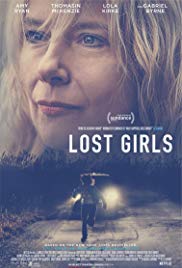
Lost Girls tells the true and infuriating story of Mari Gilbert and her search for her oldest daughter, Shannan.
Mari Gilbert is a single mother who is works as a waitress and struggles to give her children the best life that she can. She’s still haunted by a decision that she made years ago to temporarily put her three daughters into foster care. Though she eventually reclaimed two of her daughters, her eldest — Shannan — has basically been on her own since she was sixteen. Shannan, who is now 24, visits her mother and her sisters on a semi-regular basis. Despite the fact that Shannan claims that she’s just a waitress (like her mother), Shannan always seems to have a lot of money on her. Mari has her suspicions about what Shannan’s doing to make that money but she keeps them to herself.
Then, one day in May, Shannan disappears. Mari can’t get the police to take her seriously when she says her oldest daughter has vanished. They say that Shannan left on her own and will probably return at some point. They dismiss Mari’s concerns, telling her that her daughter was a prostitute and therefore, by their logic, unreliable. Even when Mari gets strange phone calls from a doctor who lives in a gated community in Long Island, the police refuse to take her seriously.
However, Mari then discovers that Shannan called 911 the night that she disappeared. Despite the fact that Shannan sounded panicked, the police waited an hour before responding to her call and, by the time they arrived, Shannan had disappeared. It’s only when Mari goes to the media that the police actually start to search the area of Long Island where Shannan disappeared. The police discover the bodies of several sex workers, all murdered by the same unknown killer.
However, they still don’t find Shannan’s body. Though Mari and her daughter, Sherre (Thomasin McKenzie), are convinced that Shannan is one of the killer’s victims, the police continue to insist that Shannan probably just ran off on her own. In fact, the local police commissioner (Gabriel Byrne) finds himself being pressured to do something about Mari because her now constant presence on TV is making the entire community look bad.
Meanwhile, Mari finds herself caught up in a personal feud between two men who live in the gated community, an amateur investigator (Kevin Corrigan) and a shady doctor (Reed Birney) who has a history of making inappropriate phone calls….
Lost Girls is an interesting but frustrating film. Some of that is because the story on which the film is based did not have a happy ending. The Long Island serial killer has never been identified or captured. The most obvious suspect was never charged with anything and subsequently moved down to Florida. Mari never got justice for Shannan and, sadly, was eventually murdered by her youngest daughter. (The murder is acknowledged via a title card but it is not actually depicted in the film.) As a result, the film itself doesn’t really offer up any of the payoff that you would normally expect to get after devoting 90 minutes of your life to it. It’s frustrating but, at the same time, its understandable.
Amy Ryan gives a great performance as Mari. That shouldn’t shock anyone. She makes you feel Mari’s pain, fury, and guilt. To its credit, the film does shy away from the fact that Mari often looked the other way when it came to how exactly Shannan was making the money that she regularly sent back to her family and Amy Ryan perfectly captures Mari’s struggle to not only get justice for her daughter but also to forgive herself. Unfortunately, the film is a bit less convincing when it deals with the police and the suspects. The film, for instance, can’t seem to decide whether or not Gabriel Byrne’s character is indifferent, incompetent, or just overwhelmed by a bad situation. By that same token, the doctor and his neighbor both seem oddly underwritten and underplayed. Obviously, the film can’t just come out and accuse a real, living person of murder (especially when that person hasn’t been charged with anything) but it still makes for a frustrating viewing experience.
Where Lost Girls succeeds is at creating a properly ominous atmosphere. Every scene seems to be filled with dread and, from the minute that Mari starts her investigation, you feel nervous for her. She’s taking a true journey into the heart of darkness. The film leaves you angry that the police refused to search for Shannan. Sex workers are regularly preyed upon and, because of what they do for a living, society often looks the other way. That’s how you end up with killers like The Green River Killer and the Long Island serial killer. They don’t get away with their crimes because they’re clever. They get away with it because, far too often, society refuses to care about their victims. Lost Girls is an imperfect film but its heart is in the right place and its message is an important one.
This episode was a true Detective Comics story. It had a eerie feel to it and I understand why- Carol Banker (Director) and Jason Hatem (Writer) are veterans of The X-Files and Supernatural. These shows are often grisly whodunnits and this episode fit that mold.
The direction and character development and dialogue are so confluent that it has an unsettling realism. You watch Dick go through a metamorphosis of grief and brutality into something new- something he doesn’t even know yet. The dialogue is quick and sharp slowly revealing the differences between Jason and Dick, building the tension between Dick’s uncertainty and Jason’s brutality. The last shot of the detective story pulls back with Dick alone, staring at what Jason has wrought. There are crippled police everywhere. The cost of Dick saving his friend is the unleashing of this hurricane of cruelty wearing the costume that he once proudly wore.
This episode picks up right after the last one. It’s uncertain why Jason Todd was there to help Dick. It turns out that Dick and Jason are both Lo-Jacked with tracking devices because of Batman. Batman discovered that someone is hunting down all of the members of the circus that Dick grew up with- essentially his family other than Bruce. This person is the son of the man who killed Dick’s parents. We learn that five years ago Dick got the revenge upon his parents’ killer. Although Dick didn’t do the fatal blow, he purposefully stood back so the killer would die at another’s hands.
This whodunnit also serves as a Mid-Point Crisis and realization for Dick’s story arc. He doesn’t want to be Robin, but he carries the suit across the country. Jason Todd is the new Robin, but Jason, unlike Dick, is pure Robin. Batman had a code of non-killing and certainly forbade beating up people because you could. Jason Todd does not follow that; in fact, he likes to brutalize people for sport. Jason Todd is rage and violence distilled to its darkest conclusion. This is in line with the comics where Jason becomes the Red Hood and straight up murders criminals.
As they work together in the episode to track down the killer, Dick realizes that he’s not Robin anymore, but he’s not on the sidelines either. The Melting Man essentially kills Dick Grayson’s Robin persona because by forcing Dick to work along side Jason to stop him, it causes Dick to realize that he’s no one’s sidekick and that he isn’t a pure psychopath either.
Dick sees Jason’s thrill in beating up cops and crippling them. Dick tries to explain to Jason that this embrace of darkness costs your soul, but Dick realizes soon that you can’t lose something that you never had. Jason Todd is like the Joker – in Christopher Nolan’s words- The Joker is an absolute. The Joker and Jason Todd are the Id of humanity- both absolutes; there is no reasoning with them. They want and do and they do -without feeling.
Dick is likely to evolve into Nightwing, but more importantly we see in this show very careful layering and texture added over time for every character. It really brings out the goose-flesh to see these people struggle with being heroes. It’s so human and painful and more clear when you see a Jason Todd who relishes embracing darkness and violence.
The Robins do save the day, but Dick is left changed permanently. Like the funeral scene the story opened with, Dick Grayson’s Robin is dead. Dick is unaware as to what he will become, but we know it will be born among the Titans. Without question, this is the BEST show on television.
Hello again! It’s been exactly one month since the last Titans installment. I was busy reviewing the steaming piece of trash that is Stranger Things 3. Now, I’m back and I have to start banking reviews for October!!! Horrorthor is just around the corner as is Titans Season 2 due out in September!!!
This episode was all about bringing the team together and learning how to fight as one. Now, I know this doesn’t sound terribly exciting, BUT this episode was actually one of my favorites.
The biggest reason is that I love this episode is because of the Director Meera Menon. She really knows how to direct a fight scene- a virtuoso! Like horror, a great action story can be filmed terribly, making you wish you’d done an extra load of laundry or it can draw you in and make you feel like part of the action. Meera is the latter. I haven’t seen action sequences directed this well since Blade I. I was bummed to find out that she didn’t direct any additional Titans episodes. If Greg Berlanti is reading my reviews- AND HE SHOULD- Meera is a real talent and will elevate any and all of your properties! Get her now while she’s affordable!
The episode has the gang on the run. They hole up in a motel and try to assess their individual abilities. This leads to a fun quasi-montage. It also leads to the final consummation of the sexual tension between Dick Grayson and Starfire. They really play the tension well. These two have CHEMISTRY!
The Nuclear Family has got a brand new Dad and they are in hot pursuit of the Titans, which leads to one of the best fight sequences that I have ever seen….REALLY. Just awesome! Meera- get in touch with Dwayne Johnson!
After the fight, Dick figures out where the evil headquarters are located using his detective skills. This sends him to Toronto…I mean evil Headquarters. Dick confronts King Evil Pants and gets beaten A LOT by his henchmen….Until Jason Todd shows up and saves him. This introduces the most psychopathic anti-hero since The Comedian. The next episode review will about a WHODUNNIT!



 Through the Shattered Lens