Review: The Killer (dir. by David Fincher)


“Stick to your plan. Anticipate, don’t improvise. Trust no one. Never yield an advantage. Fight only the battle you’re paid to fight. Forbid empathy. Empathy is weakness. Weakness is vulnerability.” — The Killer

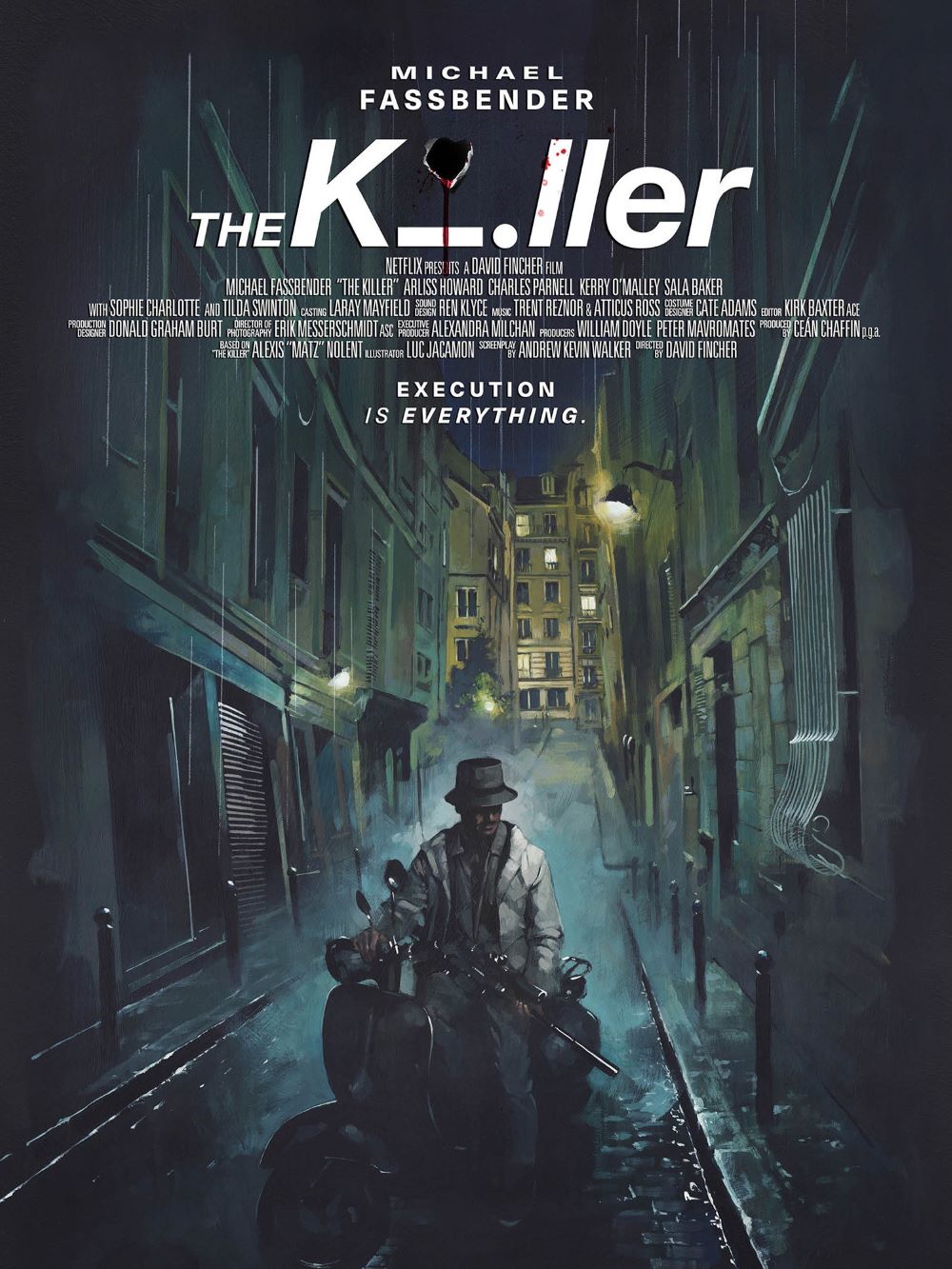
David Fincher’s The Killer lands like a perfectly aimed shot: clean, methodical, and laced with just enough twist to make you rethink the whole trajectory. At its core, the film follows an elite assassin—brilliantly played by Michael Fassbender—who suffers a rare professional failure during a high-stakes hit in Paris. After days of obsessive preparation in a WeWork cubicle, complete with hourly surveillance checks, yoga breaks, protein bar sustenance, and a nonstop loop of The Smiths, he pulls the trigger only to miss his target entirely.

This one slip shatters his world of ironclad redundancies and contingencies. Retaliation soon hits close to home, striking his secluded Dominican Republic hideout and drawing in his girlfriend. What begins as a routine job quickly escalates into a personal cleanup mission, spanning cities like New Orleans, Florida, New York, and Chicago. Fincher transforms these stops into taut, self-contained vignettes, layering precise bursts of violence over the protagonist’s gradual psychological fraying—all while keeping major reveals under wraps to maintain the film’s coiled tension.

The structure dovetails perfectly with Fassbender’s commanding performance. He embodies a man radiating icy zen on the surface, while a relentless machine churns underneath. His deadpan voiceover delivers self-imposed rules like a deranged productivity gospel—”forbid empathy,” “stick to your plan,” “anticipate, don’t improvise”—even as he slips seamlessly into civilian guises: faux-German tourist, unassuming janitor, casually ordering tactical gear from Amazon like it’s toothpaste.

The result is darkly hilarious, conjuring a corporate bro reborn as high-functioning sociopath, where bland covers clash absurdly with lethal intent. Yet as stakes mount, subtle cracks appear: split-second hesitations, flickers of unexpected mercy that betray buried humanity. Fassbender nails this evolution through sheer minimalism—piercing stares, economical gestures, weaponized silence—morphing the killer from untouchable elite into a flawed, expendable player in the gig economy’s brutal grind.

These nuances echo the film’s episodic blueprint, quintessential Fincher territory. On-screen city titles act as chapters in a shadowy assassin’s handbook, with tension simmering through drawn-out prep rituals: endless surveillance, gear assembly, contingency mapping that drags just enough to immerse you in the job’s soul-numbing tedium. The Paris mishap ignites the chase—he evades immediate pursuit, sheds evidence, and races home to fallout, then pursues leads through handlers, drivers, and rivals in a chain of escalating confrontations.

Fincher deploys action sparingly but with devastating impact. A standout brawl erupts in raw, prolonged chaos—captured in extended, crystal-clear shots with improvised weapons and no shaky-cam crutches—perfectly embodying the killer’s ethos even as it splinters around him. Each sequence builds without excess, from tense interrogations to standoffs that flip power dynamics, underscoring how the world’s rules bend unevenly.

This kinetic progression meshes flawlessly with Fincher’s visual command. Cinematographer Erik Messerschmidt crafts a hypnotic palette of cool desaturated blues, sterile symmetries, and digital hyper-reality, evoking unblinking surveillance feeds into an emotional void. Tactile details obsess: the rifle case’s satisfying zip, suppressed gunfire’s sharp snick, shadows creeping across WeWork pods, dingy motels, and gleaming penthouses—all mirroring the killer’s frantic grasp for order amid encroaching disarray.

Sound design heightens every layer, sharpening ambient clacks of keyboards, hallway breaths, and gravel footsteps to a razor’s edge. Integral to the immersion is the minimalist electronic score by Trent Reznor and Atticus Ross, Fincher’s trusted collaborators from The Social Network to Mank. Their eerie ambient drones and ominous rhythmic pulses bubble like a suppressed heartbeat—swelling subtly in stakeouts, throbbing through violence, threading haunting motifs into voiceovers. It mirrors the protagonist’s inner turmoil without overwhelming the chill precision, turning silences between notes into weapons as potent as any sniper round.

This sonic and visual restraint powers the film’s bone-dry irony, which methodically punctures the protagonist’s god-complex. He preaches elite status among the “few” lording over the “many sheep,” yet reality paints him as sleep-deprived, rule-bending, and perpetually improvising—empathy leaking through denials in quiet, humanizing beats. Fincher weaves these into his signature obsessions—unmasked control freaks, dissected toxic masculinity, exposed capitalist churn—but with playful lightness, sidestepping the heavier preachiness of Fight Club or Seven.

The killer’s neurotic Smiths fixation injects quirky isolation amid globetrotting nomadism; their melancholic lyrics (“How Soon Is Now?”) punctuate stakeouts and flights like wry commentary on his fraying detachment. It all resolves in a low-key homecoming: no grand redemption or downfall, just weary acknowledgment that even “perfect” plans crack under chaos’s weight.

This sleight-of-hand elevates The Killer beyond standard assassin tropes into a sharp study of elite evil’s banality. Supporting roles deliver pitch-perfect economy: Tilda Swinton’s poised, lethal rival in mind-game restaurant tension; Arliss Howard’s obliviously entitled elite; Charles Parnell’s wearily betrayed handler; Kerry O’Malley’s poignant bargainer; Sala Baker’s raw, physical menace. Under two hours, Fincher packs density without bloat—layered subtext, rewatchable craft everywhere.

Gripes about its procedural chill or emotional distance miss the sleight entirely: this is a revenge thriller masking profound dissection of a borderless mercenary world, where pros prove as disposable as their untouchable clients. Fans of methodical slow-burns like ZodiacThe Game, or Gone Girl will devour the razor wit, process immersion, and unflinching thematic bite.

Ultimately, The Killer crystallizes as a sly late-period Fincher gem, fusing pitch-black humor, visceral horror, and surprising humanism into precision-engineered sleekness. It dismantles mastery illusions in unforgiving reality, leaving Fassbender’s killer stubbornly human: loose ends mostly tied, slipping back to obscurity as a survivor adapting. In a flood of bombastic action sludge, it offers bracing cerebral air—proving restraint, dark laughs, and surgical insight remain the filmmaker’s deadliest tools. For obsessive breakdowns of the human machine at its breaking point, it’s Netflix essential.

Trailer: Kick-Ass 2 (Extended Red Band)


KickAss2

This past week saw the largest collection of nerd, geek and comic book fandom gathered in one magical place. The place in question is San Diego and the event is called San Diego Comic-Con or simply just uttered in awed whispers as Comic-Con. It is a place that many outsiders have shunned as a place that has no place in good, normal society yet they continue to arrive in larger numbers to ply their products to those they shun. Even this blog has it’s shamers and ignorant individuals who spew insults yet they too continue to visit because deep in their subconscious they know, like those who ridicule Comic-Con and those who attend them with a passion, that they’re the ones out of step with whats not accepted in society.

What does this mean when it comes to the latest trailer for Kick-Ass 2 that just came out of Comic-Con?

Absolutely nothing other than the trailer and the film itself is just another weird meeting of the two cultures. It’s a film that celebrates the ridiculousness and absurdity of the comic book culture, yet it’s one that’s funded by the very same people who insulted the scene just a decade ago.

The first film was a revelation and helped introduced the world to one Chloe Grace Moretz, but it also showed that comic books and films made from them didn’t have to be PG or even PG-13. There was a place for ultra-violence in our comic book films. It also helped bring the name of Matthew Vaughn into the forefront of comic book fandom. While he’s not directing this sequel (he elected to go with X-Men: First Class and we’re all the better for it), he did help in bringing it to life and hand-picked his successor in Jeff Wadlow.

While Kick-Ass 2 is not getting the same sort of buzz from Comic-Con the original film did it is still one film I’m quite interested in seeing just to find out what has happened to our young superheroes and vigilante crime fighters since the last film. Plus, it’s main villain likes to call himself “Motherfucker”.

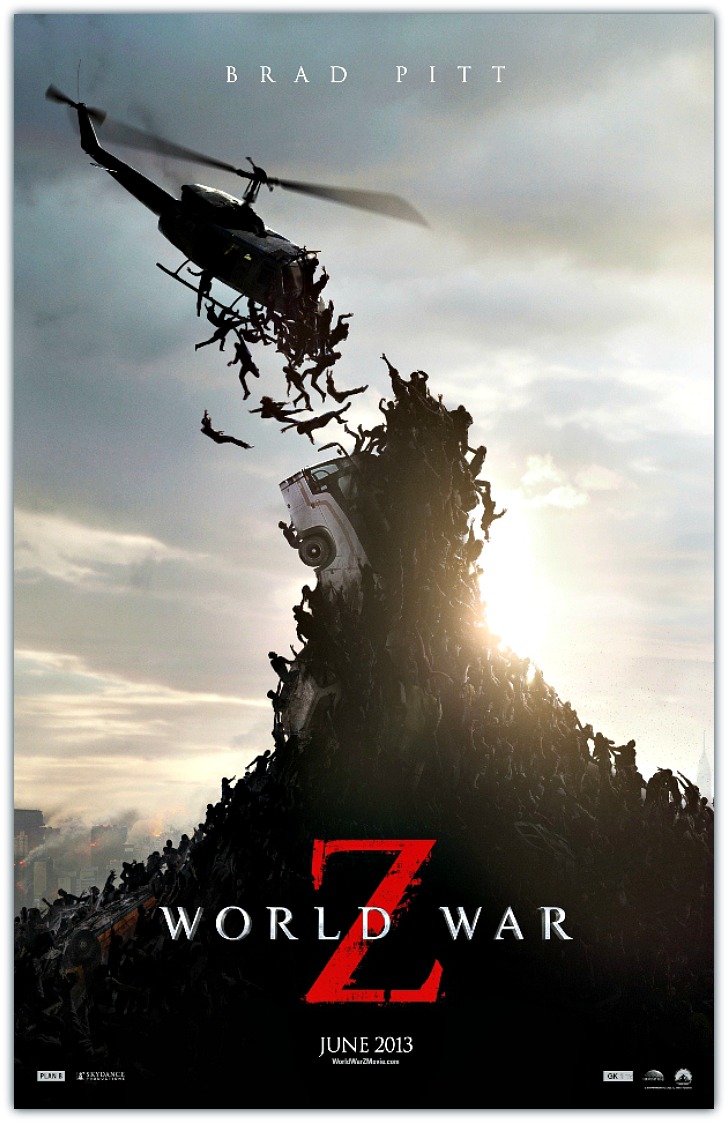
Review: World War Z (dir. by Marc Forster)


WorldWarZ

I’ll get this out of the way and just say it: World War Z the film pretty much has nothing in common with the acclaimed novel of the same name by author Max Brooks (reviewed almost at the very beginning of the site). Ok, now that we have that out of the way it’s time to get to the important part and that’s how did the film version turn out on it’s own merits.

World War Z was a film that took the long, winding and rough road to finally get to the big-screen. Whether it was the five different writers brought in to work on the script (J. Michael Straczynski of Babylon 5 fame came onboard first with Christopher McQuarrie coming unofficially to help tighten a few scenes in the end) to the massive changes made to the original source material that was bound to anger the fans of the novel, the film by Marc Forster had an uphill climb to accomplish even before the final product even came to market.

I was as surprised as man others were that the finished product was better than I had anticipated. Some had very low expectations about World War Z coming in due to the rumors and news reports coming in about the problems during production, but it doesn’t change the fact that the unmitigated disaster predicted by every film blogger and critic beforehand never came to fruition.

World War Z might not have been what fans of the novel had wanted it to be, but when seen on it’s own merit the film was both exciting and tension-filled despite some flaws in the final script and use of well-worn horror tropes.

The film begins with a visual montage interspersing scenes of nature (particularly the swarming, hive-like behavior of certain animals like birds, fish, and insects), alarmist news media reporting and the mindless celebrity-driven entertainment media that’s so big around the world. From there we’re introduced to the main protagonist of the film in one Gerry Lane (played by Brad Pitt) and his family. We see that the Lane family definitely love and care for each other with his wife Karin (Mireille Enos in the supportive wife role) and their two young daughters, Rachel and Constance. The film could easily have spent a lot of time establishing this family and their relationship towards each other, but we move towards the film’s first major sequence pretty much right after the opening. It’s this choice to not linger on the characters too long that becomes both a strength and a weakness to the film’s narrative throughout.

WorldWarZPhilly

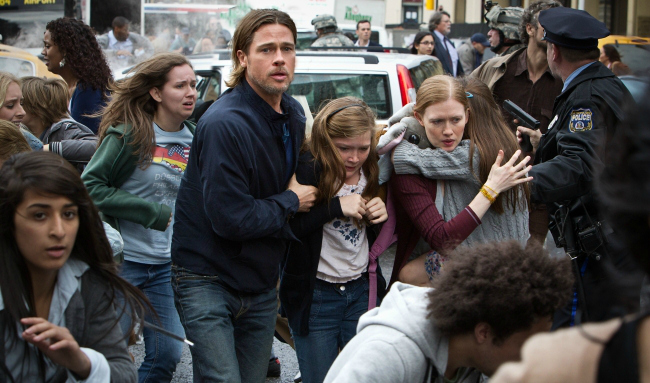
World War Z finally shows why it’s not your typical zombie film with it’s first major sequence in the center of downtown Philadelphia as Gerry and his family sees themselves in bumper-to-bumper traffic. As they wait there are some subtle hints that something might just be somewhat awry ahead of them as we see more and more police racing towards some sort of emergency ahead of the family and more and more helicopters flying overhead. There’s a brief lull in the scene before all hell breaks loose and the film’s zombie apocalypse aspect goes from 0 straight to 11 in a split second.

It’s this sequence of all-encompassing chaos overtaking a major metropolitan city seen both on the ground through the eyes of Gerry Lane and then on flying overhead wide shots of the city that gives World War Z it’s epic scope that other zombie films (both great and awful) could never truly capture. It’s also in this opening action sequence that we find the film’s unique take on the tried-and-true zombie. While not the slow, shambling kind that was described in the novel, these fast-movers (owes a lot more on the Rage-infected from 28 Days Later) bring something new to the zomgie genre table by acting like a cross between a swarm of birds or insects with the rapidly infectious nature of a virus.

These zombies do not stop to have a meal of it’s victims once they’ve bitten one but instead rapidly moves onto the next healthy human in order to spread the contagion it carries. We even get an idea of how quickly a bitten victim dies and then turns into one of “Zekes” as a soldier has ended up nicknaming them. It’s this new wrinkle in the zombie canon that adds to the film’s apocalyptic nature as we can see just how the speed of the infection and the swarm-like behavior of the zombies could easily take down the emergency services of not just a city and state but of entire nations.

WorldWarZJerusalem

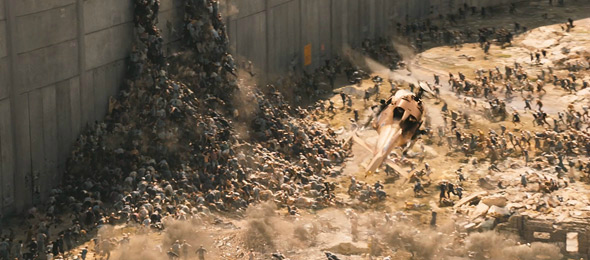
World War Z works best when it doesn’t linger too long between action sequences. Trying to inject some of the themes and ideas that made the novel such a joy to read only comes off as an uncomfortable attempt to try and placate fans of the novel. When we get scenes like Philadelphia in settings like Jerusalem and, in smaller scales but no less tense, like in South Korea and on a plane, the film works as a nice piece of summer action fare. This works in the first two thirds of the film but a sudden shift in the final third in Cardiff, Wales could be too jarring of a tonal shift in storytelling for some.

While the change from epic and apocalyptic to intimate and contained in the final third was such a sudden change this sequence works, but also shows just how bad the original final third of the film was to make this sudden change. It proves to be somewhat anticlimactic when compared to the epic nature of the first two-thirds of the film. We get a final third that’s more your traditional horror film. In fact, one could easily see World War Z as two different films vying for control and, in the end, the two halves having to try to co-exist and make sense.

World War Z doesn’t bring much of the sort of societal commentaries and themes that we get from the very best of zombie stories, but it does bring the sort of action that we rarely get from zombie films. The film actually doesn’t come off as your traditional zombie film, but more like a disaster story that just happened to have zombies as the root cause instead of solar flares, sudden ice age or alien invasion.

So, while World War Z only shares the title with the source novel it was adapting and pretty much not much else, the film wasn’t the unmitigated disaster that had been predicted for months leading up to it’s release. It’s a fun, rollercoaster ride of film that actually manages to leave an audience wanting to know more instead of being bombarded with so much action that one becomes desensitized and bored by it. There’s no question that a better film, probably even a great one, lurks behind the fun mess that’s the World War Z we’ve received, but on it’s own the film more than delivers on the promise that most films during the summer fails to achieve and that’s to entertain.

Trailer: World War Z (2nd Official)


WorldWarZ

We see the release of a new trailer for this summer’s epic zombie film based on the equally epic novel of the same name by Max Brooks.

World War Z is already the most expensive zombie film ever made with a budget rumored to be between 125-200 million dollars. Some of this has been due to the delays in filming and most of it seems to stem from a massive rewrite of the third act. Damon Lindelof was first hired to rewrite but due to prior commitments the job went to Drew Goddard. Such a rewrite also meant reshoots had to be done which took another seven weeks of shooting.

All in all, World War Z is one troubled film before it even gets to the general public.

Yet, it is also one of the more anticipated films for this summer. Some from fans of the genre who just can’t get enough of zombie films. Some from people wanting to see just what sort of zombie film ends up with a budget around 200 million dollars. From the trailer we’ve seen some of that money seem to have gone on some massive special effects sequences which includes swarming zombies of the Rage-infected kind. Then again we don’t really see the zombies close-up which tend to make them look like swarming ants from afar. Maybe the look of the zombies themselves have been saved for the release of the film.

This latest trailer actually gives a bit more of the plot of the film which puts Brad Pitt’s UN employee character to travel the world in search for the cause of the worldwide zombie pandemic. The speed by which things happen seems to have compressed all the events in the novel into a film of two hours. This, I’m sure will be a major contention with fans of the novel, but it looks like a decision by filmmaker to try and create a single narrative from a novel that was mostly single-hand accounts of the zombie war from survivors who have no connection with each other whatsoever.

We’ll find out in just under 3 months if this film will be a major flop or succeed despite all the stumbling blocks and problems throughout its production.

World War Z is set for a June 21, 2013 release date.

Trailer: Kick-Ass 2 (Red Band)


KickAss2

2010’s Kick-Ass was one of those films that you either loved or hated. It was a film adapted from the Mark Millar and John Romita, Jr. comic book of the same name that also had a similar reputation of having extreme opposites in regards to how people perceived it.

I, for one, loved the film despite just being “meh” when it came to the comic. Where the film by Matthew Vaughn was a darkly comic deconstruction of the superhero story the comic book that gave birth to it was just an exercise in shocking the readers without working for it. Yet, despite that the film was a hit with both the fans of the comic book and those who didn’t even know it was a comic book. That popularity allowed the film to make enough profit that a sequel was greenlit even before a second volume of the comic book was even started by Millar and Romita, Jr.

Kick-Ass 2 sees the return of both Hit-Girl and Kick-Ass with Red Mist now calling himself The Motherfucker and the film’s main antagonist. The sequel sees Matthew Vaughn return as producer with Jeff Wadlow stepping in as director.

Kick-Ass 2 is set for an August 16, 2013 North American release date with the film premiering earlier on July 19, 2013 in the UK.

Trailer: World War Z (Super Bowl Exclusive)


One of the films that was to have it’s day in the Super Bowl ad campaign rush was Paramount Pictures’ troubled epic zombie apocalypse film, World War Z.

Starring Brad Pitt and directed by Marc Forster, the film is an adaptation (very loosely adapted from the novel) of the novel of the same name written by Max Brooks. Anyone who is even remotely interested in the topic of zombie fiction (or that they’re real like certain awesome people) have read this novel and have been highly anticipating the film. When the first trailer was released several months ago the reaction to the changes made from book to film was a resounding “Huh” to “WTF?!” from fans.

Time will not be changing some of these reactions, but from the sudden release of the Super Bowl ad TV spot that the film will show during Sunday’s Big Game it looks like the film will take the basic premise of the novel and go it’s own way. The zombies being CGI when seen from a distance and moving like ravenous army ants (siafu as the Japanese call them which is also what the zombies were called in the novel).

The film seems to want to see the zombie apocalypse first-hand as it occurs and sped things up to bring more action to the proceedings. This is not a bad thing if the film had been titled other than World War Z, but since it needed to use that name the complaints by fans of the novel will continue. Just based on the trailer and this teaser spot alone it looks like there’s something interesting going on in this film that people will either love or hate. I’m hoping I’ll be of the former than the latter.

World War Z is set for a June 21, 2013 release date.

WorldWarZ

Trailer: World War Z (Official)


It’s not hyperbole to say that one of the best horror novels to come out in the past 20 years was written by Mel Brook’s son. A son who wrote comedy scripts for Saturday Night Live. Max Brooks before 2003 was relatively unknown to genre fans. This changed post-2003 with the release of his tongue-in-cheek how-to book, The Zombie Survival Guide. It was a book that was slow to succeed in terms of sales but grew in popularity as more and more fans of the zombie genre heard about it and recommended it to like-minded friends. Just like the subject matter Brooks worte about this guide spread in a geometric pattern and more and more people began to know.

In 2006, Brooks released the companion piece to his best-selling guide with the fictional oral history account of the aftermath of a zombie apocalyptic war and how humanity fought back from the brink of extinction. This novel was World War Z and even before one could say “this book could be made into a film…” the film rights to the book became a hot commodity in Hollywood. In the end, Brad Pitt’s Plan B production company won the right to adapt the novel into a feature-length film.

After several years of trying to create a screenplay from the documentary-style and sprawling narrative of the novel the film finally went into production in mid-2011 with a screenplay that took some of the important events from the novel and set the film during the war itself as it unfolded instead of flashbacks as recounted by those who survived. This change has angered fans of the book and their anger and frustration went up another notch when some leaked on-the-set footage showing the zombies as more of the running-style zombies than the slower ones in the novel.

Another stumbling block pushed the film from a holiday 2012 release date to a summer 2013 release as Paramount looked to having World War Z as part of their 2013 summer blockbuster slate of films. This film has had so much issues and problems that it took to Brad Pitt finally agreeing to headline the cast to get the film finally made. So, instead of a film the chronicles the stories of the war’s survivors a decade after the war ended we now have a film that skews more towards a film that’s heavy on action set-pieces and globe-trotting. Someone on IGN.com has called World War Z (after seeing the attached official trailer) as 2012 with zombies. The first official trailer does seem to make it look like that.

As a fan of the novel I’m saddened by the changes, but I will say that the trailer does make this film look very epic. I’m more than willing to watch this film (who am I kidding I will watch this film and probably more than once or twice.) and look at it as the filmmakers’ own take on the novel. I mean if it turns out to be great on it’s own then hooray. If it sucks then I still have my novel to go back to. Plus, this is the first zombie film that will show the pandemic in global settings and proportions. This will be the first time we get to see this on film and not just on the written page.

My own review of the novel gives an idea just how different the film will be from the source material.

Trailer source: Joblo Movie Network