Missile X: The Tehran Incident (1979, directed by Leslie H. Martinson)


The international terrorist and casino owner known as The Baron (Curd Jurgens) has stolen a Soviet-made nuclear warhead.  With the help of Prof. Nikolaeff (John Carradine), the Baron is planning on dropping the warhead on an international peace conference that is being held off the coast of Iran.  American Alec Franklin (Peter Graves) and Russians Konstanine Senyonov (Michael Dante) and Galina Fedorovna (Karin Schubert) want to prevent the Baron from doing that but, in order to stop the Baron, they’re going to need the help of Leila (Pouri Baneai), a member of the Shah’s secret police.

Missile X was a German-Italian-Spanish co-production that was shot on location in Tehran with the full cooperation of the Shah of Iran.  The film goes out of its way to attempt to present the Shah-era Tehran as being a modern and welcoming city, the type of place that anyone would by a fool not to choose for a vacation.  The Shah’s secret police are portrayed as being friendly and heroic and the only time the name “Ayatollah Khomeini” is mentioned is when Alex and Leila are listening to a radio and a news report mentions that Khomeini is far away in Paris.  Leila turns off the radio in the middle of the report, as if to say, “There’s someone will never have to think about again.”  Unfortunately, for both the film and the world at large, that was the case.  In an example of truly bad timing, Missile X was not released in the United States until December 10th, 1979, six days after Khomeini officially took control of Iran and a month into the Iran hostage crisis.  By the time the film was released, the Shah had long-since fled Iran and was seeking asylum and medical care in the United States.

As for the film itself, imagine a Bond film with no car chases, no exciting action sequences, no creative gadgets, and no one-liners.  Imagine also that the main Russian was played by an American who don’t even attempt to speak with any sort of accent.  On top of that, imagine if James Bond himself came across less like a ruthless super spy and more like an insurance executive trying not to overspend on the company account while on a business trip.  Curd Jurgens actually did play a memorable Bond villain in The Spy Who Loved Me but he sleepwalks his way through Missile X.  Not even giving him a mute henchman with a knife-hand can make the Baron seems dangerous.  Even if you can overlook all of that, the Baron’s plan never makes sense.  What does he have to gain from blowing up a peace conference?  Alec and Konstantine both agree that the Baron’s actions will probably start World War III and lead to the end of the world but it’s never explained why the Baron would want that.  Presumably, the Baron would end up getting blown up with everyone else.

Of course, you don’t have to imagine any of this.  You can just watch Missile X — The Tehran Incident.

Retro Television Reviews: The Love Boat 2.10 “Man of the Cloth / Her Own Two Feet / Tony’s Family”


Welcome to Retro Television Reviews, a feature where we review some of our favorite and least favorite shows of the past!  On Wednesdays, I will be reviewing the original Love Boat, which aired on ABC from 1977 to 1986!  The series can be streamed on Paramount Plus!

It’s time to give thanks as the Love Boat sets sail for another holiday adventure!

Episode 2.10 “Man of the Cloth / Her Own Two Feet / Tony’s Family”

(Dir by Richard Kinon, originally aired on November 17th, 1978)

It’s time for the big Thanksgiving cruise and love is in the air!

Unfortunately, the ship’s chief engineer calls in sick the day of the cruise.  The ship can’t sail without a chief engineer!  Rather than cancel the cruise, Captain Stubing decides that assistant engineer Tony Santini (Larry Storch) will just have to give up his Thanksgiving and work on the cruise.  Needless to say, Tony is not happy about this.  As he explains to Gopher and Julie, his entire family is in town and he was planning on spending his holiday with them.  Julie comes up with a brilliant idea!  Maybe Tony’s family could secretly take the cruise with Tony.  They can just sneak on board and remember to stay away from the captain.  Tony agrees.  Of course, it then turns out that Tony has a gigantic family.  Along with his wife and his children, he is also accompanied by his parents, neither of whom speak English.  His parents bring a chicken with them.

The crew goes out of their way to keep the Captain from discovering the stowaways but, eventually, the chicken gets loose and Stubing figures out what is going on.  The entire crew — including the Captain — volunteers to pay for the family’s tickets but Tony announces that he doesn’t take charity.  He’ll figure out a way to pay the bill.

While that’s going on, Rev. Gerald Whitney (Peter Graves) is excited to find love on the cruise.  The only problem is that the woman who he’s fallen in love with (Roz Kelley) is also a stripper!  Rev. Whitney doesn’t care but unfortunately, Barbara Sharp (Vivian Blane) does.  Barbara just happens to be a member of Whitney’s church and she is shocked to see the reverend and the stripper together on the cruise.  Barbara gets so judgmental that her husband, Phil (Alan Young), threatens to divorce her.  Barbara and Phil finally have a heart-to-heart talk in the casino.  Barbara agrees to stop being so judgmental.  Phil agrees to stop gambling as soon as he puts his last silver dollar in the ship’s slot machine.  That silver dollar was given to him by one Tony’s kids and when the slot machine pays off, Phil and Barbara give all of the money to Tony’s family.  Yay!  Now Tony can pay for the cruise.

(I guess the lesson here is that, if you’re going to be a stowaway, make sure the ship has a casino.)

Finally, Bert (Van Johnson) and his wife, Audrey (June Allyson), are having to adjust to life now that Audrey has gone blind.  Fortunately, Doc Bricker takes a break from hitting on every woman on the boat and gives them some words of encouragement.  Soon, Bert is no longer lying about Audrey’s condition and Audrey is using her cane and learning how to read braille.

This episode felt a bit weird.  Obviously, the most interesting story was the reverend falling in love with a stripper but the show itself devoted more energy to Tony and his family and Phil gambling.  To be honest, with the amount of time that Phil spent in the casino, he came across like he might have a problem.  Hopefully, he went straight from the cruise to Gamblers Anonymous.  The guest stars themselves just seemed to be going through the motions and the end result was a fairly forgettable Thanksgiving.

Retro Television Reviews: Fantasy Island 2.10 “The Flight of the Great Yellow Bird” / “The Island of Lost Women”


Welcome to Retro Television Reviews, a feature where we review some of our favorite and least favorite shows of the past!  On Tuesdays, I will be reviewing the original Fantasy Island, which ran on ABC from 1977 to 1986.  The entire show is currently streaming on Tubi!

Smiles, everyone, smiles!  It’s time to search for Bigfoot!

Episode 2.11 “The Flight of the Great Yellow Bird / The Island of Lost Women”

(Dir by Joseph Pevney, originally aired on November 25th, 1978)

This week’s episode is all about people looking for things.

Tattoo, for instance, is looking for success on the stock market.  He thinks he’s got a hot tip on how to make a lot of money.  Mr. Roarke rolls his eyes when Tattoo speaks about it.  Obviously, Mr. Roarke has heard a lot about Tattoo’s hot tips and he’s given up on pretending to have any respect whatsoever for his loyal assistant.  Later, Mr. Roarke will order Tattoo to get his stock ticker out of the office.  One gets the feeling that, much like Joseph P. Kennedy in the 1920s, only Mr. Roarke will be smart enough to escape the collapse of the world’s economy.

(Legend has it that Joseph Kennedy — father of the Kennedy children — got out of the Stock Market when the guy who was shining his shoes started giving him stock tips.  Kennedy figured that if even the shoe shine guy was playing the market, that meant there were too many deals being made.  Kennedy turned out to be correct and, as a result, his family suffered not at all during the Great Depression.  Of course, after the Great Depression, there would be suffering all around.)

While Tattoo looks for money, this week’s guests look for ancient legends.

For instance, Barney Shore (Robert Morse) is a sailor who spent two years on an atomic submarine.

“He went two years without seeing a woman!?”  Tattoo says, “Boss, what did he do?”

Well, what do you think he did!?  Mr. Roarke, being a gentleman, says that Barney spent all of his time reading and researching legends of an island that was populated only by women.  Barney’s fantasy is to discover the island and indeed, he does.  Barney is dropped off on a tropical island that is populated by women who all dress as if they’re extras in an Italian Hercules movie.

Unfortunately, for Barney, Queen Delphia (Cyd Charisse), has very strict rules about men on the island.  Only one man is allowed to be around the women per year.  That man is crowned the Harvest King and his job is to …. well, make sure that the population continues to grow.  Of course, once the Harvest King has done his job, there’s no reason to keep him around and he’s sacrificed.  Barney falls in love with one of the women and he convinces the rest of the tribe that it’s okay for men and women to live together on the same island.  Good for Barney….

“But what about Bigfoot!?”

I hear you, I’m getting to him.  Barney’s a nice guy and I’m glad he survived his trip to the island but obviously, the main attraction here is to watch Peter Graves play the world-renowned adventurer Singapore Eddie Malone.  Eddie comes to Fantasy Island to give a lecture about his hunt for Bigfoot.  However, he’s hired to help Prof. Smith-Myles (Barbara Rush) explore an isolated area of the island where Bigfoot may indeed live.  Eddie is here to help the professor experience her fantasy of finding Bigfoot while Eddie’s fantasy is to be a true explorer and everyone’s fantasy comes to true!  Of course, Eddie is also an old friend of Rourke’s and, at the end of the episode, Tattoo suggests that maybe the whole thing was just Roarke’s fantasy to make Eddie feel better about his life.

But what about Bigfoot!?

The actual Bigfoot doesn’t really get much screen time, sorry.  Then again, I think that’s why Bigfoot is so intriguing.  He’s elusive!  He’s fun to search for.  He’s fun to talk about.  But spending too much time with him would just take away the mystery.  Besides, who needs Bigfoot when you have Peter Graves glowering and doing his whole “international man of mystery” routine?

This was a silly episode and both stories felt a bit rushed but Peter Graves gave such a grave, deep-voiced performance that the episode was still entertaining.  Hopefully, Bigfoot will return!

Horror Film Review: Killers From Space (dir by W. Lee Wilder)


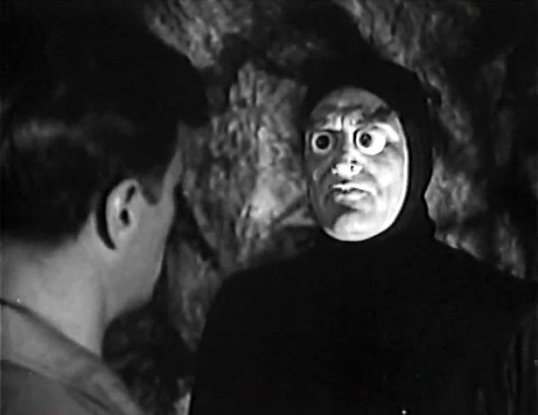
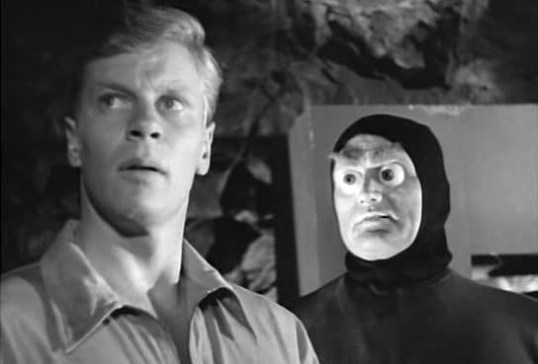
This is the one with the googly-eyed aliens.

Killers From Space was released in 1954 and, in many ways, it’s typical of the sci-fi B-movies that were released at the time. A nuclear scientist (Peter Graves) crashes the airplane that he’s flying. Everyone thinks that he’s dead but, a day later, he shows up at the army base. He says he can’t remember anything about the crash but once he’s put under hypnosis, he remembers being abducted by a bunch of aliens. No one believes his story but Graves knows what happened and he’s determined to thwart the aliens before they can sap away all of Earth’s energy. And by Earth, I mean America because this film is from 1954 and every character in the movie understands that there’s only one nation that matters!

With a running time of only 70 minutes, it’s a standard alien invasion flick. It’s perhaps a bit distinguished by the presence of Peter Graves, who handles his role with dignity.  Graves was one of those actors who could deliver even the most ludicrous dialogue with a certain amount of gravitas and the film certainly gives him plenty of chances to do just that.  Graves has the perfect deep, resonant establishment voice.  Just the sound of it makes the viewer think of America.  As such, there’s something undeniably fun about him deploying that voice for a film about an invasion of googly-eyed aliens.  And the film is also somewhat notorious for being one of the many B-movie to be directed by Lee Wilder, the brother of Billy Wilder.  Billy Wilder not only perfected the modern comedy but he also made some of the most important film noirs ever made.  He was a master of every genre and someone who inspired countless filmmakers.  He directed witty masterpieces like Double Indemnity and Sunset Boulevard and The Apartment.  Billy Wilder made the first major film about alcoholism, The Lost Weekend. Billy Wilder won Oscars and competed at Cannes. Lee Wilder made movies like Killers From Space.  The Cannes elitists never invited Lee Wilder to their festival and, watching his films, one gets the feeling that it was the festival’s lost.  Ironically, both directors made films that continue to intrigue viewers, though for very different reasons.  Billy Wilder gave us an amoral Hollywood screenwriter narrating a film from beyond the grave.  Lee Wilder gave us googly-eyed aliens.  And true film lovers love both of them for their entertaining contributions to world cinema.

With all that in mind, the main thing that people remember about Killers From Outer Space are the aliens and …. well, who can blame them? Seriously, look at them!

I mean, obviously they’re just big googly eyes and half the time, they don’t even fit correctly. You can probably buy eyes like that for yourself if you really wanted to. But still, the image of those big eyed aliens is undeniably creepy! You may quickly forget most of what happens in Killers From Space. It’s not that memorable of a film, to be honest. But you will never forget those eyes!

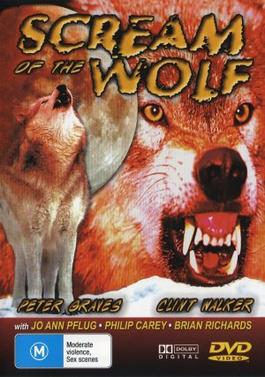
Retro Television Review: Scream of the Wolf (dir by Dan Curtis)


Welcome to Retro Television Reviews, a feature where we review some of our favorite and least favorite shows of the past!  On Sundays, I will be reviewing the made-for-television movies that used to be a primetime mainstay.  Today’s film is 1974’s Scream of the Wolf.  It  can be viewed on YouTube!

A small town in California is shocked when a series of brutal murders occur within the city limits.  Someone or something is killing people whenever the moon is full.  The only clue are the footprints that the killer leaves behind at every scene.  Strangely, there are time when the kill seems to walking on all fours, suggesting that it’s a wild animal.  But then, suddenly, there are only two footprints, indicating that the killer is a man.  Is the killer a beast or a human?

Maybe it’s both.

That’s the question that John Weatherby (Peter Graves) attempts to answer in Scream of the Wolf.  John is a former hunter who is now working on a book about his life.  He looks at the footprints and the savagery of the attacks and he says that the killer is obviously a wolf because no human could be capable of doing such a thing.  However, many people in town are convinced that the killer is a werewolf.  That includes John’s girlfriend, Sandy (Jo Ann Pflug).

In fact, Sandy thinks that she knows exactly who the werewolf is.  She thinks that Bryon Douglas (Clint Walker) is responsible for the murders.  Byron is an old friend of John’s.  They used to hunt together.  John eventually turned his back on hunting but Byron continues to insist that people are never more alive than when they are hunting another creature.  In fact, Byron claims that the murders are actually a good thing.  According to Byron, the murders have woken up the survival instinct in the spoiled inhabitants of the town.  And indeed, the citizens of the town do appear to be getting progressively more and more paranoid.

Okay, so Byron obviously has some issues.  But does that make him a werewolf?  John insists that there are no werewolves and that Byron is just a somewhat eccentric blowhard.  John better hope that he’s right because Byron has announced that he’s going to hunt down the werewolf and he’s invited John to join him on the hunt.

Running a brisk 78 minutes and not wasting a single one of them, Scream of the Wolf is an enjoyable and atmospheric werewolf film.  I don’t think I actually heard a wolf scream over the course of the film but I did hear plenty of people scream.  For a made for TV movie, Scream of the Wolf doesn’t shy away from showing the horror of being stalked by an unseen creature in the middle of the night.  Needless to say, any film featuring Peter Graves as a former big game hunter is going to have a bit of camp appeal but, in the end, Graves’s somewhat stolid acting style works well for the character that he is playing.  Clint Walker, who towers over everyone else in the film, gives an intimidating and creepy performance as Byron.  The film’s central mystery isn’t particularly complex but the story is told well.  Scream of the Wolf is a simple but entertaining film, one that’s ideal for October viewing.

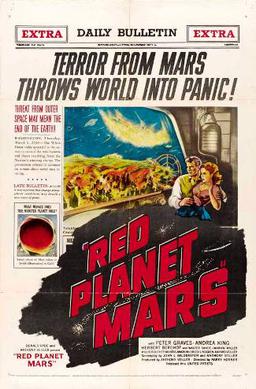
Red Planet Mars (1952, directed by Harry Horner)


Chris Cornyn (Peter Graves) and his wife, Linda (Andrea King) are two scientists who have spent the years since World War II listening to transmissions from Mars.  The technology that they use was developed by a scientist who may have been a Nazi but the Cornyns feels that the greater good of learning about Mars outweighs the problematic background of their equipment.

One day, the transmitters pick up a message from Mars, announcing that Mars is a Socialist paradise where there is no fear of nuclear war.  The Soviets are gleeful because they think the Martian messages will lead to the collapse of NATO.  But then the Martians start sending out religious messages, which lead to riots in the USSR and Eastern Europe.

Are the Martians really contacting Earth?  Is God really transmitting a message from Mars?  Or is a more sinister figure responsible?

Red Planet Mars is one of those films that only could have been made at the height of the Cold War.  Despite the title, the film is decidedly Earth-bound and full of stock footage of the nations of the world reacting to the Martians.  The main theme is that, Martians or not, nothing is more important than protecting the American way of life. even if that means sacrificing your own life and misleading the world.  Even if it is now impossible to listen to his dialogue without thinking about the “Do you like movies about gladiators?” conversations from Airplane!, Peter Graves was the perfect, no-nonsense messenger.  An artifact of a different time, the movie’s greatest strength is that it takes its ridiculous story seriously and even today, it leaves you wonder how we would react to messages from Mars.  Hopefully, we would today be more skeptical.  People in 1953 would believe anything.

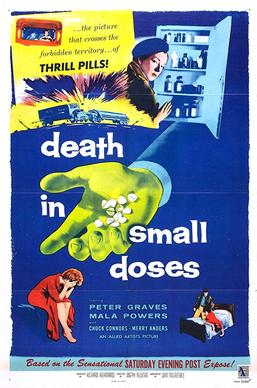
30 More Days of Noir #10: Death in Small Doses (dir by Joseph M. Newman)


Ah, speed.

I have to admit that I always find films about amphetamines to be fascinating because I take them for my ADD.  I’ve been taking Dexedrine since I was in middle school and it has always amused me how people who don’t have ADD seem to think that the meds will give you super powers.  For instance, every season of Big Brother, there’s people online who get outraged over certain houseguests taking Adderall.  “She had an unfair advantage!” someone will say, “Because she’s taking Adderall!”  What can I say?  People who don’t have ADD just don’t get it.  Yes, if you have ADD, the meds can help you focus but it’s not like they’re going to give you any sort of special power that’s not available to any other person.

(I will admit that there is a slight difference between me on my meds and me off my meds.  Actually, my family says that there’s a huge difference but I think they’re exaggerating.  It is true that I’m a lot more focused when I take my Dexedrine.  My mind wanders a bit less than usual and I’m also usually in better control of my frustrations.  When I take my meds, I can finish any project.  When I don’t take them, I can talk about finishing any project.)

Dexedrine focuses me but apparently, it does the opposite for those who don’t have ADD.  The 1957 film, Death in Small Doses, features a truck driver named Mink Reynolds who, despite not having ADD, pops too many capsules and ends up playing really loud music and trying to force a waitress to dance with him.  He also hallucinates seeing a car and then grabs a knife and tries to kill another truck driver.  To be honest, that seems a bit extreme to me.  In fact, I’d almost argue that Mink’s behavior would indicate that the filmmakers really didn’t know much about amphetamines.  Making things even stranger is that Mink is played by Chuck Connors, who was a remarkably inexpressive actor.  Watching Connors, with his stone face, trying to dance and jump around is an interesting experience.  Mink is supposed to be a jazz-crazed, speed-abusing hepcat but instead, he comes across like an animatronic mannequin.  You can almost hear the gears shifting whenever he has to move across the screen.

Mink’s fellow truck driver is Tom Kaylor (Peter Graves), a seemingly upright man who is usually seen wearing a tie and who looks like he would be more comfortable working behind a desk than driving a truck.  Of course, that’s because Tom is actually an FBI agent!  He’s working undercover, pretending to be a truck driver so that he can smash a ring of drug dealers!  Of course, the problem here is that everything about Peter Graves’s screen presence shouts out, “Narc!”  With his square jaw and his perfect haircut and his stiff but authoritative delivery of his dialogue, he seems like he was created in a lab that specifically set out to develop the most stereotypical FBI agent imaginable.  There’s not a single rough edge to him and it’s hard to buy that the other truck drivers wouldn’t see straight through him.

While Tom tries to bust the ring, he also finds time to possibly fall in love with two different women, both of whom seem as if they might know more than they’re letting on.  Amy (Merry Anders) is the waitress who has developed a drug habit of her own.  Val (Mala Powers) owns the boarding house when Tom and Mink live.  Can Tom trust either one of them?  And will Tom not only undercover the identity of the head of the drug ring but also survive long enough to bring the dealers to justice?

So, here’s the thing.  During its worst moments — i.e., whenever Chuck Connors is jumping all over the place and talking about how much he loves his friend “benny” — this is a campy and rather silly film that makes Reefer Madness look subtle by comparison.  However, during its best moments, this is a tough and entertaining noir that features good performances from Merry Anders and Mala Powers.  Both Anders and Powers manage to transcend the film’s sillier moments and they actually bring a charge of reality to the story.  And while director Joseph M. Newman may not have known much about drugs, he did know how to shoot a fight scene.  Making good use of its desolate locations (the truck drivers spend a lot of time driving through the desert) and setting many of the film’s best moments at night, Newman overcomes some of the script’s weaker moments.  In the end, it makes for a rather uneven but entertaining viewing experience.  Despite the film’s cluelessness about drugs and the miscasting of both Graves and Connors, this lesser-known noir is worth tracking down.

Horror on The Lens: Where Have All The People Gone? (dir by John Llewellyn Moxey)


For today’s horror on the lens, we have a 1974 made-for-TV movie about what happens when a family comes down from the mountains and discovers that everyone’s disappeared.

“Where have all the people gone!?” is the obvious question and it’s also the title of this film.  Our own Jedadiah Leland reviewed this movie back in March and he described it as being “effectively creepy.”  I watched it with my friends in the Late Night Movie Gang a few months later and we described as being perhaps the best Peter Graves film we had seen since we watched that one where everyone was a clone.

So, after those recommendations, how can you not watch Where Have All The People Gone?

Enjoy!

Where Have All The People Gone? (1974, directed by John Llewellyn Moxey)


Steve Anders (Peter Graves) and his teenage children, David (George O’Hanlon, Jr.) and Deborah (Kathleen Quinlan), are exploring a cave in the mountains of California when they experience a sudden earthquake.  After managing to escape from the cave and meeting a man who tells them about how there was a bright flash of light in the sky before the earthquake, the three of them come down from the mountain and discover that there does not appear to be anyone around.  Instead, where people once stood, there are now only piles of clothes and white dust.  Where have all the people gone?

As the Anders try to make their way back home to Malibu, they discover that the entire world has changed.  Towns are completely deserted and once friendly animals are now viscous and hostile.  While Steve tries to keep his children from giving up hope, he also tries to find the answer to the question, where have all the people gone?

This film, which is only a little over an hour long, was made for NBC.  Though the film’s short running time can sometimes make it feel rushed, Where Have All The People Gone? is still a effectively creepy movie from made-for-television specialist John Llewellyn Moxey.  Though it’s always difficult to accept an actor like Peter Graves as being anyone other than Peter Graves, he actually did a pretty good job playing the confused father and there are some good scenes where both of his children deal with thing in their own way.  (David refuses to get emotional.  Deborah does the opposite.  Only Steve understands the importance of mixing emotion with reason.)  When they do finally find another survivor, she’s played by Verna Bloom and the scene where they come across her sitting in her car, apparently catatonic, is really well-handled.

Though the film does eventually explain where all the people have gone, it still has an unsatisfying, open-ended ending.  It wouldn’t surprise me if this film was meant to be pilot for a potential televisions series because it ends with the promise of future adventures.  A weekly tv series would have allowed the Anders family to find more survivors and more angry animals but instead, the story ends with everyone still unsure as to what type of world they’re about to inherit.

If you’re one of those who is stuck inside right now, Were Have All The People Gone? is reasonably diverting and is available on YouTube and Prime.

Film Review: The Adventurers (dir by Lewis Gilbert)


The 1970 film, The Adventurers, is a film that I’ve been wanting to watch for a while.

Based on a novel by Harold Robbins, The Adventurers was a massively expensive, three-hour film that was released to terrible reviews and even worse box office.  In fact, it’s often cited as one of the worst films of all time, which is why I wanted to see it.  Well, three weeks ago, I finally got my chance to watch it and here what I discovered:

Yes, The Adventurers is technically a terrible movie and Candice Bergen really does give a performance that will amaze you with its ineptitude.  (In her big scene, she sits in a swing and, with a beatific look on her face, begs her lover to push her “Higher!  Higher!”)

Yes, The Adventures is full of sex, intrigue, and melodrama.  Director Lewis Gilbert, who did such a good job with Alfie and The Spy Who Loved Me, directs as if his paycheck is dependent upon using the zoom lens as much as possible and, like many films from the early 70s, this is the type of film where anyone who gets shot is guaranteed to fall over in slow motion, usually while going, “Arrrrrrrrrrrrgh….”  A surprisingly large amount of people get shot in The Adventurers and that adds up to a lot of slow motion tumbles and back flips.  Gilbert also includes a sex scene that ends with a shot of exploding fireworks, which actually kind of works.  If nothing else, it shows that Gilbert knew exactly what type of movie he was making and he may have actually had a sense of humor about it.  That’s what I choose to believe.

Despite the fact that The Adventurers is usually described as being a big-budget soap opera, a good deal of the film actually deals with Latin American politics.  For all the fashion shows and the decadence and the scenes of Candice Bergen swinging, the majority of The Adventures takes place in the Latin American country of Cortoguay.  If you’ve never heard of Cortoguay, that’s because it’s a fictional country.  Two hours of this three-hour film are basically devoted to people arguing and fighting over who is going to rule Cortoguay but it’s kind of impossible to really get to emotionally involved over the conflict because it’s not a real place.

Ernest Borgnine plays a Cortoguayan named — and I’m being serious here — Fat Cat.  Seriously, that’s his name.  And really, how can you not appreciate a movie featuring Ernest Borgnine as Fat Cat?

Fat Cat is the guardian of Dax Xenos (Bekim Fehmiu).  Dax’s father is a Cortoguayan diplomat but after he’s assassinated by the country’s dictator, Dax abandons his home country for America and Europe.  While he’s abroad, Dax plays polo, races cars, and has sex with everyone from Olivia de Havilland to Candice Bergen.  He also gets involved in the fashion industry, which means we get two totally 70s fashion shows, both of which are a lot of fun.  He marries the world’s richest heiress (Bergen) but he’s not a very good husband and their relationship falls apart after a pregnant Bergen flies out of a swing and loses her baby.

Throughout it all, Fat Cat is there, keeping an eye on Dax and pulling him back to not only Cortoguay but also to his first love, Amparo (Leigh Taylor-Young), who just happens to be the daugther of Cortoguay’s dictator, Rojo (Alan Badel).  In fact, when Fat Cat and Dax discover that an acquaintance is selling weapons to Rojo, they lock him inside of his own sex dungeon.  That’s how you get revenge!  And when Dax eventually does return to Cortoguay, Fat Cat is at his side and prepared to fight in the revolution.  Incidentally, the revolution is led by El Lobo (Yorgo Voyagis), who we’re told is the son of El Condor.

The Adventurers is melodramatic, overheated, overlong, overdirected, and overacted and, not surprisingly, it’s eventually a lot of fun.  I mean, the dialogue is just so bad and Lewis Gilbert’s direction is so over the top that you can’t help but suspect that the film was meant to be at least a little bit satirical.  How else do you explain that casting of the not-at-all-Spanish Bekim Fehmiu as a Latin American playboy?  Candice Bergen plays her role as if she’s given up any hope of making sense of her character or the script and the rest of the cast follows her lead.  Ernest Borgnine once said that The Adventurers was the worst experience of his career.  Take one look at Borgnine’s filmography and you’ll understand why that’s such a bold statement.

The Adventurers is three hours long but it’s rarely boring.  Each hour feels like it’s from a totally different film.  It starts out as Marxist agitprop before then becoming a glossy soap opera and then, once Fat Cat and Dax return home and get involved in the revolution, the film turns into “modern” spaghetti western.  It’s a film that tries so hard and accomplishes so little that it becomes rather fascinating.

And, if nothing else, it reminds us that even Fat Cat can be a hero….