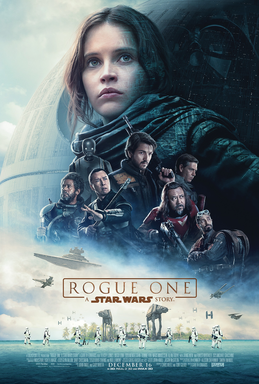
No Ewoks, No Jar Jar: Rogue One: A Star Wars Story (2016, directed by Gareth Edwards)


rogue_one_a_star_wars_story_posterA long time ago in a galaxy far, far away…

The evil Galactic Empire spent what had to be billions of Imperial credits to build the greatest weapon in the universe.  It was known as the Death Star and it housed a laser so powerful that it could blow up a planet with just one shot.  And yet, for all the effort and all the years that were spent building it, the Death Star had one glaring vulnerability, an exposed exhaust valve that the Rebel Alliance twice used to the destroy it.

For years, fanboys debated why the Empire would go to the trouble to build a super weapon with such an obvious design flaw.  I have to admit that I was often one of them.  No one else seemed to care but, to us, this was a huge deal.  If the Empire could figure out how to blow up a planet with one super laser, why couldn’t they figure out how to protect that one valve?

Now, thanks to Rogue One: A Star Wars Story, we have an answer.  We not only know why that valve was there but we also know what was meant in New Hope when the rebel general said that the plans to the Death Star had been stolen at great cost.

Rogue One is a fan’s dream, one that answers questions while expanding on the Star Wars mythology.  Unlike the previous prequels, it adds to the story without cheapening the original films.  In fact, of all the Star Wars films, Rogue One is the first to make the Death Star into a believable weapon of mass destruction.  When it appears over one planet, it blots out the sun.  When it blows up a rebel base, we see the destruction from inside the base instead of observing it from the safety of Death Star.  Director Gareth Evans does for the Death Star what he previously did for Godzilla.
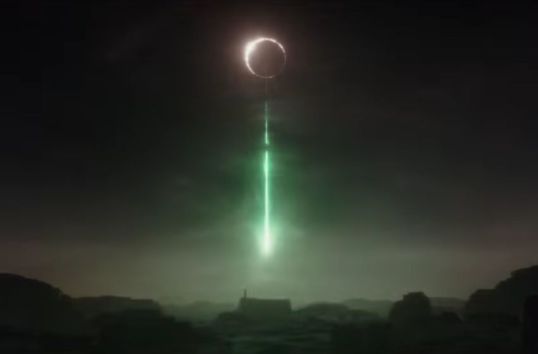
death-star

Unfortunately, like Godzilla, the action and the special effects in Rogue One are usually more interesting than any of the film’s characters.  Felicity Jones, Diego Luna, Donnie Yen, Jiang Wen, Alan Tudyk, and Riz Ahmed are all good actors but they’re all playing underwritten parts.  No one steps up like Harrison Ford did in the original trilogy.  Commander Kennec, played by Ben Mendelsohn, has a little more depth than the typical Imperial villain but, for better or worse, the film’s most memorable performances come from a CGI Peter Cushing and James Earl Jones providing the voice of Darth Vader.

rogue-one

Despite the underwritten characters, Rogue One is still the best Star Wars film since Empire Strikes Back, a return to the grittiness, the thrilling action, and the awe of discovering new worlds that distinguished the first two movies.  For once, a Star Wars film seems to have more on its mind than just selling toys.  Though we already know what is ultimately going to happen to the Death Star at the end of New Hope, Rogue One is a frequently downbeat film.  There are no Ewoks and, to great relief and rejoicing, Jar Jar is never seen.  The closest that Rogue One gets to comic relief is Alan Tudyk providing the voice of a cynical robot.  The emphasis is on the horrors of war and even the rebels are troubled by some of the things that they have done.  For once, the Rebel Alliance actually feels like a rebellion and the evil of the Empire feels real instead of cartoonish.

Rogue One is projected to be the first of many “Star Wars stories,” stand-alone film that will expand the universe and hopefully clarify some of the points that were left unclear by the original trilogy.  I think it’s going to be very successful very Disney.  I’m just dreading the inevitable Jar Jar origin story.


Halloween Havoc!: THE HOUSE THAT DRIPPED BLOOD (Amicus 1971)


gary loggins's avatarcracked rear viewer

drip1

Hammer Films wasn’t the only British company cranking out the horrors back in the 60’s and 70’s. American ex-pats producers Milton Subotsky and Max Rosenberg formed Amicus Films in 1962 and after a couple of films aimed at the teen audience (with American rockers like Chubby Checker, Del Shannon, Freddy Cannon, and Gene Vincent) began concentrating on horror. The team specialized in the anthology genre, or “portmanteau” as the intelligentsia call them. I’ll stick with anthologies!

THE HOUSE THAT DRIPPED BLOOD was a 1971 effort written by Robert Bloch, forever known as “The Guy Who Wrote PSYCHO”. The nail to hang Bloch’s four tales on concerns the disappearance of famous horror actor Paul Henderson, who was last seen at the old house in the countryside. Inspector Holloway (John Bennett) of Scotland Yard (where else?) arrives on the scene and speaks with the local constable, who warns Holloway about mysterious doings past:

drip2

In “Method for Murder”…

View original post 690 more words

Horror Film Review: The Revenge of Frankenstein (dir by Terence Fisher)


revengetitle

Last year, Gary reviewed the first of the Hammer Frankenstein films, The Curse of Frankenstein.  For today’s horror film review, I’m going to take a look at the second movie in Hammer’s Frankenstein series, 1958’s The Revenge of Frankenstein!

The Revenge of Frankenstein opens where The Curse of Frankenstein ended.  The monster (played by Christopher Lee in the first film) has been destroyed and Baron Frankenstein (Peter Cushing) has been sentenced to be executed for the monster’s crimes.  However, the Baron escapes the guillotine.  Instead, he arranges for a priest to be beheaded in his place.  Working under the name Dr. Stein, the Baron escapes to another village and, after several years, re-establishes himself as a wealthy and respected doctor.  While most of his patients are rich, Dr. Stein also helps the poor and the disabled.  By all accounts, he’s doing wonderful work but he’s also deliberately enigmatic, refusing to join the local doctors council.

Right from the beginning, we’re reminded of just how different Hammer’s Baron Frankenstein was from Universal’s version of the good doctor.  In the Universal films, Dr. Frankenstein — regardless of whether the doctor in question was Henry, Wolf, or Ludwig — was always portrayed as being misguided but ultimately noble.  If any of the Universal Frankensteins had been sentenced to death, it’s probable that they would have put on a stoic face, walked to the guillotine, and allow their head to roll.  In fact, they would have felt so responsible for the actions of the Monster that they probably would feel it was their moral duty to allow themselves to be executed.

That’s not the case when it comes to Hammer’s Baron Frankenstein.  Baron Frankenstein feels no guilt over what the Monster has done.  Go the guillotine?  No way!  Baron Frankenstein is determined to create life and if creating life means that other, lesser mortals end up dead … well, so be it.  As opposed to the Universal Frankensteins, who all developed god complexes after the success of their experiment, Baron Frankenstein has his god complex from the beginning.  And if Baron Frankenstein is a god, why shouldn’t a priest be sacrificed for the good of the Baron’s work?

Anyway, Dr. FrankenStein and his assistant, Dr. Kleve (Francis Matthews) are determined to once again bring the dead back to life.  This time, the plan involves transplanting the brain of hunchback Karl (Oscar Quitak) into a physically strong body (played by Michael Gwynn).  Dr. Kleve is worried that a brain transplant could lead to unforseen complications.  For instance, one of Dr. Stein’s chimpanzees reacts to being given an orangutan’s brain by turning into a cannibal.  However, Stein tells Dr. Kleve not to worry about it.  After all, what could go wrong?

Well, a lot goes wrong.  It’s a Frankenstein movie, after all.

I have to admit that, while I love Hammer’s Dracula films, I’ve never been a huge fan of their take on Frankenstein.  While Peter Cushing always makes for a wonderfully compelling and often chillingly evil Baron Frankenstein, the majority of the Hammer Frankenstein films always seem to move way too slowly.  Whenever I watch one of them, I always find myself growing rather impatient with the endless scenes of grave robbery and body stitching.  “HURRY UP AND BRING THAT DAMN THING TO LIFE!” I’ll find myself shouting.

However, I was actually pleasantly surprised by how well The Revenge of Frankenstein holds up.  That Cushing would give an excellent performance as Baron Frankenstein is to be expected.  But really, the entire film is well-acted and both Oscar Quitak and Michael Gwynn give poignant performances as Frankenstein’s latest experiment.  It’s a visually vibrant and nicely paced horror film, one that never drags like some of the later Hammer Frankenstein films.

The Curse of Frankenstein and The Revenge of Frankenstein make for a great double feature, especially in October!

Halloween Havoc!: Peter Cushing in CORRUPTION (Columbia 1968)


gary loggins's avatarcracked rear viewer

corrupt1

Hammer horror icon Peter Cushing is remembered for his two signature roles with the company, the obsessed Baron Frankenstein and the vampire hunter Van Helsing. The actor made many other films as well, but none as bizarre as CORRUPTION. This sleazy slice of 60’s dementia finds Cushing once again a brilliant surgeon, this time in a contemporary setting, in a gore fest that goes off the deep end with a uniquely wild denouement that will leave viewers in  shock.

corrupt2

Sir John Rowan (Cushing), eminent plastic surgeon,  is engaged to beautiful young model Lynn Nolan, popular fashion face of the day. Despite being tired, John attends a typical swinging 60’s party with her, and it’s clear he’s not comfortable in this milieu. When the host begins taking sexy pics of Lynn, John’s had enough and wants to leave. The host gets belligerent and a fight breaks out between the men, causing a flood lamp to…

View original post 614 more words

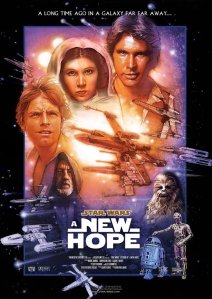
Sci-Fi Review – Star Wars: Episode IV – A New Hope (dir. by George Lucas)


newhopemain

Before I start, a quick apology. This isn’t a great review by any means. One, I rushed it. Two, In writing about a film that everyone knows, I found I had problem figuring out exactly what to say. What you’re getting here is a stream of consciousness. The Empire Strikes Back review will be better.

In anticipation of The Force Awakens, the Shattered Lens are taking on the other films in the Star Wars Saga. It’s next to impossible for anyone to avoid seeing anything related to the new film as the fever grows and we reach the December 18th release date.

There are a few movies where I wish I could’ve been there during their theatrical release. How great would it be to see audiences squirm during Ridley Scott’s Alien, Steven Spielberg’s Jaws or William Friedkin’s The Exorcist? I was a little too young to see the original Star Wars when it premiered in May of 1977, but I can’t imagine it wasn’t amazing. I wouldn’t be familiar with the films until 1980’s The Empire Strikes Back. That was the film I saw first. Then Star Wars on VHS and finally Return of the Jedi in the cinema when I was 9.

Still, I grew up knowing what Star Wars was before I could really read. Thanks to an older brother who was enthralled with the film at 7, there were Star Wars curtains in our room and Star Wars bedsheets/blankets. We had action figures and models to play with. Since LED’s in toys weren’t the norm, our lightsabers consisted of whiffle-bat plastic rods with cuts in them. Swing the sword a bit and you’d hear the “hum” of the blade. It was an awesome time.

Years later, when my little brother was born in the mid-1980’s, we kept him occupied with movies. Once he learned what Star Wars was, it was almost always the film he’d pick out to watch. I took him with me to catch all three of the Prequels during late night runs. We’d spend the wait with our own lightsabers, re-enacting Episode I fights or just talking about what we hoped we’d see. Earlier this year, during my last visit to my friends in Oregon, I was able to introduce a new generation to the magic of it all.

All of that is me, gushing over one of my favorite set of films. You have my sympathies.

So, how did a little sci-fi film in the late 70s manage to become such a pop culture beacon today? Was it the special effects, so ground breaking that we still use its techniques (such as the Green Screen)? Was it the sound design? The cast, perhaps, made up of a mix of relative unknowns and seasoned film veterans?

I’d argue that the film’s biggest success is the overall impact in the Motion Picture industry. Lucas and the production team were forced to make some innovations to get the vision they wanted. To that end, Industrial Light & Magic was created, and the effects studio pioneered special effects for years to come. Pixar wouldn’t have happened without Star Wars and ILM, since they were just a branch of the company that Lucas couldn’t quite find a use for, supposedly. The best comparison I can make for anyone unfamiliar with ILM is Weta Digital and the Lord of the Rings Trilogy. You know when you watched those three films, you were seeing effects that everyone would want to use down the road. That’s just my view. The ties to classic myths were also strong, as Lucas was heavily influenced by Joseph Campbell. Campbell’s Hero Journey is basically the template used for A New Hope (and for The Matrix by the Wachowski’s, if you watch them side by side). Ben Burtt would go on to win a special award for Sound Effects in the film. His work would eventually end up being the backbone of Skywalker Sound.

From a casting standpoint, most of the principals were relative unknowns at the time. Lucas worked with Harrison Ford on American Graffiti some years before. Mark Hamill was brought on board after auditioning at the behest of his friend, Robert Englund (which I found out during writing this). Carrie Fisher loved the script and was also cast as Princess Leia. For some added weight, Lucas managed to cast both Sir Alec Guinness and Peter Cushing. I’m still not entirely certain of how he pulled that off.

Star Wars (or A New Hope as I’ll refer to it) takes place 30 years after the events of Revenge of the Sith. The Galactic Empire is in control over everything, the Jedi are no more. It’s a near complete victory, save for the fact that the plans for the Empire’s greatest weapon were stolen. When a Star Destroyer intercepts a Rebel Cruiser with Princess Leia Organa (Carrie Fisher) on board, she’s captured for interrogation. This is, of course, after she sneaks the plans for the Death Star in her trust R2 Unit, R2-D2 (Kenny Baker). R2, along with his companion C-3PO (Anthony Daniels) manage to escape the Star Destroyer and land on the desert planet of Tatooine.

The Droids are discovered by Jawas and are then sold to Owen Lars, his wife Beru and their nephew, Luke Skywalker. Luke wants to join up with the Alliance and become a starfighter, but the family needs him on the farm. After stumbling on to the message the Princess hid in R2-D2, he looks for his old friend, Ben Kenobi (Alec Guinness), who turns out to be more than what he seems.

In order to get to the Princess, they need someone to get them there. This is where the coolest character in the entire series appears. For a price, Han Solo (Harrison Ford) and his buddy Chewbacca (Peter Mayhew) take Ben and Luke in their spaceship, the Millenium Falcon to search for her. They get captured by the Empire, practically stumble upon the princess and she rescues them by way of a garbage chute. They get the plans, escape the Death Star and collaborate on a rebel assault to destroy it before it can do more harm. That’s the bulk of it, though admittedly, I’m leaving a lot out. It’s a simple tale, but an effective one as well.

Overall, A New Hope is still the template for a lot of Sci-Fi films. Battles in space, a little bit of swashbuckling, and some humor here and there are all elements borrowed by many films and games since it was released. Some handle Sci-Fi better (Mass Effect, Dune) and others fail in comparison (Jupiter Ascending, anyone?), but most modern works pay some homage to Star Wars in a way.

Tomorrow, we take a look at The Empire Strikes Back, arguably the best story in the Star Wars saga.


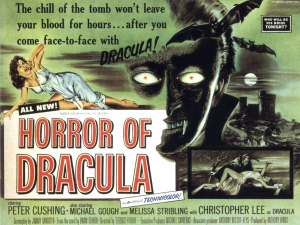
GODS OF THE HAMMER FILMS 2: Peter Cushing, Christopher Lee, and HORROR OF DRACULA (1958)


gary loggins's avatarcracked rear viewer

hor drac4

(second of a series)

Hammer Films Ltd. knew they were on to something with the release of 1957’s THE CURSE OF FRANKENSTEIN. The Gothic horror was box office gold on both sides of the Atlantic, and Hammer wasted no time finding a follow up. Reuniting CURSE OF FRANKENSTEIN costars Peter Cushing and Christopher Lee with director Terence Fisher, the company set its sights on giving the full Eastmancolor treatment to Bram Stoker’s immortal Count Dracula.

View original post 554 more words

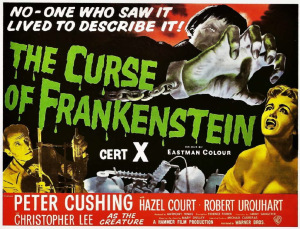
Gods of the Hammer Films: Peter Cushing, Christopher Lee, and THE CURSE OF FRANKENSTEIN (1957)


gary loggins's avatarcracked rear viewer

curse4

When Britain’s Hammer Films began in the early 1930’s they were just another movie production company. After finding some success with the 1955 sci-fi adaptation THE QUARTERMASS EXPERIMENT, they chose to make a Gothic horror based on Mary Shelley’s classic 1818 novel about a man obsessed with creating artificial life. FRANKENSTEIN had been filmed many times before, most notably Universal’s 1931 version that brought eternal fame to Boris Karloff. This time however, the producers shot in vibrant color, with blood and body parts on gory display. Tame stuff compared to today’s anything goes horrors, but in the fifties it was considered quite shocking.

Peter Cushing and Christopher Lee had appeared in two films before, Lawrence Olivier’s 1948 HAMLET and John Huston’s 1952 MOULIN ROUGE, though not as a team. Once CURSE OF FRANKENSTEIN was unleashed upon the public, they were paired another nineteen times, making Cushing and Lee terror’s all-time tandem. HORROR OF DRACULA came next, with…

View original post 613 more words

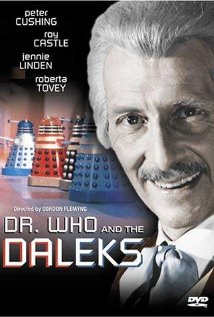
What if Peter Cushing Had Played The Doctor: A Look at Dr. Who And The Daleks


MV5BMjA5MDE3MDI5MV5BMl5BanBnXkFtZTcwNjU3NTgxMQ@@._V1_SY317_CR5,0,214,317_AL_When the long-running British science fiction show Doctor Who premiered over 50 years ago, it was originally envisioned as being a serialized educational program for children.  Each serial would see The Doctor (William Hartnell), his granddaughter Susan (Carole Ann Ford), and teachers Ian (William Russell) and Barbara (Jacqueline Hill) traveling via TARDIS to a different historical period and interacting with real-life figure like Marco Polo and the Emperor Nero.  The first serial, An Unearthly Child, featured the Doctor and his companions going back to prehistoric times and teaching cavemen how to make fire.

However, the show’s second serial forever changed the direction of the series.  Written by Terry Nation, The Daleks introduced viewers to a race of militaristic aliens who, because they had nearly destroyed their planet in a nuclear war, could only exist inside of a tank-like shell.  Devoid of all emotion except for hate, the Daleks were best known for their shrill battle cry of “EXTERMINATE!”  Despite being defeated and apparently destroyed at the end of the serial, The Daleks returned to face the Doctor many times and the show itself shifted its focus away from teaching history lessons and instead became the show that we all know and love today.

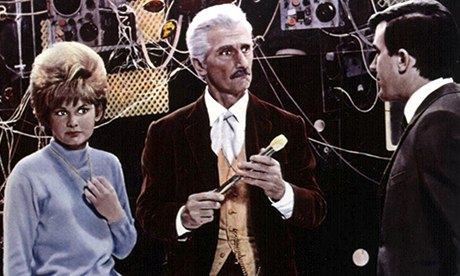
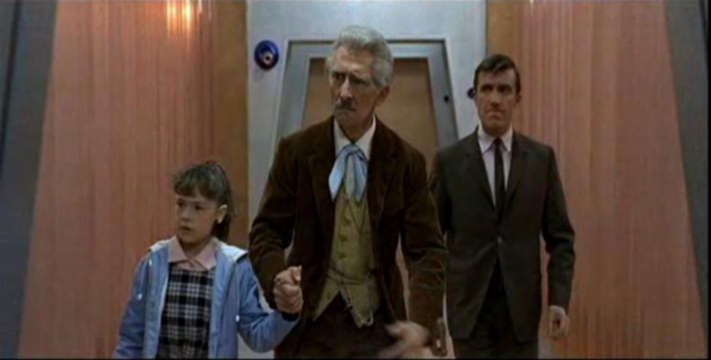
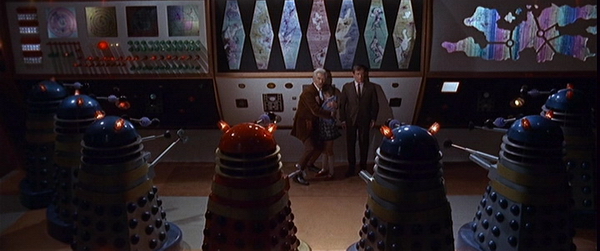
Dr-Who-and-the-Daleks-Poster-by-Tim-DoyleAt its height, the popularity of the Daleks rivaled that of the Doctor and his companions.  In 1965, when Amicus Productions produced the first Doctor Who feature film, it was a no-brainer that it would feature the Daleks.  With a few key changes (mostly to the character of the Doctor and his companions), Dr. Who and the Daleks recreates the plot of Terry Nation’s original serial.  The Doctor (played by Peter Cushing), his granddaughters, Barbara (Jennie Linden) and Susan (Robert Tovey), and Barbara’s boyfriend Ian (Roy Castle) go to the planet Skaro, where they help the peace-loving Thals battle the war-obsessed Daleks.

Beyond selling the rights to the story, the BBC had nothing to do with the film’s production.  Amicus obviously geared the film towards children, perhaps not understanding that, though Doctor Who may have started out as a kid’s show, the program itself had become much more adult as it grew in popularity.  Hoping to make a film that could appeal to a wider (read: American) audience than the original TV show, Amicus changed a few key details.  As a result,  for fans of the original show, Dr. Who and the Daleks is a true oddity.  It provides an alternative vision of what Doctor Who could have been.

One change that did work is that, at a time when Doctor Who was still being broadcast in black-and-white, Dr. Who and the Daleks was in color.  Visually, the film has a pop art feel, full of primary color and featuring locations that feel like low-budget version of the villainous lairs that Ken Adam used to design for the James Bond films.  This was the first time that the Daleks had been seen in Technicolor and the show even appropriated the film’s Dalek color-scheme when color episodes started to air in 1970.

Dr-Who-The-Daleks-2

Other changes do not work quite as well.  The Daleks’ famous “EXTERMINATE” battle cry is never heard.  The show’s beloved theme music has been replaced with an uninspired score from veteran Amicus composer Malcolm Lockyer.  While the TARDIS still looks like a blue police box and is bigger on the inside than the outside, the sleek control console and the familiar grinding noise are both gone.  Instead, the inside of the TARDIS is a cluttered mess of loose wires and flashing lights.  The Doctor now has two granddaughters and, undoubtedly in order to appeal to children, Susan is much younger than she was in the television series.  As well, in the television series, Ian was a science teacher who had no fear of standing up to The Doctor.  The film’s Ian is clumsy and used mostly for broad comic relief.

Dr. Who & the Daleks films tillThe biggest change is to the character of the Doctor himself.  For fans of the series, there is no bigger pet peeve than when unfamiliar critics refer to the main character as being “Dr. Who.”  True fans know that the show’s title is a question and not a statement.  No one knows the Doctor’s true name or his exact age.  What they do know is that Doctor is a Time Lord from Gallifrey and that he stole his TARDIS.  Whenever the Doctor’s body suffers too much damage, he regenerates into a new body (and a different actor).

Of course, in 1965, the Time Lords had yet to be officially introduced.  The name “Gallifrey” had never been uttered on the television show.  The Time Meddler, which was the first serial to introduce another member of the Doctor’s race, only aired a month before the release of Dr. Who and the Daleks.  On the TV series, William Hartnell was still playing the First Doctor and it would be another two years before the character would regenerate for the first time.  When Dr. Who and the Daleks was released, all that was known of the Doctor was that he was an alien and no one knew his true name.

Even those two facts are ignored in Dr. Who and the Daleks.  Instead of being the abrasive alien that Hartnell played on the show, the film’s Doctor is portrayed as being a brilliant but absent-minded inventor who is very much a human being.  The film also establishes early that his last name really is Who, with Ian regularly addressing him as “Dr. Who.”  We never learn his first name.  Maybe it was Larry.

Dr-Who-and-the-Daleks-Dr-Who-4Dr. Who was played by Peter Cushing, who Amicus felt would be a bigger box office draw than William Hartnell.  Cushing does a good job playing his version of the character and it’s interesting to compare his kindly performance to both his better known work for Hammer and George Lucas and William Hartnell’s ruthless interpretation of the character.  Cushing regularly goes back to save the life of Castle’s cowardly Ian.  Hartnell would have just let him die.

Though the film bombed in North America (where, at the time, Doctor Who was still unknown) it did will enough in the UK to lead to a sequel, Daleks — Invasion Earth: 2150 A.D.  When the sequel failed at the box office, plans for future movies starring Peter Cushing as the Doctor were abandoned.  That was probably for the best.  If the Amicus films had been a success, they could have changed the direction of Doctor Who just as surely as Terry Nation did when he first introduced the Daleks.  Doctor Who could have reverted to being a show for children instead of becoming the show that it is today.

Still, it is hard not to wish that Peter Cushing could have gotten to play the Doctor in a “real” Doctor Who film.  After all, Christopher Lee would have made a great Master.

Dr Who and the Daleks (13)

Christopher Lee, R.I.P.


Jinnah

The picture above is Christopher Lee in the 1998 film Jinnah.  In this epic biopic, Lee played Muhammad Ali Jinniah, the founder of modern Pakistan.  Up until yesterday, I had never heard of Jinnah but, after news of Lee’s death broke, Jinnah was frequently cited as being Lee’s personal favorite of his many roles and films.

Consider that.  Christopher Lee began his film career in the 1940s and he worked steadily up until his death.  He played Dracula.  He played The Man with the Golden Gun.  Christopher Lee appeared, with his future best friend Peter Cushing, in Laurence Olivier’s Oscar-winning Hamlet.  He played Seurat in John Huston’s Moulin Rouge.  He appeared in both The Lord of the Rings and the Hobbit trilogies.  He appeared in several films for Tim Burton.  He even had a small role in Martin Scorsese’s Hugo.  He appeared in two Star Wars prequels.  He appeared in the original Wicker Man (and reportedly considered it to be his favorite of his many horror films).  He appeared in Oscar winners and box office hits.  And, out of all that, Christopher Lee’s personal favorite was Jinnah, a film that most people have never heard about.

Unless, of course, you live in Pakistan.  When I did a google search on Christopher Lee, I came across several Pakistani news sources that announced: “Christopher Lee, star of Jinnah, has died.”

And really, that somehow seems appropriate.  Christopher Lee was the epitome of an international film star.  He worked for Hammer in the UK.  He worked with Jess Franco in Spain and Mario Bava in Italy.  He appeared in several movies in the United States.  And, in Pakistan, he played Jinnah.  And I haven’t seen Jinnah but I imagine he was probably as great in that role as he was in every other role that I saw him play.  Over the course of his long career, Christopher Lee appeared in many good films but he also appeared in his share of bad ones.  But Christopher Lee was always great.

It really is hard to know where to begin with Christopher Lee.  Though his death was announced on Thursday, I haven’t gotten around to writing this tribute until Friday.  Admittedly, when I first heard that Lee had passed away, I was on a romantic mini-vacation and had promised myself that I would avoid, as much as possible, getting online for two days.  But, even more than for those personal reasons, I hesitated because I just did not know where to start when it came to talking about Christopher Lee.  He was one of those figures who overwhelmed by his very existence.

We all know that Christopher Lee was a great and iconic actor.  And I imagine that a lot of our readers know that Lee had a wonderfully idiosyncratic musical career, releasing his first heavy metal album when he was in his 80s.  Did you know that Lee also served heroically during World War II and, after the war ended, helped to track down fleeing Nazi war criminals?  Did you know that it has been speculated that Lee may have served as one of the role models for James Bond?  (Ian Fleming was a cousin of Lee’s and even tried to convince Lee to play Dr. No in the first Bond film.)  Christopher Lee lived an amazing life, both on and off the screen.

But, whenever one reads about Christopher Lee and his career or watches an interview with the man, the thing that always comes across is that, for someone who played so many evil characters, Christopher Lee appeared to be one the nicest men that you could ever hope to meet.  Somehow, it was never a shock to learn that his best friend was his frequent screen nemesis, Peter Cushing.

Christopher Lee is one of those great actors who we assumed would always be here.  The world of cinema will be a sadder world without him.

Legends together

Legends together

Here is a list of Christopher Lee films that we’ve reviewed here on the Shattered Lens.  Admittedly, not all of these reviews focus on Lee but they do provide a hint of the man’s versatility:

  1. Airport ’77
  2. Dark Shadows
  3. Dracula A.D. 1972
  4. Dracula Has Risen From The Grave
  5. Dracula, Prince of Darkness
  6. Hercules in the Haunted World
  7. The Hobbit
  8. The Hobbit: Battle of the Five Armies
  9. Horror Express
  10. The Horror of Dracula
  11. Hugo
  12. Jocks
  13. The Man With The Golden Gun
  14. The Satanic Rites of Dracula
  15. Scars of Dracula
  16. Scream and Scream Again
  17. Season of the Witch
  18. Starship Invasions
  19. Taste The Blood of Dracula
  20. The Wicker Tree

Sir Christopher Lee was 93 years old and he lived those 9 decades in the best way possible.  As long as there are film lovers, he will never be forgotten.

Horror On The Lens: Horror Express (dir by Eugenio Martin)


Today’s horror on the lens is the 1972 classic Horror Express!

And you can watch it below!