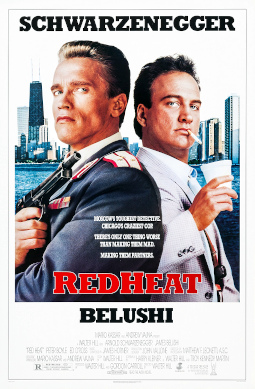
Red Heat (1988, directed by Walter Hill)


Ivan Danko (Arnold Schwarzenegger) is a Russian who lives in Moscow.  Art Ridzik (James Belushi) is an American who lives in Chicago.  They have two things in common.  They’re both cops and they both recently lost their partners while pursuing Russian drug lord Viktor Rostavali (Ed O’Ross).  When Danko comes to Chicago to bring the recently arrested Rostavali back to Moscow, Ridzik is assigned to be his handler.  When Rostavali escapes from custody, Ridzik and Danko team up to take him down.

Directed by Walter Hill, Red Heat may not be as well-remembered as some of Arnold Schwarzenegger’s other action films from the 80s but it’s still a good example of Schwarzenegger doing what Schwarzenegger did best.  Danko may not have been the quip machine that Schwarzenegger usually played but the movie gets a lot of comedic mileage out of his straight-to-the-point dialogue and the culture clash that Danko, a proud Soviet, experiences in Chicago.  It’s also an exciting action film, featuring a classic bus chase that perfectly complements Schwarzenegger’s bigger-than-life persona.

It gets a lot of mileage from the comedic chemistry of Arnold Schwarzenegger and James Belushi.  The always-talking Belushi provides a good comic foil to the steely Schwarzenegger.  Made in the waning years of the Cold War, Red Heat featured Belushi learning that the Russian cops didn’t worry about Miranda warnings and Schwarzenegger learning about “decadent” capitalism.  Belushi does a good job defending the honor of America.  Schwarzenegger, an anti-communist in real life, does an equally good job defending the Soviet Union.  Ultimately, they put aside their differences and show that even people on opposite sides can work together.

(We all know who won ultimately won the Cold War, though.)

Walter Hill specialized in buddy action movies.  Red Heat isn’t up to the level of 48 Hrs but it’s still an entertaining East-meets-West action film that packs a punch.

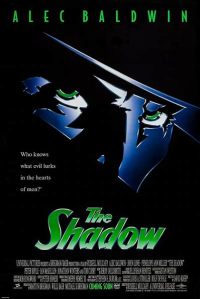
Guilty Pleasure No. 82: The Shadow (dir. by Russell Mulcahy)


As Guilty Pleasures go, The Shadow is a movie that has absolutely everything you need for a fun, campy ride. An Al Leong cameo, alongside James Hong? Check. Heroes and Villains taking time out to discuss their wicked plans (and how they’ll be stopped) over a glass of fine American Bourbon? Check. Early 90s Era CGI? Mark it down. Duel Wielding Pistol shooting action? Got it. Tim Curry just being there? Sweet.

After the wild success of Tim Burton’s Batman in 1989, Hollywood was scrambling to squeeze what they could out of the Superhero Movie. The Punisher, with Dolph Lundgren, would come out the same year. We’d end up with The Rocketeer (one of my personal favorites), BarbWire, Dick Tracy,The Crow, The Mask, and The Phantom, among others leading into the mid-90s. Among these was 1994’s The Shadow, based off the 1930’s character from Walter B. Gibson. Pre-dating all of the before mentioned characters (including DC’s Batman by almost a decade), The Shadow started as a series of radio stories before moving on to other forms of media. The movie didn’t do very well on it’s original release. Much like the magic that clouds men’s minds, audiences were more enraptured with The Crow months before and The Lion King. Some may remember a Shadow movie was made, but it was eclipsed by more popular films at the time.

At the same time, there were major advances happening in audio technology, thanks to a tiny Universal film called Jurassic Park. Jurassic Park helped to usher in an update in sound quality known as The Digital Experience (which we now know as DTS for short). As theatres coverted to the new sound system, various films in the early to mid nineties would make use of it, such as The Crow, The Mask, Timecop and The Shadow. By the time my family picked up their first Laserdisc player, DTS quality sound was available at home. My dad had a series of speakers lined around the living room of our house so that regardless of where you sat, the sound would move around you. One of the best tests of it was with John Carpenter’s The Thing, where Blair is standing off against the crew. The gunfire from his pistol would richochet from the front to the rear speakers, making the kids duck down.

The Shadow also made of use of this in certain areas, particularly with the way voices carried in a room. The part with Shiwan Khan’s voice moving over the city at night was amazing to hear with the right sound system. Just about any scene where The Shadow spoke had this sweet spatial effect that I loved.

The Shadow is the tale of Ying Ko (Alec Baldwin, The Getaway), a.k.a. Lamont Cranston. Living high in the Opium Fields of Tibet, he is a man of darkness, having inflicted great evil over time. Kidnapped and brought to a Tulku (a wise man) who has decided it’s time for redemption, Cranston is taught to cloud men’s minds, bending people to his will and to hide every aspect of himself save for one thing, his Shadow. He then returns seven years later to that “most wretched lair of villainy we know as” New York City, for we all know that the weed of crime bears bitter fruit.

Cranston spends most of his nights at The Cobalt Club with his Uncle Wainwright (Jonathan Winters, It’s a Mad, Mad, Mad, Mad World), who also happens to be the Police Commissioner. It allows him to keep up appearances while making sure the police don’t put The Shadow in their spotlight. When he meets the beautiful Margot Lane (Penelope Ann Miller, The Relic), he’s not only smitten, but finds her ability to read minds a dangerous threat to him.

When a metal casket from Tibet arrives at the New York Museum of Natural History, it reveals Shiwan Khan (John Lone, The Last Emperor), the last descendant of Genghis Khan. Gifted with the same abilities as Cranston, Khan has plans for the city and the world. He would rather have Cranston join him than to kill him. This turns the story into a classic Bond-like cliche where the hero and villain spend the bulk of the movie explaining their plans.

Enjoying the successes of Death Becomes Her and Jurassic Park, writer David Koepp was on a roll. The Shadow doesn’t take itself too seriously. Koepp and director Russell Mulcahy (Highander) splash moments of light comedy at just about every turn, mostly through the witty banter between characters. Some are over the top, particularly with Tim Curry’s character, while others are more subtle, like with Ian McKellan (The Lord of the Rings). If you’re looking for a serious drama in your superhero film, this isn’t it. Additionally, there are one or two elements that make no sense whatever. Mongol warriors walking around in full armor that no one ever seems to notice and taking rides in taxicabs (unless we assume they’re masked by Khan’s magic).

Most of the movie was filmed on the Universal Studios New York backlot, which explains why some scenes look like they were borrowed from Walter Hill’s Streets of Fire (that also used it years before). The mystical Tibetan Phurba dagger that echoes the disposition of its owner was a variant of the one used in Eddie Murphy’s The Golden Child in the late 80s.

if the movie’s climax between The Shadow and Khan feels a bit abbreviated, it’s because of a last minute change in filming. The original plan for the ending involved a series of mirrors, but an earthquake earlier in the year caused damage to the props the production team planned to use. So, what we get is a quicker scene, still falling in line with Mulcahy’s penchant for glass shattering, but leaving the audience to partially wonder what we could have had if everything worked out.

Finally, the real gem in all this is Jerry Goldsmith’s score. Although out of print, you can still find most of the tracks on YouTube, and the songs keep the immersion flowing. While I don’t see the film getting any kind of remakes in the near future, it’s nice to know everything came together (as well as it could) for this entry. Then again, who knows?

Previous Guilty Pleasures

  1. Half-Baked
  2. Save The Last Dance
  3. Every Rose Has Its Thorns
  4. The Jeremy Kyle Show
  5. Invasion USA
  6. The Golden Child
  7. Final Destination 2
  8. Paparazzi
  9. The Principal
  10. The Substitute
  11. Terror In The Family
  12. Pandorum
  13. Lambada
  14. Fear
  15. Cocktail
  16. Keep Off The Grass
  17. Girls, Girls, Girls
  18. Class
  19. Tart
  20. King Kong vs. Godzilla
  21. Hawk the Slayer
  22. Battle Beyond the Stars
  23. Meridian
  24. Walk of Shame
  25. From Justin To Kelly
  26. Project Greenlight
  27. Sex Decoy: Love Stings
  28. Swimfan
  29. On the Line
  30. Wolfen
  31. Hail Caesar!
  32. It’s So Cold In The D
  33. In the Mix
  34. Healed By Grace
  35. Valley of the Dolls
  36. The Legend of Billie Jean
  37. Death Wish
  38. Shipping Wars
  39. Ghost Whisperer
  40. Parking Wars
  41. The Dead Are After Me
  42. Harper’s Island
  43. The Resurrection of Gavin Stone
  44. Paranormal State
  45. Utopia
  46. Bar Rescue
  47. The Powers of Matthew Star
  48. Spiker
  49. Heavenly Bodies
  50. Maid in Manhattan
  51. Rage and Honor
  52. Saved By The Bell 3. 21 “No Hope With Dope”
  53. Happy Gilmore
  54. Solarbabies
  55. The Dawn of Correction
  56. Once You Understand
  57. The Voyeurs 
  58. Robot Jox
  59. Teen Wolf
  60. The Running Man
  61. Double Dragon
  62. Backtrack
  63. Julie and Jack
  64. Karate Warrior
  65. Invaders From Mars
  66. Cloverfield
  67. Aerobicide 
  68. Blood Harvest
  69. Shocking Dark
  70. Face The Truth
  71. Submerged
  72. The Canyons
  73. Days of Thunder
  74. Van Helsing
  75. The Night Comes for Us
  76. Code of Silence
  77. Captain Ron
  78. Armageddon
  79. Kate’s Secret
  80. Point Break
  81. The Replacements

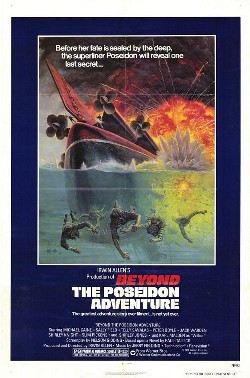
Lisa Marie’s First Review of 2025: Beyond the Poseidon Adventure (dir by Irwin Allen)


On New Year’s Eve in 1972, a tragedy struck in the Aegean Sea.  Just as the clock hit midnight and its passengers wished each other a happy new year, the cruise ship Poseidon was capsized by a tidal wave.  The majority of the ship’s crew and passengers were killed in the disaster but a small group managed to climb up through the wreckage and make their way to the ship’s hull, where they were rescued.  Gene Hackman sacrificed his life so that Ernest Borgnine, Red Buttons, Jack Albertson, Carol Lynley, and Pamela Sue Martin could all survive.

We all know the story of The Poseidon Adventure and some of us have even been goaded by our sisters into singing There’s Got To Be A Morning After for karaoke night at Grandpa Tony’s.  (Grandpa Tony’s has since shut down but, for a while, it was the best place in Dallas for nachos and karaoke.)  But do you know the story of what happened after that initial group of survivors was rescued from the ship?  Have you gone Beyond The Poseidon Adventure?

First released in 1979, Beyond The Poseidon Adventure picks up directly from where the first film ended.  Mere minutes after the rescue helicopter flies off, a tugboat pulls up alongside the still capsized wreck of the Poseidon.  Needing money to pay off his debts, Captain Mike Turner (Michael Caine) has decided to declare salvage rights and claim all of the cash and jewelry that he can find in the wreckage.  Accompanying him is his mentor Dead Meat (Karl Malden) and his protegee, Annoying and Cutesy (Sally Field).  Actually, Dead Meat is named Wilbur but, as soon as Karl Malden starts to dramatically grab at his chest, viewers will know that he’s destined to heroically sacrifice himself.  Annoying and Cutesy’s real name is Celeste.  Sally Field gives perhaps the worst performance of her career as the almost always perky Celeste.  This movie came out the same year that Sally Field appeared in the film for which she won her first Oscar, Norma Rae.  I have to imagine that Field was happy to win that Oscar because it meant she would never have to do another film like Beyond The Poseidon Adventure.

Before the tugboat crew can begin to explore the Poseidon, another boat shows up.  This boat is captained by Stefan Svevo (Telly Savalas), who claims to be a doctor who is responding to an S.O.S. from the capsized ship.  Svevo and his crew insist on accompanying the tugboat crew into the Poseidon.  It’s obvious from the start that Svevo is not actually a benevolent doctor.  For one thing, the men accompanying him are armed.  For another thing, he’s played by veteran screen villain Telly Savalas.

The two crews finally enter the ship and …. hey, there’s even more people on the boat!  At the end of The Poseidon Adventure, we were told that only six people had survived the disaster but apparently, that was just a damn lie.  The ship is literally crawling with people who still haven’t gotten out.  (Why didn’t the people who rescued the first batch of survivors check to make sure that they had gotten everyone?)  There’s Tex (Slim Pickens), who says he’s from “Big D” and talks about how he owns an oil well (as we all do in Big D).  There’s Frank Mazzetti (Peter Boyle, basically playing the same loudmouth that Ernest Borgnine played in the first film) and his daughter Theresa (Angela Cartwright) and Theresa’s new boyfriend, Larry (Mark Harmon).  There’s a nurse (Shirley Jones) and a blind man (Jack Warden) and his wife (Shirley Knight).  There’s Susanne (Veronica Hamel), the cool femme fatale who has a connection to Svevo.

While Svevo searches for a crate of plutonium (what the Hell was that doing on the Poseidon?), Mike tries to get the survivors to safety.  That means once again climbing up to the hull while the ship shakes and the engines continue to explode.  Both the first film and the sequel feature the exact same footage of the engines exploding.  At this rate, I guess the Poseidon might finally sink sometime this year.

Directed by Irwin Allen (who produced the first film), Beyond The Poseidon Adventure is about as bad as a film could be.  The first film had plenty of silly moments but it also had the entertaining spectacle of Gene Hackman and Ernest Borgnine competing to see who could yell the loudest.  Beyond the Poseidon Adventure has Michael Caine and Telly Savalas both looking bored while Peter Boyle complains, “That was the worst New Year’s Party I’ve ever been to!” and Sally Field says stuff like, “I’ve been to Anzio!  It’s the pits!”  At one point, Slim Pickens says that he’s as phony as a three dollar bill.  The same could be said of this film.  Beyond The Poseidon Adventure looks and feels cheap and generates none of the suspense of the first film.

As Beyond The Poseidon Adventure ended, I found myself worrying that there might be other passengers still stuck on the ship.  I mean, apparently, it’s very easy to not only survive on a capsized cruise ship but also to be overlooked by professional rescue crews.  Unfortunately, there was not another sequel so those folks were just out of luck.

Retro Television Reviews: Poochinski 1.1 “Pilot”


Welcome to Retro Television Reviews, a feature where we review some of our favorite and least favorite shows of the past!  On Thursdays, I will be reviewing Poochinski, which aired on NBC in 1990.  The entire show is currently streaming on YouTube!

This week, we take a look at another one-episode wonder, Poochinski!

Episode 1.1 “Pilot”

(Dir by Will Mackenzie, originally aired on July 9th, 1990)

Detective Stanley Poochinski (Peter Boyle) is a veteran of the mean streets of Chicago.  He’s rude and crude but he’s also a good cop, one who is mentioned as having once caught a mad bomber.  I mean, I guess you have to be good at your job to capture someone who not only knows how to make bombs but who is also mad about it.

Poochinski shows his softer side when he comes across a bunch of teenagers taunting a stray English bulldog.  Poochinski pulls his gun and threatens to kill a 12 year-old.  That may sound extreme but it works!  (The 12 year-old, I should mention, was also holding a switchblade.)  Poochinski adopts the dog and starts to bring it to work with him, much to the consternation of Poochinski’s uptight and ambitious partner, Detective Robert McKay (George Newbern, a talented actor who somehow always seemed to turn up in stuff like this).  McKay dislikes the fact that the dog is flatulent and so is Poochinski.

However, Detective Poochinski is run down by two thieves during a pursuit.  As Poochinski dies, the dog runs over to him.  They stare into each other’s eyes.

Cut to Poochinski’s funeral.  Detective McKay attends with the dog.  After everyone else leaves, the dog starts to talk to McKay in Poochinski’s voice!

That’s right …. Poochinski has been reincarnated as a dog!  Except, of course, the dog was already alive when Poochinski died so I guess it’s not reincarnation.  I guess Poochinski’s soul just entered the dog’s body.  But what about the dog’s soul?  These are the unanswered questions that haunt me.

Probably because this was only a 21-minute episode and didn’t really have much time to spare, McKay quickly accepts that his partner is inhabiting the body of a dog.  McKay adopts the dog and names it Poochinski.  While McKay helps Poochinski come to terms with the fact that he’s now a dog, Poochinski gives McKay advice on how to flirt with the neighbor (Amy Yasbeck).  Working together, they also set out to catch the criminals responsible for Poochinski’s “death.”

Probably the creepiest thing about Poochisnki is that, half the time, the dog is played by a real dog.  But whenever Poochisnki starts talking, the real dog is replace by a terrifying rubber puppet that doesn’t even look like the original dog.  Watching the rubber dog talk, I couldn’t help but be reminded of that scene in Spike Lee’s Summer of Sam when the neighbor’s dog enters David Berkowitz’s house and orders him to “KILL!” while happily wagging its tail.

There was only one episode of Poochinski.  The pilot was not picked up for a series but it was still aired on NBC during the dog days of summer.  It’s easy to see why the pilot did not lead to more shows.  Poochinski says that he only wants to do two things: catch a criminal and lick himself.  He does both in the pilot so there really wasn’t much left for this devil dog to do, other than turn evil and taunt McKay into transforming into the Son of Poochinski.

(That said, I did smile at the fact that the police sergeant’s name was Sgt. Shriver.  But that’s just because I’m a history nerd who has spent way too much time reading about the Kennedy family.)

Some TV shows only need one episode and Poochinski was definitely one of them.

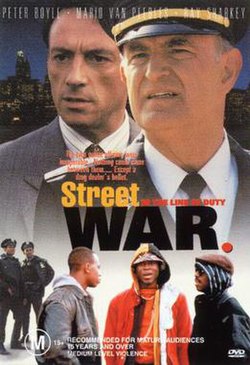
In the Line of Duty: Street War (1992, directed by Dick Lowry)


Street War, the fifth In The Line of Duty movie to be produced by NBC, takes place in Brooklyn.  Raymond Williams (Mario Van Peebles) and Robert Dayton (Michael Boatman) are two uniformed officers trying to keep the peace in the projects.  When Raymond is shot and killed in a stairwell, everyone knows that drug dealer Justice Butler (Courtney B. Vance) was responsible but no one can prove it.

The case is assigned to two detectives, Dan Reilly (Peter Boyle) and Victor Tomasino (Ray Sharkey).  Reilly is a veteran cop who is just a few months away from retirement.  Tomasino is the son of a “made man” who can’t understand why the drug lords in Brooklyn aren’t as interested in keeping the peace as the old Mafiosos were.

When Justice leaves Brooklyn so that he can hide out with his family in South Carolina, Reilly and Dayton follow him down there and discover that people in South Carolina distrust the cops just as much as people in Brooklyn.  Meanwhile, back in Brooklyn, Justice’s second-in-command, Prince (Morris Chestnut), tries to keep an all-out war from breaking out.

Prince and Tomasino take turns narrating the movie.  Prince talks about the reality of trying to restart your life after doing time in prison while Tomasino complains that “the animals” have taken over the city.  (Because this was made for television, “Animals” is Tomasino’s go-to label for anyone he dislikes.  Anyone with any experience with the police will know what word he is actually thinking.)  While Chestnut gives a restrained and thoughtful performance, Ray Sharkey shouts his lines and snarls whenever he’s onscreen.  Though it’s not always evident in this movie, Sharkey started out as a talented actor who played small roles in several independent films before starring in The Idolmaker.  Unfortunately, Sharkey was also a heroin addict whose once promising career was derailed by a series of arrests and jail sentences.  He looks thin and tired in Street Wars and, one year after the film aired, he would die of complications from AIDS.

With Sharkey yelling his lines, it falls on Peter Boyle to play the voice of reason in Street War.  Dan Reilly is a cliché, the weary cop who still wants to make the world a better place and who is just a few days away from retirement.  But Boyle does a good job playing him and brings his own natural gravitas to the movie.

Dick Lowry, who directed the first three In The Line of Duty movies, returns for this one and he keeps the action moving.  Street War is significantly more violent than the previous movies, with even two children getting shot onscreen.  The story itself is a predictable and Tomasino’s casual racism can be hard to take (even if he does eventually called out about it) but, thanks to the performances of Boyle, Boatman, Chestnut, and Vance, Street War is an improvement on Mob Justice and an adequate entry in the series.

Street War would be followed by two movies about FBI sieges, The Siege at Marion and Ambush in Waco.  Since I’ve already reviewed both of those, I will be moving onto In the Line of Duty: The Price of Vengeance tomorrow.

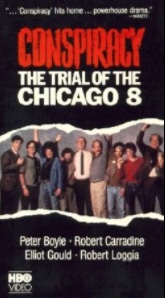
Conspiracy: The Trial of the Chicago 8 (1987, directed by Jeremy Kagan)


The year is 1969 and, in an Illinois courtroom, 8 political radicals stand accused of conspiring to disrupt the 1968 Democratic Convention.  The prosecution is putting the entire anti-war movement on trial while the defendants are determined to disrupt the system, even if it means being convicted.  The eight defendants come from all different sides of the anti-war movement.  Jerry Rubin (Barry Miller) and Abbie Hoffman (Michael Lembeck) represent the intentionally absurd Yippies.  Tom Hayden (Brian Benben) and Rennie Davis (Robert Carradine) are associated with the Students for a Democratic Society.  Bobby Seale (Carl Lumbly) is one of the founders of the Black Panthers while David Dellinger (Peter Boyle) is a longtime peace activist.  John Friones (David Kagan) and Lee Weiner (Robert Fieldsteel) represent the common activists, the people who traveled to Chicago to protest despite not being a leader of any of the various organizations.  Prosecuting  the Chicago 8 are Richard Schulz (David Clennon) and Tom Foran (Harris Yulin).  Defending the 8 are two radical lawyers, Leonard Wienglass (Elliott Gould) and William Kunstler (Robert Loggia).  Presiding over the trial is the fearsome and clearly biased Judge Julius Hoffman (David Opatoshu).

Conspiracy: The Trial of the Chicago 8 is a dramatization of the same story that inspired Aaron Sorkin’s The Trial of the Chicago 7 but, of the two films, it’s Jeremy Kagan’s The Trial of the Chicago 8 that provides a more valuable history lesson.  By setting all of the action in the courtroom and recreating only what was said during the trial, director Jeremy Kagan and his cast avoid the contrived drama that marred so much of Sorkin’s film.  Kagan trusts that the true story is interesting enough to stand on its own.  Kagan includes documentary footage from the convention protest itself and also interviews with the people who were actually there.  While Kagan may not have had the budget that Sorkin did, his film has the authenticity that Sorkin’s lacked.  Kagan also has the better cast, with Michael Lembeck and Barry Miller both making Abbie Hoffman and Jerry Rubin into something more than the mere caricatures that they are often portrayed as being.

The Trial of the Chicago 8 was a film that Jeremy Kagan spent a decade trying to make.  When he first tried to sell the idea behind the film to CBS in 1976, Kagan had Marlon Brando, Walter Matthau, George C. Scott, and Dustin Hoffman all willing to work for scale and take part in the production.  CBS still passed on the project, saying that no one was interested in reliving the 60s.  It wasn’t until 1987 that Jeremy Kagan was finally able to revive the film, this time with HBO.  It actually worked out for the best because, with HBO, there was no need to try to come up with a “clean” version for the language that was used in the courtroom or in the interviews with the actual participants.  The defendants could be themselves.

Though it has been overshadowed by Sorkin’s subsequent film, The Trial of the Chicago 8 is the definitive film about what happened in the aftermath of the the 1968 Democratic Convention.

Scenes That I Love: Putting On The Ritz from Young Frankenstein


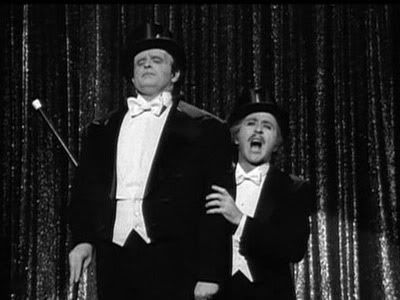
Since today is Peter Boyle’s birthday (he would have been 86), it seems only appropriate that today’s scenes that I love should come from 1974’s Young Frankenstein. Here, for your viewing and listening pleasure, are Gene Wilder and Peter Boyle….

Horror Scenes That I Love: Frankenstein and his Creation Put On The Ritz From Young Frankenstein


This scene from 1974’s Young Frankenstein is not only funny but kinda poignant and sad.  I mean, you can tell that the Monster (Peter Boyle) is trying so hard to do a good job and what does it get him?  Not only does the audience turn on him but even his creator (Gene Wilder) starts yelling at him.

I mean, considering that the Monster had only been alive for a few days, I think he deserves a lot of credit for handling the performance as well as could be expected!  To me, the true monsters in this scene are the theater patrons who apparently brought cabbages and other vegetables with them to the theater.  I mean, you don’t pack a salad unless you’re planning on using it.

The performers didn’t have a chance.

Enjoy!


Horror Scenes That I Love: Dr. Frankenstein and The Monster Dance In Young Frankenstein


Earlier today, my sister shared with us a look at Frankenstein through the ages. 

It seems only appropriate to follow that up with a look at the doctor and his creation putting on the ritz.

From 1974’s Young Frankenstein….

Dirty Boulevard: George C. Scott in HARDCORE (Columbia 1979)


gary loggins's avatarcracked rear viewer

Cracked Rear Viewer: “Back in the day….”

Dear Readers: (groaning) “There he goes again. Another history lesson!”

CRV: “B-but it’s important to put things in their proper historical context!”

DRs: (sigh) “We guess you’re right. Sorry.”

CRV: (beaming) “No problem! Now, like I was saying…”

Back in the day, every major urban city, and many smaller sized ones, had what was known as a “Red Light District”, where sex workers plied their trade. These streets were loaded with sex shops, peep shows, massage parlors, strip joints, and Triple-X movie palaces, with hookers and drug dealers hawking their wares. New York City had its Times Square/42nd Street area, Boston had The Combat Zone near Chinatown, and Montreal the infamous St. Catherine Street. For Los Angeles, the action was on Sunset Boulevard, and it’s into this seedy milieu that writer/director Paul Schrader plunges George C. Scott in 1979’s HARDCORE, which isn’t about…

View original post 999 more words