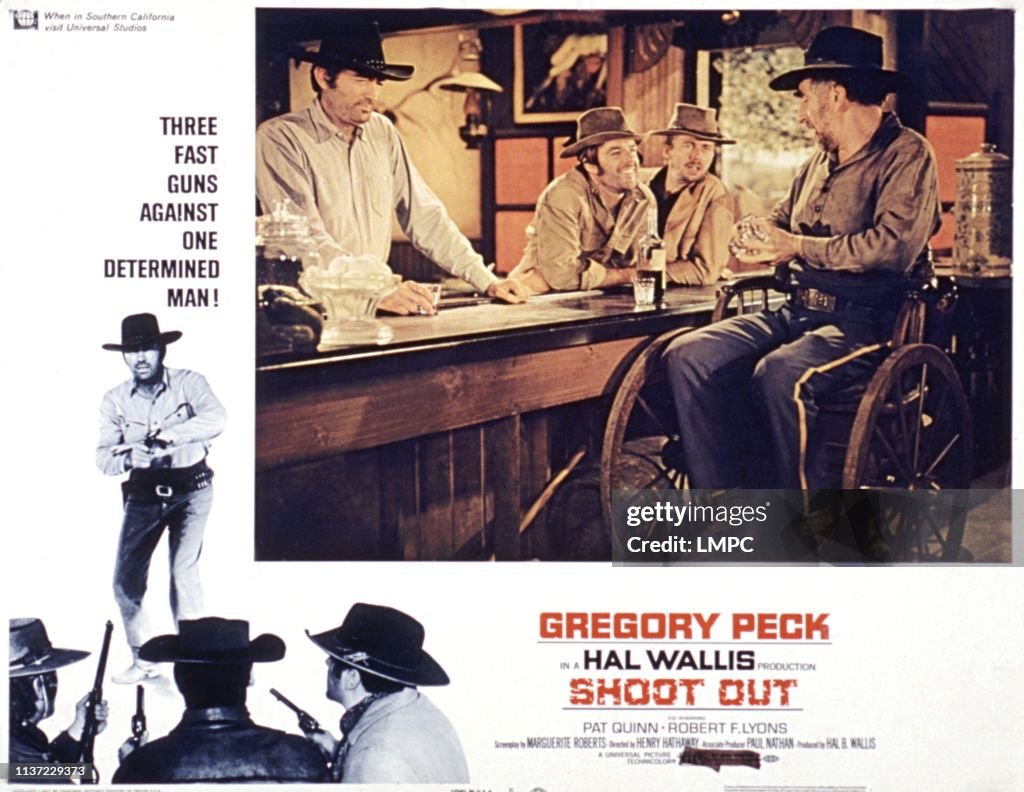
Brad reviews SHOOT OUT (1971), starring Gregory Peck & Robert F. Lyons! 


After serving a stretch at the Canon City penitentiary, Clay Lomax (Gregory Peck) gets out with only one thing on his mind… revenge on his former partner Sam Foley (James Gregory), who shot him in the back during a bank robbery, leaving him to take the rap. Foley isn’t a fool, though, so he’s hired a trio of young punks, Bobby Jay (Robert F. Lyons), Skeeter (John Davis Chandler), and Pepe (Pepe Serna) to surveil Lomax and let him know if he’s heading to his home in Gun Hill with payback on his mind. These guys are about as crazy as it gets, and they make two major mistakes. First, they kill Lomax’s friend Trooper (Jeff Corey) who lets him know where Foley is with his dying breath. Second, they kidnap the prostitute Alma (Susan Tyrell) just because they want to treat her like crap and have fun with her, which turns out to be a dumb move. Interrupting Lomax’s quest for revenge, he finds himself being forced to care for a young child named Decky (Dawn Lyn), who just may be his daughter with a lady back in Kansas City who used to be his “friend.” Looking after Decky, and then meeting and falling for the widow Juliana Farrell (Patricia Quinn), Lomax is soon facing off against his most dangerous foe, the crazed Bobby Joe, as he attempts to protect all these new people that he loves so he can move on with his life. But is it all too late?!!

I love westerns, but I must admit that I’m not the biggest fan of director Henry Hathaway’s SHOOT OUT. Hathaway has directed some of my favorite actors and movies, like Charles Bronson’s debut film with Gary Cooper, YOU’RE IN THE NAVY NOW (1951), along with the Jimmy Stewart film CALL NORTHSIDE 777 (1948) and John Wayne’s Oscar winning TRUE GRIT (1969). Unfortunately, it seems his best years are behind him, and he would only direct one more film after this, the less than excellent black action film HANGUP (1974). This isn’t exactly Gregory Peck’s best work either. Coming nine years after his Oscar winning performance in TO KILL A MOCKINGBIRD (1962), this is definitely not even close to that kind of level. Don’t get me wrong, I do enjoy his turn as Lomax when he’s the wronged outlaw looking for revenge, but I don’t really care at all for his part as the reluctant father figure trying to deal with the six-year-old Decky. I found Dawn Lyn to be more annoying than cute in the role, and this storyline distracted me from the revenge plot that I actually enjoyed. As a co-host of the “This Week in Charles Bronson Podcast,” we had the opportunity to interview Robert F. Lyons, who plays the bad guy, Bobby Jay Jones. I specifically asked him about this film and what it was like working with Gregory Peck. While he enjoyed working with Peck, his response about the film itself was telling…. “The work in there is not my work.” If you’ve watched much of the excellent actor’s work before, you can immediately understand what he means. Lyons goes so over-the-top as the spying outlaw Bobby Jay Jones, that his performance is inconsistent with the bulk of his career. Lyons told us that his performance was orchestrated by Hathaway in a way that he disagreed with, and he essentially disowns his work in the film. You can see a similar vibe with his “gang” that includes the actors John Davis Chandler and Pepe Serna. 

While I’m not a huge fan of the overall direction of the storyline or the focus of some of the main performances in SHOOT OUT, I am appreciative of the genre and the classic western stars that Hathaway cast in supporting roles. I especially enjoy seeing Jeff Corey in the small but pivotal role as the wheelchair bound Trooper, Paul Fix as the train brakeman who delivers Decky and a stack of cash to Lomax, and Arthur Hunnicutt as the ranch owner who barters with Lomax over the price of a pony. Hunnicutt is a particular favorite of mine although his role here is very small. Nominated for an Oscar for his performance in Howard Hawks’ THE BIG SKY (1952), Hunnicutt is from the small town of Gravelly, Arkansas, which is not far from where my own family is from. He even attended the same college that I graduated from, the University of Central Arkansas, which was known as the Arkansas State Teachers College when he (and my dad) went there. And then there is the setup of the revenge scenario at the beginning and the final showdown at the end, classic staples of the western genre. These are enjoyable and satisfying moments as Lomax settles his scores and the bad guys get their comeuppance.

Overall, SHOOT OUT is best enjoyed by fans of old school westerns and star Gregory Peck. It veers aways from the best storylines of the genre and wastes a lot of time with uninteresting melodrama, but it does offer us another chance to see some of our great character actors doing what they do. That means something to me. 

I’ve included our podcast episode with Robert F. Lyons below. He discusses SHOOT OUT at around the 1:00:30 mark.
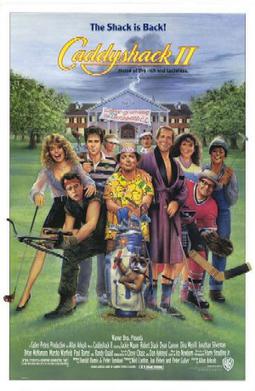
Caddyshack II (1988, directed by Allan Arkush)


Welcome back to Bushwood Country Club!  The Gopher is still stealing balls and burrowing through the course.  Ty Webb (Chevy Chase) is still the majority shareholder of the club, even though he now only plays golf inside of his mansion.  And that’s it!

Only the Gopher and Chevy Chase returned for Caddyshack II.  Ted Knight died before the movie went into production.  Bill Murray didn’t want to recreate his role from the first movie.  Rodney Dangerfield was involved in developing the movie but then dropped out after two million had already been spent in pre-production.  Chevy Chase was paid seven figures to return and he later called it one of the biggest mistakes of his career.  Only the Gopher didn’t complain.

With hardly anyone from the first film willing to come back for a second round, Caddyshack II features comedian Jackie Mason as Jack Hartounian, a real estate developer whose daughter, Kate (Jessica Lundy), wants to be a part of the WASPy Bushwood social set.  When Chandler Young (Robert Stack) keeps the plain-spoken Jack from being given a membership, Jack teams up with his old friend Ty and buys Bushwood.  He turns Bushwood into an amusement park called Jackie’s Wacky Golf.  Kate tells Jack that he’s ruined everything and turned Bushwood into Coney Island.  Chandler hires survivalist Tom Everett (Dan Aykroyd) to kill Jack and then agrees to play Jack in a round of golf.  The winner wins Bushwood.

A bust with both audiences and critics, Caddyshack II is one of the worst sequels ever made.  Why would you do a sequel to Caddyshack that features almost nothing that made the first film so entertaining?  Jackie Mason was a great comedian and writer but he wasn’t much of an actor and he makes a poor replacement for Rodney Dangerfield.  The film really loses me when Chandler Young literally pays money to have Jackie murdered.  It’s just a step too far.  Not even Ted Knight tried to kill Rodney Dangerfield and Dangerfield was a lot more obnoxious than Jackie Mason ever was.  Not even the dancing Gopher can generate much laughs and Kate’s right.  Jackie’s Wacky Golf really is a terrible place.

There are some interesting actors and actresses in the supporting cast.  The lovely Dyan Cannon plays Jack’s love interest and is one of the few good things about the movie, despite having no chemistry with Mason.  Randy Quaid gives a manic performance as Jack’s lawyer, a role that was originally meant for Sam Kinison.  Jonathan Silverman is the good caddy who falls for Jack’s daughter while Chynna Phillips is Chandler’s snobby daughter who befriends Kate and tells her she should change her last name to Hart.  Dan Aykroyd delivers all of his lines in a high-pitched voice that isn’t funny but which becomes very annoying.

The slobs win again.  The snobs are defeated and the Gopher dances with noticeably less enthusiasm.  There has never been a Caddyshack 3.

Retro Television Review: Miami Vice 3.13 “Down For The Count: Part Two”


Welcome to Retro Television Reviews, a feature where we review some of our favorite and least favorite shows of the past!  On Mondays, I will be reviewing Miami Vice, which ran on NBC from 1984 to 1989.  The entire show can be purchased on Prime!

This week is all about justice for Zito!

Episode 3.13 “Down For The Count: Part Two”

(Dir by Richard Compton, originally aired on January 16th, 1987)

Picking up where last week’s episode ended, Down For The Count: Part Two finds almost the entire Vice Squad mourning the death of Larry Zito.  I say “almost” because, as usual, Castillo refuses to show any emotion or even look anyone in the eye.  When he first appeared, Castillo’s stoicism made him an interesting character but I have to admit that I’m starting to get a bored with the character and his refusal to speak in anything more than terse growls.  ZITO’S DEAD!  WAKE UP, CASTILLO!

Switek, needless to say, is heart-broken.  Trudy tells Gina that she had a totally meaningless one night stand with some guy she met at a club because she was depressed.  (“Did it make you feel better?” Gina asks.  “No!” Trudy wails.)  Crockett is determined to take down crooked boxing promoter Oswaldo Guzman (Pepe Serna) and prove that Zito was not a junkie but that he was instead murdered by Guzman’s goons.  As for Tubbs, he makes a few jokes.  WHAT’S WRONG WITH YOU, TUBBS!?  ZITO’S DEAD!

Crockett and Tubbs go undercover as Burnett and Cooper and, once again, I find myself wondering how they can keep successfully doing that when their cover has gotten blown over a dozen times over the course of the series.  Do criminals in Miami not talk to each other?  This time, Crockett pretends to be involved with a cable sports network that wants to make a deal to air the fights that Guzman sponsors.  When a Las Vegas gangster named Guilinni (former Warhol superstar Joe Dallesandro) shows up looking to kill Guzman, Crockett and Tubbs effortlessly manipulate both sides.  It turns out that criminals aren’t that smart.

Meanwhile, Trudy and Gina meet one of Crockett’s associates from the Vietnam War.  His name is Danny Allred (Chris Elliott) and he’s a former CIA agent who now lives in an abandoned airplane.  Danny is a codebreaker and he helps them to figure out the code that Guzman was using to keep track of all of his crooked fights.  Danny is a fun character and I hope he shows up in more episodes.  He added some moments of levity to what was otherwise a pretty grim episode.

This episode had plenty of good moments.  The scene where Crockett and Tubbs visited Zito’s apartment was both poignant and nicely-acted by both Don Johnson and Philip Michael Thomas.  The final shoot-out was violent even by the standards of Miami Vice.  That said, I’m a bit surprised that the episode didn’t revolve around Switek.  Switek gets to express his anger and argue with Internal Affairs at the start of the episode and gets to repeatedly shoot Guzman at the end of the episode but he’s largely absent for the middle part of the story.  As Switek was both Zito’s partner and his best friend, it really does seem like he should have been at the center of the entire episode.

Still, I was glad that Zito’s name was cleared and that Guzman ended up getting shot multiple times until he fell out a window.  The show’s final credits featured still shots of John Diehl as Zito.  I’m going to miss Larry.

Silverado (1985, directed by Lawrence Kasdan)


In the old west, a cowboy named Emmet (Scott Glenn) teams up with a reformed outlaw named Paden (Kevin Kline) and they bust Emmet’s wild younger brother, Jake (Kevin Costner), out of jail.  After Mal (Danny Glover) helps the three of them escape from a posse, they all end up going to the town of Silverado, where all four of them have business.  Emmett and Jake want to protect their sister from the corrupt son (Ray Baker) of a cattle baron who was previously killed by Emmett.  Mal wants to save his sister Rae (Lynn Whitfield) from an evil gambler (Jeff Goldblum).  Paden discovers that Cobb (Brian Dennehy), his former partner-in-crime, is now the sheriff of Silverado and working for the cattle barons.  When Paden tries to protect the new settlers (including Rosanne Arquette), it leads to a confrontation with his former partner.

In the 80s, when he wasn’t directing films like The Big Chill and The Accidental Tourist, Lawrence Kasdan specialized in paying homage to the films of Hollywood’s golden age.  He started his directorial career with Body Heat, a modern film noir.  He worked on the screenplays of both Empire Strikes Back and Raiders of the Lost Ark.  With Silverado, Kasdan tried to resurrect the western.

Silverado is a traditional western with a few modern touches, like casting Jeff Goldblum as a gambler and John Cleese as the sheriff who wants to execute Kevin Costner.  Silverado also has more humor than a typical western, largely thanks to Kevin Kline.  Silverado starts out as a comedy before turning serious and grim once the four heroes finally reach Silverado.

Kasdan’s love of the genre is obvious in every frame of Silverado but, in trying to tell multiple stories at once, the movie spreads itself too thin.  I like that Kasdan tried to shake things up by casting actors who most people wouldn’t expect to see in a western but both Kevin Kline and Brian Dennehy seem miscast in their roles and their final confrontation never becomes the epic moment that it needs to be.  Scott Glenn and Kevin Costner are far more believable in their roles.  Danny Glover is also believable but his character is underused.

Silverado was obviously a labor of love for Kasdan and it shows that, if nothing else, Kasdan understood the appeal of the genre and the beauty of the wide open frontier.  The movie has its flaws but fans of westerns will appreciate his effort.

Retro Television Review: Miami Vice 3.12 “Down For The Count: Part One”


Welcome to Retro Television Reviews, a feature where we review some of our favorite and least favorite shows of the past!  On Mondays, I will be reviewing Miami Vice, which ran on NBC from 1984 to 1989.  The entire show can be purchased on Prime!

This week, Miami Vice says goodbye to a friend.

Episode 3.12 “Down For The Count: Part One”

(Dir by Richard Compton, originally aired on January 9th, 1987)

Larry Zito finally gets his own episode!

Played by John Diehl, Larry Zito was a part of the show from the very beginning.  Occasionally, it’s easy to forget that Diehl was a part of the ensemble because his character was rarely given anything to do and we rarely learned that much about Zito.  He was Switek’s partner and he seemed to have a quirky sense of humor.  Occasionally, he had long hair and a beard and he seemed to enjoy wearing elaborate disguises while working undercover.  That said, Zito was always a bit of an enigma.  Even the rare episodes that centered on the Switek/Zito partnership seemed to feature Zito mostly in the background.

In this episode, though, we finally learn a bit about Zito.  We learn that he has a background as a boxer and he’s good at training other fighters.  We learn that he takes it seriously whenever he hears about a crooked promoter manipulating a boxer.  We learn that Zito is a recovering alcoholic.  In this episode, we learn that Zito is more than just goofy comic relief.  He’s got a heart as gold.  When the Vice Squad investigates a crooked promoter named Guzman (Pepe Serna), Zito takes it upon himself to train an up-and-coming boxer named Bobby Sykes (Mark Breland).  Bobby’s previous trainer (played by Randall “Tex” Cobb) was a friend of Zito’s and was murdered by Guzman.  For Zito, this case is personal.  He even helps Bobby win a championship.  Yay, Zito!  That’s not bad for a supporting character!

Unfortunately, this also leads to Zito dying.  After the fight, Zito is confronted by Guzman and his men.  Switek later finds Zito’s body in the gym with a hypodermic needle sticking out of his arm.  Guzman gave Zito a fatal overdose of heroin.

This really depressed me!  I mean, Zito finally gets a chance to handle a serious case and, even more importantly, John Diehl finally gets a chance to show off the fact that he’s a very good actor and then, at the end of the episode, Zito’s dead!  Poor Zito!

(From what I’ve read, John Diehl wanted off the show because he felt his role was underwritten and he also preferred doing theater to weekly television.  That’s understandable.  At least he got one turn in the spotlight before he was written off the show.)

Needless to say, this episode is dominated by the death of Zito.  The scene with a tearful Switek cradling Zito’s dead body makes such an impression that it’s easy to forget that this episode also featured the odd spectacle of Don King playing Mr. Cash, an ex-con turned honest fight promoter who disapproves of Guzman’s tactics.  Somehow, Don King being the voice of integrity makes sense in the topsy-turvy world of Miami Vice.  King says that Guzman is in Miami because it’s a brand new territory and a place where anyone can make it rich.  That’s been one of the recurring themes of this show since it began.  Anything can happen in Miami.  Including Larry Zito dying….

Give me a moment to wipe away the tears.  Seriously, the end of this episode really depressed me!

Next week, Switek is out for revenge.  I hope he gets it!

Retro Television Review: Miami Vice 2.14 “Yankee Dollar”


Welcome to Retro Television Reviews, a feature where we review some of our favorite and least favorite shows of the past!  On Mondays, I will be reviewing Miami Vice, which ran on NBC from 1984 to 1989.  The entire show can be purchased on Prime!

This week, Sonny’s latest girlfriend gets involved in the drug trade.

Episode 2.14 “Yankee Dollar”

(Dir by Aaron Lipstadt, originally aired on January 17th, 1986)

It’s another night in Miami.  Sonny Crockett is looking forward to driving out to the airport and picking up his latest girlfriend, a flight attendant named Sarah (Audrey Matson).  For two years, Sarah has been working the Miami to Bogota to Paris and back route.  She doesn’t make a lot of money but, as is typical for this show, she lives in a small but very nicely furnished house.

Unfortunately, Sarah dies shortly after Sonny picks her up.  She goes into cardiac arrest, the result of a balloon of cocaine bursting inside of her.  It turns out that Sarah was working as a drug mule, all so she could make a quick five grand and buy a used BMW.

Seriously, what are the chances that Sonny Crockett’s girlfriend would turn out to be a drug smuggler?  Maybe she thought she was dating Sonny Burnett.  Or maybe, like so many others on this show, she allowed her desire for the finer things in life — like a BMW — to lead her astray.  This is one of the major themes of Miami Vice.  In a society where conspicuous consumption rules, people will do anything to appear richer than they actually are.

When Sonny and Rico arrest Sarah’s brother, Tim (Clayton Rohner), they discover that he works for a wealthy businessman named Charlie Glide (Ned Eisenberg).  Everyone knows that Charlie Glide (a great name, by the way) is involved in the drug trade but no one has ever been able to pin anything on him.  In the past, Charlie avoided cocaine but he’s now looking to branch out.  Sonny and Rico go undercover to try to bring Charlie down.

Of course, it doesn’t work.  Charlie is smart enough to figure out that Sonny and Rico are trying to set him up.  Even after Crockett and Tubbs drag him down to the police station and Charlie makes a deal for immunity in return for setting up two other drug dealers (Anne Carlisle and Pepe Serna), he still tries to double cross the cops.  And even though the double cross doesn’t quite work, Charlie remains smug in his knowledge that he has immunity.

Except, of course, he doesn’t have immunity from all crimes.  Earlier in the episode, Charlie’s executive assistant, Max Rogo (Austin Pendleton), used Charlie’s gun to execute Tim.  Even though Crockett and Tubbs know that Max is the one who pulled the trigger and that Max is the one who decided to kill Tim, they still arrest Charlie for the murder.  (Max was apparently killed in an earlier shootout so it’s not like he’s around to tell the truth.)  “You changed the rules!” Charlie shouts as he’s dragged away.

This episode is Miami Vice at its most cynical.  Crockett and Tubbs can’t get Charlie for the crime he committed so, instead, they set him up for a crime he didn’t commit.  They did change the rules in that they decided they no longer have to follow them.  The episode is full of characters so desperate for money that they’ll do just about anything, even smuggling a lethal drug in their body.  Crockett can only watch helplessly as Sarah dies and, even as Charlie is taken away, there’s never any doubt that he’ll be replaced by someone else, the drug trade will continue, and more people will die just because they wanted to be able to afford a few extra things.  Crockett and Tubbs are fighting a war that can never be won.  Whatever victories they get ultimately feel hollow.  Arresting Charlie won’t bring Sarah back and it won’t stop more innocent people from dying.  Ned Eisenberg was wonderfully smug as Charlie Glide and Austin Pendleton was appropriately creepy as the always-smiling Max Rogo.  This was a good episode, one that challenged the traditional cop show narrative.  How long can one fight a losing war?

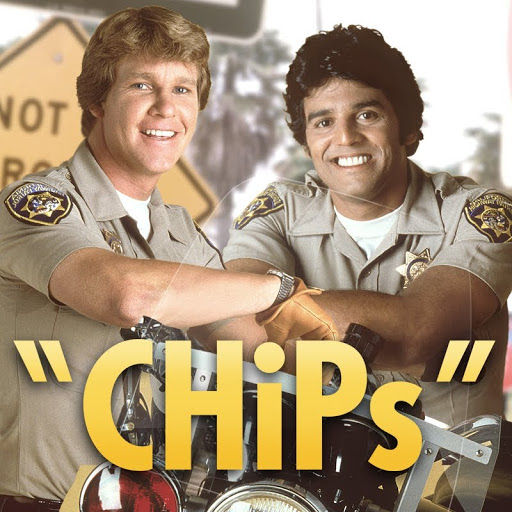
Late Night Retro Television Reviews: CHiPs 1.16 “Vintage ’54”


Welcome to Late Night Retro Television Reviews, a feature where we review some of our favorite and least favorite shows of the past!  On Mondays, I will be reviewing CHiPs, which ran on NBC from 1977 to 1983.  The entire show is currently streaming on Freevee!

This week, the key words on the highway of California are “team work!”

Episode 1.16 “Vintage ’54”

(Dir by Barry Crane, originally aired on January 26th, 1978)

It’s a three-day weekend and that means the California Highway Patrol even more mayhem to deal with than usual!

For instance, two car thieves are driving up and down the highway, searching for classic cars.  One stolen car belongs to 85 year-old Margaret Downey (Marjorie Bennett), who proceeds to go down to the station and personally demand that Sgt. Getraer find her car.  The thieves are eventually caught, thanks to the entire Highway Patrol working as a team and keeping an eye out for stolen cars.  The emphasis here was on teamwork, which Ponch and Baker just doing their part as opposed to be singled out.

It’s also teamwork that reunites a baby with the family that accidentally left her behind at a rest stop.  Ponch and Baker are the ones who take the baby to the station and they’re the ones who nickname the baby “Princess” and buy her toys but, in the end, it’s the entire Highway Patrol working together that eventually brings the baby back to her grateful parents.

Baker and Ponch do get a moment in the spotlight when a skydiver ends up getting tangled up and hanging from a highway overpass.  Baker is the one who grabs hold of her legs to keep her from falling while Ponch is the one who recruits a crane to help rescue her.  But again, Baker and Ponch are not working alone.  Instead, there are other motorists who help out, some by holding onto Baker and another by allowing Ponch to use his crane.

My point is that this episode was all about people working together to make the world a better and a safer place.  That’s not a bad message and the show delivers it with a good deal of sincerity.  With the exception of the scenery-chewing Marjorie Bennett, everyone is on their best behavior with this episode, with even Erik Estrada toning down his usual overacting.  And, of course, there’s two exciting motorcycle chases, both of which are very well-filmed.  There was nothing particularly amazing about this episode.  It was pretty much a typical hour of CHiPs but it was still very well-done.

Next week, Ponch and Baker have an important lesson to teach about hitchhiking!

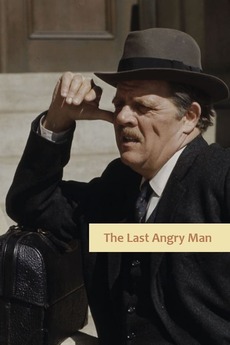
Retro Television Reviews: The Last Angry Man (dir by Jerrold Freedman)


Welcome to Retro Television Reviews, a feature where we review some of our favorite and least favorite shows of the past!  On Sundays, I will be reviewing the made-for-television movies that used to be a primetime mainstay.  Today’s film is 1974’s The Last Angry Man!  It  can be viewed on YouTube.

During the Great Depression, Dr. Sam Abelman (Pat Hingle) is a doctor who works in the slums of Brooklyn.  Dr. Abelman can be gruff.  Dr. Abelman can be crotchety.  Dr. Abelman can be, as the title suggests, a little bit angry.  He can’t help but get annoyed at how difficult it is to get his patients to pay him.  He gets easily annoyed with red tape and bureaucracy.  Dr. Abelman is an angry man.  In his eyes, he’s the last angry man.

But that doesn’t mean that Dr. Abelman doesn’t care about his patients or the community in which he lives.  Underneath his gruff exterior, Dr. Abelman is truly a man who wants to make the world a better place.  Sam Abelman is especially angry at the doctors who have abandoned the neighborhood that once supported them and who now work at hospitals that have little room for the poor.

The film focuses on Dr. Abelman’s attempts to help Frankie Parelli (Michael Margotta), a troubled teenager who has a reputation for being a bully and a petty criminal.  When Frankie starts to suffer from frequent seizures, Dr. Abelman comes to be convinced that Frankie is suffering from a brain tumor.  Dr. Abelman wants to get Frankie seen by a specialist and a surgeon but it’s difficult because of Frankie’s own bad reputation and also the fact that Frankie’s family doesn’t have much money.  Dr. Abelman uses a combination of shaming and outrage to finally get Frankie examined.  But, when it become apparent that Frankie is going to need an operation, is Dr. Abelman going to be able to get him under the knife?

The Last Angry Man was loosely based on a novel by Gerald Green.  The novel was previously adapted into a 1959 film, which starred the great actor Paul Muni in his final role.  (Muni received an Oscar nomination for his performance.)  If the novel and the 1959 film emphasized the grittiness of the neighborhood in which Dr. Abelman worked, the 1974 made-for-TV version takes place in a remarkably clean version of Brooklyn.  It’s a very pleasant slum.  There’s no trash to be seen.  The apartment buildings and the streets have the crisp look that only comes from shooting on a studio backlot.  Everyone in the neighborhood is remarkably friendly.  Even Frankie is a rather mild-mannered delinquent.  Dr. Abelman may be angry but everyone’s so nice that it sometimes seems like he’s going a little bit overboard.

The Last Angry Man was clearly meant to be a pilot for a television series and, as such, the movie’s action doesn’t really seem to build up to any sort of grand climax.  Instead, the film is more about introducing Dr. Abelman and all the quirky people in the neighborhood.  Pat Hingle was a good actor but, as Dr. Abelman, he’s all bluster with little depth.  It’s hard not to feel that both the film and the potential show would have been well-served by having Pat Hingle and Sorrell Brooke (who plays Abelman’s best friend, Dr. Vogel) switch roles.  When Sorrell Brooke gets annoyed and angry in this film, you have no doubt that the feeling is genuine.

Unfortunately, The Last Angry Man just isn’t angry enough.

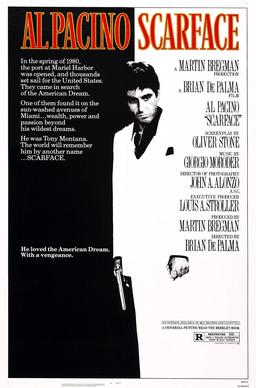
An Offer You Can’t Refuse #19: Scarface (dir by Brian DePalma)


“Hello to my little friend!”

Hi, little friend….

BOOM!

The 1983 film, Scarface, is a misunderstood film.  As we all know, it’s the story of Tony Montana (Al Pacino), who comes to Miami from Cuba along with his friend, Manny (Steven Bauer).  In return for murdering a former member of Castro’s government, Tony is given a job working for Frank Lopez (Robert Loggia).  When it becomes obvious that Tony is becoming too ambitious and might become a threat to him, Frank attempts to have Tony killed.  However, the assassination attempt fails, Tony murders Frank, and then Tony becomes Miami’s richest and most powerful crime lord.  Soon, Tony is burying his face in a mountain of cocaine while making deals with a sleazy Bolivian drug lord named Alejandro Sosa (Paul Shenar).  Tony also marries Frank’s mistress, Elvira Hancock (Michelle Pfieffer), though it’s obvious from the start the the only person that Tony truly loves is his sister, Gina (Mary Elizabeth Mastrantonio).  Anyway, it all eventually leads to a lot of violence and a lot of death.  Even F. Murray Abraham ends up getting tossed out of a helicopter, which is unfortunate since his character was a lot of fun.

Scarface is a famous film, largely because of Oliver Stone’s quotable dialogue and the no holds barred direction of Brian DePalma.  However, I think that people get so caught up on the fact that this is a classic gangster film that they miss the fact that Scarface is also an extremely dark comedy.  It satirizes the excess of the 80s.  Once Tony reaches the top of the underworld, he becomes a parody of the nouveau riche.  He moves into a gigantic house and proceeds to decorate it in the most tasteless way possible and there’s something oddly charming about this crude, not particularly bright man getting excited over the fact that he can finally afford to buy a tiger.  Towards the end of the film, there’s a scene where Tony rants while lounging in an indoor hot tub while Elvira languidly snorts cocaine and complains about the crudeness of his language and, at that moment, Scarface becomes a bit of a domestic comedy.  Tony’s reached the top of his profession, just to discover that it takes more than a live-in tiger and a wardrobe of wide lapeled suits to achieve true happiness.  So, he ends up sitting glumly in his office with a mountain of cocaine rising up in front of him.  “The world is yours” may be Tony’s motto but it turns out that the world is extremely tacky.  For all of his attempts to recreate himself as a wealthy and sophisticated man, Tony is still just a barely literate criminal with a nasty scar and a sour disposition.  The only thing he’s gotten for all of his ruthless ambition is an order of ennui with a cocaine appetizer.

I’ve always found Brian DePalma to be an uneven director.  He has a very distinct style and sometimes that style is perfectly suited to the story that he’s telling (i.e., Carrie) and sometimes, all of that style just seems to get in the way (i.e. The Fury).  Scarface, however, is the ideal story for DePalma’s over-the-top aesthetic.  DePalma’s style may be excessive but Scarface is a film about excess so it’s a perfect fit.  For that matter, you could say the same thing about Oliver Stone’s screenplay.  Stone has since stated that he was using almost as much cocaine as Tony Montana while he wrote the script.  The end result of the combination of Stone’s script, DePalma’s hyperactive direction, Pacino’s overpowering lead performance, and Giorgio Moroder’s propulsive score is a film that feels as if every minute is fueled by cocaine.  It’s not just a film that’s about drugs.  It’s also a film that feels like a drug.

Scarface is a big movie.  It runs nearly three hours, following Tony from his arrival in the United States to his final moments in his mansion, taking hundreds of bullets while grandly announcing that he’s still standing.  (Even after all of the bad things that Tony has done — poor Manny! — it’s impossible not to admire his refusal to go down.)  It’s also a difficult movie to review, largely because almost everyone’s seen it and already has an opinion.  Personally, I think the film gets off to a strong start.  I think the scenes of Tony ruthlessly taking control of Frank’s empire are perfectly handled and I love the scenes where Pacino and Steven Bauer just bounce dialogue off of each other.  They’re like a comedy team who commits murder on the side.  I also loved the “Take it to the limit” montage, which belongs in the 80s Cinema Hall of Fame.  At the same time, I think the final third of the movie drags a bit and that Tony’s sudden crisis of conscience when he sees that a man that he’s supposed to murder has a family feels a bit forced.  It also bothers me that Elvira just vanishes from the film.  At the very least, the audience deserved more of an explanation as to where she disappeared to.

But no matter!  Flaws and all, Scarface is a violent satire that holds up surprisingly well.  Al Pacino’s unhinged performance as Tony Montana is rightly considered to be iconic.  Pacino’s gives such a powerhouse performance that it’s easy to forget that the rest of the cast is pretty impressive as well.  I particularly liked the wonderfully sleazy work of F. Murray Abraham and Paul Shenar.  That said, my favorite character in the film remains Elvira, if just because her clothes were to die for and she just seemed so incredibly bored with all of the violent men in her life.  She goes from being bored with Frank to being bored with Tony and how can you not admire someone who, even when surrounded by all Scarface’s excess, just refuse to care?

Scarface is an offer that you can’t refuse.

Previous Offers You Can’t (or Can) Refuse:

  1. The Public Enemy
  2. Scarface (1932)
  3. The Purple Gang
  4. The Gang That Could’t Shoot Straight
  5. The Happening
  6. King of the Roaring Twenties: The Story of Arnold Rothstein 
  7. The Roaring Twenties
  8. Force of Evil
  9. Rob the Mob
  10. Gambling House
  11. Race Street
  12. Racket Girls
  13. Hoffa
  14. Contraband
  15. Bugsy Malone
  16. Love Me or Leave Me
  17. Murder, Inc.
  18. The St. Valentine’s Day Massacre

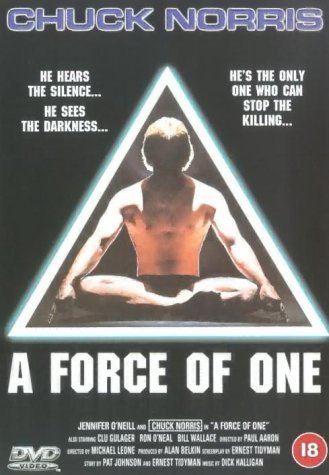
A Force of One (1979, directed by Paul Aaron)


Someone is targeting a squad of undercover narcotics detectives, killing them by taking them by surprise and breaking their necks before they even have a chance fight back.  Lt. Dunne (Clu Gulager) doesn’t like seeing his best detectives getting murdered so he orders all of them — including Mandy Rust (Jennifer O’Niell) and Rollins (Superfly himself, Ron O’Neal) — to take martial arts training so that they can defend themselves.  And who better to train them than karate champ and dojo owner, Matt Logan (Chuck Norris)?  The no-nonsense Logan teaches the detectives a few moves and even starts a tentative romance with Mandy.  But when his adopted son (played by future director Eric Laneuville) is murdered by the drug dealers, Logan goes from being a teacher to being an avenger.

Since today is Chuck Norris’s 80th birthday, it only seems appropriate to review one of Chuck Norris’s better films.  A Force of One was made at a time when Chuck was still trying to make the transition from being the karate instructor to the star to being a star himself.  Norris had been disappointed by his previous few starring vehicles, all of which strangely played down Norris’s martial arts skills.  After his friend and student, Steve McQueen, told Chuck that he needed to specialize in playing strong, silent types, Norris followed his advise with A Force Of One, which features considerably less dialogue than Norris’s previous films but also a lot more fighting.

Though the character may be named Matt Logan, Chuck Norris is basically playing himself in A Force of One.  In the scenes where he’s training the detectives and talking about why he’s personally so opposed to drugs, Chuck comes across as so earnest that it doesn’t matter that he’s not much of an actor.  What he’s always lacked in range, Chuck makes up for in general badassery and A Force Of One features him at his most badass.  Chuck’s final fight with the ninja assassin is one of his best.

Jennifer O’Neill got top billing in A Force Of One and she and Chuck actually have decent romantic chemistry.  She seems to bring him a little bit out of his shell and she’s also actually believable as a tough cop.  Because this was early in Chuck’s career and the script was co-written by police procedural specialist Ernest Tidyman, A Force Of One spends as much time following round the other cops as it does with Chuck and the squad’s camaraderie is believable.  The cops are all played by good character actors like Ron O’Neal, Clu Gulager, Pepe Serna, and James Whitmore Jr. and they all give pretty good performance while, at the same time, not upstaging Chuck.

One final note: There’s a scene where Chuck and Jennifer O’Neill are in an evidence room.  Keep an eye out for a box that is labeled K. Reeves.  That’s a reference to director Paul Aaron’s stepson, Keanu Reeves, who worked as a production assistant on this film.

The German version of A Force Of One