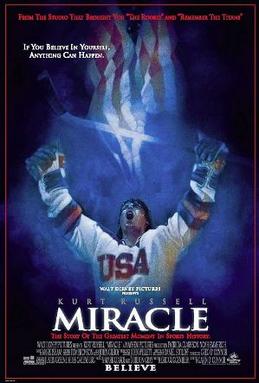
Like all good people, I’m currently obsessed with the Winter Olympics. Earlier this week I asked a couple of friends if they could recommend some good Winter Olympics movies. A lot of movies were suggested but, without fail, everyone thought I should see Miracle. (A lot of people also suggested Cool Runnings, which I’ll be watching next week.) Having watched Miracle earlier today, I can see why everyone recommended it.
The year is 1980 and two hockey teams are about to face off at the Winter Olympics in upstate New York. (The location, to be exact, is Lake Placid. Fortunately, the giant alligators are nowhere to be seen.)
On one side you have the Russian team (or the Soviets as they were known back then). They are widely considered to be one of the greatest hockey teams in history. They are big, fierce, and determined. Coming from a system that has declared individuality to be a crime against the state, the Soviet team plays like a machine. The Soviets have won the gold in the last four Olympics. As one American coach puts it, their greatest strength is that every other hockey team in the world is terrified of them.
On the other side, you have the American team. However, this isn’t the type of American dream team that one would expect to see today. In 1980, professional athletes were not allowed to compete on the U.S. Olympic team. Instead, the 1980 hockey team is made up of amateurs and college players. Unlike the Soviet teams, the American don’t have a government that grooms and supports them. Instead, win or lose, they have to do it on their own.
Of course, it’s not just two hockey teams that are about to face off. It’s also two super powers and two very different ways of life. In 1980, the U.S. and the Soviet Union were the two most powerful rivals in the world. The Soviets were trapped in an endless and unpopular war in Afghanistan. Meanwhile, in the U.S., the economy was shaky, American citizens were being held hostage in Iran, and an ineffective President gave long-winded speeches about how unhappy everyone in the country appeared to be. Both countries needed a victory but only one could win.
And it would take a miracle for that winning team to be American…
I don’t think it requires a spoiler alert to tell you that’s exactly what happens. I mean, after all, I’m reviewing a film called Miracle! On top of that, it’s based on true events. The U.S. hockey team — made up of college students and led by Coach Herb Brooks (played, in one of his best performance, by Kurt Russell) — not only managed to defeat the highly favored Soviet team but they went on to win the gold medal.
Even if you didn’t know that the Americans beat the Russians, you would never have any doubt about how Miracle is going to end. Miracle is a film that utilizes almost every sports film cliché but it manages to do so with such sincerity and such style that you don’t mind the fact that the movie doesn’t exactly take you by surprise. Is there any actor who is as good at project sincerity and human decency as Kurt Russell? Whenever he says that he’s going to make his team into champions, you believe him. When he says that he’s being hard on them because he wants them to be the best, you never doubt him or his techniques. When he says that he’s proud of his team and his country, it brings tears to your eyes. If there’s ever a movie that deserves a chant of “USA! USA! USA!,” it’s Miracle.
Here are a few good things about Maze Runner: The Death Cure.
First off, and most importantly, Dylan O’Brien is still alive. When The Death Cure first went into production way back in 2016, O’Brien was seriously injured on the set. While it’s never really been disclosed just how serious the injuries were, they were bad enough that it took O’Brien several months to recover. There was even some speculation that his career might be over. Fortunately, that wasn’t the case. Last year, O’Brien returned to the screen and gave a superior performance as the lead in American Assassin. In The Death Cure, O’Brien returns as Thomas and even if the character is still a bit of cipher, O’Brien does a good job playing him.
Secondly, Gally lives! In the first Maze Runner, Gally was a villain but, because he was played by Will Poulter, he was also strangely likable. Maze Runner was the first film in which I ever noticed Will Poulter and I have to admit that I’ve always felt that both the actor and the character deserved better than to be casually killed off at the end of the first movie. Since Maze Runner, Poulter has given great performances in both The Revenant and Detroit. (He was also briefly cast as Pennywise in It, though the role was ultimately played by Bill Skarsgard.) In The Death Cure, it is not only revealed that Gally is still alive but he also finally gets to be one of the good guys.
Third, the Death Cure confirms what I felt when I first saw The Maze Runner. Wes Ball is a talented director. Despite whatever narrative flaws that the Maze Runner films may have, they’re always watchable. Death Cure opens with a genuinely exciting action sequence and there are more than a few visually striking shots.
Fourth, Death Cure actually ends the Maze Runner saga. That may sound like a strange or back-handed compliment but it’s not. Death Cure resists the temptation to try to milk more money out of the franchise by unnecessarily splitting the finale in two. I’ve always felt that The Hunger Games made a huge mistake with its two-part finale. (The first part was good but the second part dragged.) Divergent appears to be destined to be forever unfinished because the first part of it’s two-part finale bombed at the box office. Death Cure refuses to indulge in any of that nonsense. Unfortunately, this also means that Death Cure ends up lasting an unwieldy 142 minutes but still, that’s better than forcing the film into two parts. With the current YA dysptopia cycle winding down, now is the right time to end things.
Finally, I appreciated the fact that the bad guys in Death Cure were named WCKD. There’s nothing subtle about that but this isn’t a movie the demands subtlety. As opposed to many other films based on dystopian YA fiction, The Maze Runner films have always been aware of just how ludicrous they often are. Unlike the Divergent films or The Fifth Wave, the Maze Runner films have always been smart enough not to take themselves too seriously.
Anyway, as for Death Cure itself, it’s big and noisy and your enjoyment will largely depend on how much you remember about the first two films. It’s been nearly three years since The Scorch Trials came out, which is an eternity when it comes to a franchise like Maze Runner. Death Cure pretty much jumps right into the action and if you don’t remember all of the details from the first two films … well, good luck getting caught up! (Unfortunately, it doesn’t help that, while the first movie was fun, Scorch Trials was a lot easier to forget.) It’s pretty much a typical tale of YA dystopia, complete with tragic deaths, shocking betrayal, and a chosen one. If you’re a fan of the previous two films or the books, you’ll probably enjoy Death Cure. For the rest of us, it’s a bit of a confusing ride but at least there’s a lot of up-and-coming talent on display.
The 2010 film Shutter Island finds the great director Martin Scorsese at his most playful.
Taking place in 1954, Shutter Island tells the story of two detectives, Teddy Daniels (Leonardo DiCaprio, giving an excellent performance that, in many ways, feels like a test run for his role in Inception) and Chuck Aule (Mark Ruffalo, also excellent), who take a boat out to the Ashecliffe Hospital for The Criminal Insane, which is located on Shutter Island in Boston Harbor. They are investigating the disappearance of inmate Rachel Solando, who has been incarcerated for drowning her three children.
Ashecliffe is one of those permanently gray locations, the type of place where the lights always seem to be burned out and the inmates move about like ghostly visions of sins brought to life. It’s the type of place that, had this movie been made in the 50s or 60s, would have been run by either Vincent Price or Peter Cushing. In this case, the Cushing role of the cold and imperious lead psychiatrist is taken by Ben Kingsley. Max Von Sydow, meanwhile, plays a more flamboyantly sinister doctor, the role that would have been played by Vincent Price.
When a storm strands Teddy and Chuck on the island, they quickly discover that neither the staff nor the patients are willing to be of any help when it comes to tracking down Rachel. As Teddy continues to investigate, he finds himself stricken by migraines and haunted by disturbing images. He continually sees a mysterious little girl. He has visions of his dead wife (Michelle Williams). A horribly scarred patient in solitary confinement (Jackie Earle Haley) tells him that patients are regularly taken to a lighthouse where they are lobotomized. When Teddy explores more of the island, he comes across a mysterious woman living in a cave and she tells him of even more sinister activity at Ashecliffe. Meanwhile, Chuck alternates between pragmatic skepticism and flights of paranoia.
And I’m not going to share anymore of the plot because it would be a crime to spoil Shutter Island. This is a film that you must see and experience for yourself.
This is one of Martin Scorsese’s most entertaining films, an unapologetic celebration of B-movie history. He knows that he’s telling a faintly ludicrous story here and, wisely, he embraces the melodrama. Too many directors would try to bring some sort of credibility to Shutter Island by downplaying the film’s more melodramatic moments. Scorsese, however, shows no fear of going over the top. He understands that this is not the time to be subtle. This is the time to go a little crazy and that’s what he does.
One of my favorite episodes of South Park is called Smug Alert! As you may remember, this is the episode where the citizens of South Park all buy hybrid cars and end up getting so self-satisfied that a dangerous cloud of smug forms over the town. At the same time, another smug storm is racing across the United States. This smug storm was created by the speech that George Clooney gave when he won the Oscar for Syriana. When those two clouds of smug meet, it’s the perfect storm. It also ends up destroying San Francisco.
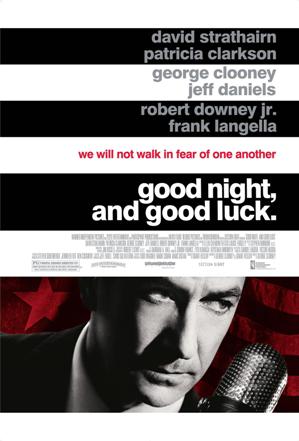
The same year that Clooney was named Best Supporting Actor for Syriana, he was also nominated for directing the 2005 best picture nominee, Good Night, and Good Luck. In his speech, Clooney specifically said that he felt he was winning supporting actor to make up for not winning director and proceeded to give the speech that he would have given if he had won director.
And looking back, I think that we do have to admit that it was a very smug speech.
Fortunately, Good Night, and Good Luck has aged better than Clooney’s speech.
I do have to admit that, when I recently rewatched Good Night and Good Luck, I was a little concerned. I always manage to forget that the film starts on a really bad note. The year is 1958 and news anchorman Edward R. Murrow (played by David Strathairn) is receiving an award. As Murrow stands behind the podium, he proceeds to give a long and self-righteous speech about how television should be used not to entertain but to educate as well. And, quite frankly, he comes across like such a pompous blowhard that I was dreading the idea of having to spend the next 90 or so minutes with him.
But then, fortunately, the film entered into flashback mode and, until the final few minutes of the film, we didn’t have to listen to anymore of Murrow’s speech. The majority of Good Night and Good Luck takes place in 1953. U.S. Sen. Joseph McCarthy (who appears in archival footage throughout the film) has declared that he has the names of communists who hold important positions in both the government and the media. Murrow and his producer, Fred Friendly (George Clooney) defy the corporate overlords of CBS and bravely investigate and challenge McCarthy’s claims. McCarthy and his henchmen respond by trying to smear both Murrow and one of his reporters (Robert Downey, Jr.) as a communists. As always seems to happen in films about McCarthyism, another supporting character reacts to the change of communism by committing suicide. And, in this particular vision of the fight against Joseph McCarthy, Edward R. Murrow and the media save America.
Of course, if you actually make the effort to learn history, you’ll discover that it wasn’t just Edward R. Murrow who stood up to McCarthy. In fact, you’ll discover that Murrow stood up to McCarthy after several other prominent people — on both sides of the political divide — had already done so. If anything, the real-life Murrow seems to have more in common with pompous scold seen at the beginning and end of the film, as opposed to the one that we see standing up to McCarthy.
One can very legitimately debate whether or not Murrow deserves all of the credit that he’s given in this film. Still, the film does make a larger and very important point. We, as Americans, have to always be on guard against witch hunts and against demagogues and the forces of fear and paranoia that are always trying to shape our politics. And, whether or not Murrow was a hero or just a bystander, one cannot deny that the larger message of Goodnight, and Good Luck remains as relevant today as when the film was originally released.
Judging from some of his other films — The Monuments Men and the Ides of March — I don’t particularly feel that George Clooney is that good of a director. But he does do a good job with Good Night and Good Luck. (In fact, he does such a good job that you can’t help but feel that it’s the exception to the rule as far as Clooney the director is concerned.) Filmed in wonderful black-and-white and full of good performances, Good Night, and Good Luck remains surprisingly watchable.
Just avoid any George Clooney Oscar speeches while watching it. San Francisco has never recovered.
Hi there and greetings from beautiful Lake Texoma. Having recently completed both 3 months of covering Big Brother for the Big Brother Blog and my series of Back to School reviews for this site, I am currently on a much-needed vacation with my wonderful boyfriend. However, you all know that I would never let a little thing like being on vacation keep me from watching and then reviewing whatever is currently playing down at the closest available theater.
For instance, last night, we saw The Maze Runner at the Cinemark 14 in Denton, Texas. The Cinemark is a really nice theater. The seats are comfortable. The people working there were nice and polite. The movie sounded great. Even the audience was surprisingly polite. Only a few people came in late and, for the most part, everyone refrained from talking during the film. Good for them and good for you, Cinemark 14!
As for the movie itself…
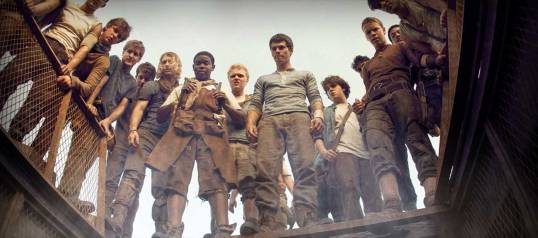
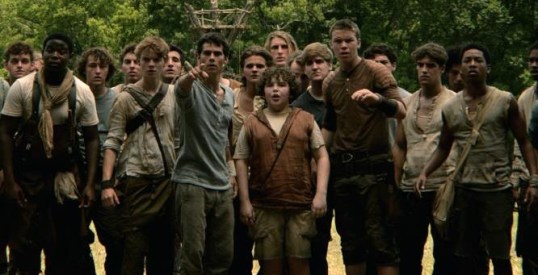
The Maze Runner tells the story of Thomas (Dylan O’Brien), a teenager who wakes up one day in a grassy clearing that is encircled by gigantic, gray walls. Thomas finds himself surrounded by several other teenage boys. Unable to remember anything about his past (but haunted by chaotic dreams that suggest that he is the part of some sort of lab experiment), Thomas initially reacts by trying to run. However, he is quickly tackled and introduced to his new home.
The grassy area is known as the Glade and the boys who live there are known as Gladers. Their leader is Alby (Aml Ameen) and, as he quickly explains to Thomas, he has created a tediously collectivist society where everyone has his assigned place and his assigned duty. (And yes, that is the correct pronoun. There are no girls among the Gladers.) Alby explains that, behind the walls, there lies a maze that is patrolled by terrifying creatures known as Grievers. The most athletic and intelligent of the Gladers are allowed to become Runners. Everyday, the Runners run through the maze and memorize every twist and turn.
Thomas, needless to say, wants to be a runner. And it’s good that he does because otherwise, the film would be kind of boring.
Anyway, along the way to becoming a runner, Thomas has more visions of an autocratic woman (Patricia Clarkson) and he also manages to make an enemy out of Gally (Will Poulter), a Glader who never wants to leave Glade. Eventually, a girl named Teresa (Kaya Scodelario) shows up, along with a note saying that she’s the last one and no one else will be showing up in the Glade.
Now, at this point, you may be tempted to ask, “What’s going on?”
Well, you’ll have to wait a few years to find out because The Maze Runner is just part one of a trilogy. Much like The Hobbit, Divergent, and The Hunger Games, it answers just enough questions to keep the audience satisfied while still ending with a cliffhanger. So, if you do see The Maze Runner, be sure to pay attention because you don’t want to forget everything that happened before the sequel comes out sometime next year.
There’s a lot of good things that can be said about The Maze Runner. For the most part, the actors did a good job. The grievers were scary. The maze looked impressive, though it’s hard not to feel that the film did not take full narrative advantage of it.
However, to be honest, I have seen so many recent adaptations of dystopian YA books that, with the exception of The Hunger Games and Catching Fire, they’re all starting to blend together. The Maze Runner was well made but there really wasn’t anything about it that distinguished it from the pack. Without the presence of a star like Jennifer Lawrence or the satirical subtext that distinguished The Hunger Games, The Maze Runner ultimately just felt like your typical franchise starter, not so much a story but instead just an extended prologue.
Again, it’s not necessarily a bad film. It’s based on a book and, undoubtedly, a lot of details did not make it from the page to the screen but there’s still enough there that even people who haven’t read the book will probably be able to follow the story. Me, I’m a Texas girl and, therefore, it’s a part of my heritage to appreciate any film that features an individual taking on an elitist dystopia. But, in the end, the film is never quite as memorable as you want it to be.
Perhaps we’ve all just been spoiled by The Hunger Games…
Last night, I turned over to Chiller and watched the brilliant 2006 horror film, The Woods.
Why Was I Watching It?
I ended up watching The Woods almost at random. I didn’t want to go out last night because it’s Texas-OU weekend and that meant that the streets of Dallas would probably be full of drunk people from Tulsa. Even more importantly, I couldn’t go out because I’m recovering from a sprained ankle.
Normally, under those circumstances, I would have watched and live tweeted an original SyFy film. However, last night, SyFy was showing Fright Night which I had little interest in sitting through. So, instead, I turned over to Chiller and decided to give The Woods a try.
And that is how I randomly discovered one of the best horror films that I’ve recently seen.
What Was It About?
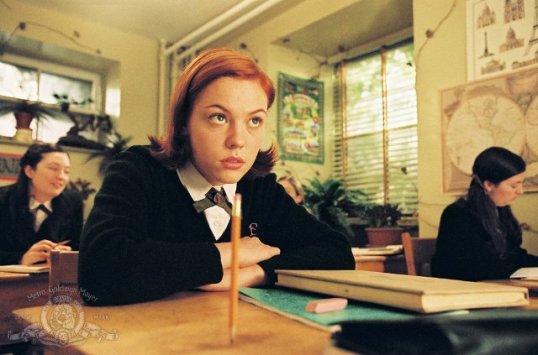
The year is 1965. Angry teenager Heather (Agnes Bruckner) starts a fire in a forest. Frustrated by their daughter’s rebellious nature, her parents enroll her at Falburn Academy, a boarding school that sits in the middle of the woods. Because she is the only redhead at the school, Heather is an immediate outsider who finds herself being taunted by the blonde Samantha (Rachel Nichols) and called “Firecrotch” by her other classmates.
However, Heather has more problems that just a bunch of anti-redhead bigots. She has nightmares where voices seem to call to her from the woods. Her friends Marcy and Ann both disappear from their beds, leaving behind a pile of dead leaves. Meanwhile, the school’s mysterious headmistress (Patricia Clarkson) insists that nothing strange is happening…
What Worked?
I wasn’t expecting much from The Woods. After all, it was a film that was released straight-to-DVD in 2006 and Chiller doesn’t exactly have a reputation for showing the best films. But, oh my God, y’all — The Woods turned out to be such a good film! The Woods is an atmospheric and surprisingly well-acted film that’s full of haunting imagery and memorable details. Much like Dario Argento’s Suspiria (which has a similar plot to this film), The Woods is a triumph of both style and substance.
While the entire film is well-acted, special mention should be made of Patricia Clarkson, who gives a performance that is both menacing and humorous. Genre fans will be happy to see Bruce Campbell in the role of Bruckner’s well-meaning father.
Finally, I have to admit that, as a member of the 2% of the population who have been blessed with red hair, I have a special appreciation for this film. Behind all of the scares, The Woods provides a compelling portrait of the discrimination that those of us with red hair struggle with every single day. From the minute Heather enters Falburn Academy, she is the subject of constant prejudice because of the color of her hair. As someone who has had to endure countless comments about redheads not having souls, I both related to and appreciated the film’s sensitivity to those of us in the 2%.
What Did Not Work?
Over on the film’s imdb page, there’s some debate as to whether or not the term “Firecrotch” was in use back in 1965. Personally, I think that’s nitpicking. The fact of the matter is that anti-redhead prejudice has always been with us. If people in the 60s didn’t attack us by calling us “Firecrotch,” they undoubtedly called us something equally bad. As far as I’m concerned, the entire film worked perfectly.
“Oh my God! Just like me!” Moments
Almost the entire film was an “Oh my God! Just like me!” moment, largely because the main character was a redhead and had to deal with constant anti-redhead prejudice. (“Oh my God! Just like me!”)
At one point, Samantha taunts Heather by asking, “Is your pubic hair red?” which is the exact same question that I got asked several times throughout high school, though in my case, I was usually asked by a guy with a smirk on his face. (“You’ll never know,” I would reply.) Heather then finds herself being repeatedly called “Firecrotch” by people who are jealous of her red hair and again, oh my god! Just like me!
Finally, as I mentioned above, I sprained my ankle last Wednesday and, as such, I’ve spent the last few days recovering. Amazingly enough, about halfway through the film, Heather twists her ankle. She spends the rest of the movie either on crutches or painfully limping. Oh my God! Just like me!
(As a quick aside, can I just say how much I HATE crutches!? Oh my God, they’re the worst…)
Lessons Learned
I am tempted to say that the main lesson to be learned from The Woods is that it’s not easy being a redhead. However, I knew that before I watched the film. I also knew that you should stay out of the woods, which is the main reason why you’ll never catch me camping.
So, the most important lesson that I learned is that everyone should see The Woods.
Hi there! Today, I will be concluding my look at the Dirty Harry series with the final film in the franchise, 1988’s The Dead Pool.
Harry’s back and he’s still carrying a gun. He’s also older, wrinklier, grouchier, and suddenly famous because he’s just given testimony in a mob boss’s trial. You would think that Harry would already be famous seeing as how he not only killed the Scorpio Killer but he also rescured the Mayor from all those communists. But, I guess that’s what Harry gets for living in the same city that’s been sending Nancy Pelosi to Congress for the last 100 years.
Harry and his new partner (Evan C. Kim) are assigned to investigate the death of rock star Johnny Squares (Jim Carrey). Harry immediately suspects that the murderer was pretentious film director Peter Swan (Liam Neeson). This is largely because Swan makes the type of horror films that inspire Harry to snarl with disdain. It also turns out that Swan has been playing a “dead pool” game and that the various celebrities on his list have been getting killed. And guess what? Harry’s name is also on that list…
The Dead Pool was the final Dirty Harry film and, in many ways, it also feels like the most generic. Whereas Dirty Harry actually had quite a lot on its mind and the first three sequels at least pretended to be concerned about something more than just mayhem, The Dead Pool is often content to be a rather cartoonish action film. With the exception of a rather witty car chase involving a remote-controlled toy car that’s been strapped with an explosive, the action scenes are predictable and Eastwood’s character could just as easily have been named Spinner Mason or Eli Goldworthy. There’s simply no huge reason for this film to be a Dirty Harry film, beyond the fact that it wouldn’t show up on AMC every few weeks if it wasn’t.
And yet, it’s impossible for me not to like The Dead Pool. Though the film might feel generic overall, there’s still the occasional moments that hint that the movie is actually a bit smarter than it might first appear to be. Considering that the film largely takes place on a movie set and features a film critic among its victims, it’s tempting to see The Dead Pool as being almost a spoof on both the Dirty Harry films themselves and the controversy that’s been generated by their violent content. It makes sense that Harry Callahan’s name would appear on Swan’s dead pool list because, after spending four films battling serial killers, fascists, communists, gangsters, white trash, and a countless amount of bank robbers, the only opponent left for Harry to face is his own reputation.
The Dead Pool has one of the more interesting casts of the Dirty Harry films. After dominating the previous films in the series,Clint Eastwood steps to the side and instead, allows his supporting cast to run off with the movie. It’s a little bit bizarre to see Jim Carrey playing a rock star (and even more bizarre to see him lip-synching to Welcome to Jungle) but that odd touch seems strangely appropriate for a film that doesn’t seem to be too concerned with much more than being entertaining. Evan C. Kim is one of Harry’s more likable partners and Liam Neeson, complete with pony tail and superior attitude, is a lot of fun to watch as he spoofs every single pretentious filmmaker that you’ve ever been unfortunate enough to have taken a film class with.
For a lot of reasons, The Dead Pool was the last of the Dirty Harry films. It was a box office disappointment and, even way back in 1988, Eastwood looked a just little bit old for an action hero. Eastwood has said that he has no interest in playing the character again and that’s probably for the best because, after five films, you have to wonder just what exactly was left for Harry to deal with. (That said, I’ve always thought of Gran Torino as being the unofficial sixth Dirty Harry film.)
Well, that concludes my look at the Dirty Harry film series and, not coincidentally, it also concludes the month of September as well! Starting tomorrow, along with all the other usual great stuff that you expect from us at the Shattered Lens, we’re going to be starting horror month!
As part of my continuing effort to offer up a review of every 2011 release that I’ve seen so far this year, here’s 8 more quickie reviews of some of the films that I’ve seen over the past year.
The 13 Assassins are a group of samurai who are gathered together to assassinate a sociopathic nobleman in 19th Century Japan. As directed by Takashi Miike, this is a visually stunning film full of nonstop, brutal action and Miike powerfully contrasts the old school honor of the 13 Assassins with the soulless evil of their target.
There are some films that simply have to be seen to believed and Bunraku is one of those films. In the aftermath of a global war, guns have been outlawed but this attempt at social engineering has just resulted in greater societal collapse. Nicola (Ron Perlman) is the most powerful man on the East Coast but he lives life in paranoid seclusion and instead sends out nine assassins to enforce his will (his main assassin being Killer No. 2, played by a super stylish Kevin McKidd). Two strangers ( a drifter played by Josh Hartnett and a samurai played by Gackt) arrive in town and, with the help of a bartender played by Woody Harrelson, they team up to destroy the nine assassins and ultimately Nicola himself. Bunraku, which comes complete with an ominous narrator and sets that look like they belong in a Lars Von Trier film, is a glorious and fast-paced triumph of style over substance, an exciting and fun celebration of the grindhouse films of the past. With the exception of a miscast Demi Moore (playing Perlman’s mistress), the film is very well-acted but it’s completely stolen and dominated by Kevin McKidd, who can poke me with his sword any time he wants.
3) The Double Hour (dir. by Giuseppe Capotondi)
It took The Double Hour about two years to make it over here from Italy and when it did finally play in American arthouse theaters, it really didn’t get as much attention as it deserved. That’s a shame because the Double Hour is a pretty entertaining mystery-thriller that’s full of twists and turns and which features an excellent performance by Kseniya Rappoport as an enigmatic hotel maid. It hasn’t been released on region 1 DVD or blu-ray yet but apparently, there’s some interest in doing an American remake which will probably suck.
Jig is a documentary that follows several competitors at the 40th Irish Dancing World Championships held in Glasgow in 2010. I always try to be honest about my personal biases and I have to admit that one reason why I absolutely loved this film is because I not only love to dance but I love Irish stepdancing in specific and, as much as I love ballet, stepdance will always hold a special place in my heart. I’m not quite sure how to put it into words other then to say that it just makes me incredibly happy as both a participant and a watcher. For me, Jig captured that joy as well as showing just how much dedication and sacrifice it takes to truly become proficient at it. This film — much like Black Swan — made me dance.
I’ll never forget going to the Cinemark West Plano and seeing Meek’s Cutoff last May. The theater was nearly deserted except for me, Jeff, an elderly couple, and two women who were, in their appearance and manner, almost stereotypically upper middle class suburban. As the film’s frustratingly ambiguous conclusion played out on-screen and the end credits started to roll, one of the women angrily exclaimed, “WHAT!? Well, that won’t win any Academy Awards!” In many ways, Meek’s Cutoff is a frustrating film. Based on a true story, it follows a group of 19th century settlers as they try to cross the Oregon Trail while following a guide (Bruce Greenwood) who might be totally incompetent. Plotwise, not much happens: the settlers kidnap an Indian and demand that he lead them to water, Michelle Williams plays a settler who doubts that any of the men in the party know what they’re doing, and everyone continues to keep moving in search of … something. The film is, at times, really frustrating and I think it’s been overrated by most critics but, at the same time, it remains an oddly fascinating meditation on life and fate. Add to that, both Greenwood and Williams give good performances and the film’s cinematography is hauntingly beautiful and desolate at the same time.
Of Gods and Men is a quietly powerful and visually stunning French film that’s based on the true story of 7 Trappist monks who were kidnapped from their monastery and murdered by muslim rebels during the Algerian Civil War. The film imagines the final days of the monks and attempts to answer the question of why they didn’t flee their monastery when they had the opportunity to do so, but instead remained and chose to accept their fate as martyrs. This meditative film also features excellent performances from Lambert Wilson and Michael Lonsdale and avoids the trap of both easy idealization and easy villainy.
This is another one of those films that was dismissed by almost every critic except for Roger Ebert and you know what? For once, I’m going to agree with Roger. I absolutely loved One Day and I think that all the haters out there need to take a chance on romance and stop coasting on the easy cynicism. One Day follows the love affair of a writer (Anne Hathaway) and a TV personality (Jim Sturgess), visiting them repeatedly on the same day over the course of 20 years. The film starts with them as college students having a wonderfully awkward one night stand and it ends with Sturgess and their son walking up a beautiful green hill and it made me cry and cry. Hathaway and Sturgess have a wonderful chemistry together and the film also features some good supporting performances from Patricia Clarkson (as Sturgess’ dying mother) and Rafe Spall (bringing humanity to the thankless role of being the “other guy.”) This is one of the most deliriously romantic films that I’ve ever seen and I loved it. So there.
8 ) There Be Dragons (dir. by Roland Joffe)
There Be Dragons came out in May and it didn’t get much respect from the critics. I’ve also read that it was considered to be a box office failure, which is odd because I seem to remember that it was actually in theaters for quite some time. Anyway, There Be Dragons is an oddly old-fashioned war epic that attempts to mix the fictional story of a Spanish revolutionary (played by Wes Bentley) with an admiring biopic of the founder of Orpus Dei, St. Josemarie Escriva (played by Charlie Cox). The two stories never really seem mix and instead, they just coexist uncomfortably beside each other. It doesn’t help that Wes Bentley gives one of the worst performance of 2011. On the plus side, Charlie Cox gives a good and believable performance as Escriva and the film looks great. The film is so sincere in its desire to make the world a better place that its hard not to regret that it doesn’t succeed.










 Through the Shattered Lens