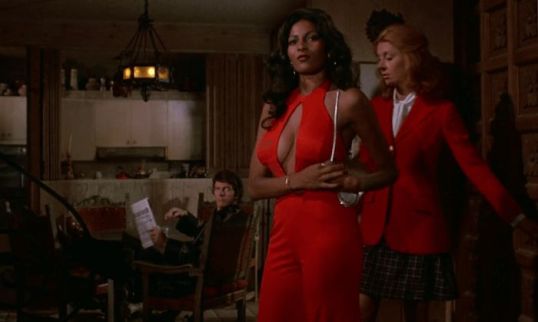
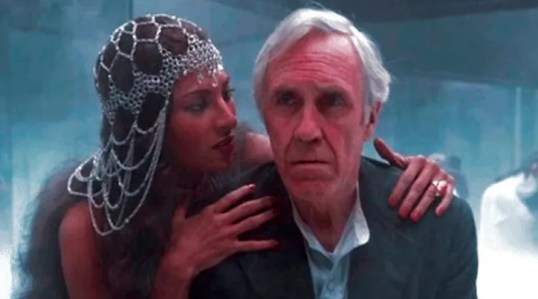
The 2019 film, A Christmas Wish, takes place in a small Louisiana town where people leave their Christmas wishes in a wooden box. Faith (Hilarie Burton) is encouraged by her sister, Maddy (Megan Park), to wish for true love. Myself, I wished for a Christmas movie featuring not only several actors from One Tree Hill but also Pam Grier! And, with this film, my wish came true.
Welcome to Late Night Retro Television Reviews, a feature where we review some of our favorite and least favorite shows of the past! On Wednesdays, I will be reviewing Monsters, which aired in syndication from 1988 to 1991. The entire series is streaming on YouTube.
This week, Monsters takes a look at what is required to get ahead in the cut-throat world of corporate finance.
Episode 3.22 “Hostile Takeover”
(Dir by Randall Moldave, originally aired on February 24th, 1991)
Ruthless but not particularly intelligent corporate executive Laurence Bauer (Dennis Christopher) thinks that he has figured out the perfect way to take over the business from CEO Tom Hart (William Lanteau). He teams up with a voodoo priestess named Matilde (Pam Grier) and, with her help, he manages to force Hart out. However, Matilde explains that all of this comes with a price. The Voodoo Gods want a piece of Bauer’s body. Bauer responds by killing Matilde.
In his office, getting faxes from the Voodoo Gods and dealing with taunting messages on his computer screen, Bauer decides to sacrifice the janitor, Ed (Tracey Walter). However, Ed turns out to be not just any old janitor. He’s a demon who reacts to Bauer’s condescension by plucking out his right eye.
“You’re my boy now!” Ed shouts.
Agck! Scary!
This was a good episode. Christopher, Walter, and Grier all gave memorable performances and the demon effects were genuinely disturbing. The final season of Monsters wasn’t perfect. I’ve reviewed more than a few bad episodes from season 3. That said, it was still a marked improvement over the first two seasons, as demonstrated by episodes like this one. The whole point of the show was to show off the Monsters and this episode featured a truly effective one.
Two more episodes to go and then a new show will be premiering in this time slot!
It took me a while to really appreciated Jackie Brown.
I was nineteen and in college when I first watched the movie. A friend rented it and we watched it with the expectation that it would be another Tarantino film that would be full of violence, fast music, and stylish characterizations. And, of course, Jackie Brown did have all three of those. But it was also a far more melancholy film than what we were expecting and compared to something like Kill Bill, Jackie Brown definitely moved at its own deliberate pace. That’s a polite way of saying that, at times, the film seemed slow. It seemed like it took forever for the story to get going and, even once it became clear that Jackie Brown (Pam Grier) and Max Cherry (Robert Forster) were going to steal from Ordell Robbie (Samuel L. Jackson), it still felt like an oddly laid back heist. Robert de Niro, the film’s biggest star, played a guy who seemed to be brain dead. Bridget Fonda brought an interesting chaotic energy to the film but her character was disposed of in an almost off-hand manner. The whole thing just felt off. I appreciated the performances. I appreciated the music on the soundtrack. But I felt like it was one of Tarantino’s weaker films.
As I’ve gotten older, I’ve come to better appreciate Jackie Brown. First released in 1997 and adapted from a novel by Elmore Leonard, Jackie Brown finds Quentin Tarantino at his most contemplative. Indeed, Tarantino wouldn’t direct anything quite as humanistic until he did Once Upon A Time In Hollywood. If the heist seemed rather laid back, that’s because Jackie Brown really isn’t a heist film. It’s a film about aging, starring two icons of 70s exploitation. Robert Forster was 56 when he played bail bondman Max Cherry while Pam Grier was 48 when she was cast as Jackie Brown, the flight attendant turned smuggler. Jackie and Max two middle-aged people faced with a world that doesn’t really make much sense to them anymore. (Obviously, it’s easier for me to understand them now than it was when I was nineteen and I felt like the future was unlimited.) Max bails people out of jail and it’s obvious that he still has a shred of idealism within him. He actually does care about the people he gets out of jail and he’s disgusted by Ordell’s callous attitude towards the people who work for him. Jackie is a flight attendant who, when we first see her, looks like she could have just stepped out of a 1970s airline commercial. Ripping off Ordell isn’t just something that she’s doing for revenge or to protect herself, though there’s certainly an element of both those motivations in her actions. This is also her chance to finally have something for her. Jackie and Max are two lost souls who find each other and wonder where the time is gone. All of those critics who have wondered, over the years, when Quentin Tarantino would make a mature movie about real people with real problems need to rewatch Jackie Brown.
Of course, it’s still a Quentin Tarantino film. And that means we get a lot of scenes of Samuel L. Jackson talking. This is one of Jackson’s best performances. Ordell is definitely a bad guy and most viewers will be eager to see him get his comeuppance but, as played by Jackson, he’s also frequently very funny and definitely charismatic. One can understand how Ordell lures people into his trap. Jackson loves to watch video tapes of women shooting guns. He allows De Niro’s Louis to crash at his place and the scene where Ordell realizes that Louis is thoroughly incompetent is brilliantly acted by both men. And then you have Bridget Fonda, as a force of pure sunny chaos. Jackson, De Niro, and Fonda are definitely a watchable trio, even if the film rightly belongs to Pam Grier and Robert Forster.
The older I get, the more I appreciate Jackie Brown. This is the film where Tarantino revealed that there was more to his artistic vision than just movie references and comic book jokes. This film takes Tarantino’s style and puts it in the real world. It’s Tarantino at his most human.
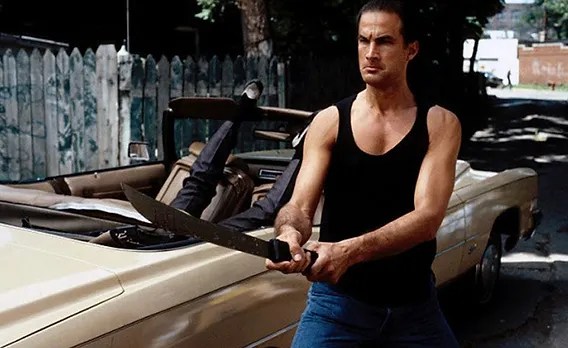
Did any actor have a better opening act than Steven Seagal? His first five movies are all star turns in high quality, enjoyable action films, beginning with ABOVE THE LAW, and then moving forward to HARD TO KILL, MARKED FOR DEATH, OUT FOR JUSTICE and UNDER SIEGE. While UNDER SIEGE has been described as “Die Hard on a boat” and OUT FOR JUSTICE occupies the top spot as my personal favorite Steven Seagal film, today we will focus on the movie that started it all, ABOVE THE LAW, from 1988.
ABOVE THE LAW begins with Nico Toscani (Steven Seagal) providing a voiceover of his early years as a kid in Chicago who became obsessed with the martial arts and who found himself studying with the masters in the orient by the age of 17. He’s clearly a badass. By 22, he’s been recruited by the CIA and is completing missions in Viet Nam. While on a mission, he runs into Zagon (Henry Silva), a CIA torturer, who seems to be able to do whatever he wants with no consequences. After knocking the crap out of Zagon, Toscani quits on the spot and heads back to Chicago to become a tough cop and marry Sara (Sharon Stone). While working a touchy family situation in the Windy City, he stumbles upon a potential drug deal going down soon in the city. He and his partner Delores (Pam Grier) set up the bust, but the product of choice turns out to be C4 explosives, not drugs. Wouldn’t you know that the folks behind these C4 explosives are the CIA and Toscani’s old pal Zagon. Can he stop his old adversary this time and still protect his family?!!
My favorite Chuck Norris film is from 1985 and is called CODE OF SILENCE. I mention that because there are quite a few similarities between ABOVE THE LAW and CODE OF SILENCE. First, Andrew Davis directed both films. He’s a talented filmmaker who would later direct such solid action films as THE PACKAGE (Gene Hackman & Tommy Lee Jones), UNDER SIEGE (Seagal & Tommy Lee Jones), and THE FUGITIVE (Harrison Ford and an Oscar winning Tommy Lee Jones). I wonder now how this film was made without Tommy Lee Jones?!! Second, both films feature a tough cop who practices martial arts and beats the crap out of corruption within law enforcement. In the case of CODE OF SILENCE, it was the police force itself; in ABOVE THE LAW, it’s the Central Intelligence Agency. It’s my personal opinion that CODE OF SILENCE is Chuck Norris’ finest hour. Steven Seagal gets this same kind of bravado and credibility in his very first film role. That’s truly unique. And finally, both movies feature the awesome Henry Silva as the bad guy. Silva has been a bad guy in so many movies, and he’s just damn good at it. I recently watched him in THE TALL T with Randolph Scott from way, way back in 1957. Damn, his Chink’s a psycho. Combine that with his turn as Billy Score in SHARKY’S MACHINE with Burt Reynolds, and you have a guy who deserves to be in the villain hall of fame. These tried and true elements all help produce a fine feature film debut for Seagal!
Just one final comment about the movie’s theme… we all would like to think that no one is above the law in the real world. Unfortunately, all we have to do is watch the news to know that’s simply not the case. Our world is full of people who actually are above the law. One of the best things about a movie like ABOVE THE LAW is that we can watch the movie, munch our popcorn, and just pretend for 100 minutes that justice does exist. It may not be completely realistic, but it’s definitely a satisfying thought!
Welcome to Retro Television Reviews, a feature where we review some of our favorite and least favorite shows of the past! On Mondays, I will be reviewing Miami Vice, which ran on NBC from 1984 to 1989. The entire show is currently streaming on Tubi!
This week, the second season with a two-hour long premiere! Crockett and Tubbs are going to New York!
Episode 2.1 and 2.2 “The Prodigal Son”
(Dir by Paul Michael Glaser, originally aired on September 27th, 1985)
The second season premiere of Miami Vice opens with a series of set pieces.
In Panama, Crockett and Tubbs visit a secret military base in the jungle and are disgusted to learn how the Panamanian military gets information about drug smugglers. Tubbs and Crockett find one horribly tortured man in a tent. Tubbs gives him a drink of water and gets what information he can from the man. Crockett and Tubbs leave the tent. A gunshot rings out as the involuntary informant is executed. When the shot rings out, both Crockett and Tubbs turn back to the tent in slow motion, stunned by the brutality of their allies in the Drug War. Indeed, it’s hard not to compare the scene to the famous photograph of a South Vietnamese general executing a communist during the Vietnam War.
The Vietnam analogy continues with the next scene. In the Everglades, Crockett, Tubbs, and the entire Vice Squad work with the DEA to ambush the Revilla cousins as they bring drugs into the U.S. Sitting in the swamp, Crockett compares the experience to Vietnam, suggesting that the war on the drugs is just as futile and as costly. And indeed, it’s hard not to notice that every drug dealer that Crockett and Tubbs has taken down over the course of this show has immediately been replaced by another. The Revillas are just another in a long line of people getting rich off of other people’s addictions.
After the bust goes down, Crockett and Tubbs arrives at a celebratory party, just to discover that almost of all of the undercover DEA agents have been murdered and Gina has been seriously wounded. There is something very haunting about this scene, with Crockett and Tubbs rushing through a penthouse and seeing a dead body in almost every room.
At a meeting in a stark office, the head DEA agent explains that his agency has been compromised and all of his undercover agents have been unmasked. Someone has to go to New York and work undercover to take down the Revillas but it can’t be any of his people. Since the Revillas are smuggling their stuff in through Miami, Miami Vice has jurisdiction. Paging Crockett and Tubbs!
Working undercover as Burnett and Cooper, Crockett and Tubbs visit a low-level drug dealer (played by Gene Simmons) who lives on a yacht and who gives them the name of a connection in New York City.
From there, Miami Vice moves to New York City, where Crockett and Tubbs meet a low-level criminal named Jimmy Borges (played by an almost impossibly young Penn Jillette) and they try to infiltrate the Revilla organization. Along the way, Tubbs meets up with Valerie (Pam Grier) and discovers that she has apparently lost herself working undercover. Meanwhile, Crockett has a brief — and kind of weird — romance with a photographer named Margaret (Susan Hess).
(“I like guns,” she says when Crockett demands to know why she stole his.)
With Crockett and Tubbs leaving Miami for New York in order to get revenge for a colleague who was wounded during an operation, The Prodigal Son almost feels like the pilot in reverse. Also, much like the pilot, the exact details of The Prodigal Son‘s story are often less important than how the story is told. This episode is full of moody shots of our heroes walking through New York while songs like You Belong To The City play on the soundtrack. (There’s also a song from Phil Collins, undoubtedly included to bring back memories of the In The Air Tonight scene from the pilot.) It’s all very entertaining to watch, even if the story itself doesn’t always make total sense. Indeed, you really do have to wonder how all of these criminals keep falling for Sonny’s undercover identity as Sonny Burnett. You would think that someone would eventually notice that anyone who buys from Sonny Burnett seems to get busted the very next day.
Stylish as the storytelling may be, this episode actually does have something on its mind. Those lines comparing the War on Drugs to the Vietnam Conflict was not just throwaways. Towards the end of the episode, Crockett and Tubbs follow a lead to the offices of J.J. Johnston (Julian Beck, the ghost preacher from Poltergeist II). The skeletal Johnston is an investor of some sort. He has no problem admitting that he’s involved in the drug trade, presumably because he knows that there’s nothing Crockett and Tubbs can do to touch him. Upon meeting the two cops, he immediately tells them exactly how much money they have in their checking accounts. He points out that they’re poor and they’re fighting a losing war whereas he’s rich and he’s making money off of a losing war. Beck gives a wonderfully smug performance as Johnston and it should be noted that, of all of the episode’s villains, he’s the only one who is not brought to any sort of justice. Val almost loses herself. Tubbs and Crockett don’t even get a thank you for their hard work. The somewhat sympathetic Jimmy Borges ends up dead while the Revillas were undoubtedly been replaced by even more viscous dealers. Meanwhile, J.J. Johnston relaxes in his office and counts his money. This is the No Country For Old Men of Miami Vice episodes.
This episode is also full of familiar faces. Charles S. Dutton, Kevin Anderson, Anthony Heald, Miguel Pinero, James Russo, Bill Smtirovich, Zoe Tamerlis, Paul Calderon, and Louis Guzman, they all show up in small roles and add to show’s rather surreal atmosphere. This is Miami Vice at its most dream-like, full of people you think you might know despite the fact that they’re doing things of which you don’t want to be a part.
As for the title, The Prodigal Son is Tubbs and he is tempted to stay in New York City. But, in the end, he joins Crockett on that flight back to Miami. It’s his home.
Welcome to Retro Television Reviews, a feature where we review some of our favorite and least favorite shows of the past! On Mondays, I will be reviewing Miami Vice, which ran on NBC from 1984 to 1989. The entire show is currently streaming on Tubi!
This week, Pam Grier and John Turturro show up in Miami!
Episode 1.16 “Rites of Passage”
(Dir by David Anspaugh, originally aired on February 8th, 1985)
This week’s episode of Miami Vice opens with a 5-minute mini-movie. Before we even get to the opening credits, we have watched as young and innocent Diane Gordon (Terry Ferman) arrives in Miami from New York, takes her first walk on a Florida beach, has a “chance” meeting with a smooth-talking guy named Lile (David Thornton), and ends up at a party being held at a mansion belonging to David Traynor (a young John Turturro). Traynor tells Diane that he runs a modeling agency and that he would love to put her under contract.
It’s a stylish and rather brave opening. For five minutes, we don’t see or even hear about any of the regular characters. Instead, we’re introduced to world where image is everything, from the bodies on the beach to Traynor’s art deco mansion to the beautiful women who have been paid for by considerably less attractive men. In those five minutes, Diane wins our sympathy and we also see how she (and so many others) have fallen into the trap set by the David Traynors of the world. For those five minutes, we are reminded that this is a show about more than Sonny Crockett and Ricardo Tubbs. It’s about more than even Miami. This is a show about America.
After the opening credits, we watch as the police retrieve the body of one of Traynor’s girls from a lagoon. She committed suicide. In the crowd watching is Diane’s sister, Valerie (played by the legendary Pam Grier). Valerie is a New York cop. When she goes to the Vice Squad to ask for Castillio’s help in searching for her sister, we learn that she is also Tubbs’s former (and soon current) lover.
In many ways, the rest of this episode is traditional Miami Vice. Zito and Switek provide some comic relief when they disguise themselves as exterminators and invade one of Traynor’s parties. Crockett and Tubbs once again go undercover as Burnett and Cooper, infiltrating Traynor’s mansion so that they can rescue Diane. Diane has been so brainwashed by Traynor and Lile that, even after she’s been reunited with her sister, she still can’t bring herself to admit that Traynor was using her. She calls Traynor and tells him that she’s decided to go back to New York City. In a montage that is rather creepily scored to Foreigner’s I Want To Know What Love Is, scenes of Valerie and Tubbs making love are mixed with scenes of Lile giving Diane an intentional drug overdose.
Technically, this is a Tubbs episode. For once, of the two main detectives, Tubbs is the one who has a personal reason for wanting to take Traynor down while it falls to Crockett to deal with Castillo’s withering stare of concern. That said, Rites of Passage is Pam Grier’s show all the way. From the minute that Grier shows up, she controls every scene in which she appears. Just as in Coffy, Grier plays an avenging angel. This episode ends, as Miami Vice often did, with a shoot out but this time, it’s Grier who guns down Lile and Traynor. “Read me my rights,” Valerie says to Crockett as the episode ends.
Again, the storyline may have been typical Vice but the performance of Pam Grier and the stylish direction of David Anspaugh elevated the episode. This episode presents Miami as being beautiful but heartless, a place where innocents come to pursue the American dream but instead find themselves being used and abused by sleazy but wealthy men. (At one point, it is mentioned that Traynor specializes in finding women for diplomats, meaning that most of his clients have diplomatic immunity.) Traynor’s mansion is a brilliant combination of the sleek and the tacky and Turturro plays Traynor as being a not particularly clever man who has gotten rich because he understands that everyone ultimately driven by the same desire for power and pleasure without consequences.
Next week …. it’s another Tubbs episode! Can Tubbs defuse a hostage situation, despite not having an ex-lover around to help him? We’ll find out!
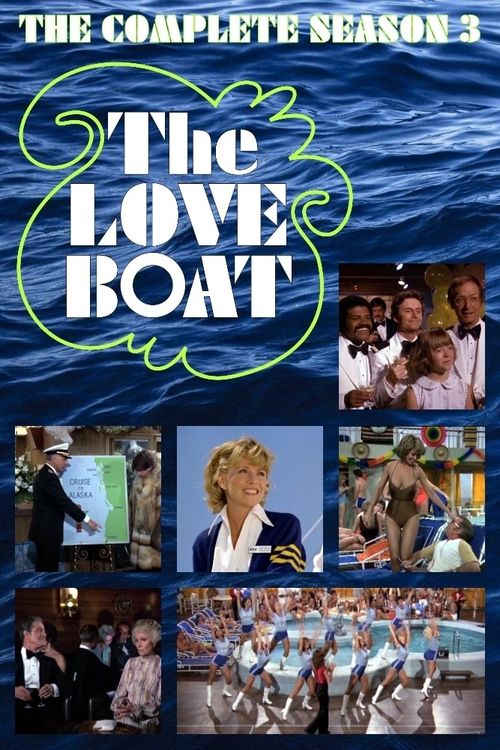
Welcome to Retro Television Reviews, a feature where we review some of our favorite and least favorite shows of the past! On Wednesdays, I will be reviewing the original Love Boat, which aired on ABC from 1977 to 1986! The series can be streamed on Paramount Plus!
This week, it’s a family affair on The Love Boat!
Episodes 3.18 & 3.19 “Kinfolk/Sis & the Slicker/Moonlight & Moonshine/Too Close for Comfort/The Affair: Part 2”
(Dir by Roger Duchowny, originally aired on January 19th, 1980)
Well, heck, it’s another double-sized, two-hour episode of The Love Boat.
This is actually the third two-hour episode of the third season, following the season premiere and the episode with the Dallas Cowboy Cheerleaders. I have to admit that I don’t really look forward to these two hour episodes because they’re usually a bit uneven. The Love Boat was the perfect hour show, one that featured stories that were specifically designed to be neatly wrapped up in 40 minutes. The two-hour episodes always seem to lose their narrative momentum after that first hour and that’s certainly the case here.
At the center of the episode is Danny Fields (Donny Osmond), a singer who has been booked to perform on the cruise. Julie is convinced that Danny is going to be a big star and she’s even convinced a talent scout named Steve Sorrell (Rich Little) to board the ship so that he can see Danny perform. However, Steve is more interested in Kitty Scofield (Loni Anderson), an innocent West Virginia girl who is eager to see the rest of the world but who is also engaged to marry the unambitious Elmer Fargas (Randall Carver). Kitty is also Danny’s sister and, in fact, Danny’s entire family (played by Richard Paul, Marion Ross, and Slim Pickens) are on the cruise. Danny is worried that his hillbilly family will stand in the way of his rock ‘n’ roll career and he goes out of his way to avoid them. While the rest of the Scofields are willing to accept that Danny doesn’t want to associate with them, Grandpa Luke Scofield (Slim Pickens) lets Danny know that he’s not to happy with Danny and his rock ‘n’ roll ways. Of course, Luke himself is being courted by Brenda Watts (Eve Arden), a writer who wants to write about the Scofield family and who gets close to them by pretending to be from West Virginia herself.
Fortunately, Danny comes to realize the error of his ways, especially after he sees how Steve has been manipulating his sister. At his next performance, Danny introduces his family and sings Country Roads especially for them. Meanwhile, Kitty realizes that she needs to be independent for a while so she dumps both Steve and Elmer, though it’s suggested that she’ll eventually give Elmer a second chance. Brenda comes clean to Luke about not being a hillbilly and Luke eventually forgives her because he’s in love with her and Brenda’s in love with him. Even old Steve turns out to be not such a bad guy, though he does tell Danny that his record label just isn’t looking for any new country acts. Hmmm …. maybe Danny should have stuck with the rock ‘n’ roll. Oh well!
Got all that? I hope so because I’m not typing all that out again.
Meanwhile, Frank (Robert Guillaume) and Maura Bellocque (Denise Nicholas) are taking the cruise with their best friends, Dave (Richard Roundtree) and Cynthia Wilbur (Pam Grier). Frank and Cynthia are having an affair and they aren’t particularly discreet about it. I was expecting Maura to decide that maybe she and Dave should have an affair of their own but instead, she just spent the entire cruise glaring at Frank. This was actually a surprisingly dramatic story, one that did not end with the expected positive outcome. (Is this the first cruise of the Love Boat to end in divorce?) This is a story that demands at least one big, explosive moment but instead, it was all surprisingly low-key.
Finally, the sprinkler system malfunctioned while the boat was in dock and the cabins of Doc, Gopher, and Isaac were flooded. So, they move in with the Captain! The Captain is not amused by Doc’s snoring, Gopher’s New Age chanting, or Isaac’s disco dancing. And when Doc, Gopher, and Isaac all try to bring different women back to the cabin with them, no one is amused by that. I’m not really sure I understand why they all had move in together. Why couldn’t Doc just sleep in his doctor’s office and maybe Isaac and Gopher could have shared an empty passenger’s cabin during the cruise? (Julie did mention that there were some “small” cabins available.) Anyway, the important thing is that they all manage to survive the cruise without killing each other.
This was an uneven episode. The Captain annoyed with everyone as funny because Gavin MacLeod was always amusing whenever he acted annoyed. The storyline with the cheating couple was well-acted, if dramatically a bit unsatisfying. But then you get to all the stuff about Danny and his country family. I know that The Love Boat is not meant to be a realistic or particularly nuanced show but still, Danny’s family was portrayed as being such a bunch of hicks that I was half-expecting them to ask the Captain whether he ever worried about the boat sailing over the edge of the world. Loni Anderson and Slim Pickens gave likable performances but Donny Osmond was incredibly bland as Danny and the scenes where he “performed” featured some truly abysmal lip-synching. It was also a bit difficult to buy Rich Little as a swinger. He came across like he just couldn’t wait to get back home and hang out at the Elks Lodge.
This episode probably would have been fun if it had played out over a compact 60 minutes but, at two hours, things were just stretched a bit too thin.
As some of our regular readers undoubtedly know, I am involved in hosting a few weekly live tweets on twitter and occasion ally Mastodon. I host #FridayNightFlix every Friday, I co-host #ScarySocial on Saturday, and I am one of the five hosts of Mastodon’s #MondayActionMovie! Every week, we get together. We watch a movie. We snark our way through it.
Tonight, for #MondayActionMovie, the film will be 1987’s The Return of the Six Million Dollar Man and Bionic Woman!
Following #MondayActionMovie, Brad and Sierra will be hosting the #MondayMuggers live tweet! We will be watching 1997’s Jackie Brown, starring Pam Grier, Robert Forster, Samuel L. Jackson, Robert De Niro, Bridget Fonda, Michael Keaton, and Diana Uribe! The film is on Prime!
It should make for a night of fun viewing and I invite all of you to join in. If you want to join the live tweets, just hop onto Mastodon, pull up Return of the Six Million Dollar Man and Bionic Woman on YouTube, start the movie at 8 pm et, and use the #MondayActionMovie hashtag! Then, at 10 pm et, switch over to Twitter and Prime, start Jackie Brown, and use the #MondayMuggers hashtag! The live tweet community is a friendly group and welcoming of newcomers so don’t be shy.
4 Or More Shots From 4 Or More Films is just what it says it is, 4 shots from 4 of our favorite films. As opposed to the reviews and recaps that we usually post, 4 Shots From 4 Films lets the visuals do the talking!
Today, the Shattered Lens wishes a happy birthday to screen icon Pam Grier! It’s time for….
4 Shots From 4 Pam Grier Films
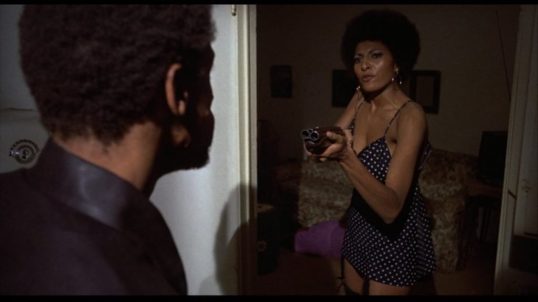
Coffy (1973, dir by Jack Hill, DP: Paul Lohmann)
Foxy Brown (1974, dir by Jack Hill, DP: Brick Marquard)
Something Wicked This Way Comes (1983, dir by Jack Clayton, DP: Stephen H. Burum)
Jackie Brown (1997, dir by Quentin Tarantino, DP: Guillermo Navarro)
The 1986 film, The Vindicator, is one of those Canadian exploitation films that doesn’t make much sense but is still memorable just because of how dedicated it is to being utterly incoherent.
Basically, an evil corporate guy named Alex Whyte (played by Richard Cox) wants to design a space suit that will turn people into rage-filled assassins. Or something like that. To be honest, I had a hard time following just what exactly Alex was trying to do. When one of his scientists, Carl Lehman (David Mcllwraith), figures out that Alex is up to something sinister, Alex blows him up. Alex then puts Carl’s charred body into the suit and Carl is transformed into a cyborg who flies into a murderous rage whenever anyone gets too close to him. That’s not exactly what Carl was hoping to spend the rest of his life doing so Carl breaks free from the lab and seeks revenge while also trying to protect his wife (Terri Austin) and his daughter (Catherine Disher). Unfortunately, because of the whole rage thing, Carl can’t allow himself to get close to them but somehow, he figures out how to speak to them through the synthesizer that’s sitting in the living room.
Now that Carl is wandering around Canada and killing all of his former co-workers, Alex decides that he needs to do something to take Carl out of commission so he hires an assassin known as Hunter. Hunter is played by Pam Grier. Yes, that’s right — the Pam Grier! Soon, Hunter and her team are pursuing Carl across Canada and, in the process, they end up killing almost as many people as Carl. And those people who aren’t killed by Carl or Hunter fall victim to the types of accidents that could only happy in a Canadian exploitation film. For instance, in one scene, a truck drives over a guard rail and immediately explodes.
Meanwhile, Carl’s friend, Bert (played by Maury Chaykin because this is a Canadian film), is falling in love with Carl’s wife and plotting to try to take her away from her cyborg husband. At first, Bert appears to be a sympathetic character and then, about an hour into the movie, Bert is suddenly not sympathetic at all. The same can actually be said for just about everyone in the film, which will lead most viewers to wonder just why exactly we should care about whether or not Carl is ever stopped.
It’s a messy film. For a relatively short and presumably low-budget film, there’s a lot of characters in The Vindicator and it’s not always clear how everyone is related. Since Carl kills most of them, I can only assume that they’re all bad but still, you can’t help but wonder if maybe Carl is being a bit too quick to assume that everyone was okay with him getting blown up. Carl is one judgmental cyborg.
Supposedly, special effects maestro Stan Winston was involved with the production of The Vindicator and, to give credit where credit is due, Carl does look like what I guess most people would expect a cyborg to look like. In fact, when I watched the movie, I originally assumed that it was a Robocop rip-off but then I discovered that The Vindicator actually came out a year before Robocop. That’s not to say, of course, that The Vindicator was, in any way, an influence on Robocop. Beyond the cyborg-theme, the two films really have nothing in common. Robocop is a satirical commentary on fascism. The Vindicator is …. well, I’m not really sure what it’s supposed to be.
The Vindicator is a mess. It’s one of those films where no one’s motivations make any sense and it is often next to impossible to actually keep track of who is who. (The actors playing Alex and Carl looked so much alike that it took me a few minutes to figure out that Carl was the one who got blown up.) And yet, like many Canadian exploitation films from the 80s, The Vindicator is also compulsively watchable. The actions move quickly. The entire plot has a make-it-up-as-you-go-along feel to it that’s kind of entertaining. Plus, Pam Grier’s in the film, openly rolling her eyes at just how silly it all is. The Vindicator isn’t exactly good but it did hold my interest. All things considered, maybe that’s vindication enough.