Scenes That I Love: Elvis and JFK in Bubba Ho-Tep


Today is both President’s Day and Don Coscarelli’s birthday!  As such, it only seems appropriate that today’s scene of the day should come from Coscarelli’s 2002 film, Bubba Ho-Tep.  

In this film, Elvis (Bruce Campbell) and John F. Kennedy (Ossie Davis) team up  to battle the killer Mummy that is haunting their nursing home.  Personally, I choose to believe that both Elvis and JFK were exactly who they said they were in this film.

Film Review: The Cardinal (dir by Otto Preminger)


The 1963 film, The Cardinal, opens with an Irish-American priest named Stephen Fermoyle (Tom Tyron) being instituted as a cardinal.

In a series of flashbacks, we see everything that led to this moment.  Stephen starts out as an overly ambitious and somewhat didactic priest who, over the years, is taught to be humble by a series of tragedies and mentors.  It’s a sprawling story, one that encompasses the first half of the 20th Century and, as he did with both Exodus and Advice and Consent, Preminger tells his story through the presence of several familiar faces.  Director John Huston plays the cardinal who takes an early interest in Stephen’s career.  Burgess Meredith plays a priest with MS who teaches Stephen about the importance of remaining humble and thankful.  When Stephen is in Europe, Romy Schneider plays the woman for whom he momentarily considers abandoning his vows.  When Stephen is assigned to the American South, Ossie Davis plays the priest and civil rights activist who teaches Stephen about the importance of standing up for those being oppressed.  In the days leading up to World War II, Stephen is sent to Austria to try to keep the local clergy from allying with the invading Nazis.  Stephen also deals with his own family drama, as his sister (Carol Lynley) runs away from home after Stephen counsels her not to marry a good Jewish man named Benny (John Saxon) unless Benny can be convinced the convert to Catholicism.  Later, when his sister becomes pregnant and Stephen is told that she’ll die unless she has an abortion, Stephen is forced to choose between his own feelings and teachings of the Church.  Along the way, performers like Dorothy Gish, Cecil Kellaway, Chill Wills, Raf Vallone, Jill Haworth, Maggie McNamara, Arthur Hunnicut, and Robert Morse all make appearances.

All of the familiar faces in the cast are used to support Tom Tryon and Tryon needs all the support that he can get.  Despite Otto Preminger’s attempts to make Tom Tyron into a star, Tryon eventually retired from acting and found far more success as a writer of the type of fiction that Stephen Fermoyle probably would have condemned as blasphemous.  Tryon gives a stiff and unconvincing performance in The Cardinal.  The entire film depends on Tryon’s ability to get us to like Stephen, even when he’s being self-righteous or when he’s full of self-pity and, unfortunately, Tryon’s stiff performance makes him into the epitome of the type of priest that everyone dreads having to deal with.  Tryon gives such a boring performance that he’s overshadowed by the rest of the cast.  I spent the movie wishing that it would have spent more time with John Saxon and Burgess Meredith, both of whom give interesting and lively performances.

The Cardinal is a long and rather self-important film.  The same can be said of many of Preminger’s films in the 60s but Exodus benefitted from the movie star glamour of Paul Newman and Eva Marie Saint and Advice and Consent was saved by an intelligent script.  The Cardinal, on the other hand, is a bit draggy and makes many of the same mistakes that many secular films make when they try to portray Catholicism.  Oddly enough, The Cardinal received more Oscar nominations than either Exodus or Advice and Consent.  Indeed, Preminger was even nominated for Best Director for his rather uninspired work here.  Considering the number of good films for which Preminger was not nominated (Anatomy of a Murder comes to mind), it’s a bit odd that The Cardinal was the film for which he was nominated.  (Of course, in 1944, the Academy got it right by nominating Preminger for his direction of Laura.)  The Cardinal is largely forgettable, though interesting as a type of self-consciously “big” films that the studios were churning out in the 60s in order to compete with television and the counterculture.

Live Tweet Alert: Join #FridayNightFlix For Bubba Ho-Tep!


As some of our regular readers undoubtedly know, I am involved in a few weekly live tweets on Twitter and Mastodon.  I host #FridayNightFlix every Friday, I co-host #ScarySocial on Saturday, and I am one of the five hosts of #MondayActionMovie!  Every week, we get together.  We watch a movie.  We tweet our way through it.

Tonight, at 10 pm et, #FridayNightFlix has got 2002’s Bubba Ho-Tep, starring Bruce Campbell and Ossie Davis!

If you want to join us this Friday, just hop onto twitter, start the movie at 10 pm et, and use the #FridayNightFlix hashtag!  It’s a friendly group and welcoming of newcomers so don’t be shy.

Bubba Ho-Tep is available on Prime!  See you there!

Bubba Ho-Tep (2002, dir by Don Coscarelli)

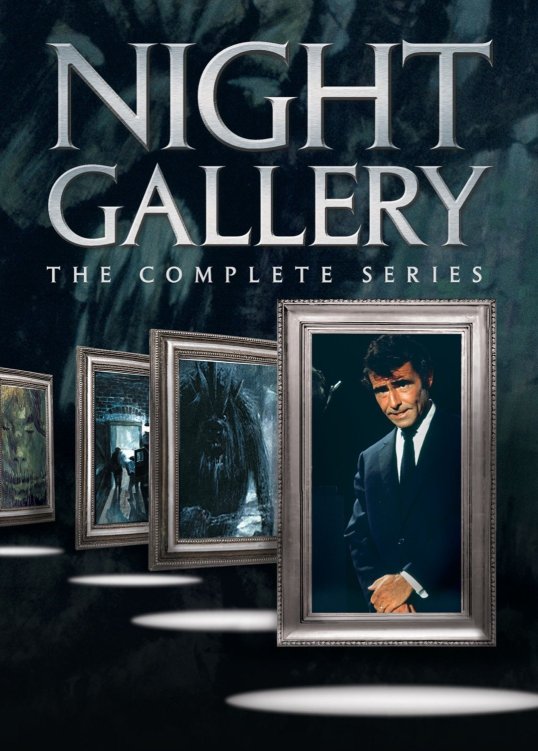
Film Review: Night Gallery (dir by Boris Sagal, Barry Shear, and Steven Spielberg)


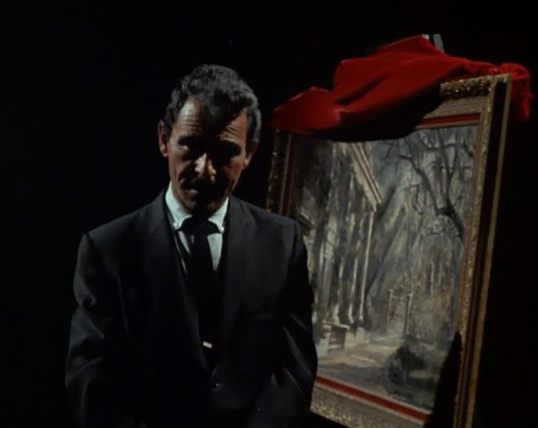
Night Gallery was a horror anthology series that aired on NBC in the early 70s.  Each episode featured Rod Serling, of Twilight Zone fame, serving as the curator of a museum where all of the paintings have a somewhat macabre theme.  (One could even say that the museum was a …. wait for it …. night gallery!)  Serling would give each painting a properly pithy introduction and then the audience would see the story behind the artwork.  It was a bit like the Twilight Zone, except the Night Gallery episodes were in color, they were all horror-themed, and, for the most part, they steered away from social commentary.  The series ran from 1970 and 1973 and it still airs in syndication and on some of the retro stations.  (I believe it currently airs on Comet TV.)  Even if it wasn’t as consistently good as Twilight Zone, it’s still a pretty fun little series.

Two Christmases ago, I was gifted  Night Gallery: The Complete Series on DVD.  Though I’ve watched several episodes from the DVD, I recently realized that I have never actually sat down and watched every episode in order.  With the world currently shut down due to the pandemic (a development that, if we’re going to be honest, sounds like something Rod Serling would have used on the Twilight Zone), I figured what better time to watch the entire series then now?

I started out by watching the Night Gallery pilot film.  This originally aired on November 8th, 1969, a full year before Night Gallery became a weekly series.  It features three different stories (all written by Rod Serling) of the macabre.  As with every episode of the subsequent series, each story is introduced by Serling standing in front of a painting.  In the pilot, though, the museum is rather bare and the painting’s are a bit minimalist.  I have to admit that, as a lover of the baroque, I was a bit disappointed in that aspect of the pilot.

But what about the stories themselves?  Read on!

The Cemetery (dir by Boris Sagal)

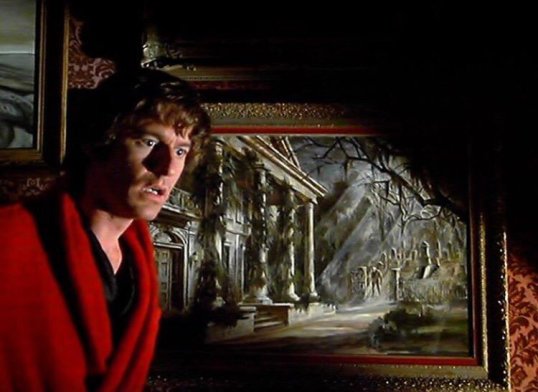
The first story was The Cemetery, a cheerfully gruesome little tale that featured Roddy McDowall and Ossie Davis.  McDowall plays Jeremy, a spoiled young man who murders his uncle so that he might inherit the dead man’s estate.  At first, it looks like McDowall’s plot is a complete success but then McDowall notices a painting of the family graveyard hanging above a staircase.  (To be honest, it seems odd to hang a painting of a graveyard in the foyer but I guess that’s something old rich people do.)  The painting keeps changing.  One minute, the painting looks normal.  The next minute, it features a newly dug grave.  And then something emerging grave.  And then something heading towards the house….

Is Jeremy losing his mind or is the painting warning him that his uncle has risen from the dead and is seeking revenge!?  You’ll probably be able to guess the answer long before poor Jeremy but no matter.  This is a fun little horror story and it benefits from two enjoyably arch performances, from McDowall and, in the role of a butler who may have an agenda of his own, Ossie Davis.

Eyes (dir by Steven Spielberg)

Of the three stories presented in the pilot, Eyes probably gets the most attention from critics because it not only stars Joan Crawford in one of her final performances but it was the professional directorial debut (if you don’t count Amblin’) of 22 year-old Steven Spielberg.  Spielberg apparently had some issues dealing with the veteran crew members, many of whom didn’t like the idea of taking orders from a 22 year-old.  (It probably didn’t help that pictures from that era suggest that Spielberg looked several years younger than his age.  Let’s just say that it’s easy to understand why he eventually grew that beard.)  I’d like to think that Joan Crawford yelled at everyone and defended Spielberg and maybe even Rod Serling came down with Luca Brasi and said, “You’re going to the give this kid the respect he deserves or your brains are going to be all over that union contract.”  I don’t know if that’s true but it’s a nice thought.

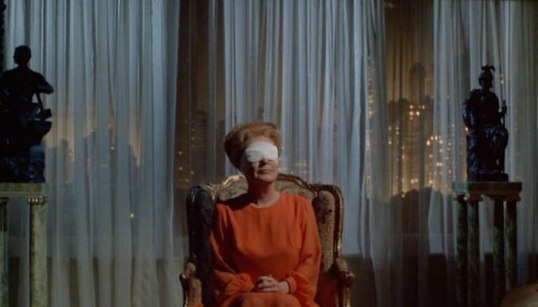
That said, Eyes is pretty good.  Even if the crew doubted him, Spielberg proved himself as a director with this story.  It’s about a hateful and selfish woman (Joan Crawford) who happens to be both rich and blind.  She has manipulated a doctor into performing an experimental operation that will allow her to see.  The only catch is that the operation will only be good for 22 hours and a donor (Tom Bosley, as a bookie who is in trouble with the mob) will be required to give up his eyes so that Crawford can have those 22 hours.

On the one hand, this is very-much a Rod Serling-type tale.  It’s easy to imagine Eyes, with its belief in karma and its final macabre twist, as a Twilight Zone episode.  At the same time, Spielberg very much brings his own signature style to the film, livening up dialogue-heavy scenes with interesting camera angles and getting good performances from Crawford, Barry Sullivan, and Tom Bosley.  Eyes is a clever story but, for modern viewers, the most interesting thing about it will be discovering that, even at the age of 22, Spielberg already had a clear directorial style.

The Escape Route (dir by Barry Shear)

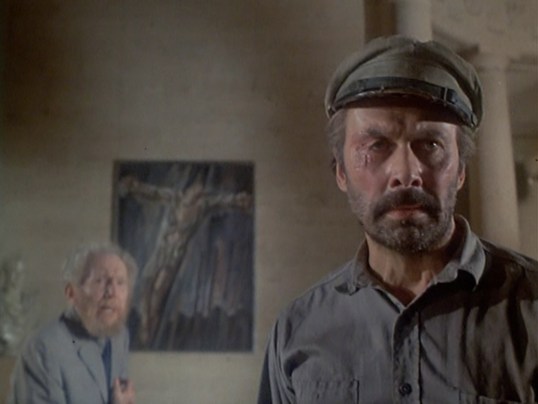
The Escape Route is about an Nazi war criminal named Joseph Strobe (played by Richard Kiley) who is hiding out in South America and spending all of his time nervously looking over his shoulder.  One day, he enters a museum where he finds himself drawn to two paintings.  One painting features a man who has been crucified in a concentration camp, which we learn was Strobe’s trademark back when he, himself, was a camp commandant.  The other painting features a fisherman in a peaceful setting.  Even though Strobe imagines himself as the peaceful fisherman, his attention keeps getting redirected to the painting of the concentration camp.  Soon, Strobe realizes that a survivor of the camp (played by Sam Jaffe) is also in the museum and that he is studying the painting as well.

Compared to Eyes and especially The Cemetery, The Escape Route may seem like a rather low-key story but it has a power that sneaks up on you.  Hiding out (as many real-life Nazi war criminals did) in South America, Strobe is full of excuses for his past and he may indeed be sincere in his wish that he had just become a fisherman as opposed to a brutal Nazi.  But, in the end, Strobe can neither escape his past nor his final punishment.  Justice cannot be escaped, no matter how hard Strobe tries to outrun it.  In the end, there is no escape for the wicked.  Richard Kiley and Sam Jaffe both give excellent performances.  The Escape Route will stick with you.

As a series, Night Gallery was a bit uneven but the pilot stands as a classic of its type, featuring three short films that all deserve to be remembered.

As for me, I’m going to try to watch an episode or two a day.  I may review a few more Night Gallery episodes here on the Shattered Lens.  As I said, the series itself was a bit uneven and not every episode is as good as the pilot.  Still, there’s definitely some gems to be found in the Night Gallery and I’ll share them as I come across them.

30 Days of Noir #24: Fourteen Hours (dir by Henry Hathaway)


As a genre, film noir has always been associated with crime: murder, brutish gangsters, seductive femme fatales, and occasionally a cynical private detective doing the right thing almost despite himself.  However, not all film noirs are about criminals.  Some are just about desperate characters who have found themselves on the fringes, living in a shadow-filled world that appears to be monstrously indifferent to all human suffering.

That’s certainly the case with the 1951 noir, 14 Hours.  The film centers around Robert Cosick (Richard Basehart, who previously played a murderer in another classic noir, He Walked By Night).  Robert isn’t a gangster.  He’s not a private detective.  He doesn’t carry a gun and he doesn’t provide any sort of hard-boiled narration.  In fact, for the majority of the film, Robert is defined by less who he is and more by what he’s doing.  Robert Cosick, having earlier checked into a room on the 15th floor of a New York hotel, has climbed out of a window and is now standing on a ledge.  Robert says that he’s going to jump.

What has driven Robert Cosik to consider such an extreme action?  The film never settles on any one reason, though it gives us several clues.  When his father (Robert Keith) and his mother (Agnes Moorehead) show up at the scene, they immediately start bickering about old family dramas.  When Robert’s ex-fiancee (Barbara Bel Geddes) begs him to step in from the ledge, he listens a bit more to her than he did to his parents but he still refuses to come in from the ledge.

But perhaps the real reason that Robert Cosick is out on that ledge can be found in the film’s shadowy visuals.  Directed in a semi-documentary fashion by Henry Hathaway and featuring harsh, black-and-white cinematography that’s credited to Joe MacDonald, Fourteen Hours emphasizes the indifference of the city.  From the menacing landscape of concrete buildings to the crowds gathering below the ledge to see if Robert lives or dies,  New York City is as much as a character in this film as Robert, his family, or the cop (played by Paul Douglas) who finds himself trying to talk Robert into reentering his hotel room.  When night falls, the city may light up but it does nothing to alleviate the shadows that seem to be wrapping themselves around Robert.  For the fourteen hours that Robert is on that ledge, he may be the center of the world but the film leaves little doubt that New York City will continue to exist in all of its glory and its horror regardless of how Robert’s drama plays out.  Whether he lives or dies, Robert appears to be destined to be forgotten.

When the film isn’t concentrating on the cops trying to talk Robert into getting back in the hotel room, it shows us the reactions of the people who see him standing out on that ledge.  (If this film were made today, everyone would be holding up their phones and uploading Robert’s plight to social media.)  Some people are moved by Robert’s struggle.  For instance, a young woman played by Grace Kelly (in her film debut) reaches a decision on whether or not to get a divorce based on what she sees happening on the ledge.  Two office workers (played by Jeffrey Hunter and Debra Paget) even strike up a romance as they wait to see what will happen.  Some people view Robert as being a madman.  Others see him as being a victim.  And then there’s the many others who view him as being either a minor distraction or a piece of entertainment.  For them, it’s less important why Robert’s on the ledge or even who Robert is.  What’s important to them is how the story is going to end.

It’s not a particularly happy film but it’s made watchable by Hathaway’s intelligent direction and the performances of Paul Douglas and Richard Basehart.  With its theme of instant fame and hollow indifference, it’s a film that remains as relevant today as when it was initially released.

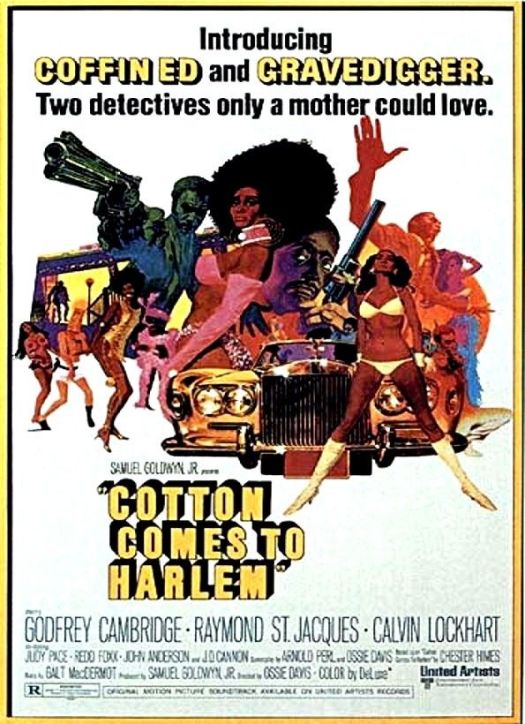
That’s Blaxploitation! 12: COTTON COMES TO HARLEM (United Artists 1970)


gary loggins's avatarcracked rear viewer


I’m not really sure if COTTON COMES TO HARLEM qualifies as a Blaxploitation film. Most genre experts point to Melvin Van Peebles’ SWEET SWEETBACK’S BADASSSSS SONG and/or Gordon Parks’s SHAFT , both released in 1971, as the films that kicked off the Blaxploitation Era. Yet this movie contains many of the Blaxploitation tropes to follow, and is based on the works of African-American writer Chester Himes.

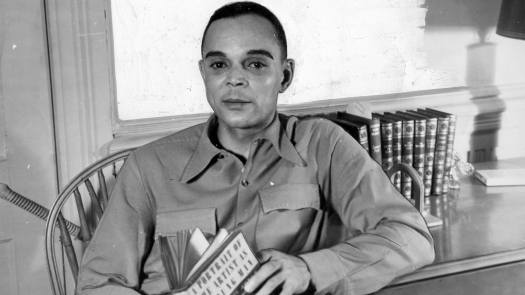
Hardboiled author Chester Himes

Himes (1909-1984) began his writing career while doing a prison stretch for armed robbery. After his short stories started being published in Esquire, he was paroled in 1936, and soon met poet Langston Hughes, who helped him get established in the literary world. Reportedly, Himes worked for a time as a screenwriter for Warner Brothers in the 40’s, but was let go when a racist Jack Warner declared he “don’t want no n*ggers on this lot” (1). His first …

View original post 591 more words

Catching-Up With Two Courtroom Dramas: Suspect and 12 Angry Men


As a part of my continuing effort to get caught up with reviewing all of the movies that I’ve seen this year, here’s two courtroom dramas that I recently caught on This TV.

  • Suspect
  • Released in 1987
  • Directed by Peter Yates
  • Starring Cher, Dennis Quaid, Liam Neeson, John Mahoney, Joe Mantegna, Philip Bosco, Fred Melamed, Bernie McInerney, Bill Cobbs, Richard Gant, Jim Walton, Michael Beach, Ralph Cosham, Djanet Sears 

Suspect is a hilariously dumb movie.  How dumb is it?  Let me count the ways.

First off, Cher plays a highly successful if rather stressed public defender.  And don’t get me wrong.  It’s not that Cher is a bad actress or anything.  She’s actually pretty good when she’s playing Cher.  But, in this movie, she’s playing someone who managed to graduate from law school and pass the DC bar.

Secondly, Cher is assigned to defend a homeless man when he’s accused of murdering a clerk who works for the Justice Department.  The homeless man is deaf and mute, which isn’t funny.  What is funny is when he gets a shave and a shower and he’s magically revealed to be a rather handsome and fresh-faced Liam Neeson.  Liam doesn’t give a bad performance in the role.  In fact, he probably gives the best performance in the film.  But still, it’s hard to escape the fact that he’s Liam Neeson and he basically looks like he just arrived for a weekend at Cannes.

Third, during the trial, one of the jurors (Dennis Quaid) decides to investigate the case on his own.  Cher even helps him do it, which is the type of thing that would get a real-life attorney disbarred.  However, I guess Cher thinks that it’s worth the risk.  I guess that’s the power of Dennis Quaid’s smile.

Fourth, the prosecuting attorney is played by Joe Mantegna and he gives such a good performance that you find yourself hoping that he wins the case.

Fifth, while it’s true that real-life attorneys are rarely as slick or well-dressed as they are portrayed in the movies, one would think that Cher would at least take off her leather jacket before cross-examining a witness.

Sixth, it’s not a spoiler to tell you that the homeless man is innocent.  We know he’s innocent from the minute that we see he’s Liam Neeson.  Liam only kills who people deserve it.  The real murderer is revealed at the end of the film and it turns out to be the last person you would suspect, mostly because we haven’t been given any reason to suspect him.  The ending is less of a twist and more an extended middle finger to any viewer actually trying to solve the damn mystery.

I usually enjoy a good courtroom drama but bad courtroom dramas put me to sleep.  Guess which one Suspect was.

  • 12 Angry Men
  • Released 1997
  • Directed by William Friedkin
  • Starring Courtney B. Vance, Ossie Davis, George C. Scott, Armin Mueller-Stahl, Dorian Harewood, James Gandolfini, Tony Danza, Jack Lemmon, Hume Cronyn, Mykelti Williamson, Edward James Olmos, William Petersen, Mary McDonnell, Tyrees Allen, Douglas Spain

The 12 Angry Men are back!

Well, no, not actually.  This is a remake of the classic 1957 film and it was produced for Showtime.  It’s updated in that not all of the jurors are white and bigoted Juror #10 (Mykelti Williamson) is now a member of the Nation of Islam.  Otherwise, it’s the same script, with Juror #8 (Jack Lemmon) trying to convince the other jurors not to send a young man to Death Row while Juror #3 (George C. Scott) deals with his family issues.

I really wanted to like this production, as it had a strong cast and a strong director and it was a remake of one of my favorite films.  Unfortunately, the remake just didn’t work for me.  As good an actor as Jack Lemmon was, he just didn’t project the same moral authority as Henry Fonda did the original.  If Fonda seemed to be the voice of truth and integrity, Lemmon just came across like an old man who had too much time on his hands.  Without Fonda’s moral certitude, 12 Angry Men simply becomes a story about how 12 men acquitted a boy of murder because they assumed that a woman would be too vain to wear her glasses to court.  The brilliance of the original is that it keeps you from dwelling on the fact that the accused was probably guilty.  The remake, however, feels like almost an argument for abandoning the jury system.

Playing Catch-Up: Autumn in New York, Griffin & Phoenix, Harry & Son, The Life of David Gale


So, this year I am making a sincere effort to review every film that I see.  I know I say that every year but this time, I really mean it.

So, in an effort to catch up, here are four quick reviews of some of the movies that I watched over the past few weeks!

  • Autumn in New York
  • Released: 2000
  • Directed by Joan Chen
  • Starring Richard Gere, Winona Ryder, Anthony LaPaglia, Elaine Stritch, Vera Farmiga, Sherry Stringfield, Jill Hennessy, J.K. Simmons, Sam Trammell, Mary Beth Hurt

Richard Gere is Will, a fabulously wealthy New Yorker, who has had many girlfriends but who has never been able to find the one.  He owns a restaurant and appears on the cover of New York Magazine.  He loves food because, according to him, “Food is the only beautiful thing that truly nourishes.”

Winona Ryder is Charlotte, a hat designer who is always happy and cheerful and full of life.  She’s the type who dresses up like Emily Dickinson for Christmas and recites poetry to children, though you get the feeling that, if they ever somehow met in real life, Emily would probably get annoyed with Charlotte fairly quickly.  Actually, Charlotte might soon get to meet  Emily because she has one of those rare diseases that kills you in a year while still allowing you to look healthy and beautiful.

One night, Will and Charlotte meet and, together, they solve crimes!

No, actually, they fall in love.  This is one of those films where a young woman teaches an old man how to live again but then promptly dies so it’s not like he actually has to make a huge commitment or anything.  The film does, at least, acknowledge that Will is a lot older than Charlotte but it still doesn’t make it any less weird that Charlotte would want to spend her last year on Earth dealing with a self-centered, emotionally remote man who is old enough to be her father.  (To be honest, when it was revealed that Charlotte was the daughter of a woman who Will had previously dated, I was briefly worried that Autumn in New York was going to take an even stranger turn….)

On the positive side, the films features some pretty shots of New York and there is actually a pretty nice subplot, in which Will tries to connect with the daughter (Vera Farmiga) that he never knew he had.  Maybe if Farmiga and Ryder had switched roles, Autumn in New York would have worked out better.

  • Griffin & Phoenix
  • Released: 2006
  • Directed by Ed Stone
  • Starring Dermot Mulroney, Amanda Peet, Blair Brown, and Sarah Paulson

His name is Henry Griffin (Dermot Mulroney).

Her name is Sarah Phoenix (Amanda Peet).

Because they both have highly symbolic last names, we know that they’re meant to be together.

They both have cancer.  They’ve both been given a year to live.  Of course, they don’t realize that when they first meet and fall in love.  In fact, when Phoenix comes across several books that Griffin has purchased about dealing with being terminally ill, she assumes that Griffin bought them to try to fool her into falling in love with him.  Once they realize that they only have a year to be together, Griffin and Phoenix set out to make every moment count…

It’s a sweet-natured and unabashedly sentimental movie but, unfortunately, Dermot Mulroney and Amanda Peet have little romantic chemistry and the film is never quite as successful at inspiring tears as it should be.  When Mulroney finally allows himself to get mad and deals with his anger by vandalizing a bunch of cars, it’s not a cathartic moment.  Instead, you just find yourself wondering how Mulroney could so easily get away with destroying a stranger’s windshield in broad daylight.

  • Harry & Son
  • Released: 1986
  • Directed by Paul Newman
  • Starring Paul Newman, Robby Benson, Ellen Barkin, Wilford Brimley, Judith Ivey, Ossie Davis, Morgan Freeman, Katherine Borowitz, Maury Chaykin, Joanne Woodward

Morgan Freeman makes an early film appearance in Harry & Son, though his role is a tiny one.  He plays a factory foreman named Siemanowski who, in quick order, gets angry with and then fires a new employee named Howard Keach (Robby Benson).  Howard is the son in Harry & Son and he’s such an annoying character that you’re happy when Freeman shows up and starts yelling at the little twit.  As I said, Freeman’s role is a small one.  Freeman’s only on screen for a few minutes.  But, in that time, he calls Howard an idiot and it’s hard not to feel that he has a point.

Of course, the problem is that we’re not supposed to view Howard as being an idiot.  Instead, we’re supposed to be on Howard’s side.  Howard has ambitions to be the next Ernest Hemingway.  However, his blue-collar father, Harry (Paul Newman, who also directed), demands that Howard get a job.  Maybe, like us, he realizes how silly Howard looks whenever he gets hunched over his typewriter.  (Robby Benson tries to pull off these “deep thought” facial expressions that simply have to be seen to be believed.)  There’s actually two problems with Howard.  First off, we never believe that he could possibly come up with anything worth reading.  Secondly, it’s impossible to believe that Paul Newman could ever be the father of such an annoying little creep.

Harry, of course, has problems of his own.  He’s just lost his construction job.  He’s having to deal with the fact that he’s getting older.  Fortunately, his son introduces him to a nymphomaniac (Judith Ivey).  Eventually, it all ends with moments of triumph and tragedy, as these things often do.

As always, Newman is believable as a blue-collar guy who believes in hard work and cold beer.  The film actually gets off to a good start, with Newman using a wrecking ball to take down an old building.  But then Robby Benson shows up, hunched over that typewriter, and the film just becomes unbearable.  At least Morgan Freeman’s around to yell at the annoying little jerk.

  • The Life of David Gale
  • Released: 2003
  • Directed by Alan Parker
  • Starring Kevin Spacey, Kate Winslet, Laura Linney, Gabriel Mann, Rhona Mitra, Leon Rippy, Matt Craven, Jim Beaver, Melissa McCarthy

For the record, while I won’t shed any tears whenever Dzhokahr Tsarnaev is finally executed, I’m against the death penalty.  I think that once we accept the idea that the state has the right to execute people, it becomes a lot easier to accept the idea that the state has the right to do a lot of other things.  Plus, there’s always the danger of innocent people being sent to die.  The Life of David Gale also claims to be against the death penalty but it’s so obnoxious and self-righteous that I doubt it changed anyone’s mind.

David Gale (Kevin Spacey) used to the head of the philosophy department at the University of Texas.  He used to be a nationally renowned activist against the death penalty.  But then he was arrested for and convicted of the murder of another activist, Constance Harraway (Laura Linney) and now David Gale is sitting on death row himself.  With his execution approaching, journalist Bitsey Bloom (Kate Winslet) is convinced that Gale was framed and she finds herself racing against time to prevent Texas from executing an innocent man…

There’s a lot of things wrong with The Life of David Gale.  First off, it was made during the Bush administration, so the whole film is basically just a hate letter to the state of Texas.  Never have I heard so many inauthentic accents in one film.  Secondly, only in a truly bad movie, can someone have a name like Bitsey Bloom.  Third, the whole film ends with this big twist that makes absolutely no sense and which nearly inspired me to throw a shoe at the TV.

Of course, the main problem with the film is that we’re asked to sympathize with a character played by Kevin Spacey.  Even before Kevin Spacey was revealed to be a sleazy perv, he was never a particularly sympathetic or really even that versatile of an actor.  (Both American Beauty and House of Cards tried to disguise this fact by surrounding him with cartoonish caricatures.)  Spacey’s so snarky and condescending as Gale that, even if he is innocent of murder, it’s hard not to feel that maybe David Gale should be executed for crimes against likability.
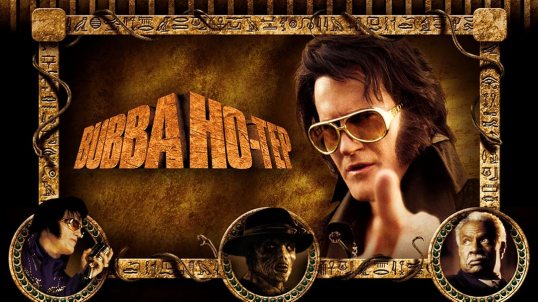
Halloween Havoc!: BUBBA HO-TEP (Vitagraph 2002)


gary loggins's avatarcracked rear viewer

Don Coscarelli, the man who brought you the PHANTASM series, scores a bulls-eye with BUBBA HO-TEP, a totally unique film based on Joe R. Lansdale’s novella. Lansdale is well known to fans of horror fiction for his books and short stories in the filed as well as other genres (crime, westerns, even comic books). Coscarelli’s adaptation is a delightful blend of horror and humor, and a bittersweet reflection on aging, if not gracefully, then with courage.

Bruce Campbell (ASH VS EVIL DEAD) stars as Sebastian Haff, former Elvis impersonator who may or may not really be The King. He believes he is, and that’s what matters. He’s stuck in a Mud Creek, Texas rest home, confined to a walker and battling a weird growth on his pecker. People at the rest home are dying, as you’d expect in a place like this, but under some strange circumstances that’re causing Elvis…

View original post 349 more words

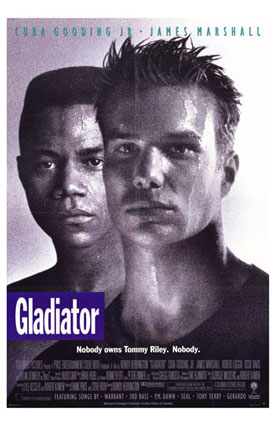
A Movie A Day #96: Gladiator (1992, directed by Rowdy Herrington)


What ever happened to James Marshall?

Whenever the subject of Twin Peaks comes up, that question gets asked a lot.  Marshall played the sensitive (and oft-ridiculed) motorcycle-riding rebel James Hurley on Twin Peaks and, after the show’s cancellation, he went on to play a key supporting role in A Few Good Men.  Marshall’s role may not have been huge but he managed to hold his own against actors like Tom Cruise, Jack Nicholson, and Kevin Bacon.

And then after A Few Good Men, nothing.

Why did James Marshall disappear?

He starred in a movie called Gladiator.

No, not the Russell Crowe movie that won all the Oscars.  This Gladiator is about Tommy Riley (played by James Marshall), a teenager who moves to Chicago from Massachusetts.  As one of the only white kids in his new neighborhood, Tommy finds himself being harassed by the local gangs.  One night, he gets into a fight in a parking lot.  (Fortunately, none of the neighborhood gangs carry guns or knives.  They settle everything with fists.)  Pappy Jack (Robert Loggia) is so impressed with Tommy’s fighting skills that he recruits Tommy to fight in illegal, underground boxing matches. Normally, Tommy would say no but he needs the money to help his father (John Heard) pay off his gambling debts.

Once recruited, Tommy is trained by the wise Noah (Ossie Davis) and works for boxing promoter, Jimmy Horn.  Horn is played by all-purpose bad guy Brian Dennehy, who gives such a villainous performance that even Lance Henriksen would say, “Dude, dial it down a notch.”  Tommy befriends two other boxers, Romano (Jon Seda) and Lincoln (Cuba Gooding, Jr.).  At the time that Gladiator was filmed, Marshall was hot off of Twin Peaks and Gooding was hot off of Boyz ‘n The Hood.  Fortunately, Gooding’s role is actually pretty small so he survived Gladiator and was able to go on to win an Oscar for Jerry Maguire and play O.J. Simpson in American Crime Story.  Marshall was less lucky.

At one time, I thought that no one could be a least convincing boxer than Damon Wayans was in The Great White Hype.  Then I watched Gladiator and saw James Marshall dancing around the ring and throwing punches.  Normally, good editing can be used to disguise a lack of athletic ability but both Marshall and Gooding are so miscast as boxers that all the editing in the world can’t help.  Jon Seda, who actually was an amateur boxer before getting into acting, is more convincing in the ring but his character is so saintly that anyone watching will know better than to get too attached to him.

A still notorious flop at the box office, Gladiator was directed by Rowdy Herrington but it’s no Roadhouse.