 Last week, when the world first learned of the death of the actor Alan Rickman, it was shocking to realize just how many great roles he had played. He made his feature film debut as Hans Gruber in Die Hard. He played Colonel Brandon in Sense and Sensibility, Severus Snape in the Harry Potter movies, the Sheriff of Nottingham in Robin Hood: Prince of Thieves, Hilly Kristal in CGBG and Marvin the Paranoid Android in Hitchhiker’s Guide to the Galaxy. He even played
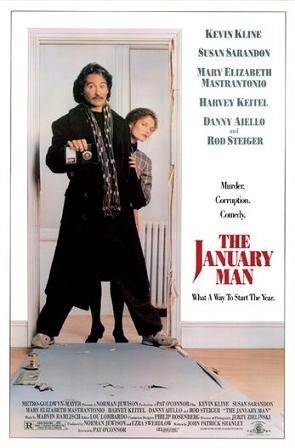
 Leonard Nimoy Alexander Dane in Galaxy Quest. But the first time I ever saw Alan Rickman, he was playing Ed the Painter in The January Man.
As The January Man begins, the new year is barely a day old and already Manhattan is in a panic. Over the past 11 months, a serial killer has terrorized the city, killing one woman per month. His latest victim, Allison Hawkins (Faye Grant) was murdered on New Year’s Eve. Now, it’s January and everyone in New York City is waiting for the killer to strike again.
Mayor Flynn (Rod Steiger, bellowing his lines as only an Oscar-winning “great” actor can) is upset because Allison was a friend of his daughter, Bernadette (Mary Elizabeth Mastrantonio). Flynn orders the police commissioner, Frank Starkey (Harvey Keitel), to put his brother on the case. Nick Starky (Kevin Kline) was the best detective in New York but Frank framed him on corruption charges. Now, Nick is working as a fireman and does not want to return to police work. However, Nick tells Frank that he will investigate the murders on one condition: Nick wants to make dinner for Frank’s wife (and Nick’s former lover), Christine (Susan Sarandon).
After cooking an octopus for Christine, Nick works the case. His unorthodox methods get on the nerves of Capt. Alcoa (Danny Aiello, bellowing almost as much as Rod Steiger) but also wins him the heart of Bernadette. Helping him investigate the case (and repainting his office) is his neighbor, Ed (Alan Rickman). Ed is not only a painter but he’s also a computer expert who figures out exactly where the killer is going to strike next.
The January Man was Alan Rickman’s second film and followed his debut in Die Hard. Other than sharing a similarly sarcastic sense of humor, Ed the Painter is the exact opposite of Hans Gruber. Gruber was a murderer who would do anything for money. Ed is an artist who wants only to paint and hang out with Nick Starkey.
When I first saw The January Man, I was seven years old and I was on an airplane flying to London. I was too young to really understand what was happening in the movie but I knew that Ed was my favorite character because he was the one who got all the funny lines and he spoke with a British accent. When he told one of his models “Don’t molest anything,” I thought it was hilarious even though I did not really understand what he was talking about. (Years later, I would watch The January Man on HBO and I would discover that Ed made his living painting nudes and that Bernadette and Nick were having sex, all information that was edited out of the airplane version.)
After I heard that Rickman had died, I rewatched The January Man for the first time in years. I discovered that The January Man is a terrible movie that tries to unsuccessfully to mix slapstick comedy with brutal serial killer action but Alan Rickman still gives a really good performance, the best in the film. (A close second would be Mary Elizabeth Mastrantonio, whose smile lights up every scene in which she appears. She married the movie’s director so at least she got something good out of appearing in The January Man.) That Alan Rickman is one of the film’s few bright spots is a testament to his talent as an actor. Alan Rickman was such a great actor that he even made The January Man watchable.

RIP, Alan Rickman.