“What is rock and roll?” — Fire Up The Shoeshaw by Lionrick
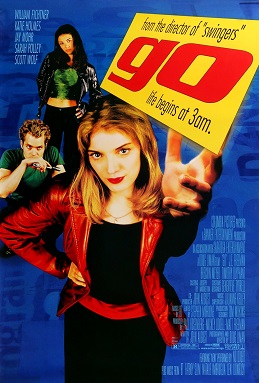
In 1999’s Go, Sarah Polley plays Ronna, a supermarket cashier who is on the verge of getting kicked out of her apartment because she can’t pay the rent. (As Julianne Moore put it in Boogie Nights, “My landlord is a real jerk.”) When Adam (Scott Wolf) and Zack (Jay Mohr) approach her and ask if she can hook them up with twenty ecstasy pills, Ronna agrees. Her co-worker, Simon (Desmond Askew), is a low-level dealer and he’s gone to Las Vegas for the weekend. Ronna decides to get the pills from Simon’s connection, Todd Gaines (Timothy Olyphant). Because Ronna doesn’t have enough money to pay Todd, she agrees to leave her friend Claire (Katie Holmes) behind as collateral.
Meanwhile, Simon goes to Vegas with Marcus (Taye Diggs), Singh (James Duval), and Tiny (Breckin Meyer). While Singh and Tiny deal with the consequences of eating too much shrimp and Marcus deals with people assuming that he must work at the casino, Simon nearly burns down the hotel and then manages to piss off both a bouncer (Jimmy Shubert) and his father (J.E. Freeman).
Finally, in the film’s third storyline, Adam and Zack are revealed to be two soap opera actors who are secretly dating and who were busted by a bizarre cop named Burke Halverson (William Fichtner). Halverson wants Adam and Zack to help him set up Todd Gaines. However, beyond that, Halverson really wants Adam and Zack to have Christmas dinner with him and his wife (Jane Krakowski). Adam and Zack suspect that Halverson has ulterior motives and he does. However, it turns out that neither one of them could have guessed what Halverson really wants them to do.
Go is one of those films that seems like the greatest thing ever made when you’re a teenager and you’re watching it at your friend’s house with the volume turned down super low so that their parents don’t come in the room and ask why William Fichtner is wandering around naked while talking to Jay Mohr about cologne. Under those circumstances, it makes sense that the employees of a grocery store would all look like models and that they would spend their break playing the dead celebrity game. When you’re the right age, it doesn’t matter that Todd Gaines is a homicidal drug addict. All that matters is that Timothy Olyphant has probably never been sexier than he was in this film.
Once you grow up, it becomes a bit more obvious that Ronna, Simon, and even Adam and Zack are basically complete and total idiots and that they really have no one to blame but themselves for the trouble that they get into. When you’re a teenager and you watch Go, you ask yourself, “How could anyone evict someone during the holidays!?” When you’re an adult and you watch Go, you ask yourself, “Why didn’t you just pay your rent, Ronna?”
That said, I still love Go. Yes, it’s basically a rip-off of Pulp Fiction, but it’s still an energetic, well-acted, and surprisingly funny movie and I love the soundtrack. I love the fact that the film actually earns the right to be called Go by giving us a narrative that never stops to catch its breath. It’s a film about being young and being stupid and it perfectly captures why so many of us have nostalgia for the mistakes we made years ago. Go was Doug Liman’s follow-up to Swingers and feels like the type of film that would have been produced by Trent and Sue. It’s derivative, irresponsible, and oddly charming. It’s a mix of Los Angeles and Vegas that encourages us all to never stop moving.