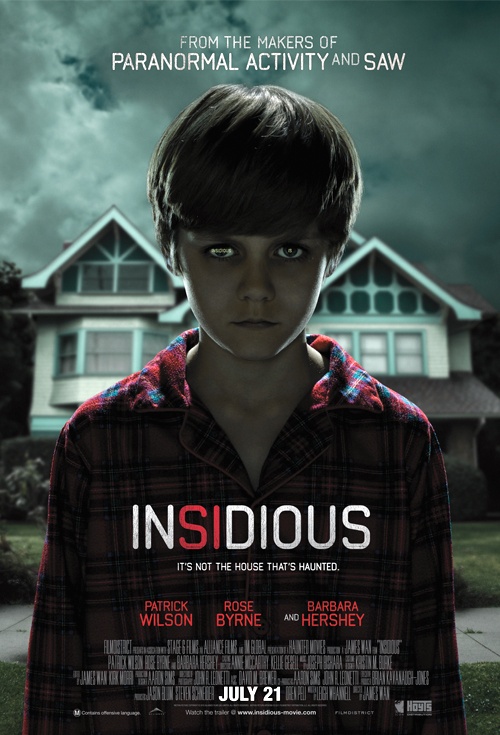
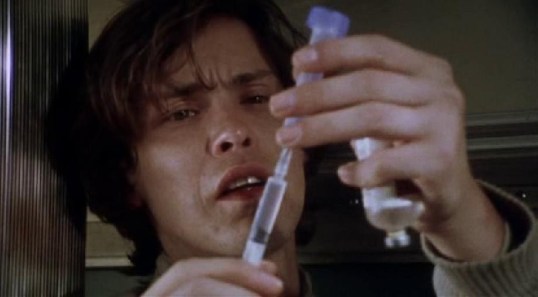
After all of the sequels and the rip-offs, it’s easy to forget just how scary Insidiouswas when it was first released, way back in 2011.
Believe it or not, it’s still pretty scary. Take the scene below, for instance. I screamed the first time I saw it and then I screamed again rewatching it on YouTube.
The reason this scenes works is because, from the start, you know that those two ghosts are going to show up. You just don’t know when. With each click, you know you’re getting closer and closer to something bad appearing in that hallway. And then when they do finally show up and the movie’s soundtrack goes “BOOOOM!” and then you see the smiles on their face — AGCK! Seriously, this is one of the best jump scares of the past decade.
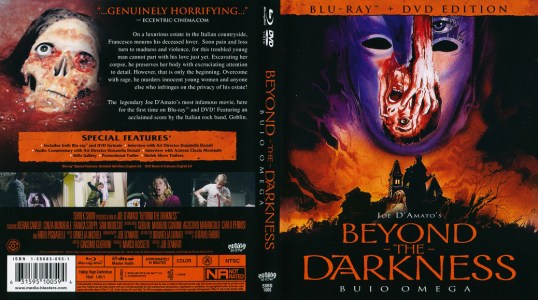
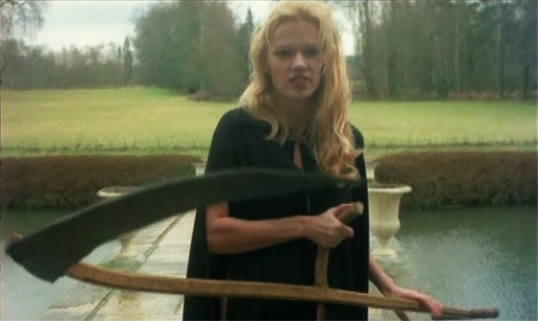
Now, me, I absolutely love Beyond the Darkness. However, this 1979 Italian film is definitely not for everyone and I’m always very careful about recommending it. At it’s heart, it’s a story about a man named Frank Wyler (Kieran Canter) who is so in love with Anna Volkl (Cinzia Monreale, who Italian horror fans will immediately recognize from her iconic role as Emily in Lucio Fulci’s The Beyond) that he won’t even allow death to keep them apart. At the same time, the film contains scenes of cannibalism, gore, and nudity (poor Cinzia Monreale had to spent the majority of the movie naked and pretending not to breathe) that were so graphic that the film was actually banned in several countries. Did I mention that Frank’s a taxidermist? If you’ve ever wanted to see a film about how messy taxidermy can be, I guess this would be the one to go with.
Frank is a young man who has inherited a villa in the country. He lives there with Iris (Franca Stoppi), the servant who has literally raised him from his birth. Frank is a handsome but strange man, one who spends most his time locked away in his garage and stuffing dead animals. (Before anyone panics, there’s no animal cruelty to be witnessed in this film. Though there is a bit of human cruelty….) Frank is in love with Anna but Anna has recently been taken ill. She’s in the hospital, where the doctor’s simply cannot figure out what’s wrong with her. Could it have something to do with the voodoo curse that the jealous Irish has placed on her?
When Anna finally dies, Iris is convinced that she’ll have Frank to herself but Frank has other ideas. After the funeral, Frank promptly digs Anna back up and then takes her body back to his garage. Unfortunately, along the way, an obnoxious hitchhiker (played by Lucia D’Elia) decides that Frank’s going to give her a ride. The hitchhiker ends up passing out in Frank’s van.
So, here Frank is. All he wants to do is stuff his dead girlfriend. But he’s got this obnoxious hitchhiker running around the garage and knocking over buckets of intestines! Frank kills the hitchhiker and Iris, despite being disgusted by the fact that Frank has insisted on bringing Anna home, helps him dispose of the hitchhiker’s body. The problem’s solved, except for the fact that Frank is now becoming obsessed with cannibalism….
Okay, it’s a weird film and it only gets weirder from there. As I said, it’s definitely not a film for everyone and there’s certain scenes that would be incredibly offensive if not for the fact that the film is so well-directed and Canter, Monreale, and Stoppi are all so well-cast and give such sincere performances that you can’t help but get caught up in the film’s storyline. Frank may be a spoiled, cannibalistic murderer and Anna might be dead but their love for each other is so sincere that you can’t help but feel for both of them. Director Aristide Massaccesi (who was usually credited under the name Joe D’Amato) creates an ominous and gothic atmosphere while Goblin provides a pulsating and moody score that perfectly mirror Frank’s descent into madness (Admittedly, Frank doesn’t have far to descend.) Massaccesi often said that he only made the film to gross people out but an accidental success is a success nonetheless.
4 Shots From 4 Films is just what it says it is, 4 shots from 4 of our favorite films. As opposed to the reviews and recaps that we usually post, 4 Shots From 4 Films lets the visuals do the talking!
This October, we’re using 4 Shots From 4 Films to look at some of the best years that horror has to offer!
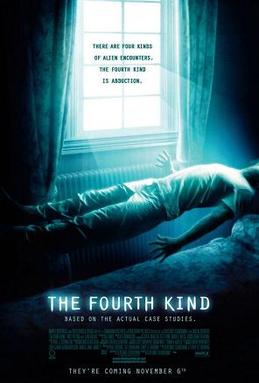
“I’m actress Milla Jovovich, and I will be portraying Dr. Abigail Tyler in The Fourth Kind. This film is a dramatization of events that occurred October 1st through the 9th of 2000, in the Northern Alaskan town of Nome. To better explain the events of this story, the director has included actual archived footage throughout the film. This footage was acquired from Nome psychologist Dr. Abigail Tyler, who has personally documented over 65 hours of video and audio materials during the time of the incidents. To better protect their privacy, we have changed the names and professions of many of the people involved. Every dramatized scene in this movie is supported by either archived audio, video or as it was related by Dr. Tyler during extensive interviews with the director. In the end, what you believe is yours to decide. Please be advised, that some of what you’re about to see is extremely disturbing.”
And so began the 2009 film, The Fourth Kind! Milla Jovovich plays Dr. Abbey Tyler, who is still emotionally devastated by the murder of her husband and who finds herself interviewing a lot of potential UFO abductees in Nome, Alaska. You may remember that, when this film came out, there was a lot of online debate over whether or not it was based on a true story. That’s because the film was advertised as containing actual “documentary footage” of Dr. Tyler talking to hypnotized alien abductees. Often times, during the film, a split screen was used so you could watch the “original” Dr. Tyler interviewing a patient while, at the same time, Milla Jovovich and an actor “recreated” the scene for the film.
Of course, the really interesting question here isn’t whether or not the documentary footage was real. Instead, to me, the real mystery of the film is why, if you had all of this amazing footage of real people freaking out under hypnosis, would you then make a movie starring Milla Jovovich, Will Patton, and Elias Koteas? It seems like a better idea would be to just make a documentary and save a lot of money on paying the cast.
Anyway, as you probably already guesses, the documentary footage was faked as well and there is no Dr. Abigail Tyler. Still, you have to admire the amount of effort that director Olatunde Osunsanmi put into trying to convince us that we were watching something based on a true story. I mean, he went far beyond just using the whole shaky cam stuff that most found footage horror movies fall back on. Wisely, Onsunsanmi made sure that none of the actors in the found footage were more attractive than the actors in the movie that was supposedly based upon it. Anyone who has seen enough “based on a true story” movies knows that the real people never look as good as the people hired to play them. I mean, honestly, this is a gimmick that Orson Welles would probably have appreciated. That said, Welles probably would have gotten better performances out of the actors in his fake documentary. When Milla Jovovovich is more convincing as a psychologist than the woman who were told actually is a psychologist, it’s a problem.
As for the film itself, it has a few effective jump scares. There’s a lot of people yelling in strange voices and, when Abbey’s daughter vanishes, Milla Jovovich does a good enough job communicating the anguish that any mother would feel if her child was abducted by aliens. Dependable actors like Will Patton and Elias Koteas show up and do what they can with underwritten roles. The Fourth Kind isn’t a bad movie but its storyline and characters are never as interesting as its gimmick. It’s the type of horror film that might make you jump while you’re watching but, a week later, all you’ll remember is Milla Jovovich introducing herself.
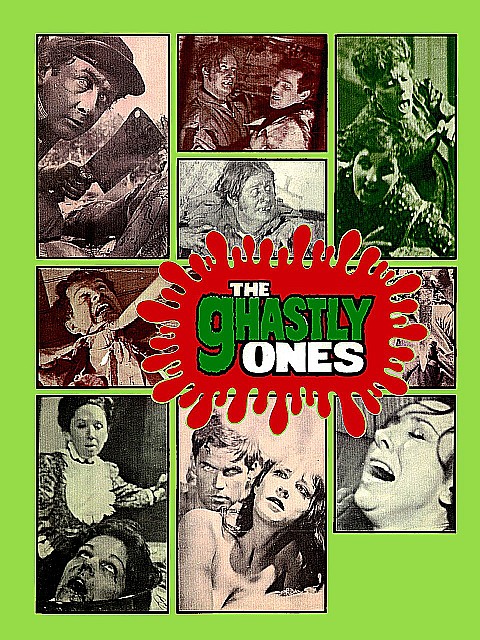
Watching The Creeping Terror is an October tradition here at the Shattered Lens. How could anyone resist a film about a killer carpet, especially one that features a random dance party?
A young couple — both of whom are dressed in clothes that appear to come from the 1890s — enjoys a romantic and sunny excursion to an isolated island. Unfortunately, their day is ruined when they’re discovered by a buck-toothed hunchback named Colin (played by Hal Borske). Death and dismemberment follows.
Somewhere in New York, three sisters are informed that their father has died but that neither they nor their husbands can receive a cent of their inheritance until they fulfill one very specific requirement. According to their father’s impossibly elderly attorney (played by Neil Flanagan, who is made up to look like an old witch from a community theater production of MacBeth), the sisters and their husbands must spend three nights in their father’s mansion. Of course, the sisters agree.
Upon arriving at the mansion, they discover that the mansion is being looked after by two maids and a hunchbacked, buck-toothed handyman named …. COLIN! Within a few minutes of meeting everyone, Colin eats a live rabbit while everyone watches. Later the remains of the rabbit shows up in one of the sister’s bed, along with a note that reads, “Blessed are the meek for they shall inherit!”
Speaking for myself, I would probably leave as soon as I saw the handyman eating a live rabbit. I mean, none of the sisters appear to be struggling financially but then again, greed is a powerful force. Instead, everyone settles in for their three-night stay, which leads to 1968-style sex scenes and a lot of footage of people sitting around and talking about nothing. For a low-budget grindhouse film, this is an extremely talky movie.
Anyway, eventually people start dying. Someone gets pitchforked. Another person is found hanging by his ankles. There’s a rather bloody disembowelment and someone else loses their head. Bloody X’es are left on doorways. Who is doing the killing? Hmmm …. well, Colin is the obvious suspect since we already saw him kill two people for absolutely no reason. But, it turns out that Colin has a little help. That’s right! The Ghastly Ones comes with a twist ending that you’ll see from miles away.
So, what exactly is The Ghastly Ones? It’s an extremely low-budget film, full of unlikable people dying in various grotesque ways. It’s an oddly moralistic film, with everyone dying because their greed prevents them from doing the sensible thing and leaving the house. It’s also apparently a period piece, with everyone dressed like they belong in the 1890s even though you can clearly hear the sound of cars in the background of a few scenes.
In short, this is another Andy Milligan film! Filmed on Staten Island and featuring a largely amateur cast (though one of the husbands is played by Richard Romanus, who went on to appear in Martin Scorsese’s Mean Streets and has since had a respectable career as a character actor), The Ghastly Ones is just as bad and weirdly hypnotic as you would expect any Andy Milligan film to be. Milligan even makes a cameo of sorts in the film. Listen closely and you can occasionally hear him off-camera, feeding the actors their lines and, at one point, telling one of the sisters to “roll over.”
It’s a terrible movie and yet, it’s also strangely fascinating. I think that’s because Milligan’s ineptness was matched only by his anger and that anger (along with a lot of pressimism) courses through the entire film. Every frame of the film drips with Milligan’s sincere disdain for the greedy and selfish characters who appear throughout the movie and, as you watch, it becomes obvious that Milligan had more sympathy for Colin than for any of his victims. (Of course, two of Colin’s victims were just two innocent people in love who were trying to have a nice picnic so perhaps it’s for the best not to dwell too much on what that might mean.) Milligan directs this story with an intensity that doesn’t quite make up for the lack of talent involved but, at the very least, it does keep things vaguely interesting. “Who are the Ghastly Ones?” Andy Milligan seems to be asking. “We all are.”
By the way, between this and Guru, The Mad Monk, I have now watched two Andy Milligan films in one week. Pray for me.
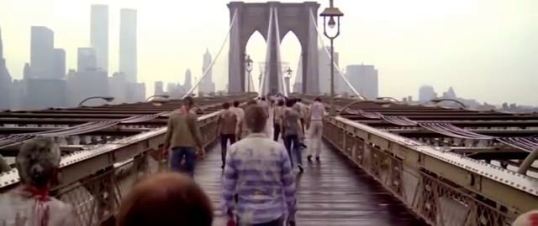
The scene below comes from the 1979 Lucio Fulci masterpiece, Zombi 2.
In this scene, a mysterious boat is floating towards New York City. Two cops are sent to check the boat out and, as they eventually discover, the boat isn’t quite as deserted as they thought it was.
Now, there’s a few reasons why this scene is important. Number one, Zombi 2 is an Italian film that was designed to pass for an American film. (Technically, it was sold as being a prequel to Dawn of the Dead, which was released under the title Zombi in much of Europe.) In order to maintain the illusion, Italian filmmakers would often spend a day or two shooting on location in a recognizable American city. More often than not, that city would turn out to be New York.
Number two, since Zombi 2 was promoted as being a bit of a prequel to Dawn of the Dead, one could argue that this scene shows how the whole zombie apocalypse began in the United States. It wasn’t radiation from space or Hell running out of room. No, instead, it was juts a boat floating from an island in the Caribbean all the way to New York.
This scene is also memorable because of the “boat zombie,” who is one of the best-known of the movie zombies. Even people who have never heard of Lucio Fulci will probably recognize the boat zombie. He’s an icon of the undead!
Finally, this scene sets up one of the greatest closing shots in the history of zombie cinema. New York beware!
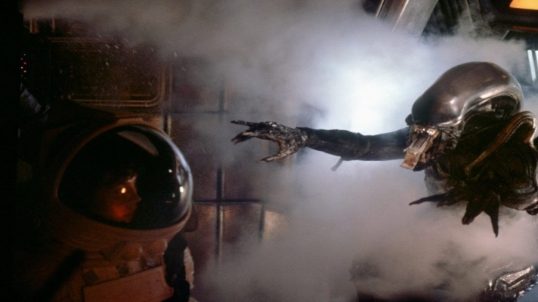
Don’t get too excited about that title. Yes, I know that it says Alien 2: On Earth, which would suggest that this is a sequel to the classic sci-fi horror film that we all know and love but …. well, we’ll get to it in a moment.
First, let’s talk about the movie….
HEY, EARTH! YOU’RE GETTING INVADED AGAIN!
This time, it’s not flying saucers. It’s not pod people. It’s not the monsters from Cloverfield or A Quiet Place or Battle Los Angeles or Skyline or any of those films. Instead, this time, you’re getting invaded by little blue rocks. These rocks may look pretty but, if you hold them long enough, something will spring out of them and cause your face to explode. Sometimes, the creature inside the rock will even hug onto your face for a while. I guess maybe you could call it a face hugger, assuming that you had enough money to settle the copyright suit that would follow….
Famed cave explorer Thelma Joyce (Belinda Mayne) has been having horrific visions, largely due to the fact that she’s psychic whenever it’s convenient for the plot. Could her visions have something to do with a spacecraft that has recently returned to Earth with all of its inhabitants missing? (The implication is that the spacecraft was captained by a man named Dallas and had a warrant officer named Ripley, though that’s never specifically stated.)
Oh, why worry about all that ominous outer space stuff? After all, Thelma and her husband Roy (Mark Bodin) have already got a full weekend planned out. They’re going to get together with a group of friends and explore a cave! It sounds like fun. Of course, on the way to the cave, one of their friends finds a blue rock and decides to take it with him. Hmmm….there’s no way that could backfire.
Once everyone’s in the cave, Thelma tells Roy that she has a feeling that something awful is about to happen. Roy laughs off her concerns. I mean, is Thelma supposed to be a psychic or something? Oh, wait a minute….
Can you guess what happens? If you think that Roy, Thelma, and their friends end up getting trapped in the cave with an alien that’s looking to dissolve all of their faces, you might be as much of a psychic as Thelma. Needless to say, everyone picked the wrong weekend to go underground.
This Italian production from 1980 is, in many ways, a typical low-budget exploitation film. There’s a lot of gore (including a pretty nifty beheading) and the film ends on a properly (and somewhat humorously) dark note but it takes forever for the movie to actually get going. Fans of Italian horror will be happy to see Michele Soavi show up as one of the cave explorers and, if nothing else, the film does feature an effective sequence involving a survivor running down the streets of an eerily deserted city.
That said, this film is best-remembered as an example of just how shameless that Italian film industry could be when it came to ripping off more successful films. Alien 2 had nothing to do with the original Alien but, because Ridley Scott’s film was a huge hit, the film was marketed as being a direct sequel. Because the word “alien” existed long before any of the movies using it as a title were ever released, 20th Century Fox’s efforts to sue producer/director Ciro Ippolito for copyright infringement were just as unsuccessful as Ippolito’s later attempt to sue the makers of The Descent for, in Ippolito’s opinion, ripping off his story of cave explorers getting ripped apart by a strange creature.
So, no, this is not technically a part of the Alien franchise …. unless you want it to be. That’s the fun thing about watching an unofficial sequel like this. You can decide for yourself whether or not to accept it.
Finally, keep watching the skies and don’t pick up any blue rocks! To quote the film’s final title card, “YOU MAY BE NEXT!”
4 Shots From 4 Films is just what it says it is, 4 shots from 4 of our favorite films. As opposed to the reviews and recaps that we usually post, 4 Shots From 4 Films lets the visuals do the talking!
This October, we’re using 4 Shots From 4 Films to look at some of the best years that horror has to offer!
Adapted from Stephen King novel, 1984’s Firestarter is a film about a girl with a very special power.
Back in the day, a bunch of college students needed weed money so they took part in a government experiment. Half of them were told that they were being given a placebo. The other half were told that we would be given a low-grade hallucinogen.
Surprise! The government lied! It turns out that everyone was given the experimental drug! Some of the students ended up going crazy. One unfortunate hippie clawed his eyes out. Meanwhile, Vicky (Heather Locklear) gained the ability to read minds. She also fell in love with Andy McGee (David Keith), a goofy fellow who gained the ability to mentally control people’s actions. They married and had a daughter named Charlie (played by a very young Drew Barrymore). Charlie, it turns out, can set things on fire! She’s a firestarter!
Well, of course, the government can’t just leave the McGees out there, controlling minds and setting things on fire. Soon, the McGees are being pursued by the standard collection of men in dark suits. Vicky is killed off-screen, leaving Charlie and Andy to try to find some place where they’ll be safe.
Good luck with that! This is the government that we’re talking about. The thing with films like this is that the government can do practically anything but it never occurs to them to not all dress in dark suits. I mean, it just seems like it would be easier for all of these secret agents to operate if they weren’t automatically identifiable as being secret agents. Anyway, Andy and Charlie are eventually captured and taken to The Farm, a really nice country estate where Andy and Charlie are kept separate from each other and everyone keeps talking about national security.
Running the Farm is Capt. Hollister and we know that he’s a bad guy because he wears a suit and he’s played by Martin Sheen. Working with Hollister is John Rainbird (George C. Scott), a CIA assassin who kills people with a karate chop across the nose. When Charlie refuses to show off her firemaking abilities unless she’s allowed to talk to her father, Rainbird disguises himself as a custodial engineer and proceeds to befriend Charlie. Of course, Rainbird’s plan is to kill Charlie once she’s displayed the extent of her powers….
Stephen King has written that he considers this film to be one of the worst adaptations of one of his novels but, to be honest, I think the movie is actually a bit of an improvement on the source material. Firestarter is probably the least interesting of Stephen King’s early novels. Supposedly, Charlie was based on King’s youngest daughter and, reading the book, it’s obvious that everyone’s fear of Charlie is mostly a metaphor for a father trying to figure out how to raise a daughter. Unfortunately, instead of concentrating on those primal fears, the book gets bogged down in boomer paranoia about MK-ULTRA experiments.
The movie, however, is just silly enough to be kind of charming. For example, consider the way that Andy grabs his forehead and bugs out his eyes whenever he uses his powers. Andy’s powers may be slowly killing him but he just looks so goofy whenever he uses them that you just can’t help but be entertained. And then you’ve got Drew Barrymore sobbing while setting people on fire and George C. Scott growling through all of his dialogue and even Martin Sheen gets a scene where he gets excited and starts jumping up and down. (And don’t even get me started on Art Carney and Louise Fletcher as the salt-of-the-Earth farmers who try to protect Andy and Charlie….) Some of the special effects are a bit hokey, as you might expect from a film made in 1984 but occasionally, there’s a good shot of something (or someone) burning up. It’s all so over-the-top and relentlessly dumb that you can’t help but be entertained. You can even forgive the fact that basically nothing happens between the first 10 and the last 15 minutes of the movie.