Scenes I Love: Tom Cruise and Val Kilmer Play Beach Volleyball in Top Gun


Tom Cruise is 60 years old today!  He doesn’t look a day over 36.  Insert your own Dorian Gray joke here.

No matter what else you may want to say about Tom Cruise, you can’t deny that he’s one of the last of the genuine movie stars.  He’s been a star in since the 80s, doing things onscreen that you could never imagine some of our younger actors even attempting.  And right now, Top Gun: Maverick appears to be unstoppable with audiences and critics.  There are many reasons for Maverick‘s popularity but one cannot deny that a lot of it is the fact that Cruise just has that old-fashioned movie star charisma.

Today’s scene that I love comes from the first Top Gun.  In this scene, Tom Cruise, Anthony Edwards, Val Kilmer, and Rick Rossovich play beach volleyball.  The scene kind of comes out of nowhere and there are times when the whole thing comes close to self-parody.  (Actually, if we’re going to be honest, it crosses the line into self-parody more than a few times.)  But, Cruise and Kilmer manage to save it, like the movie stars they are!

Film Review: The Princess (dir by Le-Van Kiet)


An unnamed Princess (Joey King) has been taken prisoner by the evil Julius (Dominic Cooper).  Julius wants to take control of the kingdom and the best way to do that is to force the Princess to marry him.  The morning of what is planned to be her forced wedding, the Princess wakes up handcuffed and trapped in one of those huge towers that always seem to turn up in movies like this.  The Princess takes one look out the window and is confronted by some cartoonish CGI that lets the viewer know that she’s really up high.

Fortunately, this Princess has spent most of her life training to be a warrior.  Under the tutelage of Linh (Veronica Ngo) and Khai (Kristofer Kamiyasu), the Princess has learned how to fight and defeat almost any enemy.  (“Fight from you heart,” Linh tells her.)  As such, the Princess has no fear of breaking her wrist so that she can remove the handcuffs.  Soon, she is running through the tower, fighting every man that she comes across.

The first few fight scenes are cool and I appreciated the scene where the Princess shot a man with a crossbow just as he started to yell the C-word because, seriously, you boys have been going overboard with that word lately.  Ultimately, though, there’s so many fight scenes that eventually, the viewer can’t help but notice that the fight choreography itself is rather simplistic.  The Princess spends a lot of time jumping and spinning around in slow motion.  She’s good at sliding across the floor while ducking her head to avoid swinging swords and flying arrows.  It’s enjoyable the first few times but, as the film progresses, it all gets a bit repetitive.  A huge part of the problem is that none of Julius’s henchmen appear to be particularly competent.  They keep making the same stupid mistakes over and over again and, as such, it’s not really empowering to watch The Princess defeat them because they’re all so clumsy that it seems anyone could defeat them.  Even Julius commits the cardinal sin of talking when he should be fighting.  A great hero needs a great villain and unfortunately, The Princess doesn’t provide that.  Still, the fight scenes are preferable to any scene that involves dialogue as the script sometimes seems to have been written by an AI programmed to include every cliché possible.  On the one hand, the Princess is smashing the patriarchy.  On the other hand, good intentions do not make up for clunky dialogue.

To be honest, there’s a certain cynicism at the heart of The Princess that’s a bit off-putting.  Written by two men and directed by another, The Princess is so proud of itself for featuring a young woman kicking ass that one has to wonder if the people responsible are seriously not aware that the action girl is one of the leading pop culture clichés of the past 20 years.  The main complaint about the action girl trope is that the character is often not given any personality or motivation beyond the fact that she can beat people up and look good while doing it.  The Princess doesn’t even bother to give its main character a name.  For all the talk about the fate of the kingdom, we never learn how the Princess feels about any of it.

As for the cast, neither Joey King nor Dominic Cooper are well-served by a script that doesn’t offer any sort of real depth to the characters.  Both deserve better.

Film Review: Strategic Command (dir by Rick Jacobson)


In the 1997 film, Strategic Command, Richard Norton plays a terrorist named Carlos …. wait for it …. Gruber.  If that last name sounds familiar, that’s because the villain of Die Hard was named Hans Gruber and the bad guy from Die Hard With A Vengeance was named Simon Gruber.  Gruber — the number one name in hostage situations!

Anyway, Carlos Gruber and his fellow terrorists steal a chemical called Bromax from the FBI.  Bromax is a chemical weapon, one that can be used to kill thousands of people.  It’s probably not a good idea for anyone to have Bromax, regardless of whether they are terrorists or the FBI.  What’s the point of Bromax, really?  It only has evil purposes.  Plus, it has a stupid name.

Gruber proceeds to hijack Air Force Two, holding the Vice President (Michael Cavanaugh) and several journalists hostage.  Gruber wants his fellow terrorists to be released from prison and he’s prepared to kill the Vice President if he doesn’t get what he wants.  Perhaps because Gruber realizes how little the Vice President actually does, Gruber is also willing to spray Bromax over America.

Not wanting to see America get Bromaxed, the President sends an elite force of special op. soldiers after Air Force Two.  Captain Rattner (Jsu Garcia, back when he was still using the name Nick Corri) is in charge of the mission and he doesn’t expect there to be any slip-ups.  Accompanying Rattner’s men is Rick Harding (Michael Dudikoff!), the inventor of Bromax!  Along with not wanting to see Bromax sprayed over America, Harding also wants to save the life of his wife, Michelle (Amanda Wyss, who co-starred with Jsu Garcia in the original Nightmare on Elm Street).  Michelle is one of the journalists on the plane.

Strategic Command is stupid, yet strangely likable.  It’s impossible not to admire the film’s attempt to be a huge action epic without actually spending any money.  As a result, Air Force 2 is a commercial airliner.  There’s a surprisingly small number of people involved on both sides of the plot.  The viewer might expect the hostage situation to be one of those big, “all hands on deck” emergencies but, instead, the President is content to send 6 people to get the job done.  Fortunately, there aren’t that many terrorists either.  This is action on a budget.

Adding to the film’s overall strangeness is the miscasting of Michael Dudikoff as a quiet and somewhat nerdy scientist.  This is one of those films where the viewer is meant to assume that a character is smart just because he’s wearing glasses.  Dudikoff is so miscast that, again, it all becomes strangely likable.  He and Richard Norton are so enthusiastic about chewing up the scenery that it’s kind of fun to watch.  Also fun to watch is the legitimate great actor Bryan Cranston, cast here as a vain and cowardly anchorman.  One gets the feeling that this is probably not a film that Cranston brags about but his performance isn’t bad at all.  Every film like this needs to have a self-important reporter who can get humiliated in some fashion and Cranston handles the role like a pro.

Strategic Command is dumb but kind of fun, in the way that many 90s direct-to-video action films tend to be.  It’s a good film for when you want to watch something that won’t necessarily require your full attention.  In fact, the less thought one gives to what happens in Strategic Command, the better.  Watch it for Dudikoff, Norton, and especially the one and only Bryan Cranston!

4 Shots From 4 Films: Special Sydney Pollack Edition


4 Or More Shots From 4 Or More Films is just what it says it is, 4 shots from 4 of our favorite films. As opposed to the reviews and recaps that we usually post, 4 Shots From 4 Films lets the visuals do the talking!

87 years ago today, Sydney Pollack was born in Indiana.  Though Pollack got his start as an actor, he soon moved into directing and was one of the key television directors of the 1960s.  He eventually branched out into film, making a name for himself as a director of intelligent and sensitive comedies and dramas.  Though he only directed 21 films over the course of his career, his films received a total of 48 Oscar nominations and 11 wins.  1982’s Tootsie and 1985’s Out of Africa were both nominated for Best Picture.  Out of Africa won.

Pollack also returned to acting in the 90s, making a name for himself as a skilled character actor.  I’ll always remember him from Eyes Wide Shut, interrogating Tom Cruise while playing pool.

When he passed away in 2008, Pollack was remembered as one of the best directors of Hollywood’s second golden age.

In honor of Sydney Pollack, here are….

4 Shots From 4 Sydney Pollack Films

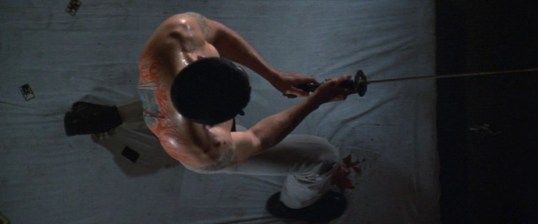
Jeremiah Johnson (1972, dir by Sydney Pollack, DP: Duke Callaghan)

The Yakuza (1974, dir by Sydney Pollack, DP: Duke Callaghan and Kozo Okazaki)

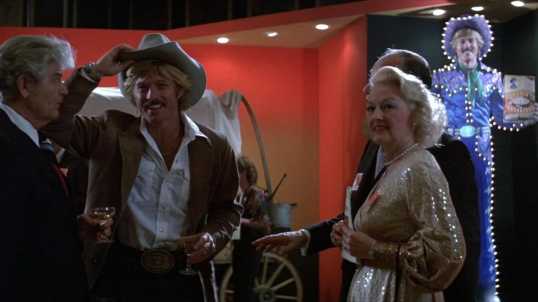
The Electric Horseman (1979, dir by Sydney Pollack, DP: Owen Roizman)

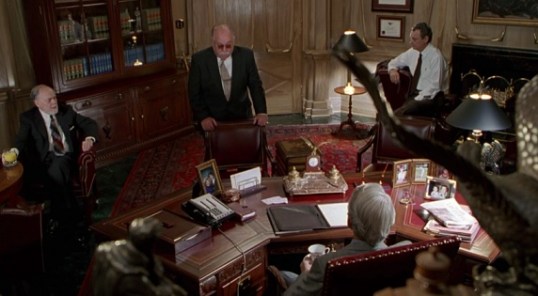
The Firm (1993, dir by Sydney Pollack, DP: John Seale)

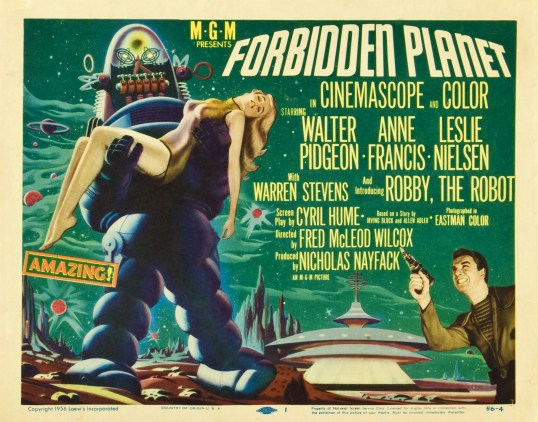
Scenes I Love: Robby the Robot Makes His Debut in Forbidden Planet


According to the imdb, today is Robby the Robot’s birthday.  I didn’t know that robot’s had birthdays but apparently, they do.  Robby is 67 years old and I think that, along with Earl Holliman, he might be one of the last two surviving cast member of the 1956 sci-fi classic, Forbidden Planet.

So, it only seems appropriate that today’s scene that I love should be Robby the Robot’s debut appearance in Forbidden Planet.  Happy birthday, Robby!

8 Shots From 8 Films: Special Robert Evans Edition


4 Or More Shots From 4 Or More Films is just what it says it is, 4 shots from 4 of our favorite films. As opposed to the reviews and recaps that we usually post, 4 Shots From 4 Films lets the visuals do the talking!

92 years ago today, Robert Evans was born in New York City.  He started out working in his brother’s clothing business but a chance meeting with actress Norma Shearer led to him becoming an actor.  And while Evans, by his own account, was not a particularly good actor, he did prove himself to be very skilled at playing the games of Hollywood.  Evans eventually moved from acting to production, first as an executive at Paramount and then as an independent producer.

He lived a life as glamorous and tumultuous as the stars of his pictures and his memoir, The Kid Stays In The Picture, is considered to be one of the classic show biz autobiographies.  He hung out with cinematic rebels like Jack Nicholson and Robert Towne and counted Secretary of State Henry Kissinger as a friend.  He suggested that Francis Ford Coppola should direct The Godfather and, when Paramount put pressure on Coppola to cut the film down to two hours, it was Evans who famously announced that a two-hour Godfather was nothing more than a trailer.  He lost Ali MacGraw to Steve McQueen and, again by own account, he lost a lot of potentially productive years to cocaine.  (The Cotton Club scandal is one of the wildest in the history of Hollywood, though it should be noted that Evans himself was never charged with any wrongdoing.)  But, for all that he lost, Evans continues to gain admirers as being the epitome of the producer who was willing to take chances.  For all of his flamboyance, Evans had an eye for good material and the willingness to protect his directors.  In many ways, he was as important to the cinematic revolution of the 70s as the directors that he hired.  When Evans passed away in 2019, it was truly the end of an era.

Here, in honor of the birth and legacy of Robert Evans, are 8 Shots from 8 Films that Evans produced, either as studio chief at Paramount or as an independent producer.

8 Shots From 8 Robert Evans Films

Rosemary’s Baby (1968, dir by Romnn Polanski, DP: William A. Fraker)

Love Story (1970, dir by Arthur Hiller, DP: Richard Kratina)

The Godfather (1972, dir by Francis Ford Coppola, Cinematography by Gordon Willis)

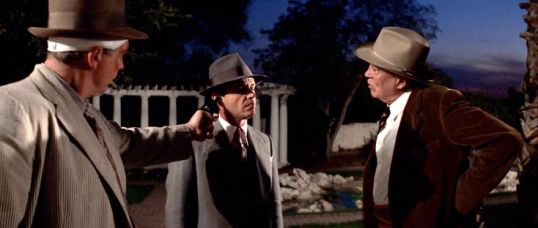
Chinatown (1974, dir by Roman Polanski, DP: John A. Alonzo)

Marathon Man (1976, dir by John Schlesinger, DP: Conrad Hall)

The Cotton Club (1984, dir by Francis Ford Coppola, DP: Stephen Goldblatt)

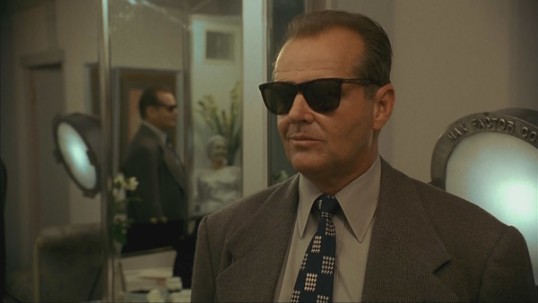
The Two Jakes (1990, dir by Jack Nicholson, DP: Vilmos Zsigmond)

Sliver (1993, dir by Phillip Noyce, DP: Vilmos Zsigmond)

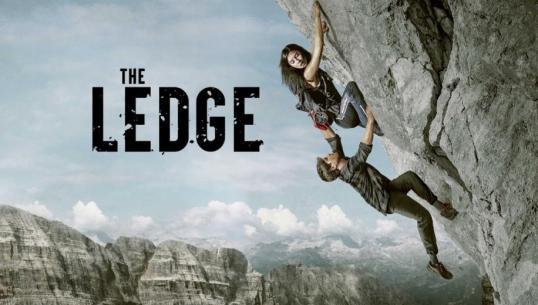
Film Review: The Ledge (dir by Howard J. Ford)


One year ago, Kelly (Brittany Ashworth) and her boyfriend, Luca (Talha Senturk), were climbing a mountain in Italy.  It was a great experience, until Luca put his foot on the wrong part of the mountain and promptly plunged to his death.

Now, on the anniversary of Luca’s fatal fall, Kelly and her friend Sophie (Anias Parello) are planning on climbing the mountain in his memory.  However, the night before their scheduled climb, they meet four friends.  Josh (Ben Lamb), Zach (Louis Boyer), Taylor (David Wayman), and Reynolds (Nathan Welsh) have known each other since they were kids.  They grew up together.  They went to high school and college together.  Now, they still go on weekend trips together, hoping to hold onto some remnant of their disappearing youth.  They’re a tightly-knit group, even though Zach, Taylor, and Reynolds seem to be a bit weary of Josh.

Josh invites Kelly and Sophie to hang out with the group.  Kelly, who is still mourning Luca, quickly grows disgusted with Josh’s overbearing and toxic personality.  Leaving Sophie behind, Kelly returns to her cabin to get some sleep.  When Sophie doesn’t return to the cabin, Kelly steps outside to look for her and discovers and films the four men tossing Sophie over the edge of a cliff.

With the men now pursuing her, Kelly has no choice but to climb the mountain from which Luca previously fell.  The men chase after her, reaching the top of the mountain before her and leaving Kelly trapped between the rocks below and Josh above.  Josh says that he just wants the camera but Kelly knows that there’s no way Josh is going to let her escape the mountain alive.

There’s a slightly interesting idea at the heart of The Ledge.  While Josh is, from the start, an obvious sociopath, the other three men are portrayed with a bit more ambiguity.  All three of them know that Josh is dangerous and, when Josh initially kills Sophie, all three of them initially resist his demands that they help him cover up what has happened.  In the end, though, all three of them set aside their qualms and literally get blood on their hands.  Taking as individuals, Taylor, Zach, and Reynolds are all level-headed and even likable but none of them are willing to stand up to Josh and, when they get together as a group, only Reynolds is the only one to weakly protest their actions.  Even though Zach, Taylor, and Reynolds are not as vicious as Josh, they all became complicit in his actions when they decided that their loyalty to the group was more important than doing the right thing.  As such, it doesn’t matter that Zach has a family or that Taylor initially tried to calm Josh down.  It doesn’t even matter that the guilt-stricken Reynolds, at one point, allows Kelly to run past him rather than attempt to capture her.  For all of the guilt that they feel as a result of their actions, Taylor, Zach, and Reynolds are all complicit because none of them were willing to do the right thing from the start.  The fact that they don’t do more to stop Josh make them just as guilty as he is.

As I said, it’s an interesting idea but the film doesn’t really do much with it.  Indeed, once Kelly starts to climb that mountain, the narrative gets bogged down with flashbacks to her relationship with Luca and scenes of Josh shouting insults at her while she climbs.  The film features some striking shots  and Brittany Ashworth is a likable lead but the narrative momentum stalls out early.  It turns out that there’s only so much time you can spend watching one person climb and one person yell until your attention starts to wander elsewhere.  Much like Luka, The Ledge gets off to a promising enough start but then loses its grip and falls back to Earth.
The TSL’s Grindhouse: World Gone Wild (dir by Lee H. Katzin)


“World Gone Wild!?  What’s that about?”

Don’t ask me.  I just watched the movie and I’m not particularly sure what the point of it all was.  Released in 1987, World Gone Wild is one of those films that was made to capitalize on the post-apocalypse boom of the 70s and 80s.  Basically, imagine a Mad Max film that sucks and you’ll have a pretty good idea of what World Gone Wild is like.

There’s been a nuclear war.  Civilization has collapsed and now, there are just tiny outposts of humanity who are trying to survive.  It hasn’t rained in decades.  Old-timer Ethan (Bruce Dern) is in charge of a town called Lost Wells.  He remembers what rain was like and he also remembers what rock music used to sound like, too.  As for Lost Wells, it’s one of those dreary little desert communities that always tend to pop up in movies like this.  Angie (Catherine Mary Stewart) teaches the community’s children in an abandoned school bus.  They have a bunch of books on etiquette.  One little girl can recite every word ever written by Emily Post.  That gets annoying fast.  Emily Post didn’t live on a school bus in the desert.

That etiquette doesn’t do much good when it comes to protecting Lost Wells from Derek Abernathy (Adam Ant), a cult leader who dresses in all-white and who wants to take control of Lost Wells away from Ethan.  (In a somewhat clever twist, it turns out that Ethan learned how to become a cult leader by reading a book about Charles Manson.)  Knowing that the majority of the people in his town are too obsessed with Emily Post to fight off Derek and his army, Ethan recruits a group of mercenaries led by George Landon ( who is played by Michael Pare, who looks like he was absolutely miserable while shooting this movie).  George and his men agree to protect Lost Wells from Derek and, in the process, they regain some of their lost humanity and they start to believe in the possibility of rain.  Or something like that.  Fortunately, one of George’s mercenaries is played by the supercool character actor Anthony James.  He doesn’t get to do much but hey, it’s still Anthony James and Bruce Dern in the same movie!  Yay!

For a film called World Gone Wild, this is a strangely low-key affair.  Even the most unimpressive of Mad Max rip-offs will usually have an exciting car chase or two.  At the very least, there’s usually a big battle where people sacrifice their lives for the future of humanity.  In World Gone Wild, the mercenaries pretty much just go to Lost Wells and then wait for Derek to come back.  And when Derek returns, there’s a few explosions and some gunfire but that’s pretty much it.  Neither side really puts up much of a fight, which leads me to wonder if Derek really even cared about Lost Wells.

On the plus side, the film has got Bruce Dern, doing his wild-eyed old-timer bit.  That’s always fun to watch and, if nothing else, Dern appears to be having fun in this movie.  At the very least, he’s having more fun that Michael Pare and Catherine Mary Stewart, both of whom seem to spend the majority of the movie looking for a way to make a quick escape.  And I suppose the film does win some novelty points for casting Adam Ant as the main villain, even though Derek ultimately turns out to be not much of a threat.

In the end, World Gone Wild‘s greatest strength is Bruce Dern.  He’ll make you believe in the rain again.