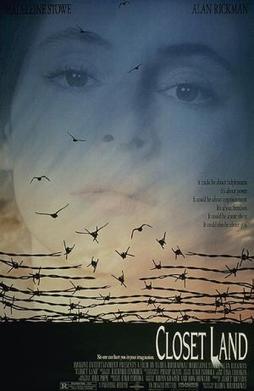
 It has been nearly two years since the death of Alan Rickman and it is a loss that film lovers are still feeling today. When Rickman was with us, it was easy to take him for granted. It was only after his death that many started to look at the films he made, both the good ones and the bad ones, and realizing just how much Rickman brought to every role he played.
Take Closet Land, for instance. This was made early in Rickman’s film career. It is a very theatrical film, all taking place on one set and featuring only two major roles. Madeleine Stowe plays the Victim, a writer of children’s books whose latest autobiographical work deals with a girl who uses her imagination to escape from unhappiness. Alan Rickman plays the Interrogator, a government functionary who demands that the Victim confess to hiding anti-government propaganda in her books. When the Victim refuses to sign the confession, the Interrogator continually switches techniques in his attempt to break her, trying everything from physically torturing her to blindfolding her and pretending to be other people to even claiming that he abused her when she was younger.
There are many problems with Closet Land but Alan Rickman’s performance is not one of them. Rickman is hypnotically malevolent as the otherwise cultured Interrogator and the most fascinating part of the movie is watching him switch back and forth from being a harried bureaucrat just doing his job and a manipulative sociopath who views the Victim’s sanity as a trophy for him to claim. Closet Land is too stagey and heavy-handed to be effective but Rickman’s performance reminds us of what a great actor we lost when we lost Alan Rickman.
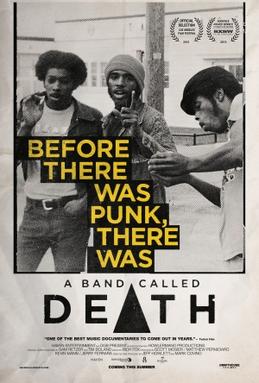 A band called Death was one of the best bands that most people have never heard of. Formed in the early 70s by three brothers in Detroit, Death produced some of the most incendiary music ever recorded. They played fast and they played loud. They were punk before punk even existed. At a time when most black musicians were defined by the smooth Motown style, Death created their own unique sound. Led by a visionary named David Hackney, Death were trailblazers and, as so often happens with trailblazers, they would not receive the recognition that they deserved until several years after Death performed for the last time.
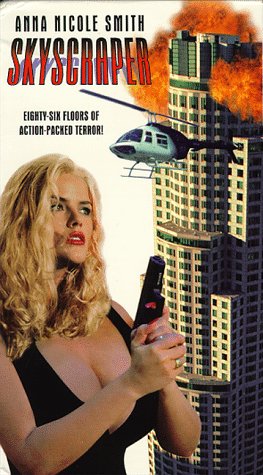 If you want to see a movie about somone trapped in a skyscraper and battling terrorists, the obvious solution is to watch Die Hard. After all, it’s always a good time to watch Die Hard.
 Someone is murdering models and trying to frame Larry Roberts (Albert Finney), a plastic surgeon. Larry suspects that the actual murderer is somehow involved with the Digital Matrix research firm, a shadowy organization that is headed by James Coburn and Leigh Taylor Young. Digital Matrix has developed a new technique where they digitally scan a model’s body and then generate a 3-D duplicate that can be used in commercials and on film. The real-life models stand to make a fortune from the royalties, assuming that they are physically perfect and they do not end up getting murdered immediately after being scanned. Larry’s girlfriend, Cindy (Susan Dey), is just the latest model to have been scanned and now Larry suspects that she might be targeted for death as well.
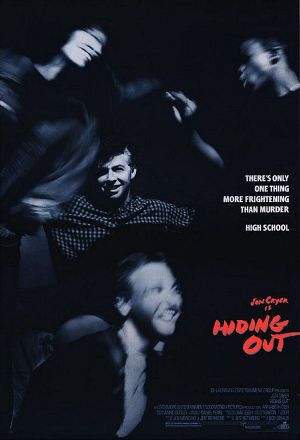 Andrew Morenski (Jon Cryer) is a stockbroker in the 1980s. What could be better than handling large amount of money during the decade of excess, right? The only problem is that Andrew and two of his colleagues have gotten involved with Mafia. And now, the Mafia wants them all dead. On the run from both the FBI and the Mob, Andrew tries to change his appearance. He shaves off his beard. He gives himself a bad dye job. No sooner has Andrew traded clothes with a homeless person than he is mistaken for a high school student.
 When high school student Dan Bartlett (John Cusack) is late arriving at the airport, he finds himself watching as the plane taking his girlfriend (Wendy Gazelle) and her parents (Monte Markham and Shelley Fabares) to the Caribbean takes off without him. Dan catches the next available flight and tries to track down his girlfriend and her family. Helping him out is a Ganja-smoking islander (Keith David) and a crusty sea captain (Robert Loggia). Complicating matters is that Dan’s girlfriend has been kidnapped by pirates (Jerry Stiller and his son, Ben)!
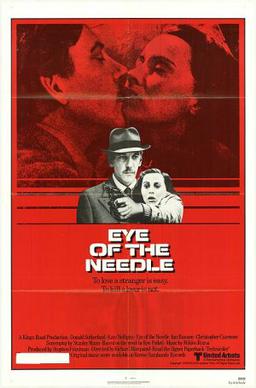 The time is World War II, shortly before D-Day. Lucy Rose (Kate Nelligan) lives on an isolated island with her crippled husband, David (Christopher Cazenove), their young son, and a sheep herder named Tom (Alex McCrindle). Embittered by the accident that left him in a wheelchair, David is abusively violent and emotionally shut off. One night, during a sudden storm, a man who says his name is Henry Faber (Donald Sutherland) turns up on the island. Henry claims that the storm caught him by surprise and left him stranded. David doesn’t trust him and it turns out that, for once, David is right. Faber is actually a semi-legendary German spy, code-named The Needle because his preferred instrument of murder is a stiletto. Faber has discovered the plans for the Allied Invasion of Normandy. He’s only on the island because he is waiting for a German u-boat to arrive and take him back to Berlin. Complicating matters is that a romance has developed between Faber and Lucy.
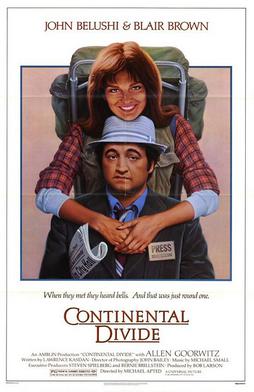 Ernie Souchak (John Belushi) is a reporter in Chicago. He specializes in stories about municipal corruption and Mafia power plays. Needless to say, living in Chicago, that keeps him busy. Literally everyone in the city knows him. Even the two muggers who try to steal his wallet recognize him and share inside information about which street gang is about to make a big move. From a modern day vantage point, it seems strange to see everyone so excited about meeting a newspaper columnist but this movie was made in 1981, long before an army of bloggers put journalists like Ernie Souchak out of business.
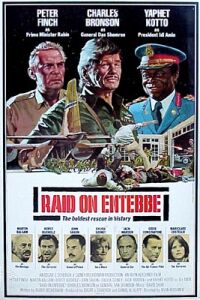 On June 27th, 1976, four terrorists hijacked an Air France flight and diverted it to Entebbe Airport in Uganda. With the blessing of dictator Idi Amin and with the help of a deployment of Ugandan soldiers, the terrorists held all of the Israeli passengers hostage while allowing the non-Jewish passengers to leave. The terrorists issued the usual set of demands. The Israelis responded with Operation Thunderbolt, a daring July 4th raid on the airport that led to death of all the terrorists and the rescue of the hostages. Three hostages were killed in the firefight and a fourth — Dora Bloch — was subsequently murdered in a Ugandan hospital by Idi Amin’s secret police. Only one commando — Yonatan Netanyahu — was lost during the raid. His younger brother, Benjamin, would later become Prime Minister of Israel.
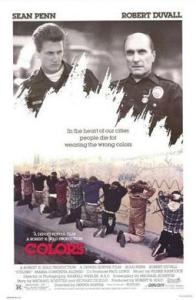 Los Angeles in the 80s. Beneath the California glamour that the rest of America thinks about when they think about L.A., a war is brewing. Bloods vs Crips vs the 21st Street Gang. For those living in the poorest sections of the city, gangs provide everything that mainstream society refuses to provide: money, a chance to belong, a chance to advance. The only drawback is that you’ll probably die before you turn thirty. Two cops — veteran Hodges (Robert Duvall) and rookie McGavin (Sean Penn) — spend their days patrolling a potential war zone. Hodges tries to maintain the peace, encouraging the gangs to stay in their own territory and treat each other with respect. McGavin is aggressive and cocky, the type of cop who seems to be destined to end up on the evening news. With only a year to go before his retirement, Hodges tries to teach McGavin how to be a better cop while the gangs continue to target and kill each other. The cycle continues.
 Through the Shattered Lens