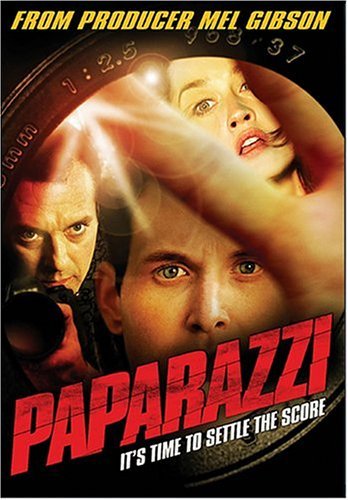
Guilty Pleasure No. 8: Paparazzi


259791_ori

I once got into an argument with a friend of mine about whether or not a film could actually be so bad that it was good.

His argument was that bad, by its very definition, was the opposite of good and therefore, nothing bad could be good and vice versa.

My argument was Paparazzi.

First released back in 2004, Paparazzi tells the story of Bo Laramie (Cole Hauser).  Bo is an up-and-coming super star.  As the film begins, we’re told — by a breathless correspondent from E! News — that Bo has arrived.  He’s starring in what promises to be “the world’s biggest action franchise.”  Bo has a wife (Robin Tunney), a son, and a beautiful house on the beach.  Whenever he goes jogging, huge groups of women magically materialize so that they can giggle as he runs by.

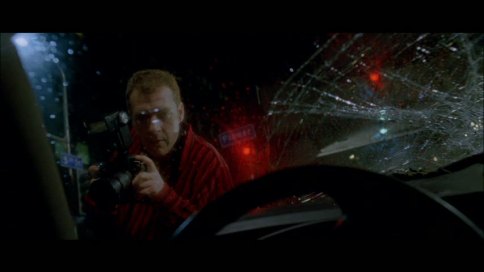
However, not everything is perfect in the world of Bo Laramie.  Like far too many defenseless celebrities, he’s being harassed by the paparazzi.  At first, Bo attempts to be polite.  However, a demonic photographer named Rex (Tom Sizemore) refuses to stop trying to take pictures of Bo at his son’s soccer game.  Things escalate until eventually, Bo’s son is in a coma and Bo is coming up with ludicrously elaborate ways to kill all of Rex’s colleagues.

The thing that distinguishes Paparazzi is not that it’s a revenge film.  What distinguishes Paparazzi is that it seems to seriously be arguing that celebrities have the right to kill people who annoy them.  Rex and his colleagues are portrayed as being pure evil (one even laughs maniacally after snapping a picture) while Bo is the victim who has to deal with the issues that come from being a multimillionaire.  Even the homicide detective played by Dennis Farina seems to be continually on the verge of saying, “Right on!” while looking over the results of Bo’s handiwork.

It’s so ludicrous and stupid and over-the-top that it can’t help but also be a lot of fun.

Don’t get me wrong.  Paparazzi is a terrible film.  In fact, it’s so terrible that, if a group of aliens ever somehow saw Paparazzi, they would probably hop in their spaceship and come to Earth specifically to wipe out the human race.  However, as bad as the film is, it’s also one of those films that you simply cannot look away from.  Watching this film is like witnessing a tornado of pure mediocrity coming straight at you.  You know that you should just stop watching and get to safety but it’s such an unexpectedly odd sight that you can’t look away.  Once you’ve seen it, you’ll never forget it and it becomes impossible not to become fascinated by the fact that such a terrible film could actually exist.

Consider the following:

1) When he’s not busy killing photographers, Bo Laramie is filming a movie called Adrenaline Force 2.  Seriously, that title is so generic that I couldn’t help but smile every time it was mentioned.  Can you imagine anyone saying, “I want to see that new movie, what’s it called, uhmm… Adrenaline Force 2?”

2) Speaking of generic, do you think that anyone named Bo Laramie could ever possibly become the biggest film star in the world?

3) In the role of Bo Laramie, Cole Hauser seems like he’s as confused by this movie as everyone else.  However, towards the end of the film, he starts to flash a psychotic little grin and the contrast between that grin and Laramie’s previously stoic facade is oddly charming.
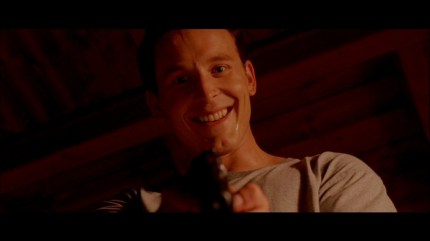
Hauser-in-Paparazzi-cole-hauser-12392470-853-480

4) You haven’t lived until you’ve seen Tom Sizemore play the world’s sleaziest photographer.

5) Vince Vaughn has a cameo as himself!  He’s co-starring in Adrenaline Force 2.

6) Mel Gibson has a cameo as himself!  He’s seen sitting in a psychologist’s office.  (No, seriously…)

7) Matthew McConaughey has a cameo as himself!  He shows up out-of-nowhere, tells Bo that it’s a pleasure to meet him, and then goes, “Alright, alright…”

8) Chris Rock has a cameo as a …. pizza deliveryman!  At first, I assumed that Chris Rock was playing himself and I kept waiting for him to explain why he was delivering a pizza to Bo Laramie’s house.  However, according to the end credits, Vaughn, McConaughey, and Gibson were playing themselves while Rock was playing the role of “Pizza Guy.”

9) Plotwise, this film invites the viewer to play a game of, “What if everyone in this film wasn’t a total and complete idiot?”  For all the effort that Bo puts into plotting his revenge, it’s hard not to feel that he just got extremely lucky.

10) The film manages to be both silly and completely humorless at the same time.  As a result, it’s a good for more than a few laughs.

11) There’s a scene where, out of nowhere, Bo recites an inner monologue about the price of fame that will remind observant viewers of Tony Bennett’s classic narration from The Oscar.

12) At one point, Tom Sizemore says, “I am going to destroy your life and eat your soul. And I can’t wait to do it.”

13) The film’s director used to be Mel Gibson’s hairdresser.

14) Finally, the film was produced by Mel Gibson and that probably means that the film actually is making a sincere case for murdering members of the paparazzi.

If ever a film has deserved the description of being so bad that it’s good, it is Paparazzi.  Between the sense of entitlement, the feverish fantasies of revenge, and the out-of-nowhere celebrity cameos, Paparazzi is a film that has earned the title of guilty pleasure.
Tom-in-Paparazzi-tom-sizemore-26901287-853-480

Previous Guilty Pleasures:

  1. Half-Baked
  2. Save The Last Dance
  3. Every Rose Has Its Thorns
  4. The Jeremy Kyle Show
  5. Invasion USA
  6. The Golden Child
  7. Final Destination 2

Lisa Marie Talks About The Beaver (dir. by Jodie Foster)


So, there’s this thing in Hollywood that they call the Black List.  The Black List comes out at the end of each year and basically, it’s a list of the “best” unproduced screenplays of the year.  The reason I put best in quotation marks is because the list is 1) determined by studio people and studio asskissers and we all know that those people are toadsuckers, 2) film is not a writer’s medium so the best screenplay in the world can still be ruined if the wrong director gets involved with it, and 3) the films made from the scripts on the blacklist always seem to end up sucking like I did during my sophomore year of high school.  Seriously, that was a lot of sucking.

The Beaver (written by Kyle Killen) was at the top of the Black List in 2008 and now, 3 years later, it’s finally been made by Jodie Foster and released to mixed reviews and indifferent box office.  I saw The Beaver on Saturday.  So does, the Beaver continue the tradition of disappointing movies being produced from Hollywood’s “best” screenplays?  Well, yes and no.  The final 20 minutes of the Beaver are incredibly effective and almost moving.  Unfortunately, they’re not effective enough to make up for the wildly uneven 90 minutes that come before.

One thing that films that top the Black List tend to have in common is that they almost always try to tell a very traditional, rather obvious story by using some quirky gimmick that becomes less and less clever the more you think about it.  The Beaver continues that tradition.  Mel Gibson plays a guy named Jerry who runs a toy company and who has become clinically depressed.  After a unsuccessful attempt to commit suicide, he comes up with a novel solution to deal with his inability to communicate his feelings.  He starts to walk around with a beaver hand puppet and whenever he has to talk to his estranged wife (Jodie Foster) or his angry son (Anton Yelchin), he does so through the puppet.  And, as long as he has that beaver puppet, he has the strength to be a good husband and a good father.  At first, Foster is happy — if confused — but soon she finds herself growing frustrated with always having to talk to the Beaver as opposed to speaking to her husband.  However, Gibson has now grown so dependent on the Beaver that he can’t give it up, even though the Beaver has now started to insult Gibson whenever there’s no one else around.

Eventually, this leads Gibson to doing something very shocking and quite disturbing and it’s once that happens that The Beaver actually starts to work as a film.  Unfortunately, by that point, there’s only 20 minutes left in the film and we’ve had to sit through a whole lot of subplots, none of which seem to belong in the same movie. 

On the one hand, we have Gibson reviving his company by launching a toy line based on the Beaver.  These scenes are probably the weakest in the film.  Gibson shows up at work and tells everyone that the Beaver hand puppet is in charge and nobody quits.  Apparently, nobody calls up the tabloids to tell them that CEO of a major toy company has apparently had a nervous breakdown.  Instead, work goes on as normal.  Every time I saw Gibson’s character sitting in his office with that hand puppet, I wondered, “Does this company not have shareholders?”

Meanwhile, Yelchin is dealing with the beginning stages of the same clinical depression that has crippled Gibson and (its implied) led to his grandfather killing himself years earlier.  A high school senior, Yelchin has a lucrative career writing other students papers for them.  He’s hired by Jennifer Lawrence who asks him to write her graduation speech.  It also turns out that Lawrence is not only a popular cheerleader who is graduating at the top of her class but she’s also a graffiti artist as well who has a convenient family tragedy that she needs help getting through.  Now, that’s not as impossible as it may sound because my sister Erin’s a truly talented artist who was also a cheerleader  in high school but that doesn’t change the fact that Lawrence’s character still basically came across as just being a typical male fantasy, the nurturing madonna figure who only exists to justify and/or excuse the behavior of an obviously autobiographical male figure.  Still, Lawrence and Yelchin’s subplot is probably the most compelling part of the movie. 

As you can probably guess, the main problem with the movie is that it’s essentially about a guy walking around with a Beaver puppet.  Neither Kellen’s screenplay nor Foster’s direction seems to be sure just how seriously we should take that beaver and as a result, it just comes across as being a really cutesy idea that never really works as well as the movie seems to think that it does.  As well, it’s hard to take anything seriously once the word Beaver is introduced into the conversation.  For instance, as we watched Gibson bonding with his employees, my friend Jeff suggested that all Gibson needed to do in order to feel better about his life was to “stick his hand up a beaver and move his fingers.”  However, I have to admit that the worst beaver joke was made by me and it happened about halfway through the film when we see Gibson and Foster having sex, with Gibson keeping that beaver on his hand.  After they finish, Foster turns her back to him and Gibson caresses her face with — yes, you guess it — the beaver.  “I bet that’s not the first time she’s had a beaver in her face,” I said.  All of this could have been avoided if the film just hadn’t been made in the first place.

Still, The Beaver is not a complete failure and when the film does work, it works so well that it makes it even more frustrating that the movie, as a whole, doesn’t.  Even before the final 20 minutes, the film has the occasional intelligent line or knowing detail that indicates that, if not for the whole beaver thing, this could have been a very touching film about the pain of mental illness.  Perhaps the film’s greatest strength is that it features a quartet of excellent performances.  Yelchin and Lawrence have a real chemistry and watching them, you kinda wish that the movie would have just focused on them.  Foster also does a good job as Gibson’s confused wife and, it must be admitted, that Mel Gibson is perfectly cast in the lead role.  He looks like hell here and there’s next to no vanity to be found in his performance here.  He actually probably gives the best performance of his career here but, I do have to admit, it was difficult to watch him onscreen without imagining some alcohol-soaked voice ranting and raving and spewing out a lot of anti-Semitic hate.

We saw the Beaver at the Plano Angelika and I have to admit that, even if the film didn’t really work, at least we had a good time seeing the film.  On the Saturday afternoon that we went to see it, the Shops at Legacy (where the Plano Angelika is located) were having a street fair with live music and booths and everything.  So, at the very least, I got to literally dance in the street both before and after seeing The Beaver.

That was fun.