Review: The Silent Hour (dir. by Brad Anderson)


“One missing piece doesn’t make you any less whole.” — Ava Fremont

The Silent Hour is the kind of mid-budget thriller that used to quietly fill up Friday night multiplex lineups, and there’s something refreshing about that. It is not reinventing the genre, but it does just enough with its premise of hearing loss, a deaf witness, and a sealed-off apartment block to feel engaging instead of disposable. When it leans into that sensory angle and the physical geography of the building, it clicks; when it falls back on stock corrupt-cop beats, you can feel the air go out of the room a little.

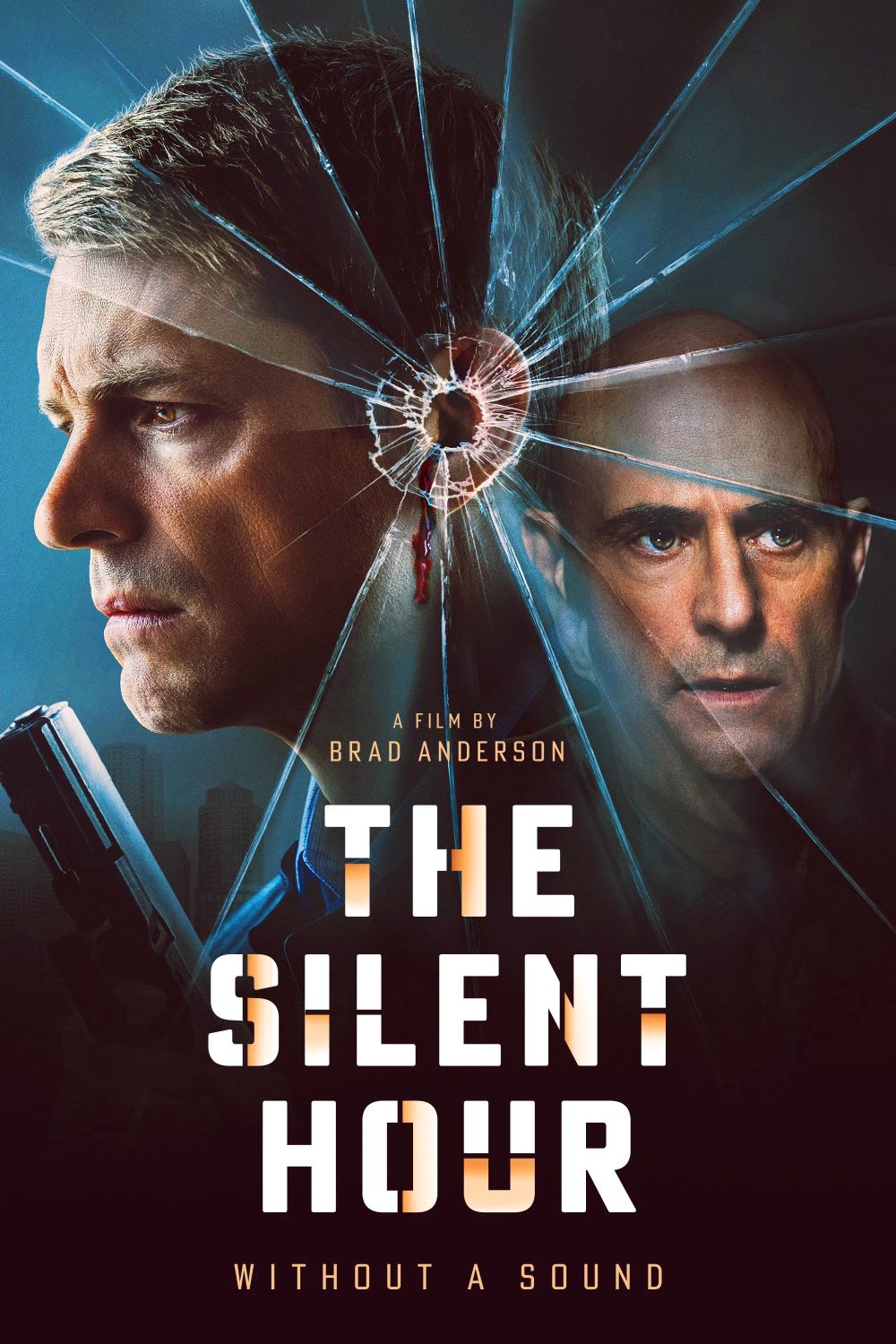
The setup is straightforward: Boston detective Frank Shaw (Joel Kinnaman) is struggling with permanent hearing loss after an on-the-job accident, trying to find a way back onto the force and into his own life. He is brought in because he knows some sign language and is asked to help take the statement of Ava Fremont (Sandra Mae Frank), a deaf photographer who has video evidence of a brutal gang murder. Once Frank leaves her run-down apartment building, he realizes he forgot his phone, heads back, and walks straight into a hit team sent to silence Ava; the rest of the film traps them inside the almost-condemned complex with a crew of killers who, crucially, they often cannot hear coming.

Director Brad Anderson has always had a knack for tense, contained spaces, and you can feel the same instincts here that powered films like Session 9 and Transsiberian, even if The Silent Hour is more conventional. The apartment block is shot as a grim, half-abandoned maze: flickering lights, long hallways, and just enough remaining tenants to complicate any hope of a clean escape. Anderson stages several sequences as slow, creeping cat-and-mouse instead of wall-to-wall gunfire, which fits the “you can’t hear the danger” concept nicely and gives the movie a more claustrophobic vibe than the plot synopsis might suggest.

Where the film genuinely distinguishes itself is in how it uses sound—or sometimes refuses to use it. Scenes that shift into Frank’s perspective often dampen or distort the audio, letting the score fall away so small vibrations, visual cues, and body language carry the tension, while Ava’s point of view goes further, dropping into near-total silence and forcing the audience to scan frames the way she would. It is not as radical as something like A Quiet Place, but it is effective, and the sound department clearly understands that “absence” can be as expressive as any bombastic action mix.

Kinnaman slides comfortably into this kind of bruised, low-key action role, and here he plays Frank as a guy permanently half a step behind the world around him, frustrated but not wallowing. The script gives him some predictable beats—guilt, self-destructive drinking, a shot at redemption—but Kinnaman sells the physical awkwardness of someone relearning how to move and work while not fully trusting his own body. Sandra Mae Frank is the movie’s secret weapon, though; as Ava, she never reads as a passive victim, and there is a practical, almost sardonic edge to the way she navigates the situation that helps keep the film from turning mawkish about disability.

The dynamic between Frank and Ava is also where the film finds its heart, even if it is pretty lightly sketched. Their communication is messy at first—his sign language is rusty and limited, hers is fast and precise—but that awkwardness becomes part of the tension, because a misread sign or delayed understanding can get people killed in this environment. As they settle into a rough rhythm, the movie quietly nudges Frank toward accepting that his hearing loss is not just a temporary obstacle but a permanent part of who he is now, and Ava is allowed to be more than a symbolic “guide” through that, with her own fears and bad decisions hanging over her.

On the flip side, the actual crime plot is about as standard as they come. The villains are corrupt cops cleaning up a messy murder, and if you have seen more than a couple of thrillers, you will probably guess who is dirty long before the script “reveals” it. There are a few half-hearted attempts at moral compromise and temptation—a hefty bribe, old loyalties—especially around Frank’s former partner Doug Slater (Mark Strong), but the story never digs into systemic rot or moral ambiguity in any meaningful way; it just uses corruption as a convenient engine to keep the bullets and double-crosses coming.

Structurally, the film works best as a series of mini-scenarios inside the building rather than as a twisty conspiracy. You get sequences where Frank and Ava navigate dark stairwells while trying to stay ahead of men they can feel but not hear, tense face-offs in cramped apartments with panicked tenants, and a few well-staged bursts of violence that remind you this is still a pretty nasty situation. The climax leans into fire, chaos, and one last push for survival, and while the resolution lands exactly where you’d expect, the final quieter beats give the characters a bit of closure that feels earned rather than tacked on.

Performance-wise, the supporting cast does its job without stealing the movie. Mekhi Phifer and Mark Strong bring some veteran presence as fellow cops circling around Frank, and even when the writing nudges them toward archetype, they at least feel like people who have known each other for years rather than walking plot devices. The henchmen are more one-note, essentially “the guys with guns” hunting through the building, but the film leans on their physicality and menace instead of trying to give everyone a tragic backstory, which is probably the right call for a lean thriller like this.

If there is a frustration here, it is mostly about missed potential. The core hook—two people with hearing loss trying to survive in a sound-dependent cat-and-mouse game—is strong enough that you can imagine a slightly sharper script pushing much harder on point of view, communication breakdown, and the way the police institution treats disability. Instead, The Silent Hour uses those elements as flavoring around a very familiar skeleton, resulting in a movie that is solid and sometimes gripping but rarely surprising.

Taken on its own terms, though, The Silent Hour is a tight, competently staged thriller that understands how to milk a confined space and an offbeat sensory angle for suspense. The running time is under two hours, the pacing stays brisk, and there are enough well-executed set pieces and committed performances to make it an easy recommendation if you are in the mood for a darker, low-key action night. It will not stick with you the way the very best of Brad Anderson’s work does, but as a late-night watch with the lights down and the volume doing most of the heavy lifting, it gets the job done.

The Films of 2024: Lights Out (dir by Christian Sesma)


Duffy (Frank Grillo) is haunted by the past.  When he was serving in the U.S. military, he watched as his friends and fellow soldiers were killed in battle.  Now that he’s back in America, he’s haunted by the memories and the trauma has left him incapable of finding peace.  He’s angry and paranoid and restless.  He drifts around the country, making whatever money that he can as a gambler.  But when a poker game at a Los Angeles roadhouse leads to a physical confrontation, Duffy is offered a new opportunity.

Max (Mekhi Phifer) watches as Duffy defends himself and is impressed with what he sees.  Max is a ex-con who works as a recruiter for underground fight clubs.  Max recognizes the source of Duffy’s anger because Max’s brother was also a veteran who returned to America carrying the mental and physical scars of war.  Max feels that he failed his brother but maybe he can make up for it by saving Duffy’s life.  Max recruits Duffy as a fighter and gives him a place to live.  Duffy and Max soon find themselves in conflict with an evil gym owner (Dermot Mulroney, making the most of a rare villainous role) and a corrupt cop (Jaime King) who is secretly in charge of the town’s underground fight scene.

Lights Out is a fast-paced and occasionally self-aware B-movie.  I always find movies like this fascinating because they present a world where there’s an underground fight club located in every backroom and lumber yard.  Don’t get me wrong.  I’m not saying that there aren’t underground fight clubs.  I’m sure they’re out there and I’m sure that there are some dangerous people involved in promoting them.  I’m just saying that I kind of suspect that there might not be as many of them as there tends to be in the movies.  I always find it interesting that so many underground fight clubs seem to have a “fight until the death” rule.  I mean, it seems to me that would cause you to quickly run out of fighters.  I also wonder what people do when they want to start an underground fight club but they don’t have access to an abandoned warehouse or any acquaintances in the Russian Mafia.  I guess those people are just screwed.

While Mulroney and King definitely make an impression as the two over-the-top villains, Lights Out is dominated by Frank Grillo.  Grillo has been lucky enough to be blessed with a down-to-Earth screen presence that allows him to be likable while also leaving little doubt that he is someone who can handle himself in a fight.  He has the weathered good looks of some one who has seen some things but who hasn’t yet surrendered his humanity.  He’s like the modern day version of one of those wonderful character actors who used to populate the gangster movies of the 1930s.  Grillo’s tough sincerity and streetwise persona is well-used here.  John Garfield had his Body and Soul.  Frank Grillo has his Lights Out.

Cleaning Out The DVR: O (dir by Tim Blake Nelson)


(Lisa is currently in the process of cleaning out her DVR!  This could take a while.  She recorded the 2001 high school film O off of Cinemax on July 6th.)

Tell me if this sounds familiar.

O (Mekhi Phifer) is one of the only black students attending an exclusive high school in South Carolina.  Despite a past that involves petty crime and drugs, O appears to have his life on the right track.  As the captain of school’s basketball team, O is the most popular student at his school.  Everyone looks up to him.  Everyone wants to be him.  He’s even dating Desi (Julia Stiles), the very white daughter of the school’s very white headmaster (John Heard).  At a school assembly, Coach Duke Goulding (Martin Sheen) describes O as being like a son to him.  When O is awarded the MVP trophy, he shares it with his teammate, Michael Cassio (Andrew Keegan).

Watching all of this with seething jealousy is Hugo Gaumont (Josh Hartnett).  Hugo is a teammate of O’s.  In fact, he even thought that he was O’s best friend.  That was before O shared his award with Michael.  Making Hugo even more jealous is that he happens to be the son of the coach.  For every kind word that Duke has for O, he has a hundred petty criticisms for Hugo.  Whereas O has overcome drug addiction and is proclaimed as a hero for doing so, Hugo is secretly doing steroids, trying to do anything to improve himself as a player and hopefully win everyone’s love.

So, Hugo decides to get revenge.  Working with a nerdy outcast named Roger Calhoun (Elden Hansen), he manipulates O into thinking that Desi is cheating on him with Cassio.  He also tricks Cassio into getting into a fight with Roger, leading to Cassio getting suspended from the team.  To top it all off, Hugo gets O hooked on drugs, once again.  Finding himself consumed by a violent rage that he thought he had under control, O starts to obsess on determining whether or not Desi has been faithful to him…

If that sounds familiar, that’s because O is basically Othello, transported to modern times and involving privileged teenagers.  Even though the whole modernized Shakespeare thing has become a bit of a cliché, it actually works pretty well in O.  Hugo’s obsessive jealousy of the “cool kids” feels right at home in a high school setting and director Tim Blake Nelson and writer Brad Kaaya do a fairly good job of transporting Shakespeare’s Elizabethan melodrama to the early aughts.

(Actually, O was filmed in 1999 but it sat on the shelf for two years.  After a spate of school shootings, distributors were weary about releasing a film about high school students trying to destroy each other.)

Admittedly, O has its share of uneven moments.  Martin Sheen, playing the type of role that always seems to bring out his worst instincts as an actor, goes so overboard as the coach that he threatens to sink almost every scene in which he appears and Rain Phoenix is miscast as Hugo’s girlfriend.  Even Julia Stiles struggles a bit in the role of Desi.  However, both Mekhi Phifer and Josh Hartnett are perfectly cast as O and Hugo.  Phifer brings just the right amount of arrogant swagger to the role while Hartnett is a sociopathic marvel as Hugo.  Tim Blake Nelson’s direction is occasionally overwrought, relying a bit too heavily on a groan-inducing metaphor about taking flight and claiming the spotlight.  However, both Nelson and the film deserve some credit for not shying away from directly confronting and portraying the source material’s cultural and racial subtext.

O is hardly perfect but it is always watchable and, at its best, thought-provoking.

Film Review: The Divergent Series: Allegiant (dir by Robert Schwentke)


Oh, Who Gives A Fuck About This Fucking Movie?

Oh, who cares?

I really hate to start my review with such a negative statement but seriously, after watching Allegiant today, I am now convinced that the Divergent movies are perhaps the least interesting film franchise since the Paranormal Activity sequels.  Not only are the films so derivative of The Hunger Games that I’m always surprised that Donald Sutherland isn’t lurking around in the background but they’ve also managed to waste the talents of some of the best actors of my generation.  When you’ve got performers like Shailene Woodley and Miles Teller at your disposal, there’s no excuse not to be interesting.

I watched Allegiant with my BFF Evelyn and I’ll admit right now that we talked throughout the entire movie.  We laughed at the most serious of moments.  When Jeff Daniels showed up, we had a very long discussion about how, when he’s good, Jeff Daniels is really good but when he’s bad, he manages to come across as being the most boring man on the planet.  When Miles Teller betrayed his allies, Evelyn said, “Again!?” and then she had to remind me that Miles Teller always ends up betraying everyone in every Divergent film.

(It makes you wonder why the Tris (played by Shailene Woodley) and Four (Theo James) always bring Miles Teller with them as opposed to just killing him.  I suppose some of it might have to do with the fact that he’s Miles Teller and he’s a badass.  In fact, he probably should be playing Four.  He certainly has more chemistry with Shailene Woodley than Theo James does.  In fact, Theo James always looks like he’d rather be doing anything other than appearing in another goddamn Divergent film.)

And yes, Evelyn and I did get a few dirty looks from some people in the audience but you know what?  I fully understand that it’s rude to talk through a movie but oh my God, we had to do something.  Allegiant is such a boring movie.  The film moves slowly, as if the filmmakers don’t understand that everyone in the audience has seen enough YA adaptations to already know everything that’s going to happen.  If you want to truly understand what film critics mean when they say that a film is “draggy,” try to watch an entire Divergent film without standing up to stretch your legs or get something to drink.  Perhaps the biggest mistake you can make while watching Allegiant is to actually concentrate on what’s slowly playing out on screen.

The Divergent films aren’t terribly complicated and yet, I always find myself struggling to follow them.  They’re so bland and forgettable that I can never remember what happened in the previous film.  As Allegiant started, I was like, “Why is Naomi Watts in charge of Chicago now?  Oh yeah, Kate Winslet did die at the end of the last movie!”  And then I remembered that Evelyn was Four’s mother.

And then my BFF Evelyn (as opposed to the film’s Evelyn) said, “Four is a stupid name,” and I started laughing way too hard.  In fact, we made many jokes about Four’s nickname and then eventually, I remembered that he was called Four because he only has four fears.  But it took me a while to remember and, once I did remember, I couldn’t help but think about how stupid a backstory that was.

Anyway, the plot of the film is that the movie’s Evelyn is now in charge of Chicago but she’s turning out to be just as bad as the system that she’s replacing.  So, Tris, Four, and friends escape from Chicago and explore the barren landscape that surrounds the city.  Eventually, they are found by the Bureau of Genetic Welfare.  The Bureau is headed up by a boring guy named David (Jeff Daniels).  At first, David seems to be a good guy but then it turns out that the Bureau was behind the whole Faction experiment.  And now the Bureau wants to attack Chicago, wipe the slate clean, and start the experiment all over again.

Will Four and Tris go along with David’s plan or will they try to stop him?

At this point, who cares?

The thing that’s annoying about the Divergent films is that the storyline has potential.  At the heart of it all, the battle between the Factions and the Factionless has the potential to be a powerful, if simplistic, metaphor.  But the films are so plodding and take such an obvious approach that most of that potential is wasted.  Add to that, Shailene Woodley is a great actress.  In fact, I think it can be argued that she actually has more range than Jennifer Lawrence.  (Just check out her performance in The Spectacular Now.)  But the franchise has never known what to do with her uniquely off-center style.  Instead, it simply gives her speeches that feel as if they’ve been lifted from every other dystopian YA franchise.  The films insist on trying to make Shailene Woodley predictable and she deserves better on that.

As is typical of big franchise films nowadays, Allegiant is just part one of the Divergent finale and even the “to be continued” ending feels annoying because it’s so obviously lifted from every other franchise finale that’s ever been produced.  As with all the Divergent films, Allegiant never escapes the shadow of The Hunger Games.  The best that can be said about this franchise is that it will be over soon.  Hopefully, Shailene Woodley will be able to move onto a film more worthy of her considerable talents.

Playing Catch-Up With 6 Film Reviews: Avengers Grimm, Bad Asses On The Bayou, Hayride 2, Insurgent, Poltergeist, Tomorrowland


Here are 6 films that I saw during the first half of 2015.  Some of them are on Netflix and some of them were major studio releases.  Some of them are worth seeing.  Some of them most definitely are not.

Avengers_Grimm

Avengers Grimm (dir by Jeremy M. Inman)

Obviously made to capitalize on the popularity of Avengers: Age of UltronAvengers Grimm opens with a war in the world of fairy tales.  Evil Rumpelstiltskin (Casper Van Dien) uses Snow White’s (Laura Parkinson) magic mirror to cross over into our world and he takes Snow White with him!  It’s now up to Cinderella (Milynn Sharley), Sleeping Beauty (Marah Fairclough), and Rapunzel (Rileah Vanderbilt) to cross over into our world, save Snow White, and defeat Rumpelstiltskin.  Also sneaking over is rebellious Red Riding Hood (Elizabeth Petersen) who is determined to kill Rumpelstiltskin’s henchman, The Wolf (Kimo Leopoldo).  

Got all that?

Avengers Grimm is another enjoyably insane mockbuster from The Asylum.  The budget’s low, the performances are intentionally melodramatic, and it’s all lot of fun.  Casper Van Dien has a lot of fun playing evil, the women all get to kick ass, and Lou Ferrigno is well-cast as a labor leader named Iron John.

Avengers Grimm is currently available on Netflix.

Bad_Asses_on_the_Bayou

Bad Asses On The Bayou (dir by Craig Moss)

Apparently, this is the third film in which Danny Trejo and Danny Glover have respectively played Frank Vega and Bernie Pope, two old guys who kick ass in between worrying about their prostates.  I haven’t seen the previous two Bad Asses films but I imagine that it really doesn’t matter.

In this film, Trejo and Glover go to Louisiana to attend a friend’s wedding.  When she’s kidnapped, they have to rescue her and impart some important life lessons to her younger brother.  It’s all pretty predictable but then again, it’s also pretty good for a film called Bad Asses On The Bayou.  This is a film that promises two things: Danny Trejo kicking ass and lots of bayou action.  And it delivers on both counts.

In fact, I would say that Bad Asses On The Bayou is a better showcase for Danny Trejo’s unique style than the better known Machete films.  Danny Trejo is a surprisingly adept comedic actor and he gives a performance here that shows his talent goes beyond mere physical presence.

Bad Asses On The Bayou is currently available on Netflix.

hayride-2

Hayride 2 (dir by Terron R. Parsons)

I should admit up front that I haven’t seen the first Hayride film.  Luckily, Hayride 2 picks up directly from the end of the first film and is filled with so many flashbacks and so much conversation about what happened that it probably doesn’t matter.

Essentially, Pitchfork (Wayne Dean) is a murderous urban legend who turns out to be real.  He killed a lot of people in the first film and he stalks those that escaped throughout the 2nd film.  Like all good slasher villains, Pitchfork is a relentless killer.  He’s also an unrepentant racist, which leads to a genuinely unpleasant scene where he attacks a black detective (Corlandos Scott).  Say whatever else you will about the film, Hayride 2 deserves some credit for being on the side of the victims.  No attempt is made to turn Pitchfork into an anti-hero and the movie is relentlessly grim.

Hayride 2 is an odd film.  The film’s low-budget is obvious in every single scene.  The pacing is abysmal and the performances are amateurish.  And yet, when taken on its own meager terms, it has a dream-like intensity to it that I appreciated.  Then again, I always have had a weakness for low-budget, regional horror films.

Hayride 2 is available on Netflix.

Insurgent_poster

Insurgent (dir by Robert Schwentke)

Insurgent is both the sequel to Divergent and was also 2015’s first YA dystopia film.  Shailene Woodley is as good as ever and I guess it’s good that she has a commercially successful franchise, which will hopefully inspire audiences to track down better Shailene Woodley films like The Spectacular Now.  

All that said, Insurgent often felt even more pointless than Divergent.  For a two-hour film featuring performers like Woodley, Kate Winslet, Octavia Spencer, Ansel Elgort, and Miles Teller, Insurgent has no excuse for being as forgettable and boring as it actually was.  The next installment in The Hunger Games can not get here soon enough.

Poltergeist_2015_poster

Poltergeist (dir by Gil Kenan)

When a family (led by Sam Rockwell and Rosemarie DeWitt) move into a new house, they discover that everything is not what it seems.  For one thing, they come across a bunch of creepy clown dolls.  They also hear a lot of scary sounds.  They discover that the house was built on an old cemetery.  Their youngest daughter vanishes.  And finally, someone says, “Isn’t this like that old movie that was on TCM last night?”

Okay, they don’t actually say that.  However, as everyone knows, the 2015 Poltergeist is a remake of the 1982 Poltergeist.  Since the 1982 Poltergeist still holds up fairly well, the 2015 Poltergeist feels incredibly unnecessary.  It has a few good jump scenes and it’s always good to see Sam Rockwell and Rosemarie DeWitt in lead roles but ultimately, who cares?  It’s just all so pointless.

Watch the wall-dancing original.  Ignore the remake.

Tomorrowland_poster

Tomorrowland (dir by Brad Bird)

Welcome to the world of tomorrow!  Wow, is it ever boring!

Actually, I feel a little bit bad about just how much I disliked Tomorrowland because this is a film that really did have the best intentions.  Watching the film, you get the sinking feeling that the people involved actually did think that they were going to make the world a better place.  Unfortunately, their idea of a better world is boring and almost oppressively optimistic.  There is no room for cynicism in Tomorrowland.  Bleh.  What fun is that?

Anyway, the film basically steals its general idea from the Atlas Shrugged trilogy.  Tomorrowland is a secret place that is inhabited by inventors, dreamers, and iconoclasts.  Years ago, Frank (George Clooney) was banished from Tomorrowland because, after learning that the Earth was destined to end, he lost “hope” in mankind’s future.  Fortunately, he meets Casey (Britt Robertson), who is full of hope and through her, he gets to return.  They also get a chance to save the world and battle a cartoonish super villain played by Hugh Laurie.  (Why is he a villain?  Because he’s played by Hugh Laurie, of course!)

After all the hype and build-up, Tomorrowland turned out to be dull and predictable.  What a shame.  The Atlas Shrugged trilogy was at least fun because it annoyed the hipsters at the AV Club.  Tomorrowland is just forgettable.

Review: Torchwood: Miracle Day Ep. 08 “End of the Road”


“End of the Road” is quite an apt title for the eight episode in the fourth season of Torchwood. We see the end of a couple characters during the episode and at the same time we finally get the final pieces to the question of who or what caused “Miracle Day”.

The episode begins with the Torchwood team arriving at the Colasanto estate and led by Olivia Colasanto to her grandfather and Jack’s former companion and lover from the late 1920’s. We find out that Angelo Colasanto has kept himself alive through natural means, but is now in a coma as Jack looks on. Angelo’s condition when revealed almost felt like a cop out, but in a major exposition info dump done by his granddaughter we find out who is behind Miracle Day”. They’re called The Families and are made up of the descendants of the three men last seen in the previous episode forming an alliance to study Jack’s seeming immortality.

Angelo himself has been kept out of the alliance due to the three men’s discomfort over his homosexuality. Angelo has been observing not just the three families through the years, but Jack as well in an attempt to either stave off whatever plans The Families have in regards to the “Miracle” or, at the very least, give Jack the clues needed to fix the problem. But before Jack, Gwen, Esther and Rex can do their thing to save the day there’s the little obstacle of Rex’s old boss in the form of Wayne Knight interrupting the Jack/Colasanto reunion. The rest of the episode never lets go of the throttle once John De Lancie’s CIA head honcho Shapiro show’s up and we get closer to this season’s endgame.

The episode was well-written even with the major expositional scene involving Nana Visitor’s character. Each character in the Torchwood team got a chance to shine in their roles with Barrowman making Jack’s bittersweet reunion with Angelo a mixture of happiness and regret. If there was a weak point in the cast’s performance it would continue to be some of the side characters like Wayne Knight’s deputy director Friedkin and Bill Pullman’s Oswald Danes. While I can understand the role of Knight’s character in the overall scheme of things this season I still can’t quite grasp just exactly what Pullman’s Danes character is suppose to do other than be over-the-top creepy. Even Ambrose’s Kitzinger got a chance to own her scene as she finally unleashes what she truly feels about Oswald Danes despite having to be his publicist.

“End of the Road” ends on a major cliffhanger with one of the Torchwood team members shot and the team split apart as the CIA, The Families and everyone else seem to be pulling at them from all directions making their task about solving “Miracle Day” that much more difficult. With only two more episodes remaining this season what looked to be a show that seemed stuck on idle for most of the middle episodes has suddenly begun to speed ahead towards what could be an epic conclusion.

Review: Torchwood: Miracle Day Ep. 07 “Immortal Sins”


I didn’t think Russell T. Davies and his writers could pull off moving the story of Torchwood: Miracle Day towards a resolution that would be interesting, but it looks like they might just do it. The series is now on it’s final stretch run and fears that the show was spinning its wheels about not having any idea what the cause of “Miracle Day” was and what was the endgame looks to be easing somewhat with this 7th episode titled “Immortal Sins”.

The episode was mainly told through a flashback to the early 1920’s where we see Jack entering the U.S. through Ellis Island and befriending an Italian immigrant who also happened to have tried to steal his visa papers. We learn that this man is one Angelo Colasanto and his bright-eyed outlook on being in a new land has made quite an impact on the well-traveled Captain. Soon enough Jack and Angelo become companions and romantically involved, but as with everything involving Jack such happiness never last for long as we find out why Jack was entering the U.S. in the first place. It’s a consequence of Jack and Angelo’s attempted escape following Jack’s mission that his companion  later learns of his inability to die.

In one of the more disturbing sequences throughout this series, so far, Jack’s immortality was tested time and time again. Angelo’s misguided betrayal of his lover leads to Jack being killed over and over only for him to return. It’s from this sequence we see what could be the birth of the shadowbrokers pulling the strings behind PhiCorp and the many others complicit in moving “Miracle Day” along.

While the bulk of the episode was taken up mostly by Jack’s flashback to his meeting with Angelo we still got enough time given over to Gwen as she attempted to save her family from the very people who also want Jack. Even with her loyalty to Jack we see that Gwen will be willing to turn him over to the very people holding her family hostage if it meant saving them. It’s only through a timely intervention by Esther and Rex that Gwen and Jack get out of another crisis. It’s the final moments of this sequence that we finally learn the name of the person who has the key to learning the true nature of “Miracle Day”. Sins of the past looks to have caught up to Jack this time around and it’ll be interesting to see if “Miracle Day” becomes the elaborate plan of a spurned lover and companion and whether Jack will be the key to unraveling the effect of the world’s current bout of “immortality”.

Overall, “Immortal Sins” was a good episode that gave us a nice look into a part of Jack’s past that has only been shown briefly in the past. The episode was actually stronger when it focused on Jack’s past with Angelo and the discoveries made by both men about each other that looks to color the current situation occurring on the planet right now. While the other half with Gwen had it’s exciting moments (mainly once Esther and Rex get involved) this section of the episode looked to be more of an expositional trigger to get Jack to recount his past. I did like how Jack and Gwen seemed to make-up and get back on track as partners once again when the danger had passed. The chest bump between the two was quite amusing. Only time will tell if Gwen’s attempt to save her family’s life by trying to turn Jack over to the very people opposing them would have any lingering effects as the season comes to a close and towards any potential future seasons.

The final three episodes of this season should make for some interesting tv watching.

Review: Torchwood: Miracle Day Ep. 06 “The Middle Men”


Torchwood: Miracle Day is now into the second-half of it’s 10-episode latest season and something just occurred to me even while I was enjoying this 6th and latest episode. For a new season that’s just 10-episode the writers seem to be doing things as if there’s more than just the 10 episodes. For some people this slow pace has become an annoyance as the mystery of what is “Miracle Day” seem to be doing the glacial unveiling. I’m beginning to lean towards these individuals who thinks this season, as entertaining as it has been, looks to be wasting too much of of the season’s remaining episodes introducing new characters left and right to be nothing more than exposition mouthpieces to help add another clue to the mystery of the season.

While episode 6, perfectly titled as “The Middle Men”, was entertaining as we see Rex, Esther and Gwen deal with their part in exposing the government “Outflow Camps” (aka extermination camps for those deemed braindead but still alive), the episode seemed to spin it’s wheels in place once Jack met with one of PhiCorp’s executive who may or may not know the company’s role in “Miracle Day”. Ernie Hudson plays PhiCorp’s COO, Stuart Owens,  who also has begun to investigate on the true nature of the Outflow Camps. One of Owens’ operatives in Shanghai tasked with investigating that country’s Outflow Camps relays an ominous and cryptic message to Owens in the form of jumping off of the roof of the tallest building in the city after what he had uncovered. It looks like the burn units in the Outflow Camps’ module might not be the only way to get around the forced upon “immortality” everyone now has.

The episode actually takes place pretty much where the last one ended and it spends most of it’s time with Rex and Esther finding out who was responsible for Vera Juarez’s “death”. This part of the episode was actually quite frustrating to watch. Some of it was very difficult to watch in a good way as Rex goes through a form of torture that had even me averting my eyes. But it was also a part of the episode where both Rex and Esther make one stupid mistake after the other. Esther I can understand as she’s become almost useless as a Torchwood member outside of her hacking skills. Rex on the other hand I thought would’ve been more wary of his surroundings and those in the Camp he interacted with. The fact that it took a bumbling idiot to save the two put this whole part of the episode into the realm of the absurd.

Gwen’s time in the Cardiff Outflow Camp was a bit more successful though this leads to consequences which puts her in a no-win situation as the episode draws to a cliffhanger close. We did get to see her get into badass mode as she figures out in her own way to put a temporary stop to the burn modules. She does this all the while playfully bantering back and forth with Jack back in LA. This past of the episode was actually the best of the three concurrent story plot threads which has been running for the past couple episodes.

The third part of the episode is more of an exposition dump than anything else. For some reason this season has seen Jack in less of badass role while at the same time the one member of the team who seems to run across people who do nothing but act as exposition dump devices. While Ernie Hudson’s character unloading information on Jack was good and all most of it was something that audiences probably have figured out by now and that PhiCorp is just a link to the those in the shadows pulling the strings on “Miracle Day”. He did give a little tidbit about what might be the endgame for those behind-the-scenes of this worldwide event: The Blessing.

All in all, episode 6 (“The Middle Men”) was a good episode but definitely a step back from some strong ones previous to this one. With only four more episodes remaining in the season I’d be really interested in how Davies and his writers will be able to wrap things up without rushing things. Part of me thinks they may not be able to pull it off and another part of me suspect that there won’t be a true resolution and that a follow-up season may be what’s in store.

Review: Torchwood: Miracle Day Ep. 05 “The Categories of Life”


We’ve now reached the halfway point of the latest season of Torchwood. While the previous four episodes in this season has been quality work there’s been a small, but growing number of the show’s fans who saw the series as not as good season 3, Torchwood: Children of Earth, and that the addition of more American characters and transplanting the team to the US had lessened the show to some degree. I can’t say if these fans are right or not, but this midway point episode goes a long way to really giving Torchwood: Miracle Day the punch it really needed to put the season from just very good to something on the level of season 3.

The team has now split up into three working groups with Gwen headed back to Wales to try and get her ailing father from becoming just another statistic in the so-called “Outflow Camps” being set up by world governments with the help of the pharma-transnational PhiCorp. Her brief reunion with Rhys and her baby girl makes for some fun moments, but it doesn’t last long as Gwen gets right down to the business of “rescuing” her father from the very people tasked to help him. Their plan seemed like something that would never succeed, but seeing the chaos at the newly created “Outflow Camps” really helped in believing that Gwen and Rhys could actually pull off their rescue of her father. It’s not the danger of being discovered which puts her father in greater danger but the “Miracle Day” situation itself which does it and from that development in this episode’s story thread do we get a clue as to the darker nature of the hidden modules being built in these camps.

It’s during the plot thread involving Rex, Esther and Dr. Vera (who had decided earlier in the episode that she had a better chance to help people if she helped Rex with his plans) in California which was the strongest thread in the episode. We get to see first-hand through the eyes of Vera and Rex just how unprepared the government really was even in setting up these PhiCorp “Outflow Camps”. Camps which have been designed to house those who have been given new categories to describe their “Miracle Day” status. Category 1 being those who were braindead but still alive for some reason (including those who have been horrifically mangled in some fashion). Category 2 being people who have survived a fatal event and still alive and conscious (Rex for example) with Category 3 being everyone else who are healthy and no need for extensive care.

It’s during Vera’s tour with an unctuous, inept camp administrator that the true nature of the camps come to light. It serves less as a place to help ease the overcrowding in hospitals, but more of a concentration camp to segregate those labeled Cat 1 and 2 from the general population who make up Cat 3. It’s also in this plot thread that we see for the first time the horrific nature of the secret camp modules that Rhys had heard being called “burn units”. I wasn’t surprised that the writers decided to go all the way with demonstrating the nature of the modules with one of the season’s lead characters with still half a season to go, but it was a major gut-punch and should change how the Torchwood team goes about exposing not just PhiCorp, but those behind it and the true nature and agenda of “Miracle Day”.

The third plot thread in this episode was the weakest of the three as we see Capt. Jack continue in his attempt to understand Oswald Danes and his role in whats going on, but also use him to try and expose PhiCorp.  I’ll be the first to admit that I was wrong in thinking Pullman’s performance as Danes would smooth itself out, but with five episodes in the season already in the can his character (as interesting as this character still remains to be) just looks and behaves like a bad caricature of an unhinged villain. Maybe Pullman will pull back on the scenery-chewing long enough to actually appear as the dangerous, albeit tortured, foil for the team, but I’m losing hope. This thread does show that whatever sympathy Jack may have had for Danes just went out the window as the very person he’s trying to use has just set himself up to be the face of “Miracle Day” and the cult growing around his personality.

“The Categories of Life” was still the best episode to date for this new season of Torchwood despite the weakness that is Oswald Danes. It explored the subject matter that’s dear to many (health care in the country or lack thereof) and themes of how in times of crisis people will flock to whoever is speaking the loudest (even if the message is one that is not for the benefit of people) and give those in power the blank check to do whatever needs to be done to keep the masses a false sense of hope and security.

Torchwood: Miracle Day still hasn’t reached the epic greatness that was season 3’s Torchwood: Children of Earth, but with five more episodes to go it’s making a strong push to try and equal it. Whether it does or spectacularly fail in the attempt should make the second half of the season worth watching.

1st Episode: “The New World”

2nd Episode: “Rendition”

3rd Episode: “Dead of Night”

4th Episode: “Escape to L.A.”

Review: Torchwood: Miracle Day Ep. 04 “Escape to L.A.”


Torchwood: Miracle Day has been very casual in revealing the cause and ultimate agenda behind the so-called “Miracle Day” event which has turned everyone on the planet Earth with a unique form of immortality. There’s been speculation from new and old fans alike about the cause and reason. Some think it’s aliens from the future. Some believe it to be a government experiment that went terribly wrong. One thing the previous and third episode in this new season did dole out was that a major pharmaceutical company, PhiCorp, seemed to have been aware of the arrival of “Miracle Day” and planned accordingly even to the point of infiltrating governmental agencies to deflect suspicion from them. Which brings us to the fourth and latest episode: “Escape to L.A.”.

This fourth episode sees the latest incarnation of the Torchwood team arriving in Los Angeles with a plan to infiltrate one of PhiCorp’s many headquarters around the country and steal a server which may hold the information they need to expose the company to the world and finally get down to the bottom of what “Miracle Day” truly is. To say that PhiCorp has become more than just an ovelry opportunistic megacorporation after this episode would be an understatement. This episode had everything for pretty much all spectrum of Torchwood fans. It had some very emotional and quieter moments for some of the main characters (such as Esther Drummond and Rex Matheson). For those wanting a bit more action this episode had it as well as the team’s plans to infiltrate the PhiCorp server room runs across a few stumbling blocks in the form of a creepy hired assassin in the form of one C. Thomas Howell. There’s even a few lighter and funnier moments involving the team’s search for a base of operations while in L.A. with Rex sarcasticly commenting that Jack was trying to turn everyone he meets gay with Jack’s retort admitting to just such.

“Escape to L.A.” also continues to delve into the growing role of Oswald Danes (Bill Pullman still hamming it up as the twitchy, but smarter than he looks pedophile-murderer) in this new season’s scheme of things. While the last episode threw off the cloak of repentance Danes had shown on live TV this latest episode shows Danes as quite devious in trying to keep himself in what he thinks is the only way to protect himself from those who still thinks he owes society for what he had done. The interesting thing about what Danes does in this episode was that it put a voice into one of the themes being explore in this season. Danes sees those still living when they should be dead just like him being herded into places (abandoned hospitals and camps being built by PhiCorp) to be away from those still living in truth. It was interesting that he would be the voice for this theme and a counter to the fearmongering of a Tea Party politico in the form of Mayor Ellis Hartley Monroe (Mare Winningham). For once in this series, so far, I think many wouldn’t be too far off in saying they were rooting for Danes. He was the lesser of two evils in this episode even though it looks like it will be the catalyst which will propel Pullman’s character into the cult leader the season’s marketing had been hinting at.

While the episode wasn’t as good as episode 3’s “Dead of Night” it was still a very strong episode. This was an episode that actually added more pieces to the mystery of “Miracle Day” and just how far-ranging PhiCorp’s (and what could be others as hinted at cryptically in the episode’s final moments) role as the main antagonist for this new season. From how the episode ended for the Torchwood team it looks like we might see the team back on British soil as Gwen must now deal with her father’s safety.

The season continues to improve with each new episode and it’s a good thing this episode gave out more than just dribbles of clues. With only 6 more episodes to go it was high time the series went into the next gear as it races towards the answer to the question of “What is Miracle Day?”.

1st  Episode: “The New World”

2nd Episode: “Rendition”

3rd Episode: “Dead of Night”