
As I sit here working on my recap of the first two episodes of Showtime’s revival of Twin Peaks, it’s occurring to me that this is not going to be an easy job. Last month, when Leonard, Jeff, and I were reviewing the show’s first two seasons, we had the advantage of knowing where the story was leading. We knew what would be important and what was a red herring.
With this revival, we no longer have that luxury. I have no idea where this show is going. All I know, for sure, is that David Lynch has given us 18 hours of new material. It’s not necessarily going to be easy to review the revival. I can already tell that. From what I’ve heard and read, it appears that Lynch approached this less as a TV series and more as an 18-hour movie. I’ve already noticed that several reviewers are already overplaying the “Twin Peaks is weird” angle. David Lynch may be a surrealist but there is always a definite logic to all of his work. You just have to have the patience to find it and I imagine that’ll be the case with Twin Peaks: The Return as well.
I’ve already shared my initial thoughts on the first two episodes and Ryan The TrashFilm Guru has posted a review of his own. What follows below is a more in-depth recap of what we saw last night. Needless to say, if you haven’t seen the first two episodes of the revival yet, this entire post is one huge spoiler. So, read it at your own risk!
Okay — ready?
Let’s go!
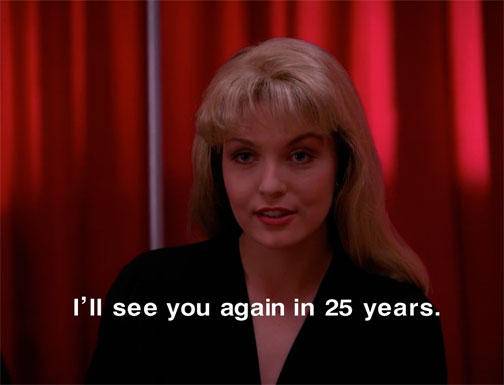
We start where we left, with a clip from 27 years ago. In the Black Lodge, Laura Palmer (Sheryl Lee) tells Dale Cooper (Kyle MacLachlan) that she will see him in 25 years.
Cut to Twin Peaks, the town that we all know and love. The trees are still shrouded in fog. The high school hallways are empty. Laura Palmer’s homecoming queen picture still sits in the trophy case. The title appears. Angelo Badalamenti’s haunting theme music starts to play. We see the waterfall. We read the opening credits. Twin Peaks is back.
In the Black Lodge, a much older Giant (Carel Struycken) talks to an aged Cooper. The inhabitants of the Lodge still speak backwards and we are still provided with subtitles so that we can follow what they’re saying. Cooper still speaks in his normal voice, indicating that he may be trapped in the Lodge but he has yet to truly become a part of it. The Giant tells Cooper to listen to the sounds and looks over at an old-fashioned phonograph. “It is in our house now,” the Giant says. “Remember Four Three Zero. Richard and Linda. Two birds with one stone.”
“I understand,” Cooper says. (I’m glad someone does.)
Cut to a trailer sitting in the middle of nowhere. A pickup truck drives up. The truck has two cardboard boxes in the bed. Dr. Jacoby (Russ Tamblyn) comes out of the trailer and gets the boxes. What’s inside the boxes? Shovels, of course! Jacoby certainly does seem to be happy to have them. Maybe he’s still looking for that necklace that Donna and James buried 25 years ago…

Cut to New York City. Sam Colby (Ben Rosenfield) has a new job. He sits on a couch in a room and he watches a black box that is sitting inside of a glass box. His job is to see if anything happens in the box and to make sure that there is always a camera filming the box. There’s a guard posted outside of the room. Sam’s friend, Tracey (Madeline Zima), is allowed to bring him coffee but she’s not allowed to enter the room or see the boxes. The sight of Sam sitting in that room, staring at that box, reminded me of the scenes with Michael Anderson as the man who controlled Hollywood in Mulholland Drive. As creepy as that box may have been, it was the stillness of this scene that made me nervous. Sam seemed remarkably uninterested in why exactly he had to watch the box and that lack of curiosity struck me as odd and just a little depressing.
Cut to … oh my God, we’re back at the Great Northern! And there’s Ben Horne (Richard Beymer)! He’s in his office and he’s leering at his new secretary, Barbara (Ashley Judd). It’s just like old times and, of course, it’s nice to see that Ben survived striking his head on the fireplace mantle 25 years ago. That said, Ben appears to have given up on being a do-gooder. He’s back to obsessing over money. Jerry (David Patrick Kelly) drops by for a visit and reveals that, since Washington legalized marijuana, he’s made a fortune. Way to go, Jerry!
Cut to the Sheriff’s Department and there’s Lucy (Kimmy Robertson)! An insurance salesman comes in and asks to see Sheriff Truman. Lucy asks him if he wants to see the Sheriff Truman who is sick or the Sheriff Truman who is out of the office. Neither one is available.
Cut to a country road. Someone is driving down the street while listening to evil music. The driver is none other than … Agent Cooper? Well, it kind of looks like Agent Cooper but it’s not Cooper. For one thing, this guy has long, greasy hair and doesn’t wear a dark suit. He also doesn’t smile. He has cold, dead eyes. For another thing, he parks next to a shack and beats up a redneck, which is not exactly Agent Cooper behavior. Then he goes inside, where he meets Buelah and Otis. He tells them that he has come to pick up Ray (George Griffith) and Darya (Nicole LaLiberte). I don’t remember Agent Cooper having such an affinity for white trash…
Oh wait! That’s not Agent Cooper! That must be Cooper’s Doppelganger!
Meanwhile, back in New York, Tracey shows up with more coffee. She and Sam are shocked to discover that the guard has left his post. This means that Tracey can now go into the room and see the mysterious box for herself! It also means that she and Sam can have some fun on the couch. While they do, Sam suddenly sees that the inside of the glass box has turned black. Suddenly, what appears to be a demonic creature appears in the box. It springs through the glass and, in a scene that leaves no doubt that this is Showtime Twin Peaks and not ABC Twin Peaks, it literally rips Sam and Tracey into pieces.
Along with giving me a good fright, this scene made me sad because I thought Sam and Tracey were a cute couple. The reviewer at TVLine complained about Sam and Tracey and the actors playing them and I really have to wonder what show he watched because, to me, both Ben Rosenfield and Madeline Zima were likable and sympathetic in their brief time on screen. Then again, the TVLine recapper also managed to confuse Bobby Briggs and James Hurley so we know he’s not a true Twin Peaks fan.
I should also mention that this scene, with hints of the demons flickering in the darkness before the sudden attack, reminded me of the infamous “there’s an evil man behind the dumpster” scene from Mulholland Drive.
Cut to Buckhorn, South Dakota. We’re confronted with a very Lynchian image. A fat woman walks a tiny dog down the hallway of an apartment building. She stops when she smells a terrible stench coming from the neighbor’s apartment. She calls the police, worried that her neighbor Ruth Davenport may be dead.
The police arrive and it takes them forever to find a key to open up the apartment. This is one of those sequences that Lynch loves, the sequence were a simple task is made progressively more and more difficult by awkward minutia. The neighbor doesn’t know if there’s a manager available but then remembers that the manager’s been committed to an asylum. However, the manager’s brother might have the key. But she doesn’t know where the brother is but the brother’s friend, Hank Filmore (Max Perlich), might know. Hank does know but he refuses to tell and then the neighbor suddenly mentions that she has an extra key to the apartment. When the police finally get inside the apartment, they discover the naked remains of Ruth Davenport in bed. Her eyes have been removed and her head has been disconnected from her body.
Continuing the Mulholland Drive comparison, the discovery of Ruth’s body was shot in much the same way as the discovery of Diane Selwyn’s body in Mulholland Drive. As well, Brent Briscoe played a detective in Mulholland Drive and he plays one in Twin Peaks as well, leading the investigation into Ruth’s murder.

Cut back to Twin Peaks. The Log Lady (Catherine Coulson) calls Deputy Hawk (Michael Horse), who is now Deputy Chief Hawk and who is in charge while Sheriff Truman is gone. The Log Lady tells Hawk that her log has a message. “Something is different and you have to find it,” she tells him. “It has to do with Federal Agent Dale Cooper and with your heritage. This is the message of the log.”
(Coulson died shortly after filming her scenes here and her frailty make her scenes here unexpectedly poignant. As she talks to Hawk, it’s obvious that both of them know that this could be their last conversation.)
Back in South Dakota, Detective Dave is informed that one man’s finger prints have been found all over Ruth’s apartment. The finger prints belonged to Bill Hastings (Matthew Lillard), a respected high school principal. As his shocked wife, Phyllis (Cornelia Guest), watches, Bill is arrested and charged with murder. “But the Morgans are coming to dinner!” Phyllis shouts as Dave leads Bill away.
Back at the Twin Peaks Sheriff’s Department, Hawk, Lucy, and Andy (Harry Goaz) gather in the conference room. Hawk order them to look through all the files on the disappearance as Dale Cooper. Lucy says that Cooper disappeared 24 years ago and then mentions that her son is 24 years old. “He was born on the same day as Marlon Brando,” Lucy says.
Back in South Dakota, Dave is interrogating Bill. When Dave asks Bill if he’s ever heard of Ruth Davenport, Bill says that he only knew her in passing. He denies having ever been to Ruth’s apartment but, when he says it, he nervously glances around the room. Is Bill hiding something or is he just nervous as anyone who has been arrested — whether guilty or innocent — would be? It turns out that Bill can’t account for where he was during every minute of the previous night. Dave jots down some notes on a legal pad. That’s never good. Bill wants a lawyer. Dave says that lawyer is on the way but he also asks if there’s anything else Bill would like to add “before we get a lawyer involved.” At this point, I was yelling at the screen, “Stop talking! The police are not your friends!” Dave immediately proved my point by accusing Bill of murder and then taking him to a jail cell.
Dave and the cops then go back to the Hastings house, the time with a search warrant. While the police search his car, Bill sits in his jail cell and probably wonders why he hasn’t been allowed to see his lawyer yet.

Suddenly, Dave arrives with Phyllis. Phyllis steps into the cell and tells Bill that they’re not going to give him bail. Bill says that he was never in Ruth’s apartment but that he had a dream the night that she was killed. “Fuck you!” Phyllis sanps, “you fucking bastard!” She reveals that she knows that Bill was cheating on her with Ruth. Bill shouts back that he knows about Phyllis and someone named George. Phyllis taunts him. “You’re going down. Life in prison.”
After Phyllis leaves, Bill sits in his cell. Little does he know that, three cells down, a shadowy man is sitting on a bed. The shadow slowly fades away, becoming a wisp of smoke that eventually dissipates in the air.
Phyllis arrives home. Doppelganger Cooper is waiting for her. Phyllis smiles and asks what he’s doing there. Doppelganger Cooper replies that Phyllis did a good job duplicating human nature and then shoots her in the head.
Cut to Las Vegas, Nevada. A man in an office (Patrick Fischler, who also played the man who had a morbid — and justifiable fear — of the dumpster behind the diner in Mulholland Drive) talks to his associate Roger about a mysterious figure who “uses” him. “You better hope you never have someone like him in your life,” the man says.
Cut to a diner in South Dakota, where Doppelganger Cooper has an awkward dinner with Ray and Darya. Doppelganger Cooper tells Ray that he doesn’t “need anything.” However, he does want things. Ray kind of smirks. Doppelganger Cooper explains that what he wants is information.
Cut to Ghostwood Forest. Equipped with a flashlight, Hawk walks. He gets a call from the Log Lady. “The stars turn,” she tells hm, “and a time presents itself.” The Log Lady says she wishes she could go with Hawk but then tells him to stop by. She has coffee and pie for him. Hawks says he will, as he approaches Glastonbury Grove, which once served as the entrance into the Black Lodge.
Speaking of the Black Lodge, Cooper is still sitting in the waiting room. He has been joined by MIKE (Al Strobel), the one-armed man. “Is it the future or is it the past?” MIKE asks before saying that someone has come to see Cooper.
Enter Laura Palmer (Sheryl Lee), still wearing the black dress from the last time that we saw her but definitely no longer a teenager. (Of course, this is because 25 years has passed not only on the show but in real life as well. Still, in the world of Twin Peaks, it’s interesting that time passes in The Black Lodge and people continue to age, even after they die.) Cooper and Laura recite some of the same dialogue from the dream that Cooper had during the third episode of the first season of Twin Peaks.
When Laura says, “I am Laura Palmer,” Cooper replies that Laura is dead.
“I am dead,” Laura says, “yet I live.”
Laura opens her face like a door, revealing a bright white light.
“When can I go?” Cooper asks as Laura closes her face.
Laura kisses Cooper and then, just as she did in the original dream, she starts to whisper in his ear while the aged Cooper smiles.
Suddenly, the curtains shake and Laura screams. Something appears to yank her into the air and she vanishes. A wind blow through the lodge and suddenly, the curtain disappear. The same white horse that, 25 years earlier, appeared to Sarah Palmer now appears to Cooper.
Suddenly, Cooper is back in the waiting room and MIKE is again asking if it is the past or the future.
MIKE leads Cooper into another room, one that is inhabited by a tree that has what appears to be a perfectly smooth brain sitting atop of it. MIKE says that the tree is his arm. The tree starts to speak to Cooper. It asks if Cooper remembers his doppelgänger. Cooper does and we get a flashback to this still powerful scene:

The tree explains that before Cooper can go out, the Doppelganger must return to the Black Lodge.
Meanwhile, in South Dakota, the Doppelganger is busy killing people. First he kills a business associate and then he returns to his motel and confronts Darya with the knowledge that someone hired her and Ray to kill him. Darya says that she doesn’t know who hired them and puts all of the blame on Ray. The Doppelganger reveals that he’s supposed to go back to the Black Lodge but he’s not planning on returning. Then, in a disturbing and deeply unpleasant scene that I personally felt went on a bit too long, the Doppelganger beats and then murders Darya.

Having killed Darya, the Doppelganger places a phone call to Philip Jeffries, the FBI agent who was played by David Bowie in Twin Peaks: Fire Walk With Me. They have a cryptic conversation. Philip says that the Doppelganger should be in New York and then says that the Doppelganger met with Major Garland Briggs. “How did you know that!?” the Doppelganger demands. “I just called to say goodbye,” Philip says.
The Doppelganger downloads the plans for Yankton Federal Prison and then walks down to another motel room. There he is greeted by Chantel (Jennifer Jason Leigh!). He tells Chantel that he needs her to go “clean up” the other room. Chantel is more than happy to do it.
At the Black Lodge, Cooper continues to stare at the tree. The tree says that Cooper can go but when Cooper goes out to the hallway, he finds that he still cannot pass through the curtains and back into our world. Cooper continues to walk through the Lodge until he discovers Leland Palmer (Ray Wise) sitting in a leather chair.
“Find Laura,” Leland says.
Suddenly, MIKE and the Tree appear again. MIKE says something is wrong. The tree says to find the Doppelganger. Cooper continues to walk around the lodge. (Is this all he’s been doing for the past 25 years?) He finally manages to open the curtains and finds himself watching as his Doppelganger drives down a desert road. Suddenly, the tree appears and starts lashing out at him with its limbs.
“Non-existent!” the tree snaps.
Cooper falls through the floor of the Lodge. Suddenly, he’s in the glass box in New York. And he can see Tracey and Sam having the same conversation that they had before they were killed by the weird demon creature. (Is time looping back on itself, in much the same way that it did at the end of Lost Highway with Bill Pullman telling his future self that “Dick Laurent is dead?”)
Suddenly, Cooper is falling again.
In Twin Peaks, Sarah Palmer (Grace Zabriskie) sits alone in the Palmer House, drinking, smoking, and watching one of those traumatic nature documentaries where predators eat their prey in closeup.
At the Roadhouse, the Chromatics are singing a beautifully dream-like song. Shelley (Madchen Amick) is sitting at a booth with a group of friends. She says she’s worried about her daughter, Becky. Suddenly, they see that James Hurley (James Marshall) has entered the bar and is now looking over at them.
“What’s wrong with that guy?” one of them says.
“There’s nothing wrong with that guy!” Shelley says, “He was in a motorcycle accident but he’s just quiet. He’s always been cool.”
And it’s such a sweet scene, even if it does feel a bit odd since Shelley and James didn’t even seem to know each other during the original series. I found myself wondering if Shelley is now married to Bobby Briggs. If James ends up stealing Shelley away (and that certainly seems a possibility, especially with Lara Flynn Boyle not coming back to reprise the role of Donna Hayward), this will be the second time Bobby has lost a lover to James.
(By the way, both James Marshall and Madchen Amick have aged wonderfully. If anything, James Marshall is far more handsome now than he was during the first two seasons of the show.)
There was also some excitement online when Walter Olkewicz appeared as the bartender at the roadhouse. Could it be, we all wondered, that Jacques Renault was once again alive!? Well, no. According to the credits, Olkewicz was playing Jean-Michel Renault. Apparently, he’s the fourth Renault brother.
And that’s how this perplexing episode ends. The Chromatics perform on the Roadhouse while two of our favorite characters acknowledge each other. At times, I loved this episode. At times, I was frustrated. However, I was always intrigued and this ending — this wonderfully sentimental little moment between Shelley and James — was the perfect way to cap it all off.
Do I understand everything that happened tonight? No, but it doesn’t matter. I can’t wait to see where Lynch is taking us next.

- Twin Peaks: In the Beginning by Jedadiah Leland
- TV Review: Twin Peaks 1.1 — The Pilot (dir by David Lynch) by Lisa Marie Bowman
- TV Review: Twin Peaks 1.2 — Traces To Nowhere (directed by Duwayne Dunham) by Jedadiah Leland
- TV Review: Twin Peaks 1.3 — Zen, or the Skill To Catch A Killer (dir by David Lynch) by Lisa Marie Bowman
- TV Review: Twin Peaks 1.4 “Rest in Pain” (dir by Tina Rathbone) by Leonard Wilson
- TV Review: Twin Peaks 1.5 “The One-Armed Man” (directed by Tim Hunter) by Jedadiah Leland
- TV Review: Twin Peaks 1.6 “Cooper’s Dreams” (directed by Lesli Linka Glatter) by Lisa Marie Bowman
- TV Review: Twin Peaks 1.7 “Realization Time” (directed by Caleb Deschanel) by Lisa Marie Bowman
- TV Review: Twin Peaks 1.8 “The Last Evening” (directed by Mark Frost) by Leonard Wilson
- TV Review: Twin Peaks 2.1 “May the Giant Be With You” (dir by David Lynch) by Leonard Wilson
- TV Review: Twin Peaks 2.2 “Coma” (directed by David Lynch) by Jedadiah Leland
- TV Review: Twin Peaks 2.3 “The Man Behind The Glass” (directed by Lesli Linka Glatter) by Jedadiah Leland
- TV Review: Twin Peaks 2.4 “Laura’s Secret Diary” (dir by Todd Holland) by Lisa Marie Bowman
- TV Review: Twin Peaks 2.5 “The Orchid’s Curse” (dir by Graeme Clifford) by Lisa Marie Bowman
- TV Review: Twin Peaks 2.6 “Demons” (dir by Lesli Linka Glatter) by Leonard Wilson
- TV Review: Twin Peaks 2.7 “Lonely Souls” (directed by David Lynch) by Jedadiah Leland
- TV Review: Twin Peaks 2.8 “Drive With A Dead Girl” (dir by Caleb Deschanel) by Lisa Marie Bowman
- TV Review: Twin Peaks 2.9 “Arbitrary Law” (dir by Tim Hunter) by Lisa Marie Bowman
- TV Review: Twin Peaks 2.10 “Dispute Between Brothers” (directed by Tina Rathbone) by Jedadiah Leland
- TV Review: Twin Peaks 2.11 “Masked Ball” (directed by Duwayne Dunham) by Leonard Wilson
- TV Review: Twin Peaks 2.12 “The Black Widow” (directed by Caleb Deschanel) by Leonard Wilson
- TV Review: Twin Peaks 2.13 “Checkmate” (directed by Todd Holland) by Jedadiah Leland
- TV Review: Twin Peaks 2.14 “Double Play” (directed by Uli Edel) by Jedadiah Leland
- TV Review: Twin Peaks 2.15 “Slaves and Masters” (directed by Diane Keaton) by Lisa Marie Bowman
- TV Review: Twin Peaks 2.16 “The Condemned Woman” (directed by Lesli Linka Glatter) by Leonard Wilson
- TV Review: Twin Peaks 2.17 “Wounds and Scars” (directed by James Foley) by Lisa Marie Bowman
- TV Review: Twin Peaks 2.18 “On The Wings of Love” (directed by Duwayne Dunham) by Jedadiah Leland
- TV Review: Twin Peaks 2.19 “Variations on Relations” (directed by Jonathan Sanger) by Lisa Marie Bowman
- TV Review: Twin Peaks 2.20 “The Path to the Black Lodge” (directed by Stephen Gyllenhaal) by Lisa Marie Bowman
- TV Review: Twin Peaks 2.21 “Miss Twin Peaks” (directed by Tim Hunter) by Leonard Wilson
- TV Review: Twin Peaks 22.2 “Beyond Life and Death” (directed by David Lynch) by Lisa Marie Bowman
- Film Review: Twin Peaks: Fire Walk With Me (dir by David Lynch) by Lisa Marie Bowman
- Here’s The Latest Teaser for Showtime’s Twin Peaks by Lisa Marie Bowman
- Here’s The Newest Teaser for Showtime’s Twin Peaks by Lisa Marie Bowman
- 12 Initial Thoughts About Twin Peaks: The Return Parts One and Two by Lisa Marie Bowman
- This Week’s Peaks: Parts One and Two by Ryan C. (trashfilm guru)


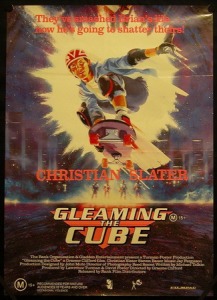 Brian Kelly (Christian Slater) is a California skater with a rebellious attitude and an adopted Vietnamese brother named Vinh (Art Chudabala). When the movie starts, all Brian cares about is not selling out and finding empty pools to skate. He even hires an airplane to fly him and his friends over Orange County so they can get a bird’s-eye view of the layout. Vinh is more worried about his job with the Vietnamese Anti-Community Relief Fund. The fund has been set up to send medical supplies to Vietnam but, when Vinh comes across a discrepancy in the shipping records, he realizes that something else is going on. When Vinh turns up dead in a hotel room, everyone else may believe that it is suicide but Brian knows that his brother was murdered. With the help of his fellow skaters and a sympathetic cop (Steven Bauer), Brian sets out to bring his brother’s killers to justice.
 Through the Shattered Lens