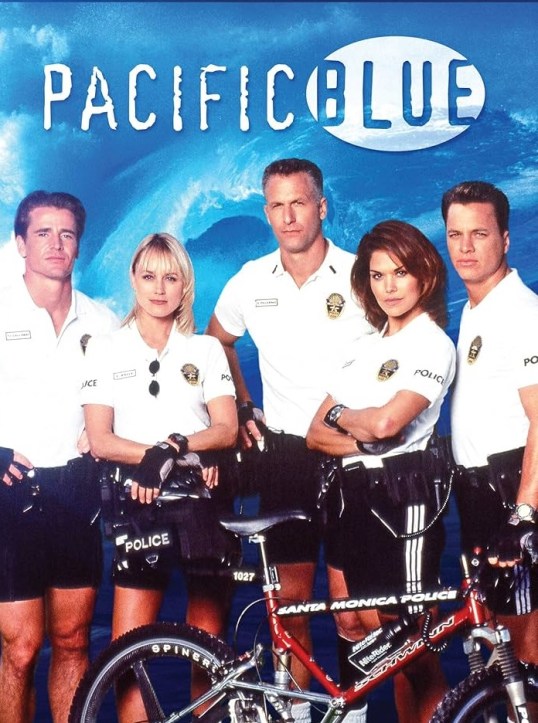
Welcome to Late Night Retro Television Reviews, a feature where we review some of our favorite and least favorite shows of the past! On Tuesdays, I will be reviewing Pacific Blue, a cop show that aired from 1996 to 2000 on the USA Network! It’s currently streaming everywhere, though I’m watching it on Tubi.
This week, two vigilantes disturb the peace, Cory meets a special guest star, and everyone continues to look stupid on their little bicycles.
Episode 3.13 “Avenging Angel”
(Dir by Terence H. Winkless, originally aired on December 14th, 1997)
This episode was dumb.
Cory is haunted by nightmares involving her mother, who died when Cory was 10. In her latest nightmare, she runs into her mother at a crime scene and her mom shoots her! Chris thinks that’s an odd dream and she’s right. Cory explains that her mom is just trying to get her attention. Cory believes that her mom is her guardian angel. Chris doesn’t know how to react to this because Cory is expressing an emotion that doesn’t involve being snarky or self-righteous.
When Cory is injured while chasing two Korean brothers (we’ll get to them in a minute), she has to go to rehab. Luckily, Olympic track medalist Florence Griffith Joyner is a patient at the same rehab clinic. Joyner takes Cory under her wing and encourages her to work hard and get her knee back into shape. When Cory says she’s thinking of leaving the force, Joyner tells her not to. “Thanks, FloJo,” Cory replies.
(Yes, Florence Griffith Joyner played herself. As an actress, she was a good athlete.)
As for the two Korean brothers, they are vigilantes who are beating up criminals on the boardwalk and becoming celebrities in their own right. Palermo views them as being a threat to the peace and he’s determined to catch them. Meanwhile, the Mob is determined to kill them and a very annoying talent agent is determined to sign them.
Ugh, what a stupid episode. Usually, I’m a sucker for episodes that deal with people coming to terms with the death of a parent. That’s something to which I can relate. I have no doubt that my mom is also looking over me. But, as much as I wanted to fully embrace Cory’s story, I couldn’t get past the fact that she went to rehab and just happened to meet an Olympic athlete. Maybe if Joyner has been a better actress, this storyline would have worked but, as it was, it just felt forced. There was really no reason why Joyner should have been so wrapped up in whether or not Cory decided to remain with the force.
As for the stuff with the brothers, the entire plotline felt like filler. The brothers couldn’t act. The actors playing the gangsters who wanted to kill the brothers couldn’t act. The talent agents who kept popping up and talking about how much they wanted to sign the brother, they also couldn’t act.
This episode was just painful and all the rehab in the world isn’t going to change that.
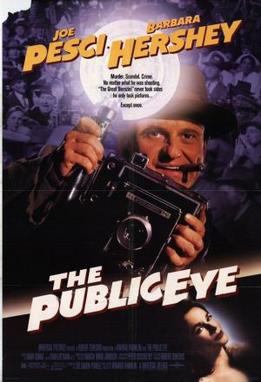
New York in the 1940s. Leon “Bernzy” Bernstein (Joe Pesci) is nearly a legend in the city, a freelance news photographer with a police radio in his car and a darkroom in his trunk. Bernzy is a solitary man who lives for his work, the type who has many acquaintances but few friends. He gets the pictures that no one else can get but his dream of seeing a book published of his photographs seems to be unattainable. As more than one snobbish publisher tells him, tabloid photographs are not art.
Bernzy is invited to a meeting with Kay Levitz (Barbara Hershey). Kay is the widow of one of Bernzy’s few friends. She has inherited a nightclub but now a mysterious man is claiming to be a former partner of her husband and says that he owns half of the club. She asks Bernzy to discover who the man is. Bernzy agrees and soon finds himself a suspect in a murder. Even as Bernzy tries to clear his name, he never stop looking for the perfect shot.
Joe Pesci made this neo noir shortly after winning an Oscar for Goodfellas. The Public Eye was an attempt to elevate Pesci from being a character actor to a leading man. It may not have accomplished that but it is still one of the better neo noirs of the 90s. Howard Franklin does such a good job of recreating the style of film noir that the movie seems like it’s in black-and-white even though it’s in color and Barbara Hershey is perfectly cast as a sultry femme fatale. The tough but eccentric Bernzy turns out to be a perfect role for Joe Pesci, who gives one of his best performances. This overlooked film is one to watch for.
Oh my God, I just watched the trailer for The Great Wall and it looks like it might actually be a lot of fun! Monsters are threatening to destroy the Great Wall of China but don’t worry! Matt Damon’s there and he has a bow and arrow! Add to that, the film is directed by the great Zhang Yimou and it was written by Max Brooks, the man who wrote World War Z!
Seriously, this looks like a lot of fun to me.
The Great Wall will hit theaters on February 17th, 2017.
Okay, I get it — fans of Max Brooks’ best-selling “zombie apocalypse” novel World War Z are pissed off about director Marc (Monster’s Ball, Quantum Of Solace) Forster’s big-budget, big-screen “adaptation” of it because the finished product bears essentially no recognizable similarity to its printed-page predecessor. Heck, some are even going so far as to say that they actually like the film, they just feel that it should be called something else.
On the other hand, it seems that more or less everyone who hasn’t read the book loves the movie.
Much as I’d enjoy picking a side in this, the latest great “genre geek debate,” I honestly can’t, simply because I don’t really fit into either of the “warring” camps, seeing as how I neither read the novel nor loved the film with the kind of awestruck wonder its most fervent partisans seem to be brimming over with.
Oh, sure, it was pleasantly entertaining enough — United Nations bad-ass-for-hire Gerry Lane (Brad Pitt — who, let’s face it, is probably contractually obligated to always play somebody at least a little bit cooler than the Average Joe) races against the clock, and around the globe, to keep his wife, Karin (Mireille Enos of TV’s The Killing) and their kids safe from a massive viral plague that essentially mashes together elements of the scenarios George Romero laid out in both The Crazies and his seminal “Living Dead” flicks, only with a much larger budget that enables the filmmakers to give us a more international perspective on the goings-on. Governments are strained to breaking point and/or collapse entirely, WHO and the world’s various military forces struggle to get a handle on things, no area is left unaffected, no one is safe —you get the picture.
The script went through four sets of hands — Babylon 5 creator and frequent comics scribe J. Michael Straczynski gave way to former Lost head honcho and occasional comics scribe Damon Lindelof who in turn gave way to Drew Goddard who in turn gave way to Matthew Michael Carnahan — and, as you can imagine, is something of a mess as a result. Fortunately, it never slows down long enough for you to fully realize that fact, and instead keeps you on the edge of your seat with its PG-13-level action and semi-violence (notice I don’t say anything about gore — sorry, die-hard zombie-holics) from the time it clocks in to the time it knocks off and heads for the bar around the corner.
The end result is something of a hustle — it’ll slowly dawn on you as you make your way home from the theater that what you just saw really wasn’t anything too special, but what the hell — you were too busy having fun to notice.
And that was probably the whole point, really. I don’t think Forster and his literal army of screenwriters set out to reinvent the wheel here or overturn the sacred “Romero Rules” permanently. They were just the guys brought in to make something of a damn popular book that Paramount bid a fortune to obtain the rights to and if, at the end of the day, all that survived of World War Z as most folks knew it was the title, well — that’s pretty much all they were paying for, anyway. Beyond that the only edicts from the studio “suits” were probably to land a huge star, load up on the CGI, and deliver a product that the average summertime movie-goer would find to be a reasonable enough investment of ten bucks and (roughly) two hours.
Judging it on that scorecard, you’d have to say they can all pat themselves on the back, say “mission accomplished,” and go home. Those hoping for a movie that would revolutionize the genre on celluloid the same way the book did in print are bound to be left feeling a bit disappointed, as is anyone who bothers to actually think about what they’re seeing while they’re seeing it, but for anyone and everyone else, hey — it’s a decent enough little thrill ride. Grab some popcorn, sit back, and please don’t struggle against your inner 12-year-old.
Now, as to the other raging debate splitting the internet about whether or not this is actually a horror movie or just a “thriller” with some genre trappings —
Forget it. I’m sooooo not going there. One nerd-controversy per review is my limit.
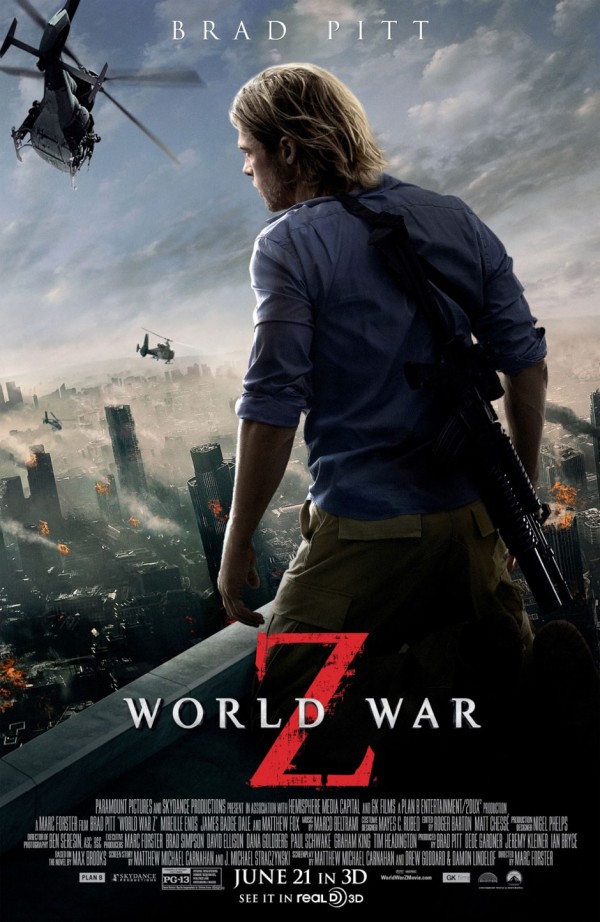
I’ll get this out of the way and just say it: World War Z the film pretty much has nothing in common with the acclaimed novel of the same name by author Max Brooks (reviewed almost at the very beginning of the site). Ok, now that we have that out of the way it’s time to get to the important part and that’s how did the film version turn out on it’s own merits.
World War Z was a film that took the long, winding and rough road to finally get to the big-screen. Whether it was the five different writers brought in to work on the script (J. Michael Straczynski of Babylon 5 fame came onboard first with Christopher McQuarrie coming unofficially to help tighten a few scenes in the end) to the massive changes made to the original source material that was bound to anger the fans of the novel, the film by Marc Forster had an uphill climb to accomplish even before the final product even came to market.
I was as surprised as man others were that the finished product was better than I had anticipated. Some had very low expectations about World War Z coming in due to the rumors and news reports coming in about the problems during production, but it doesn’t change the fact that the unmitigated disaster predicted by every film blogger and critic beforehand never came to fruition.
World War Z might not have been what fans of the novel had wanted it to be, but when seen on it’s own merit the film was both exciting and tension-filled despite some flaws in the final script and use of well-worn horror tropes.
The film begins with a visual montage interspersing scenes of nature (particularly the swarming, hive-like behavior of certain animals like birds, fish, and insects), alarmist news media reporting and the mindless celebrity-driven entertainment media that’s so big around the world. From there we’re introduced to the main protagonist of the film in one Gerry Lane (played by Brad Pitt) and his family. We see that the Lane family definitely love and care for each other with his wife Karin (Mireille Enos in the supportive wife role) and their two young daughters, Rachel and Constance. The film could easily have spent a lot of time establishing this family and their relationship towards each other, but we move towards the film’s first major sequence pretty much right after the opening. It’s this choice to not linger on the characters too long that becomes both a strength and a weakness to the film’s narrative throughout.
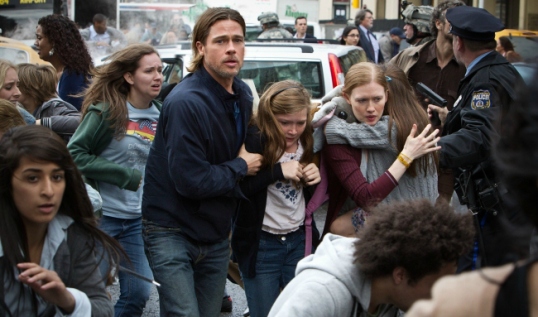
World War Z finally shows why it’s not your typical zombie film with it’s first major sequence in the center of downtown Philadelphia as Gerry and his family sees themselves in bumper-to-bumper traffic. As they wait there are some subtle hints that something might just be somewhat awry ahead of them as we see more and more police racing towards some sort of emergency ahead of the family and more and more helicopters flying overhead. There’s a brief lull in the scene before all hell breaks loose and the film’s zombie apocalypse aspect goes from 0 straight to 11 in a split second.
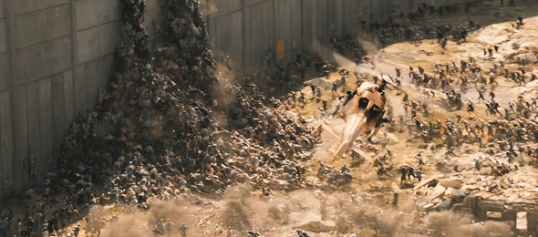
It’s this sequence of all-encompassing chaos overtaking a major metropolitan city seen both on the ground through the eyes of Gerry Lane and then on flying overhead wide shots of the city that gives World War Z it’s epic scope that other zombie films (both great and awful) could never truly capture. It’s also in this opening action sequence that we find the film’s unique take on the tried-and-true zombie. While not the slow, shambling kind that was described in the novel, these fast-movers (owes a lot more on the Rage-infected from 28 Days Later) bring something new to the zomgie genre table by acting like a cross between a swarm of birds or insects with the rapidly infectious nature of a virus.
These zombies do not stop to have a meal of it’s victims once they’ve bitten one but instead rapidly moves onto the next healthy human in order to spread the contagion it carries. We even get an idea of how quickly a bitten victim dies and then turns into one of “Zekes” as a soldier has ended up nicknaming them. It’s this new wrinkle in the zombie canon that adds to the film’s apocalyptic nature as we can see just how the speed of the infection and the swarm-like behavior of the zombies could easily take down the emergency services of not just a city and state but of entire nations.
World War Z works best when it doesn’t linger too long between action sequences. Trying to inject some of the themes and ideas that made the novel such a joy to read only comes off as an uncomfortable attempt to try and placate fans of the novel. When we get scenes like Philadelphia in settings like Jerusalem and, in smaller scales but no less tense, like in South Korea and on a plane, the film works as a nice piece of summer action fare. This works in the first two thirds of the film but a sudden shift in the final third in Cardiff, Wales could be too jarring of a tonal shift in storytelling for some.
While the change from epic and apocalyptic to intimate and contained in the final third was such a sudden change this sequence works, but also shows just how bad the original final third of the film was to make this sudden change. It proves to be somewhat anticlimactic when compared to the epic nature of the first two-thirds of the film. We get a final third that’s more your traditional horror film. In fact, one could easily see World War Z as two different films vying for control and, in the end, the two halves having to try to co-exist and make sense.
World War Z doesn’t bring much of the sort of societal commentaries and themes that we get from the very best of zombie stories, but it does bring the sort of action that we rarely get from zombie films. The film actually doesn’t come off as your traditional zombie film, but more like a disaster story that just happened to have zombies as the root cause instead of solar flares, sudden ice age or alien invasion.
So, while World War Z only shares the title with the source novel it was adapting and pretty much not much else, the film wasn’t the unmitigated disaster that had been predicted for months leading up to it’s release. It’s a fun, rollercoaster ride of film that actually manages to leave an audience wanting to know more instead of being bombarded with so much action that one becomes desensitized and bored by it. There’s no question that a better film, probably even a great one, lurks behind the fun mess that’s the World War Z we’ve received, but on it’s own the film more than delivers on the promise that most films during the summer fails to achieve and that’s to entertain.
We see the release of a new trailer for this summer’s epic zombie film based on the equally epic novel of the same name by Max Brooks.
World War Z is already the most expensive zombie film ever made with a budget rumored to be between 125-200 million dollars. Some of this has been due to the delays in filming and most of it seems to stem from a massive rewrite of the third act. Damon Lindelof was first hired to rewrite but due to prior commitments the job went to Drew Goddard. Such a rewrite also meant reshoots had to be done which took another seven weeks of shooting.
All in all, World War Z is one troubled film before it even gets to the general public.
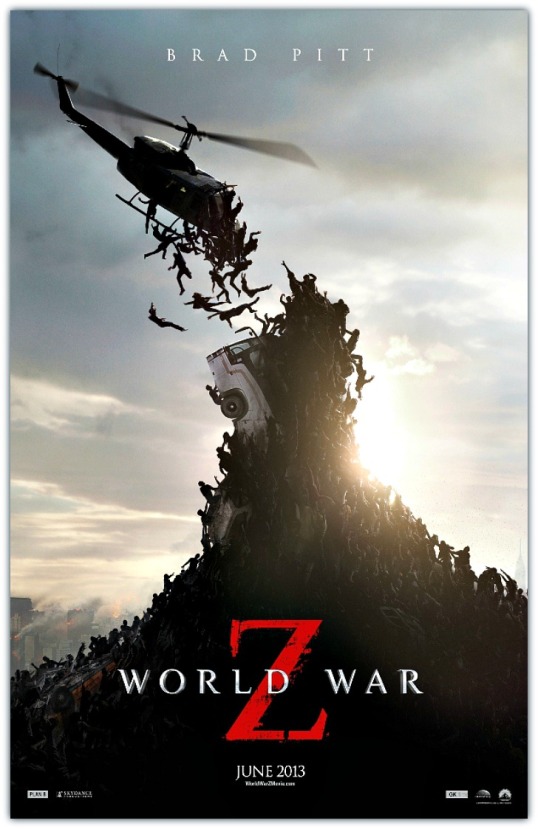
Yet, it is also one of the more anticipated films for this summer. Some from fans of the genre who just can’t get enough of zombie films. Some from people wanting to see just what sort of zombie film ends up with a budget around 200 million dollars. From the trailer we’ve seen some of that money seem to have gone on some massive special effects sequences which includes swarming zombies of the Rage-infected kind. Then again we don’t really see the zombies close-up which tend to make them look like swarming ants from afar. Maybe the look of the zombies themselves have been saved for the release of the film.
This latest trailer actually gives a bit more of the plot of the film which puts Brad Pitt’s UN employee character to travel the world in search for the cause of the worldwide zombie pandemic. The speed by which things happen seems to have compressed all the events in the novel into a film of two hours. This, I’m sure will be a major contention with fans of the novel, but it looks like a decision by filmmaker to try and create a single narrative from a novel that was mostly single-hand accounts of the zombie war from survivors who have no connection with each other whatsoever.
We’ll find out in just under 3 months if this film will be a major flop or succeed despite all the stumbling blocks and problems throughout its production.
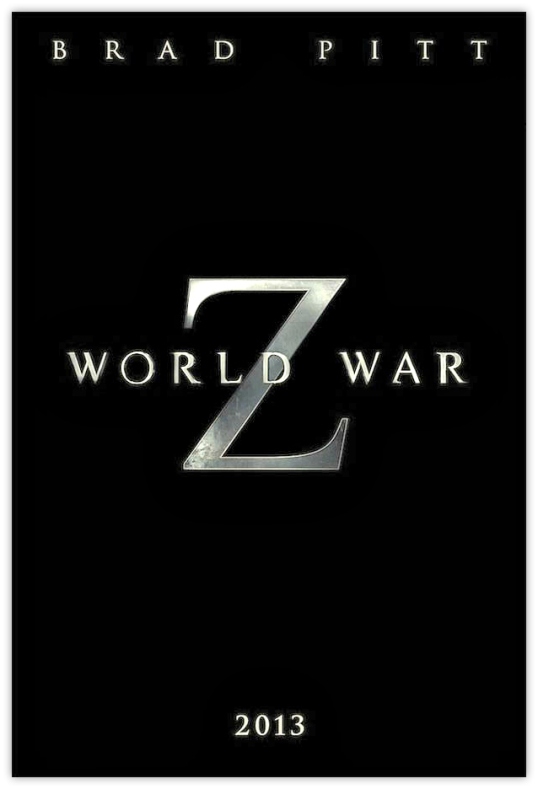
World War Z is set for a June 21, 2013 release date.
One of the films that was to have it’s day in the Super Bowl ad campaign rush was Paramount Pictures’ troubled epic zombie apocalypse film, World War Z.
Starring Brad Pitt and directed by Marc Forster, the film is an adaptation (very loosely adapted from the novel) of the novel of the same name written by Max Brooks. Anyone who is even remotely interested in the topic of zombie fiction (or that they’re real like certain awesome people) have read this novel and have been highly anticipating the film. When the first trailer was released several months ago the reaction to the changes made from book to film was a resounding “Huh” to “WTF?!” from fans.
Time will not be changing some of these reactions, but from the sudden release of the Super Bowl ad TV spot that the film will show during Sunday’s Big Game it looks like the film will take the basic premise of the novel and go it’s own way. The zombies being CGI when seen from a distance and moving like ravenous army ants (siafu as the Japanese call them which is also what the zombies were called in the novel).
The film seems to want to see the zombie apocalypse first-hand as it occurs and sped things up to bring more action to the proceedings. This is not a bad thing if the film had been titled other than World War Z, but since it needed to use that name the complaints by fans of the novel will continue. Just based on the trailer and this teaser spot alone it looks like there’s something interesting going on in this film that people will either love or hate. I’m hoping I’ll be of the former than the latter.
World War Z is set for a June 21, 2013 release date.
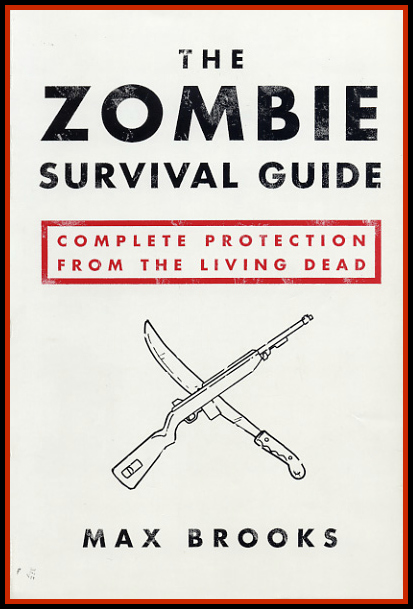
It’s not hyperbole to say that one of the best horror novels to come out in the past 20 years was written by Mel Brook’s son. A son who wrote comedy scripts for Saturday Night Live. Max Brooks before 2003 was relatively unknown to genre fans. This changed post-2003 with the release of his tongue-in-cheek how-to book, The Zombie Survival Guide. It was a book that was slow to succeed in terms of sales but grew in popularity as more and more fans of the zombie genre heard about it and recommended it to like-minded friends. Just like the subject matter Brooks worte about this guide spread in a geometric pattern and more and more people began to know.
In 2006, Brooks released the companion piece to his best-selling guide with the fictional oral history account of the aftermath of a zombie apocalyptic war and how humanity fought back from the brink of extinction. This novel was World War Z and even before one could say “this book could be made into a film…” the film rights to the book became a hot commodity in Hollywood. In the end, Brad Pitt’s Plan B production company won the right to adapt the novel into a feature-length film.
After several years of trying to create a screenplay from the documentary-style and sprawling narrative of the novel the film finally went into production in mid-2011 with a screenplay that took some of the important events from the novel and set the film during the war itself as it unfolded instead of flashbacks as recounted by those who survived. This change has angered fans of the book and their anger and frustration went up another notch when some leaked on-the-set footage showing the zombies as more of the running-style zombies than the slower ones in the novel.
Another stumbling block pushed the film from a holiday 2012 release date to a summer 2013 release as Paramount looked to having World War Z as part of their 2013 summer blockbuster slate of films. This film has had so much issues and problems that it took to Brad Pitt finally agreeing to headline the cast to get the film finally made. So, instead of a film the chronicles the stories of the war’s survivors a decade after the war ended we now have a film that skews more towards a film that’s heavy on action set-pieces and globe-trotting. Someone on IGN.com has called World War Z (after seeing the attached official trailer) as 2012 with zombies. The first official trailer does seem to make it look like that.
As a fan of the novel I’m saddened by the changes, but I will say that the trailer does make this film look very epic. I’m more than willing to watch this film (who am I kidding I will watch this film and probably more than once or twice.) and look at it as the filmmakers’ own take on the novel. I mean if it turns out to be great on it’s own then hooray. If it sucks then I still have my novel to go back to. Plus, this is the first zombie film that will show the pandemic in global settings and proportions. This will be the first time we get to see this on film and not just on the written page.
My own review of the novel gives an idea just how different the film will be from the source material.
The latest choice for “Song of the Day” came to me while I was reading the last third of Max Brooks’ very awesome novel World War Z. In a later chapter in the novel when the survivors of the United States during an ongoing zombie apocalypse finally go on the offensive and leave the relative safety of the West Coast and the Rockies which provide a natural barrier from the hundreds of millions of zombies to the east. During this offensive the forces uses a particular song to lure zombies into an ambush zone where they could be destroyed en masse. The song the soldiers and their superiors used to help lure the undead and to also pump up the men was Iron Maiden’s “The Trooper”.
The song is another one of those Iron Maiden songs which takes its inspiration from a moment in military history and from a classic English poem. This time around the moment in military history is the Charge of the Light Brigade during the the Battle of Balaclava of the Crimean War (1854). The English poem which inspired the song was Lord Tennyson’s poem of the same name. This is classic heavy metal at its best. We have the galloping bass rhythm which sounds like the Light Brigade mentioned above making their courageous, but ill-fated charge into the muskets and cannons of the Russian forces.
I could continue to try and describe all the other musical details about this song, but I feel I’m ill-equipped to do so. I’m sure the site’s own music and metal expert necromoonyeti could better describe the awesome guitar work by Dave Murray and Adrian Smith during this song.
One thing that I am sure of is that if there ever was a zombie apocalypse and I found myself one of the survivors looking to take back the country then this would be part of my playlist when I’m destroying zed heads.
The Trooper
You’ll take my life but I’ll take yours too You’ll fire your musket but I’ll run you through So when you’re waiting for the next attack You’d better stand there’s no turning back
The bugle sounds as the charge begins But on this battlefield no one wins The smell of acrid smoke and horses breath As you plunge into a certain death
Ooooohhhhhhh
The horse he sweats with fear we break to run The mighty roar of the Russian guns And as we race towards the human wall The screams of pain as my comrades fall
We hurdle bodies that lay on the ground And as the Russians fire another round We get so near yet so far away We won’t live to fight another day
Solo
Ooooooooohhhhhhh
We get so close near enough to fight When a Russian gets me in his sights He pulls the trigger and I feel the blow A burst of rounds takes my horse below
And as I lay there gazing at the sky My body’s numb and my throat is dry And as I lay forgotten and alone Without a tear I draw my parting groan
I am what one would call an aficionado of all things zombie. The subject has been an interest of mine since I saw my very first true zombie film: Night of the Living Dead. Romero’s seminal work made such an impact in my young mind that, despite the primal sensation of fear I felt while watching it, my curiosity and imagination won out. I was stilled scared shitless for the next couple weeks once night arrived, but it didn’t stop me from thinking about it then letting my young mind start thinking of what I would do if put in a similar situation. It’s almost two decades since that moment and I still think about such things whenever the topic turns to things zombies.
I first came across Max Brooks’ book when I was browsing the web and decided to check out a site a fellow zombie-fan had recommended I visit: HomePageoftheDead.com. It was my first time visiting the site and right from the beginning I saw a link that had Brooks’ book title on it. I clicked it to see what it was all about. Lo and behold it was a for real survival guide on what to do if and when a zombie outbreak ever occurred. I knew it was one of those satire, gag books taking a ludicrous, albeit funny situation and writing a faux-serious work of instructions and guidelines around it. It didn’t take me long to check if Amazon had the book for sale and it did to my surprise. The moment I received the book I sat down and read it from beginning to end in a day’s time.
Max Brooks’ experience as a comic staff writer for Saturday Night Live and being Mel Brooks’ son probably helped in keeping the book from being too campy and also overly serious. Brooks’ hit the right balance of seriousness and yet giving every procedural instructions on how to survive and the optimal way of surviving a darkly black comedic tone to it all. Part of me was thoroughly amused and even laughed out loud a few times as I read through the guide, but part of me also felt a bit of dread in how real his descriptions were and how much common sense his survival guide had for the reader to take note of. I thought the final chapter describing documented reports of zombie outbreaks throughout man’s history was especially well-done. It sure made some of the darker moments in man’s history take on a much more horrifying note.
Max Brooks’ Zombie Survival Guide has been a great addition to my collection of dvds, comics and novels about the zombie subgenre. It also helped continue my on-going interest in the what-if scenarios of such an event from ever happening. His writing balances both satire and horror and the book is much better than it should be because of it. Being a zombie aficionado I would highly recommend this to like-minded readers and would gradually introduce it to those who have no notion of such a topic. One never knows when the fantastic suddenly becomes horrifyingly real. When and if it ever does happen, I know this book will have served me and mine well.
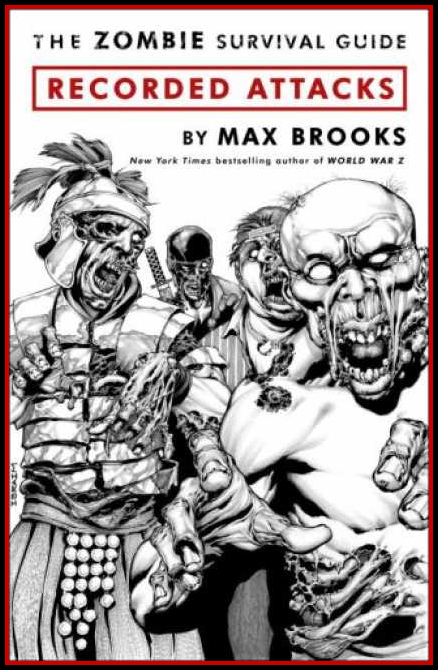
I would also like to point out that in addition to this book is a companion volume released by the comic book publisher, Avatar Press which takes those so-called historical accounts of zombie outbreak incidents and creates a graphic novel out of it. Again, Max Brooks has a hand in writing this book. He took some of the longer entries in the survival guide’s last chapter and rewrites them to better fit the comic book format.
The artwork by Ibraim Roberson for The Zombie Survival Guide: Recorded Attacks are some of the finest black & white inks I’ve seen and definitely one of the best zombie artwork. Roberson really captures the grotesque and hungry nature of the undead as Brooks’ describes them. Even though there’s no color involved in all the visuals it still doesn’t diminish the scenes of gore. I think it actually makes the scenes even more effective as the reader imagines the colors being there while reading them. There was no need to add to the shock value when it was already shocking.
While I wish they could’ve included every historical entry from The Zombie Survival Guide in this graphic novel I understand that to do so would mean a book at least over a hundred pages or more in size. Maybe there’ll be a plan to make a second volume if this first one sells well. Fans of Max Brooks’ guide can only hope that this indeed is what he and Avatar Press have in mind. Despite not having everything I expected it to the graphic novel was still a find companion piece to Brooks’ Zombie Survival Guide with some of the best looking zombie artwork outside of The Walking Dead‘s Tony Moore and Charlie Adlard.
 New York in the 1940s. Leon “Bernzy” Bernstein (Joe Pesci) is nearly a legend in the city, a freelance news photographer with a police radio in his car and a darkroom in his trunk. Bernzy is a solitary man who lives for his work, the type who has many acquaintances but few friends. He gets the pictures that no one else can get but his dream of seeing a book published of his photographs seems to be unattainable. As more than one snobbish publisher tells him, tabloid photographs are not art.


 Through the Shattered Lens