Embracing the Melodrama Part II #26: Cleopatra (dir by Joseph L. Mankiewicz)


Cleopatra_posterWhile watching the 1963 best picture nominee, Cleopatra, I had many thoughts.  The film lasts over 4 hours so I had a lot of time to think.

For instance, I often found myself impressed by the sheer size of the production.  I marveled at the recreation of ancient Greece and Rome.  I loved looking at the ornate costumes.  I loved feeling as if I was taking a look back at what Rome may have actually looked like at the height of the Roman Empire.  Making it all the more impressive was that this film was made in the days before CGI.  When the film’s Romans walked through the streets of Rome, they weren’t just actors standing in front of a green screen.  They were walking down real streets and surrounded by real buildings.  It reminded me of the awe and wonder that I felt when I was in Italy and I was visiting the ruins of ancient Rome.

(I don’t know if any of the cast accidentally flashed everyone like I did when I visited during Pompeii on a windy day but considering how short some of the skirts on the men were, it wouldn’t surprise me if they did!)

And, as I marveled at the recreation of Rome, I also thought to myself, “How long is this freaking movie?”  Because, seriously, Cleopatra is an amazingly long movie.  It’s not just the film is over four hours long.  It’s that the film feels even longer.  Gone With The Wind, The Godfathers Part One and Part Two, Once Upon A Time In America; these are all long films but, because they’re so great, you never find yourself checking the time while watching.  Cleopatra is the opposite of that.  Cleopatra is a film that, at its slowest, will make you very much aware of how many seconds are in a minute.

I found myself marveling at the lack of chemistry between Elizabeth Taylor and Richard Burton.  If anything, this is the most shocking thing about Cleopatra.  If Cleopatra is famous for anything, it’s famous for being the film where Elizabeth Taylor (cast in the role of Cleopatra) first met Richard Burton (who was playing Mark Antony).  Their affair dominated the gossip headlines.  (If TMZ and YouTube had been around back then, there would be daily videos of Richard Burton punching out paparazzi.)  Cleopatra was the first of many big-budgeted, overproduced films that Taylor and Burton co-starred in.

(Then again, they also starred in Who’s Afraid of Virginia Woolf, a film that is almost the exact opposite of Cleopatra.)

In the role of Mark Antony, Burton spends most of the film looking absolutely miserable.  Elizabeth Taylor, meanwhile, seems to be having a lot more fun.  It’s almost as if she understood what Cleopatra was going to become so she went out of her way to give the type of over-the-top performance that the film deserved.  The same can also be said about Rex Harrison, who plays Julius Caesar and who, perhaps because he appears to have shared her attitude, actually does have some chemistry with Taylor.

Actually, if anyone gives a truly great performance in Cleopatra, it’s Roddy McDowall.  McDowall plays the future Emperor Augustus with a mesmerizing intensity.  Again, McDowall’s performance is not exactly subtle but Cleopatra is not a film that demands subtlety.

As the film finally neared its end, I found myself wondering how Joseph L. Mankiewicz went from directing two close to perfect films, A Letter To Three Wives and All About Eve, to directing this.  Even more amazing, Mankiewicz had previously directed one of the best Roman Empire films ever, 1953’s Julius Caesar.  (When compared to Cleopatra, the low-key and thoughtful Julius Caesar appears to have been filmed on an entirely different planet.)  Well, in Mankiewicz’s defense, he was not the original director.  He was brought in to replace Rouben Mamoulian, who had previously attempted to make the film with Joan Collins, Ben-Hur‘s Stephen Boyd, and Peter Finch.  When Mankiewicz was brought in, the cast was replaced with Taylor, Burton, and Harrison.  Between the expensive stars, the troubled production, and all of the offscreen romantic melodrama, Mankiewicz probably did the best that he could.

Today, Cleopatra is mostly interesting as an example of a film from the “Only Gigantic Productions Will Save Us From Television!” era of Hollywood filmmaking.  Cleopatra started out as a $2,000,000 production and ended up costing $31,000,000.  It was the number one film at the 1963 box office and it still nearly bankrupted 20th Century Fox.  While the film does have some kitsch appeal, the critics hated it and it’s easy to see why.

And yes, it was nominated for best picture of the year, a tribute to the size of the production and the determination of 20th Century Fox to get something — anything — in return for their money.

Cleopatra is a bit of a chore to sit through but it can be fun if you’re in a snarky mood.  It’ll do until the inevitable Angelina Jolie remake comes along.
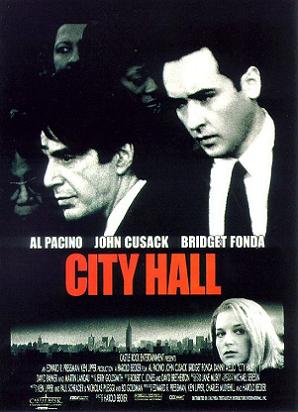
Shattered Politics #58: City Hall (dir by Harold Becker)


City_hall_ver1

Interestingly enough, New York City may be the center of wealth and politics in the United States but being Mayor of New York rarely leads to any sort of greater office.  Though the Americans Elect people tried to unsuccessfully recruit Michael Bloomberg in 2012 and there’s a few deluded souls who seem to think that Bill de Blasio could run and win in 2016, only three NYC mayors have taken the plunge and actually run for President.  Of the three of them, DeWitt Clinton was the most successful.  He not only won the Federalist nomination but he came close to beating James Madison in the election of 1812.  However, both John V. Lindsay and Rudy Giuliani were forced to end their campaigns when their electoral success in New York failed to translate into votes outside of the Northeast.

And that’s the thing really.  Everyone in America knows that New York is an important city, perhaps the most important city in the United States.  And they resent the Hell out of it.  It’s kinda like how the rest of country hates my home state of Texas because they need our oil more than we need … well, whatever the Hell it is that the rest of the country brings to the table.

I mean, let’s face it.  There’s a lot of resentment out there.  And that resentment will probably keep anyone from going from Gracie Mansion to the White House.

That’s one of the problems that I had with the 1996 film City Hall.  In order for City Hall to work, you have to believe that Mayor John Pappas has a legitimate chance to not only be nominated for President but to win the election as well.  At the start of the film, we’re informed by Deputy Mayor Kevin Calhoun (John Cusack, speaking in one of the worst attempts at a Louisiana accent that I’ve ever heard) that Pappas is the greatest mayor that New York City has ever had.  I guess that might be true, even though we really don’t see any evidence of that fact.  (Pappas does get to deliver a few monologues about how much he loves New York but if love is all it took, I’d be a really kick ass Prime Minister of Canada.)  However, it’s because Mayor Pappas is such a product of New York City that he’d probably never be able to actually win a primary in Vermont and capture Iowa’s electoral votes.  That’s one reason why it’s difficult to buy Mayor Pappas as a future President.

The other reason is that Mayor Pappas is played by Al Pacino.  And we’re not talking about Godfather or Dog Day Afternoon Al Pacino here.  Instead, we’re talking about raspy voiced, constantly bellowing, thousand-yard state Al Pacino.  As played by Al Pancino, it takes only one look at Mayor Pappas to imagine thousands a middle American voters running in terror away from the voting booths.

(One gets the feeling that if a large group of police officers ever turned their back on Mayor Pappas, he would immediately start jumping up and down while yelling, “YOU ARE TURNIN’ YOUR BACKS ON DA MAYOR HERE!  WHAT DA FUCK IS GOIN’ ON WITH THIS SHIT HERE!?”)

That said, there’s another reason why Mayor Pappas may never be President.  There’s been a shooting.  An undercover cop and a drug dealer shot each other.  A little boy was hit by a stray bullet.  The little boy is black but, oddly enough, nobody in the film ever suggests that there was any sort of racial element involved.  Instead, Mayor Pappas goes to the boy’s funeral and is enthusiastically applauded by the entirely African-American congregation.

It turns out that the drug dealer is the nephew of a mafia don.  He should have been in prison at the time of the shooting but instead, he was given an early release by a seemingly incompetent judge (Martin Landau).  As Calhoun and a lawyer named Marybeth Cogan (Bridget Fonda, giving a good performance in a generically written role) investigate how the dealer came to be released, they discover that local politician Frank Anselmo (Danny Aiello) may have had something to do with it.  Calhoun also discovers that his idol, Mayor Pappas, may know more than he’s saying as well…

If you do happen to watch City Hall, be sure to compare Danny Aiello’s performance with Al Pacino’s.  Both Aiello and Pacino are playing larger-than-life characters.  And both Aiello and Pacino have a tendency to bellow and to play big.  But, whereas Pacino’s performance feels forced and oddly empty, Aiello’s performance feels totally natural.  You actually believe that Aiello could be elected to a citywide office whereas Pacino — or at least the version of Al Pacino that shows up for City Hall — seems like he’d have a hard time getting elected to a student council, much less Mayor of America’s largest city.

Anyway, City Hall is currently making the rounds on cable, which is how I saw it.  It had the potential to be an interesting look at urban politics but, ultimately, it just doesn’t work.  To a certain extent, I hate to be negative about any film that, like City Hall, has its heart in the right place but the movie just doesn’t work.


6 Trailers To Make You Go “Yay!” Or “Bleh!”


Hi out there.  As I sit here typing this, I am so freaking sick, it is not even funny!  Seriously.  I’m congested, I’m running a fever, and I’m taking way too many naps while everyone else in the world is having a lot of fun playing outside and going to the new Twilight film.  However, despite feeling all bleh, nothing will stop me from sharing another edition of Lisa Marie’s Favorite Grindhouse and Exploitation Film Trailers.  NOTHING!

1) A Nightmare On Elm Street (1984)

One of the classic “old school” horror trailers.  The bit with the stairs always freaks me out.

2) Alone in the Dark (1982)

Not to be confused with the later film from Uwe Boll.

3) Without Warning (1980)

Martin Landau was apparently busy in the early 80s.

4) Deadtime Stories (1986)

This film appears to be an alternative take on beloved bedtime stories and…wait.  Bedtime.  Deadtime.  Hey, I just got that!  Neat.

5) Hello Mary Lou: Prom Night 2 (1987)

Apparently, this film has next to nothing to do with the original Prom Night and you have to ask yourself: if there’s no elaborate disco dance-off, then what’s the point?  Still, I own this one on DVD and I’ll be watching it soon if I don’t start to feel better.

6) Pet Sematary 2 (1992)

I remember that I saw this movie on TV one late night when I was like ten or eleven and oh my God, it scared the Hell out of me!  I mean, literally everyone dies in it!  Even kids!  Trust me, that’s a really scary thing to see when you’re still just a kid yourself.  But anyway, I rewatched it last year and was mostly bored.