Retro Television Review: Homicide: Life On The Street 1.6 “Three Men And Adena”


Welcome to Retro Television Reviews, a feature where we review some of our favorite and least favorite shows of the past!  On Sundays, I will be reviewing Homicide: Life On The Street, which aired from 1993 to 1999, on NBC!  It  can be viewed on Peacock.
This week, we finally meet the arraber.

Episode 1.6 “Three Men and Adena”

(Dir by Martin Campbell, originally aired on March 3rd, 1995)

This week’s episode opens with Tim Bayliss and Frank Pembleton preparing to interrogate Risley Tucker (Moses Gunn).  Tucker is the arraber who Bayliss believes is responsible for murdering Adena Watson.  Adena used to work for Tucker, helping him take care of his horse before her mother told Adena that she didn’t want her spending so much time with Tucker.  As Tucker himself puts it, people tend to view arrabers (men who sell fruits and vegetables from a horse-drawn carriage) as being nomads.  As Tucker himself is a recovering alcoholic who was previously charged with (but not convicted of) statutory rape, it’s understandable why Adena’s mother didn’t want her spending time alone with him.  It’s also easy to understand why Bayliss is convinced that Tucker is guilty.  Pembleton, meanwhile,  is not as convinced.

Bayliss and Pembleton have already brought Tucker down to the station three times and interrogated him.  Giardello also points out that Tucker has been interviewed a total of 10 times about the case and, if he’s not charged after his latest interrogation, he’ll have grounds for a harassment suit.  Bayliss and Pembleton have fourteen hours to interrogate Tucker one final time and try to get a confession out of him.  After fourteen hours, they have to either arrest Tucker or send him home.  Giardello says that regardless of what happens, Bayliss has to go back into the regular rotation after this interrogation.  Bayliss’s time of exclusively investigating the Watson case is coming to an end.

Tucker arrives at the station and Bayliss and Pembleton get to work, trying to manipulate him into slipping up and confessing.
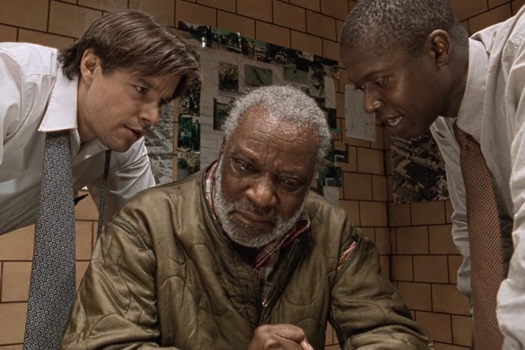
Considering how much they initially disliked each other, it’s interesting to watch how smoothly Bayliss and Pembleton work together in this episode.  Bayliss takes on the role of the “bad cop,” flat out accusing Tucker of killing Adena and shoving what little evidence they have in Tucker’s face.  At first, Pembleton plays the “good cop,” asking Tucker about what it’s like to be an arraber before moving on to discussing Tucker’s alcoholism.  Tucker says that he hasn’t had a drink in sixteen months.  Even when Pembleton asks if it’s possible that he slipped up and had a drink and blacked out on the night that Adena died, Tucker insists that he hasn’t touched a drop in sixteen months.

Bayliss and Pembleton work well together but Tucker remains adamant that he did not kill Adena.  Even when Bayliss threatens to press Tucker’s face against a hot pipe, Tucker swears he didn’t kill Adena.  Even when Pembleton gets Tucker to admit that he had feelings for Adena, Tucker says he didn’t kill Adena.  Tucker defiantly demands to take a polygraph and he passes it.  Bayliss, knowing that polygraphs are inadmissible in court and are hardly reliable arbiters of the truth, tells him that he failed.  At one point, the emotionally exhausted Tucker says that he’s not even sure if he’s innocent or not anymore.  That’s as close as Tucker comes to confessing.

As the interrogation wears on, Tucker starts to fight back and it’s somewhat jolting to realize that he’s been aware of how Bayliss and Pembleton have been manipulating him from the start.  He accuses Pembleton of thinking that he’s better than other black people.  He accuses Bayliss of having a dark side, pointing out that Bayliss was prepared to torture him to get a confession to a crime that Tucker insists he didn’t do.  It’s obvious that, in both cases, Tucker has correctly read both men.  Pembleton and Bayliss react by ganging up on Tucker, bombarding him with questions.  Tucker breaks down and starts to cry but, as time runs out, he continues to insist that he didn’t kill Adena Watson.

In the end, Tucker ends up sitting in the break room, watching television and waiting for someone to take him home.  Bayliss packs up all of the evidence in the Watson case, knowing that he failed to get the confession that he needed.  Despite not getting the confession, Bayliss has finally won Pembleton’s respect.  Pembleton tells Bayliss that he now believes Tucker is guilty.  Bayliss admits that he’s no longer as sure as he once was.

It says something about the strength of this episode that I’m not fully convinced of Tucker’s guilt as well.  When the episode started, I was sure that the arraber was guilty.  By the time it ended, my feelings were a bit more mixed.  For all of the emotional turmoil that Tucker went through over the course of the interrogation, he remained adamant that he didn’t kill Adena Watson.  Tucker confessed to being an alcoholic.  He confessed to having gotten into fights in the past.  He confessed to having pedophiliac feelings towards Adena.  But the only time he even slightley wavered in his claim that he didn’t kill Adena was when he was so exhausted that he barely knew what he was saying.  As well, the evidence against him was almost entirely circumstantial.  Evidence was found that Adena had been in Tucker’s barn but there was no way to prove that she was there the night she died.  Tucker’s barn did mysteriously burn down after Adena’s murder but there was no way to prove that Tucker burned it down to hide evidence.  I suspect Risley Tucker probably was guilty.  But if I was on a jury, I’d probably have to say that, without a confession, there was too much reasonable doubt.

By the end of the interrogation, all three men are exhausted.  The viewer is exhausted too!  This is an intense episode, one that plays out like a particularly kinetic, three-person play.  Kyle Secor and Andre Braugher continue to prove themselves to be a brilliant team but, in this episode, they’re equally matched by Moses Gunn, who keeps you guessing as far as Risley Tucker’s guilt or innocence is concerned.  Gunn, who died a few months after this episode aired, gives a performance that leaves you feeling as conflicted about Tucker as the two detectives.  If Tucker is guilty, then he’s a soulless monster who has gotten away with murder.  If Tucker is innocent, then we’ve just spent 50 minutes watching an elderly, recovering alcoholic go through a truly Hellish experience.  As the episode ends, the viewer is aware that all three of the men will be changed forever as a result of the 14 hours they spent in the box.

This was an outstanding episode, one that ended on a note of sadness.  Adena Watson’s killer will never be caught.  If Tucker did it, he got away with it.  If Tucker didn’t do it, Bayliss and Pembleton’s obsessive pursuit of him means that the real killer is probably already far away from Baltimore.  Not every case gets solved and not everyone gets justice.  To quote Casino’s Ace Rothstein, “And that’s that.”
 

Retro Television Review: Homicide: Life on the Street 1.2 “Ghost of a Chance”


Welcome to Retro Television Reviews, a feature where we review some of our favorite and least favorite shows of the past!  On Sundays, I will be reviewing Homicide: Life On The Street, which aired from 1993 to 1999, on NBC!  It  can be viewed on Peacock.

This week, the search for Adeena Watson’s murderer begins.

Episode 1.2 “Ghost of a Chance”

(Dir by Martin Campbell, originally aired on February 3rd, 1993)

There’s been a murder in Baltimore.  That, in itself, is not news.  The pilot firmly established that murder is a fact of life in Baltimore.  But, the victim of this crime is an 11 year-old girl named Adeena Watson, who left her home to go to the library and who never returned.  The press is covering every detail.  The police brass want an arrest and they want an arrest quickly.  And the primary detective on the case is rookie Tim Bayliss, who has never even worked a murder case on his own before.  Giardello refuses to replace Bayliss but he also makes it clear that he needs Bayliss to bring him something.

As for Bayliss, he spends most of this episode struggling.  Not only does he not have the respect of his fellow detective but he also, as a rookie, doesn’t even have a desk until Giardello, in a fit of anger, knocks everything off an unoccupied desk and awards it to Bayliss.  (So, was that desk just sitting there the whole time?  I thought they didn’t have any available desks.)  Because this crime is what is known as a “red ball,” (i.e., a murder that has attracted the attention of the media and the public), every detective is looking for Adeena’s murderer.  While Bayliss obsesses on who Adeena was before she was killed, the rest of the squad does the practical things, like talking to neighbors and bringing in all of the city’s sex offenders for interrogation.

My heart broke for Bayliss while watching this episode.  Kyle Secor did a good job of capturing both Bayliss’s outrage over the crime and his fear of failing to solve his first case as a primary.  While Bayliss stared at Adeena’s body in the alley, Munch, Lewis, and Crosetti debated sports.  And while their attitude may have seemed callous, this episode established that disconnecting is the only way to handle working Homicide.  Bayliss, having not learned how to disconnect, grows more and more obsessed with Adeena.  I cheered a little when Bayliss finally stood up for himself and even won the grudging respect of Frank Pembleton.  That said, the change in Bayliss happened almost too quickly to be credible.  Apparently, all it took was for Giardello to give him a desk for Bayliss to go from being meek and overwhelmed to being a confident and take-charge detective.

While Bayliss searched for Adeena’s killer, Much and Bolander dealt with a murder that happened in a wealthy neighborhood.  The killer (Gwen Verdon) was a wife who snapped after 60 years of marriage.  As she explained to Bolander and Munch, she and her husband had earlier promised each other that they wouldn’t get a divorce until the children died.  Bolander has a crush on the coroner, Dr. Blythe (Wendy Hughes), but he’s worried about getting back in the dating game after his own divorce.  When Munch asks Bolander how old he is, Bolander replies, “48.”  Ned Beatty was a great actor and I’ve never seen a bad Ned Beatty performance.  That said, it’s also hard for me to think of any film where he looked a day under 50.

Meanwhile, Kay tries to get a confession from a guy who is about to go on trial for murder.  Felton laughs when Kay says that she was visited by the ghost of the guy’s victim.  However, Felton makes up for being a jerk by helping Kay find the murder weapon.  This whole subplot was odd to me, largely because Kay really doesn’t come across as the type to believe in ghosts.  But whatever works, I guess!  Melissa Leo and Daniel Baldwin did a good job in this episode, selling a storyline that had the potential to be a little bit too cute for its own good.

As the episode ended, the killer of Adeena Watson had yet to be captured.  While the other detective drank at a wharf bar, Bayliss went to Adeena’s memorial service and stared at her coffin, haunted.  It was a powerful moment but one that left the viewer worried about Bayliss’s sanity.  Earlier in this episode, Pembleton said that a murder that goes 72 hours without being solved will never be solved.  Bayliss is running out of time.


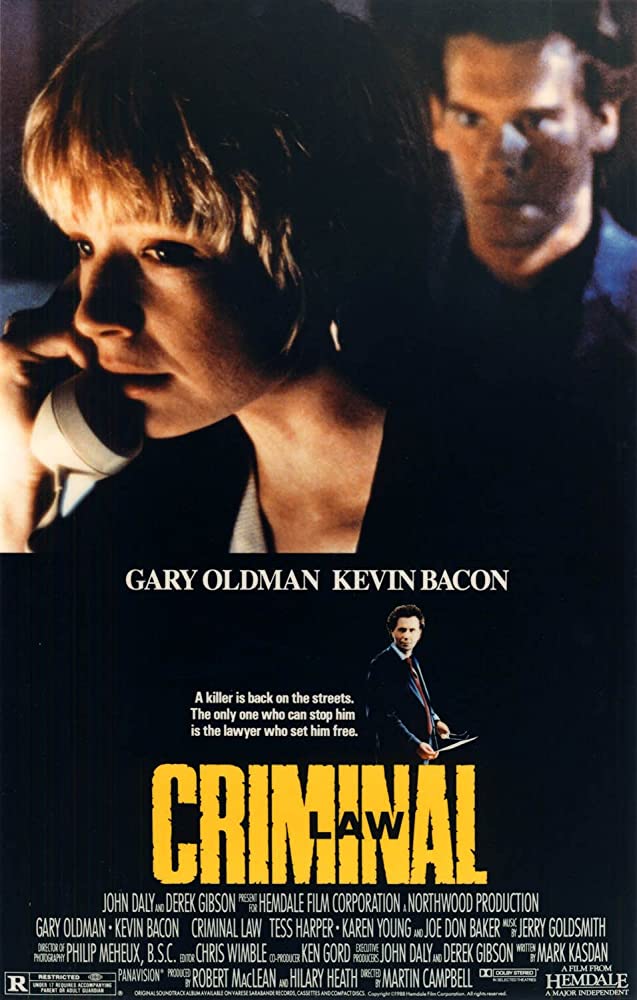
Criminal Law (1988, directed by Matin Campbell)


Gary Oldman is Ben Chase, a hotshot defense attorney who graduated from Harvard and now practices law in Boston.  That means that he gets to have a Boston accent and you know how much Gary Oldman loves playing a role with an accent.  Ben also has a pompadour because Gary Oldman always has something weird going on with his hair in almost every film he appears in.

Ben’s latest client is Martin Thiel (Kevin Bacon), a sociopathic rich kid who has been accused of murder.  Even though Ben thinks that Martin is probably guilty, he still gets Martin off the hook.  As soon as Martin get his acquittal, he starts murdering again.  Ben feels responsible so he decides that what he needs to do is trick Martin into implicating himself.  However, Martin knows what Ben is planning so, instead, he decides to frame Ben for the murders.  Somehow, it all links back to Martin’s feelings about abortion.  I guess Martin is against abortion or maybe he’s for it.  It was hard to keep track.  I watched the movie and I’m still not sure I followed everything that I saw.  It’s not that the plot is diabolically clever.  It’s just that it’s so incoherent that not a single plot point logically follows from another.

The film experiments with suggesting that there’s some sort of deeper connection between Martin and Ben.  Martin is obsessed with Ben and when Ben is in bed with his girlfriend, he briefly imagines that she’s turned into Martin and has a good old-fashioned freak out as a result.  It doesn’t make any sense.  First off, you have to believe that Ben can’t tell the difference between Kevin Bacon and his girlfriend.  Secondly, you have to then accept that Ben — a HARVARD GRADUATE — is so stupid that he would actually believe that his girlfriend had suddenly transformed into Kevin Bacon and must now be strangled.

Criminal Law is a film that you may be tempted to watch because of the pairing of Kevin Bacon and Gary Oldman but you’d be better off just watching JFK again.  They’re both great actors and and it’s always interesting to see them cast against type but neither one of them is particularly good in Criminal Law.  They’re let down by a script that doesn’t allow either one to create a consistent character.  Sometimes, Martin is a soulless attorney and other times, he’s a panicky social justice crusader.  Sometimes, Kevin Bacon is a clever sociopath and, other times, he’s just your typical mindless movie slasher.

On the plus side, Joe Don Baker is in this mess, playing a cop.  Joe Don Baker has played so many cops in so many bad movies that I wonder if he’s ever been tempted to try to arrest someone in real life.  In Criminal Law, he’s not given much to do but it doesn’t matter.  He’s Joe Don Baker!

Horror on the Lens: Cast a Deadly Spell (dir by Martin Campbell)


For today’s horror on the lens, we have a real treat!

Produced for HBO in 1991, Cast a Deadly Spell takes place in an alternate 1948, where magic is used regularly and zombies are used as slave labor but the streets of Los Angeles are just as mean as they’ve ever been.  Fred Ward gives a fantastic performance as Harry Phillip Lovecraft, a hard-boiled P.I. who refuses to use magic on general principle.  Lovecraft, however, may have no choice when he finds himself embroiled in a case involving a magic book, Julianne Moore, and Clancy Brown!

Enjoy!

(If you want to know more about the film, check out this review that I wrote for Horror Critic.)

James Bond Review: Goldeneye (dir. by Martin Campbell)


After License to Kill, there was darkness.

The Bond Franchise would hit the longest lull in the series history, a break of about 6 years before Goldeneye came into fruition. I remember seeing the poster for Goldeneye in a subway station and the shock of both finding out there was finally a Bond film and that they managed to pick one of my favorite Bond choices at the time in Pierce Brosnan.

Albert “Cubby” Broccoli was upset with the response of License to Kill after its release. In the process, he decided to try something new and perhaps go with a different writer / director pairing. John Glen did a number of the Bond films leading up to this, and like a change in coaching, Broccoli may have felt it wasn’t going where it should. MGM, who was in the process of dying (and let’s face it, MGM was like that for some time), were in a deal that would allow the new owners to publish the Bond movies on TV without any consent or control from EON Productions. It was basically a fight to hold on to the ownership of the entire Bond Library, from what I’m finding. I could be wrong there, but it’s how I read into it.

Additionally, Dalton was supposed to do a third Bond film, but the issues between MGM and EON lasted so long that he eventually decided to bow out. Brosnan was approached to play Bond right after Moore finished A View to A Kill, but was unable to do so due to the success of Remington Steele. It was only after License to Kill (and Dalton’s departure) that the offer came back again and this time he jumped right on it.

One of the challenges for Goldeneye was to come up with a story for Bond. With the Cold War ending around the beginning of the decade, they couldn’t use General Gogol and the other angles that worked well in previous 007 files. The story that was made was seemingly tailored to work around that. Goldeneye deals with a joint mission with James and Alex Trevelyan (Sean Bean), who is also 006. During the mission, 006 is believed killed and Bond is able to both complete the job and escape. Bond later discovers that Trevelyan is alive and is behind a plot to fire an orbital EMP that would let him rob all of the banks in London via an electronic transfer. The film concentrates on how Bond doesn’t exactly fit in, considering that so much has changed around him.

One thing that Goldeneye really failed at was the music. Instead of the traditional Orchestra like tones from John Barry, they went with The Professional’s Eric Serra. The music was a mixture of electronic sounds and beats, a major departure from everything that Bond fans up until that point knew. For a number of Bond fans, the music just didn’t work for the film in any way (or only marginally made sense). This would be later rectified in Tomorrow Never Dies and a composer change. Here’s a bit of trivia: The end song of Goldeneye, “The Experience of Love” is actually a song made for The Professional, and an instrumental version of that song can be heard in that film’s soundtrack. Not the first time that’s happened musically – A James Horner track for James Cameron’s Aliens can be heard in the movie Die Hard – but it is a first for a Bond film, as far as I can tell.

Martin Campbell took over the directing for Goldeneye. While he doesn’t have a perfect track record (see Green Lantern and The Legend of Zorro), he was able to pull an action film together. He did so well with Goldeneye that he was actually brought on to film Casino Royale, possibly because both films were different kinds of reboots.

Another notable difference in Goldeneye is the introduction of Dame Judi Dench as “M”. It marks the first time that M is played by a woman. Her candor towards James is that he is “a relic of the Cold War” and a “misogynist dinosaur”. The chemistry between Brosnan and Dench is a bit rough when compared to her work with Daniel Craig, but the change also lends to an interesting dynamic. For someone who is considered a ladies man, here 007 is having to answer to a woman. Not terrible by any means, but it’s a shake up in the scheme of things. A younger Moneypenny (Samantha Bond) is also introduced, whose attitude is similar to M’s, but not as venomous. Desmond Llewelyn returns as Q, providing Bond with a BMW, outfitted with all of the regular gear. Although an Aston Martin DB5 was used in the beginning of the movie, it’s not the same car that Bond uses for the rest of the film. Where Moore was a Lotus driver and Dalton an Aston Martin one, Brosnan would be found behind BMW’s for the span of his 007 career.

For the Bond girls, two are better than one, and for Goldeneye we were given Izabella Scorupco as Natalia Simonova, a programmer with knowledge of how to stop the Goldeneye and a witness to the attack and theft of the device. The other is Xenia Onatopp, a former Soviet helicopter pilot and assassin, played by X-Men’s Famke Janssen. Jansen’s character is a bit cliche in that she kills with her thighs, but one has to wonder if that was just a carry over from what EON had to work with in previous films.

I thought Sean Bean was a great choice for a Bond Villain. At the time, he was young and dynamic, so  his character was able to hold his own with Bond in the fighting scenes and had a great plan with what he wanted to do with Goldeneye. I wouldn’t mind seeing more Bond guys be of the actual fighting type, rather than ones who let their henchmen do it for them. Speaking of henchmen, Alan Cumming’s hacker was more funny than fearsome to me, providing a comic relief to the film. Robbie Coltrane also adds a bit of humor as a contact of Bond’s that leads him to Trevelyan.

Goldeneye is also the first Bond movie to have it’s very own console based video game, and the impact of that game as a first person console shooter was huge at the time. We leave you with Tina Turner’s theme to the movie, with the assistance of Bono and the Edge. Tomorrow, we take on Tomorrow Never Dies.

A Quickie With Lisa Marie: Green Lantern (dir. by Martin Campbell)


So, earlier tonight, I was sitting in a dark theater watching the latest super hero film, Green Lantern.  Now, Green Lantern is getting some terrible reviews right now and having seen it, I can understand why.  That said, Green Lantern is not an offensively terrible movie in the way that Priest, The Beaver, or The Conspirator were terrible films.  Instead, Green Lantern’s main problem is that it’s just so freaking forgettable.  To be honest, I found myself forgetting about it while I was watching it.  So, this isn’t going to be an easy review to write.

(This is also why this is a quickie review.  I mean, I’ll make some noise for a few minutes and I’ll try to come up with something halfway neat for the end of it but don’t ask me if I really felt anything.)

Since I realized I was forgetting about the movie even as I was watching it, I decided to use social media to help me out.  Blatantly ignoring the rules (but that’s why you love me, baby), I spent most of the film texting and tweeting.  I’m pretty sure I heard the people sitting behind me whining about it but who cares?  I did what I had to do.

Anyway, checking my texts, I find the following conversation:

Text from LMB (that’s me) to ENB (that’s my sister, Erin): Hey bitch where you at?

ENB to LMB: WTF, bitch?  I’m sitting next to you in the theater.

LMB to ENB: Hi, Erin!  lol. : )

Okay, so that’s not much help but it does tell you just how engaging this film is.  I had the choice of either watching Green Lantern or sending text messages to my sister who was sitting right next to me and I chose to send text messages.

I also resorted to posting a few cryptic messages to twitter, with the hope that they would serve to remind  me of what I was watching.  Here they are:

Tweet #1: About to see Green Lantern. : ) — See, I didn’t start this film out with a bad attitude.  I was looking forward to it.

Tweet #2: Old ppl always take forever buying tickets — What’s up with that?  I would think they would be in a hurry seeing as how they’ve got less time to see a movie than I do.  Just saying.

Tweet #3: We need a super hero named Red Herring — I sent this tweet just 15 minutes into the film but it shows that I had already picked up on the main problem with this film.  There’s a lot going on but it all feels like it’s just been spit out by some script-o-matic sitting hidden behind the Hollywood sign.  It just doesn’t ever really add up to anything beyond a sinking feeling of been there, done that. 

Ryan Reynolds is haunted by flashbacks of his father dying.  Why?  Because Scriptwriting 101 says that the hero has to have some sort of self-doubt to overcome. 

When we first see Ryan Reynolds, he’s lying in bed with a naked blonde.  Who is she?  What happens to her?  Why does Reynolds, at no other point in the film, seem to be the type who would have a one night stand with some anonymous blonde?

Reynolds joins the Green Lantern Corp. when he gets a glowing green ring.  All the other members of the Corp. doubt him because he’s human but then they say that the ring never makes a mistake.  Okay, so if the ring is incapable of making a mistake and the ring chose Reynolds than why is everyone so convinced that Reynolds can’t cut it as the Green Lantern?

Seriously, it’s as if someone just wrote out a list of plot points and some anonymous script doctor just went down the list, checking off everything as he tossed it into the mix.

Plus, I think Red Herring would be a cool super hero.  He could have the power of creating mass distraction and he could be the sidekick of my super heroine alter ego, Lady Verbose.

Tweet #4: Lol, cockpit is a funny word — I believe the exact line that inspired this tweet was something like: “And I still get into a cockpit occasionally.”  It just made me laugh because cockpit is a funny word, largely because it’s a combination of cock and pit.  Anyway, that is honestly the only line of dialogue that I actually remember from the film.  As action and comic book movies tend to live and die on the basis of the quotable one-liner, that’s not a good sign.

Tweet #5: Green Lantern kinda bleh but Ryan Reynolds is mancandy — And you know what?  He is.  Green Lantern may have been forgettable but Ryan Reynolds made a likable hero and he brought some much-needed humor to the role.  To be honest, as I look back at the various Green super hero movies, I can’t help but wonder how much better Green Hornet would have been if it had starred Ryan Reynolds as opposed to Seth Rogen.  (I love you, Seth, but the super hero thing just isn’t for you.)

Also, Peter Sarsgaard did a pretty good job playing a surprisingly sympathetic villain.  Both he and Reynolds deserved a better film. 

Other than Sarsgaard and Reynolds, the cast was pretty forgettable but then again, it’s not like they really had much to work with.  I have to be honest, though, that I am now officially bored with Tim Robbins.  He shows up here playing yet another insensitive rich white guy.  As usual, you don’t really buy him as the character because he’s just too obviously Tim Robbins.

Tweet 6: Lets not go to Camelot. Its a silly place. — I think this was inspired by all the scenes that were set on the home planet of the Green Lantern Corps.  (That’s the group that Reynolds becomes a member of.)  These scenes were obviously meant to inspire awe but they just felt silly.  In the film’s defense, some of the special effects — particularly the evil entity known as Parallax — are impressive but, for almost every impressive special effect, there was another that just fell flat (which is never a good thing for a 3-D film).

Tweet #7: Sinestro is a silly name. — Sinestro, played by Mark Strong, is the leader of the Green Lantern Corp.  And Sinestro is a really silly name.

Tweet #8: Why not just call him Eviltro? — Well, why not?

Trailer: Green Lantern (2nd Official Trailer)


The WonderCon 2011 exclusive trailer and footage was a major step in creating major buzz and hype for Warner Brothers’ and DC Entertainment upcoming superhero film Green Lantern. With just a little over a month left before the film premieres the second (most likely the final trailer for the film) trailer has been released and whatever doubts early marketing and ads the film seemed to give rise to have gone away with this final release.

Green Lantern is sort of the Iron Man of the DC Comics pantheon in that he’s one of the more powerful characters in that universe, but he never got to the level of iconic status as Superman and Batman. There’s a reason why the only DC comic characters to have sustained any sort of film franchise have been Superman and Batman. The Green Lantern character was never about fighting evil on Earth. His fight was always on a much more cosmic-scale and this trailer shows that the danger in the Green Lantern is cosmic in scale even. The last superhero to attempt such a concept story-wise was the Fantastic Four sequel with Silver Surfer and Galactus. That didn’t turn out as well as many hoped it would. Here’s to hoping that Green Lantern will succeed where the Fantastic Four sequel failed.

Green Lantern is set for a June 17, 2011 release. It will come out in both 2D and 3D (RealD and IMAX 3D).

Green Lantern: WonderCon Exclusive Footage


I posted just recently that Warner Brothers and DC Entertainment had been dropping the ball when it came to promoting their upcoming superhero action-adventure film slated for this summer blockbuster season. Green Lantern had its first teaser released around November of 2010 and the reception to that trailer was lukewarm at best and dismissal of the film at it’s most vocal.

It’s been almost 4 months since that disastrous attempt at promoting what would be Warner Brothers’ biggest film of the 2011. It looks like Warner Brothers and those in charge of promoting their films may have just learned a valuable lesson in releasing promotion materials when footage needed to spice it up for the target audience is not ready.

WonderCon 2011 at San Francisco has become Green Lantern central as the studios in charge of the film have released not just a kickass official theatrical poster for the film, but a 9-minute sizzle reel for those lucky enough to get a seat in the film’s panel at the Esplanade Ballroom at Moscone Center South. For those who weren’t able to see that 9-min footage the people at Warner Brothers have been gracious enough to release an abridged 4min and 3 second version into the interwebs for everyone to witness.

Even just looking at this abridged version of the WonderCon-exclusive footage has helped in dispelling much of my apprehension towards the success and workability of this film as a live-action blockbuster. The footage goes a long way in setting the tone of the film. Green Lantern has always been part of the cosmic tapestry of the overall DC Universe and the filmmakers seem to have found a way to show that epic cosmic side of the character and do it without making it look cheesy (though some of the CGI effects on the non-human members of the Green Lantern Corps could still use much tuning up).

Except for the part where Jordan is trying to figure out the Green Lantern oath in his living room the footage seems very serious in tone with little comedic beats like the teaser. I would hope that the film does have some comedic beats to it since this is Ryan Reynolds and early Hal Jordan wasn’t always the serious, gloomy gus he turned out later on in his Green Lantern run.

Green Lantern is slated for a June 17, 2011 release.

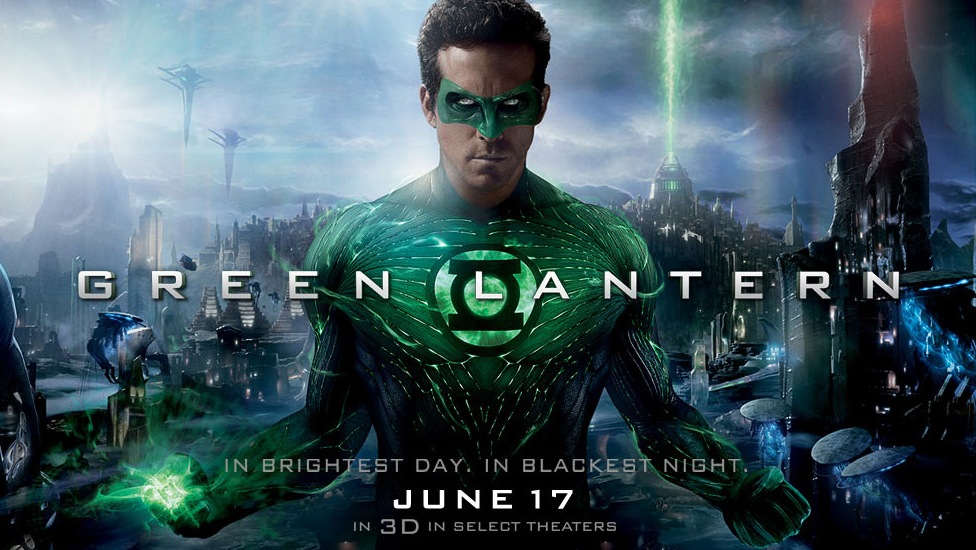
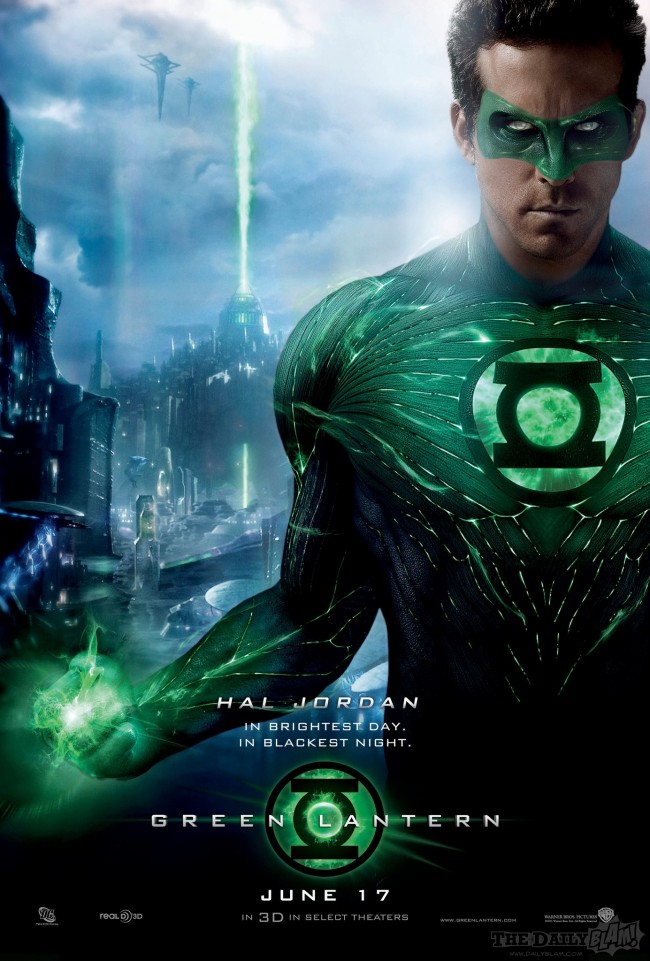
Green Lantern Poster (WonderCon Exclusive)


DC Entertainment and Warner Brothers have been criticized these last few months for their handling of the ad/media blitz for their upcoming summer tentpole film: Green Lantern.

People have been quite underwhelmed with the teaser trailer shown a couple months ago then with releases of concept art for the film. It’s true that the character of Green Lantern is not as iconic as Batman or Superman, but who are outside of Spider-Man and the X-Men. Still it’s been quite perplexing how little hype Warner Brothers has been working on giving this film (starring Ryan Reynolds in the role of Hal Jordan as Green Lantern). One would think that both WB and DC Entertainment would make a massive push for this film not just to try and set it up as another DC film franchise the way Marvel has been creating their very own film universe with their properties.

One thing that may be a sign that Warner Brothers and DC Entertainment are ready to unleash a major advert and media blitz for Green Lantern is the panel at this year’s WonderCon at San Francisco where the cast were available for roundtables and a con exclusive poster of the film was released. The poster will be one of the few things from WonderCon that non-attendees will be able to see and examine.

The poster goes a long way in helping dispel my feelings about this film. While I still haven’t fully bought into this project I do get a sense of the cosmic nature of this film which other superhero films of the past decade haven’t been able to convey. If WB and DC are able to build on the positives that this new poster is giving this film then maybe Green Lantern may just become a must-see for this summer.

Green Lantern is set for a July17, 2011 release date.

Green Lantern Official Trailer


DC has always had the Batman franchise as it’s standard bearer when it came to its many properties adapted to the big-screen. In the past one could add the Superman franchise as well, but a return (no pun intended) to that franchise a couple years ago didn’t pan out too well.

Marvel Studios (film division of Marvel Comics) has had a better track record in the past decade in adapting its own franchise characters, both top tier and supporting, to the big-screen. Some of these adaptation have been through other studios like Sony, 20th Century Fox, Paramount and Universal who licensed the characters for film. In the last 3-4 year Marvel has made the decision to adapt their characters themselves to better rake in the profits. This has led to successes and a subsequent purchase of the company as a whole by giant entertainment conglomerate Disney. With Disney’s Scrooge McDuck money bin to help finance further Marvel properties to the big-screen DC and it’s parent company Time-Warner had to respond with something other than Nolan’s Batman franchise.

What DC has decided to answer with first is the live-action adaptation of the iconic DC character Hal Jordan and his Green Lantern persona. The film has veteran action filmmaker Martin Campbell behind the director’s chair with Ryan Reynolds in the title role. The film has finally released it’s first official trailer and the film is set for a Summer 2011 release. A summer that’s becoming more and more crowded with superhero tentpole films not to mention the 800-lb gorilla waiting in the wings to beat everyone senseless: Warner Brother’s final Harry Potter film.

The trailer for Green Lantern just gives enough of a taste about what the film is about but despite some intergalactic scenes was still quite bare in terms of what the story will be about beyond it being an origin tale. Here’s to hoping the next trailer gives a bit more with a much more refined and polished fx work.