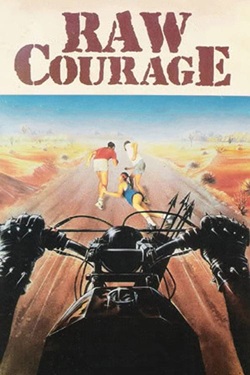
Three friends (Ronny Cox, Art Hindle, and Tim Maier) leave their families behind and go on a 72-mile run through the desert of New Mexico. They’re marathon runners and they are trying to survive the ultimate challenge. Instead, they run into a right-wing militia led by “Colonel” Crouse (M. Emmet Walsh) and Sonny (William Russ). Soon, the joggers are being chased through the desert. Their survival depends on if they have the raw courage to make it back to civilization.
RawCourage was written and produced by Ronny Cox and I like to think that he made this movie as his way to get back at everyone who typecast him as a victim after Deliverance. Cox’s jogger never gives up in RawCourage, even while being chased through the broiling desert by a bunch of madmen on motorcycles. Cox and Art Hindle both give good performances and their well-matched by Walsh and Russ. (Unfortunately, Walsh’s role in pretty small. Most of the actual villainy is committed by William Russ.) Cox and Hindle both play intelligent men who just happened to find themselves in the wrong place at the wrong time. That the victims are sympathetic and you actually care about whether or not they make it back to their families elevates the film.
The film does start to run out of gas towards the end. The scenes of our heroes running through the desert start to get repetitive. Raw Courage is still an exciting action film and it’s flat, made-for-TV look is probably less of a problem when viewed on YouTube than it was when the movie was initially released. The film provides a rare starring role for Ronny Cox, four years before Robocop typecast him as everyone’s favorite corporate villain. Cox delivers. It’s a shame he didn’t get to play more heroes.
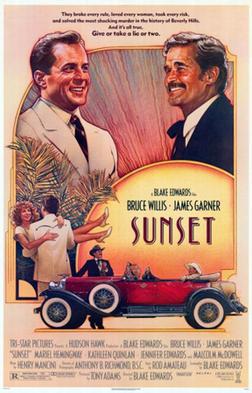
In 1920s Hollywood, famed comedian Alfie Alperin (Malcolm McDowell) has made the transition from screen stardom to working behind the scenes as a producer and studio head. With the coming of the talkies and the death of silent cinema, Alfie plans to make his mark with an epic western starring Tom Mix (Bruce Willis) as Wyatt Earp. The real Wyatt (James Garner) is hired to act as an on-set consultant. Wyatt’s former girlfriend, Christina (Patricia Hodge), is now married to Alfie.
What Mix and Earp discover is that, despite his beloved public image, Alfie is actually a monster who is involved with organized crime and sex trafficking and who has the police on his payroll. While searching for Christina’s missing son (Dermot Mulroney), Mix and Earp get caught up in a murder involving Alife’s sister (Jennifer Edwards) and a gangster named Dutch (Joe Dallesandro). At the first Academy Awards are handed out in Beverly Hills, Tom Mix and Wyatt Earp prepare for the final showdown with their producer.
The idea behind Sunset was promising. Wyatt Earp, a real cowboy who survived the end of the West, teams up with Tom Mix, a movie cowboy who is trying to survive the end of the silent era. (Earp and Mix were friend in real life, as well.) Bruce Willis comes across as being too contemporary in the role of Tom Mix but James Garner plays Wyatt Earp with a weary dignity and Malcolm McDowell does a convincing Charlie Chaplin impersonation. Unfortunately, Blake Edwards’s direction allows the story to meander and the mystery itself is so full of red herrings that it’s impossible to follow. Edwards didn’t seem to know if he wanted this movie to be a buddy comedy, an elegiac tribute to the end of the silent era, or a satire of Hollywood. He tried to include elements of all three but the movie itself just doesn’t come together. Only Garner and McDowell emerge from the film relatively unscathed.
Fortunately, for Bruce Willis, DieHard was released just two months after Sunset.
In honor of Bruce Campbell’s 67th birthday, I decided to watch a movie he’s featured in that I’ve never seen before. I thought the horror-comedy SUNDOWN: THE VAMPIRE IN RETREAT looked like it might be fun so I went for it!
In the desert town of Purgatory, a colony of vampires led by Count Mardulak (David Carradine) want to live in peace, abstaining from human blood, and instead, drinking a blood substitute called “Necktarine,” which is produced in a local factory. They also use high powered sunscreen that allows them to go out in the day time as long as they wear thick sunglasses, big hats or umbrellas, and gloves. Unfortunately, the blood factory begins experiencing production issues, so Mardulak asks David Harrison (Jim Metzler), the unsuspecting human who designed the production process, to come to town and fix their problems. Harrison brings his family with him, including his wife Sarah (Morgan Brittany), and their two daughters. The Harrison family soon find themselves in the middle of an other worldly war as Jefferson (John Ireland) and Shane (Maxwell Caulfied), rebellious local vampires, plot to overthrow Mardulak so they can return to their murderous ways. Meanwhile, Robert Van Helsing (Bruce Campbell), the great grandson of the famed vampire hunter, walks into town, ready to romance the local vampire beauty Sandy (Deborah Foreman) and drive stakes into the hearts of as many bloodsucking freaks as possible!
As far as I’m concerned, SUNDOWN is a blast as a completely absurd horror-comedy that puts an interesting spin on traditional vampire legend, with its endless sunscreen slathering and a growing local weariness over “Necktarine” adding to the good times. It’s campy and silly, with purposely terrible stop motion bat effects, over-the-top family drama, and lots of cheesy one-liners, but of course that’s all part of the charm.
The B-movie dream cast is what I enjoyed the most about SUNDOWN. David Carradine plays it pretty straight as the town leader Count Mardulak, which is effective when you consider all of the craziness going on around him. Bruce Campbell, and his mustache, steals all of his scenes with his goofy charm and misguided heroics. And, of course, the inimitable M. Emmet Walsh is perfect as old man Mort, a vampire who loses his temper and beheads a disrespectful city slicker. He just can’t help himself. Throw in other veteran character actors like Bert Remsen and John Ireland and it’s easy to enjoy the movie no matter how silly it all gets.
On a personal note, I did want to point out a couple of performances in SUNDOWN that have Arkansas connections. First, Jim Metzler had a solid part a couple of years after this movie in the crime thriller ONE FALSE MOVE (1991), which was co-written by Billy Bob Thornton and partially filmed in Eastern Arkansas. It’s a great movie and Metzler is good in it. Second, Elizabeth Gracen has a small part in the film. Gracen, whose actual name is Elizabeth Ward, won the title of Miss Arkansas in 1981 and then went on to win Miss America in 1982. My uncle Billy was her hair stylist as she made her run to beauty pageant immortality. Other notable Gracen life events include her affair with Arkansas Governor Bill Clinton in 1983, her appearance in Steven Seagal’s MARKED FOR DEATH in 1990, and her Playboy spread in 1992. Interestingly, 18 years old at the time, I saw the layout when my girlfriend’s mom bought the issue and let me look at it!
Overall, SUNDOWN lets us know right off the bat the kind of absurd movie we’re dealing with, so you’ll either be into it or want to just move on. I was into it, mainly due to its strong cast. It’s not perfect, and it overstays its welcome by a good 15 minutes, but SUNDOWN is a fun watch for fans of silly horror-comedies and the excellent cast. I had a great time with it!
I hated Grindso much that I decided to watch another movie to get it out of my head. I’m glad I did because, for my second movie, I picked a good one.
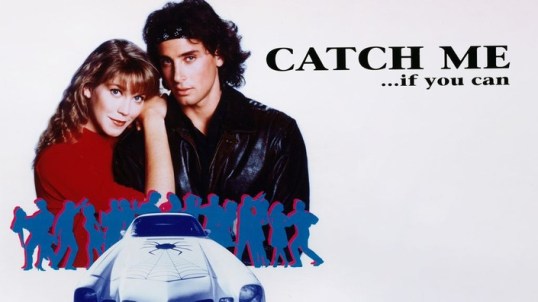
Catch Me If You Can takes place in Minnesota. The school board is planning on closing down Cathedral High School unless the school can raise $200,000. Class president Melissa (Loryn Locklin) takes charge of the fundraising drive but, even though she pours her heart into all of the car washes and bake sales, she’s only been able to raise $19,000. Dylan Malone (Matt Lattanzi, who was married to Olivia Newton-John) is the school bad boy, who is always late to class because he’s busy racing other cars on the country roads near the school. The principal (Geoffrey Lewis) gives Dylan an option. He can either help Melissa or he can go to detention. Dylan’s idea of helping is to take the money that Melissa has raised and bet on the illegal races that he’s entering. At first, it works. But when the Fat Man (M. Emmet Walsh) challenges Dylan to race his best man and then tells his racer to cheat, Dylan and Melissa lose all the money. The Fat Man has a proposition. The Fat Man dares Dylan to enter an impossible, timed race. If Dylan wins, he’ll make the double the money that he lost and he and Melissa will be able to save the school. Dylan agrees. Luckily, it turns out that the school’s principal is also the legendary Fast Freddie, the only person to ever win the Fat Man’s race.
It may not be anyone’s idea of great art but CatchMeIfYouCan is still a delightful and fun 80s teen movie, complete with a nerdy sidekick who turns out to be secretly cool, a bad boy with a heart of gold and a mullet, and a big football game at the end. The plot doesn’t even make sense but the cast gave it their all and, as someone who took part in way too many car wash fund raisers in high school, I knew exactly what Melissa was going through! I’ll admit that, towards the end of the film when everyone was counting down how many seconds Dylan had to make it to the finish line, I got a little caught up in the moment and I may have even cheered a little. CatchMeIfYouCan is a wonderful slice of 80s goodness.
In 1973’s Serpico, Al Pacino plays a cop who doesn’t look like a cop.
Indeed, that’s kind of the start of Frank Serpico’s problems. He’s a New York cop who doesn’t fit the stereotype. When we see him graduating from the Academy, he’s clean-shaven and wearing a standard patrolman uniform and he definitely looks like a new cop, someone who is young and enthusiastic and eager to keep the streets safe. However, Serpico is an outsider at heart. The rest of the cops have their homes in the suburbs, where they spend all of their time with their cop buddies and where they go also go out of their way not to actually live among the people that they police. Serpico has an apartment in Greenwich Village and, as a plainclothes detective, he dresses like a civilian. He has a beard. He has long hair. He has a succession of girlfriends who don’t have much in common with the stereotypical (and there’s that word again) cop’s wife. Serpico is an outsider and he likes it that way. In a world and a career that demands a certain amount of conformity, Frank Serpico is determined to do things his own way.
However, the real reason why Serpico is distrusted is because he refuses to take bribes. While he’s willing to silently accompany his fellow officers while they collect their payoffs from not only the people that they’re supposed to be arresting but also from the storeowners that they’re meant to be protecting, Serpico refuses to take a cut. Serpico understands that the small, everyday corruption is a way of forcing his silence. The corruption may help the cops to bond as a unit but it also ensures that no one is going to talk. Serpico’s refusal to take part makes him untrustworthy in the eyes of his fellow cops.
Serpico and Bob Blair (Tony Roberts), a politically-connected detective, both turn whistleblower but it turns out that getting people to listen to the truth is not as easy as Serpico thought it would be. The Mayor’s office doesn’t want to deal with the political fallout of a police conspiracy. Serpico finds himself growing more and more paranoid, perhaps with good reason. When words gets out that Serpico has attempted to turn into a whistleblower, his fellow cops start to turn on him and, during a drug bust, Serpico finds himself deserted and in danger.
Serpico opens with its title character being rushed to the hospital after having been shot in the face. This actually happened to the real Serpico as well. What the film leaves out is that hundreds of New York cops showed up at the hospital, offering to donate blood during Serpico’s surgery. That’s left out of the film, which at times can be more than a little heavy-handed in its portrayal of Serpico as an honest cop surrounded by nonstop corruption. Filmed just three years after Serpico testified before New York’s Knapp Commission (which was the five-man panel assigned to investigate police corruption in the city), Serpico the movie can sometimes seem a bit too eager to idealize its title character. (Vincent J. Cannato’s excellent look at the mayorship of John V. Lindsay, The Ungovernable City, presents far more nuanced look at the NYPD corruption scandals of the early 70s and Serpico’s role as a whistleblower.) Director Sidney Lumet later expressed some dissatisfaction with the film and even made other films about police corruption — The Prince of the City, Q & A, Night Falls On Manhattan — that attempted to take a less heavy-handed approach to the subject.
That said, as a film, Serpico works as a thriller and as a portrait of a man who, because he refuses to compromise his ideals, finds himself isolated and paranoid. Al Pacino, fresh from playing the tightly-controlled Michael Corleone in The Godfather, gives an intense, emotional, and charismatic performance as Serpico. (One can see why the image of a bearded, hippie-ish Pacino was so popular in the 1970s.) Sidney Lumet brings the streets of New York to vibrant and dangerous life and he surrounds Pacino with an excellent supporting cast, all of whom bring an authentic grit to their roles. Serpico may not be a totally accurate piece of history but it is a good work of entertainment, one that works as a time capsule of New York in the 70s and as a portrait of bureaucratic corruption. It’s also the film in which Al Pacino announced that he wasn’t just a good character actor. He was also a movie star.
One of the great character actors of all time, M. Emmet Walsh, would have been 90 years old today. Walsh lived a good long life, passing away on March 19th, 2024, three days short of what would have been his 89th birthday. The great movie critic Roger Ebert created his own movie rule that featured Walsh. He called it the “Stanton-Walsh” rule, which also honored the great Harry Dean Stanton. The rule went something like “no movie featuring Harry Dean Stanton or M. Emmet Walsh in a supporting role can be altogether bad.” High praise indeed.
When I think of Walsh, I picture his characters in movies like FAST-WALKING (1981), BLADE RUNNER (1982), MISSING IN ACTION (1984), and RAISING ARIZONA (1987). I’ve tried to forget one of his scenes in FAST-WALKING, but I’m afraid it’s a hopeless cause! His characters always stand out. The movie I first saw him in was the Coen Brothers’ BLOOD SIMPLE (1984). Fox 16 out of Little Rock played this often in the 80’s. The advertisements heavily featured Walsh’s amazingly sleazy private detective character, with his cowboy hat and his slimy grin. It’s a truly amazing performance.
On his birthday, I share one of his great scenes from BLOOD SIMPLE. Rest in peace, Mr. Walsh! And enjoy, my friends.
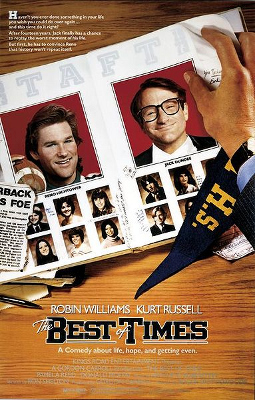
For years, banker Jack Dundee (Robin Williams) had been haunted by a pass that he dropped in high school. The pass was perfectly thrown by quarterback Reno Hightower (Kurt Russell) but Jack couldn’t bring it in and, as a result, Taft High lost to its rival, Bakersfield. Adding to Jack’s humiliation is that he now works for The Colonel (Donald Moffat), a confirmed Bakersfield fan who also happens to be Jack’s father-in-law. When Jack visits a “massage therapist” (Margaret Whitton) and tells her about his problems, she suggests that he needs to replay the game. Getting everyone interested in replaying the game is not easy. No one wants to be humiliated a second time and Reno, who now fixes vans for a living, fears the he’s lost his edge. Jack dresses up in the Bakersfield mascot’s uniform and vandalizes the town. Finally, everyone is ready for the game. Now, it’s a matter of town pride.
The Best of Times is a likable comedy about getting older and wishing you could have just one more chance to be young again and to have your entire future ahead of you. Jack is haunted by that one dropped pass, feeling that it has cast a cloud over his entire life. Reno is still a town hero but he’s struggling financially and in debt to Jack’s bank. Replaying the game isn’t going to fix their lives but it is going to give them one last chance to relive their former glory and maybe an opportunity to learn that, even if they are getting older, they’re still living in the best of times. The world that these two men live in is skillfully drawn and believable, with character actors like Moffat, M. Emmet Walsh, R.G. Armstrong, and Dub Taylor adding to the local color. Jack and Reno’s wives are played by Holly Palance and Pamela Reed and they are also strong and well-developed characters. Finally, Robin Williams and Kurt Russell are a strong comedic team. Russell is perfectly cast as the aging jock and Williams gives one of his more restrained performances as Jack, allowing us to see the sadness behind Jack’s smile.
The stakes aren’t particularly high in The Best Of Times. It’s just a football game between some middle-aged men looking to regain their youth. But the story sticks with you.
In the 1981 film Reds, Warren Beatty plays Jack Reed, the radical journalist who, at the turn of the century, wrote one of the first non-fiction books about Russia’s communist revolution and then went on to work as a propagandist for the communists before becoming disillusioned with the new Russian government and then promptly dying at the age of 32.
Diane Keaton plays Louise Bryant, the feminist writer who became Reed’s lover and eventually his wife. Louise found fame as one of the first female war correspondents but then she also found infamy when she was called before a Congressional committee and accused of being a subversive.
Jack Nicholson plays Eugene O’Neill, the playwright who was a friend of both Reed and Bryant’s and who had a brief affair with Bryant while Reed was off covering labor strikes and the 1916 Democratic Convention.
Lastly, Maureen Stapleton plays Emma Goldman, the anarchist leader who was kicked out of the country after one of her stupid little dumbass followers assassinated President McKinley. (Seriously, don’t get me started on that little jerk Leon Czolgosz.)
Together …. well, I was going to say that they solve crimes but that joke is perhaps a bit too flippant for a review of Reds. Reds is a big serious film about the left-wing activists at the turn of the century, one in which the characters move from one labor riot to another and generally live the life of wealthy bohemians. Reed spends the film promoting communism, just to be terribly disillusioned when the communists actually come to power in Russia. For a history nerd like me, the film is interesting. For those who are not quite as obsessed with history, the film is extremely long and the scenes of Reed and Bryant’s domestic dramas often feel a bit predictable, especially when they’re taking place against such a large international tableaux. At its best, the film is almost a Rorschach test for how the viewer feels about political and labor activists. Do you look at Jack Reed and Louise Bryant and see two inspiring warriors for the cause or do you see two wealthy people playing at being revolutionaries?
Reds was a film that Warren Beatty spent close to 20 years trying to make, despite the fact that the heads of the Hollywood studios all told him that audiences would never show up for an epic film about a bunch of wealthy communists. (The heads of the studio turned out to be correct, as the film was critically acclaimed but hardly a success at the box office.) It was only after the success of the 1978, Beatty-directed best picture nominee Heaven Can Wait that Beatty was finally able to get financing for his dream project. He ended up directing, producing, and writing the film himself and he cast his friend Jack Nicholson as O’Neill and his then-romantic partner Diane Keaton as Louise Bryant. (Gene Hackman, Beatty’s Bonnie and Clyde co-star, shows up briefly as one of Reed’s editors.) One left-wing generation’s tribute to an early left-wing generation, Reds is fully a Warren Beatty production and, for his efforts, Beatty was honored with the Oscar for Best Director. That said, the Reds lost the award for Best Picture to another historical epic, Chariots of Fire. Chariots of Fire featured no communists and did quite well at the box office.
The film is good but a bit uneven, especially towards the end when we suddenly get scenes of Louise Bryant trudging through Finland as she attempts to make it to Russia to be reunited with Reed. The film actually works best when it features interviews with people who were actual contemporaries of Reed and Bryant and who share their own memoires of the time. In fact, the interviews work almost too well. The “witnesses,” as the film refers to them, paint such a vivid picture of the Reed, Bryant, and turn of the century America that Beatty’s attempt to cinematically recreate history often can’t compete. One can’t help but feel that Beatty perhaps should have just made a documentary instead of a narrative film.
(Interestingly enough, many of the witnesses were people who were sympathetic to Reed’s politics in at the start of the century but then moved much more to the right as the years passed. Reed’s friend and college roommate, Hamilton Fish, went on to become a prominent Republican congressman and a prominent critics of FDR.)
That said, Jack Nicholson gives a fantastic performance as Eugene O’Neill, adding some much needed cynicism to the film’s portrayal of Reed and Bryant’s idealism. Keaton and Beatty sometime both seem to be struggling to escape their own well-worn personas as Bryant and Reed but Beatty does really sell Reed’s eventually disillusionment with Russia and the scene where he finally tells off his Russian handler made me want to cheer. Fans of great character acting will want to keep an eye out for everyone from Paul Sorvino to William Daniels to Edward Herrmann to M. Emmet Walsh and IanWolfe, all popping up in small roles.
Reds is not a perfect film but, as a lover of history, I enjoyed it.
Chevy Chase is Norman Robberson, a hen-pecked suburban dad who likes to watch cop shows. When he is informed that his next door neighbor, Horace Obsborn (Robert Davi), is suspected of being a Mafia hitman, he agrees to allow Detectives Jake Stone (Jack Palance) and Tony Moore (David Barry Gray) to use his house as their stakeout location.
Cops and Robbersons is just as terrible as its title. Norman is basically Clark Griswold without the excuse of a vacation or the holidays to explain away his stupidity. Jack Palance growls and looks annoyed but without the same comedic flair that he brought to City Slickers. Dianne Wiest is wasted as Norman’s wife. Of course, Norman’s daughter develops a crush on Tony while Norman’s son dressed up like Dracula and tries to put the bite on Stone. Norman keeps getting in the way of the two cops and trying to conduct an investigation on his own. There has to be an easier way to capture a hitman. The only thing that really works is Robert Davi’s performance as the hitman. Davi doesn’t try to be funny, which actually brings out the best in Chase whenever they share a scene. Chase’s goofy dad shtick works best when he’s dealing with someone who isn’t trying to score laughs of his own.
How did the great Michael Ritchie end up directing movies like this? Whoever let that happen should be ashamed.
The 1977 made-for-television movie, Red Alert, opens with a man walking through a cemetery on a rainy day. As we watch Howard Ives (Jim Siedow) move amongst the tombstones, we hear his thoughts. He’s a sad and bitter man, wondering why he’s wasted so many years of his life at work. He thinks about someone close to him who has died. He’s obviously very troubled.
(Of course, any horror fans in the audience will immediately recognize Jim Siedow from his role as the Drayton Sawyer in the the original Texas Chainsaw Massacre. He was troubled in that film as well!)
Howard works at the local nuclear power plant. Ominously, when the film cuts to the plant, the first thing we see is a leak of very hot water. I don’t know much about nuclear power plants but I imagine any type of leak is not a good thing. The water leak causes the computer that runs the plant assuming that a nuclear disaster is minutes away from happening. The compound is automatically sealed off, trapping fourteen men (including Howard), inside the reactor. As Commander Stone (Ralph Waite) tries to keep a possible nuclear disaster from occurring, two investigators (played by William Devane and Michael Brandon) try to determined whether the accident was the result of a malfunction or of deliberate sabotage. When the local sheriff (M. Emmet Walsh) informs them that Howard Ives’s wife has committed suicide, the investigators look into the troubled man’s history. Eventually, the two investigators realize that the only way to prevent a nuclear disaster is by risking their lives by entering the sealed-off power plant. The two investigators attempt to do their work under the cover of night and without causing a panic. Needless to say, it doesn’t work. One of them calls his wife (Adrienne Barbeau) and tells her that she needs to leave the area. She tells her mother, who then tells her neighbor and soon the airport is crowded with people looking to get out of town.
Red Alert contrasts the intuitive approach of the two inspector with Commander Stone’s insistence that every bit of a data be fed to his computer before any decisions are made. Stone’s hands are so tied by protocol and red tape that he stands by while the fourteen men who are trapped in the nuclear power plant die. Wisely, though, the film doesn’t turn Stone into a cardboard villain. He’s very much aware of what will happen if the plant suffers a core meltdown. When one of his assistants mentions that he hasn’t been given any instructions on how to evacuate the town in case the plant does explode, Stone tells him that no plans have ever been drawn up because the plans would be useless. There would be no way to evacuate everyone in time.
In the end, Red Alert is scary not because it deals with nuclear power but because it presents us with a world where no one — not even Devane and Brandon’s heroic investigators — seems to know what to do. Everyone is slowed down by a combination of red tape and their own personal angst. Devane is a strong investigator because, as a widower whose only son died in Vietnam, he has no family to worry about. Unlike everyone else in Red Alert, he has nothing left to lose. In the end, the film suggests that the only way to save the world is to cut yourself off from it.
Red Alert is a compelling and intelligent thriller, one that is well-acted by the entire cast and which builds up to strong conclusion. The film’s anti-nuclear message is a bit heavy-handed but I imagine it was an accurate reflection of the fears that people were feeling at the time. Today, the film works best as a warning about bureaucracy and depending too much on AI to make important, life-or-death decisions. In the end, it’s human ingenuity that saves the day and that message is timeless.