So, in honor of Val’s commitment to her craft, I decided that today’s six trailers would be for six movies that Val either watched or mentioned in her review of The Evil Eye! Unfortunately, it turns out that not all of those movies have trailers on YouTube. And I already shared the trailer for Mario Bava’s The Girl Who Knew Too Much (a.k.a. Evil Eye) last week.
Let’s see what I did find!
Bruka, Queen of Evil (1973)
I could not find a trailer for Queen of Evil. However, when I did a search for “Queen of Evil Trailer,” one of the trailers that came up was for Bruka, Queen of Evil. I’ve never heard of this film before but it looks like something some of our readers would like.
2. Manhattan Baby (1982)
However, YouTube did have a trailer for Lucio Fulci’s Manhattan Baby, which was also known as Evil Eye. Actually, Evil Eye was probably a better title for it. I’m one of the few people willing to defend this film and even I’m unsure just what exactly Manhattan Baby is supposed to mean.
3. The Green Inferno (1988)
Val’s search for information about The Evil Eye led her to Bloody-Disgusting.com, which featured an infamous review of The Green Inferno. Here’s the trailer for 1988’s Green Inferno, which should not be mistaken for Eli Roth’s Green Inferno.
4 Shots From 4 Films is just what it says it is, 4 shots from 4 of our favorite films. As opposed to the reviews and recaps that we usually post, 4 Shots From 4 Films is all about letting the visuals do the talking.
This October, I am going to be using our 4 Shots From 4 Films feature to pay tribute to some of my favorite horror directors, in alphabetical order! That’s right, we’re going from Argento to Zombie in one month!
Today’s director? The master of Italian horror himself, Lucio Fulci!
4 Shots From 4 Films
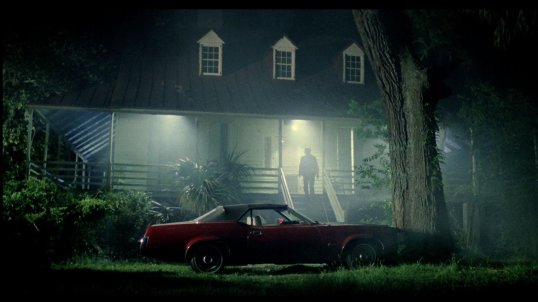
Zombi 2 (1979, dir by Lucio Fulci)
The City of the Living Dead (1980, dir by Lucio Fulci)
Listen, as someone who loves Italian horror and who feels that Lucio Fulci made some of the best (if most misunderstood) horror films of all time, I certainly wish A Cat In The Brain was a great film. Every time I watch it, I find myself hoping that it will turn out to be better than I know it’s going to be. Don’t get me wrong. I don’t necessarily think that A Cat In the Brain was a terrible film. Especially when compared to some of the other films that Fulci directed towards the end of his career, A Cat In The Brain is competently made and it certainly proves that Fulci had a better sense of humor than many critics give him credit for. It’s not really a bad film. It’s just a disappointing one.
To understand why, you have to understand just who Lucio Fulci was and why horror fans hold him in such high regard. Fulci was an Italian director, one who was responsible for some of the most visually impressive horror films of all time. Even though Fulci did not start his career working in the horror genre, it’s those films that for which he is best remembered. Many of his films, like Zombi 2, City of the Living Dead, The House By The Cemetery, and The Beyond, are rightfully remembered as classics. By design, these movies often felt like filmed nightmares and they remain influential to this very day. Literally every zombie film that has been released over the past few decades owes a debt to Fulci and The Beyond trilogy is perhaps as close as any director has ever gotten to truly capturing the feel of H.P. Lovecraft on film.
Unfortunately, many critics refuses to look past the violent content of Fulci’s films. In some countries, his movies were banned outright. In America, Fulci’s masterpiece, The Beyond, was released in a butchered, compromised form. Following the release of his controversial and disturbing slasher film, The New York Ripper,Fulci’s career went into decline and, suffering from ill-health and often in desperate need of money, he found himself directing low-budget films that were unworthy of his considerable talents. It’s one of the sadder stories in the history of Italian horror.
A Cat In The Brain was one of Fulci’s final films and it stars none other than … Lucio Fulci! Fulci plays a horror director named Lucio Fulci. Fulci is concerned that all of his recent work in the horror genre is starting to mentally damage him. For instance, after editing a scene about cannibalism, Fulci goes to a nearby restaurant and orders a steak. However, whenever he starts to eat his steak, Fulci flashes back to the movie that he’s just directed. When he goes home, the sound of the handyman using a chainsaw causes Fulci to think about a scene that he filmed, one that involved a killer chopping up a body. When a frustrated Fulci kicks a bucket of red paint, he visualizes blood. Meeting a German reporter causes Fulci to fantasize about a Nazi orgy. Is Fulci losing it? Could it be that violent movies really do cause violent urges?
Worried about his mental health, Fulci goes to see a psychiatrist, Professor Egon Schwarz (David L. Thompson). Schwarz puts Fulci order hypnosis and tells Fulci that, over the next few weeks, he will think that he has “done terrible things.” It turns out that Professor Schwarz is an aspiring serial killer. Schwarz wants to go on a killing spree and have Lucio Fulci take responsibility for it…
To be honest, the plot description probably makes A Cat In The Brain sound like it’s a lot more subversive than it actually is. It has all the ingredients to be a great satire but, unfortunately, Fulci’s heart never seems to really be in the movie. Oddly, considering that the movie is literally about his life, Fulci directs A Cat In The Brain in a rather detached and clinical fashion. There’s none of the visual poetry that distinguished Fulci’s best work.
Even worse, probably over half of this film is made up of clips that were lifted from other Fulci films. Unfortunately, the scenes don’t come from Fulci’s good films. Don’t go into A Cat In The Brain expecting to see anything from Zombi 2 or Don’t Torture A Duckling. Instead, all of the clips come from stuff like Touch of Death and The Ghosts of Sodom, films that largely represent Lucio Fulci’s declining years.
However, there is one good thing about A Cat In the Brain (beyond the title, which I think is adorable): the film ends with Fulci happy and literally sailing into the sunset. Considering both Fulci’s lasting influence as a filmmaker and the sad details of his final years, it’s hard not to feel that A Cat In The Brain gave Fulci the final scene that this talented director deserved.
4 Shots From 4 Films is just what it says it is, 4 shots from 4 of our favorite films. As opposed to the reviews and recaps that we usually post, 4 Shots From 4 Films is all about letting the visuals do the talking.
Today is the birthday of the Italian film director, Lucio Fulci! In honor of the big day, here are 4 shots from 4 films!
Mary and Roberto Vivaldi (played by Lubka Lenzi and Pascal Persiano) would appear to have a perfect life, perhaps because they do. They’re young. They’re attractive. They’re in love. They’re rich. They have a really nice house and they have two children, a boy and a girl. What could go wrong, right?
Well, they could come home from a party and discover that their house is being burglarized. And the burglar could then proceed to graphically and viscously murder them, smashing in Robert’s head and, since this is a Lucio Fulci film, popping out Mary’s eye. In fact, the opening murder is so graphic and so disturbing that it’s somewhat surprising to learn that this movie was made for television.
Of course, what’s even stranger is that the rest of the film is oddly tame, particularly for a Fulci film. Perhaps they only had enough money in the budget for one graphic gore scene.
Anyway, the parents are now dead and the children are now orphans. At the funeral, the children shock everyone by playing and laughing. However, a few seconds later, they’re standing over the grave and crying. Some people would call this an inconsistency but I think it’s the most realistic part of the film. When you lose someone who you love, you do strange things. There is no one proper way to grieve. As someone who suffered through his share of personal tragedy, this was something that Fulci probably understood.
The parents may be dead but they’re not gone! Instead, they’re haunting the house. The children are overjoyed but their new guardian, Aunt Marcia (Cinzia Monreale, who was Emily in Fulci’s The Beyond) is not. Marcia freaks out upon realizing that the house is haunted and it certainly doesn’t help that she’s attacked by a gigantic fly in the attic. Her husband, the incredibly dense Carlo (Jean Christophe Bretigniere), doesn’t think anything strange is happening. Still, Carlo does agree that it would be a good idea to sell the house and move the children elsewhere.
Nope! The parents have no intention of letting that happen! Of course, the dead parents main concern to kill the man who killed them but, once he’s dead (it doesn’t take that long), they’re free to spend their time pushing a real estate agent down a flight of stairs, harassing Marcia and Carlo and eventually causing an exorcist’s hand to melt.
If you’re getting the feeling that both the dead parents and the living children are pretty obnoxious, that’s because they are. I mean, it’s one thing to not want to be separated. That’s something we can all relate to. It’s another thing to melt a man’s hand and then laugh about it. Add to that, neither Marcia nor Carlo come across as being particularly villainous. It’s not like they’re planning on murdering the kids for their inheritance or sending them to a Dickensian orphanage or anything like that. They just want the kids to stop conducting black magic ceremonies and they want to live in a house that isn’t haunted. No matter how much sympathy you may have for the parents or the kids, it’s hard to deny that Marcia and Carlo aren’t being all that unreasonable.
(It also doesn’t help that the film ends with the suggestion that the dead parents can stay with the kids regardless of whether the house is sold or not.)
And yet, I can’t help but like The Sweet House of Horrors. Even though it doesn’t make much sense and it’s hampered by a low-budget (just check out the floating flames that represent the dead parents), there’s a sincerity to The Sweet House of Horrors. The parents really do seem to love their obnoxious children and the film actually does provide some insight regarding the way that children use imagination to deal with grief. Like many of his later film, The Sweet House of Horrors is hit-and-miss but Lucio Fulci still comes up with a few good visuals, suggesting that his heart may have been in this film in a way that it wasn’t in some of the other films he made during the final years of his storied career. Just the fact that The Sweet House of Horrors tells such an openly sentimental story makes it unique in Fulci’s filmography.
The Sweet House of Horrors cannot be compared to such Fulci classics as The Beyond, The House By The Cemetery, The Black Cat, or Zombi 2. But still, it’s an interesting little film and provides a hint that, even during his decline, Fulci still possessed some of the talent that made his earlier films so iconic.
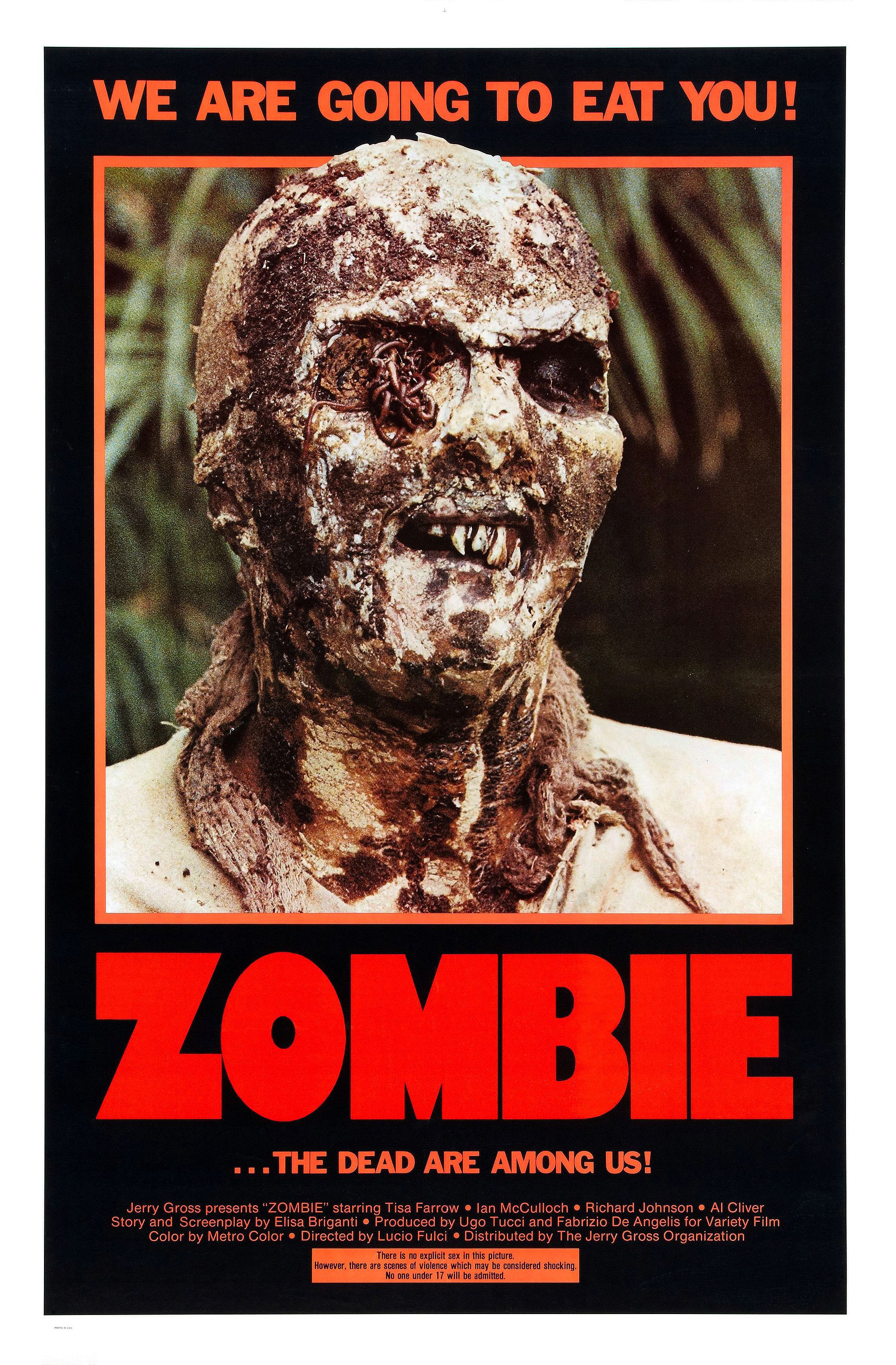
I’ll admit, I’m a latecomer to the Lucio Fulci bandwagon. I viewed my first film by The Maestro, THE HOUSE BY THE CEMETERY , earlier this year, and absolutely loved it! I’ve been looking for more Fulci films to discover ever since, and recently recorded his most famous, ZOMBIE, off the El Rey Network (which I highly recommend to Grindhouse fans out there). ZOMBIE goes by many names, but this is the title I watched it under, so we’ll stick with that.
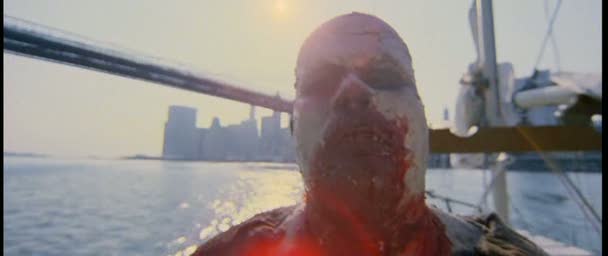
From that opening shot of a gun pointed at the camera, then blasting the head of a rising corpse, I knew I was in for a good time! After the credits roll, we see a derelict ship floating in New York harbor. The harbor patrol boards it, and find it deserted, with rotting food and supplies strewn everywhere. One of the cops investigates further, and is killed by a zombie…
This October, I’m going to be doing something a little bit different with my contribution to 4 Shots From 4 Films. I’m going to be taking a little chronological tour of the history of horror cinema, moving from decade to decade.
This slice of rural horror is based on H.P. Lovecraft’s The Colour From Outer Space and, somewhat oddly, it was produced by Lucio Fulci. The Curse, in this case, is a meteorite the lands near a farm and poisons all the crops. Mayhem follows.
Seriously, country livin’ sucks. That’s why I’m glad to live in the suburbs, away from all the aliens and the poisoned meteorites.
This October, I’m going to be doing something a little bit different with my contribution to 4 Shots From 4 Films. I’m going to be taking a little chronological tour of the history of horror cinema, moving from decade to decade.