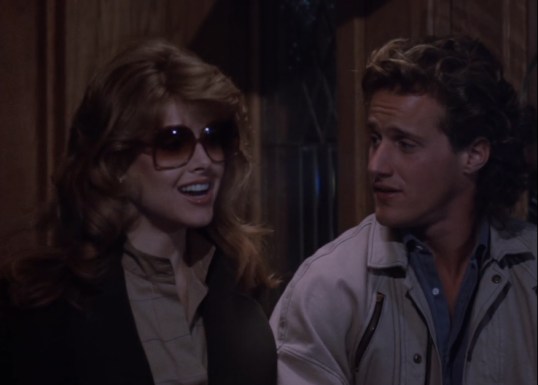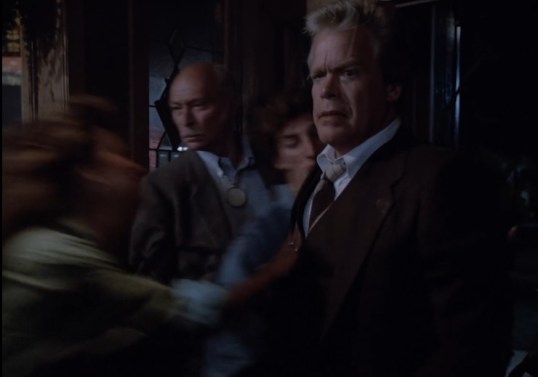
“Man is a feeling creature, and because of it, the greatest in the universe….”
Hell yeah! You tell ’em, Peter Graves!
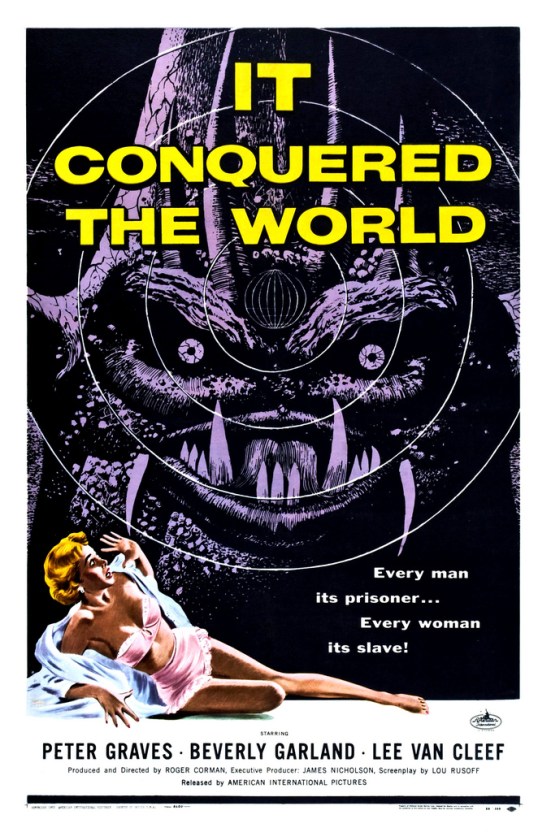
Today’s Horror on the Lens is 1956’s It Conquered The World. Graves plays a scientist who watches in horror as his small town and all of the people who he loves and works with are taken over by an alien. Rival scientist Lee Van Cleef thinks that the alien is going to make the world a better place but Graves understands that a world without individual freedom isn’t one that’s worth living in.
This is one of Corman’s most entertaining films, featuring not only Graves and Van Cleef but also the great Beverly Garland. Like many horror and science fiction films of the 50s, it’s subtext is one of anti-collectivism. Depending on your politics, you could view the film as either a criticism of communism or McCarthyism. Watching the film today, with its scenes of the police and the other towns people hunting anyone who fails to conform or follow orders, it’s hard not to see the excesses of the COVID era.
Of course, there’s also a very persuasive argument to be made that maybe we shouldn’t worry too much about subtext and we should just enjoy the film as a 50s B-movie that was directed with the Corman touch.
Regardless of how interpret the film, I defy anyone not to smile at the sight of ultra-serious Peter Graves riding his bicycle from one location to another.
Here, for your viewing pleasure, is It Conquered The World!
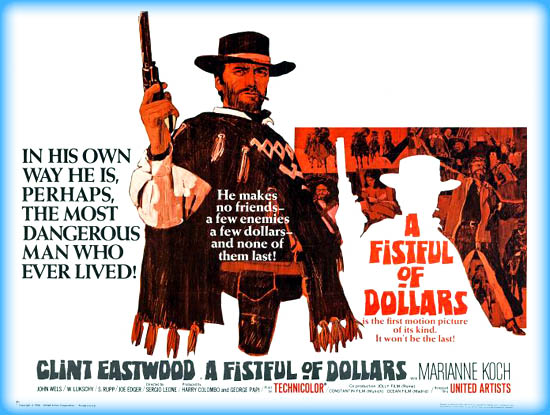
Originally, Sergio Leone envisioned none other than Henry Fond as The Man With No Name.
The year was 1964 and Sergio Leone was searching for the right actor to star in the movie that would become A Fistful Of Dollars. The film, which reimagined Akira Kurosawas’s Yojimbo as a western, centered around a mysterious, amoral gunslinger whose name was unknown. Leone needed an American or a British name to star in the film so that it could get distribution outside of Italy. Leone had grown up watching Henry Fonda movies, all dubbed into Italian. He later said he wanted to cast Fonda because he always wondered what Fonda’s voice actually sounded like.
After realizing that a major Hollywood star would never agree to star in a low-budget Italian western, Leone then offered the role to Charles Bronson. Bronson read the script and said it didn’t make sense to him. Leone went on to offer the role to Henry Silva, Rory Calhoun, Tony Russel, Steve Reeves, Ty Hardin, and James Coburn. Everyone was either too expensive or just not interested. Finally, it was actor Richard Harrison who, after tuning down the part himself, suggested that Leone offer the role to Clint Eastwood. Eastwood, then starring on the American western Rawhide, could play a convincing cowboy. Leone followed Harrison’s advice and Eastwood, eager to break free of his nice guy typecasting and hoping to restart his film career, accepted. The rest is history.
Eastwood would only play The Man With No Name in three films but, in doing so, he changed the movies and the popular conception of the action hero forever.
All three of the Man With No Name movies have been reviewed on this site. But, since today is Clint’s birthday, I thought I’d take a look at how these classic films are holding up, over 60 years since the Man With No Name made his first appearance.
A Fistful Of Dollars (1964)
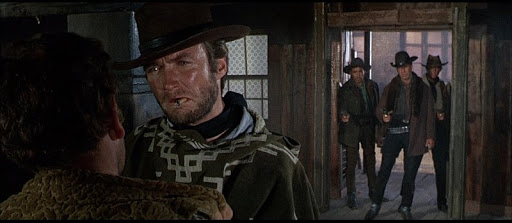
Having now seen both this film and Yojimbo, it’s remarkable how closely A Fistful of Dollars sticks to Kurosawa’s original film. Interestingly, it’s clear that Eastwood patterned his performance of Toshiro Mifune’s in Yojimbo and yet, at the same time, he still managed to make the role his own. The Man With No Name rides into a western town, discovers that there are two groups fighting for control of the area, and he coolly plays everyone against each other. Whether it’s planting the seeds of distrust, exploiting an enemy’s greed, or being the quickest on the draw, the Man With No Name instinctively knows everything that he has to do. Even when he’s getting beaten up by the bad guys, The Man With No Name always seems to be one step ahead. Today, a western in which everyone is greedy and looking out for themselves isn’t going to take anyone by surprise. But if you’ve watched enough westerns from the 40s and 50s, you’ll understand how unique of a viewpoint Leone brought to the genre. Eastwood’s amoral gunslinger was such a surprise that, when the film aired on television, a scene was shot by the network in which Harry Dean Stanton played a prison warden who released The Man With No Name (seen only from behind) on the condition that he clean up the town.
For A Few Dollars More (1965)
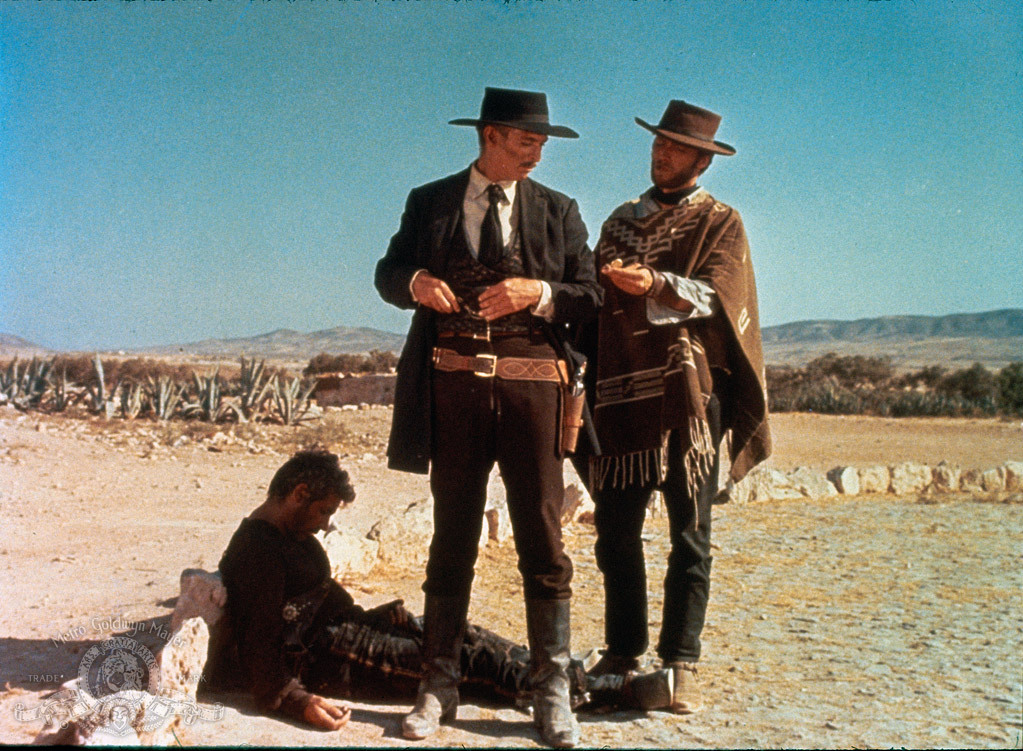
For A Few DollarsMore finds The Man With No Name working as a bounty hunter and teaming up with Colonel Mortimer (Lee Van Cleef) to take down El Indio (Gian Maria Volonte) and his gang (including Klaus Kinski as a hunchback.) This is my least favorite of the trilogy but that doesn’t mean that For A Few DollarsMore is a bad film. Being the least of three masterpieces is nothing to be ashamed of. Eastwood and Van Cleef were two of the best and it’s interesting to see them working together. El Indo is a truly loathsome villain and the members of his gang are all memorably horrid. If it’s my least favorite, it’s just because I prefer the wit of A Fistful of Dollars and the epic storytelling of The Good, The Bad, and The Ugly. Speaking of which…
The Good, The Bad, and The Ugly (1966)
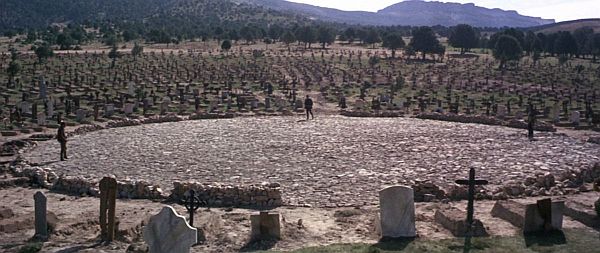
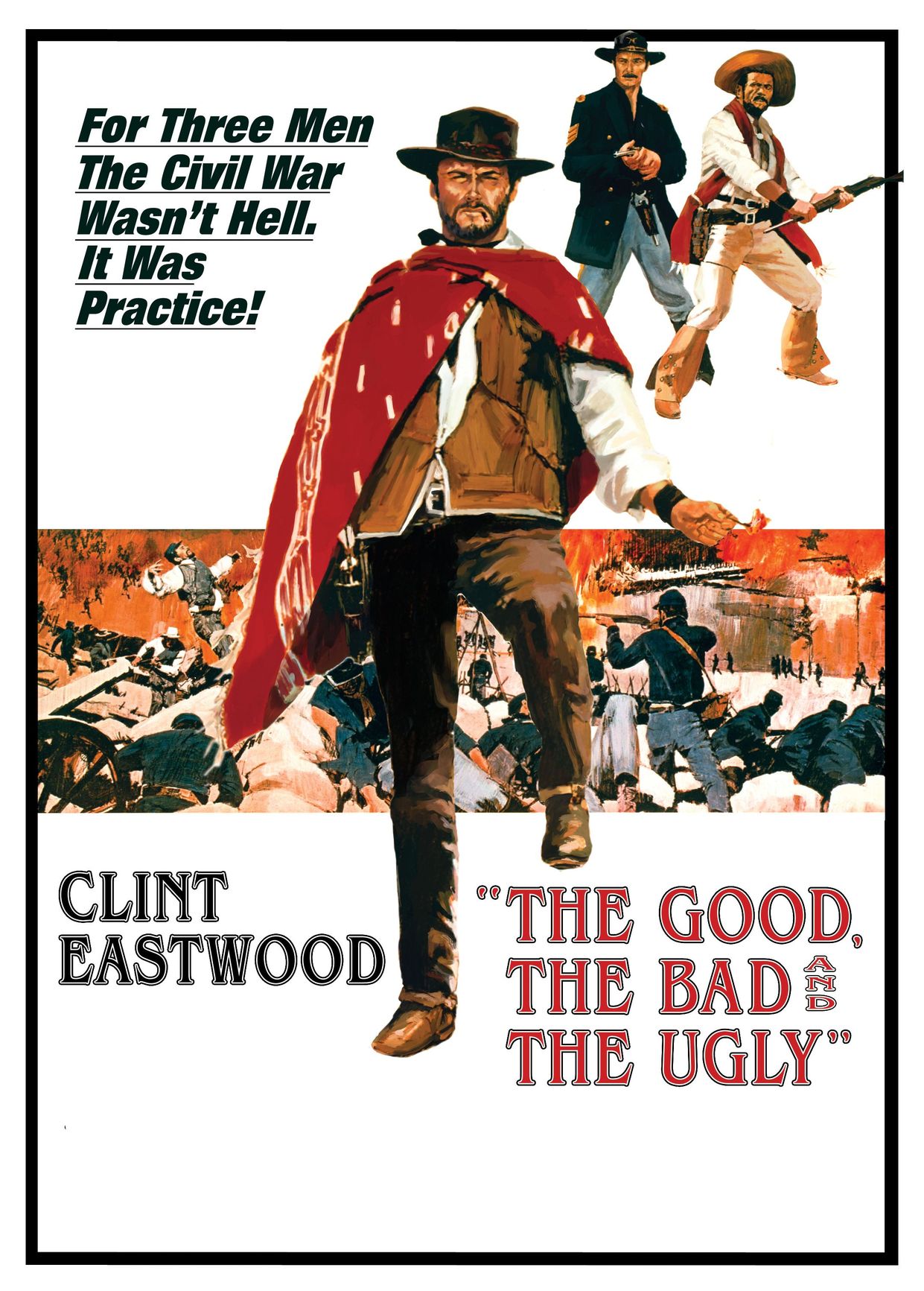
This is it. The greatest western ever made, an epic film that features Leone’s best direction, Ennio Morricone’s greatest score, and brilliant performances from Eastwood, Van Cleef, and especially Eli Wallach. It’s hard to know where to start when it comes to praising The Good, The Bad, and The Ugly. It’s a nearly three-hour film that doesn’t have a single slow spot and it has some of the most iconic gunfights ever filmed. Leone truly found his aesthetic voice in this film and that it still works, after countless parodies, is evidence of how great it is. I appreciate that this film added a historical context to the adventures of The Man With No Name. (Personally, I think this film is meant to be a prequel to A Fistful of Dollars, just because The Man With No Name is considerably kinder in this film than he was in the first two movies. The Man With No Name that we meet in AFistfulofDollars would never have gotten Tuco off that tombstone.) The Good, The Bad, and The Ugly takes place during the Civil War and, along with everything else, it’s an epic war film. While America fights to determine its future, three men search for gold. The cemetery scene will never be topped.
American critics did not initially appreciate these films but audiences did. Clint Eastwood may have been a television actor when he left for Italy but he returned as an international star. And, to think, it all started with Sergio Leone not being able to afford Henry Fonda.
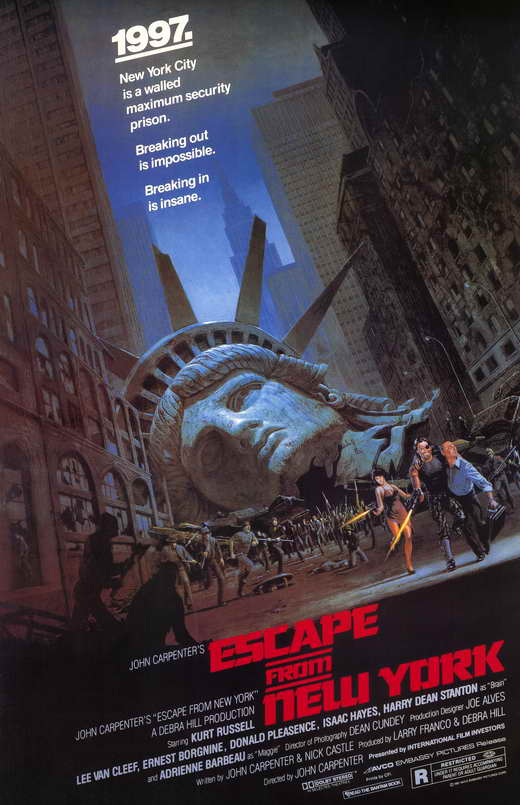
In 1925, on this very date, Lee Van Cleef was born in Somervillve, New Jersey. In honor of what would have been Lee Van Cleef’s 100th birthday, here he is with Klaus Kinski and Clint Eastwood in For A Few Dollars More.
There’s not a lot of dialogue in this scene but when you had actors like Eastwood, Kinski, and Lee Van Cleef, you didn’t need a lot of dialogue to make an impression.
“Man is a feeling creature, and because of it, the greatest in the universe….”
So says scientist Paul Nelson (Peter Graves) towards the end of 1956’s It Conquered The Universe. Paul may be a scientist but he understands the importance of emotion and imagination and individuality. He knows that it’ll take more than just cold logic to save humanity from destruction.
Unfortunately, Paul’s best friend, Tom Anderson (Lee Van Cleef), disagrees. Tom worked at Los Alamos. Tom helped to develop the atomic bomb. Tom is convinced that humanity will destroy itself unless a greater power takes over. Tom feels that he has discovered that greater power. Tom has recently contacted a Venusian and invited it to come to Earth. Upon arriving, the Venusian promptly disrupts all electrical power on Earth. It sends out bat-like creatures that inject humans with a drug that takes control of their minds and turns them into a compliant slaves. Paul tells Tom that robbing people of their free will is not going to save the Earth but Tom remains committed to the Venusian, even as it becomes obvious that the Venusian’s main concern is with its own survival.
It Conquered The World is very much a film of the 1950s. Along with tapping into the era’s paranoia about nuclear war and UFOs, it also features Peter Graves delivering monologues about freedom and the inherent superiority of the human race. When Paul confronts Tom, he not only accuses Tom of selling out the Earth but he also attacks Tom’s patriotism. When Tom’s wife, Claire (Beverly Garland), confronts the alien and orders it to leave her plant along, she does it while wearing high heels and a tight sweater and holding a rifle. The one female scientist (played by Karen Kadler) spends most of her screentime being menaced while wearing a white slip and there’s a platoon of bumbling but unbrainwashed soldiers hanging out in the woods. If one looked up 1956 in the dictionary, there’s a very good chance this film would be the definition.
At the same time, the film’s story feels like a metaphor for modern times. When the Venusian-controlled police turn authoritarian and start threatening to punish anyone who questions their orders, we’re reminded of the excesses of the COVID lockdowns. When the editor of the town’s newspaper is shot by a policeman who says that words are no longer necessary in the new world, it’s hard not to think of all the writers, commentators, artists, and ordinary citizens who have run afoul the online cancellation brigade. When Paul is reduced to riding a bicycle from place to place, it’s hard not to think of the environmental Luddites, with their hatred of anything that makes life more convenient. When Tom rationalizes his activities by saying that humanity must be saved from itself, he’s expressing an opinion that is very popular among several people today. Tom’s embrace of cold logic feels very familiar. Of course, today, people don’t need a Venusian to order them to accept authoritarianism. Instead, they’re more than happy to do on their own.
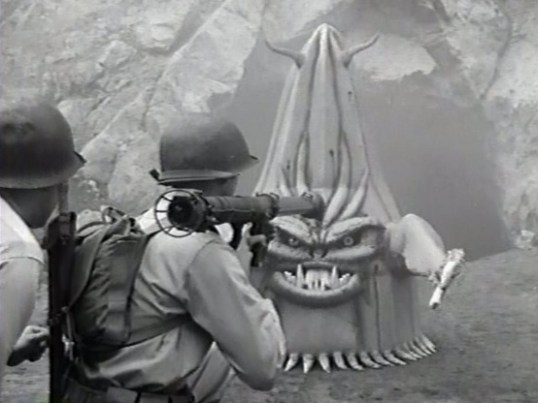
It Conquered The World was directed by Roger Corman. It was his eighth film as a director and it remains one of his most entertaining. As one might expect from a low-budget sci-fi film, It Conquered The World produces it’s share of laughs. It’s hard not to smile at the sight of the extremely serious Peter Graves peddling his bicycle from location to location. (It doesn’t help that Graves never takes off his suit or loosens his tie.) And the Venusian simply has to be seen to be believed:
At the same time, It Conquered The World holds up well. Lee Van Cleef and Beverly Garland both give performances that transcend the material, with Van Cleef especially doing a good job of paying a man struggling to rationalize his bad decisions. It Conquered The World holds up today, as both a portrait of the 50s and 2024.
Today would have been Lee Van Cleef’s 99th birthday.
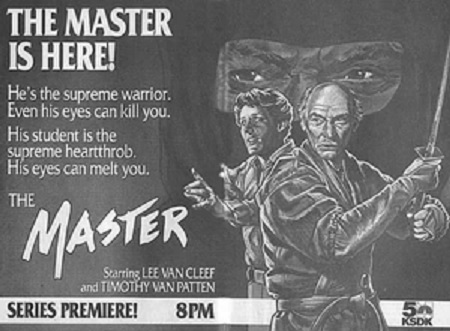
Last year, I reviewed one of Van Cleef’s final projects, a television series called The Master. On the show, Van Cleef played John Peter McAllister, an American ninja. However, Van Cleef was best known for appearing in several Italian spaghetti westerns, where his icy stare and ruthless intelligence were put to good use.
Today’s scene that I love features Van Cleef as the title character in 1969’s Sabata. In this scene, he faces off in a duel with William Berger’s Banjo. Even when he’s playing the good guy, like in this film, Lee Van Cleef leaves no doubt that he’s not someone you want to mess with.
Welcome to Retro Television Reviews, a new feature where we review some of our favorite and least favorite shows of the past! On Fridays, I will be reviewing The Master, which ran on NBC from January to August of 1984. The show can be found on Tubi!
This week, The Master comes to an end.
Episode 1.13 “A Place To Call Home”
(Dir by Gordon Hessler, originally aired on August 31st, 1984)
The Master ends in much the same way that it began, with Max and John Peter McAllister in a small town that is controlled by an evil businessman. In this case, land developer Mark Richards (Jock Mahoney) wants to run the local orphanage out of town so that he can steal the land and expand his uranium mine. Max and McAllister not only help Kim Anderson (Susan Woollen) save her orphanage but they also provide some much-needed mentoring to two of the orphans, Mike (Doug Toby) and Bobby (played by Kane Kosugi). Bobby, it turns out, has some martial arts skills of his own! It’s amazing how McAllister and Max were always traveling to small towns that just happened to be home to other people who knew karate.
Though his son plays Bobby, Sho Kosugi does not appear in this episode, which is a shame considering that it would be turn out to be the show’s finale. For that matter, the show ends with McAllister having yet to find his daughter. In fact, Terri McAllister is only mentioned briefly at the end of the episode, when McAllister says that he and Max have to get back on the road because “I’m looking for my daughter.” Considering that the whole premise of the show was that McAllister was searching for Terri while Okassa was searching for McAllister, it seems like neither was really in a hurry to accomplish their goals.
A Place To Call Home feels like a greatest hits package, duplicating the plot of the pilot while tossing in a bit of the union episode‘s political subtext. Even the scene where McAllister attempts to hop onto a helicopter feels a bit reminiscent of the ghost town episode. The Master ended with an episode that resolved nothing and didn’t really bring anything new to show’s format.
Why did The Master end after thirteen episodes? When taken as a whole, the show wasn’t as bad as its reputation. While the stunt doubles did most of the work, Lee Van Cleef and Tim Van Patten still managed to develop a likable chemistry over the course of 13 episodes. At first, the show’s writer stried too hard to play up the idea of Max Keller being a rebel with a chip on his shoulder but, after the first few episodes, it appears that they realized that Van Patten’s greatest strength as an actor was that he had a sort of amiable goofiness to him. The stories were predictable but the fight scenes were usually (if not always) well-choreographed and entertaining. The stunt people earned their paycheck.
In the end, though, I think The Master never quite figured what it wanted to be. Did it want to be a straight action show? Did it want to be a goofy buddy comedy? In some episodes, McAllister was apparently a famous and well-known figure. In others, he was a total unknown. In some episodes, finding Terri was the most important thing in his life. In others, he really didn’t seem to care. The best episodes were the ones that winked at the audience and acknowledged just how ludicrous the whole thing was. But, far too often, The Master became a generic crime show that just happened to feature martial arts.
The Master is finished and, to my surprise, I’m going to kind of miss it. It had potential. But, it’s time to move on to a new series. Get ready because next week, it’s time for T & T!
Welcome to Retro Television Reviews, a new feature where we review some of our favorite and least favorite shows of the past! On Fridays, I will be reviewing The Master, which ran on NBC from January to August of 1984. The show can be found on Tubi!
Max and McAllister continue their trip through California!
Episode 1.12 “Rogues”
(Dir by Gordon Hessler, originally aired on August 10th, 1984)
This week’s episode finds Max and McAllister on Los Angeles’s famed Rodeo Drive. We know that this episode takes place on Rodeo Drive because every single establishing shot opens with a close-up of the street sign. It’s as if someone in production said, “Do not let them forget that this episode is not only set on Rodeo Drive but we filmed it there as well!”
Wow, a television program filmed in Los Angeles! The Master was all about spoiling their audience.
Here’s my thing with Rodeo Drive — the word is pronounced Ro-Dee-O. Get out of here with all that Roe-Day-O nonsense, you yankees.
Anyway, this episode continues last week’s theme of McAllister and Max dropping in on people from Max’s past. Apparently, the hunt for John Peter McAllister’s long lost daughter has been abandoned so that Max can drop in on his old high school buddies. Seeing as how it hasn’t even been ten years since Max graduated from high school whereas McAllister has never even met his daughter and it’s totally possible that McAllister’s ninja rivals may be trying to kill her, it seems a bit odd that this is what Max and McAllister are concentrating on but whatever. We’re nearly done with this show anyway.
Max visits his ex-girlfriend, Talia (Cindy Harrell), at the health club where she works. Talia is an aerobics instructor, which means that there’s a lot of spandex in this episode. While McAllister deals with a trainer who takes one look at him and declares him to be in terrible shape (and she has a point because, unlike his stunt double, Lee Van Cleef was noticeably overweight and often seemed to be winded on The Master), Max talks to Talia and discovers that Talia’s brother, Jerry (Paul Tulley), became a cop and is now missing! Max promises to help her find Jerry.
However, it turns out that Jerry is just hiding outside the health club. When he sees Max’s van, he tosses a note inside of it, asking Max and McAllister to meet him. (How exactly did Jerry know that Max and McAllister would be able to help him?) It turns out that, while investigating a series of Rodeo Drive robberies, Jerry discovered that the culprits were rogue cops who had been hired by a local gallery owner. Now, the crooked policemen are after Jerry! Needless to say, it’s time for McAllister to put on his black ninja outfit so that Lee Van Cleef’s stunt double can beat up some corrupt law enforcers!
This was not a particularly memorable episode. The corrupt cops were generic villains and even the fight scenes, which were usually The Master‘s saving grace, felt sloppy and rushed. While it was always obvious that this show was dependent on stunt doubles, it was especially obvious in this episode as the stand-ins for both Van Cleef and Van Patten didn’t even resemble their respective actors. There was a brief moment of hope when the action moved to one of those police academy shooting ranges, full of fake buildings and cardboard targets but the show never really took advantage of the location’s potential. This was one of those episodes where it felt like the basic plot could have been used for a dozen other shows without having to make anything more than a few cosmetic changes. It could have just as easily been an episode of Half Nelson.
(L.A. — you belong to me! No, no, we’ve moved on….)
Next week …. The Master ends! Will McAllister even mention his missing daughter during the show’s final episode? We’ll find out!
Welcome to Retro Television Reviews, a new feature where we review some of our favorite and least favorite shows of the past! On Fridays, I will be reviewing The Master, which ran on NBC from January to August of 1984. The show can be found on Tubi!
This week, we meet Max Keller’s father!
Episode 1.11 “Failure to Communicate”
(Dir by Sidney Hayers, originally aired on May 4th, 1984)
This week’s episode of TheMaster opens with McAllister (Lee Van Cleef) teaching Max (Tim Van Patten) how to fight even while blindfolded. McAllister explains that, when one’s sight is taken away, the other senses become even stronger. Hmmm…. I wonder if this will prove to be relevant to their next adventure?
Having apparently given up on trying to find McAllister’s daughter (not that they ever seemed to be trying that hard to begin with), Max and McAllister head to Los Angeles so that Max can visit his father. Max’s father, Patrick (Doug McClure), has been estranged from Max ever since the death of Max’s mother and older brother. However, under McAllister’s guidance, Max has learned the importance of forgiveness.
However, before Max can drop in on his father, he and McAllister have to rescue Kathy Hunter (Ashley Ferrare), who is being chased by three men in a cemetery. McAllister is impressed when Kathy uses some martial arts skills of her own to fight off the men. (Kathy explains that she has been in training for six years.) McAllister takes Kathy home to her father, a wealthy bunker named Jason Hunter (J.D. Cannon). Max, meanwhile, goes to his father’s law office.
However, Patrick is not at his office. Instead, Max meets Patrick’s administrative assistant, Laura Crane (Rebecca Holden). Laura is blind but, as we saw at the start of the program, that just means that all of her other senses are now superhuman. As soon as she meets Max, she knows that he recently stopped off at a gas station and that he drives a van. All it takes is for her to touch his face for her to realize that she is Patrick’s son.
Patrick, unfortunately, is not doing too well. He is now an alcoholic and he’s more likely to be found in the local cocktail lounge than in court. He’s in danger of losing his license and he’s also struggling financially. In fact, at the cocktail bar, Patrick is meeting with Straker (Marc Alaimo), one of the men who previously tried to abduct Kathy in the cemetery. Straker is blackmailing Patrick into helping with Staker’s next attempt to kidnap Kathy. Of course, when Max arrives at the bar looking for his father, all Hell breaks loose when Max sees the men from the cemetery. Patrick can only watch as Max and a late-arriving McAllister chase the men out of the bar.
After the bar fight, Max and Patrick have a tense meeting at Patrick’s office. Max accuses his father of being a bitter drunk. Patrick says that Max is irresponsible. Patrick tells Max to get out of his life. Meanwhile, McAllister escorts Laura back to her apartment. Okassa (Sho Kosugi) shows up and we get yet another fight, this time between Sho Kosugi and Lee Van Cleef’s very busy stunt double.
The next day, Patrick, Laura, McAllister, and Max all end up at a reception for Kathy. Patrick spots the three kidnappers at the reception and, having had a change of heart, attempts to lead Kathy outside to safety. However, this just leads to both Patrick and Kathy being kidnapped. Straker calls Kathy’s father and demands a $3,000,000 ransom but, fortunately, Laura smelled cemetery dirt on the men who grabbed Kathy so Max and McAllister head back to the cemetery, break into a church, and manage to rescue both Kathy and Patrick!
Yay! I guess the episode’s over, right?
Nope, not even close.
While Max and McAllister are rescuing Patrick and Kathy, Straker is busy kidnapping Laura. Straker then calls Kathy’s father and announces that he still expects to get his 3 million or “your lawyer’s secretary gets it!” Kathy’s father is like, “Why would I pay 3 million dollars for someone who I don’t even know?,” which is kind of a fair question even if it’s not a popular one. McAllister, however, tells Kathy’s father that it’s important to take care of everyone, even the strangers.
Patrick finally breaks down and admits that he was a part of the plot to kidnap Kathy. He tells Max and McAllister that the man behind the plot is actually Paul Stillwell (Mark Goddard), who is Jason Hunter’s head of security. (This seems familiar….) Patrick also explains that Stillwell is holding Laura prisoner on the Princess Louise, a decommissioned cruise ship that has been turned into a floating restaurant.
Accompanied by Patrick, Max and McAllister go to the ship. Unfortunately, Okassa pops up out of nowhere and gets into another fight with Lee Van Cleef’s stunt double so it falls to Patrick and Max to rescue Laura. (Patrick suddenly turns out to have some martial arts skills as well, which is a bit odd considering that Patrick is a middle-aged, overweight, out-of-shape, alcoholic attorney.) The bad guys try to outsmart Max by turning out all the lights on the boat but Laura is able to use her supersenses to help Max beat up Straker’s men in the dark. Laura is rescued and the bad guys are sent to prison!
As for Patrick, the Hunter family decides not to press charges because they understand that Patrick was being blackmailed. Swearing that he’s going to live his life the right way from now on, Patrick pours out his last remaining liquor bottle. Hooray!
This was one of those episodes that was a bit too busy for its own good. Rather than have Max and McAllister fight against worthy opponents, this episode just had Max and McAllister continually defeat the same three idiots over and over again and you have to wonder why it never seemed to occur to the bad guys to change their strategy when it came to whole kidnapping thing as opposed to repeating the same thing over and over again. With all of those kidnappings and rescues, there really wasn’t much time left for the emotional heart of the story, which should have been Max mending his relationship with his father. Considering how much of this series has focused on Max and McAllister’s family issues, it was a bit anti-climatic that Max’s real father just turned out to be some drunk who was being blackmailed. At least some of the fight scenes were well-choreographed and Rebecca Holden did a good job as Laura Crane, even if the character herself was occasionally too flawless and perfect to be believed.
Next week, maybe McAllister will finally remember that he’s supposed to be looking for his daughter. We’ll see!
Welcome to Retro Television Reviews, a new feature where we review some of our favorite and least favorite shows of the past! On Fridays, I will be reviewing The Master, which ran on NBC from January to August of 1984. The show can be found on Tubi!
This week, the action moves off the mainland!
Episode 1.10 “The Java Tiger”
(Dir by Bruce Kessler, originally aired on April 13th, 1984)
Max and McAllister go to Hawaii!
I have to admit that I was really excited about this episode, precisely because it did feature Max and McAllister heading to Hawaii. I love Hawaii. Some of my favorite memories come from the summer that me, my sisters and our mom spent in Hawaii. It doesn’t matter how bad a show or a movie may sound, I’ll give it a chance if it features the promise of Hawaii.
Unfortunately, this episode of The Master never really takes advantage of the beauty of the islands. In fact, other than for a few generic shots of Honolulu, it appears that this episode was filmed in California. About the only thing that says Hawaii about this episode are the shirts worn by the bad guys and the lei hanging around Max’s neck when he and McAllister check into their hotel.
Max and McAllister are in Hawaii because McAllister has received a letter from an old friend of his, a private investigator/treasure hunter named Leo Fairchild (Dick O’Neill). Just as with last week, one has to wonder how McAllister got the letter when he doesn’t have a fixed address and he’s supposedly been laying low in America to avoid getting track down by the ninjas who want him dead. As well, how does McAllister have all of these old friends in the United States and how do they all know that he’s a ninja? When the series started, the whole idea was that McAllister had been Japan since the end of World War II and that he had spent the majority of that time either being trained or training others. And yet, as of last week’s episode, McAllister is now suddenly a minor celebrity.
When Max and McAllister arrive in Japan, they meet Leo’s daughter, Shelly (Cynthia Cypert). Shelly tells Max and McAllister that her father was killed while searching for the location of a priceless statue, the fabled Java Tiger. Leo, she explains, was the only person in Hawaii to have a map leading to the tiger’s location. However, whoever killed Leo, stole half of the map. Now, if she’s going to fulfill her father’s dream, she needs to get that half of the map back. She’s pretty sure that Kruger (Kabir Bedi), a notorious and greedy practitioner of the martial arts, has the missing half. So, once again, it’s time for McAllister to put on his black uniform and break into a compound with Max! When things don’t go as well as Max and McAllister might have hoped, they’re saved by an old friend of McAllister’s….
As you may have guessed, Leo isn’t actually dead. He faked his own death so that McAllister would agree to help him find the Java Tiger. As Leo explains it, he needs McAllister to enter the cave where the Tiger is hidden because the cave is full of booby traps and McAllister, being a ninja, is the only man alive who can dodge falling rocks and darts. And, of course, time is of the essence because the cave is on an island that is also home to a volcano that is about to erupt.
This is what the volcano looks like:
To be honest, there’s something oddly charming about how fake the volcano looks. I was pretty annoyed that the episode didn’t have any pretty shot of Hawaii but, as soon as I saw that miniature, plaster volcano spewing smoke, I couldn’t help but smile.
McAllister, Max, Leo, and Shelly arrive at the island with Kruger’s men closely behind. With the volcano erupting all around them, they find the cave and eventually McAllister grabs the Java Tiger. But, when it appears that Kruger might be killed by a booby trap, McAllister drops the statue and saves the life of his enemy because McAllister is a man of honor. As a result, no one gets the tiger but McAllister stays true to his ideals.
To be honest, this episode was so silly that it was almost charming. Unfortunately, the usually reliable character actor Dick O’Neill gives an annoyingly mannered performance as Leo Fairchild, hamming it up and chewing every piece of scenery in sight. Leo is one of those characters who never stops talking and it’s hard not to get annoyed both the character and the actor playing him. In fact, so much time is devoted to Leo talking and talking that the episode almost feels like a pilot for a Leo Fairchild show. Who knows? Maybe it was. All I know is that the episode needed more Hawaii and less Leo.
This was a underwhelming week for The Master. There’s only three episodes left and Max and McAllister don’t seem to be any closer to finding Teri than when they started. Get to work, guys! You’re running out of time!
Welcome to Retro Television Reviews, a new feature where we review some of our favorite and least favorite shows of the past! On Fridays, I will be reviewing The Master, which ran on NBC from January to August of 1984. The show can be found on Tubi!
This week, McAllister and Max head to Washington, D.C.!
Episode 1.9 “Kunoichi”
(Dir by Gordon Hessler, originally aired on April 9th, 1984)
The 9th episode of The Master opens by showing us what Okasa (Sho Kosugi) has been doing since coming to America to track down and kill his former teacher, John Peter McAllister (Lee Van Cleef). Okasa has been training an apprentice of his own. The apprentice ninja is always seen while wearing a light gray ninja uniform, the better to keep the apprentice’s identity a secret until halfway through the episode.
Meanwhile, McAllister and Max (Tim Van Patten) are in Washington, D.C. As McAllister explains it, he was good friends with Brian Elkwood (Jack Kelly) when they both served in the Army together. During the Korean War, they were both held in the same POW camp and they escaped together. (This, of course, goes against McAllister’s previous backstory, which was that he left the Army after World War II and spent the next 40 years hidden away in Japan.) Elkwood is now an important advisor to the President. Apparently, Elkwood sent McAllister a letter informing him that a spy known as The Hawk was threatening his life so McAllister has come to Washington to protect him. (How exactly McAllister received a letter when he and Max are constantly driving around the country in search of McAllister’s daughter is not explained.)
At the Elkwood estate, Brian Elkwood tells his assistant, Allison Grant (Kelly Harmon), that he has been receiving letters from John Peter McAllister in which McAllister has threatened to kill him. Allison argues that McAllister has always been Elkwood’s friend but Elkwood says that people can change. Elkwood’s head of security, Ron Gordon (Rick Hill), is concerned not only about McAllister but also about uncovering the identity of The Hawk.
Or at least, that’s what Gordon claims. A few scenes later, we discover that Gordon actually is The Hawk and that he’s hired Okasa to assassinate Elkwood. Okasa is planning on framing McAllister for the assassination. The assassination will be carried about his apprentice, who we learn is close to Elkwood. The episode tries to build up a lot of suspense over who Okasa’s apprentice actually is but it’s actually pretty easy to figure out. Elkwood is not the apprentice because he’s the target. Gordon is the not apprentice because he’s the Hawk. There’s only one other guest star on this episode so obviously, the apprentice is Allison. Myself, I’m just confused as to when Okasa’s mission went from personally killing McAllister to framing him for murder.
Eventually, McAllister is able to convince Elkwood that he didn’t write the threatening letters but a sudden attack of Okasa’s apprentice leaves Elkwood hospitalized and McAllister arrested for attempted murder. Fortunately, Max is able to use his ninja training to help McAllister escape from jail and they manage to not only prevent the second attempt on Elkwood’s life but they also expose both Gordon and Allison as being enemies of the state. Yay!
This is one of those episodes where everyone, with the exception of Sho Kosugi, steps to the side and lets their stunt doubles do most of the work. There’s a lot of fights but they are all awkwardly choreographed and framed, probably in an attempt to keep the audience from noticing that Lee Van Cleef’s stunt person was notably thinner and more athletic than Lee was. As far as episodes of The Master are concerned, this was not a bad one but it still ultimately leaves the viewer feeling that it could have been so much better.