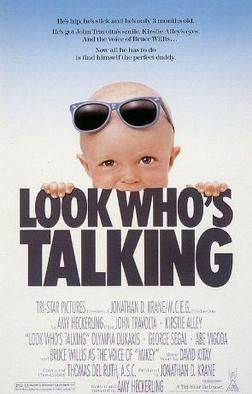
Mollie Jensen (Kirstie Alley) is an accountant who has an affair with a married client, Albert (George Segal) and ends up getting pregnant. At first, Albert has no interest in being a father but luckily, when Mollie goes into labor, she’s driven to the hospital by a down-on-his-luck taxi driver named James (John Travolta). After little Mikey is born, James agrees to be Mikey’s babysitter in return for Mollie letting James use her address so he can set up nursing care for his grandfather (Abe Vigoda). Mollie and James are falling in love but then Albert reenters the picture. Will Mollie choose rich Albert or goofy James?
As if there’s any doubt!
The important this is not the story but that the story is narrated by Mikey and Mikey sounds just like Bruce Willis!
I will admit it. I like Look Who’s Talking.
Hey, it’s cute! It’s a movie that opens with a point of view shot of a herd of sperm heading for an egg. Little sperm Mikey is so excited! Even before Mikey is born, he’s giving us his opinions. When he is born and they cut the umbilical cord, he says, “Hey, I need that!” What newborn wouldn’t say that? You’re comfortable and suddenly, you’re getting dragged into the real world.
What I really like about Look Who’s Talking is that we just hear Mikey’s narration and thoughts but Mikey himself doesn’t actually talk. It’s not like those creepy commercials where they use cheap CGI to make it look like the babies are actually talking. I hate those commercials. Instead, we’re just hearing Mikey’s thoughts and his thoughts are probably the ones that most babies would have. He just sounds like Bruce Willis. John Travolta is adorable in this. Kirstie Alley is neurotic and relatable. The babies are all cute. But the true star of the film is Bruce Willis’s voice. Supposedly, Willis ad-libbed most of his lines. Mikey’s crude but most babies are.
No, I haven’t seen the sequels. I won’t ever see the sequels. I get the feeling this is one of those movies that could only work once. Didn’t the third movie feature talking animals and no Bruce Willis? There’s no need for that.
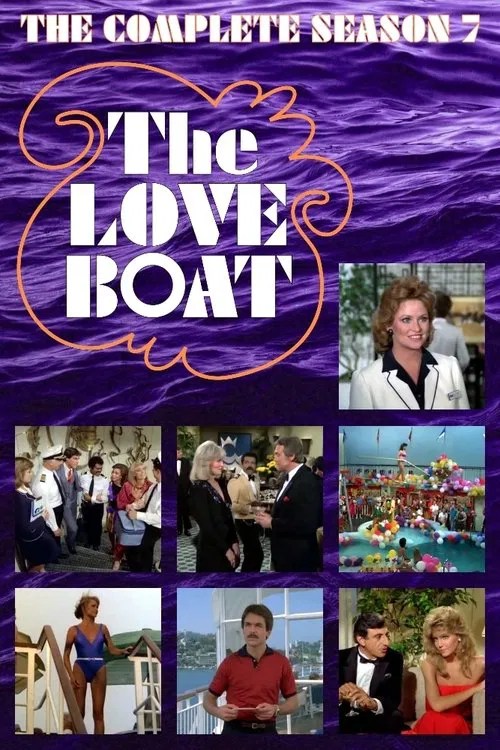
Welcome to Retro Television Reviews, a feature where we review some of our favorite and least favorite shows of the past! On Wednesdays, I will be reviewing the original Love Boat, which aired on ABC from 1977 to 1986! The series can be streamed on Paramount Plus!
Love wont hurt anymore….
Episode 7.11 “The World’s Greatest Kisser/Don’t Take My Wife, Please/The Reluctant Father”
(Dir by Ted Lange, originally aired on November 26th, 1983)
Sawdust Radell (Dan Haggerty) is looking for revenge. The woman he loved dumped him after having a romance with one of the officers on the Pacific Princess. She didn’t tell him the officer’s name but she did say that he was “the greatest kisser in the world.” Ol’ Sawdust boards the ship with his best friend, Bonnie Lee Boone (Elaine Joyce). He wants Bonnie Lee to kiss each of the ship’s officers and then report back on which one is the greatest kisser. What is Sawdust planning on doing? I have no idea but I have a feeling that Sawdust might have a prison stint in his future.
(That was certainly true for actor Dan Haggerty who, two years after this episode ended, was arrested for trying to sell cocaine to an undercover police officer.)
Bonnie Lee kisses the Captain, Doc, and Gopher. She causes a lot of jealousy amongst the crew but they’re not the only ones getting jealous. Sawdust realizes that he’s in love with Bonnie Lee. He also gets a cable from his ex, informing him of the name of the officer. It turns out that the “world’s greatest kisser” is some guy who we have never seen or heard of before and he has since transferred to a different ship. Well, that’s convenient.
Before leaving the ship, the Captain asks Bonnie who the best kisser amongst the remaining crew was. Wisely, Bonnie Lee looks over at Sawdust and says, “Him!”
(No, she did not kiss Isaac. Then again, Ted Lange was busy directing this episode so Isaac’s not really around that much.)
Young executive Matt Stevens (Parker Stevenson) is taking a business cruise. He boards with his new wife, Marion (Kirstie Alley). Uh-oh, it turns out that Matt’s boss, Arthur Boggs (David Doyle), gave strict orders that wives were not allowed on the cruise! As Arthur explains it, “If I let you bring your wife, then I have to bring my wife.” And it turns out that Arthur — who says stuff like “As they say in Moscow, I’m hot to Trotsky!” — really wants to cheat on his wife.
Matt asks Marion to remove her wedding ring and pretend she doesn’t know him. Marion agrees. (Personally, I would have just asked for a maritime divorce.) But when Arthur starts hitting on Marion and Marion starts spending time with Arthur, Matt is finally forced to stand up and announce, “This is my wife!”
“You’re fired!” Arthur replies.
And you’re sued, Matt should have said. Seriously, you can’t fire someone for being married. And perhaps Arthur figures that out because he later offers to give Matt back his job. Matt smiles and accepts. Does Matt have any self-respect?
Finally, teenage Melissa Weatherly (Danielle Brisebois) boards the boat with her father, Elliot (William Christopher). Melissa’s parents divorced when Melissa was young and she’s never really known her father. But now that her mom has died, Melissa is living with Elliot and the two are trying to adjust. Elliot makes the mistake of suggesting that Melissa go to boarding school. Melissa becomes convinced that Elliot doesn’t love her. Fortunately, Vicki is there to talk to Melissa and the Captain is there to talk to Elliot.
This storyline made me think of my own relationship with my Dad and, as a result, it brought tears to my eyes. Gavin MacLeod always did well whenever the show gave him a serious storyline. Plus, it was good that Vicki actually had someone her own age to hang out with for once. I always worry about the fact that Vicki seems to spend all of her time on a cruise ship, surrounded by people who are about 40 years older than her.
This is one of the many episodes that Ted Lange directed. Lange always seemed to get better-than-average performances out of both the regulars and the guest stars and that’s certainly the case here. William Christopher and Danielle Brisebois both turn in strong performances as the father and the daughter. Parker Stevenson and Kirstie Alley were themselves newlyweds when they did this episode and their chemistry comes through, even if Stevenson is playing an annoyingly wimpy character.
59 years ago today, the first episode of Star Trek aired in America.
There’s been a lot of different StarTrek shows and crews over the decades. I have to admit that I’ve always preferred the Original Series, with Kirk sleeping with every alien he met, McCoy and Spock bickering about logic, and Scotty warning that the engines can’t take much more. The Next Generation was strong as well, especially in the later seasons. The subsequent series have been hit-and-miss for me.
I was born long after the Original Series went off the air so, like a lot of people, my real introduction to Star Trek came through watching the films. This weekend, I sat down and watched all fourteen of the Star Trek films in order, from The Motion Picture to Section 31. Here are my thoughts.
Star Trek: The Motion Picture (1979, directed by Robert Wise)
In the first Star Trek film, Voyager returns to Earth, now known as V’ger. James T. Kirk (William Shatner) returns to the Enterprise with his old crew and takes command from Decker (Stephen Collins). Spock (Leonard Nimoy) returns from Vulcan is not happy about it.
Directed by Robert Wise, the first Star Trek film feels out-of-place amongst the films that followed it. It’s long and slowly paced and it doesn’t have the sense of humor that runs through the best of the films featuring the original cast. The film favors Kirk and Spock, with the rest of the original cast being largely used as bit players. Even the costumes are different from the uniforms worn in the later films, making Star Trek: The Motion Picture feel like an entry from an alternate universe.
Despite mixed review, Star Trek: The Motion Picture made the most money of any of the pre-reboot films at the box office. Because the film itself was so expensive, it was still judged to be a box office disappointment. The Star Trek films would continue but in a new direction.
Star Trek II: The Wrath of Khan (1982, directed by Nicholas Meyer)
Featuring a character-driven script, exciting action, the best villain in the history of the franchise, and an ending that will bring tears to the eyes of the most cynical viewer, The Wrath of Khan is the film that set the standard for the Star Trek films that would follow.
Ricardo Montalban, recreating a character that he originally played in the television series, is a compelling villain as the vengeance-driven Khan. Montalban and William Shatner make for perfect rivals, two sides of the same coin. At the same time, the other members of the original cast all get their moments to shine, especially Walter Koenig as Chekhov. Kirstie Alley is the sexist Vulcan to ever appear in the franchise and even the revelation that Kirk has a son is handled effectively. Kirstie Alley, Bibi Besch, and Merritt Butrick all fit in with the original crew.
But the thing everyone remembers about The Wrath of Khan is the death of Spock. Even though the movie features plenty of hints that Spock will return (including his command of “Remember” to McCoy), it’s impossible not to get emotional when Spock sacrifices himself for the crew. “I have always been your friend.” To quote George Costanza, that was hell of a thing when Spock died. In that scene, Leonard Nimoy shows that he was the (logical) heart of the franchise. Just as Spock brought out the best in the rest of the crew, Nimoy brought out the best in his co-stars. Shatner was never better than when he was mourning Spock.
Star Trek III: The Search For Spock (1984, directed by Leonard Nimoy)
Spock’s back! It’s not a surprise. I think everyone knew, at the end of Wrath of Khan, that the Genesis Project would bring back Spock. Star Trek III isn’t bad. Christopher Lloyd reminds us of how brutal the Klingons were before their Next Generation makeover. The self-destruction of the Enterprise is a powerful moment. I just wish that a film about Spock being given a new life hadn’t featured so much death. Both the revelation that David Marcus tampered with the Genesis Project and his subsequent death feel like missteps. Robin Curtis takes over the role of Saavik and Kirstie Alley is very much missed. DeForest Kelley playing McCoy possessed by Spock was, for me, the highlight of the film.
Star Trek IV: The Voyage Home (1986, directed by Leonard Nimoy)
Returning home after rescuing Spock from the Genesis Planet, the Enterprise crew is instead sent back into the past so that they can bring two whales into the future. The Voyage Home might not be the best Star Trek film (that honor belongs to Wrath of Khan) but it is the most likable and the most entertaining. Every member of the cast gets something to do in 20th Century San Francisco. The film is full of classic moments, from Chekhov looking for the “nuclear wessels” to Scotty trying to speak to the computer. The moment with the punk on the bus is a crowd-pleaser. I always laugh at Spock’s “One damn minute, Admiral.” After the violence in The Search for Spock, The Voyage Home‘s humor, gentle sincerity, and emphasis on the efforts of the entire ensemble is a welcome development.
Star Trek V: The Final Frontier (1989, directed by William Shatner)
Leonard Nimoy got his chance to shine as the director of the previous two Star Trek films so William Shatner was allowed to direct The Final Frontier. The Enterprise crew is brainwashed by a religious fanatic (Laurence Luckinbill) who is also, improbably, Spock’s brother. Only Kirk is able to resist and confront the entity claiming to be God. “What does God need with a starship!?” Kirk demands. It’s such an obvious question that I can’t believe the entity didn’t already have an answer worked out.
The Final Frontier gets no respect and it was probably doomed as soon as Shatner was announced as director. Shatner also developed the story and it’s probably not surprising that the main theme is that Kirk was the only person on the Enterprise strong enough to not be brainwashed by the film’s fake God. Laurence Luckinbill gave a good performance as Sybok but this film really does feel like an unfortunate episode of the original television series.
Star Trek VI: The Undiscovered Country (1991, directed by Nicholas Meyer)
Star Trek VI featured the final appearance of the Original Series cast as a group and they get a send-off worthy of their legacy. Having been previously established as the Federation’s greatest enemies, the Klingons finally pursue peace. Just as only Nixon could go to China, only Kirk and the original Enterprise crew can go to the Klingons. This movie is what Star Trek was all about, with enough world-building and continuity for the hardcore fans and a story that was interesting enough to hold the attention of the casual viewers. By featuring the start of the era of peace between the Federation and the Klingons, this film also filled in some of the Next Generation‘s backstory. The Final Frontier was meant to be the final Star Trek film featuring any of the original cast and it would have been the perfect entry for Captain Kirk to go out on. Unfortunately, that didn’t happen.
Star Trek Generations (1994, directed by David Cason)
William Shatner meets Patrick Stewart as one Star Trek crew passes the torch to the new Star Trek crew. Malcolm McDowell is the latest villain with an ill-defined plan. Picard and Kirk team up to stop McDowell’s villain. They succeed but at the cost of Kirk’s life. As opposed to Spock’s death in Wrath of Khan, Kirk’s death feels pointless and tacked on for no reason other than to signify the arrival of The Next Generation to the films. Seeing Shatner and Stewart together is interesting. Stewart may have been the better actor but Shatner still dominates their scenes together. Not giving Kirk a better send-off was one of the franchise’s biggest sins.
Star Trek: First Contact (1996, directed by Jonathan Frakes)
After the disappointing Generations, Picard and his crew finally got a film worthy of them with First Contact. Not only do the Borg return but the crew goes back into their past and experience a key date in the history of the Federation. After being outshone by Shatner in Generations, Patrick Stewart takes control in this film, giving a multi-layered and commanding performance that still gives the rest of the cast room to shine. Director Jonathan Frakes not only handles the action well but he also shows that he understands what makes the characters click. This was, without a doubt, the best of the Next Generation films and one the best of the Star Trek films overall.
Star Trek: Insurrection (1998, directed by Jonathan Frakes)
Entertaining but forgettable, Insurrection features Picard pulling a Kirk and defying orders from from a superior officer (played by Anthony Zerbe) and going out of his way to save Data from being decommissioned. Insurrection feels like an extended episodes of the Next Generation television series and lacks the epic scale of First Contact. Under the direction of Jonathan Frakes, the ensemble is strong and watching them interact feels like spending time with a group of old friends. F. Murray Abraham and Anthony Zerbe make for effective villains.
Star Trek: Nemesis (2002, directed by Stuart Baird)
Just as the Original Series crew sought peace with the Klingons in The Undiscovered Country, the final Next Generation film finds Picard, Riker, and the rest seeking peace with the Romulan Empire. Tom Hardy plays a clone of Picard who is now the leader of the Romulans. Data sacrifices himself in a move that tries too hard to duplicate the death of Spock. Picard retires. Director Stuart Baird emphasizes action over the chemistry of the Next Generation cast and the end result is a disappointing finale that left critics and audiences underwhelmed.
Star Trek (2009, directed by J.J. Abrams)
I think people forget about what a big deal this Star Trek reboot was when it first came out. Today, people focus on things like Kirk being a Beastie Boys fan and they forget how exciting it was to see Chris Pine, Zachary Quinto, Karl Urban, Simon Pegg, Anton Yelchin, John Cho, and Zoe Saldana all effortlessly stepping into the roles of the younger versions of the original cast. The storyline is predictable and Eric Bana’s a bland villain but the scenes between Leonard Nimoy and Zachary Quinto were a reminder of how important Spock was and is to Star Trek.
Star Trek wasn’t perfect, of course. In retrospect, I think creating an alternate timeline was a mistake because it created a situation where, even if someone died, it was just an alternate version dying and not the version that audiences knew and cared about. The alternate timeline would also lead to one of the biggest missteps in the history of the franchise.
Star Trek Into The Darkness (2013, directed by J.J. Abrams)
After the surprising success, both critically and commercially, of his Star Trek reboot, J.J. Abrams. Robert Orci, Alex Kurtzman, and Damon Lindelof wasted most of that good will by messing around with one of the franchise’s most memorable characters.
There are some good things to be said about Star Trek Into The Darkness. I like the action sequences and the climatic battle in the film’s futuristic version of San Francisco. But casting Benedict Cumberbatch, of all people, as Khan is a misstep that can’t be overcome. That the movie brought back Khan instead of exploring “strange new worlds” exposed the weakness of Abrams entire reboot. For all the hype, did the Star Trek reboot actually have anything new or original to offer? The answer here seemed to be no.
Star Trek Beyond (2016, directed by Justin Linn)
The final (for now) Star Trek theatrical film featured a memorable villain in the form of Idris Elba and a plot that felt like it could have just as easily been an episode of the original series. In retrospect, the film is mostly memorable for featuring the announcement of the death of Ambassador Spock. (The film was released a year after the death of Leonard Nimoy.) The death of Spock, this time with no Genesis Project around to bring him back, makes this installment feel like right place to end the films. For many of us, Nimoy was Star Trek.
Stark Trek: Section 31 (2025, directed by Olatunde Osunsanmi)
Though there have been many subsequent televisions shows, there hasn’t been a Star Trek theatrical release since 2016. The next installment has been in pre-production limbo for nearly ten years. (Quentin Tarantino was supposedly attached at one time.) Instead of coming to theaters, the latest Star Trek movie came to Paramount Plus.
I debated whether or not to include Section 31 in this list, both because it was a “made-for-TV” movie and also because it was so bad that I think most Star Trek fans would rather forget about it. A mediocre heist film that wastes star Michelle Yeoh and which doesn’t feel like it belongs in the Star Trek universe, Section31 may still represent the way forward for the franchise. With theaters having never recovered from the COVID shut-downs and more and more people preferring to stream their entertainment at home, the future of the Star Trek films could very well be a collection of assembly line Paramount Plus movies.
Finally, Case turned me onto this short film:
765874: Unification (2024, directed by Carlos Baena)
A collaboration between Otoy, a VFX company, and The Roddenberry Archive, with support from Paramount, 765874: Unification is a 10-minute short film that imagines Kirk meeting Spock in the afterlife. Shatner returns as Kirk, de-aged with CGI. Just as Kirk and Spock were friends in the film, the same was true of Shatner and Nimoy in real life. (You only have to compare Nimoy’s comments about Shatner with George Takei’s endlessly bitter takes to see what true class actually is.) This short film gives both characters the finale that they deserved.
It’s possible that we may never see another true Star Trek film. Most of the original cast is gone now. Patrick Stewart will always be Picard but even he is now approaching 90. But whatever the future may hold, I’m happy for the films that Star Trek gave us.
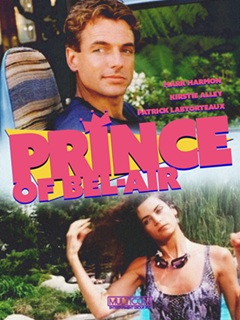
Robin Prince (Mark Harmon) is a laid-back former volleyball player who, at the age of 32, makes his living as a pool guy. It’s an easy life and he enjoys it. He sleeps with the wife (Deborah Harmon) of one of his clients and he hangs out with his richer friends. Robin enjoys being a bachelor but that all changes when he agrees to give a job to Justin (Patrick Labyorteaux), the son of Stanley Auerbach (Robert Vaughn) and meets Justin’s cousin, an artist named Jamie Harrison (Kirstie Alley). Justin goes from being bitter about having to work to idolizing Robin and his lifestyle. Robin, meanwhile, falls for Jamie.
This film came out before SummerSchool, another movie that featured Mark Harmon as a laid-back guy who falls for Kirstie Alley, but it has a similar vibe. Again, Mark Harmon is playing a likable guy who has never grown up and again, Kirstie Alley is playing a sophisticated woman who, at first, seems like she’s too serious for Harmon’s character. Robin’s mentorship of Justin feels a lot like Hamon’s mentorship of his SummerSchool students. (Dean Cameron even plays a supporting role in both Prince of Bel-Air and SummerSchool, though he’s far more memorable in Summer School.) Prince of Bel-Air is more dramatic than Summer School. In Prince of Bel-Air, Mark Harmon plays a character who secretly understands that there’s not much of a future in his lifestyle, even if he’s not initially willing to admit it.
Princeof Bel-Air is a likable movie. Mark Harmon gives an amiable and relatable performance as someone who is finally trying to grow up and, as always, Robert Vaughn is a perfectly smug villain. Kirstie Alley’s sultry performance is the highlight of the film. In the 1980s, Alley has a smoky-eyed beauty that, when combined with her ribald sense of humor, made her irresistible. It only takes a few minutes to understand why Robin would be willing to give up his previous life to be with her. There’s nothing particularly deep about PrinceofBel-Air but it’s still an entertaining 100 minutes.
SummerSchool was the movie that made flunking out look like fun.
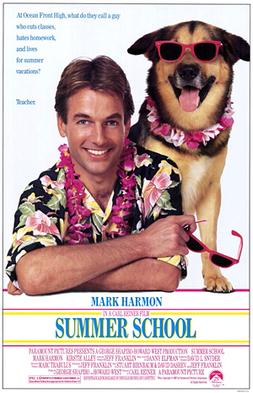
Freddy Shoop (Mark Harmon) is a relaxed, fun-loving gym teacher who is looking forward to spend his summer in Hawaii until he’s assigned to spend the summer teaching remedial English in summer school. (His girlfriend goes to Hawaii without him.) Freddy’s not happy about giving up his summer and he’s prepared to just spend his days taking his students to the beach, the amusement park, and the zoo. But when he finds out that he’s going to lose his job unless his students pass the big test at the end of the summer, he gets serious and discovers what teaching is supposed to be all about.
When I was growing up, SummerSchool seemed to be on television all the time. If it wasn’t on HBO, it was on one of the local stations, usually right before summer began. The summer school kids seemed to be having too much fun for kids stuck in school. I don’t think my classmates in Baltimore would have been as happy about losing their summer as the students in this film. Everyone who has seen this film remembers Dave and Chainsaw (Gary Riley and Dean Cameron) making jokes and showing everyone The Texas Chainsaw Massacre. They also remember Anna-Maria (Fabiana Udenio), the Italian exchange student who took summer school to work on her English. They remember Freddy letting one of his students move in with him, which doesn’t seem like a good idea even if she was played by Courtney Thorne-Smith. Myself, I remember Robin Bishop, the teacher next door, who was played by an extremely sexy Kirstie Alley. (This was one of the many 80s films in which Kirstie Alley made being uptight seem sexy.) Of course, Robin was dating the snobbish principal who was trying to get Freddy Shoop fired.
I’m not going to sit here and say that SummerSchool is a great film. It’s a dumb comedy with an uplifting message about what a good teacher can accomplish. However, SummerSchool is a very likable film, an enjoyable 80s teen romp that suggests summer school was the place to be in the late 80s. Mark Harmon, Kirstie Alley, and all the students give good performances. How many future horror nerds were inspired by Dave and Chainsaw? Legendary nice guy Carl Reiner directed and the movie itself is amiable and amusing enough to be watchable.
Mark (John Larroquette) and Jessa Bannister (Kirstie Alley) have a perfect yuppie lifestyle going until their respective family members show up at their California home and refuse to leave. First, it’s Mark cousin (John Diehl) and his wife (Jessica Lundy). Then it’s Jessa’s sister, Claudia (Alison LaPlaca), who has just left her husband and now has to find a new man to support her lifestyle. Mark and Jessa just want some time alone but instead, they have to deal with a cat who is frequently mistaken for dead, broken marriages, a shipment of cocaine, and a neighbor (Robert Ginty) who builds weird bed frames. Mark has a big contract to land and Jessa is trying to succeed as a television news reporter but it’s not easy when you’re living in a madhouse.
There are some films that you just like despite yourself and that’s the way I feel about Madhouse. It’s very much an 80s film, with its emphasis on material goods and achieving the perfect lifestyle. (The appearance of Dennis Miller as Mark’s co-worker only reminds us of just how much a product of its era that Madhouse is.) There are a lot of jokes that don’t work and some, like the cat that is continually mistaken for dead, that shouldn’t work but do. It’s a sitcom transferred to the movies and the humor rarely rises above that level. It ever stars two of the decade’s biggest sitcom stars, John Larroquette and Kirstie Alley. Larroquette shows us why he was better suited for television while Alley shows how tragic it was that she didn’t have a bigger film career. Kirstie Alley gives such a dedicated and fearless performance as someone who has been driven to the end of her rope that it keeps you interested in the film. Alley, like the great comedic actresses of Hollywood’s golden age, was an actress who could mix physical comedy with barbed one-liners and who was undeniably appealing as she moved from one disaster to the next. In Madhouse, she was beautiful, frantic, sexy, neurotic, relatable, and funny all at the same time. By the end of this movie, you really do wish she had gotten more and better opportunities to show off her talents in the years after Cheers went off the air.
Madhouse is nothing special. It’s a generic comedy about unwanted family guests. But I’ll always appreciate it for Kirstie Alley.
I’m actually kind of alone amongst my family as far as that’s concerned. All three of my sisters enjoy spending the night outdoors, listening to sounds of nature and looking up at the stars. They know how to set up tents and make campfires and they enjoy hiking and rafting and exploring the great outdoors. Myself, I do enjoy occasionally spending the weekend up at Lake Texoma and I like the fact that, even though we live in the city, we still occasionally get to see wildlife running around. I think possums are cute. A few days ago, I squealed with delight when I saw that there was a raccoon hanging out in one of our backyard trees. (“Don’t go near that thing, Lisa Marie!” Erin snapped as I reached for the den door.) Growing up, I spent time in both the country and the city. While I love living in the city, there’s still a part of me that’s still a country girl. That said, I definitely prefer sleeping inside to outside. The inside is safe. The inside is comfortable. The inside is free of creepy bugs that crawl on the ground.
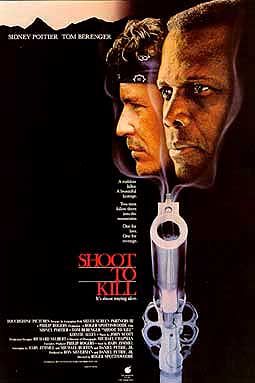
Watching 1988’s Shoot to Kill definitely did not do much to change my opinion about camping. In this thriller from director Roger Spottiswoode, Sidney Poitier plays Warren Stantin, an FBI agent who is obsessed with capturing a sadistic criminal who blackmails people into doing his work for him. At the start of the film, the extortionist has forced a jeweler to break into his own jewelry store by taking the jeweler’s wife hostage. Stantin’s attempt to capture the extortionist leads to the jeweler’s wife taking a bullet in the eye. (AGCK! Seriously, this guy is mean!) Stantin traces the man to Washington State, where he discovers that the extortionist has committed another murder and stolen the victim’s identity. The extortionist is now a member of a five-man fishing party that is being led by a local guide, Sarah Renell (Kirstie Alley). Stantin teams up with Sarah’s partner, Jonathan Knox (Tom Berenger), and the two of them attempts to track down the group before the murderer among them makes his move.
The action cuts back-and-forth, between Sarah’s party and Knox and Stantin. Most viewers will probably be able to quickly figure out which member of Sarah’s party is the killer but director Spottiswoode still creates a little suspense by casting actors like Richard Masur, Andrew Robinson, and Clancy Brown as the suspects. All three of the actors have played their share of sinister characters. (Andrew Robinson was the Scorpio Killer, for God’s sake!) While Sarah leads the murderer though the wilderness, Knox teaches Stantin how to survive in the great outdoors. As is typical with films like this, Knox and Stantin go from disliking each other to depending on each other. Have you ever wanted to see Sidney Poitier get into a verbal altercation with a bear? This is the film for you!
Shoot to Kill is a superior genre film. The story’s predictable but it’s told so well that it doesn’t matter. Kirstie Alley, Tom Berenger, and Sidney Poitier all give good performances as sympathetic characters. As for the actor who turns out to be the killer, he gives a performance that is, at times, absolutely terrifying. Shoot to Kill is an entertaining thriller. Just don’t watch it if you’re going camping the next day.
In 1984’s Blind Date, Joseph Bottoms stars as Jonathon Ratcliff, an American who works in Greece.
Jonathon would appear to have it all. He has a good job in an exotic land. He has a nice home. He has a beautiful girlfriend named Claire (Kirstie Alley). He has co-workers who love him so much that they insist on throwing him a birthday party and giving him his cake while he’s making love to Claire. Jonathon enjoys jogging and listening to music and spying on his neighbor, which the film treats as a harmless little thing that all men do. I mean, I guess we should be happy that Jonathon isn’t disguising himself as a taxi driver and murdering the women that he picks up with a scalpel. No, someone else is doing that.
Jonathon suddenly loses his eyesight. Fortunately, Dr. Steiger (James Daughton) has a solution. He’s created a computer program that turns sound into very primitive, grid-like images. As long as Jonathon is wearing his headphones, he can see … kind of. At first, it’s all good fun. Jonathon beats up the extremely flamboyant muggers who have been harassing him at the subway station. And he continues to spy on his neighbor whenever she’s getting undressed which is not cool considering that Claire has stayed with him through his entire ordeal.
Meanwhile, the scalpel murders are continuing….
Now, to be honest, I assumed that Jonathon was going to form some sort of mental connection with the killer and start seeing the murder through the killer’s eyes. Instead, Jonathon just hears the killer walking with one of his victims and he ends up investigating on his own, despite not really being able to see well. Basically, the whole idea of Jonathon being blind doesn’t have much to do with the thriller aspect of the plot. I could maybe accept that if the film hadn’t spent a huge amount of time explaining in pain-staking detail how exactly Jonathon’s “eyes” work. The action literally stopped for a huge chunk of the film’s running time so that the film could make its most ludicrous plot point seem even more ludicrous.
Greek director Nico Mastokaris is obviously trying to do an Argento-style giallo with Blind Date and, indeed, Argento himself has a noted habit of including intriguing but ultimately pointless red herrings in his films. Just as Asia Argento having the Stendhal Syndrome proved to be a bit inconsequential to The Stendhal Syndrome, Joseph Bottoms being blind is inconsequential to Blind Date. That said, Argento can get away with that sort of thing because, even in his weaker films, he’s clever stylist and he usually maintain a solid narrative pace. Blind Date, on the other hand, is rather draggy and Joseph Bottoms is not a particularly likeable hero.
On the positive side, James Daughton (he was the head of the evil frat in Animal House) gives a genuinely interesting performance and Kirstie Alley is likable as the neurotic Claire. For the most part, though, one can see why the sequel promised in the closing credits never came to be.
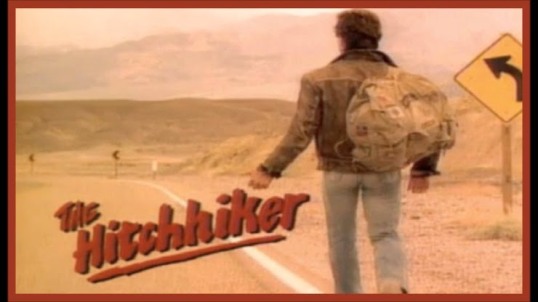
At the tail end of the 60s, the so-called king of acid rock, guitarist Billy Baltimore (Brad Dourif) was assassinated on stage. Or was he? When tabloid journalist Jane L. (Kirstie Alley) is told by her morally conflicted photographer, Hodie (Andy Summers of the Police), that he believes Billy Baltimore faked his own death and is actually living in a mansion and plotting his comeback, Jane L. decides to break into the mansion and find out for herself.
That turns out to be a big mistake. But, as badly as things go for Jane L. and Hodie, this is an entertaining episode that features Kirstie Alley at her most neurotic and Brad Dourif at his most off-beat. The ending might not make much sense but the journey is still worth it. For the record, the Hitchhiker (Page Fletcher) really does not like tabloid reporters.
The Clericuzio saga continues and it’s sillier than ever!
The Clericuzios were the Mob family who were first introduced in a Mario Puzo novel called The Last Don. In 1997, CBS turned The Last Don in a three-part miniseries. The ratings were good enough that, in 1999, the network gave the world a two-episode sequel, The Last Don II. The Last Don II was created without the input of Mario Puzo (who died shortly before the miniseries aired) but director Graeme Clifford returned, as did a few members of the cast.
For example, Danny Aiello briefly returns as the honorable but aging Don Domenico Clericuzio, talking about life in the old country and demanding to know why some of his children have yet to marry. Under his leadership, the Clericuzios are almost totally legit and they’ve even become powerful in Hollywood. Claudia De Lena (Michelle Burke) is in charge of the family’s film studio and has recently become engaged to a film star named Dirk Von Schelburg (Andrew Jackson, trying to do an Arnie impersonation but coming across more like Jean-Claude Van Damme). Still, despite the fact that the Clericuzios are (slowly) abandoning organized crime, they haven’t completely cut their ties. They still have enemies. And when Don Clericuzio dies after dancing at his final birthday party, those enemies are set to strike.
Who can run the Clericuzio family? Only one of the Don’s son was actively involved in the underworld aspect of the organization and he’s promptly (and, to be honest, hilariously) crushed when someone drops a shipping crate on him. Another Clericuzio son is gunned down at his legitimate business, proving that someone is trying to take out the entire family, regardless of whether they’re a part of the family business or not. Georgio Clericuzio (David Marciano) goes to Paris and tires to convince Claudia’s brother, Cross (Jason Gedrick), to return from exile to take things over. Cross refuses because he’s happily married to the most famous actress in the world, the improbably named Athena Aquataine (Mo Kelso, replacing Daryl Hannah in the role). However, Athena is subsequently blown up by a bomb that was meant for Cross and that’s all it takes to bring Cross back to America.
Now that Cross is in charge, he sets about to discover who, among the other Families, is targeting the Clericuzios. Helping him out with this is Billy D’Angelo (James Wilder), who we are told is the the most important of the Clericuzios capos, despite the fact that he was neither seen nor mentioned in the previous Last Don. It seems pretty obvious from the start that Billy is not to be trusted. Everyone who has ever seen The Godfather will automatically look at Billy and say, “There’s your rat.” But Cross is a remarkably naïve crime lord. He’s apparently the only guy in the Mafia who has never seen a Mafia movie.
Of course, there’s more going on than just Cross trying to figure out who is targeting the Clericuzio family. His unstable aunt, Rose Marie (Kirstie Alley), wants revenge for the murder of her son Dante but, fortunately, she’s distracted by an affair with the family’s priest (Jason Isaacs, of all people). Disgraced former studio exec Bobby Bantz (Robert Wuhl) is plotting against Claudia. And finally, Cross is falling in love with his stepdaughter’s nanny (Patsy Kensit) despite the fact that it’s kind of obvious that the nanny is actually an undercover FBI agent. Remember what I said about Cross being impossibly naïve?
The Last Don was a fairly silly miniseries. The Last Don 2 is even sillier but, for that every reason, it’s also a bit more entertaining. If the first Last Don was held together by the rivalry between Cross and Dante, the sequel is held together by a nonstop flow of melodrama, overheated dialogue, and thoroughly unsubtle acting. It’s as if the director looked at every over-the-top scene and said, “It’s okay but can we turn things up just a little bit more?” As such, tt’s not enough for Danny Aiello to merely make a cameo before his character dies. Instead, he has to deliver cryptic words of wisdom about family and and honor and he has to do one final, Zorbaesque dance of joy before his heart gives out. Meanwhile, Kirstie Alley really throws herself into playing the insane Rose Marie and whether she’s seducing a priest or hoarsely yelling that she doesn’t know how to ice skate, her performance is always more than strange enough to be watchable. Jason Isaacs, meanwhile, furrows his brow desperately as he tries to resist temptation. Patsy Kensit is the world’s worst FBI agent while Kim Coates shows up as one of her colleagues. Conrad Dunn returns as Lia, the Sicilian assassin with the world’s silliest mustache. Even the presence of Robert Wuhl is less of a problem in the sequel. With everyone chewing up every piece of scenery that they can get their hands on, it somehow makes sense that Robert Wuhl would show up and start yelling, “DON’T LAUGH AT ME!” Somehow, it even seems appropriate that Joe Mantegna receives a “special appearance” credit, even though his character pretty much only appears in the archival footage used during the opening credits. The Last Don II is just that type of miniseries.
Jason Gedrick and James Wilder are both good actors and they both do what they can with the roles of Cross and Billy. Unfortunately, both of them were seriously miscast in The Last Don 2. Neither one of them is the least bit Italian and Wilder was a bit too young to be convincing as the most feared capo in the family. Compared to the classic gangster films that inspired them, both The Last Don and its sequel feels more like gangster cosplay than an actual portrait of life as a member of the Cosa Nostra. Like the first Last Don, The Last Don II suffers from a lack of authenticity but it’s just ludicrous enough to be fun.




 Through the Shattered Lens