Released in 2000, Boiler Room tells the story of Seth Davis (Giovanni Ribisi).
Seth is only 19 years old. He’s the son of a federal judge and he’s also a college dropout. Seth is making a pretty good living for himself, running a casino out of a house near the campus. One night, a handsome 20something named Greg Weinstein (Nicky Katt) stops by and tells Seth that he could be making an even better living for himself as a broker at J.T. Marlin.
Located somewhere in Long Island, J.T. Marlin is a brokerage firm that is dominated by loud and young men. Overseen by the ruthless Jim Young (Ben Affleck, doing the glorified cameo thing), J.T. Marlin is a place where everyone owns an expensive car, an expensive watch, and where everyone brags about how much money they’ve made. The insults and slurs fly from desk to desk, as they tend to do whenever a bunch of wealthy, highly competitive guys get together. J.T. is seduced by the atmosphere, even as he watches some broker breaks down due to the pressure. He becomes friends with Chris Varick (Vin Diesel) and falls for receptionist Abbie Halpert (Nia Long), who just happens to be Greg’s ex-girlfriend. Eventually, Seth gets good at his job. Unfortunately, it turns out that his job is centered around tricking people into investing in a pyramid scheme and eventually, one of Seth’s clients, Harry (Taylor Nichols), ends up broke and without his family. The guilt-stricken Seth realizes that he has a conscience.
Like a lot of these type of movies, Boiler Room is at its best when it starts, when it’s all about tough talk, rude jokes, and obsessive competition amongst a bunch of well-dressed good-looking guys. Nicky Katt and Vin Diesel are so much fun to listen to that it’s hard not to regret that the entire film wasn’t just about them. Things become significantly less interesting once the FBI shows up and Seth decides to become a snitch. For the most part, no one like a snitch, even if they’re motivated by the purest of intentions. To make a snitch likable, he has to be a truly compelling character, like Henry Hill in Goodfellas. For the most part, audiences prefer anti-heroes who go down with the ship as opposed to the rats who jump into the first lifeboat they see. In The Wolf of Wall Street, Jordan Belfort agrees to wear a wire but then slips his business partner a note, warning him. That’s one of the reasons why The Wolf of Wall Street is still a classic while Boiler Room has been largely forgotten. As a character, Seth just isn’t compelling enough to pull off the snitch act. Nor does he really seem clever enough to pull off what he does at the end of the film.
That said, I do enjoy Boiler Room. It’s largely due to the cast. Nicky Katt, Vin Diesel, Scott Caan, Giovanni Ribisi, they were all young, energetic, and eager to show off what they could do. While their characters competed to see who could make the most money, the actors competed to see who could steal the most scenes. The film is ultimately only so-so but that cast is unforgettable.
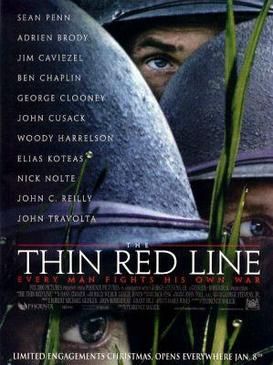
Based on a novel by James Jones (and technically, a sequel of sorts to From Here To Eternity), 1998’s The Thin Red Line is one of those Best Picture nominees that people seem to either love or hate.
Those who love it point out that the film is visually stunning and that director Terrence Malick takes a unique approach to portraying both the Battle of Guadalcanal and war in general. Whereas Steven Spielberg’s Saving Private Ryan told a rather traditional story about the tragedy of war (albeit with much more blood than previous World War II films), The Thin Red Line used the war as a way to consider the innocence of nature and the corrupting influence of mankind. “It’s all about property,” one shell-shocked soldier shouts in the middle of a battle and later, as soldiers die in the tall green grass of the film’s island setting, a baby bird hatches out of an egg. Malick’s film may have been an adaptation of James Jones’s novel but its concerns were all pure Malick, right down to the philosophical voice-overs that were heard throughout the film.
Those who dislike the film point out that it moves at a very deliberate pace and that we don’t really learn much about the characters that the film follows. In fact, with everyone wearing helmets and running through the overgrown grass, it’s often difficult to tell who is who. (One gets the feeling that deliberate on Malick’s point.) They complain that the story is difficult to follow. They point out that the parade of star cameos can be distracting. And they also complain that infantrymen who are constantly having to look out for enemy snipers would not necessarily be having an inner debate about the spirituality of nature.
I will agree that the cameos can be distracting. John Cusack, for example, pops up out of nowhere, plays a major role for a few minutes, and then vanishes from the film. The sight of John Travolta playing an admiral is also a bit distracting, if just because Travolta’s mustache makes him look a bit goofy. George Clooney appears towards the end of the film and delivers a somewhat patronizing lecture to the men under his command. Though his role was apparently meant to be much larger, Adrien Brody ends up two lines of dialogue and eleven minutes of screentime in the film’s final cut.
That said, The Thin Red Line works for me. The film is not meant to be a traditional war film and it’s not necessarily meant to be a realistic recreation of the Battle of Guadalcanal. Instead, it’s a film that plays out like a dream and, when viewed a dream, the philosophical voice overs and the scenes of eerie beauty all make sense. Like the majority of Malick’s films, The Thin Red Line is ultimately a visual poem. The plot is far less important than how the film is put together. It’s a film that immerses you in its world. Even the seeming randomness of the film’s battles and deaths fits together in a definite patten. It’s a Malick film. It’s not for everyone but those who are attuned to Malick’s wavelength will appreciate it even if they don’t understand it.
And while Malick does definitely put an emphasis on the visuals, he still gets some good performances out of his cast. Nick Nolte is chilling as the frustrated officer who has no hesitation about ordering his men to go on a suicide mission. Elias Koteas is genuinely moving as the captain whose military career is ultimately sabotaged by his kind nature. Sean Penn is surprisingly convincing as a cynical sergeant while Jim Caviezel (playing the closest thing the film has to a main character) gets a head start on humanizing messianic characters by playing the most philosophical of the soldiers. Ben Chaplin spends most of his time worrying about his wife back home and his fantasies give us a glimpse of what’s going on in America while its soldiers fight and die overseas.
The Thin Red Line was the first of Terrence Malick’s films to be nominated for Best Picture and it was one of three World War II films to be nominated that year. However, it lost to Shakespeare In Love.
Traditionally, good films are not released in January.
With most filmgoers more interested in catching up with the probable Oscar nominees and no one wanting to spend too much money after Christmas, January has become the month when the studios release all of the low-budget films that they’re hoping they can make a few bucks off before everyone forgets about them. January is the month that sees sequels to the franchises that have a small but loyal fan base. Just as last January saw the release of a new Underworld and a new Resident Evil, this January sees the release of Insidious: The Last Key.
Though it would subsequently be overshadowed by The Conjuring and its sequel, the Insidious franchise got off to a good start with the first film in the series. Released in 2010, the first Insidiouswas a genuinely scary movie, one that can still give your nightmares if you watch it on a stormy night. There are so many moments from that film that have stuck with me: the dancing ghost, the red demon suddenly appearing over Patrick Wilson’s shoulder, and the franchise’s first trip to the Further. Of course, the thing that really elevated Insidious was the performance of Lin Shaye, in the role of demonologist Elise Rainier. Lin Shaye played Elise with a combination of eccentricity and quiet authority and, from the minute she first showed up, you wanted to know more about Elise’s paranormal career. Elise was the most popular character in the movie, which made it unfortunate that she was dead by the end of it.
Despite Elise’s death, she’s continued to be at the center of the Insidious franchise. The first sequel dealt with her death by having her appear as a spirit, leading the hero through the Further. The third film in the franchise was actually a prequel, dealing with one of Elise’s earlier investigations and showing how she first met her two comedy relief assistants, Tucker (Angus Sampson) and Specs (Leigh Whannell). The Last Key is another prequel, revealing the details of Elise’s childhood and following her all the way through 2010. The Last Key ends with a call back to the first Insidious movie, suggesting that the franchise has now come full circle.
The Last Key is another haunted house movie. This time, the house in question is the one where Elise and her brother (played, as an adult, by Bruce Davison) grew up with their horribly abusive (and possibly demon-possessed) father. In 2010, the house has been purchased by Ted (Kirk Acevedo). No sooner has Ted bought the place then it becomes obvious that it’s haunted. However, Ted can’t just abandon the place because he’s sunk all of his money into this house, which he was hoping to be able to then sell to someone else. Apparently, you can’t get much money for a haunted house.
(Well, whatever. I’d pay good money to buy a haunted house and then I would open it to the paying public every October. I would make a fortune, assuming everyone didn’t get killed.)
Anyway, it all pretty much leads to everything you would expect to happen in an Insidious movie. Doors open and close. Malevolent beings appear in the shadows. Everyone goes to the Further. Lin Shaye gives another entertaining and fully committed performance, obviously enjoying the chance to be the star of the film. Nothing about the film is particularly surprising but that doesn’t mean that it isn’t often effective. Watching this film is a lot like listening to a skilled storyteller tell the story about the girl, her boyfriend, and the escaped mental patient who has a hook for a hand. You know exactly what’s going to happen. You know that it none of it really happened. You know the story is borderline ludicrous. But you still find yourself jumping at every unexpected sound. You still find yourself staring into the shadows, wondering if you really saw something moving or if it was just your imagination.
Needless to say, The Last Key is never as effective or as scary as the first Insidious or either of The Conjuring films. There were a few moments — mostly dealing with Elise’s childhood — where The Last Key showed the potential to be something a little deeper than what I was expecting but those moments were rarely followed up on. In the end The Last Key is a rather modest and workmanlike horror film, the type that makes you jump while you’re watching it but which you will also probably end up forgetting about a day or two after seeing it. However, for a January horror film, it’s good enough.
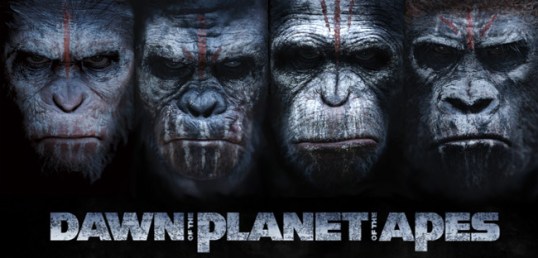
One of my most-anticipated films this summer of 2014 has released it’s latest trailer and it shows the central conflict which will drive this sequel to 2011’s Rise of the Planet of the Apes.
It’s been many years since the pandemic from the “simian flu” tore through the planet as shown during the end credits of the first film. Now the surviving humans must now contend with the growing population of hyper-intelligent apes led by Caesar from the first film.
While the first film showed the rise of Caesar as a revolutionary leader it looks like this sequel will now put him in the role of war leader as his apes must now gear up for a war with the surviving humans that can’t seem to be avoided.
Plus, all I can say is this: Apes on horses with assault rifles.
Dawn of the Planet of the Apes is set for a July 11, 2014 release date.
To say that 2011’s Rise of the Planet of the Apes went a long way in washing out the taste out of fans mouth after having seen Tim Burton’s reboot of Planet of the Apes would be an understatement. Rupert Wyatt was able to bring the franchise back to prominence by actually treating the story as a sort of scifi allegory instead of a platform to once again exercise one’s filmmaking quirks.
It was a no-brainer that a sequel will follow up the success of the 2011 film. But with a fast-moving schedule there were several casualties. Rupert Wyatt didn’t think he had enough time to shoot the film the way he wanted to so he was replaced by Matt Reeves. James Franco is also gone from the project. Instead we get several veteran actors like Gary Oldman, Jason Clarke, Keri Russell and Kirk Acevedo joining Andy Serkis.
The film seems to take places a decade or so after the release of the deadly virus at the end of the first film. Humanity has survived both the virus and the wars which followed it, but civilization as we know it now are a thing of the past. With humanity trying to rebuild it must now deal with a rising nation of genetically-enhanced apes led by Andy Serkis’ Caesar. With Gary Oldman on one side seeming to be the leader of humanity’s survivors I don’t see peace as being a goal in this film.
Dawn of the Planet of the Apes is set for a July 11, 2014 release.
“We’re not too far gone. We get to come back.” — Rick Grimes
[some spoilers]
The Walking Dead had it’s mid-season finale over this past Sunday and like previous mid-season and season-ending finales of the past three season this one went for the gut-punch. Season 4 of the show has seen a major improvement in how the writers were finally treating some of the major characters on the show.
The first five episodes were pretty much using a plague situation within the prison community to explore the growth of some of the lead roles in the show. We saw how Rick tried to escape the burdens of leadership by attempting to just be a farmer and a good role-model for his son Carl. It didn’t necessarily work out the way he wanted it to. In the end, Rick finally realized that leadership was what the group needed from him and what he was really best suited for.
We saw a major character shift in one of the show’s less realized characters in the past meek Carol Pelletier. This season we see how she has grown into becoming just as much a cold, calculating survivor as The Governor, but still retaining some of the humanity the latter seems to have lost when the zombie apocalypse happened to the world. It was a surprise to see Carol in such a new light. A person who would do anything to protect the group with special attention to the young children — especially two young girls — who have survived this far into the zombie apocalypse.
Then we had Hershel finally get to have his time in the limelight. Episode 5 has been a near-unanimous choice as the strongest episode of the first half of the season and nothing about the mid-season finale changes that. That’s how good “Interment” really was in the overall scheme of this new season’s first half. We saw Hershel finally become the show’s moral center but one that didn’t have the rigidity of ideals that Dale had. Hershel kept his humanity but also knew that this new world meant having to put one’s life on the line and not just pay lip-service to one’s ideals. I know that Dale would’ve done the same, but we never truly saw him put it all out there. He was great with the speeches, but the writers could never have him act on them. With Hershel they were able to reset the show’s moral compass and write the role properly.
The last two episode saw the return of The Governor. It was a peculiar two-parter which focused only on the return of Season 3’s main villain. Scott M. Gimple and his crew of writers tried to dial back the cartoonish way the character had become a villain by the end of Season 3. They tried to put the character back on the road to redemption. They even gave him a new surrogate family with a young girl who looked eerily like his previous daughter pre-zombie. Yet, while the attempt was an interesting one the character arrived full-circle to the very Governor we first met in the early episodes of Season 3. He wasn’t as mustache-twirling evil that he had become by the end of last season, but that redemption road that episode 6 and 7 was all about ended up being a red herring.
Now, we come to the mid-season finally which literally reset’s the finale of season 3. It was a finale that was underwhelming at best. The war between Rick and the Governor never truly materialized. This was finally rectified with the arrival of the Governor and his new band of camp followers but this time he has a tank. It’s a scene straight out of the comics and it was one that readers and fans of the books have been waiting for years to happen.
“Too Far Gone” marks a turning point for the series in that we finally leave another fixed location but do so with some major characters never to return. It was an episode that started off like a sizzle reel of every complaint detractors have about the show. Dialogue that went nowhere and just seemed to spin the episode’s wheels to fill time. Yet, as the episode progressed the entirety of the first half’s story-arcs began to take shape.
Rick was willing to share the prison with his worst enemy. He wasn’t too far gone that he would put himself as innocent of doing some heinous things to survive. He might not like the Governor, but for the sake of both groups not killing each other he would swallow his pride and accept everyone. The prison has room for everyone and the didn’t need to interact. It’s a major character growth for Rick who always saw his group as the good guys in any conflict. But like any leader he was getting tired of the battles that hurt only the survivors. The real threat were still the zombies who were slowly gathering outside. Hershel’s reaction to finally seeing Rick realize that one didn’t have to sacrifice their humanity to survive in this new world was one of the most poignant scenes in the series to date.
What followed it moment’s later would become one of the most heart-wrenching scenes of the series and one fans of the books were dreading to see.
Hershel was the MVP of this season’s first half and it was only appropriate that he went out in such a memorable, albeit very gruesome manner. It’s not often we see someone decapitated on any tv show. What had been an episode that threatened to meander just the way the finale of season 3 ended up doing instead became a final 20-minutes of intense action that saw both groups fail to hold onto the prison and the survivors scattered to all points of the compass. In the comics, this particular story-arc saw Lori and Judith die just when readers thought they were about to be safe from the battle. With Lori already dead a full season ago the only question which remained during this mid-season finale was whether the writers would actually pull off the unthinkable and do the same to tv version of Judith.
Children have never been seen a sacred cows on this show, yet infants seemed to remain safe. The episode ends with the question of whether Judith is dead or alive hanging in the air. It’s to the visceral power that this show brings to the table that peope will wait the near to three months of hiatus before the show returns of the second half of season 4. The show will remain one that’s obsessed over by the general population while derided by a minority who have valid complaints about it.
“Too Far Gone” could almost be the motto of this show. Any sort of major change on how the show’s stories has been told might be too late to implement. The fans like the show for it’s violence, gore and the soap opera stories. It’s not perfect television, but it is television which seems to have grabbed, caught and held the attention of not just the American tv viewing public but the global tv viewing public. Maybe, it’s just time to just make the that decision each viewer has to make. Either stay on the ride and hold on until the rollercoaster ends or jump off now and forever hold their peace.


 Through the Shattered Lens