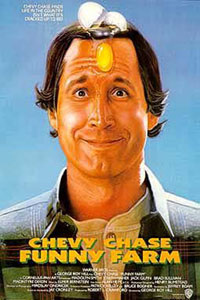
Funny Farm (1988, directed by George Roy Hill)


Andy Farmer (Chevy Chase) is a New York sports writer who leaves the city and moves to the small town of Rosebud, Vermont so that he can work on his novel.  He and his wife, Elizabeth (Madolyn Smith), struggle to adjust to living in a small town.  The delivery of their furniture is delayed by the collapse of a covered bridge.  When they try to make a phone call from inside their own house, the local operator tells them to deposit ten cents.  They were expecting a Norman Rockwell-type town and instead, they find themselves having to pay for the funeral of a man who was buried on their property long before they moved in.  When Elizabeth makes more progress writing a children’s book than Andy does with his heist novel, their marriage starts to feel the strain.

Chevy Chase is now so much better known for the stories of his unprofessional and diva-like behavior on film and television sets that it’s easy to forget that he was, at his peak, a very funny actor.  Chase may be playing a variation of his put-upon everyman but, compared to the first two Vacation movies, most of the humor in Funny Farm is very mild.  George Roy Hill was a classy director who had been making movies since the 50s and Funny Farm feels like a throwback to the type of family-friendly comedies that Disney would make in the 60s.  That I laughed as much as I did was largely due to Chase’s performance.  Whether he was tripping over a Dutch door, reacting to his wife’s dislike of the first few chapters of his new novel, or offering to pay the townspeople $50 to pretend to be nice for a weekend, Chase was consistently funny and even likable.  I don’t know if this is the type of performance that Chevy Chase could give today.  There’s a bitterness that’s now integral to screen persona and it’s made him into someone who audience want to laugh at instead of with.  It’s too bad because Funny Farm is a reminder of the type of comedic actor that Chevy Chase used to be and who he probably still could be if not for the failed talk show and the infamous Friar’s Club roast.

As for Funny Farm, it’s an amusing and likable comedy and it still holds up well today.  Chase is the key to the film’s success but he’s not the only reason that the film works.  I liked the scene where Mike Starr and Glenn Plummer, as the two movers, watch as the bridge they tried to drive over collapses.  I even liked the running joke about the two ducks who refused to leave the Farmers’s property.  Funny Farm may not have been a hit when it was first released but it’s since built up a cult following.  There will always be a place for a funny comedy that leaves you in a good mood.
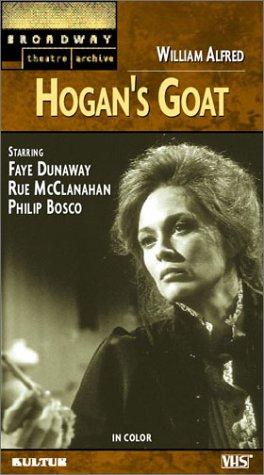
Made-For-Television Film Review: Hogan’s Goat (dir by Glenn Jordan)


1971’s Hogan’s Goat opens in Brooklyn in the 1890s.  This was when Brooklyn itself was still a separate city, before it become a borough of the unified New York City.  If you’ve watched the video that I include with most of my Welcome Back Kotter reviews, you’ll notice the boast: “Fourth largest city” on the Welcome to Brooklyn sign.  And indeed, if Brookyln had remained independent, it would now be the fourth most populated city in America, behind New York, Los Angeles, and Chicago.  Sorry, Brooklyn.

(However, Houston thanks you.)

Local ward boss Matt Stanton (Robert Foxworth) heads home with what he thinks is exciting news.  He tells his wife, Kathleen (Faye Dunaway), that he is finally going to be mayor of Brooklyn.  The current mayor, a man named Quinn (George Rose), has been caught up in some sort of corruption and the Democratic political machine is ready to abandon him.  Matt Stanton is about to become one of the most powerful men in New York.  That’s not bad for a relatively young man who came to America from Ireland in search of a better life.  Adding to Stanton’s happiness is the fact that he’ll be defeating Quinn, a canny politician towards whom Stanton holds a grudge.  Kathleen, however, is worried.  An immigrant herself, Kathleen met Stanton while the latter was in London.  They were married in a civil ceremony and, ever since Stanton brought her back to Brooklyn, she has been lying and telling everyone that they were married in a church.  Kathleen feels that she and Stanton have been living in sin and she wants to have a convalidation ceremony.  Stanton refuses because doing so would mean admitting the lie in the first place and he can’t afford to lose the support of the Irish Catholic voters of Brooklyn.

However, it turns out that there are even more secrets in Stanton’s past, ones that Kathleen doesn’t know about but Quinn does.  When those secrets start to come out, Kathleen comes to realize that there’s much that she doesn’t know about her husband.  Stanton, with political power in his grasp, desperately tries to hold on to the image that he’s created of himself and Kathleen, leading to tragedy.

Hogan’s Goat was an Off-Broadway hit when it premiered in the mid-60s and its success led to Faye Dunaway getting her first film offers.  The made-for-television version of Hogan’s Goat, which premiered on PBS and featured Dunaway recreating her stage role, is essentially a filmed play.  Little effort was made to “open up” the story and, as a result, the film is undeniably stagy.  It’s clear from the start the film was mostly shot to record Faye Dunaway’s acclaimed performance for posterity.  Indeed, she’s the only member of the theatrical cast to appear in the film version.  Dunaway does give a strong performance, easily dominating the film with her mix of nervous intensity and cool intelligence.  The rest of the cast is a mixed bag.  Robert Foxworth is appropriately driven and ambitious as Stanton but his Irish accent comes and goes.  Philip Bosco does well as a sympathetic priest and George Rose is appropriately manipulative as Quinn.

In the end, the story of Hogan’s Goat is probably of the greatest interest to Irish-American history nerds like me, who have read and studied how Irish immigrants, especially in the 19th century, faced tremendous prejudice when coming to the United States and how they reacted by building their own political machines and dispensing their own patronage.  In Hogan’s Goat, the conflict is less between more Stanton and Quinn and more between Kathleen’s traditional views and her devout Catholicism and Stanton’s own very American ambition.  Whereas Kathleen still fights to retain her faith, pride, and her commitment to who she was before she married Stanton, Stanton fights for power and to conquer the man who Stanton feels has everything that he desires.  In the end, Stanton’s hubris is not only his downfall but Kathleen’s as well.

Retro Television Review: Miami Vice 3.4 “Walk-Alone”


Welcome to Retro Television Reviews, a feature where we review some of our favorite and least favorite shows of the past!  On Mondays, I will be reviewing Miami Vice, which ran on NBC from 1984 to 1989.  The entire show can be purchased on Prime!

This week, it’s a rare Tubbs episode!

Episode 3.4 “Walk-Alone”

(Dir by David Jackson, originally aired October 17th, 1986)

As Switek puts it, Tubbs has been walking on air for two weeks.  He’s got a new girlfriend, a waitress at a hot Miami restaurant.  Unfortunately, a shoot-out at that restaurant leaves her dead.  Though Crockett thinks that Tubbs is still too close to the case to be trusted to investigate, Tubbs insists on being involved and Castillo agrees.  (Castillo, at times, just seem to automatically do the opposite of whatever Crockett suggests.)

The shoot-out happened as a result of a drug deal that went down in the state prison.  Using the name Cubero, Tubbs goes undercover as a recently transferred prisoner.  He enters the prison as his usual cool and collected self.  He’s promptly beaten up by the Aryan Nations.  Fortunately, since this is a television show and not The Shawshank Redemption, beating him up is the only thing the Aryans do to Tubbs.

Tubbs is being targeted by all the prisoners, from the Aryans to the Muslims.  But when words get out that he’s a big-time drug dealer, Commander Fox (Keven Conway) makes a deal with him.  If Tubbs keeps Fox and his men supplied with drugs, Tubbs (or Cubero) will be kept safe.

Unfortunately, when Switek, Zito, and Trudy go the prison to see Tubbs, a prisoner recognizes them.  Tubbs’s cover is blown.  Crockett wants to go into the prison to save him but Castillo points out that everyone in the prison knows that Crockett is a cop.  (Tubbs has been Crockett’s partner for three years now so why did Castillo assume no one in the prison would be able to make him?)  Castillo goes into the prison to save Tubbs from both the guards and the prisoners.  The episode ends with Castillo gunning down a few guards and saving Tubbs’s life.  Way to go, Castillo!  The main lesson here seems to be that Castillo would rather risk of his own life than depend on Crockett for anything.

This was …. well, this episode was okay.  The plot was nothing special.  For all the talk about how Florida’s state prison was the most dangerous place in the world, it actually came across as being a rather mild place.  Tubbs got beaten up and he got threatened but he didn’t get shanked and or any of the other things that one tends to associate with prison.  The prison guards were not the most intimidating or interesting villains to appear on Miami Vice, even though one of them is played by a young Laurence Fishburne.

(This episode all features a youngish Ron Perlman, playing a good guy who I kept expecting to turn out to be a bad guy because he was being played by Ron Perlman.)

In the end, this episode was a bit forgettable, though it did allow the often-underused Philip Michael Thomas a chance to have the spotlight for once.  He does a good job, even if he doesn’t get to bust out his fake Caribbean accent.

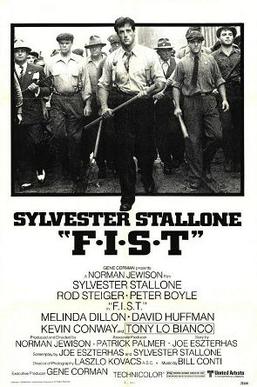
A Movie A Day #355: F.I.S.T. (1978, directed by Norman Jewison)


Sylvester Stallone is Jimmy Hoffa!

Actually, Stallone plays Johnny Kovak, a laborer who becomes a union organizer in 1939.  Working with him is his best friend, Abe Belkin (David Huffman).  In the fight for the working man, Abe refuses to compromise to either the bosses or the gangsters who want a piece of union.  Johnny is more pragmatic and willing to make deals with ruthless mobsters like Vince Doyle (Kevin Conway) and Babe Milano (Tony Lo Bianco).  Over thirty years, both Johnny and Abe marry and start families.  Both become powerful in the union.  When Johnny discovers that union official Max Graham (Peter Boyle) is embezzling funds, Johnny challenges him for the presidency.  When a powerful U.S. senator (Rod Steiger) launches an investigation into F.I.S.T. corruption, both Johnny and Abe end up marked for death.

Obviously based on the life and mysterious disappearance of Jimmy Hoffa, F.I.S.T. was one of two films that Stallone made immediately after the surprise success of Rocky.  (The other was Paradise Alley.)  F.I.S.T. features Stallone in one of his most serious roles and the results are mixed.  In the film’s quieter scenes, especially during the first half, Stallone is surprisingly convincing as the idealistic and morally conflicted Kovak.  Stallone is less convincing when Kovak has to give speeches.  If F.I.S.T. were made today, Stallone could probably pull off the scenes of the aged, compromised Johnny but in 1978, he was not yet strong enough as an actor.  Far better is the rest of the cast, especially Conway, Lo Bianco, and Boyle.  If you do see F.I.S.T., keep an eye on the actor playing Johnny’s son.  Though he was credited as Cole Dammett, he grew up to be Anthony Keidis of the Red Hot Chili Peppers.

The box office failures of both F.I.S.T. and Paradise Alley led Stallone back to his most famous role with Rocky II.  And the rest is history.


A Movie A Day #317: Flashpoint (1984, directed by William Tannen)


November 22, 1963.  While the rest of the world deals with the aftermath of the assassination of John F. Kennedy in Dallas, a man named Michael Curtis drives a jeep across the South Texas desert, heading for the border.  In the jeep, he has a $800,000 and a high-powered rifle.  When the jeep crashes, the man, the rifle, and the money are left undiscovered in the desert for 21 years.
1984.  Two border patrol agents, Logan (Kris Kristofferson) and Wyatt (Treat Williams), are complaining about their job and hoping for a better life.  It looks like they might get that opportunity when they come across both the jeep and the money.  A bitter Vietnam vet, Logan wants to take the money and run but Wyatt is more cautious.  Shortly after Wyatt runs a check on the jeep’s license plate, a FBI agent (Kurtwood Smith) shows up at the station and both Logan and Wyatt discover their lives are in danger.

Though it was made seven years before Oliver Stone’s JFK, Flashpoint makes the same argument, that Kennedy was killed as the result of a massive government conspiracy and that the conspirators are still in power and doing whatever they have to do keep the truth from being discovered.  The difference is that Flashpoint doesn’t try to convince anyone.  If you’re watching because you’re hoping to see a serious examination of the Kennedy conspiracy theories, Flashpoint is not for you.  Instead, Flashpoint is a simple but effective action film, a modern western that uses the assassination as a MacGuffin.  Though Kris Kristofferson has never been the most expressive of actors, he was well-cast as the archetypical gunslinger with a past.  Rip Torn also gives a good performance as a morally ambiguous sheriff and fans of great character acting will want to keep an eye out for both Kevin Conway and Miguel Ferrer in small roles.

Horror Film Review: The Funhouse (dir by Tobe Hooper)


1980’s The Funhouse opens with an almost shot-for-shot recreation of the famous shower scene from Psycho, with Amy (Elizabeth Berridge) getting attacked in the shower by a masked, knife-wielding maniac.

The only difference is that there’s no shrieking violins, there’s no blood, and the knife is quickly revealed to be a fake.  It turns out that the “killer” is actually Amy’s younger brother, Joey (Shawn Carson).  Joey loves horror movies.  In fact, he’s pretty much the perfect stand-in for The Funhouse‘s intended audience.  Joey was just playing a rather mean-spirited prank but now, as a result, Amy snaps that she’s not going to take him to the carnival.

Of course, Amy isn’t supposed to be going to the carnival either.  Her parents have strictly forbidden it.  Everyone knows that traveling carnivals are dangerous and, at the last town the carnival visited, two teenagers disappeared!  There’s no proof that the carnival has anything to do with those disappearances, of course.  But still…

Amy does exactly what I would have done in her situation.  She tells her parents that she’s going over to a friend’s house and then she goes to the carnival anyway!  Accompanying her is her boyfriend Buzz (Cooper Huckabee), who is so cool that he has a name like Buzz.  Also along for the ride: Amy’s best friend, Liz (Largo Woodruff), and her boyfriend, Richie (Miles Chapin).  Richie’s kind of a loser but that’s to be expected.  Every group needs at least one idiot who can do something stupid that gets everyone else killed.  We all know how that works.

The carnival turns out to be just as sleazy as Amy’s parents thought it would be.  There’s a fake psychic (Sylvia Miles).  There’s a magician who dresses like Dracula.  There’s a barker (Kevin Conway), whose deep voice is constantly heard in the background.  And, of course, there’s a funhouse!  Still, everyone’s having a good time.  Either that or they’re all just stoned.

For his part, Joey sneaks out of the house and goes to the carnival himself.  He doesn’t have quite as much fun as Amy.  In fact, his experience is pretty scary.  Weird carnival people keep yelling at him.  He keeps getting lost.  Still, things could be worse.  By the time his parents arrive to pick Joey up, Amy and her friends are all trapped in the funhouse.  They’re being pursued by the barker and his deformed son (Wayne Doba).  Needless to say, it’s all pretty much Richie’s fault.

Richie.  What a dumbass.

With its teenage victims and its lengthy chase scenes, The Funhouse is often dismissed as just being another early 80s slasher film.  However, The Funhouse is actually a fairly clever, entertaining, and occasionally even witty horror film.  Much like director Tobe Hooper’s best-known film, The Texas Chainsaw Massacre, The Funhouse gets its scares by convincing audiences that they’re actually seeing more than they are.  Hooper emphasizes atmosphere and performances over gore.  While The Funhouse has its share of jump scares, it mostly succeeds by convincing us that anyone could die at any moment.  It’s an intense film, with excellent performances from both Elizabeth Berridge and Kevin Conway.

After kickstaring the slasher genre with The Texas Chainsaw Massacre, Hooper used The Funhouse to poke a little fun at it.  From the opening shower scene to the electrifying finale, Hooper plays with the genre-savvy expectations of the audiences.  Our four victims even do the smart thing for once — they try to all stay together.  Needless to say, that doesn’t work out too well.

The Funhouse is an entertaining thrill ride and, seen today, it’s more evidence that Tobe Hooper deserved better than he got from the film industry.


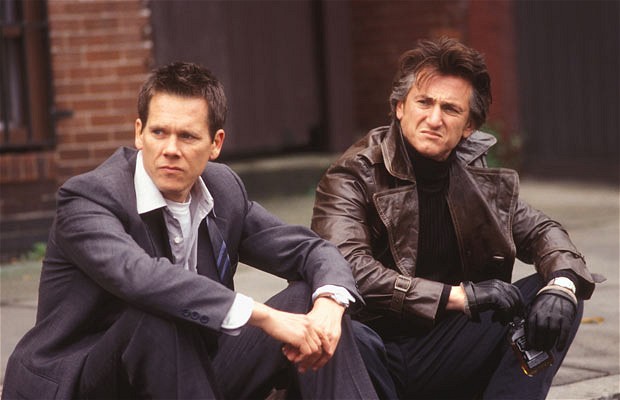
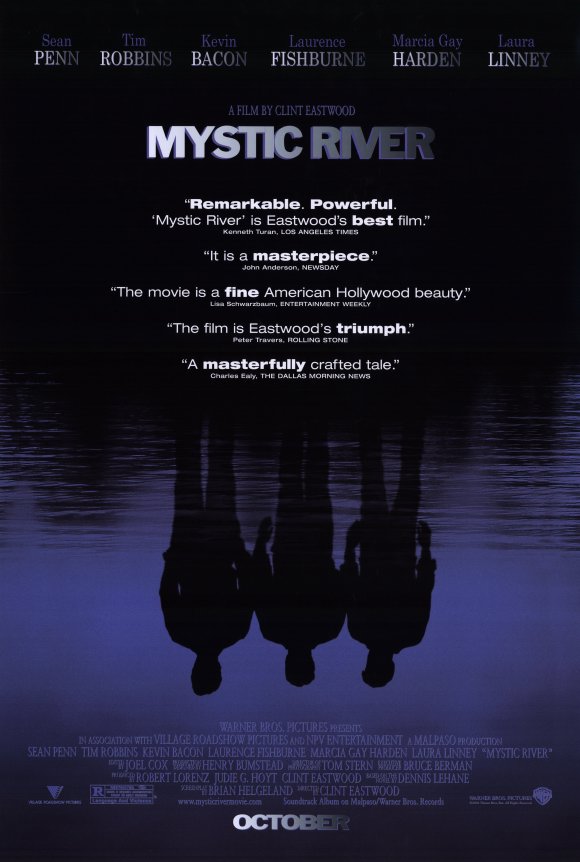
Embracing the Melodrama #51: Mystic River (dir by Clint Eastwood)


mystic-river

Much like In The Bedroom, 2003’s Mystic River is a film that deals with guilt, murder, and vengeance in New England.  Whereas In The Bedroom deals with the guilt of just four people, Mystic River deals with the guilt of an entire neighborhood.

Mystic River opens in Boston in 1975.  Three young boys are writing their names in wet cement when a car pulls up beside them.  An angry-looking man (played by the always intimidating John Doman) gets out of the car and announces that he’s a police officer and that the three boys are under arrest.  He orders them to get in the car.  Of the three boys, Jimmy and Sean refuse but meek Dave gets into the car, where he’s greeted by a leering old man.  Jimmy and Sean watch as the car drives away with their friend trapped in the back seat.  Dave is held prisoner and abused by the two men for four days until he finally manages to escape.

Twenty-five years later, the three boys have grown up but are still haunted by what happened.  Sean is now a detective with the Massachusetts State Police.  Jimmy is an ex-con who now owns a local store and who, despite being married to Annabeth (Laura Linney), the daughter of a local gangster, is trying to lead a law-abiding life.  As for Dave (Tim Robbins),  he is married to Celeste (Marcia Gay Harden) and manages to hold down a job but he’s also the neighborhood pariah.

Mystic River 1

When Jimmy’s daughter Katie (Emmy Rossum) is brutally murdered, Sean and his partner Whitey Powers (Laurence Fishburne) are assigned to the case.  The distraught Jimmy, however, starts to investigate the murder himself and, after talking to Celeste, he discovers that, on the night Katie died, Dave came home with blood on his clothes and claiming that he had a fight with a mugger.  That’s all the evidence that Jimmy and his friends need to believe that Dave is the murderer…

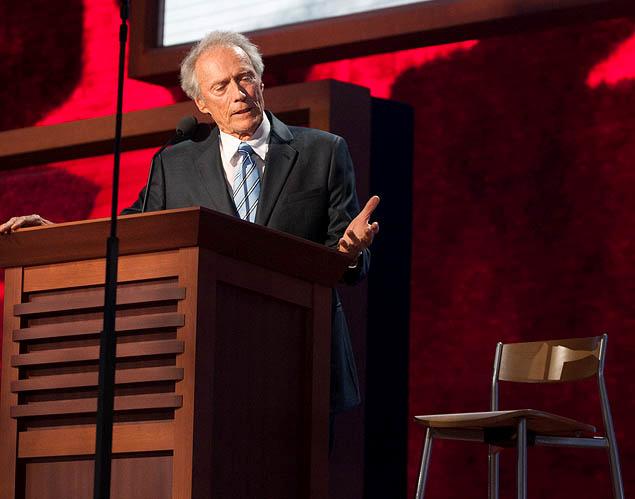
I have a lot of friends who will probably never forgive Clint Eastwood for not only endorsing Mitt Romney in 2012 but for also giving the “empty chair” speech at the Republican Convention.  From the way that a lot of them reacted, you would think that Eastwood had filmed himself drowning puppies as opposed to simply expressing his own cantankerous opinions about current events.  (Honestly, do you know any 82 year-olds who weren’t disgruntled in 2012?)  Myself, I thought the empty chair speech was an act of brilliant performance art, one that not only highlighted the fact that most politicians really are just empty chairs but also exposed just how humorless most political activists truly are.  (Admit it — if John Fugelsang had done that same routine at the 2004 Democratic convention and referred to the empty chair as being President Bush, most of the people who went on and on about how terrible it was that Eastwood was being disrespectful to the President would still be using it to create Facebook memes.)

Eastwood

Unfortunately, I sometimes find myself wondering why Clint Eastwood the director sometimes seem to struggle to be as interesting, innovative, and thought-provoking as the empty chair speech.  It sometimes seems that for every Eastwood film that works, there’s a handful films like Hereafter, Changeling, and Jersey Boys.  These aren’t bad films as much as they’re just uninspired films.  (Well, Hereafter is pretty bad…)  Ultimately, Eastwood is more of a storyteller than a Martin Scorsese-style innovator.  If Eastwood has a good story to tell, the film will work.  If he has a weak story — well, then the film will be weak.

Fortunately, with Mystic River, Eastwood has a good story and the end result is one of the best films of his uneven directorial career.  Eastwood uses a fairly standard murder mystery to explore themes of guilt, redemption, and paranoia.  Jimmy may be looking for revenge and Sean may be doing his job but ultimately, both of them are trying to absolve themselves from the consequences of their childhood decisions.  If Dave is guilty, then Jimmy will justified in having let him get in that car.  If Dave is innocent, Sean can finally step up and save him.

And complicating all of this is the Neighborhood, which is as much a character in this film as Jimmy, Dave, and Sean.  The Neighborhood will never allow anyone to forget or live down the past.  When, towards the end of the film, Jimmy is declared to be the “king of the neighborhood” by Annabeth, there’s little doubt that she’s right.  The question is whether Jimmy’s kingdom is one worth ruling.

Mystic River