4 Shots From 4 Films: Special Harvey Keitel Edition!


4 Shots From 4 Films is just what it says it is, 4 shots from 4 of our favorite films. As opposed to the reviews and recaps that we usually post, 4 Shots From 4 Films lets the visuals do the talking!

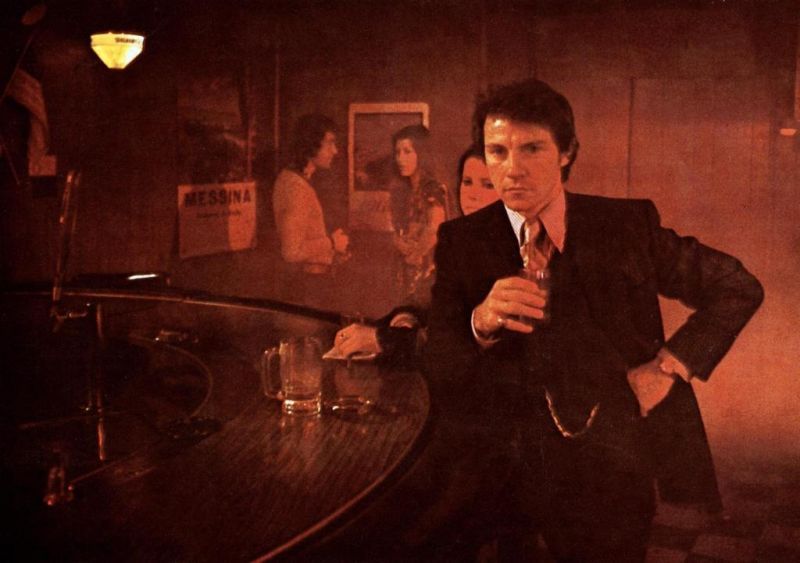
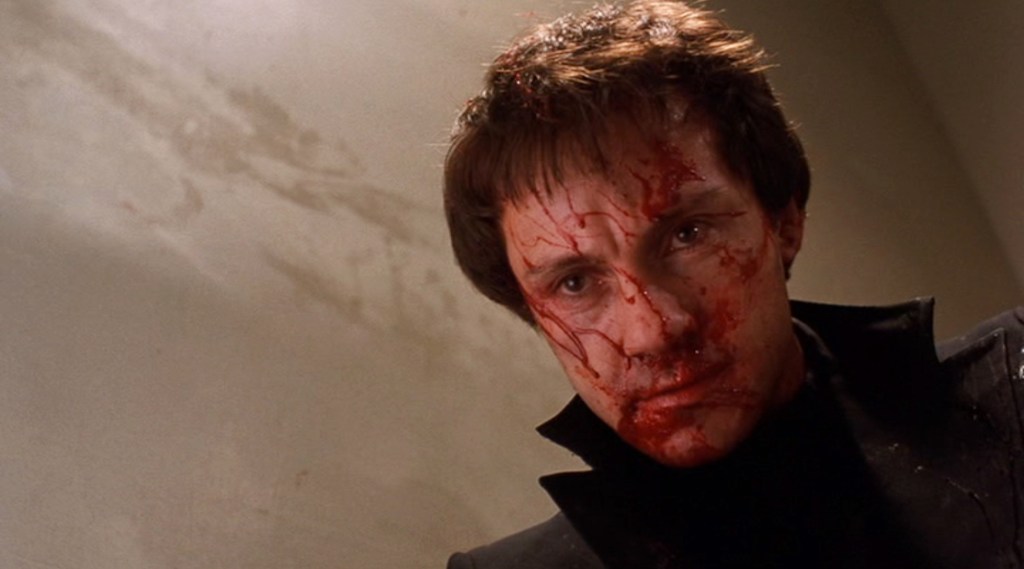
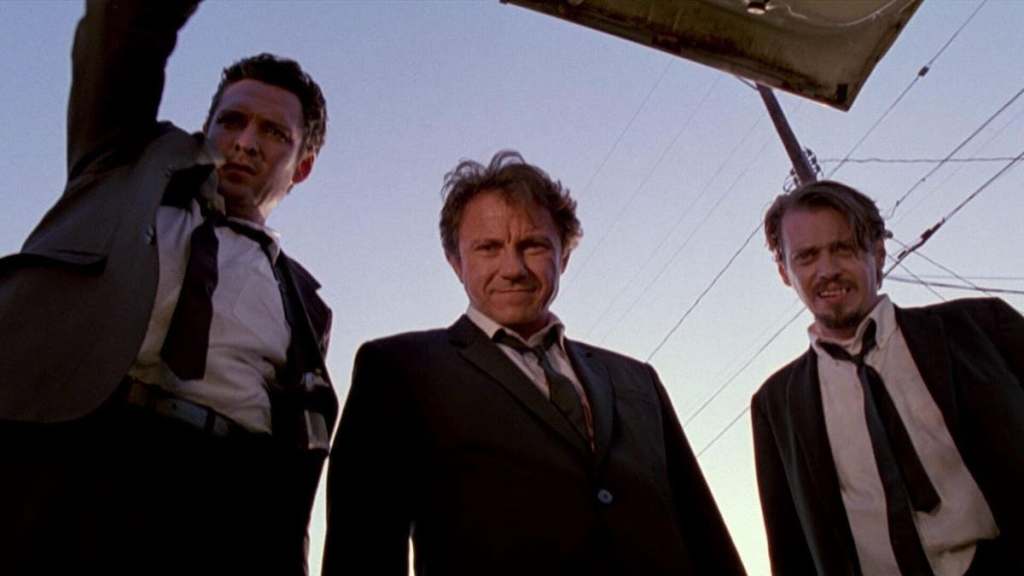
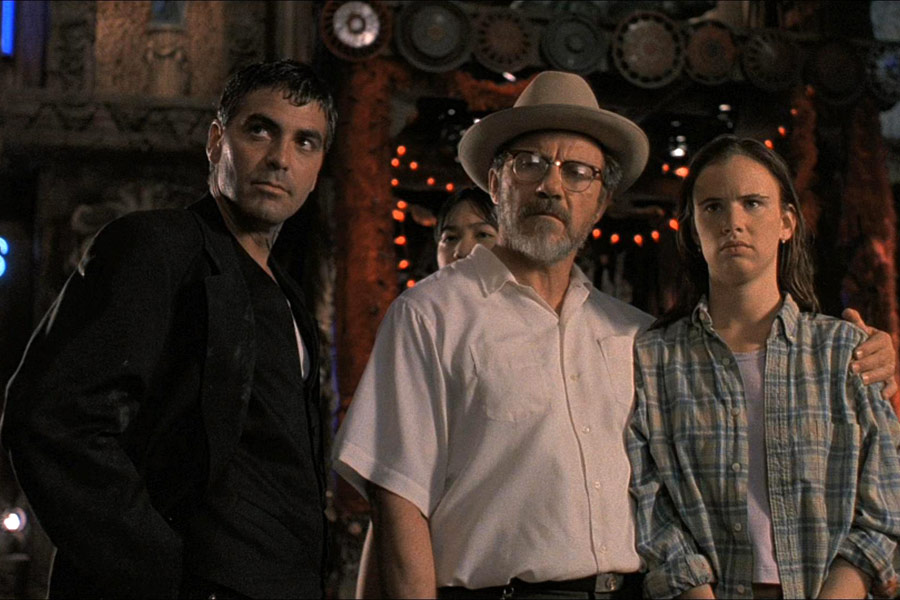
Today is Harvey Keitel’s 86th birthday! Harvey Keitel is one of the great, fearless actors of our time (BAD LIEUTENANT, anyone). He has been working hard since 1965, and he’s still going strong today, adding up to a career that spans 60 years and counting. His work for great directors like Scorsese and Tarantino has been vital to the quality and success of those films. I really came to appreciate Keitel when he had somewhat of a career resurgence in the early 90’s when I was in my late teens. He’s just a great actor who makes everything he appears in better.

Today, in honor of Harvey Keitel’s 86th birthday, here are 4 Shots from 4 Films!

MEAN STREETS (1973)

FINGERS (1978)

RESERVOIR DOGS (1992)

FROM DUSK TILL DAWN (1996)

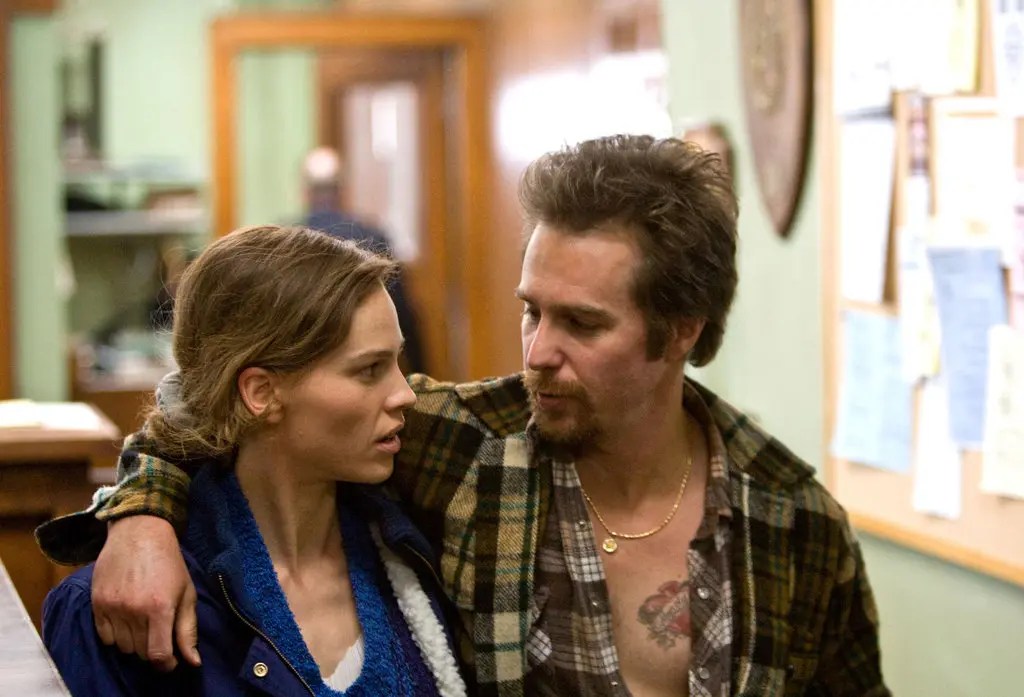
CONVICTION (2010) – Hilary Swank and Sam Rockwell star in the real-life story of a sister who saves her brother from a wrongful conviction!


My wife and I love movies based on real-life stories. We were looking for something to watch this afternoon on the MAX app and came across their “Real Life Dramas” section. One of the movies we saw listed was CONVICTION (2010) starring 2-time Oscar winner Hilary Swank. My wife loves Hilary Swank so we decided to give it a spin.

Betty Anne Waters (Hilary Swank) watches as her brother Kenny (Sam Rockwell) is convicted of the murder of Katherine Brow on May 21st, 1980 in Ayer, Massachusetts and sentenced to life in prison. Even though she knows he’s a troublemaker, Betty Anne is convinced that he’s not a murderer, so she gives up everything in her life to try to prove his innocence, especially after she learns that he tried to kill himself while in custody. Her husband (Loren Dean) divorces her and takes their kids with him. This doesn’t stop her. She goes back to school, eventually making her way to law school for the sole purpose of helping to exonerate her brother. In a positive turn of events, Betty Anne realizes that the new field of DNA testing could be the key to overturning her brother’s conviction. She contacts attorney Barry Scheck (Peter Gallagher) from the “Innocence Project” who assists those who believe DNA testing can help overturn previous convictions. Will Betty Anne finally be able to prove Kenny’s innocence, or will he have to spend the rest of his life in jail for a crime she doesn’t think he’s capable of committing?

Movies like CONVICTION are such an interesting watch for me, especially since we can know how these stories play out with a simple google search. When I see a movie is based on a real story, I purposefully avoid the facts of the actual events so I can see the events depicted on screen without my own internal bias taking front and center. I enjoyed watching how the events unfolded in CONVICTION. Hilary Swank and Sam Rockwell are such good actors, and I appreciate the work they put in here. I don’t pretend that everything depicted on screen is exactly how it was in real life, but I do believe that the actors portray the essence of truth, and I must admit to a tear in my eye when that truth is finally acknowledged for Kenny Waters at the end of the film. I also enjoyed telling my wife that the director of CONVICTION is Tony Goldwyn, the bad guy in the blockbuster film, GHOST. I just thought that was kind of cool, and so did she.

The real truth of Betty Anne Waters and Kenny Waters is ultimately bittersweet, but their story is both a testament to, and an indictment of, the American judicial system. As a person who truly loves our country, I think it’s important to realize that things aren’t always perfect, even in the United States of America!

See the trailer for CONVICTION below:

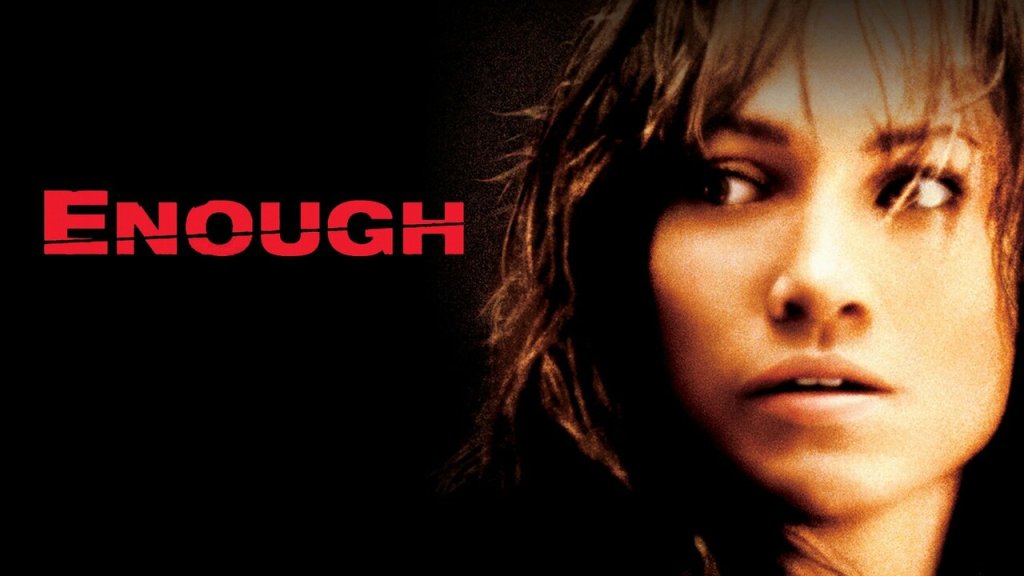
Jennifer Lopez has had ENOUGH (2002)! 


This morning I got up to make coffee for me and my wife. When I came back to our room, she had started the movie ENOUGH (2002) with Jennifer Lopez on the new projector that she bought me for Christmas. I’m not that big of a fan of Lopez, but I decided I’d go ahead and sit down to sip on my coffee prior to starting my day. I ended up watching the whole movie! 

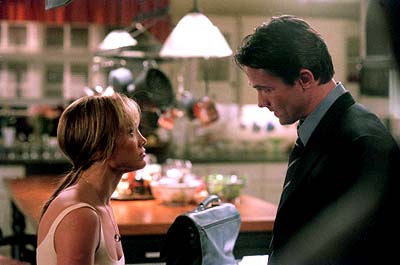
Jennifer Lopez plays Slim, a waitress in a diner in L.A., who meets a rich guy named Mitch Hiller (Billy Campbell) who impresses her when he gets rid of this rude jerk (Noah Wyle) trying to hit on her. Mitch and Slim get along famously, eventually getting married and having a cute little girl named Gracie. Everything seems perfect in their little world. Unfortunately, things aren’t what they seem, and one night Slim checks her husband’s pager. She calls the number and discovers Mitch has been cheating on her. When she confronts him about the affair, his entire countenance changes, and he begins beating the crap out of her. After the altercation, and before heading out to continue his affair, Mitch warns Slim not to leave because he refuses to live without her. With the help of her friend Ginny (Juliette Lewis) and a couple of others, Slim takes Gracie and they escape from Mitch. With all his money and connections, Mitch is able to track her down no matter where she goes. Feeling like she has no other options, Slim turns to her wealthy, estranged father, Jupiter (Fred Ward). He provides her the funds she needs to set up a new life and identity. Unfortunately, that damn Mitch tracks her down again. Narrowly escaping, Slim decides that she’s done running. She sends Gracie away with Ginny and begins training rigorously in self defense techniques. This time she’s taking the fight to Mitch with plans to end this shit once and for all. 

If you’re looking for a realistic drama about the effects of spousal abuse on the family unit and then across the larger society, ENOUGH is not the movie for you. This movie is more for the Charles Bronson crowd, where the bad guys are truly evil and the audience is in complete agreement with their need to perish. This is a formula that continues to work even if you have to completely suspend your disbelief. For example:

-Is it realistic that Mitch would be able to conceal what a complete and total asshole he is for many years from Slim, but then one night turn out to practically be the sidekick of Satan?

-Is it realistic that Mitch would be able track Slim and Gracie down time and time again, no matter where she goes across the country, even after she uses her Dad’s resources to change her identity?

-Is it realistic that Slim would be able to get enough self defense training in a short period of time to be able to confront the extremely fit Mitch at the end and kick his ass? 

While the setup is probably not the most realistic, we have to see images of Mitch beating up Slim on multiple occasions, even trying to kill her at one point. We also see him knock little Gracie to the ground and hurt her. We see him terrorizing her and anyone who tries to help her. This audience member just wanted to see Mitch pay.

I don’t really have any close connections to the main actors in ENOUGH, but they all do their jobs well enough to keep me involved. I have always been a fan of its director, Michael Apted. He’s made a few movies that I really like in CLASS ACTION (1991) with Gene Hackman, THUNDERHEART (1992) with Val Kilmer, and BLINK (1993) with Madeleine Stowe. He’s a more than competent director who knows how to get a reaction from his audience. This certainly may not reflect his best work, but he still handles the material in a professional manner. 

My final word on ENOUGH… I enjoyed the film in the same way I like the 3 piece combo at KFC, which I really do enjoy. I know it’s probably not the best stuff out there, but the classic formula still works, and I’m satisfied when it’s all gone! 

See the trailer for ENOUGH below:

Film Review: The Basketball Diaries (dir by Scott Kalvert)


When exactly did Leonardo DiCaprio become a good actor?

That may seem like a strange question because, today, Leonardo DiCaprio is often and rightfully described as being one of the greatest actors around.  He regularly works with the best directors in Hollywood, including Martin Scorsese.  His performances in The Aviator, The Wolf of Wall Street, and The Revenant should be viewed by any aspiring actor.

And yet, it’s easy to forget that Leonardo DiCaprio has been around forever.  Long before he was Martin Scorsese’s go-to actor, he was appearing in movies like Critters 3.  He started his career when he was 14 years old and spent a few years appearing in commercials and sitcoms before making his film debut in 1991.  (He was 17 when he made his first movie but, as anyone who has seen any of his early movies can attest, he looked much younger.)  When you watch those early DiCaprio films, you’re left with the impression of an actor who had some talent but who definitely needed a strong director to guide him.  Watching those early DiCaprio films, it’s always somewhat amazing to see both how good and how bad DiCaprio could be, often in the same movie.  If a scene called for DiCaprio to be quiet and introspective, he was a wonder to behold.  But whenever a scene called for big dramatic moment or gesture, DiCaprio would often become that shrill kid who made you cringe in your high school drama class.  I think that part of the problem is that the young DiCaprio was often cast as a passionate artist and, when you’re a certain age, you tend to assume that being a passionate artist means that you spend a lot of time yelling.

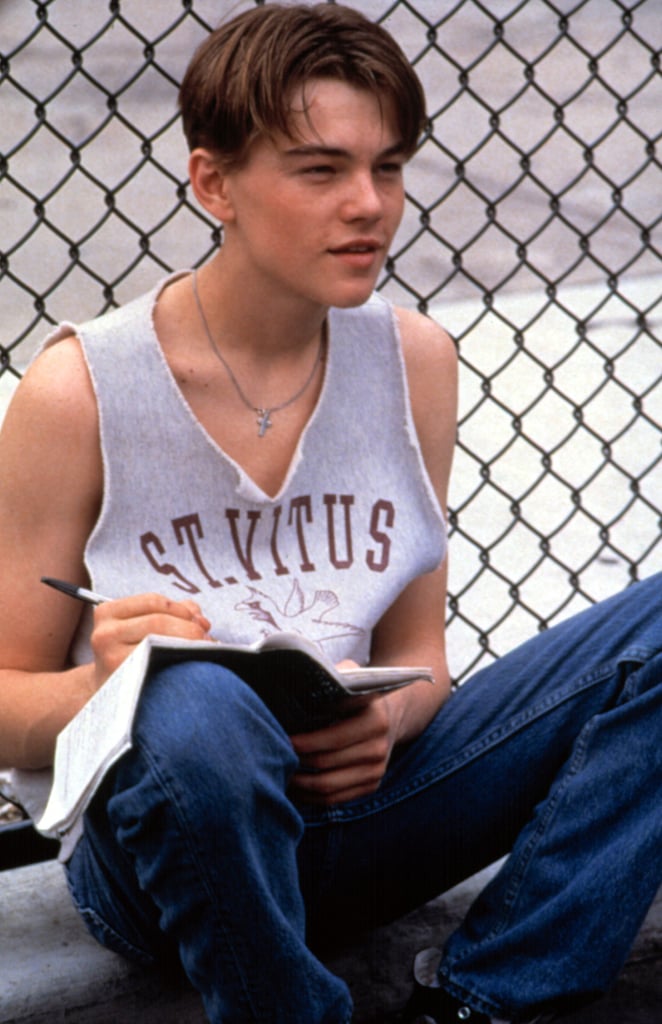
Take a film like 1995’s The Basketball Diaries, for instance.  In this film, Leonardo DiCaprio plays a real-life poet named Jim Carroll.  The film deals with Carroll’s teenage years, which were basically made up of going to Catholic school, writing poetry, playing basketball, committing petty crimes, and eventually getting hooked on heroin.  It’s pretty dramatic stuff and, with his face that’s somehow angelic and sardonic at the same time, the young DiCaprio certainly looks the part of a teenager who split his time between private school and the streets.  Though the young DiCaprio was way too scrawny to be believable as a star basketball player, he’s convincing in the scenes where he’s writing out his thoughts and his poems.

But then, Jim’s best friend (played by Michael Imperioli) dies of leukemia and a despondent Jim goes from pills and inhalants to heroin and both the film and DiCaprio’s performance quickly goes downhill.  Playing drug addiction (and, even worse, drug withdrawal) tends to bring out the worst instincts in even the best actors and that’s certainly the case with DiCaprio’s performance in The Basketball Diaries.  Suddenly, Leo is shaking and yelling in that shrill way that he used to do and, when he has gets emotional, he overplays the emotions to the extent that you can actually hear the snot being sorted back up his nostrils and you, as the viewer, start to get embarrassed for him.  As soon as Jim starts screaming at his mother (played by Lorraine Bracco), you really wish that the director or the writer or maybe the other actors had stepped in and said, “Leo …. dial it down a little.”  If you need proof that DiCaprio’s a far better actor today than he was in 1995, just compare Leo on drugs in The Basketball Diaries to Leo on drugs in The Wolf of Wall Street.

When The Basketball Diaries does work, it’s usually because of the actors around DiCaprio.  In one of his earliest roles, Mark Wahlberg has such an authentic presence that you kinda wish he and DiCaprio had switched roles.  (Yes, there was a time when Mark Wahlberg was a better actor than Leonardo DiCaprio.)  Bruno Kirby is chilling in a few cringey scenes as Jim’s basketball coach.  Ernie Hudson bring some welcome gravitas to the role of an ex-junkie who tries to help Jim straight out.  And then there’s poor Lorraine Bracco, bringing far more to the role of Jim’s underappreciated mother than was probably present in the script.

The Basketball Diaries is one of those films that seems profound when you’re like 15 and you come across it playing on TBS at like 2 in the morning.  Otherwise, it’s mostly interesting as evidence that, over the past 20 years, Leonardo DiCaprio has certainly grown as an actor.

A Movie A Day #311: Crooked Hearts (1991, directed by Michael Bortman)


“The family is like a drug and we’re all junkies.”  So says Charley Warner (Vincent D’Onofrio), one of the many pissed off people at the center of Crooked Hearts.
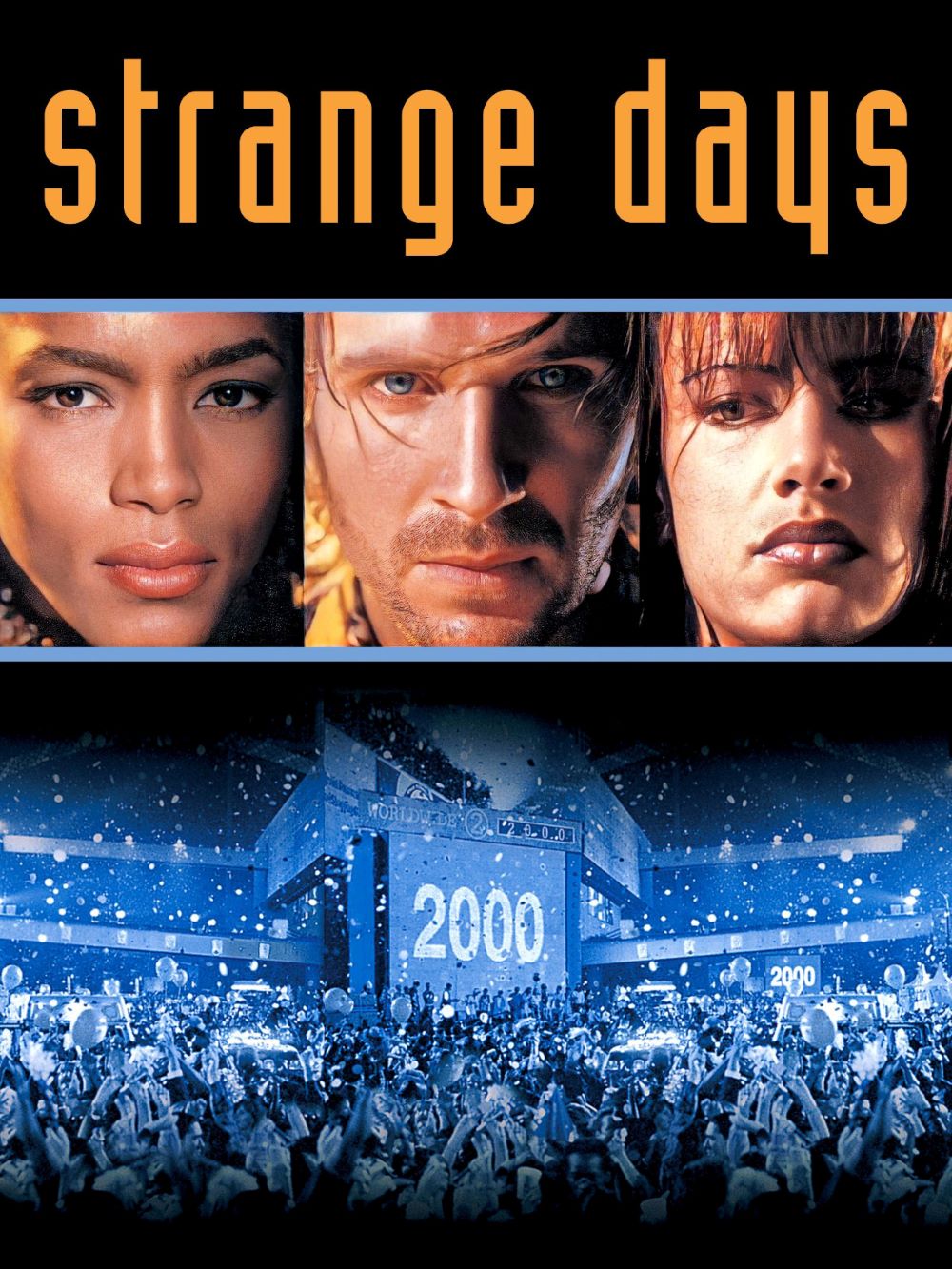
Crooked Hearts is narrated by Charley’s younger brother, Tom (Peter Berg).  When Tom drops out of college, he returns home and discovers that Charley is still living with their parents, Edward (Peter Coyote) and Jill (Cindy Pickett).  Charley feels that he can only leave the family if Edward officially kicks him out but Edward refuses to give him the satisfaction of escape.  Instead, Edward throws parties to celebrate his children’s failures, all of which he can recite from memory.  Also caught up in this mess are the two youngest children, Ask (Noah Wyle) and Cassie (Juliette Lewis).  Cassie is narcoleptic and Ask has a list of very important rules that everyone must follow to be happy, including always making sure that your socks match your shirt.  By the end of the movie, one brother has set his own house on fire and another one is mercifully dead.

Tolstoy once said, “Happy families are all alike; every unhappy family is unhappy in its own way,” but he never got to see Crooked Hearts, a movie where everyone is unhappy in the most predictable way possible.  Aside from an overbaked script and underbaked director, Crooked Hearts does feature good performances from Peter Coyote and Vincent D’Onofrio but Peter Berg is boring as the monotonous narrator and Noah Wyle tries too hard to be eccentric.  I watched Crooked Hearts because Jennifer Jason Leigh was in it but Leigh’s role was small and could have just as easily been played by Mary Stuart Masterson, Penelope Ann Miller, Mary-Louise Parker or any of the other three-name actresses of the early 90s.  Family may be addictive but this movie is not.

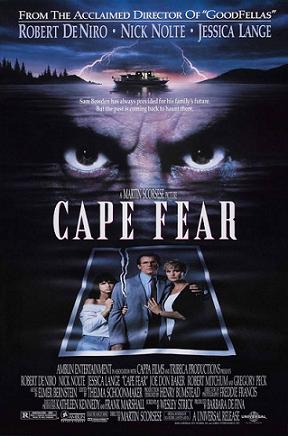
Horror Film Review: Cape Fear (dir by Martin Scorsese)


And I beheld as Scorsese remade a classic movie and, Lo, there was De Niro, decorated in india ink and speaking in tongues…

In 1991, Martin Scorsese remade the 1962 horror thriller, Cape Fear.  Both versions deal with the same basic story but each tells it in a very different way.  If the original Cape Fear was straightforward and to the point, Martin Scorsese’s version is so stylized that occasionally, it’s tempting to suspect that Scorsese might be parodying himself.  Zoom shots, negative shots, sweeping camera movements, Scorsese’s Cape Fear is full of all of them.  When a storm rolls in for the film’s operatic finale, the red clouds look as if their on fire.  Hell is coming to North Carolina, the film appears to be announcing.

While the plot largely remains the same, there are a few significant changes to the characters involved:

In the first Cape Fear, Robert Mitchum’s Max Cady was an arrogant, swaggering brute.  In the remake, Robert De Niro’s Cady is still an arrogant, swaggering brute but he’s now also an evangelical who is tattooed with bible verses and who speaks in tongues.  Cape Fear‘s approach to Cady’s religion is so over-the-top that it almost makes Stephen King’s approach to religious characters seem subtle and nuanced.  De Niro also speaks in a broad Southern accent.  Occasionally, De Niro gets the accent right but most of the time, he sounds like he’s in a Vermont community theater production of Cat On A Hot Tin Roof.

In the first Cape Fear, Gregory Peck’s Sam Bowden was a lawyer who caught Max while Max was attacking a woman and who then testified against Max in court.  That’s not the case with the remake’s version of Sam Bowden.  Despite being played by Nick Nolte, the remake’s Sam Bowden is such a wimp that you can’t help but dislike him.  His wife (Jessica Lange) doesn’t trust him.  His teenage daughter (Juliette Lewis) resents him and his attempts to control her life.  In this version, Sam didn’t testify against Max in court.  Instead, Sam was Max’s lawyer and withheld evidence that could have secured Max’s acquittal.  What Sam didn’t realize is that Max would spend his time in prison studying the law and that Max would eventually figure out what Sam did.

As in the original film, Max shows up in North Carolina and proceeds to stalk the Bowdens.  Unlike Mitchum, who was all quiet menace, De Niro plays Max as being loud and obnoxious, the type who will sit in a theater, light a cigar, and intentionally laugh at the top of his lungs.  Max knows enough about the law that he knows exactly what he can get away with.  He poisons Sam’s dog.  He rapes Sam’s associate, Lori (played, in a heart-breaking performance, by Ileana Douglas).  In one of the film’s most unsettling scenes, he pretends to be the new drama teacher and toys with Sam’s daughter.

With the help of a private eye (Joe Don Baker), Sam tries to get Max out of his life.  Eventually, Sam pretends to be out-of-town, all as part of a ruse to get Max to break into his house so that he can be shot in self-defense.  It’s here that Nolte’s wimpy performance becomes an issue.  It’s impossible not to laugh at the sight of Sam, all hunched down and desperately trying to run from room to room without being spotted through any of the windows.

To a certain extent, I suspect that were meant to see Sam as being a rather pathetic figure.  Scorsese doesn’t really seem to have much sympathy for him or his dysfunctional family.  If anything, the film seems to argue that Sam has been a bad lawyer, a bad husband, and a bad father and Max has been sent as a type of divine retribution.  Only by defeating Max can Sam find forgiveness and hope to have the type of life that Gregory Peck enjoyed in the first movie.

Scorsese’s Cape Fear is an uneasy mishmash of styles.  Is it an art film, a religious allegory, a horror film, or just a generic thriller?  It doesn’t seem to be sure.  Cape Fear‘s a Scorsese film so, of course, it’s always going to be worth watching.  But there are times when the film definitely runs the risk of overdosing on style.  Sometimes, Scorsese seems to be trying too hard to remind everyone that he’s a legitimately great director and ends up getting so invested in the film’s visuals that he runs the risk of losing the story.  De Niro has some scenes in which he is genuinely chilling but then he has other scenes where he is basically just a live action cartoon character.  The same can be said of the film itself.  It’s always watchable.  At times, it’s rather frightening.  But other times, it’s just too cartoonish to be effective.

If anything, this remake proves that sometimes, it’s best to keep things simple.

Back to School Part II #52: Nerve (dir by Henry Joost and Ariel Schulman)


For the past three weeks, Lisa Marie has been in the process of reviewing 56 back to school films!  She’s promised the rest of the TSL staff that this project will finally wrap up by the end of today, so that she can devote her time to helping to prepare the site for its annual October horrorthon!  Will she make it or will she fail, lose her administrator privileges, and end up writing listicles for Buzzfeed?  Keep reading the site to find out!)

nerve_2016_poster

Recently, I came across someone on twitter wondering if Emma Roberts is ever actually going to play an adult role.  Personally, I think the question is a bit unfair (just because you’re playing a teenager, that doesn’t mean that you’re not dealing with “adult” issues) but I understand the logic behind it.  Emma Roberts is a Hollywood veteran who made her film debut 15 years ago.  She’s currently 25 years old but, more often that not, she’s still cast as a high school student.  (At the most, she might occasionally get to be a college student.)  Going solely by her film and television roles, Emma Roberts has been a high school student for 12 years now.

But you know what?

I say more power to Emma Roberts.  Being a teenager is a lot more fun than being an adult and she should stay in high school for as long as she can pull it off!

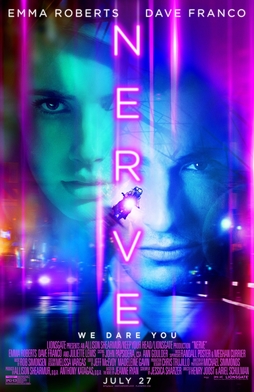
Anyway, this year’s Emma-Roberts-In-High-School film was a thriller called Nerve.  Actually, very little of the film takes place in high school though a running theme through the film is the desire of a senior named Vee (short for Venus and played by Roberts) to attend the California Institute of the Arts after she graduates.  Unfortunately, it costs money to go to a good school and Vee’s mother (Juliette Lewis) doesn’t have any.  As well, both Vee and her mother are still struggling to accept the recent death of Vee’s brother.

However, there may be a way for Vee to raise the money.  Vee learns that her friend, Sydney (Emily Meade), has become an online star by playing Nerve.  Nerve is a game where you can either volunteer to be a player or you can pay to be a viewer.  (There’s a third role that you can play in Nerve but it’s not a good role and we don’t learn about it until later in the film.)  The watchers dare the players to do something.  If the players do it, they win money.  If the players fail … well, there are consequences for everything.

Though initially reluctant, Vee agrees to be a player.  At first, it’s a lot of fun.  The normally cautious Vee gets to experience the exhilaration of taking a risk.  She even meets another Nerve player, Ian (Dave Franco) and soon the two of them are a team, partners and perhaps something more.  But, as the game progresses, the dares become more dangerous and the stakes get higher.  And, of course, Ian has a secret of his own..

The great thing about Nerve is that it tells a story about what’s is pretty much happening right now.  It’s easy to imagine a real-life version of Nerve going on right now.  As I watched Vee and Ian play Nerve, I was actually reminded of how much fun twitter used to be.  And then, just as happens in Nerve, more and more people got involved and things quickly went downhill.  The more popular both twitter and Nerve became, the less pleasant the experience.  The same is true for just about everything that’s ever happened online.  It always starts out as fun until the trolls arrive.  (And trolls, of course, have the magic ability to use their mere presence to transform former non-trolls into trolls as well.)  Nerve answers the age-old question of why we can’t have nice things.

Beyond that, it’s an entertaining film.  Emma Roberts and Dave Franco make for an exceptionally likable couple, the film is quickly paced, and Michael Simmonds’s cinematography gives the film an appealing and slickly flamboyant look.  Nerve didn’t really get as much attention as it deserved when it was originally released but I have a feeling that it is a film that will be rediscovered and appreciated by viewers in the future.


Who the Hell Are These People?


With the Golden Globe nominations set to be announced on Tuesday, I figured now would be a good time to recap which films and performances have already been honored by the various critics groups. 

One thing that I discovered as I researched this is that there are a lot of critics groups out there!   I don’t know who half these people are and most of them probably won’t have any bearing at all on who is actually nominated come Oscar time.  But since I’m a lover of trivia and lists, there you go.

The following films and performances were honored by either The National Board of Review, the D.C. Film Critics, the Boston Society of Film Critics, The New York Film Critics Online,The Los Angeles Film Critics, The Indiana Film Journalists, The Southeastern Film Critics, The New York Film Critics Circle, or the San Francisco Film Critics.

Best Picture:

The Social Network (All.  That’s right, it’s a clean sweep for an above average film.)

Best Director:

Darren Aronofsky for Black Swan (S.F)

Olivier Assayas for Carlos (LAFC)

David Fincher for The Social Network (BSFC, DC, NBR, NYFCC, NYFCO, SEFC, S.F.)

Christopher Nolan for Inception (IFJ)

Best Actor:

Jesse Eisenberg (BSFC, NBR)

Colin Firth for The King’s Speech (DC, LAFC, NYFCC, SEFC, S.F.)

James Franco for 127 Hours (IFJ, NYFCO)

Best Actress:

Annette Bening for The Kids Are All Right (NYFCC)

Kim Hye-ja for Mother (LAFC)

Jennifer Lawrence for Winter’s Bone (DC)

Lesley Manville for Another Year (NBR)

Natalie Portman for Black Swan (BSFC, IFJ, NYFCO, SEFC)

Michelle Williams for Blue Valentine (S.F.)

Best Supporting Actor:

Niels Arestrup for A Prophet (LAFC)

Christian Bale for The Fighter (BSFC, DC, IFJ, NBR, NYFCO)

John Hawkes for Winter’s Bone (S.F.)

Mark Ruffalo for The Kids Are All Right (NYFCC)

Geoffrey Rush for The King’s Speech (SEFC)

Best Supporting Actress:

Melissa Leo for The Fighter (DC, NYFCC, NYFCO)

Juliette Lewis for Conviction (BSFC)

Hailee Steinfeld for True Grit (IFJ, SEFC)

Jacki Weaver for Animal Kingdom (LAFC, NBR, S.F.)

Best Documentary:

Exit Through The Gift Shop (DC, IFJ, NYFCO)

The Inside Job (NYFCC, SEFC)

Last Train Home (LAFC)

Marwencol (BSFC)

The Tillman Story (S.F.)

Waiting For Superman (NBR)

Best Animated Feature:

How To Train Your Dragon (IFJ)

The Illusionist (NYFCC)

Toy Story 3 (BSFC, DC, LAFC, NBR, NYFCO, SEFC, S.F.)

Best Adapted Screenplay:

The Social Network (BSFC, DC, IFJ, LAFC, NYFCO, SEFC, S.F.)

Best Original Screenplay:

Inception (DC)

The Kids Are All Right (NYFCC)

The Kings Speech (SEFC, S.F.)