Insomnia File No. 8: From the Hip (dir by Bob Clark)


What’s an Insomnia File? You know how some times you just can’t get any sleep and, at about three in the morning, you’ll find yourself watching whatever you can find on cable? This feature is all about those insomnia-inspired discoveries!
From_the_Hip_(film)

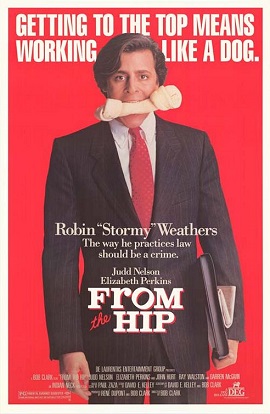
Last night, if you discovered that you couldn’t get any sleep around two in the morning, you could have turned to Showtime and watched the 1987 film, From The Hip.

In From the Hip, Judd Nelson plays a character named Robin Weathers.  Of course, his nickname is Stormy.  Robin has just graduated from law school and is working at a prestigious law firm.  He’s ambitious, he’s outspoken, and he’s totally frustrated.  As his co-workers (played, quite well, by David Alan Grier and Dan Monahan) continually remind him, nobody gets to try a case during their first year out of law school.  They advise him to be patient and to wait his turn.

However, a man who is capable of being patient would not be nicknamed Stormy.  It just wouldn’t make any sense.  So, Stormy Weathers schemes his way into the courtroom.  One morning, he intentionally withholds information from the senior partners, going out of his way to keep them from realizing that a trial is scheduled to begin that afternoon.  When senior partner Craig Duncan (Darren McGavin) discovers what Stormy has done, he fires him and makes sure that he never get hired at another law firm … oh wait.  No, he doesn’t because that would make too much sense.  Instead, he allows Stormy to try the case because, at this point, Stormy is the only one who knows anything about it.

The case is a simple assault case that involves two bankers and should be resolved easily but Stormy manages to drag it out for several days and his flamboyant style catches the attention of the media.  The other partners in the law firm — who are all old and boring — want to fire Stormy but Stormy’s client says that, if Stormy is fired, he’ll take his business and his money elsewhere.  Stormy becomes a minor celebrity but — in a rather clever little twist — it turns out that he and the prosecuting attorney are old friends from law school and they conspired to make each other look good.

Anyway, Stormy is now so famous that he gets assigned to defend a college professor, named Benoit (John Hurt), who has been accused of murder.  When it quickly becomes obvious that Benoit is not only guilty but will probably murder again, Stormy is forced to choose between ambition and morality…

When my friend Evelyn and I first started to watch From the Hip last night, I really thought I was going to hate it.  The hot pink neon credits screamed, “Bad 80s movie!” and, because I happen to know quite a few lawyers, I tend to be a 100 times more critical of movies about lawyers than I am when it comes to movies about, say, homicidal fishermen.

And, honestly, From The Hip is a heavily flawed film.  Judd Nelson is miscast and the scenes with his politically conscious girlfriend (Elizabeth Perkins) are painfully shallow and reek of limousine liberalism.  But, if you can get through the weak opening, the film itself is watchable and enjoyable in a dumb sort of way.  John Hurt does a great job as a sociopath and, miscast as he may be, it’s still fun to watch Nelson go insane in court.

From The Hip is not a great film but, in its way, it’s an enjoyable little time capsule.  Believe it or not, there was a time when Judd Nelson starred in a movies that were actually released in theaters.

Previous Insomnia Files:
  1. Story of Mankind
  2. Stag
  3. Love Is A Gun
  4. Nina Takes A Lover
  5. Black Ice
  6. Frogs For Snakes
  7. Fair Game


Embracing the Melodrama Part II #73: St. Elmo’s Fire (dir by Joel Schumacher)


St_elmo's_fire

Oh my God!  Aren’t rich, white people just like the worst!?

Actually, usually I would never say something like that.  I usually find class warfare to be tedious and I personally think poor people can be just as annoying as rich people.  I had no interest in the whole Occupy Wall Street thing and I once referred to V For Vendetta as being V For Vapid.

No, I may not be much of a class warrior but then again, that may be because I never met any of the characters at the center of the 1985 film St. Elmo’s Fire.  Seriously, if anything could turn me into a slogan-spouting, window-smashing revolutionary, it would be having to deal with any of the self-centered, entitled characters in St. Elmo’s Fire.

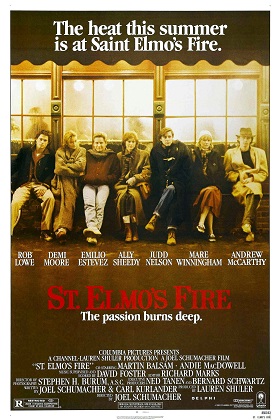
St. Elmo’s Fire is about a group of seven friends, three of whom are played by actors who co-starred in The Breakfast Club.  These friends all met at and are recent graduates from Georgetown University.  St. Elmo’s Fire follows them as they laugh, love, drink, do drugs, and try to figure out what they want to do with the rest of their lives.

For instance, there’s Billy (Rob Lowe), who has big hair and wears one dangling earring.  Billy was in a fraternity and spends most of the movie wishing that he still was.  Billy also plays the saxophone and he has a wife and a kid who he has pretty much abandoned … well, you know what?  I like Rob Lowe.  He seems like a fun guy and his DirectTV commercials were all classics but oh my God, does he ever give a bad performance in St. Elmo’s Fire.  Some of it is because Billy is not a very likable character.  He’s supposed to be the rough-around-the-edges, secretly sensitive rebel type but ultimately, he just comes across as being a loser.

And then there’s Jules (Demi Moore), who does too much cocaine and, as a result, finds herself fearing that she’s on the verge of being sold into a sexual slavery.  Jules doesn’t get to do much other than be rescued by the other characters.  Fortunately, when it looks like the group is drifting apart, Jules attempts to commit suicide and brings everyone back together.  Way to be a plot device, Jules!

Wendy (Mare Winningham) is the sweet but insecure virgin who has a crush on Billy.  Wendy works as a social worker and ends up getting insulted by the very people that she’s trying to help.  Winningham gives one of the film’s better performances but you can’t help but feel that Wendy deserves better friends.

Speaking of good performances, Andrew McCarthy also gives a pretty good one.  McCarthy plays Kevin Dolenz, the idealistic writer who everyone is convinced is gay because he hasn’t had sex in 2 years.  However, Kevin is actually in love with his best friend’s girlfriend.  As written, Kevin runs the risk of coming across as being insufferably moralistic but McCarthy gives a likable performance.  He turns Kevin into the nice guy that we all want to know.

And then there’s the Breakfast Club alumni.

Alec Newberry (Judd Nelson) was the vice-president of the Georgetown Democrats but now, because it pays better, he’s taken a job working for a Republican senator.  Alec’s girlfriend is Leslie (Ally Sheedy).  Alec obsessively cheats on Leslie, claiming that he can’t be loyal to her unless she’s willing to marry him.  The group of friends is largely centered around Alec and Leslie though it’s never really clear why.  Alec and Leslie are boring characters and, as a result, they’re a boring couple.

And then there’s Kirby (Emilio Estevez).  Estevez gives a likable performance but he often seems to be appearing in a different movie from everyone else.  Kirby is working on his law degree and he’s in love with a hospital intern named Dale (Andie MacDowell).  Unfortunately, Dale isn’t as interested in Kirby as he is in her so Kirby responds by stalking her and trying to change her mind.  There’s an earnestness and sincerity to Kirby that makes you like him, even if his behavior is actually rather creepy.

As for the film itself — well, it’s directed by Joel Schumacher and there’s a reason why Schmacher has the reputation that he does.  As a director, Schumacher is good at gathering together an attractive cast but he has close to no idea how to tell a compelling story.  St. Elmo’s Fire plods along, dutifully telling its story but providing little insight or surprise.

If you’ve read some of my previous reviews, you’re probably expecting this to be the point where I argue that St. Elmo’s Fire works as a time capsule.  But, honestly, this film doesn’t have enough insight to really work as a time capsule.  I mean, if you love 80s hair and 80s fashion, you might enjoy St. Elmo’s Fire but, then again, you could always just do a google image search and have the same basic experience.

Horror Film Review: Nurse 3D (dir by Doug Aarniokoski)


nurse-3d

So, last night, my boyfriend and I watched Nurse 3D because, based on the trailer that was released way back in January, we thought that it would be a sexy, fun, and enjoyably lurid movie.  Do you remember that trailer?  In case you need a reminder, here it is:

So, we finally got around to watching the movie and oh my God, you guys — sometimes trailers lie!  I know, I know — it’s a shock.  I’m still struggling to deal with it myself!

Actually, technically, the trailer for Nurse 3D doesn’t really lie.  The trailer tells us that the film is about a nurse who is obsessed with another nurse and who spends the majority of the film wearing only a bra.  And that’s true!  But, somehow, the trailer also makes the film look like it’s a lot more fun than it actually is.  The trailer reveals that Nurse 3D is meant to be something of a satirical tribute to the exploitation films of the past.  What it doesn’t reveal is that the film largely does not work.

In Nurse 3D, Paz de la Huerta plays Abby Russell, a nurse who also happens to be a serial killer.  When we first meet her, she’s wandering through a club in a black lace, see-through dress.  In a narration that de la Huerta delivers in an emotionless drone, Abby explains that men are a disease that has been created in an “alcoholic petri dish” and that is now “infecting innocent vaginas.”

“There is only one cure for the married cock,” Abby tells us, “Only me.  I’m the nurse.”

Abby, we discover, specializes in murdering married men who are on the verge of committing adultery.  Sounds like a good idea for a movie, right?  Well, don’t get too attached to it because, once we get through the opening credits, that entire storyline pretty much disappears.

Instead, Abby becomes obsessed with a new nurse named Danni Rogers (Katrina Bowden).  One night, after Danni both has a fight with her boyfriend (Corbin Bleu) and gets yelled at by a jerk of a doctor (played by Judd Nelson), Abby invites Danni out to a club.  Abby gets Danni drunk and drugged and soon they’re making out on the dance floor.  The next morning, Danni wakes up in Abby’s bed.  When Danni refuses to spend the day with Abby and quickly leaves, Abby reacts by trying to destroy Danni’s life…

And that plot line goes on for a while until, eventually, the filmmakers remembered that this was supposed to be a 3D film and, with the exception of one man hurtling towards the camera after being tossed off a rooftop, nothing in the film has really lent itself to whole 3D thing.  So, suddenly, Abby goes from being coolly calculating to being batshit insane, essentially so that she’ll have an excuse to toss medical equipment straight at the camera.

(I’m going to guess that this all probably looked really impressive in 3D but since we were watching the film in 2D, who cares?)

And then, eventually, the movie ends.

I like what Nurse 3D was trying to do.  The film is obviously meant to pay homage to the classic exploitation films to the past.  That was obvious in everything from the overwritten narration to the hilariously fetishized nurses uniforms to the unapologetically sordid nature of the entire plot.

However, the film’s execution left a lot to be desired.  For all of it’s attempts to celebrate over-the-top exploitation, the film never quite seems to understand what makes those films so memorable in the first place.  Perhaps if Nurse 3D had stuck with being a film about a nurse who kills cheating husbands, the film would have worked.  But, instead, it just becomes yet another film about an obsessive friend who turns out to be a psycho and who, fortunately for her, is lucky enough to be surrounded by people too stupid to pick up on the most obvious of clues.

And it doesn’t help that, whatever the joke was that Nurse 3D was trying to tell, it’s obvious that Paz de la Huerta was not in on it.  In many ways, her character is meant to be a throwback to the great and deadly femme fatales of yesterday but  it takes more than having a good body to be a femme fatale.  You have to have style and that’s totally what her performance is missing.  Scarlett Johansson could have worked wonders with the role of Abby Russell but Paz de la Huerta just seems to be lost.

That’s actually a pretty good description of Nurse 3D.  It started out on the right track but, obviously, it lost its way.

Nurse3D

Back to School #39: The Breakfast Club (dir by John Hughes)


breakfast-club-2

Dear Mr Vernon,

We accept the fact that we had to sacrifice a whole saturday in detention for whatever it was we did wrong. But we think you’re crazy to make us write an essay telling you who we think we are. You see us as you want to see us – in the simplest terms, in the most convenient definitions. But what we found out is that each one of us is a brain, and an athlete and a basket case, a princess and a criminal.

Does that answer your question?

Sincerely yours,

The Breakfast Club.

— Brian’s essay from The Breakfast Club (1985)

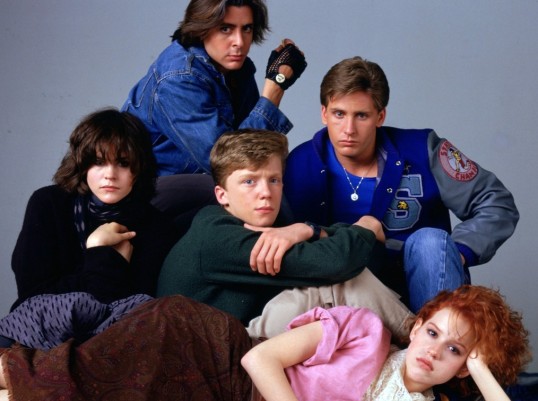
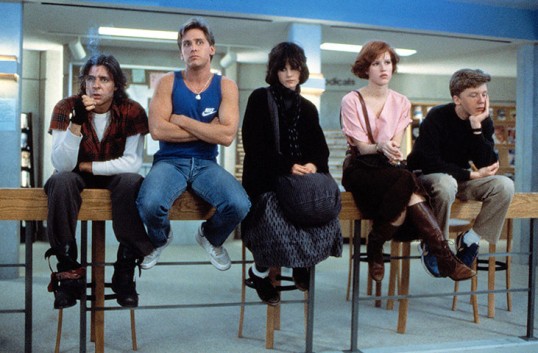
 That’s one thing that has always bothered me about The Breakfast Club.  The film, of course, is famous for being about five different high school students who are forced to spend a Saturday in detention with each other.  Over the course of the day, they start off as antagonists, separated by their own preconceived notions of who they are.  But, as the day progresses, they talk and they bond and they discover that they all have more in common than they might think.  And, at the end of the film, “basket case” Allison (Ally Sheedy) pairs off with “athlete” Andy (Emilio Estevez) and “criminal” Bender (Judd Nelson) pairs off with “princess” Claire (Molly Ringwald).  And while Claire is busy giving Allison a makeover and Bender is thinking about how iconic he’ll look when he raises his fist while leaving the school, “brain” Brian gets to write everyone’s essay.

Originally, all five of them were supposed to spend their time in detention writing individual essays about how they’re going to be better students and citizens.  But, in the end, only one essay is turned in and Brian is the one who writes it.  It’s always seemed a bit unfair to me that, while everyone else was getting to reveal a new side of his or herself, Brian was basically doing everyone’s schoolwork.  I know it can be argued that this shows that the other students finally appreciate Brian’s intelligence but everyone already knew he was smart.  In the end, Brian is the one who articulated what they all discovered during that Saturday detention but he also seems to be the one who gained the least from the experience.

The-Breakfast-Club-1985-001

But, at heart, The Breakfast Club is a deeply ambiguous movie.  That’s one reason why, despite the fact that it was initially released the same year that I was born, the film still feels relevant today and why it remains one of the most popular high school films ever made.  Everyone can relate to at least one of the five students and I imagine that when most people watch it, they wonder how they would react to an aggressive character like John Bender or how they would handle the horrific story that Andy tells when asked what he did to get sentenced to detention.  And, at the end of the film, everyone wonders if any of the new friendships and relationships would actually last longer than a weekend.  When Bender asks Claire how she’s going to act if Brian approaches her on Monday, we all know what will probably actually happen if he does.  At the end of the film, you’re happy that they got that Saturday together because you know that, once Monday comes, it’s going to be like it never happened.

the_breakfast_club_2

I’ve watched The Breakfast Club a handful of times.  Whether I relate the most to Claire or to Allison usually depends on my mood. I think that a lot of people want to relate to Allison because, for much of the movie, Claire is unapologetically selfish and spoiled.  But, if we’re honest with ourselves, we have to admit that we’re all a lot more like Claire than any of us want to admit.

It’s also easy to relate to Allison because she’s not really a very well-drawn character.  While the other characters all come from an easily identifiable group, Allison is just there.  She’s a collection of strange quirks that don’t always have a clear motivation and, in the end, the only reason Allison works as a character is because Sheedy does such a good job playing her.  At the end of the film, Claire gives Allison a makeover and I have to admit that it always kind of breaks my heart to see how Allison goes from being strange to being very conventional.

Makeover

(In Susannah Gora’s excellent book You Couldn’t Ignore Me If You Tried, Sheedy is quoted as saying that she didn’t feel very happy about it either.  According to her — and she’s correct — the only thing that really redeems this scene is the fact that Allison doesn’t quite pull off her new look.  She’s still a little awkward and you realize that she may have just been humoring Claire.)

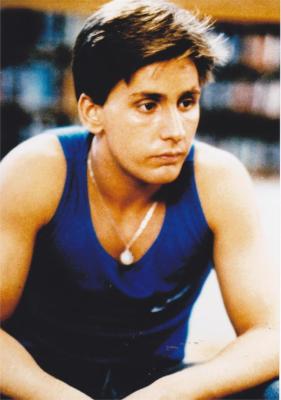
As for the males, Anthony Michael Hall gets a lot of the laughs and Judd Nelson gets the best lines but Emilio Estevez gives the best performance.  We already know that Brian is insecure despite being intelligent and we expect that Bender is angry because he’s got an abusive father.  But when Andy explains why he, an otherwise nice and likable guy, committed a horrific act of bullying, it’s an amazing scene and Estevez plays it perfectly.

Estevez

In fact,  both Estevez and Sheedy are so good that I’ve decided that Andy and Allison did stay together after detention.  Eventually they got married and, right now, they’re living in a pretty house in the suburbs of Chicago.  Bender and Claire, however — there’s no way that lasted!

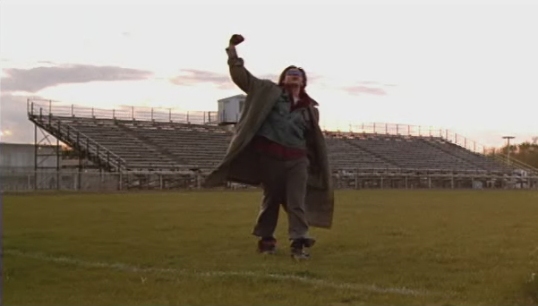
But, regardless of what happened on Monday, there’s no way your heart can’t soar a little when Bender lifts that fist above his head.

Bender and his fist