Film Review: The Outlaw Josey Wales (dir by Clint Eastwood)


Towards the end of 1976’s The Outlaw Josey Wales, Josey (played by Clint Eastwood) says, “I guess we all died a little in that damned war.”

He’s referring to the American Civil War and the film leaves you with no doubt that Wales knew what he was talking about.  A farmer living in Missouri, Josey Wales wasn’t involved in the Civil War until a group of guerillas, the Redlegs, raided his home and killed his family.  Seeking vengeance, Wales joined the Bushwackers, a group of Confederate guerillas that were led by the infamous “Bloody Bill” Anderson.  After Anderson’s death and the South’s surrender, Senator James H. Lane (Frank Schofield) offers amnesty to any of the Bushwackers willing to surrender and declare their loyalty to the United States.  Fletcher (John Vernon), the leader of the surviving Bushwackers, thinks it’s a good idea and his men eventually agree to surrender.

Everyone except for Josey Wales.

Fletcher tells Josey that he’ll be an outlaw and that Lane will send his men to capture and execute him.  “I reckon so,” Josey Wales replies.  It’s not that Josey was particularly a fan of the Confederate cause.  Instead, having lost his family and his home and having seen hundreds of men killed, Josey no longer cares.  He’s got a death wish, something that becomes apparent when he later sneaks over to Lane’s camp and discovers that the leader of the Redlegs, Terrill (Bill McKinney), has been made a captain in the Union Army.  The surrendering Bushwackers, with the exception of Fletcher and a young man named Jamie (Sam Bottoms), are gunned down as they swear allegiance to the United States.  Joey springs into action, hijacking a Gatling gun and mowing down soldiers.  It’s a suicidal move and Josey appears to be willing to die, until he sees that Jamie has been wounded.  Josey and Jamie go on the run, pursued by soldiers and bounty hunters.

It sounds like the start of typical Clint Eastwood film and, make no mistake about it, The Outlaw Josey Wales features everything that most people have come to expect from Eastwood.  Josey Wales is an expert shot, often firing two guns while charging forward on his horse.  Josey has a way of words, explaining the purpose of getting “plain man dog mean” and telling a bounty hunter that there are better ways to make a living.  The main difference, though, is that Josey is no longer seeking revenge.  He’s lost his family and his home and he knows nothing is going to bring them back.  He sought revenge during the Civil War and saw so many people killed that, much like Jimmy Stewart in Broken Arrow, he just wants to disappear from civilization.

The problem is that men like Lane and Terrill have no intention of letting Josey Wales disappear.  The sociopathic Terrill sees it as almost being his God-given duty to kill Josey Wales and anyone else that he dislikes.  The bounty hunters are also after Josey Wales.  As Fletcher explains it, bounty hunting is the only way that many former soldiers can make money and feed their families.  As Josey moves through the southwest, his legend grows.  Every town that Josey stops in, he hears stories about the growing number of men that he has supposedly killed.

Josey also discovers that he can’t do it all alone.  He soon finds himself as a part of a new family, a collection of misfits that don’t have a home in Senator Lane’s America.  Lone Waite (Chief Dan George) is an elderly Cherokee man who suggests that Josey head for Mexico.  Little Moonlight (Geraldine Keams) is a Navajo woman who Josey rescues from two bounty hunters.  Sarah Turner (Paula Trueman) and her granddaughter, Laura Lee (Sondra Locke), are rescued from Comancheros.  Josey negotiates the release of two of Sarah’s ranch hands and befriends Chief Ten Bears (Will Sampson) while doing so.  Slowly, Josey comes out of his shell and starts to embrace life once again.  Josey goes from searching for death to searching for peace.

It’s one of Eastwood’s best films, ending on a note of not violence but instead sad regret.  It’s not only a portrait of a man learning to embrace life but it’s also a portrait of a country trying to figure out how to come back together after the bloody savagery of the Civil War.  Some, like Fletcher and Josey, want to move on.  Others, like Terrill, don’t have an identity beyond fighting and killing.  Eastwood gives a good performance but, as a director, he gives every member of the cast a chance to shine.  If you only know John Vernon as Dean Wormer from Animal House, his sad-eyed performance here will be a revelation.

Originally, The Outlaw Josey Wales was meant to be directed by Phillip L. Kaufman but Eastwood felt that Kaufman was taking too long to set up his shots and worrying about details that really didn’t matter.  Reportedly, while Kaufman was away from the set, spending hours searching for a historically-correct beer bottle to be used in a bar scene, Eastwood directed the scene himself and then convinced producer Robert Daley to fire Kaufman and allow Eastwood to direct the film.  (Kaufman also objected to the script’s anti-government subtext but seriously, that’s pretty much the subtext of every film that Eastwood has ever been involved with.)  The DGA later instituted a rule that, on productions in which the director was fired,  the replacement could not be a member of his crew or an actor in the cast but that was too late to help out Kaufman.

(Rumor has it that another reason Kaufman was fired was because he and Eastwood both “liked” Sondra Locke.  This was the first of six films that Eastwood and Locke would do together.)

To be honest, I think it worked out in the film’s favor.  It’s a little surprising that someone other than Eastwood was ever considered as director to be begin with, so perfectly does the story and the lead character fit with Eastwood’s persona.  Eastwood captures both the beauty of the untouched land and also the bloody violence of combat.  In many ways, this film almost feels like a prequel to UnforgivenThe Outlaw Josey Wales is Eastwood at his best.
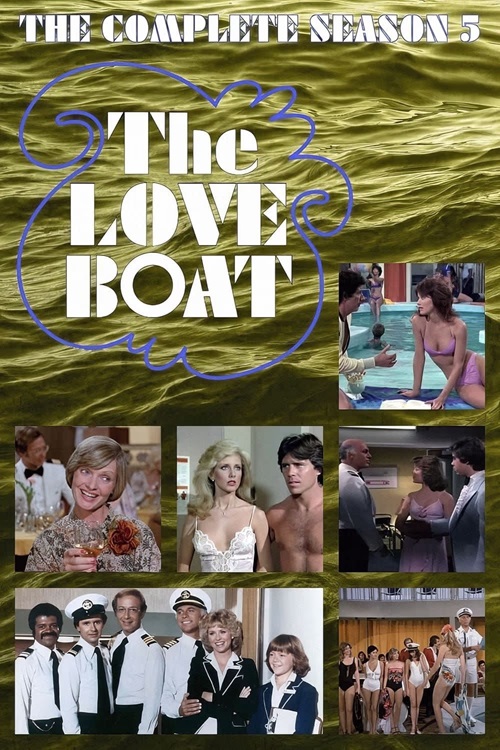
Retro Television Review: The Love Boat 5.15 “I Don’t Play Anymore/Gopher’s Roommate/Crazy For You”


Welcome to Retro Television Reviews, a feature where we review some of our favorite and least favorite shows of the past!  On Wednesdays, I will be reviewing the original Love Boat, which aired on ABC from 1977 to 1986!  The series can be streamed on Paramount Plus!

This week, Gopher thinks that he recognizes a passenger!

Episode 5.15 “I Don’t Play Anymore/Gopher’s Roommate/Crazy For You”

(Dir by Bob Sweeney, originally aired on January 23rd, 1982)

When Rachel (Mackenzie Phillips) boards the ship, Gopher is sure that they’ve met before.  Rachel tells Gopher that he must be mistaken and, in fact, she goes out of her way to avoid him.  Since no one on this ship has ever stopped to consider that getting the cruise line sued would be bad for their career, Gopher continues to follow Rachel around.  Rachel finally tells Gopher the truth.

She does know him.

In fact, they were once quite close.

In college, Rachel was Gopher’s roommate and she played for the football team.  However, after graduating college, she had gender-affirmation surgery and now, she goes by the name of Rachel.  Gopher is stunned and I know what you’re probably thinking.  You’re probably looking at the 1982 air date and assuming that the whole storyline becomes consumed with gay panic as Gopher grapples with having been attracted to his former roommate.  (Doc also hits on her but then again, Doc hits on anyone.)  Well, believe it or not, The Love Boat handles this storyline with a surprising amount of sensitivity.  Yes, Gopher is stunned at first.  But he soon comes to respect and support Rachel’s decision, even if he doesn’t fully understand it.  Physically, the rather slight Mackenzie Phillips is not particularly believable as a former football player but still, both she and Fred Grandy gave good performance in the story.  This week was a case of The Love Boat really taking me by surprise.

Meanwhile, psychiatrist Lisa Lessing (Joanna Cassidy) boards the boat to observe David Jackson (Dick Shawn), an exec who is asking for worker’s compensation because he claims to be mentally ill.  Lisa (hey!) is on board to check on David’s sanity.  Lisa comes to believe that David is not faking but — surprise! — David actually is faking and now he feels bad because he and Lisa have fallen in love.  Lisa decides to pretend to be crazy too.  Uhmmm, okay.

Pianist Paul Krakauer (James MacArthur) has retired from playing because of the crippling arthritis in his hands.  When he meets Irene (Donna Pescow), a maid on the ship, he falls in love and decides to give one last performance so that he can make a quick $25,000 and give it to Irene so she can get an operation to fix her ankle.  Turns out that Doc has some ‘medicine” that allows Paul to play the piano but it takes several hours to take it effect so Paul misses a date that he previously set up with Irene.  Irene is ready to dump David until she finds out why he stood her up.

So, this episode had one surprisingly sensitive and two kind of bland storylines.  (The pianist storyline was ultimately saved by Donna Pescow’s performance as Irene.)  And I’ve got a massive headache and a cold.  Bleh.  That said, this was actually an above-average cruise, featuring some good performances on the part of the passengers and the cruise.  This week’s trip on The Love Boat was worth it.

Horror Film Review: Tales of Terror (dir by Roger Corman)


Eh, anthology films.

I have to admit that I’ve never been a huge fan of anthology films.  Anthology films are almost always a bit uneven.  Some filmmakers are better suited to making short films than others and, as anyone who has ever sat through one can tell you, sitting through a boring short film is actually worse than having to watch a boring long film.  Too often, anthology films are just a collection of boring short films.  If you get lucky, there might be a good segment hidden amongst all of the bad segments.  But even so, that often means sitting through 30 minutes of bad filmmaking for 15 minutes of something that’s moderately entertaining.

1962’s Tales of Terror is an anthology horror film.  Directed by Roger Corman, the film is a part of his Poe cycle and features adaptations of three Poe short stories, Morella, The Black Cat, and The Facts In The Case of M. Valedemar.  While it definitely suffers from the flaws that afflict many anthology films, Tales of Terror is saved a bit by the presence of Vincent Price.  Price not only appears  in all three of the films but he also provides the narration that links each film.  As I mentioned when I reviewed The Premature Burial, one cannot underestimate the importance of Vincent Price and his unique style of acting when it comes to discussing Corman’s Poe adaptations.  With his dramatic flourishes and his theatrical style of speaking, Price was the perfect star for these films.  As an actor, he perfectly complimented Corman’s flamboyant and colorful direction.  It also helps that Price himself seems to be truly enjoying himself in all of these films.  His eccentricity brings the film’s to life.

As for the separate stories that make up Tales of Terror, things get off to a rather macabre start with Morella.  Leonora (Maggie Pierce) returns home to visit her father (Vincent Price), who is now a drunken wreck who continues to blame Leonora for the death of her mother, Morella (Leona Gage).  Morella died while giving birth to Leonora.  Leonora is shocked to discover that her father is keeping her mother’s decomposing body in the mansion.  Leonora, who is suffering from a terminal illness, tries to take care of her father.  However, Morella’s spirit remains in the house, leading this story to a rather depressing and unsettling ending.  This story was effectively done, playing out like a particularly morbid companion to The Fall Of The House of Usher.

The Black Cat is presented as a comedy, starring Peter Lorre as a man who becomes convinced that his wife is cheating on him with a snobby wine taster who is, of course, played by Vincent Price.  This overlong segment did not work for me and I have to admit that a lot of that is because I love cats, black cats in particular.  Beyond that, the humor is a bit too broad.  Corman could do comedy, as he showed with Little Shop of Horrors, but he seems to be trying a bit too hard here.

Finally, the third segment is The Facts In The Case of M. Valdemar, in which Vincent Price plays the title character.  The dying Valdemar employs a hypnotist (Basi Rathbone) to put him in a trance to help relieve his suffering.  However, the hypnotist hopes to marry Valdemar’s wife (Debra Paget) and, after putting Valdemar into a trance, he leaves the dying man there.  Valdemar, whose body starts to decay, cannot die.  But, once he becomes angry enough, he can still rise from his bed to seek revenge even as his body putrefies.  This segment was the best of the three, featuring Price’s best work in the film and also a wonderfully villainous turn from Basil Rathbone.  The makeup effects that were used to capture Valdemar’s decay remain effectively frightening today.

Tales of Terror is two good stories and one mediocre one, which is better than the usual anthology film.  Still, not surprisingly, the main reason watch is for the wonderful Vincent Price.

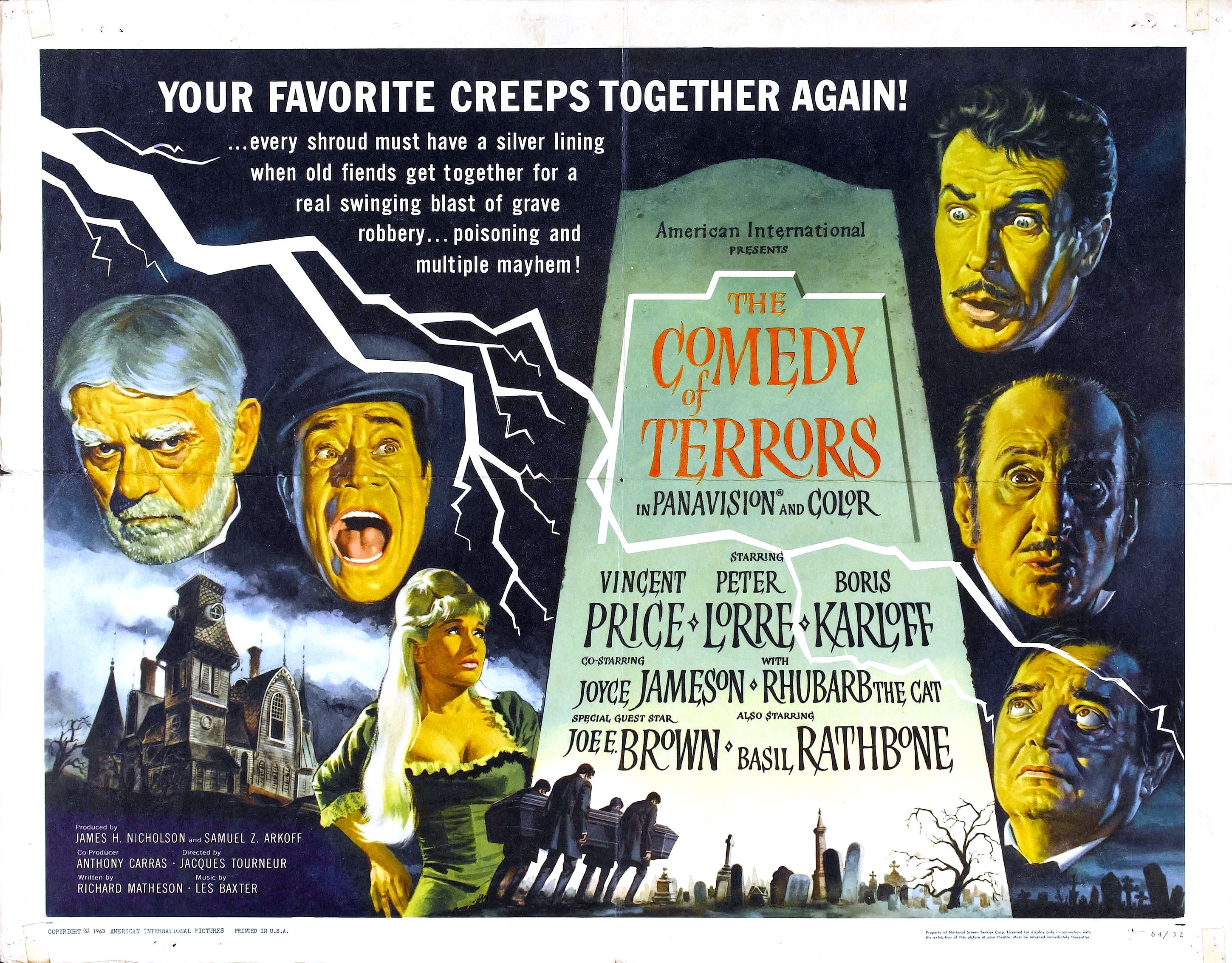
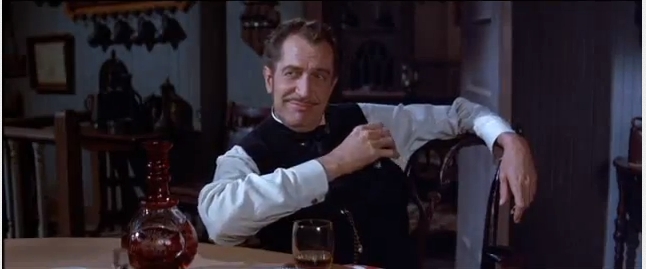
Halloween Havoc!: THE COMEDY OF TERRORS (AIP 1964)


gary loggins's avatarcracked rear viewer

cot1

Vincent Price, Peter Lorre, Boris Karloff, and Basil Rathbone had all appeared together on film in various combinations seven different times, but never all at once until THE COMEDY OF TERRORS. This black comedy masterpiece spoofs AIP’s own Poe flicks and Shakespeare, with the quartet of chiller icons having a grand old time playing Richard Matheson’s delicious screenplay to the hilt. Horror and noir vet Jacques Tourneur gets to direct the old pros, and the supporting cast features classic comic Joe E. Brown and Rhubarb The Cat (more on him later!).

cot2

Price  is Waldo Trumble, the besotted, greedy proprietor of Trumble & Hinchley Funeral Parlor. He’s cruel to wife Amaryllis (Joyce Jameson), a failed opera singer (“I wish her vocal chords would snap”) who he married only to gain control of the company from her doddering old, half-deaf father Amos. “Demon rum will get you yet!”, she tells Waldo, to which…

View original post 727 more words

Film Review: The Split (1968, directed by Gordon Flemyng)


The Split2The Split is one of the many films to be based on one of Donald Westlake’s Parker novels.  A classic antihero, Parker was a ruthless professional criminal who was only partially redeemed by being so much better at his job than all the other lowlifes around him.  In the movies, Parker has been played by everyone from Lee Marvin to Robert Duvall to Mel Gibson to Jason Statham.  In The Split, Parker is renamed McClain and he is played by Jim Brown.

McClain and his partner, Gladys (Julie Harris), have a plan to rob the Los Angeles Coliseum during a football game.  (Actual footage of the Rams playing the Falcons was used.)  McClain personally recruits a crew of criminals to help him pull off the heist.  Harry Kifka (Jack Klugman) is the getaway driver.  Bert Clinger (Ernest Borgnine) is the muscle.  Marty Gough (Warren Oates) is the electronic expert.  Dave Negli (Donald Sutherland) is the sharpshooter.

After pulling off the robbery, McClain stashes the money with his ex-girlfriend, Ellie (Diahann Carroll).  When her landlord, Herb Sutro (James Whitmore), finds out that Ellie has the money, he murders her and steals it.  When homicide detective Walter Brill (Gene Hackman) solves Ellie’s murder, he kills Herb and takes the money for himself.  Meanwhile, Gladys and the crew are convinced that McClain knows where the money is.  With everyone out to kill him, McClain tries to find the money.

The Split is mostly interesting because of its cast.  For all of his physical presence, Jim Brown was never much of an actor but the large supporting cast more than makes up for his limitations.  It’s fun to watch Sutherland, Borgnine, Harris, and Klugman compete to see who can steal the most scenes.  Meanwhile, a youngish Gene Hackman is as cantankerous as ever.  Then there’s the great Warren Oates.  Warren Oates was one of the greatest actors of all time and he spent his far too brief career stealing movies like The Split.

(The Split was released a year after Jim Brown, Ernest Borgnine, and Donald Sutherland had all appeared in The Dirty Dozen.  A year after The Split, Warren Oates and Ernest Borgnine would both be members of The Wild Bunch while Hackman and Brown would costar in Riot.)

The Split has some historical significance as the first film to ever be given an R rating.  Though tame by today’s standards, at the time of its release, The Split was considered to be extremely violent and audiences were also shocked by a brief flash of nudity.  Seen today, The Split is a conventional heist movie but it still shows what a group of good actors can do with so-so material.

The Split

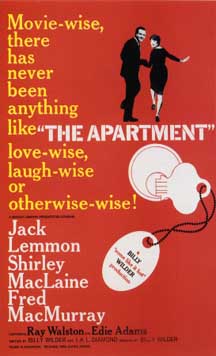
Lisa Watches The Oscar Winners: The Apartment (dir by Billy Wilder)


Apartment_60

After the Nun’s StoryI continued to experience TCM’s 31 Days of Oscar by watching the 1960 best picture winner, The Apartment.  The Apartment is unique among Oscar winners in that it’s one of the few comedies to win best picture.  (Though, in all honesty, it would probably be more appropriate to call The Apartment a dramedy.)  It was also, until the victory of The Artist, the last completely black-and-white film to win best picture.

(And, as long as we’re sharing trivia, it was also the first best picture winner to feature a character watching a previous best picture winner.  At the start of the film, Jack Lemmon deals with insomnia by watching Grand Hotel.)

The Apartment tells the story of C.C. “Bud” Baxter (Jack Lemmon), an anonymous officer worker who is determined to climb the corporate ladder despite not being very good at his job.  However, Baxter does have one advantage over his co-workers.  He’s single and therefore, his apartment has become the place to go for corporate executives who need a place where they can safely cheat on their wives.  Bud spends his day trying to coordinate who is going to be in his apartment and when.  Meanwhile, he spends his nights exiled from his own home and wandering around New York.  In fact, the only beneficial thing about this arrangement is that all of Bud’s supervisors have been giving him good evaluations in return for using his apartment.  (Well, that and Bud’s neighbor, played by Jack Kruschen, is convinced, based on the thinness of the apartment walls, that Bud must be a great lover.)

When Bud finally does get his promotion, it’s only because the personnel director, Jeff D. Sheldrake (an amazingly sleazy Fred MacMurray), wants to use Bud’s apartment.  Bud celebrates his promotion by finally working up the courage to ask out Fran (Shirley MacClaine), an elevator operator who works in the office.  What Bud doesn’t realize is that Fran is also the woman who Sheldrake wants to bring to the apartment….

Fran is convinced that Sheldrake is going to leave his wife for her.  What she doesn’t realize — and what Fred MacMurray’s performance makes disturbingly clear — is that Jeff Sheldrake is basically just a guy having a midlife crisis.  He’s the type of middle-aged guy that every woman has had to deal with at some point, the guy who pulls up next to you in a red convertible and stares at you from behind his sunglasses, attempting his best to entice you into helping him relive the youth that he never had.  When Fran eventually learns the truth about Sheldrake, it leads both to near tragedy and to Bud having to decide whether he wants to be a decent human being or if he wants to keep climbing the corporate ladder.

When one looks over a chronological list of all of the best picture winners, it’s a bit strange to see The Apartment listed in between Ben-Hur and West Side Story.  As opposed to those two grandly produced and vibrantly colorful films, The Apartment is a rather low-key film, one that devotes far more time to characterization than to spectacle.  And while both Ben-Hur and West Side Story are ultimately very idealistic films, The Apartment is about as cynical as a film can get.  The Apartment may be a comedy but the laughs come from a place of profound sadness.

Because it’s more interested in people than in spectacle, The Apartment holds up better than many past best picture winners.  We’ve all known someone like Bud.  We’ve all had to deal with men like Sheldrake.  And, in one way or another, we all know what it’s like to be someone like Fran.  The Apartment remains a truly poignant and relevant film.

http://www.youtube.com/watch?v=B4OXm9-E8OQ

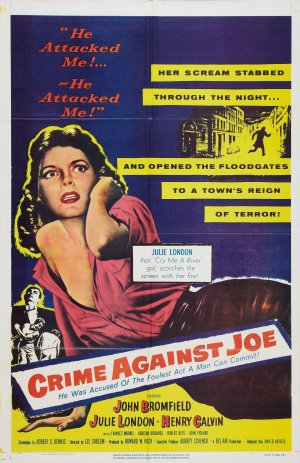
Netflix Noir #1: Crime Against Joe (dir by Lee Sholem)


Crime_Against_Joe_poster

After watching Inherent Vice last weekend, I decided to get on Netflix and do a search for film noirs.  This led to me watching four film noirs from the 50s, all of which were previously unknown to me.

For my first Netflix Noir, I watched a little something called Crime Against Joe.  It’s a 69 minute film from 1956.  It’s about a guy named Joe.  There’s been a crime.  Oddly enough, the crime really against Joe.  Instead, he’s been wrongly accused of committing a crime against a nightclub singer named Irene.  So, perhaps a better title for this film would have been It Sucks To Be Joe.

But anyway —

Crime Against Joe was directed by Lee Sholem.  According to Wikipedia, Lee Sholem had a 40 year career as a director.  During that time, he directed over 1,300 television episodes and feature films and he finished every single one of them either on time or early.  And you can certainly see evidence of that in Crime Against Joe, a film that starts out in a rush and pretty much never slows down until the final fade out.

Joe (John Bromfeld) was voted “most likely to succeed” in high school but — surprise!  surprise! — he’s failed to live up to the expectations set for him by the 1945 yearbook.  Instead, he enlisted in the army, served in the Korean War, and was diagnosed with “battle fatigue.”  (I assume that battle fatigue was the 1950s version of PTSD.)  He spent a while in a mental hospital and it was there that he first started painting.  When he was released, he moved in with his widowed mother (Frances Morris).  While she works to support him, Joe spends his time drinking and painting.

As the movie begins, a drunken Joe has just destroyed his latest painting.  (“I can see it in my head but it doesn’t come out on canvas!” Joe shouts, which is actually a pretty good way to describe the dark feeling that all artists occasionally get.)  He wanders around town, drunk.  He talks to a waitress named Slacks (Julie London), who is obviously in love with him.  He gets some sage advice from Red (Henry Calvin), a taxi driver.   He stumbles into a nightclub where he harasses a singer (Alika Louis) before finally getting thrown out of the club.  In the parking lot, as he stumbles away, a mysterious cowboy (Rhodes Reason) glares at him.

Joe stumbles about until, around two in the morning, he runs into a young woman wearing a nightgown.  He tries to talk to her but she only stares at him, her placid face frozen in a zombie-like state.  Joe leads her to a nearby house where the woman’s father thanks him for his help and then slams the door in his face.

Later that night, the nightclub singer is found dead on the side of the road.  Found near her body is a high school pin that belonged to someone from the class of 1945.  Knowing that Joe was drunk that night and had been seen in the nightclub, Detective Hollander (Robert Keys) goes to Joe’s house.  Hollander demands to see Joe’s high school pin.  Joe says he doesn’t know where it is.  Hollander stares at Joe’s paintings.  “You always paint half-naked women?” Hollander sneers before arresting Joe for murder.

At the station, Joe says that he was leading the woman back to her house at the same time that the singer was murdered.  The woman’s father shows up at the police station.  No, he says, Joe was nowhere near his house at two in the morning.  Joe is arrested for murder…

Fortunately, Slacks is willing to risk her life to prove that Joe is innocent.  And Joe knows that the murderer had to have been someone who he went to high school with…

Crime Against Joe is one of those low-budget, obscure B-movies that actually a lot more interesting than you might think.  John Bromfeld does a good job as Joe and the character’s PSTD gives the film a bit more depth than you might otherwise expect.  Julie London is great in the role of brave and selfless Slacks (though it’s interesting that this film felt the need to give a masculine nickname to a strong female character) and Rhodes Reason is genuinely menacing as the mysterious cowboy.  Crime Against Joe is also full of unexpected and occasionally surreal details.  The most obvious example would be the zombie-like woman who Joe runs into on the night of the murder.  However, my favorite little oddity is the fact that signs reading “Corey for Councilman” keep popping up in the strangest locations.

(It eventually turns out that Joe went to high school with Corey and the scene where Joe confronts his old classmate is a fun little piece of political satire.  That said, there was a part of me that hoped the significance of the sings would just remain an odd and unexplained little detail.)

There’s actually a surprisingly subversive streak running through Crime Against Joe.  We usually tend to think of the 50s as being a time when authority figures (like the police) were viewed with blind trust.  In Crime Against Joe, however, nobody in power is portrayed positively.  The police, for instance, come across like a bunch of close-minded bullies who are prepared to convict Joe based solely on his paintings and his less-than-sterling war record.  The scenes where Hollander interrogates Joe are full of menace.  In the end, this film is on the side of those living on the margins of respectable society.  When Joe and Slacks try to prove Joe’s innocence, they’re also attempting to prove their own right to exist in a society that has rejected both of them.

Crime Against Joe may not be a well-known film but there’s a lot more going on under its surface than you might originally think.  It’s on Netflix so check it out when you’ve got 70 minutes to spare.